
Life, 1908-01-30 · page 6 of 22
Life — January 30, 1908 — page 6: what you’re looking at
What you’re looking at
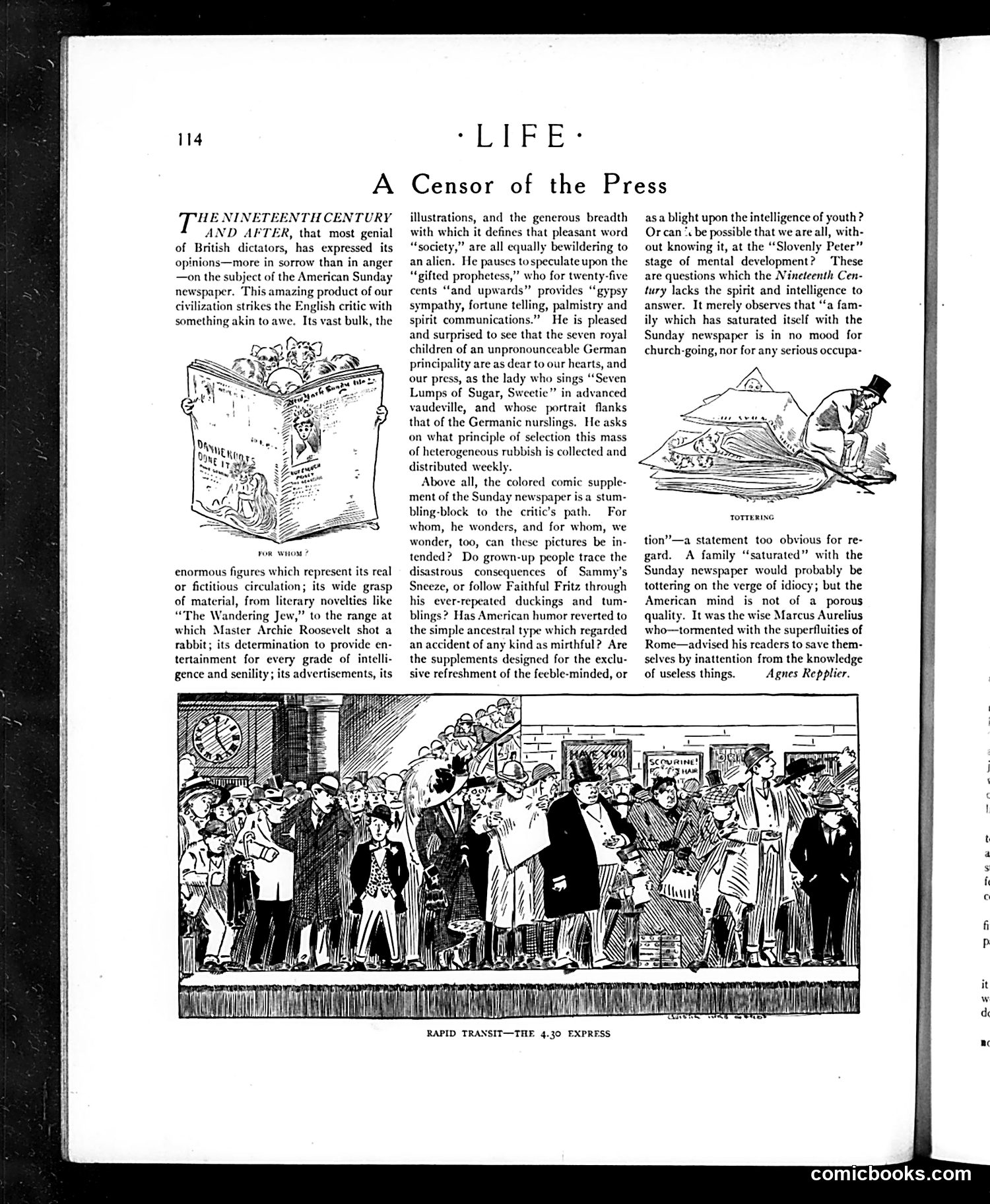
This article critiques British media censorship and sensationalism in newspapers. The text attacks the Sunday newspaper's publication of vulgar "colored comic supplements" aimed at mass audiences, arguing they degrade public taste and intelligence—particularly among youth. The top cartoon depicts a oversized, grotesque newspaper bursting with crude illustrations, labeled "FOR WHOM?"—questioning who genuinely benefits from such content. The bottom illustration shows crowded "Rapid Transit—The 4:30 Express," satirizing how newspapers are consumed during daily commutes by ordinary citizens. The author (Agnes Repplier, per signature) argues these publications represent journalistic irresponsibility, comparing them to ancient Roman decline, warning that mindless entertainment threatens cultural standards and public discourse.
📄 Transcribed text from this page (OCR, searchable)
Machine-transcribed from the original scan — historical spelling and the odd misread are preserved.
* LIFE: A Censor of the Press HE NINETEENTH CENTURY AND AFTER, that most genial of British dictators, has expressed its opinions—more in sorrow than in anger —on the subject of the American Sunday ror wioat ? enormous figures which represent its real or fictitious circulation; its wide grasp of material, from literary novelties like “The Wandering Jew,” to the range at which Master Archie Roosevelt shot a rabbit; its determination to provide en- tertainment for every grade of intelli- its advertisements, its illustrations, and the generous breadth with which it defines that pleasant word “society,” are all equally bewildering to analien. He pauses to speculate upon the “gifted prophetess,” who for twenty-five cents “and upwards” provides “gypsy sympathy, fortune telling, palmistry and spirit communications.” He is pleased and surprised to see that the seven royal children of an unpronounceable German principality are as dear to our hearts, and our press, as the lady who sings “Seven Lumps of Sugar, Sweetie” in advanced vaudeville, and whose portrait flanks that of the Germanic nurslings. He asks on what principle of selection this mass of heterogencous rubbish is collected and distributed weekly. Above all, the colored comic supple- ment of the Sunday newspaper is a stum- bling-block to the critic’s path. For whom, he wonders, and for whom, we wonder, too, can these pictures be in- tended? Do grown-up people trace the disastrous consequences of Sammy's Sneeze, or follow Faithful Fritz through his ever-repeated duckings and tum- blings? Has American humor reverted to the simple ancestral type which regarded an accident of any kind as mirthful? Are the supplements designed for the exclu- sive refreshment of the feeble-minded, or asa blight upon the intelligence of youth ? Or can ‘. be possible that we are all, with- out knowing it, at the ‘‘Slovenly Peter” stage of mental development? ‘These are questions which the Nineteenth Cen- tury lacks the spirit and intelligence to answer. It merely observes that “a fam- ily which has saturated itself with the Sunday newspaper is in no mood for church-going, nor for any serious occupa- TOTTERING tion”—a statement too obvious for re- gard. A family “saturated” with the Sunday newspaper would probably be tottering on the verge of idiocy; but the American mind is not of a porous quality. It was the wise Marcus Aurelius who—tormented with the superfluities of Rome—advised his readers to save them- selves by inattention from the knowledge of useless things. Agnes Repplier. RAPID TRANSIT—THE 4.30 EXPRESS it TE en ll comicbooks.com