
Life, 1908-01-30 · page 13 of 22
Life — January 30, 1908 — page 13: what you’re looking at
What you’re looking at
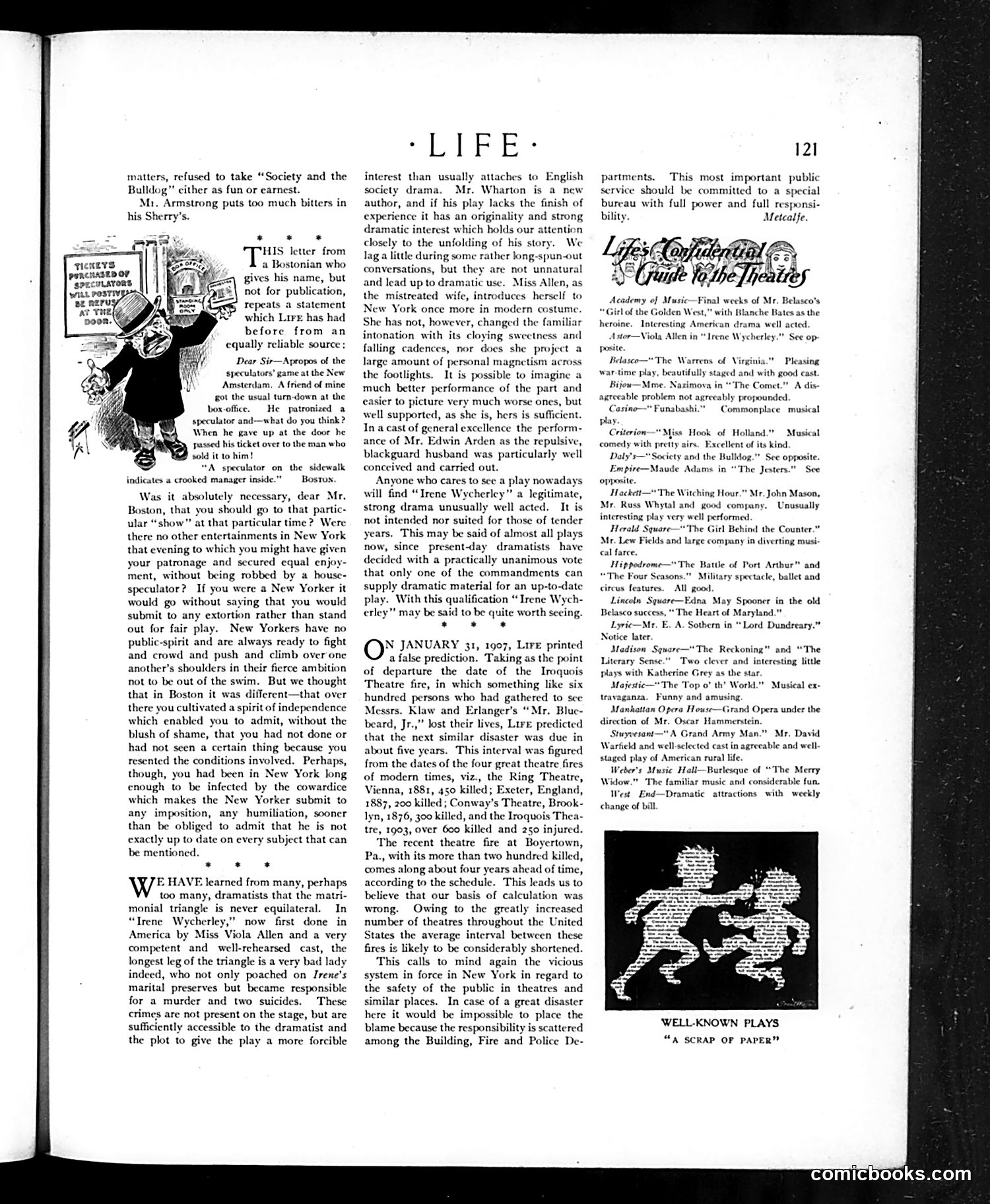
The cartoon depicts a dishonest theatrical manager—identifiable by his formal attire and scheming expression—literally depicted as crooked or bent. The caption "A crooked manager inside" suggests this is satirizing fraudulent theater management practices. The surrounding text discusses theater safety and disasters, particularly referencing the Iroquois Theatre fire (1903) and criticism of New York's theater safety regulations. The cartoon's point appears to be that corrupt managers prioritize profit over public safety, with their moral "crookedness" creating dangerous conditions. This reflects early 20th-century concerns about unchecked business practices and inadequate building codes in entertainment venues—a timely critique given the era's multiple theater fires and the deaths they caused.
📄 Transcribed text from this page (OCR, searchable)
Machine-transcribed from the original scan — historical spelling and the odd misread are preserved.
matters, refused to take “Society and the Bulldog” cither as fun or earnest. M1. Armstrong puts too much bitters in his Sherry’s. * 8 « HIS letter from a Bostonian who gives his name, but not for publication, Tepeats a statement which Live has had before from an equally reliable source: Dear Sir—Apropos of the speculators’ game at the New Amsterdam. A friend of mine got the usual turn-down at the box-office. He patronized a speculator and—what do you think? When he gave up at the door he passed his ticket over to the man who sold it to him! "A. speculator on the sidewalk indicates a crooked manager inside.” Bostox Was it absolutely necessary, dear Mr. Boston, that you should go to that partic- ular “show” at that particular time ?- Were there no other entertainments in New York that evening to which you might have given your patronage and secured equal enjoy. ment, without being robbed by a house- speculator? If you were a New Yorker it would go without saying that you would submit to any extortion rather than stand out for fair play. New Yorkers have no public-spirit and are always ready to fight and crowd and push and climb over one another's shoulder: their fierce ambition not to be out of the swim. But we thought that in Boston it was different—that over there you cultivated a spirit of independence which enabled you to admit, without the blush of shame, that you had not done or had not scen a certain thing because you resented the conditions involved. Perhaps, though, you had been in New York long enough to be infected by the cowardice which makes the New Yorker submit to any imposition, any humiliation, sooner than be obliged to admit that he is not exactly up to date on every subject that can be mentioned. * 8 @ = HAVE learned from many, perhaps too many, dramatists that the matri- monial triangle is never equilateral. In vcherley,” now first done in America by Miss Viola Allen and a very competent and well-rehearsed cast, the longest leg of the triangle is a very bad lady indeed, who not only poached on Irene’s marital preserves but became responsible for a murder and two suicides. These crimes are not present on the stage, but are sufficiently accessible to the dramatist and the plot to give the play a more forcible LIFE interest than usually attaches to English society drama. Mr. Wharton is a new author, and if his play lacks the finish of experience it has an originality and strong dramatic interest which holds our attention closely to the unfolding of his story. We lag a little during some rather long-spun-out conversations, but they are not unnatural and lead up to dramatic use. Miss Allen, a: the mistreated wife, introduces herself to New York once more in modern costume. She has not, however, changed the familiar intonation with its cloying sweetness and falling cadences, nor does she project a large amount of personal magnetism across the footlights. It is possible to imagine a much better performance of the part and easier to picture very much worse ones, but well supported, as she is, hers is sufficient. In a cast of general excellence the perform- ance of Mr. Edwin Arden as the repulsive, blackguard husband was particularly well conceived and carried out. Anyone who cares to see a play nowadays will find “Irene Wycherley” a legitimate, strong drama unusually well acted. It is not intended nor suited for those of tender years. This may be said of almost all plays now, since present-day dramatists have decided with a practically unanimous vote that only one of the commandments can supply dramatic material for an up-to-date play. With this qualification “Irene Wych- erley” may be said to be quite worth seeing. * 8 6 N JANUARY 31, 1907, Lire printed a false prediction. Taking as the point of departure the date of the Iroquois Theatre fire, in which something like six hundred persons who had gathered to see Messrs. Klaw and Erlanger’s “Mr, Bluc- beard, Jr.,” lost their lives, Lure predicted that the next similar disaster was due in about five years. This interval was figured from the dates of the four great theatre fires of modern times, viz., the Ring Theatre, Vienna, 1881, 450 killed; Exeter, England, 1887, 200 ki ‘onway’s Theatre, Brook- lyn, 1876, 300 killed, and the Iroquois Thea tre, 1903, over 600 killed and 250 injured. The recent theatre fire at Boyertown, Pa., with its more than two hundred killed, comes along about four years ahead of time, according to the schedule. This leads us to believe that our basis of calculation was Owing to the greatly increased number of theatres throughout the United States the average interval between these fires is likely to be considerably shortened. ‘This calls to mind again the vicious system in force in New York in regard to the safety of the public in theatres and similar places. In case of a great disaster here it would be impossible to place the blame because the responsibility is scattered among the Building, Fire and Police De- 121 partments. This most important public service should be committed to a special bureau with full power and full responsi bility. Metcalfe. ee ibs ik Academy of Music—Final weeks of Mr. Belasco’s * Girl of the Golden West,” with Blanche Bates as the Interesting American a { stor—Viola Allen in “Irene Wycherley."" See op- posite. Bdasco—"The Warrens of Virginia.” war-time play, beautifully staged Bijou—Mme, Nazimova in “The Comet.” agreeable problem not agreeably propounded. Casino play Criterion—" Miss Hook of Holland.” Musical comedy with pretty airs. Excellent of its kind Daly's—" Society and the Bulldog." See opposite. Em pire—Maude Jesters.”" See opposite, Hackett—" The Witching Hour.” Mr.Jo Mr. Russ Whytal and good company. interesting play very well performed. Herald Square—" The Girl Behind the Counter.” Mr. Lew Fields and large company in diverting musi cal farce. Hippodrome—"The Battle of Port Arthur” and “The Four Seasons.” Military spectacle, ballet and All good. Lincoln Square—Edna May Spooner in the old Belasco success, “The Heart of Maryland.” Lyric—Mr. E. A. Sothern in“ Lord Dundreary.” Notice later, Madison Squore—"The Reckoning" and “The Literary Sense.” Two clever and interesting little plays with Katherine Grey as the star. Majestic—*"The Top o' th’ Work.” Musical ex- travaganza. Funny and amusing. Manhattan Opera House—Grand Opera under the direction of Mr. Oscar Hammerstein. Stuyvesant—"A Grand Army Man.” Mr. David Warfield and well-sclected cast in agreeable and well- staged play of American rural life. Weber's Music Hall—Burlesque of “The Merry Widow." The familiar music and considerable fun. West End—Dramatic with weekly change of bill. heroine. ma well acted, Pleasing dl with good cast. A dis- Funabashi.” Commonplace musical Adams in n Mason, Unusually circus features. altractions ‘WELL-KNOWN PLAYS “A SCRAP OP PAPER” comicbooks.com