
Life, 1908-01-30 · page 14 of 22
Life — January 30, 1908 — page 14: what you’re looking at
What you’re looking at
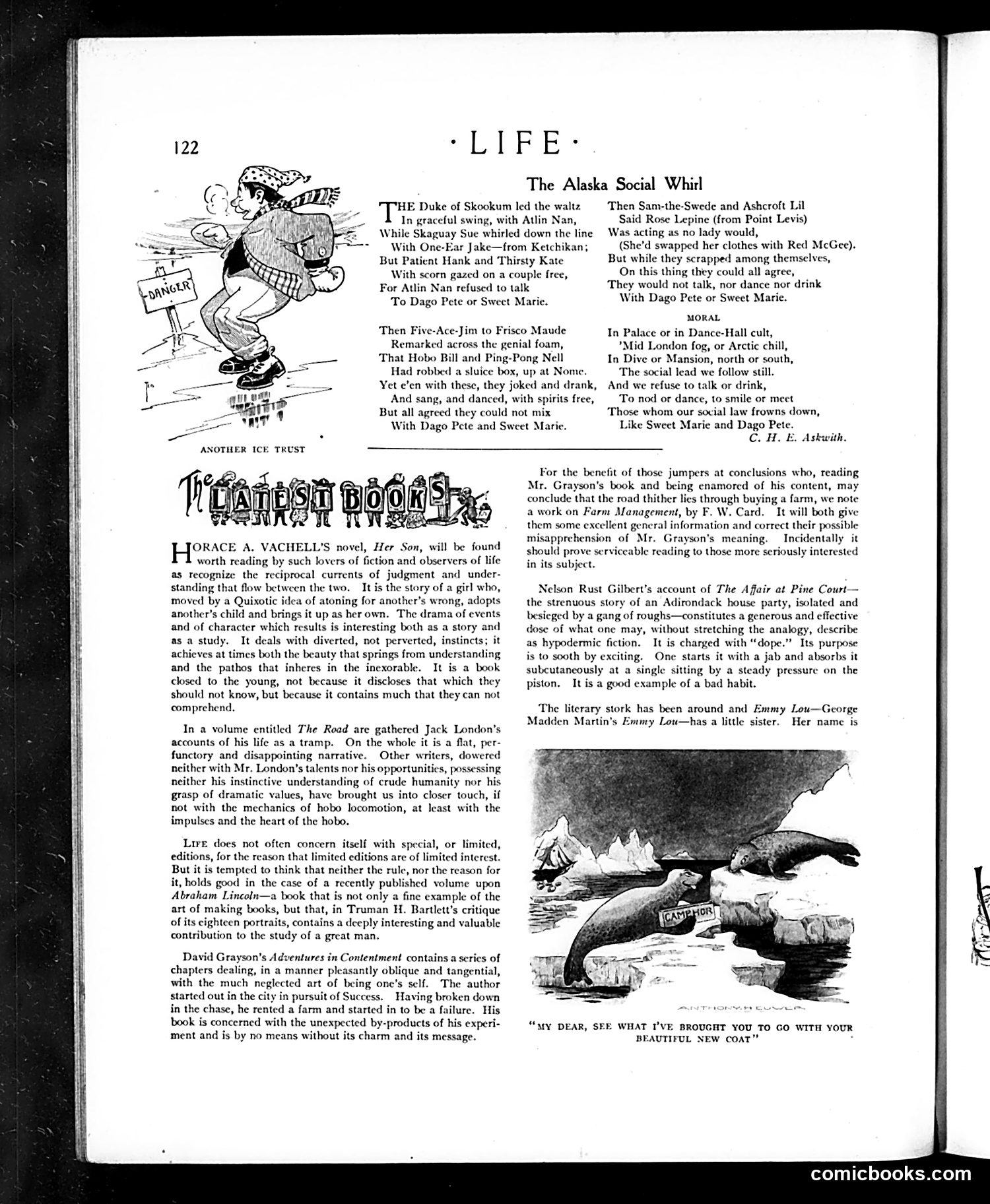
This satirical poem mocks rigid class prejudice among Alaska's rough frontier population. Despite their crude circumstances—characters with names like "Hobo Bill," "One-Ear Jake," and "Dago Pete"—these miners and prospectors strictly enforce social exclusion. The joke is ironic: even people living in harsh conditions with criminal pasts (they robbed a sluice box) maintain pretentious class boundaries, refusing to associate with certain outcasts like "Dago Pete" and "Sweet Marie" (the latter apparently disreputable). The moral undercuts their hypocrisy—whether in "Palace or Dance-Hall cult," society enforces the same arbitrary social rules. The cartoon's accompanying illustration (showing a rough character with a new coat) reinforces this theme: even frontier folk concern themselves with maintaining respectability and status despite their marginal position. Life magazine satirizes how universal and absurd social snobbery is, penetrating even the least refined communities.
📄 Transcribed text from this page (OCR, searchable)
Machine-transcribed from the original scan — historical spelling and the odd misread are preserved.
"LIFES = The Alaska Social Whirl E Duke of Skookum led the waltz In graceful swing, with Atlin Nan, While Skaguay Sue whirled down the line With One-Ear Jake—from Ketchikan; But Patient Hank and Thirsty Kate Then Sam-the-Swede and Ashcroft Lil Said Rose Lepine (from Point Levis) Was acting as no lady would, (She'd swapped her clothes with Red McGee). But while they scrapped among themselves, With scorn gazed on a couple free, For Atlin Nan refused to talk To Dago Pete or Sweet Maric. Then Five-Ace-Jim to Frisco Maude Remarked across the On this thing they could all agree, They would not talk, nor dance nor drink With Dago Pete or Sweet Marie. MORAL In Palace or in Dance-Hall cult, genial foam, ’Mid London fog, or Arctic chill, That Hobo Bill and Ping-Pong Nell Had robbed a sluice box, up at Nome. In Dive or Mansion, north or south, The social lead we follow still. Yet e’en with these, they joked and drank, And we refuse to talk or drink, And sang, and danced, with spirits free, To nod or dance, to smile or mect But all agreed they could not mix With Dago Pete and Sweet Marie. Those whom our social law frowns down, Like Sweet Marie and Dago Pete. C. H. E. Askwith, ORACE A. VACHELL'S novel, Her Son, will be found worth readit y such lovers of fiction and observers of life as recognize the reciprocal currents of judgment and under- standing that flow between the two. _ It is the story of a girl who, moved by a Quixotic idea of atoning for another's wrong, adopts another’s child and brings it up as her own. The drama of events and of character which results is interesting both as a story and as a study. It deals with diverted, not perverted, instincts; it achieves at times both the beauty that springs from understanding and the pathos that inheres in the inexorable. It is a book closed to the young, not because it discloses that which they should not know, but because it contains much that they can not comprehend. In a volume entitled The Road are gathered Jack London's accounts of his life as a tramp. On the whole it is a flat, per- functory and disappointing narrative. Other writers, dowered neither with Mr. London's talents nor his opportunities, possessing neither his instinctive understanding of crude humanity nor his grasp of dramatic values, have brought us into closer touch, if not with the mechanics of hobo locomotion, at least with the impulses and the heart of the hobo. Lire does not often concern itself with special, or limited, editions, for the reason that limited editions are of limited interest. But it is tempted to think that neither the rule, nor the reason for it, holds good in the case of a recently published volume upon Abraham Lincoln—a book that is not only a fine example of the art of making books, but that, in Truman H. Bartlett’s critique of its eighteen portraits, contains a deeply interesting and valuable contribution to the study of a great man. David Grayson’s Adventures in Contentment contains a series of chapters dealing, in a manner pleasantly oblique and tangential, with the much neglected art of being one’s self. The author started out in the city in pursuit of Success. Having broken down in the chase, he rented a farm and started in to be a failure. Hi book is concerned with the unexpected by-products of his experi- ment and is by no means without its charm and its message. For the benefit of those jumpers at conclusions who, reading Mr. Grayson’s book and being enamored of his content, may conclude that the road thither lies through buying a farm, we note a work on Farm Management, by F. W. Card. It will both give them some excellent gencral information and correct their possible misapprehension of Mr. Grayson's meaning. Incidentally it should prove serviceable reading to those more seriously interested in its subject. Nelson Rust Gilbert's account of The Affair at Pine Court— the strenuous story of an Adirondack house party, isolated and besieged by a gang of roughs—constitutes a generous and effective dose of what one may, without stretching the analogy, describe as hypodermic fiction. It is charged with “dope.” Its purpose is to sooth by exciting. One starts it with a jab and absorbs it subcutaneously at a single sitting by a steady pressure on the piston, It is a good example of a bad habit. The literary stork has been around and Emmy Lou—George Madden Martin's Emmy Lou—has a little sister. Her name is “MY DEAR, SEE WHAT I'VE BROUGHT YOU TO GO WITH YOUR BEAUTIFUL NEW COAT”” . comicbooks.com