
Life, 1908-01-30 · page 12 of 22
Life — January 30, 1908 — page 12: what you’re looking at
What you’re looking at
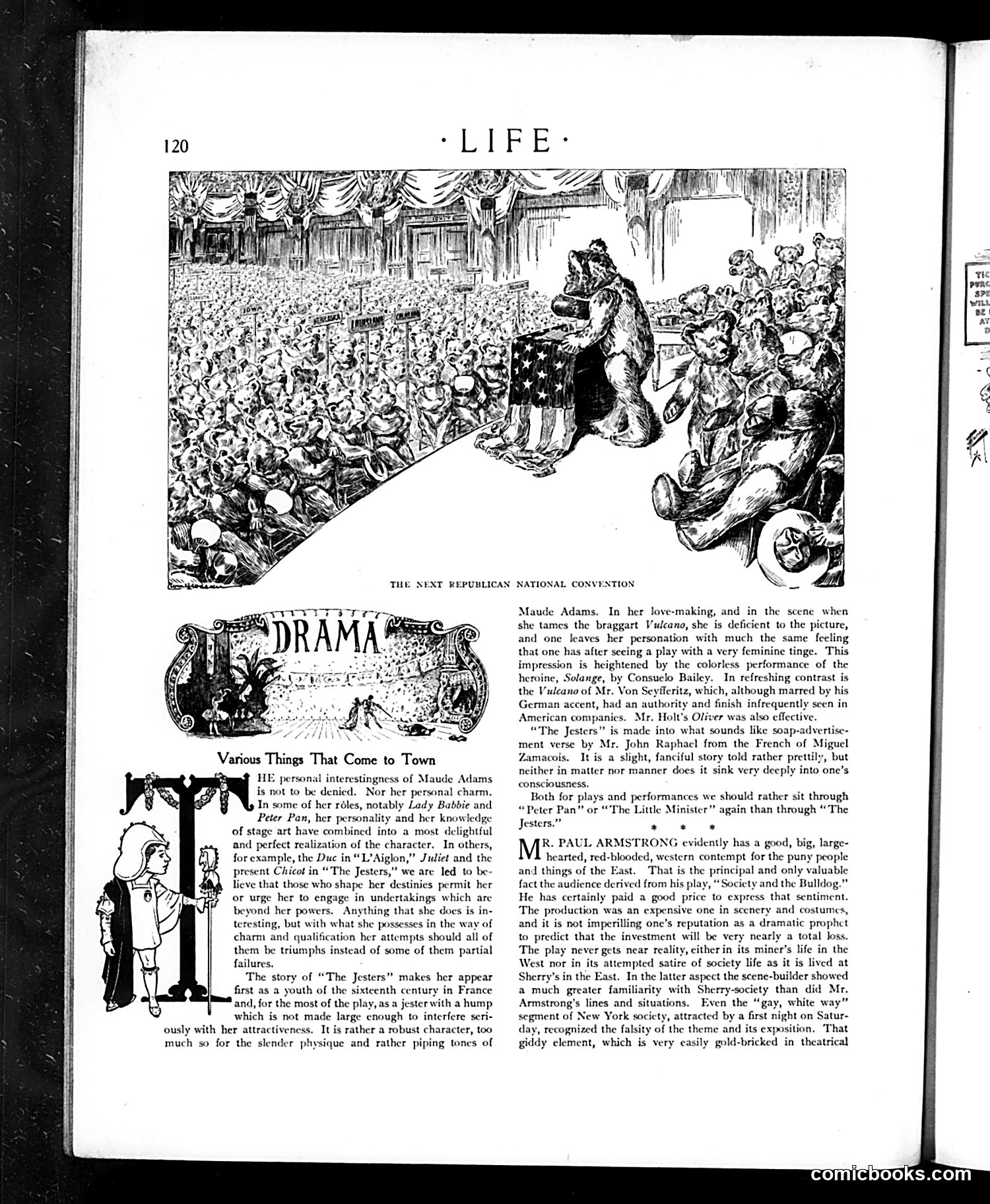
This political cartoon satirizes a Republican National Convention by depicting it as a circus-like spectacle. A figure at a podium (likely representing party leadership) addresses an enormous, chaotic crowd beneath ornate decorative draping. The scene suggests the Republican party has become a mass entertainment event rather than a serious political gathering—hence the circus atmosphere with crowds packed together. The satire appears to mock the spectacle and disorder of contemporary Republican politics, portraying the convention as theatrical and ungovernable rather than dignified or orderly. The text references various theatrical productions and performers like Maude Adams, suggesting the blending of entertainment culture with politics that Life's editors found ridiculous or concerning.
📄 Transcribed text from this page (OCR, searchable)
Machine-transcribed from the original scan — historical spelling and the odd misread are preserved.
THE NEXT REPUBLICAN NATIONAL CONVENTION That Come to Town HE personal interestingness of Maude Adams is not to be denied. Nor her personal charm. In some of her réles, notably Lady Babbie and Peter Pan, her personality and her knowledge of stage art have combined into a most delightful and perfect realization of the character. In others, for example, the Duc in“L’Aiglon,” Juliet and the present Chicot in “The Jesters,” we are led to be- lieve that those who shape her destinies permit her or urge her to engage in undertakings whi beyond her pow Anything that she does teresting, but with what she possesses in the way charm and qualification her attempts should all of them be triumphs instead of some of them partial failures. The story of “The Jesters” makes her appear first as a youth of the sixteenth century in France and, for the most of the play, as a jester with a hump which is not made large cnough to interfere seri- ously with her attractiveness. It is rather a robust character, too much so for the slender physique and rather piping tones of Maude Adams. In her love-making, and in the scene when she tames the braggart Vulcano, she is deficient to the pic and one leaves her personation with much the same feeling that one has after seeing a play with a very feminine tinge. This impression is heightened by the colorless performance of the heroine, Solange, by Consuclo Bailey, In refreshing contrast i the Vulcano of Mr. Von Seyfferitz, which, although marred by his German accent, had an authority and finish infrequent] American companics. Mr. Holt’s Oliver was also effective “The Jesters” is made into what sounds like soap-advertise- ment verse by Mr. John Raphael from the French of Miguel 7 is. It is a slight, fanciful story told rather prettily, but neither in matter nor manner does it sink very deeply into one’s consciousness. Both for plays and performances we should rather sit through “Peter Pan” or “The Little Minister” again than through “The Jesters.” ss © R. PAUL ARMSTRONG evidently has a good, big, large- hearted, red-blooded, western contempt for the puny people and things of the East. That is the principal and only valuable fact the audience derived from his play, “Society and the Bulldog.” He has certainly paid a good price to express that sentiment. ‘The production was an expensive one in scenery and costumes, and it is not imperilling one’s reputation as a dramatic prophet to predict that the investment will be very nearly a total loss. The play never gets near reality, cither in its miner's life in the West nor in its attempted satire of society life as it is lived at Sherry’s in the East. In the latter aspect the scene-builder showed a much greater familiarity with Sherry-society than did Mr. Armstrong’s lines and situations, Even the “gay, white way” segment of New York y, attracted by a first night on Satur- , recognized the falsity of the theme and its exposition, ‘That giddy clement, which is very easily gold-bricked in theatrical en in icbooks.com