
A complete issue · 36 pages · 1907
Life — October 3, 1907
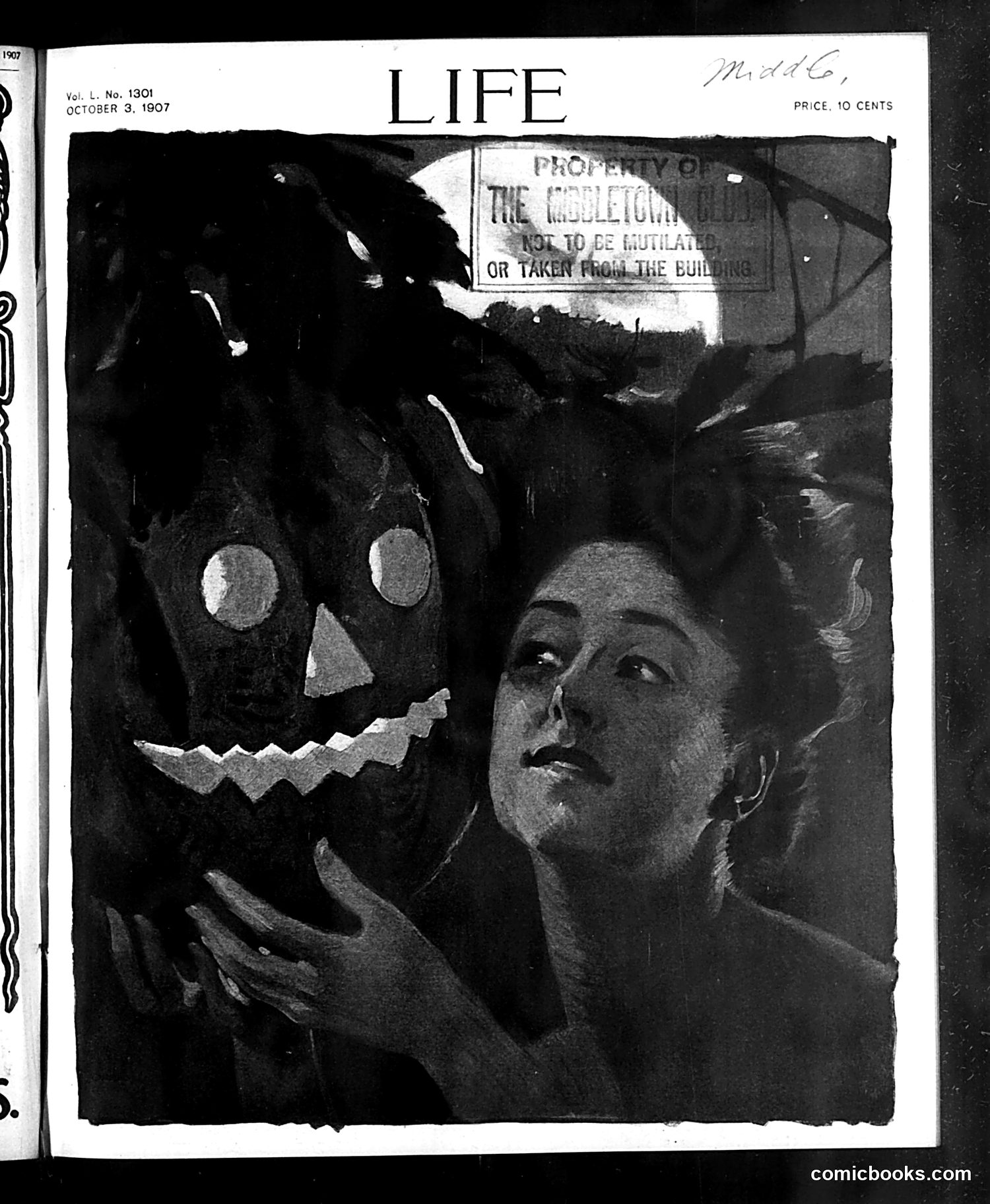
This is a Halloween-themed cover featuring a jack-o'-lantern with a menacing carved expression confronting a startled woman. The pumpkin has the classic features—triangular eyes, triangular nose, and a jagged grin. The satire appears to be a straightforward seasonal joke exploiting the traditional fear-inducing nature of jack-o'-lanterns for comedic effect. The woman's expression of alarm plays into the humorous contrast between the harmless carved pumpkin and her exaggerated terror. There's no clear political commentary visible—this seems to be purely entertainment content appropriate to the October publication date, capitalizing on Halloween associations with fright and the macabre for lighthearted satirical humor.
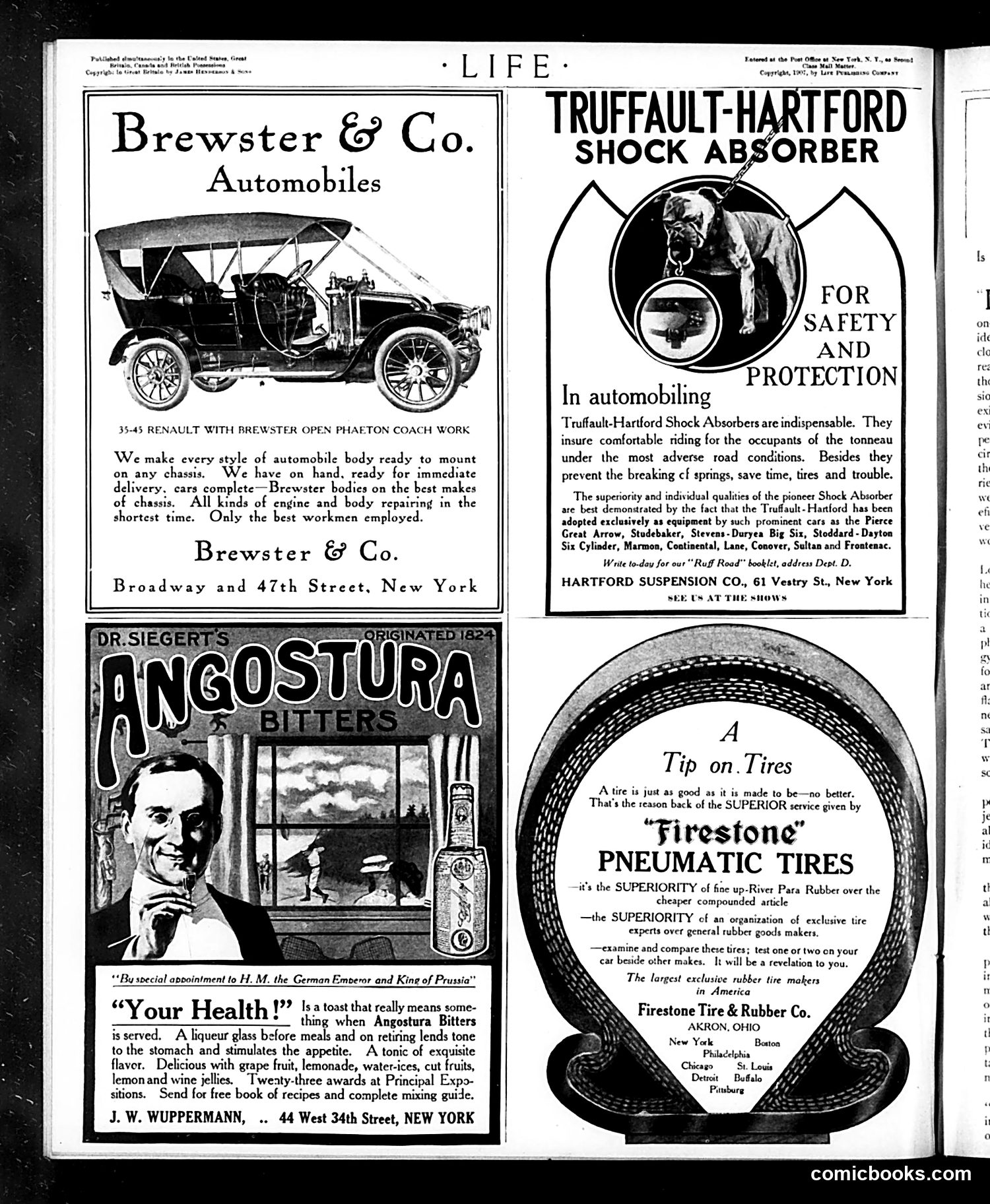
This page is **primarily advertisements** for early 1900s automobiles and accessories, not political satire. The ads include: - **Brewster & Co.** automobiles (Broadway, NYC) - **Truffault-Hartford Shock Absorber** for vehicle safety - **Dr. Siegert's Angostura Bitters** (a digestive tonic) - **Firestone Pneumatic Tires** The only figure is a portrait in the Angostura ad—appears to be Dr. Siegert himself, the product's namesake. The ad emphasizes his appointment to the German Emperor and King of Prussia as a marketing claim. There is **no political cartoon or satire** on this page. It represents typical Life magazine content from this era: a mix of editorial content alongside revenue-generating advertisements for emerging consumer products and luxury goods.
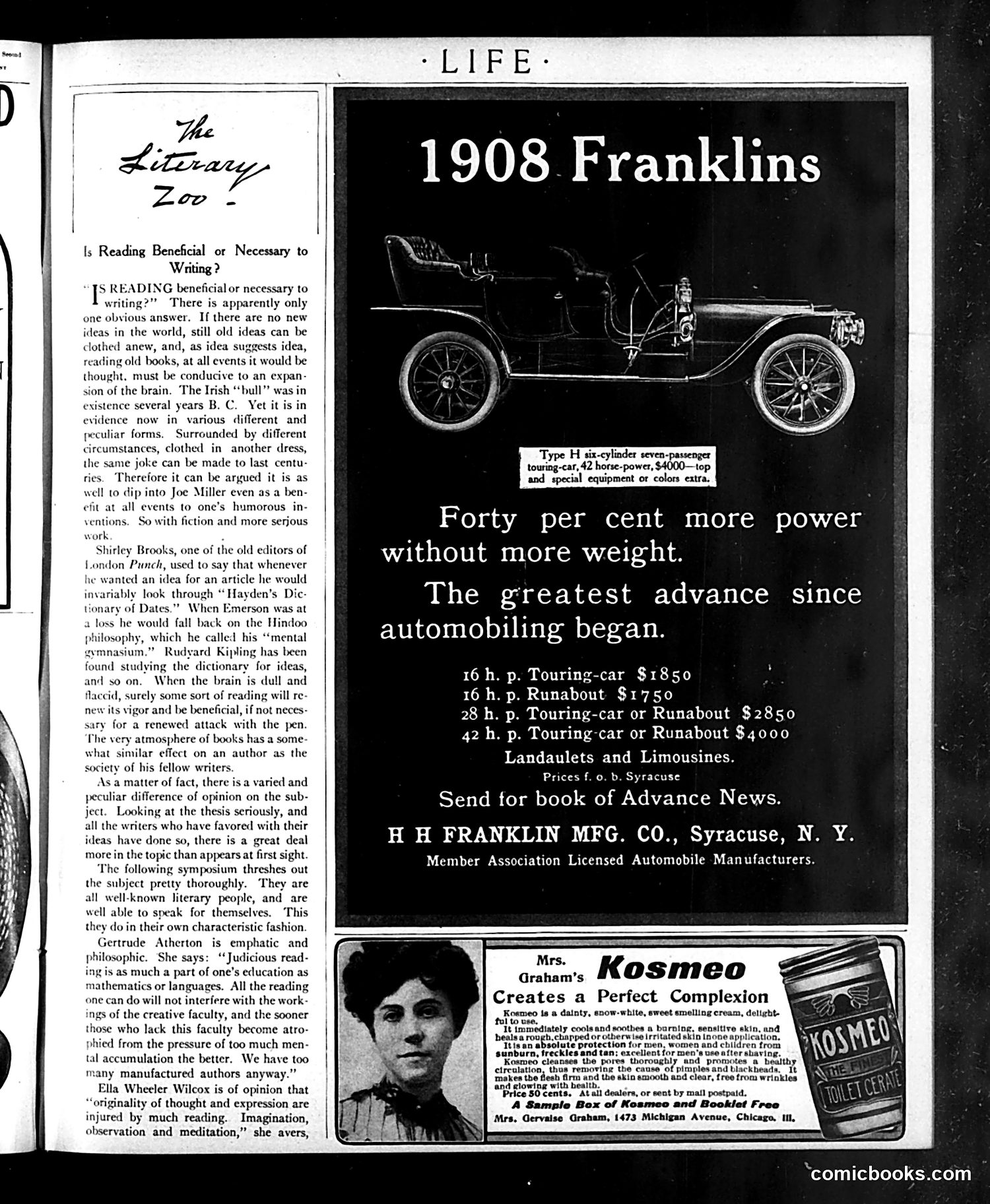
This page is primarily **advertising content** rather than satire or political commentary. The main feature is a large advertisement for 1908 Franklin automobiles, highlighting their "Type H six-cylinder seven-passenger touring-car" with claims of "forty per cent more power without more weight" and positioning it as "the greatest advance since automobiling began." The left column contains "The Literary Zoo," a brief essay on whether reading benefits writers, featuring quotes from literary figures like Gertrude Atherton and Ella Wheeler Wilcox. Below that is an advertisement for Kosmeo complexion cream. This appears to be a typical early 1900s Life magazine page mixing editorial content with paid advertising.
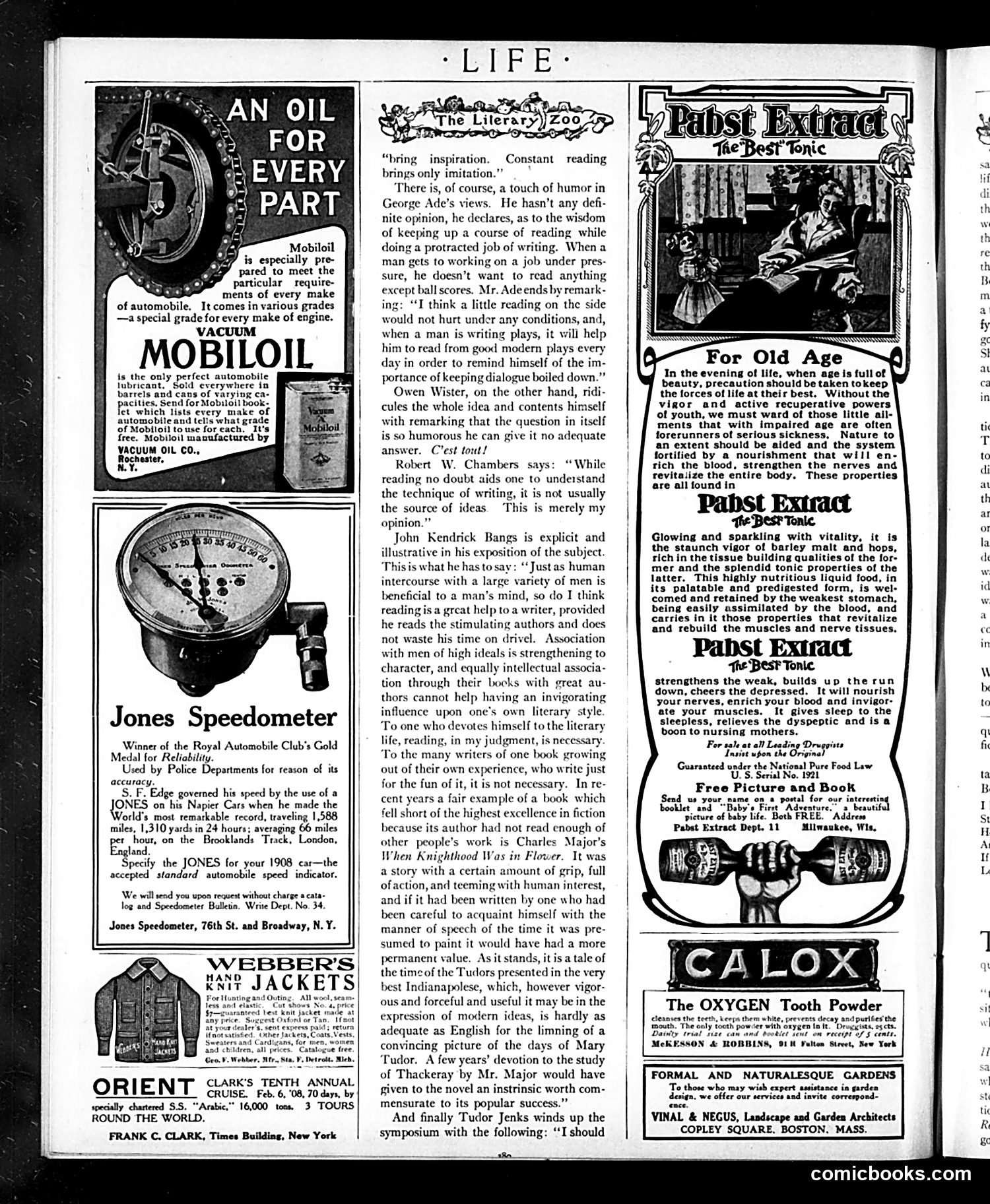
This page is **primarily advertising** with a literary column ("The Literary Zoo") as secondary content. The ads feature: - **Mobiloil** motor oil (emphasizing reliability across engine types) - **Jones Speedometer** (winning the Royal Automobile Club's Gold Medal) - **Webber's Knit Jackets** (workwear) - **Pabst Extract** (a tonic/patent medicine promising vitality and strength, marketed especially to aging men and nursing mothers) - **Calox** tooth powder - Travel and garden services The literary section discusses reading's value for working men under pressure, citing authors like George Ade and John Kendrick Bangs. No political satire is evident. This reflects early 20th-century consumer culture: automobiles were becoming mainstream, patent medicines were heavily marketed, and reading was promoted as intellectual self-improvement for working-class men.
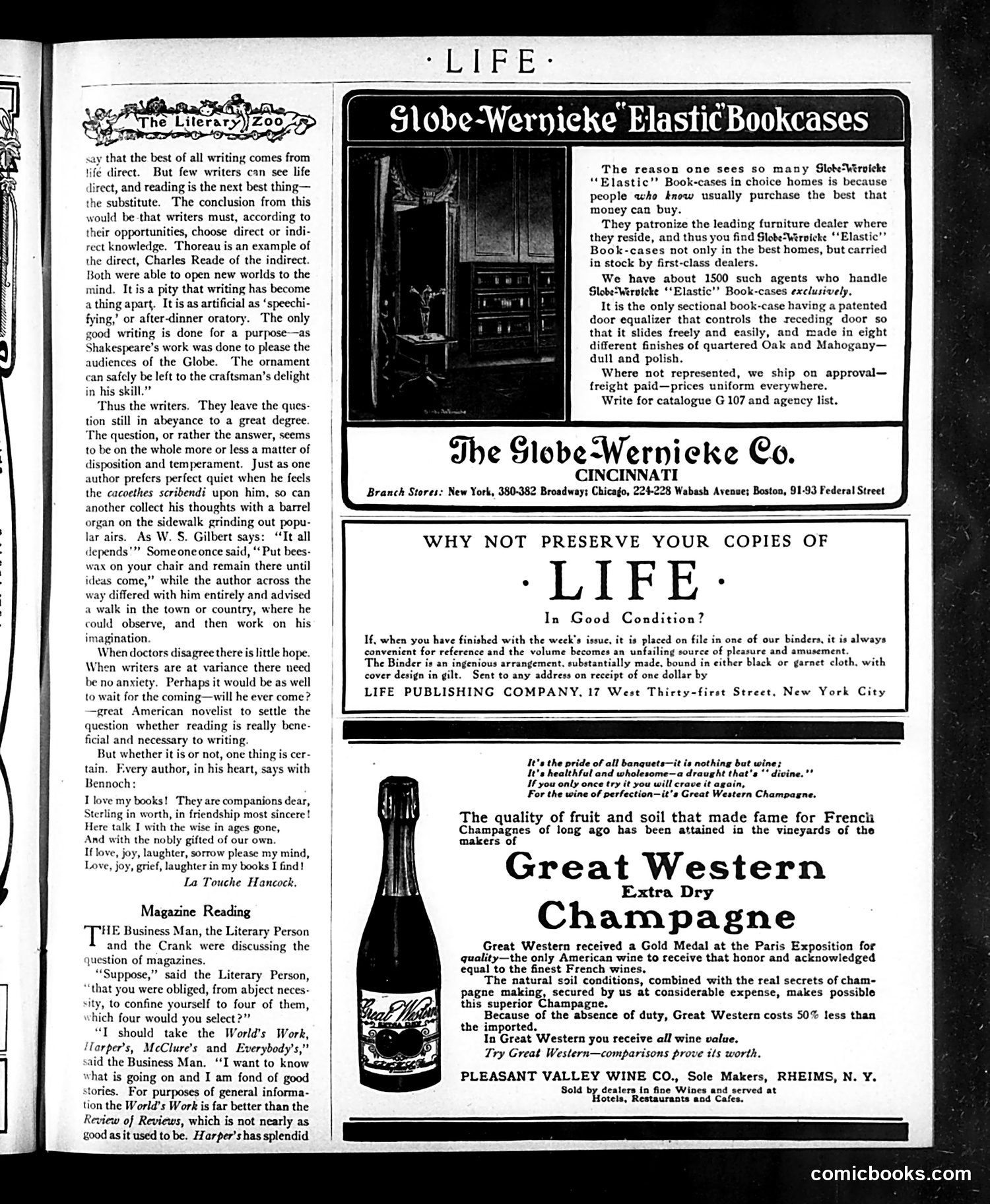
This page is **primarily advertising** rather than satirical content. The main features are: 1. **Globe-Wernicke Elastic Bookcases** (top): An advertisement highlighting their furniture's popularity and distribution through 1,500 agents nationwide. The ad emphasizes quality and availability in various wood finishes. 2. **Life Publishing Company** (middle): Promoting bound volumes of Life magazine as gifts, positioning them as reference sources and "unfailing source of pleasure." 3. **Great Western Champagne** (bottom): An advertisement claiming French-quality champagne at lower cost due to lack of import duties, targeting American consumers seeking value. The left column contains literary discussion ("The Literary Zoo") about writing and magazine reading—editorial content rather than satire. No political cartoons or caricatures appear on this page.
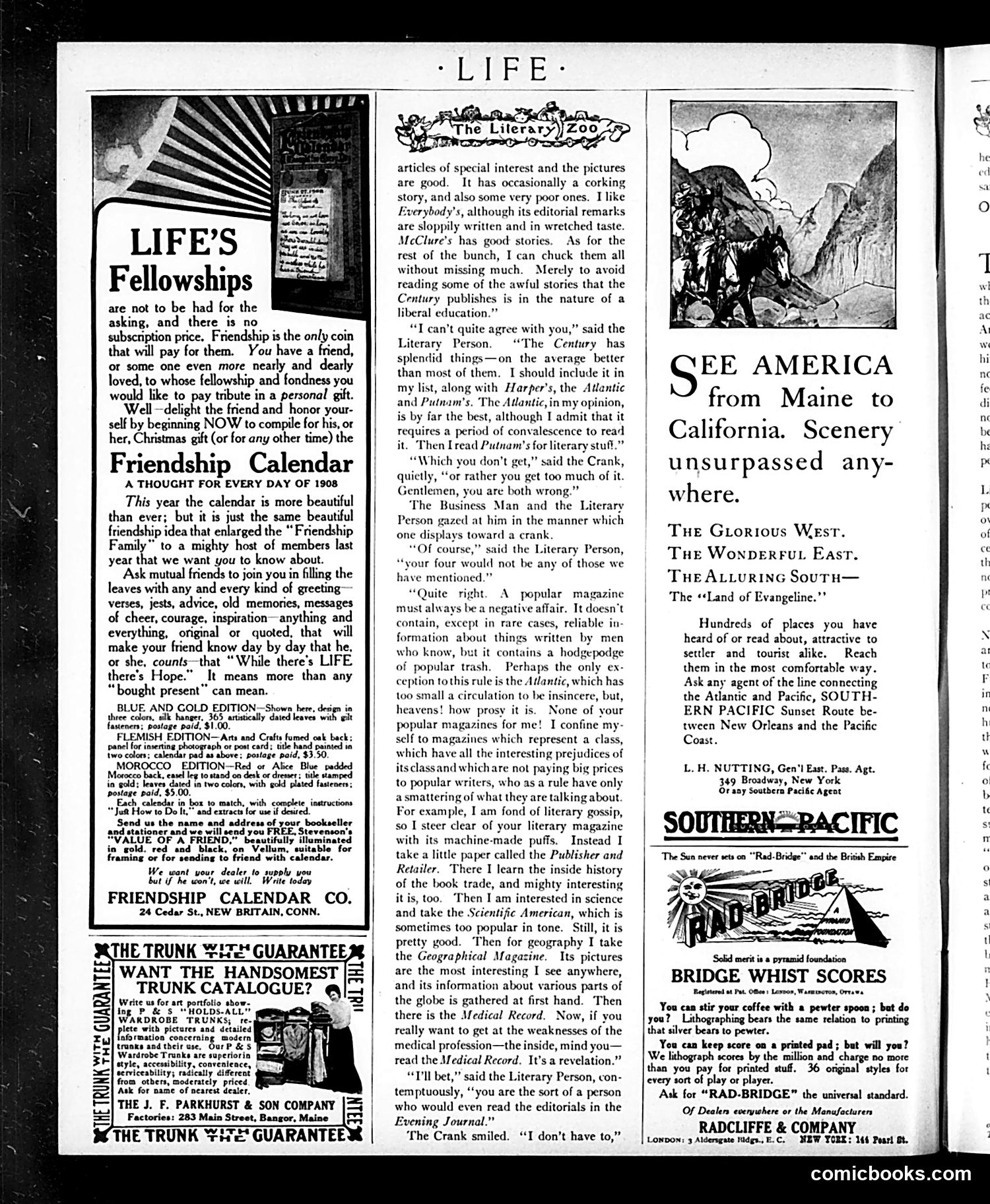
This page is primarily **editorial content and advertising** rather than political cartoons. The main feature is "The Literary Zoo," a satirical essay by the Literary Person character critiquing various American magazines. The satire targets magazines' quality and pretensions: *Century* and *Atlantic* are praised as genuinely literary, while *Everybody's* has "sloppy" editorial taste. *McClure's* receives mixed reviews. The author mocks popular magazines like *Cosmopolitan* and *Red Bridge* for sensationalism and cheap production, and criticizes *Scientific American* for being "sometimes too popular in tone." The piece essentially defends highbrow literary magazines against mass-market competitors—a common early-20th-century elitist stance about cultural gatekeeping and magazine quality standards.
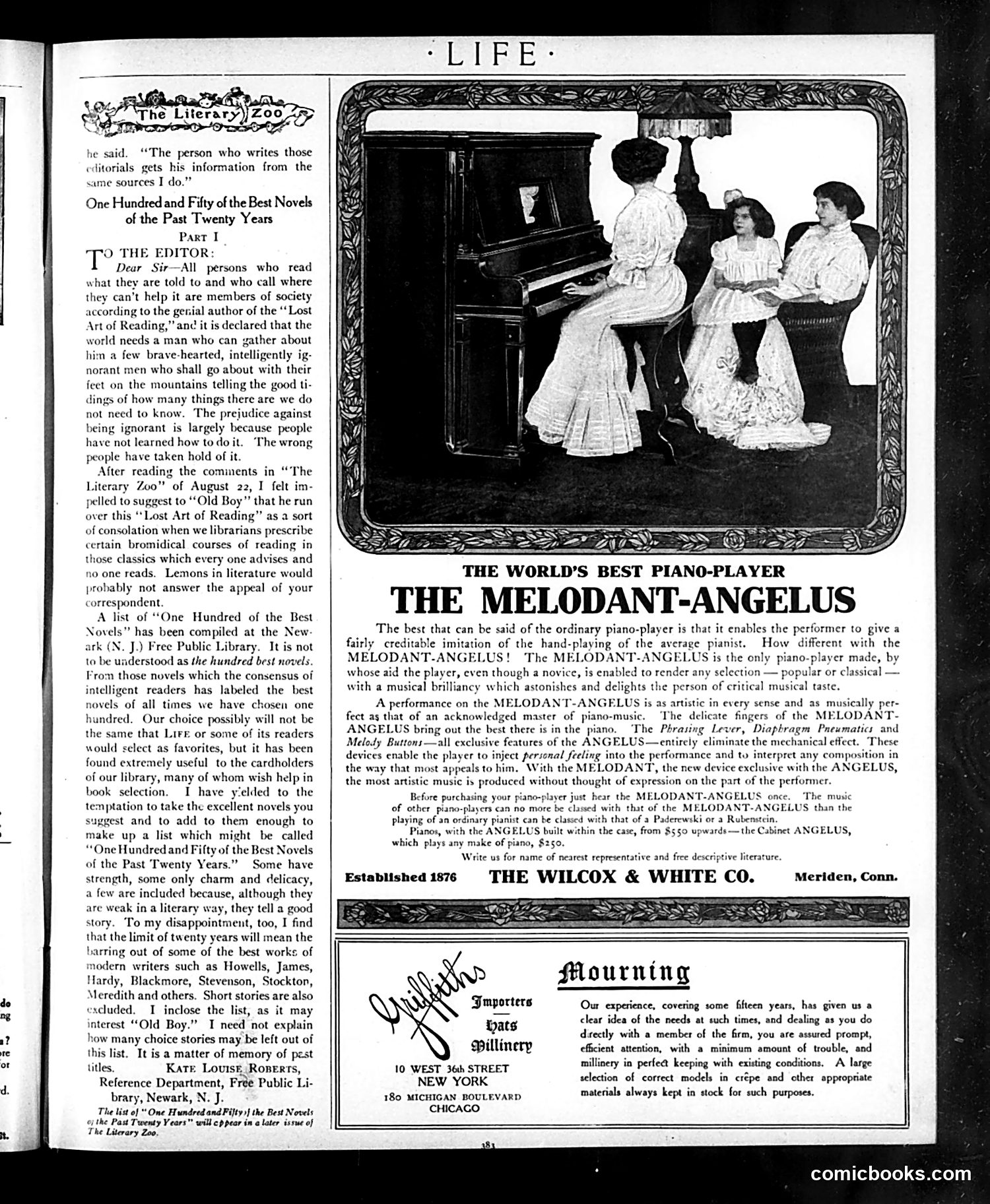
This page is primarily **advertising and editorial content** rather than political satire. The main feature is "The Literary Zoo," a letter to the editor advocating for broader reading habits beyond prescribed "classics." The writer argues against literary snobbery and proposes a curated list of "One Hundred and Fifty of the Best Novels of the Past Twenty Years." The dominant image advertises the **Melodant-Angelus piano player**—a mechanical piano device. The illustration shows three women in period dress (early 1900s) gathered around an ornate piano. The advertisement claims it enables ordinary players to perform like accomplished pianists through mechanical assistance. Below are ads for a **millinery shop** (hat seller) in New York and Chicago, and a **mourning goods importer** offering funeral-related clothing and materials. The content reflects early 20th-century consumer culture and attitudes toward technology and social refinement.
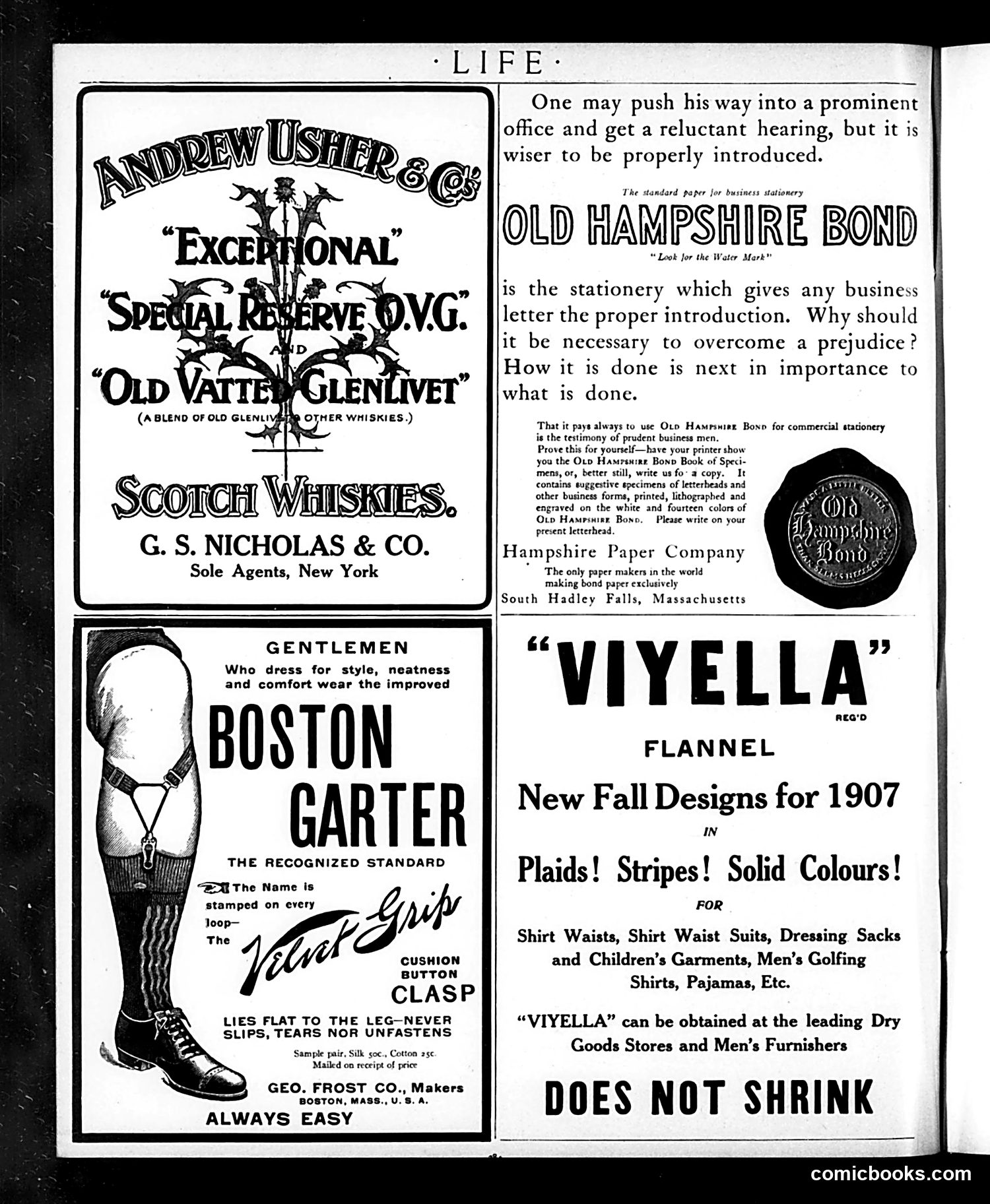
This is primarily a **page of advertisements**, not political satire. There are no cartoons or caricatures with political meaning. The page contains four product ads from around 1907: 1. **Andrew Usher Scotch Whiskeys** — promoting premium Scottish spirits 2. **Old Hampshire Bond stationery** — arguing that proper business letterhead provides "proper introduction" and overcomes prejudice 3. **Boston Garter** — a men's garter with a "cushion button clasp" that won't slip or tear 4. **Viyella Flannel** — advertising new 1907 fabric patterns for various garments, emphasizing it "does not shrink" The only social commentary is implicit in the Hampshire Bond ad: that formal stationery signals respectability and helps overcome business prejudice—a reflection of early-20th-century class consciousness.
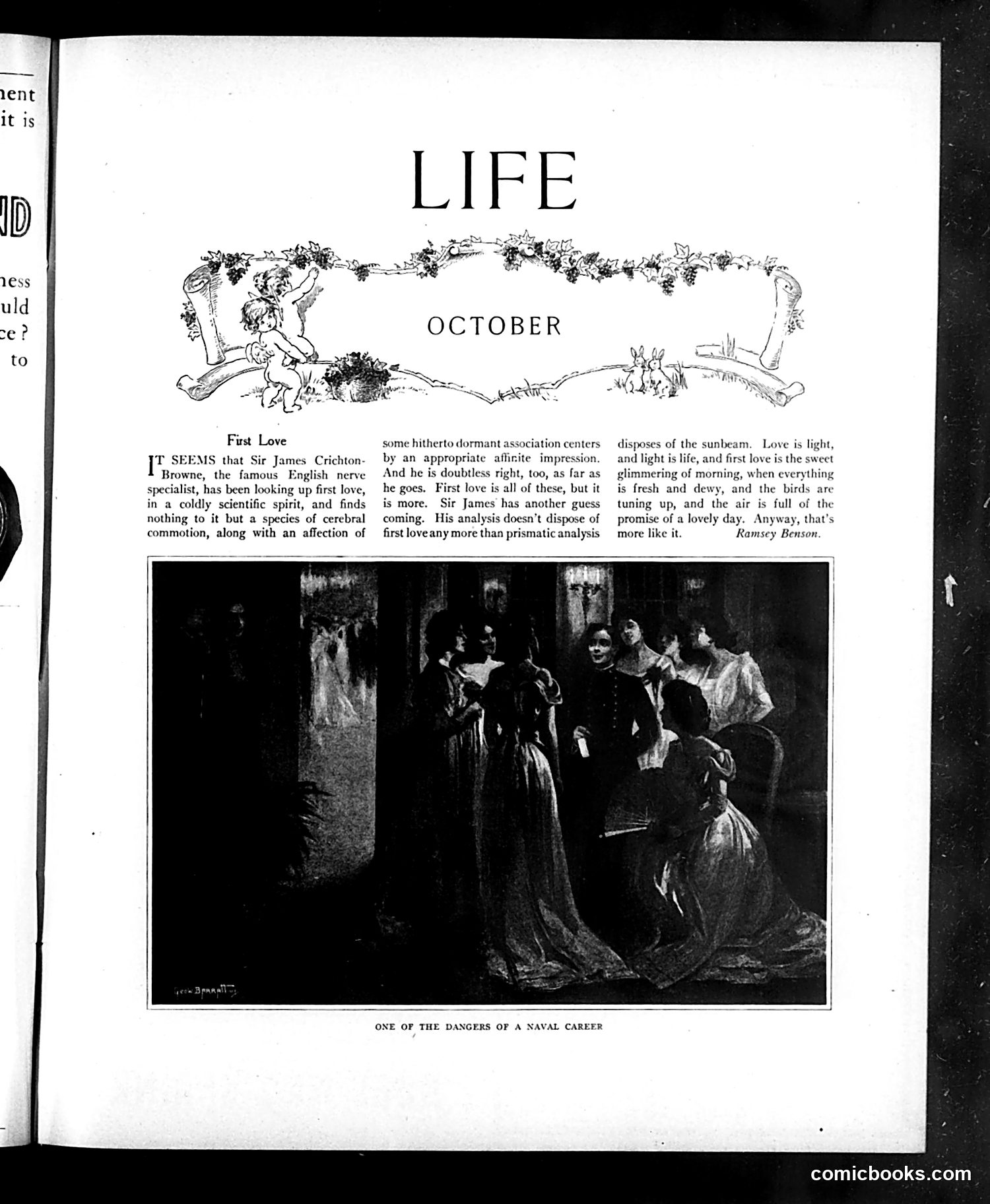
This page features an article titled "First Love" discussing Sir James Crichton-Browne, described as a famous English nerve specialist who approaches love scientifically rather than sentimentally. The text humorously critiques his overly clinical analysis of first love, suggesting he misses the romantic essence by reducing it to "prismatic analysis." The accompanying illustration, captioned "One of the Dangers of a Naval Career," appears to depict a dramatic scene with multiple figures in period dress, though the specific narrative is unclear from the image quality. The caption suggests it illustrates complications or romantic entanglements associated with naval service—likely a humorous counterpoint to the clinical discussion above, showing love's messy reality versus scientific theory.
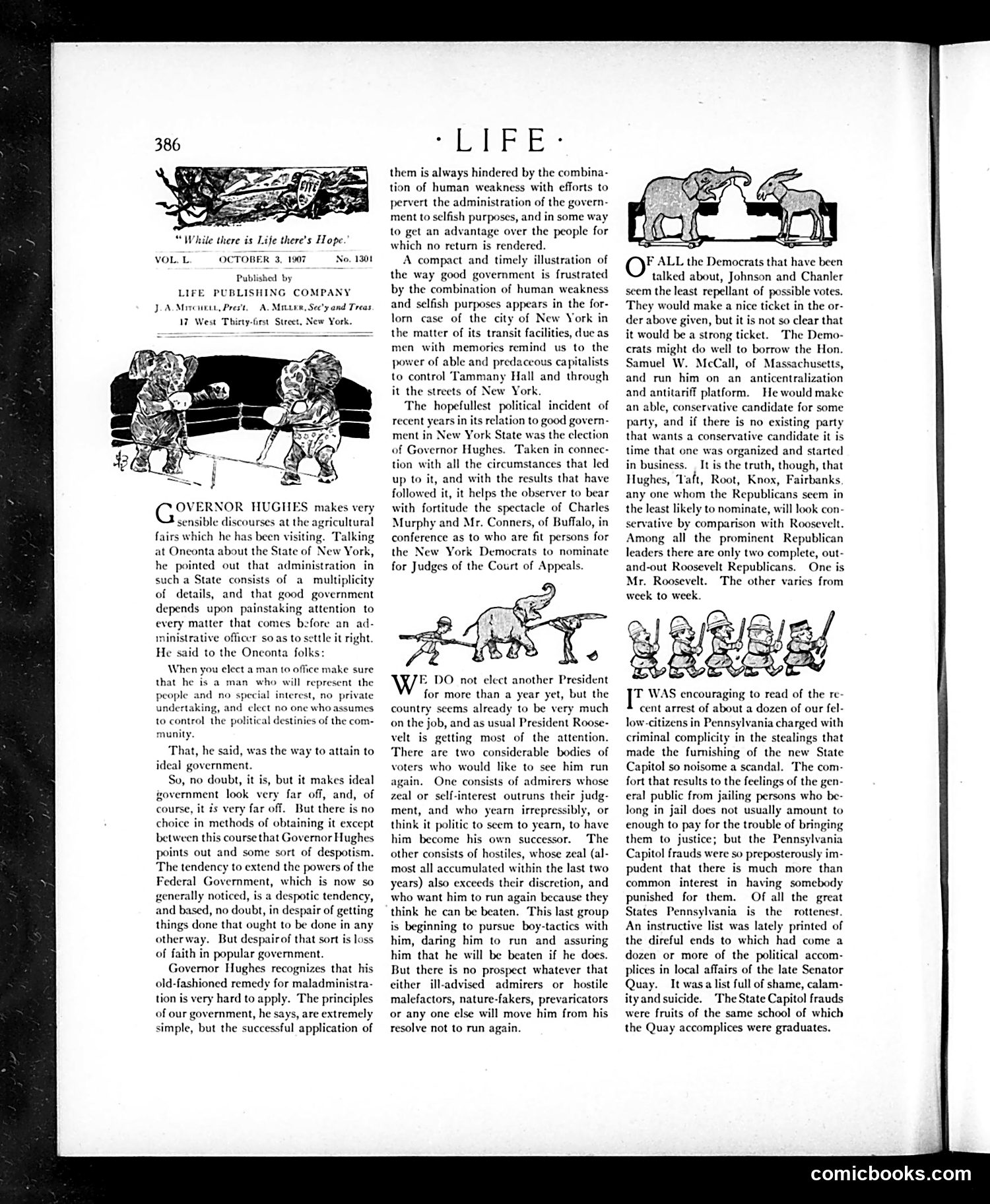
This October 1907 *Life* page discusses potential Democratic and Republican candidates to succeed President Theodore Roosevelt. The text critiques both parties' options. The cartoon depicts Governor Hughes (identifiable from the accompanying text) in conversation about New York Democratic candidates. The satirical thrust centers on the observation that Roosevelt is already dominating 1908 succession talk despite being president for only a year. The text identifies prominent Republicans potentially positioned to succeed Roosevelt, noting that "out-and-out Roosevelt Republicans" complicate the field. It also discusses Pennsylvania State Capitol fraud scandals involving political figures, suggesting institutional corruption undermines public trust. The overall satire mocks the premature jockeying for power and exposes how personal ambition and scandal plague American governance.
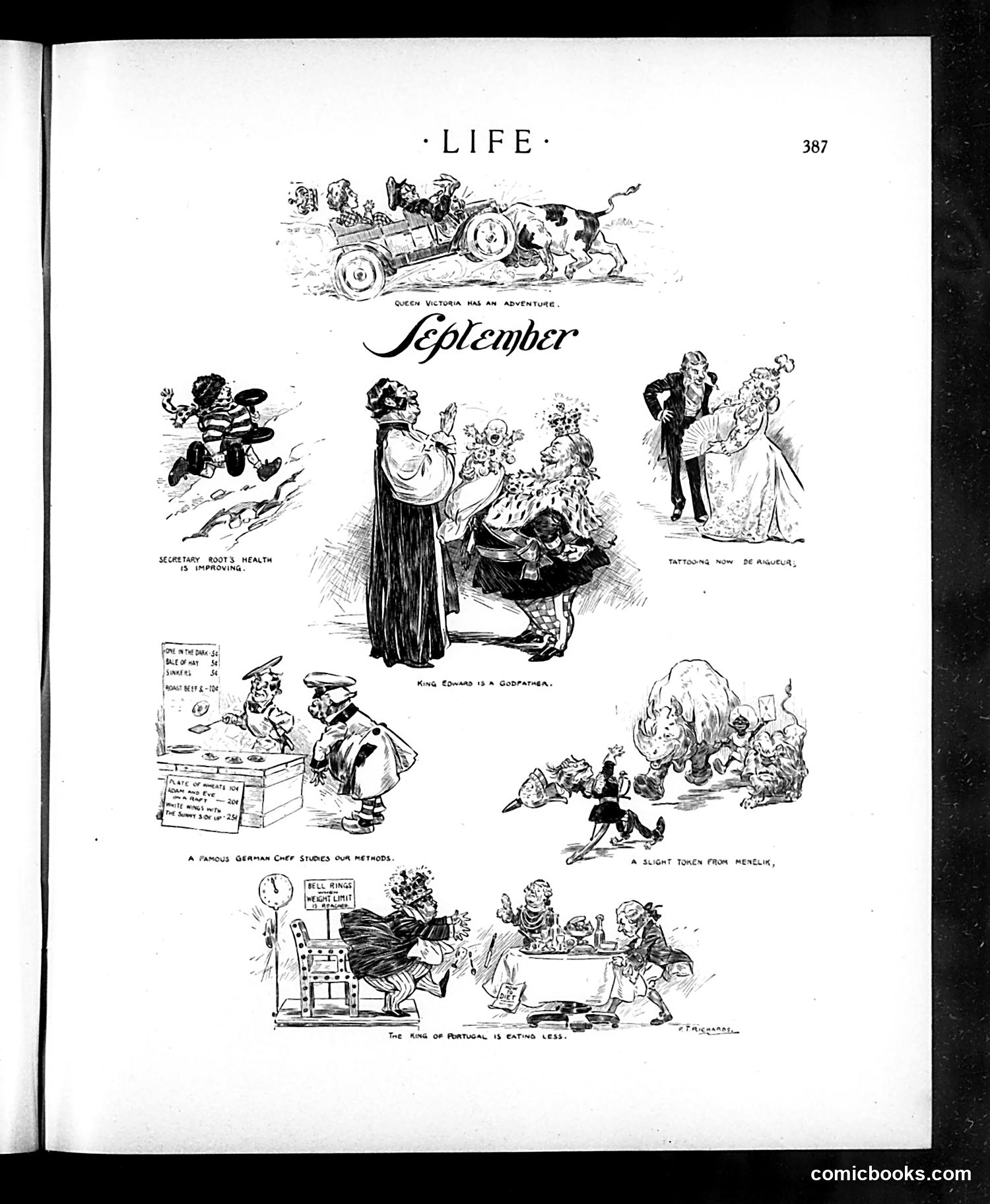
This page presents six satirical vignettes about September 1915 events and figures. The captions reference: - **Queen Victoria's adventure**: A humorous take on the late monarch (likely a historical joke, as Victoria died in 1901) - **Secretary Root's health**: References a political figure's wellness - **King Edward as godfather**: A royal social scene - **"Tattoos now be anglers"**: Unclear reference, possibly mocking a fashion or social trend - **A German chef's methods**: Satirizing German cuisine or culture during WWI tensions - **"A slight token from Menzies"**: Unclear reference - **"The King of Portugal is eating less"**: Political commentary on Portugal's situation The drawings employ exaggerated caricature typical of Life's style. Without specific date confirmation or clearer caption legibility, precise identifications remain uncertain for several vignettes.
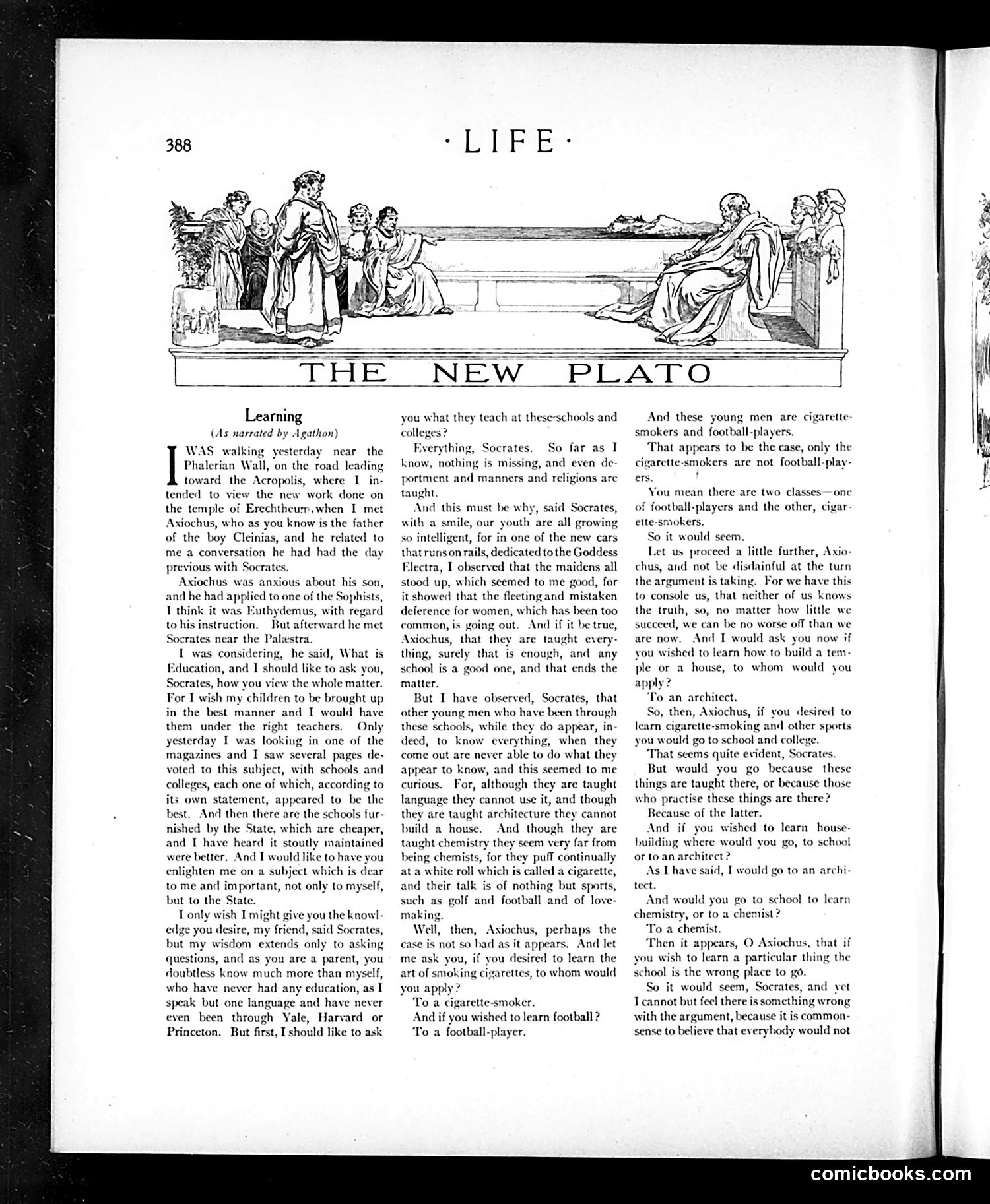
This satirical dialogue titled "The New Plato" critiques modern education by comparing classical Greek philosophy to contemporary schooling. The illustration shows figures in classical dress, mimicking Plato's famous dialogues. The text presents a conversation where Socrates questions what is actually being taught in modern schools. The satire targets the perceived uselessness of education: students learn subjects like architecture and chemistry but cannot practically apply them. The dialogue mocks young men who become "cigarette-smokers and football players" despite formal education. The piece sarcastically suggests that if one truly wants practical knowledge—smoking cigarettes or playing football—formal schooling is unnecessary. The satire implies that modern education fails to provide meaningful, applicable knowledge to students.
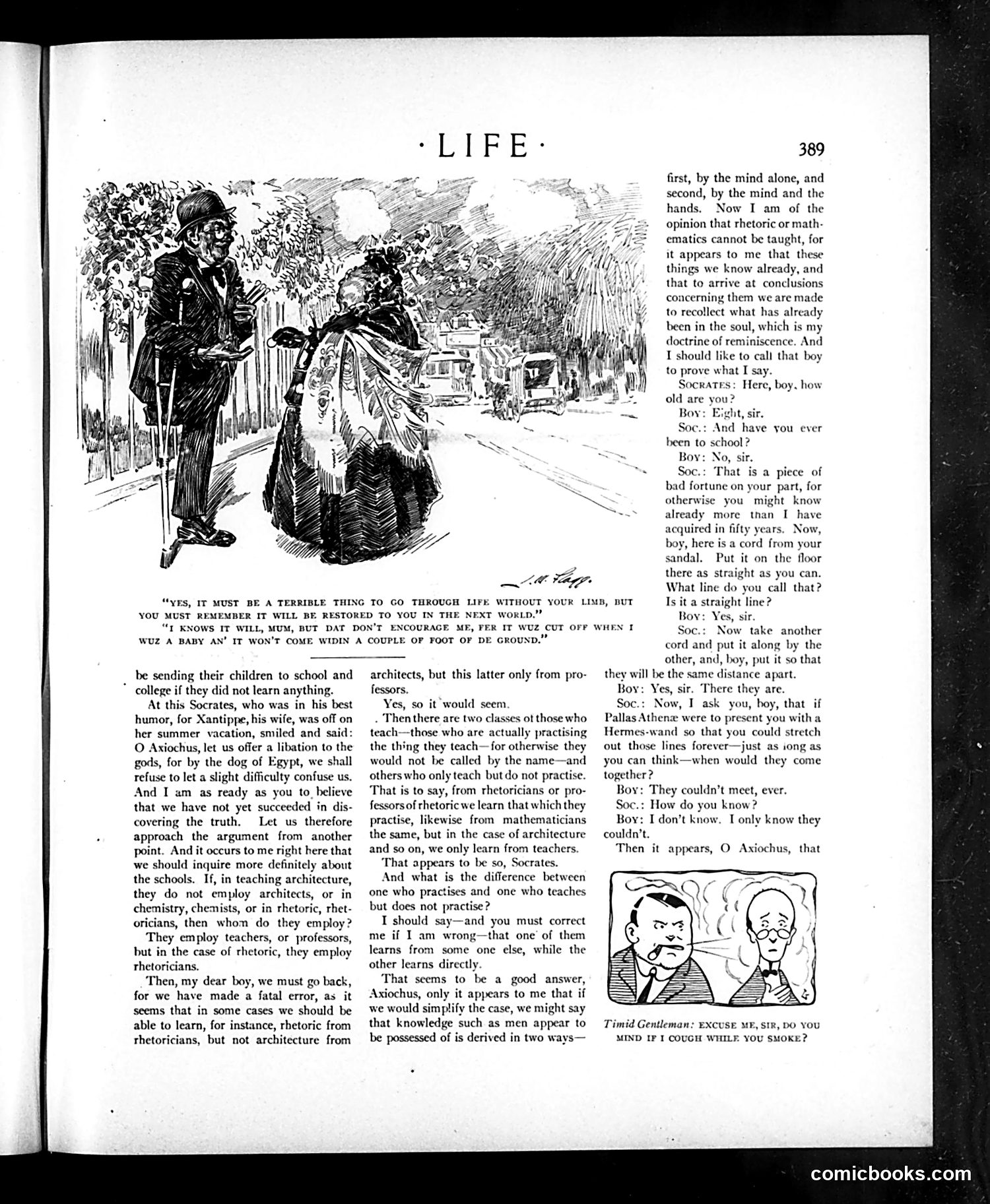
**Main Content:** A Socratic dialogue about education, featuring an older man (Socrates) instructing a young boy about learning and rhetoric. **Large Illustration:** Shows two figures on a street—an elderly man gesturing while speaking to a young boy, with period clothing suggesting classical or historical setting. **Small Cartoon (bottom right):** Two men in conversation; one complains about coughing while smoking, with the caption: "TIMID GENTLEMAN: EXCUSE ME, SIR, DO YOU MIND IF I COUGH WHILE YOU SMOKE?" **The Satire:** The small cartoon mocks social courtesy and hypocrisy—a timid person apologizes for coughing (involuntary) while someone else smokes (voluntary and potentially harmful to others). It satirizes misplaced politeness and the smoker's presumed entitlement. **Historical Context:** This reflects early 20th-century attitudes where smoking was socially acceptable and unquestioned, while a cough was treated as an imposition.
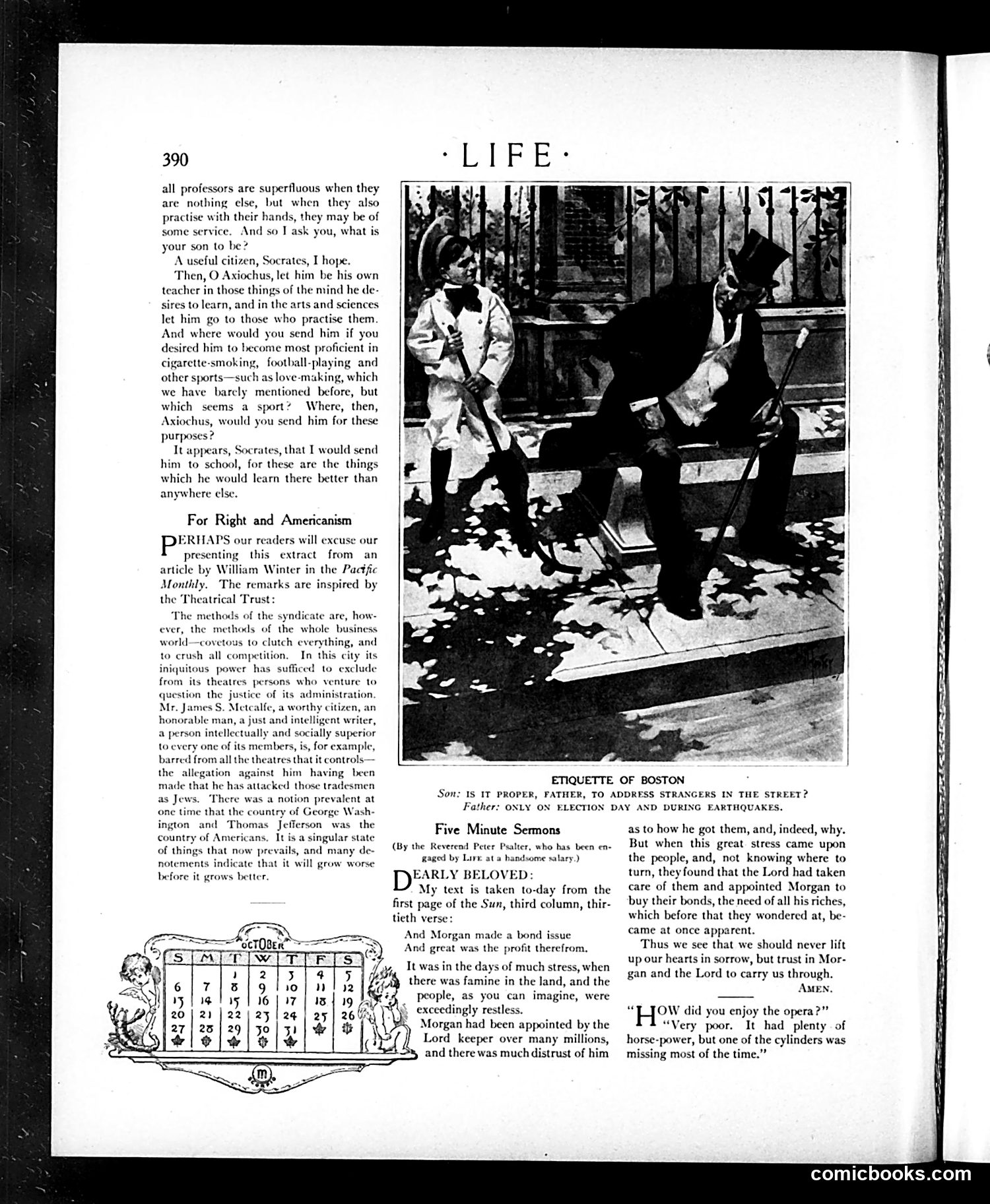
This page contains three distinct satirical pieces critiquing American institutions: 1. **The Socratic Dialogue** (top): Mocks American education by suggesting schools excel only at teaching vice—smoking, football, and "love-making"—implying schools neglect intellectual development. 2. **"For Right and Americanism"**: Attacks the Theatrical Trust (a monopoly controlling American theaters). It quotes critic William Winter condemning the syndicate's exclusion of James S. Metcalfe from theaters allegedly for criticizing Jewish tradesmen. The piece sarcastically contrasts the trust's un-American gatekeeping with founding ideals of Washington and Jefferson. 3. **"Etiquette of Boston"**: A brief joke mocking Boston's social coldness—strangers only speak during crises (elections, earthquakes). 4. **"Five Minute Sermons"**: Parodies religious authority by presenting J.P. Morgan's financial manipulations as divine providence, satirizing how the wealthy exploit crisis and public trust. The final auto joke is unrelated to these themes.
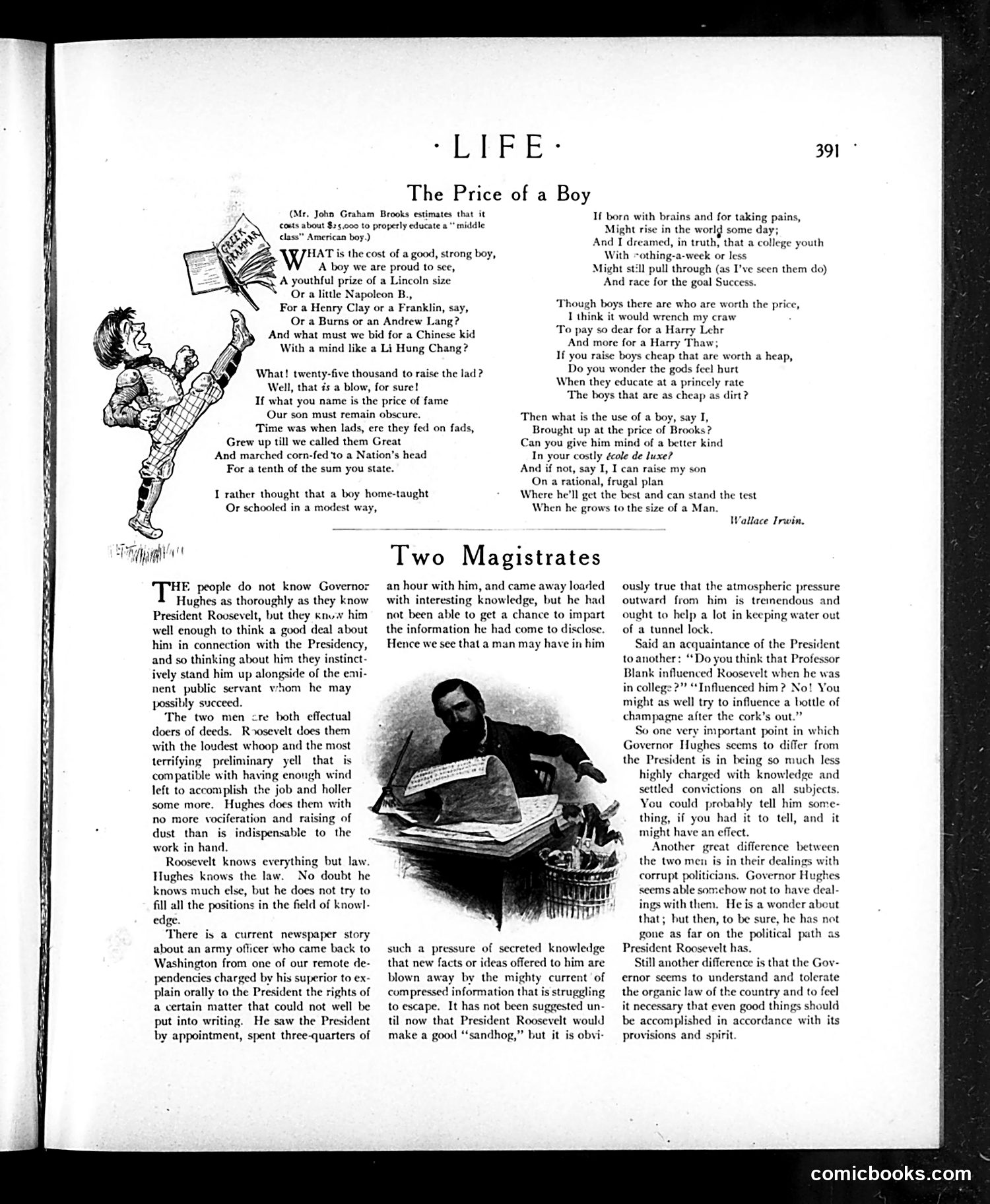
This page contains two distinct pieces of political satire from the early 1900s: **"The Price of a Boy"** (left) mocks economist John Graham Brooks's claim that raising a middle-class American boy costs $25,000. The illustrated figure represents an aspirational parent. The poem sarcastically questions whether expensive education truly produces better men than humble upbringings did historically—referencing figures like Lincoln and Napoleon who rose without such costs. It also satirizes wealthy but morally dubious examples: "Harry Lehr" and "Harry Thaw" (likely wealthy socialites of the era known for scandal or excess). **"Two Magistrates"** (right) compares President Theodore Roosevelt and Governor (later Justice) Charles Evans Hughes. The cartoon caricature shows Hughes studying documents carefully. The text contrasts their styles: Roosevelt is impulsive, loud, and omniscient; Hughes is methodical, restrained, and legally expert. An anecdote illustrates Roosevelt's overwhelming talkativeness—he literally prevents others from speaking. The satire suggests Hughes's quiet competence contrasts favorably with Roosevelt's bombastic approach to governance.
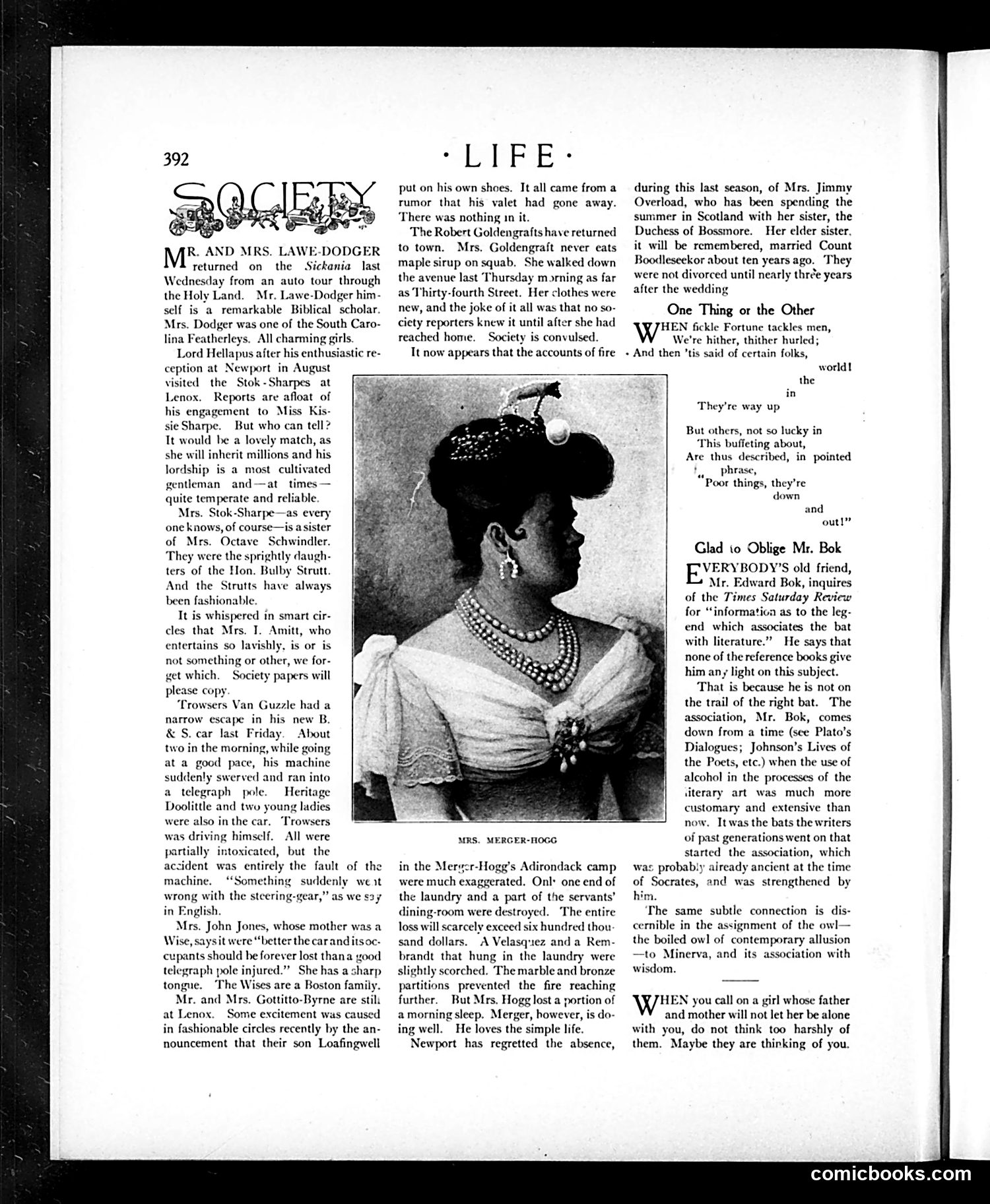
This page contains two distinct sections of satirical content typical of Life magazine's social commentary. **Society Column Satire (left):** The gossip items mock wealthy New York society by reporting trivial, fabricated, or meaningless "scandals"—a woman walking down an avenue, another never eating maple syrup on squab, rumors of engagements with no substance. The tone suggests Life is ridiculing how society newspapers breathlessly cover the inconsequential activities of the rich, treating mundane facts as newsworthy drama. The photo shows Mrs. Merger-Hogg. **"One Thing or the Other" (right):** A humorous poem about fortune's unpredictability, with clever wordplay about people being buffeted by circumstances. **"Glad to Oblige Mr. Bok" (right):** This section playfully answers Edward Bok's inquiry about why bats are associated with literature. Life's joke: the connection comes from writers using alcohol ("bats" as slang) while composing—a witty, slightly risqué reference to literary drinking culture. Overall, the page satirizes both society's shallow preoccupations and literary pretension.
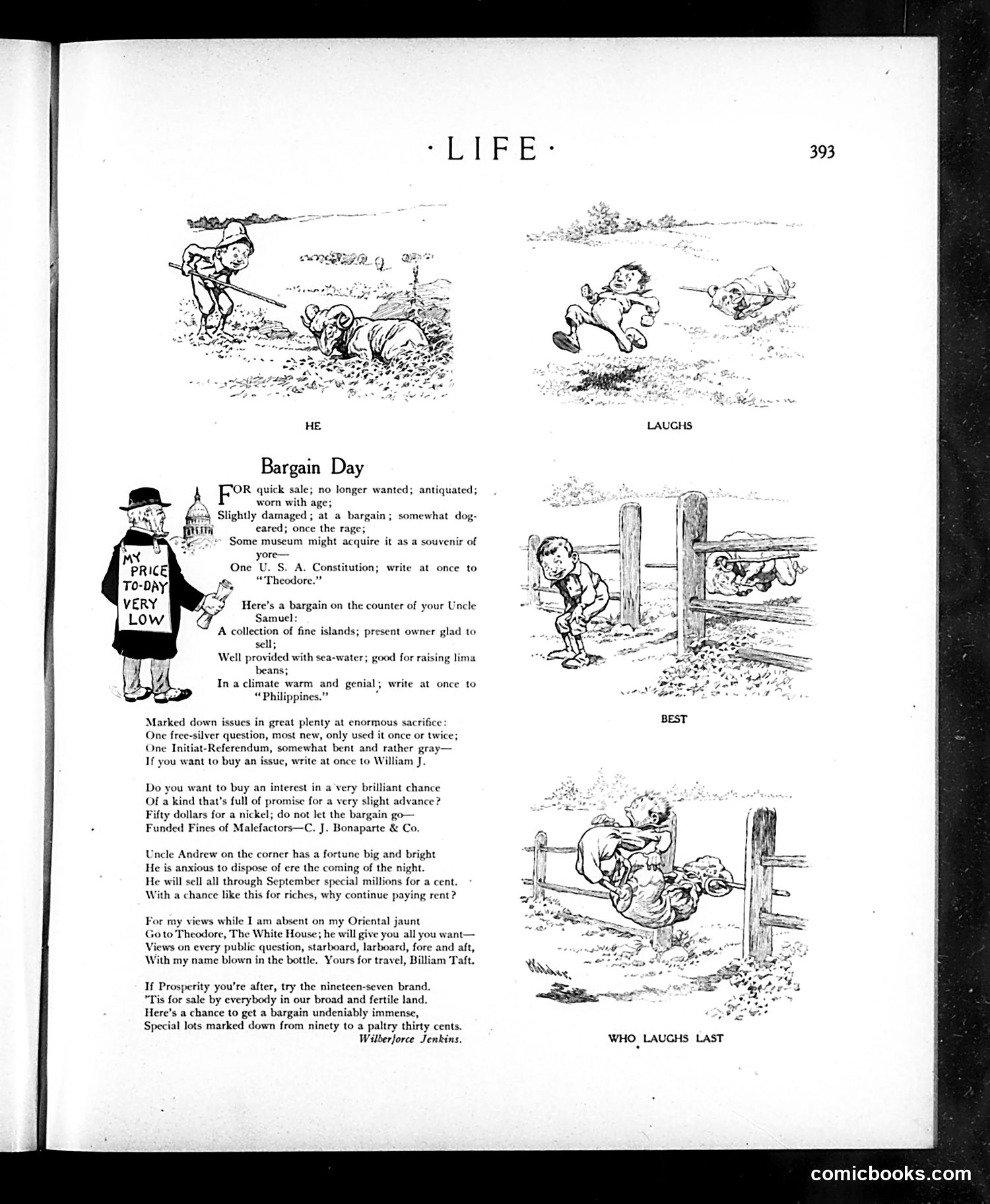
This satirical piece mocks the Roosevelt and Taft administrations' policies as worthless "bargains" being hawked like junk. The text presents political issues as marked-down merchandise: - **"Theodore"** (President Theodore Roosevelt) sells the U.S. Constitution itself—suggesting his policies violate it - **"Philippines"** refers to America's colonial acquisition, presented as an unwanted burden - **"William J."** (likely William Jennings Bryan) hawks free-silver and progressive reforms as damaged goods - **"C. J. Bonaparte & Co."** alludes to corruption in corporate penalties - **"Billiam Taft"** (President Taft) advertises contradictory political views, mocking his inconsistency with Roosevelt The accompanying illustrations show children playing, labeled "HE LAUGHS," "BEST," and "WHO LAUGHS LAST"—suggesting children's innocence contrasts with corrupt adult politics, or that the ultimate joke is on citizens who trust these leaders. The satire attacks Progressive Era reformers and executive overreach as fraudulent schemes.
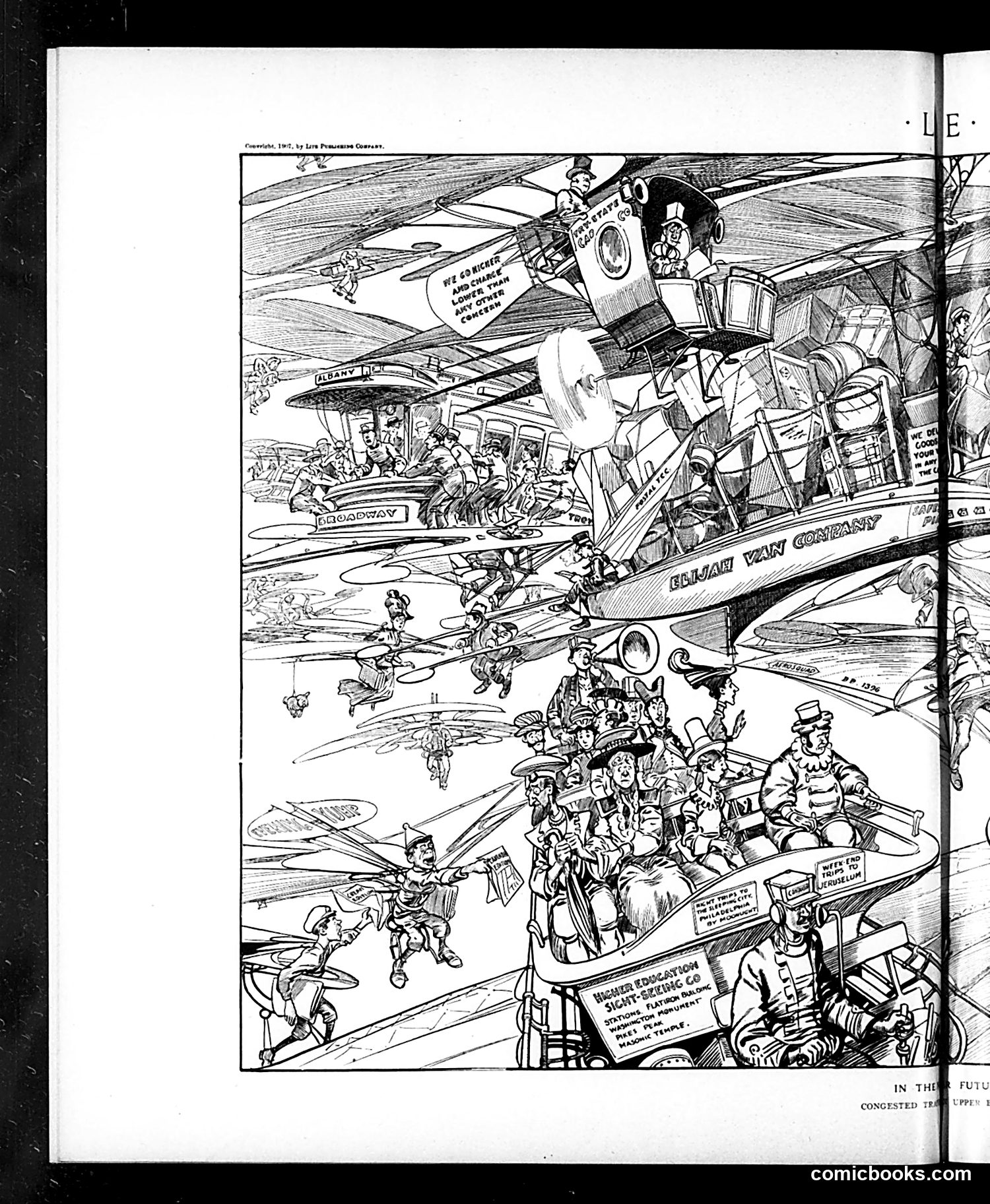
This is a futuristic satirical cartoon depicting an overcrowded aerial transportation hub. The scene shows numerous aircraft and dirigibles (airships) stacked densely in a chaotic airspace, with crowds of people boarding and disembarking. Visible text references "Buyan Van Company" and what appears to be commercial aviation operations. The satire mocks concerns about future traffic congestion—specifically predicting that air travel, rather than solving transportation problems, would simply recreate gridlock in three dimensions. The cartoon exaggerates the density to absurdist levels, suggesting anxieties about technological progress and urbanization common to early 20th-century Life magazine's satirical commentary on modern life. The title fragment "CONGESTED TRAE UPPEN" (likely "Congested Traffic Upper") confirms the traffic-congestion theme.
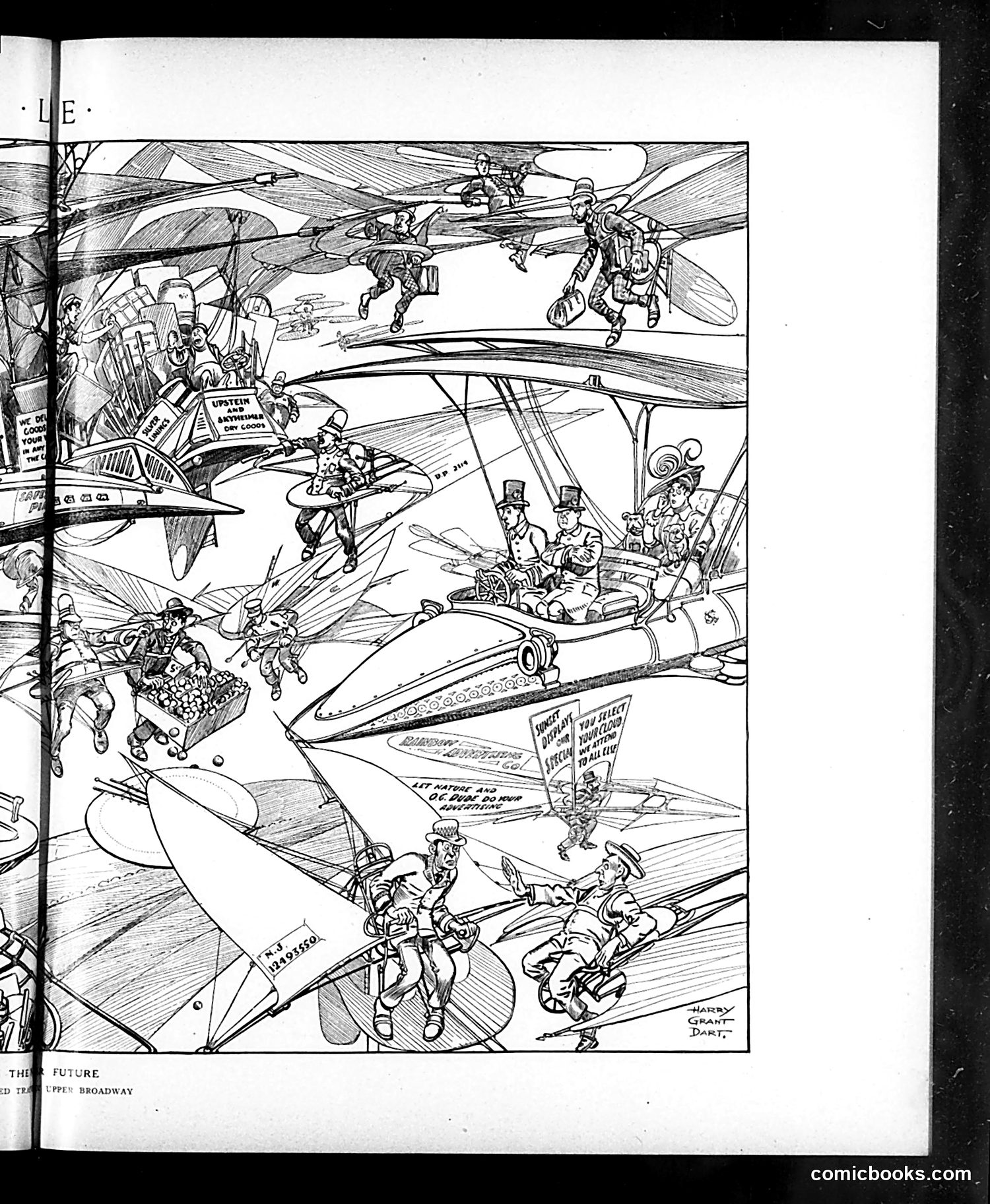
This full-page cartoon depicts an imagined futuristic aerial world populated by various airships, flying vehicles, and winged figures. The artist is credited as "Grantley Dart" (visible in lower right). The satire appears to mock turn-of-the-century predictions about aviation technology and modern life. Multiple vessels labeled with commercial names (visible text includes "UPSTEIN" and references to "DRY GOODS") suggest satirizing both technological optimism and commercialization of future transport. The chaotic composition—with figures crowding various aircraft, cargo being transported, and apparent traffic—likely lampoons anxieties about congestion and disorder that rapid technological advancement might bring to society. Without clearer OCR text or visible dates, the specific historical moment remains unclear, though the style suggests early 1900s American satire.
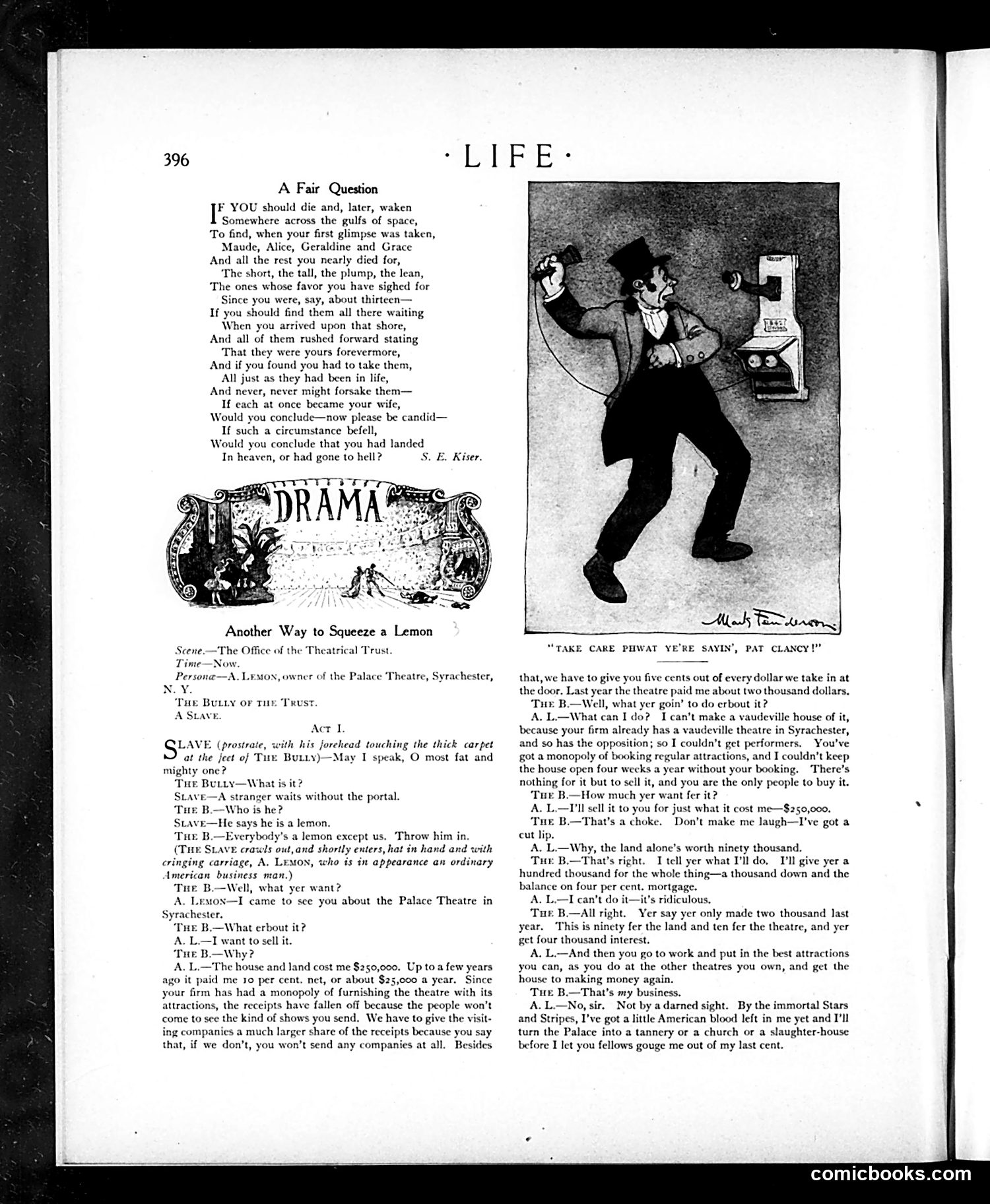
This page contains two distinct pieces of satire about power imbalances. **"A Fair Question"** (poem): A humorous meditation on the afterlife—if a man were reunited with all the women he'd romantically pursued in life, forced to marry all of them simultaneously, would that be heaven or hell? The joke hinges on the anxiety of romantic commitment and the absurdity of polygamy. **"Another Way to Squeeze a Lemon"** (theatrical sketch): This satirizes the **Theatrical Trust**, a monopolistic booking agency that controlled which shows played in theaters nationwide. A. Lemon, an independent theater owner in Syracuse, wants to sell his struggling Palace Theatre. The "Bully of the Trust" (a caricatured monopolist) exploits Lemon's desperation: the theater loses money precisely *because* the Trust supplies only unpopular shows, forcing Lemon to accept the Trust's humiliating financial terms. The Trust then lowballs his asking price, offering to buy his $250,000 property for far less. It's a critique of corporate monopolistic practices strangling small business owners.
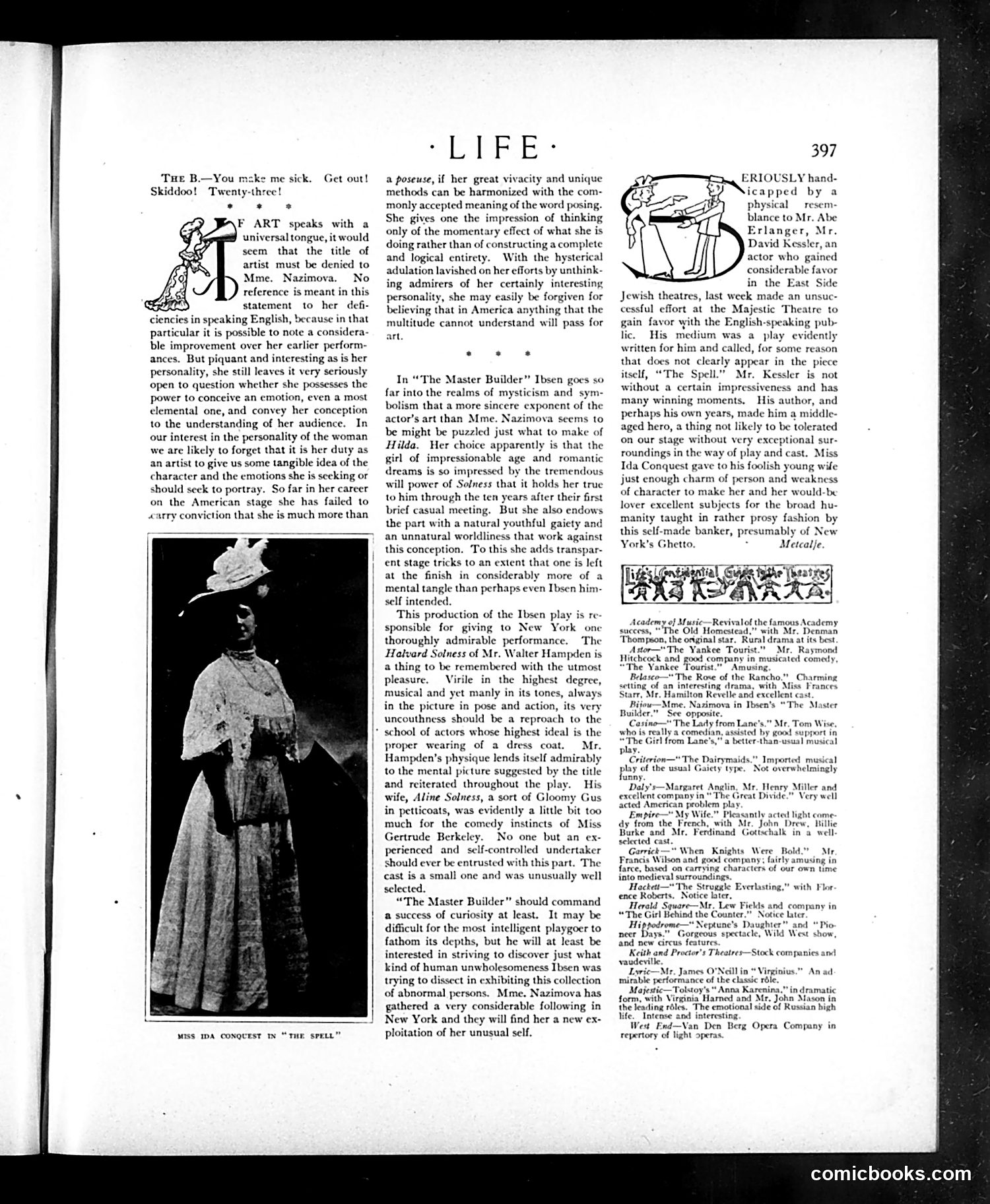
This page reviews Russian-born actress Alla Nazimova's performance in Ibsen's *The Master Builder*. The critic is sharply critical of Nazimova, arguing she is a "poseuse" (poser) concerned only with momentary theatrical effect rather than genuine emotional depth. Though acknowledging her "vivacity and unique methods," the writer contends she lacks the fundamental artistic power to convincingly convey character and emotion to audiences. The review praises Walter Hampden's performance as Solness as "virile" and "manly," contrasting it favorably with Nazimova's approach. The critic suggests Nazimova's popularity with New York audiences stems from their inability to distinguish genuine artistry from mere spectacle—anything the "multitude cannot understand will pass for art." The photograph shows "Miss Ida Conquest in 'The Spell'" (unrelated to the main review).
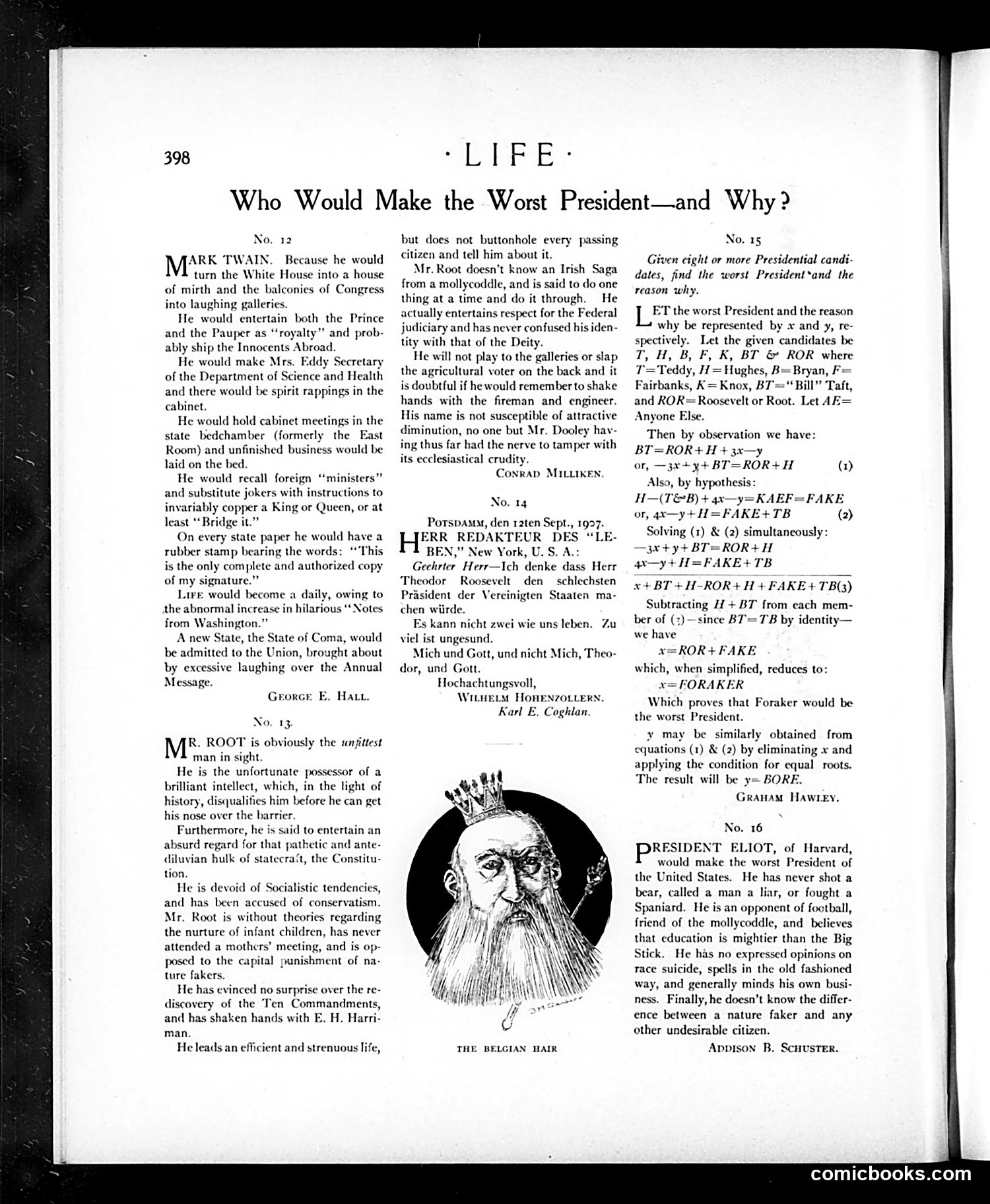
This is a satirical Life magazine feature titled "Who Would Make the Worst President—and Why?" presenting humorous submissions about various political figures. **The entries shown:** **No. 12 (Mark Twain):** Proposes author Mark Twain would be worst president because he'd turn government into comedy—entertaining foreign dignitaries with pranks, creating "spirit rappings" in the cabinet, and generating so much laughter the nation would need a new state ("State of Coma"). **No. 13 (Elihu Root):** Satirizes Root as unfit because he's *too competent*—he respects the Constitution, has actual principles, doesn't play to crowds, shakes hands with industrialist E.H. Harriman, and leads an "efficient and strenuous life" without self-promotion. **No. 14:** A German-language letter (purporting from Kaiser Wilhelm) joking that Theodore Roosevelt would be worst president because "two like us cannot live"—only one supreme figure can exist. **No. 15:** A mathematical proof "proving" which candidate would be worst, using algebraic equations with candidates' initials (Teddy, Hughes, Bryan, Fairbanks, Knox, Taft, Roosevelt/Root). The satire mocks both political figures and the very concept of ranking presidential fitness.
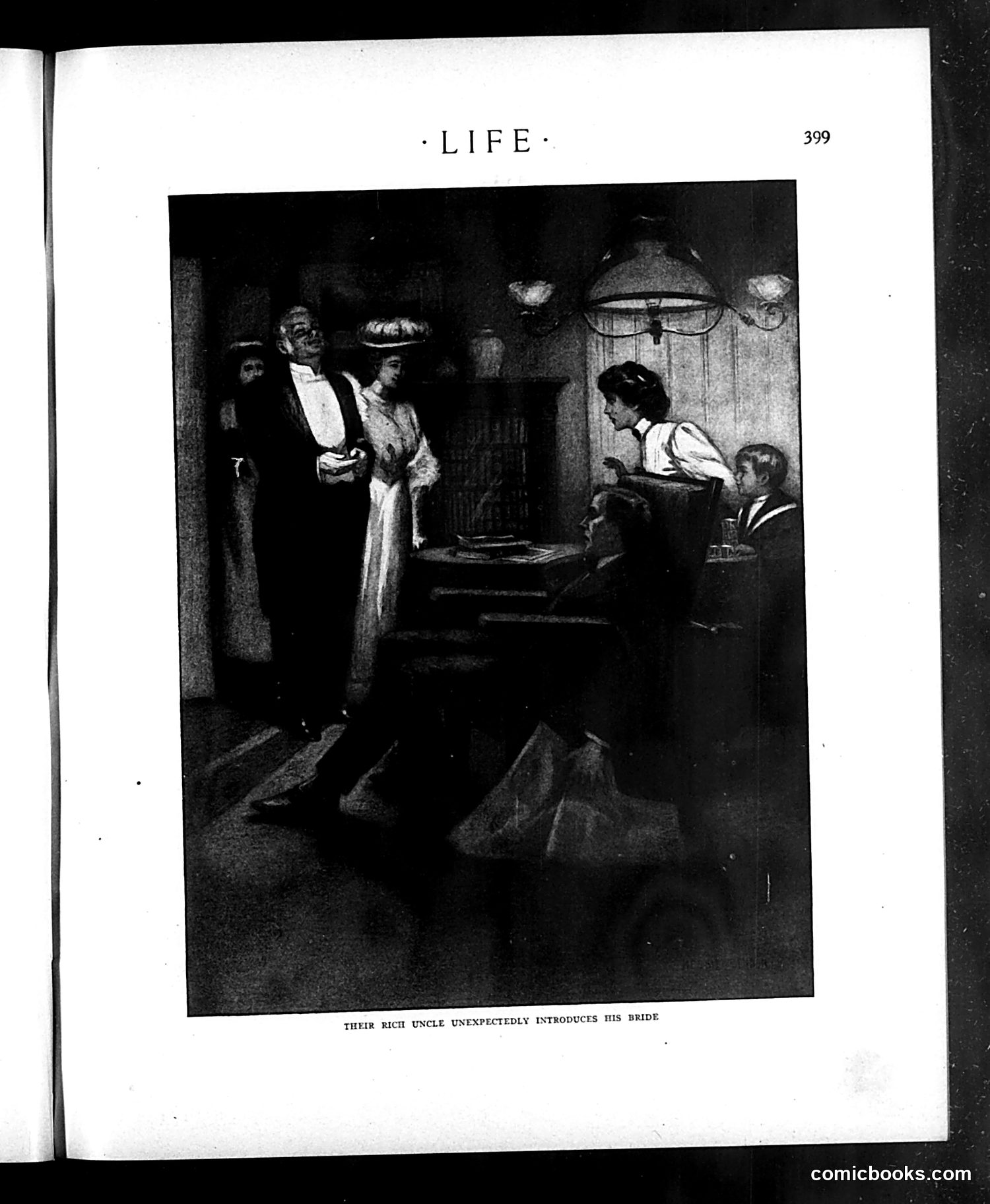
This is a dramatic illustration from *Life* magazine (page 399) depicting a social scene with the caption "Their Rich Uncle Unexpectedly Introduces His Bride." The image shows a formal indoor setting with several figures: well-dressed men in formal attire on the right appear surprised or taken aback, while on the left, a man in formal wear stands with a woman in a light-colored dress. The theatrical lighting and composition suggest a moment of social shock or scandal. The satire appears to target upper-class social expectations: a wealthy uncle's sudden, unexpected introduction of a bride—likely implying she is socially unsuitable or from a lower class—causes visible consternation among family members. The joke centers on the collision between old money's rigid social conventions and an outsider disrupting established hierarchies through marriage.
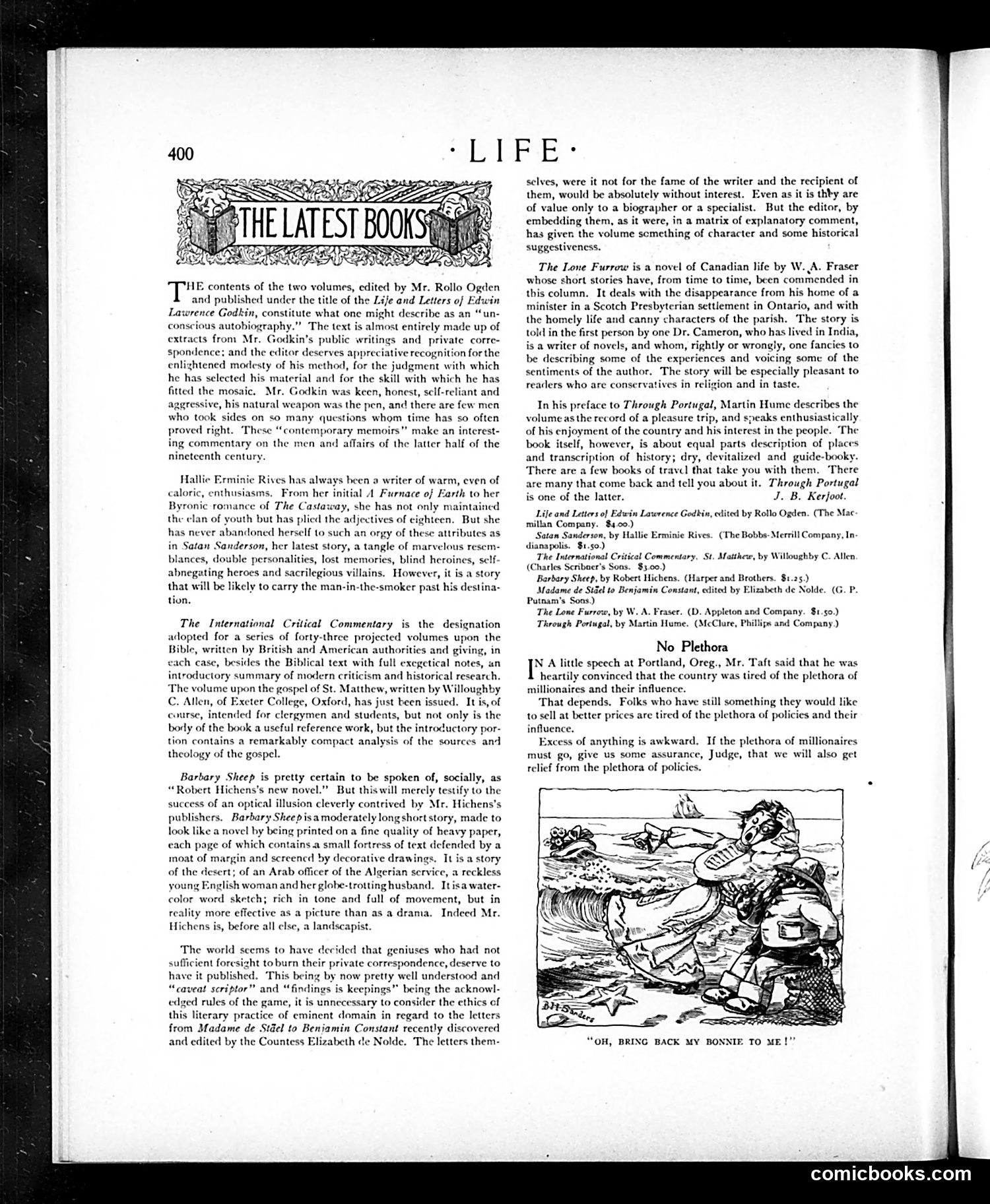
This page is primarily a book review section titled "The Latest Books," discussing several new publications including works by Hallie Ermine Rives and Robert Hichens. The cartoon at the bottom depicts a woman on a beach calling out "OH, BRING BACK MY BONNIE TO ME!" This illustrates a section titled "No Plethora," where Mr. Taft (likely President William Howard Taft) supposedly said at a Portland speech that the country was "tired of the plethora of millionaires." The joke is satirical: the woman's plea to retrieve her "bonnie" (lover/sweetheart) contrasts with the wealthy class's supposed excess. The satire suggests that while people claim to be tired of millionaires' influence, they actually desire wealth and comfort themselves—a commentary on American attitudes toward wealth inequality and the gap between public complaint and private aspiration during the Progressive Era.
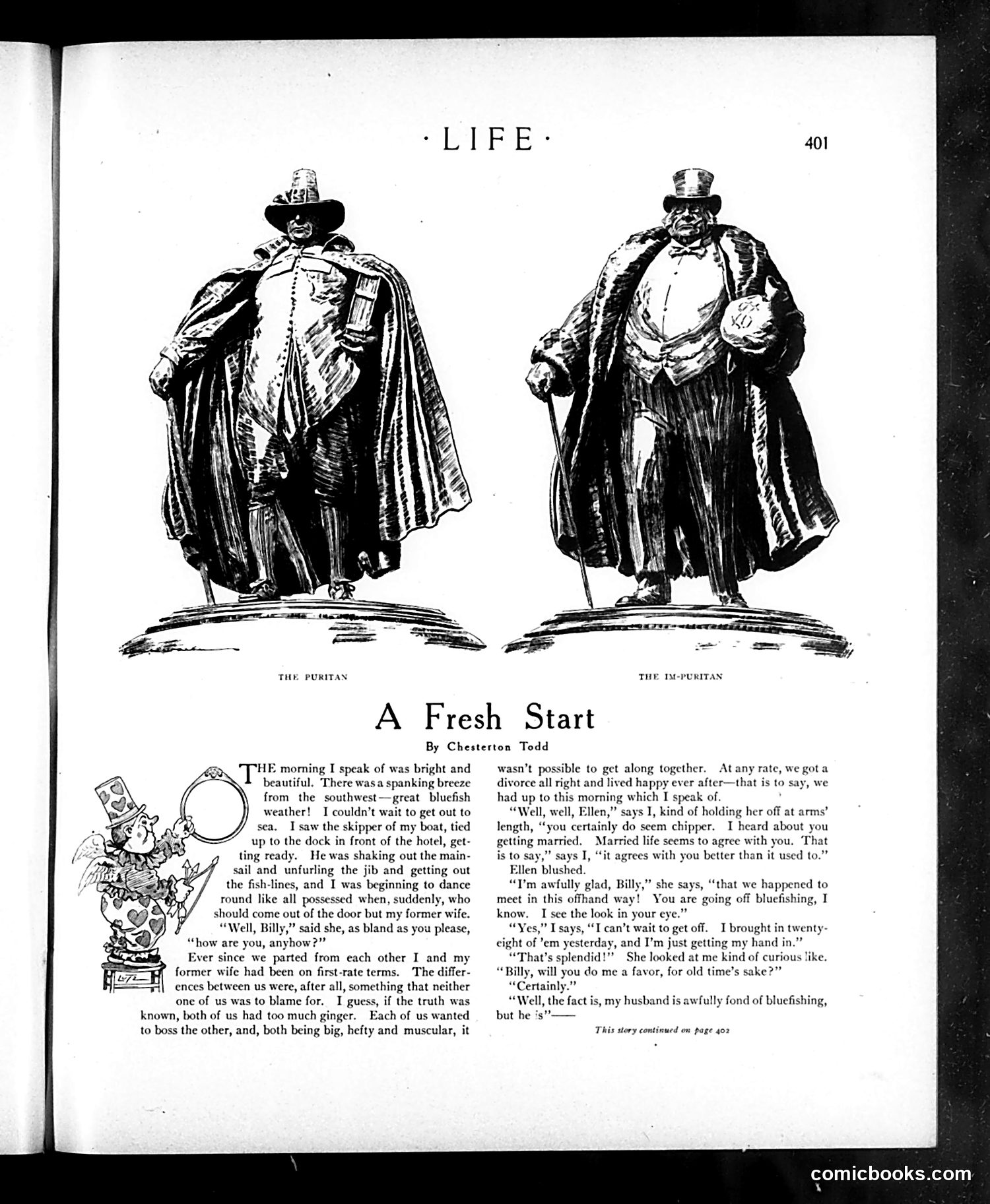
This page presents a humorous short story (not a political cartoon) about an encounter between a divorced man and his ex-wife. The two illustrations at the top—labeled "The Puritan" and "The Im-Puritan"—appear to be generic character types representing moral rigidity versus hypocrisy, likely thematic to the story below. The narrative follows Billy, who encounters his former wife Ellen at a dock. Despite their divorce due to incompatibility (both "too much ginger" to get along), they've remained friendly. Ellen is now remarried but approaches Billy asking a favor related to her new husband's interest in bluefishing—the same activity Billy is about to pursue. The humor lies in the awkward reunion and implied complications from past relationships intruding on present circumstances. The story continues on the next page.
This page contains text from a serialized short story (titled "This story continued on page 604" at bottom), not a political cartoon. The narrative depicts a domestic comedy involving three characters: the narrator "Bill," his ex-wife "Ellen," and her new husband "Josiah Huggins." The satire targets romantic idealization versus practical reality. Josiah is portrayed as a sensitive, poetic dreamer—described as an "angel" with imagination but no real-world competence. When Bill takes him fishing, Josiah becomes physically exhausted after catching just four fish, requiring Bill's assistance. The joke exposes the contrast between Ellen's romanticized view of her new husband (artistic, emotional, kind) and Bill's pragmatic assessment: Josiah is physically weak and impractical despite his spiritual qualities. The story humorously suggests that Bill's rough, capable masculinity may have been undervalued compared to Josiah's refined sensibilities—a common early 20th-century theme about masculinity and marriage expectations.
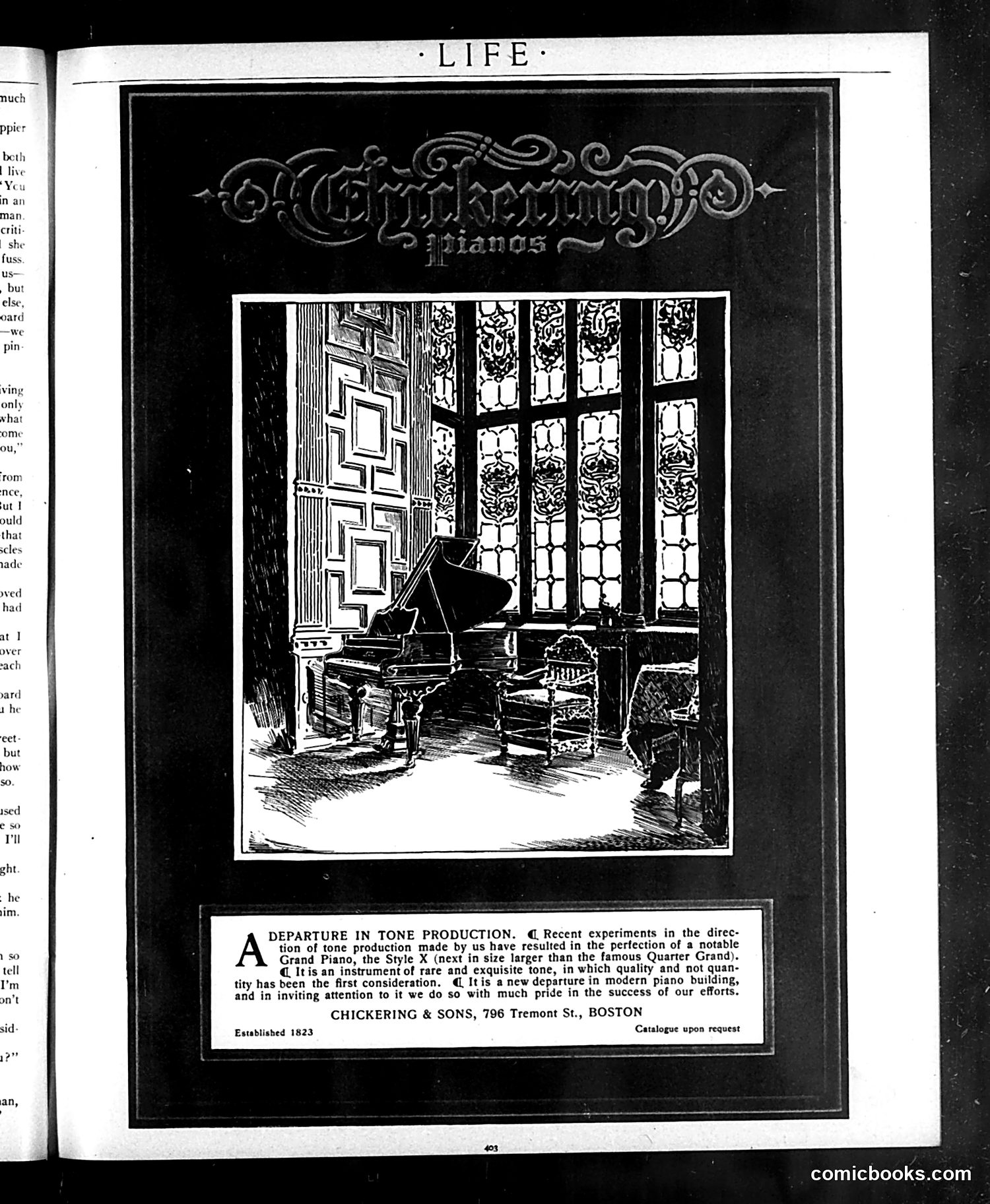
This page is primarily an **advertisement**, not a cartoon. It features a stylized illustration of an elegant parlor room with a grand piano positioned near tall, ornate windows with decorative panes. The room shows period furnishings and architectural details suggesting wealth and refinement. The ad promotes **Chickering & Sons**, a Boston piano manufacturer established in 1823, announcing their new "Style X" Grand Piano. The text emphasizes this represents "a new departure in modern piano building," prioritizing tonal *quality* over quantity—a marketing distinction aimed at discerning, affluent customers. The illustration itself contains no political satire or social commentary. Rather, it's aspirational advertising depicting the refined domestic setting where such an instrument would belong, appealing to wealthy American consumers. The ornate framing and typography reflect the magazine's aesthetic standards for luxury goods advertising.
This page is primarily **advertisements** interspersed with a serialized **romantic story** rather than political satire. The ads promote luxury goods: Steinway pianos ("Goal of Perfection"), Johann Maria Farina Cologne (claiming originality from Germany), and a perfume history book. The story—appearing to be a serialized fiction piece titled something like "Bill's Romance"—depicts a courtship narrative. A character named Bill credits his friend Josiah with introducing him to his wife Sarah Jane. The twist (revealed at page's bottom): Josiah was *previously* married to Sarah Jane before introducing her to Bill, having "planned" the arrangement because "we fit like dogs and cats." **For modern readers:** This appears to be early 20th-century sentimental fiction exploring themes of friendship, trust, and marital compatibility—likely meant as light entertainment. The revelation that the wife was "recycled" between friends would have carried different social implications then than today. The page contains no political cartoons or satire—it's primarily commercial.
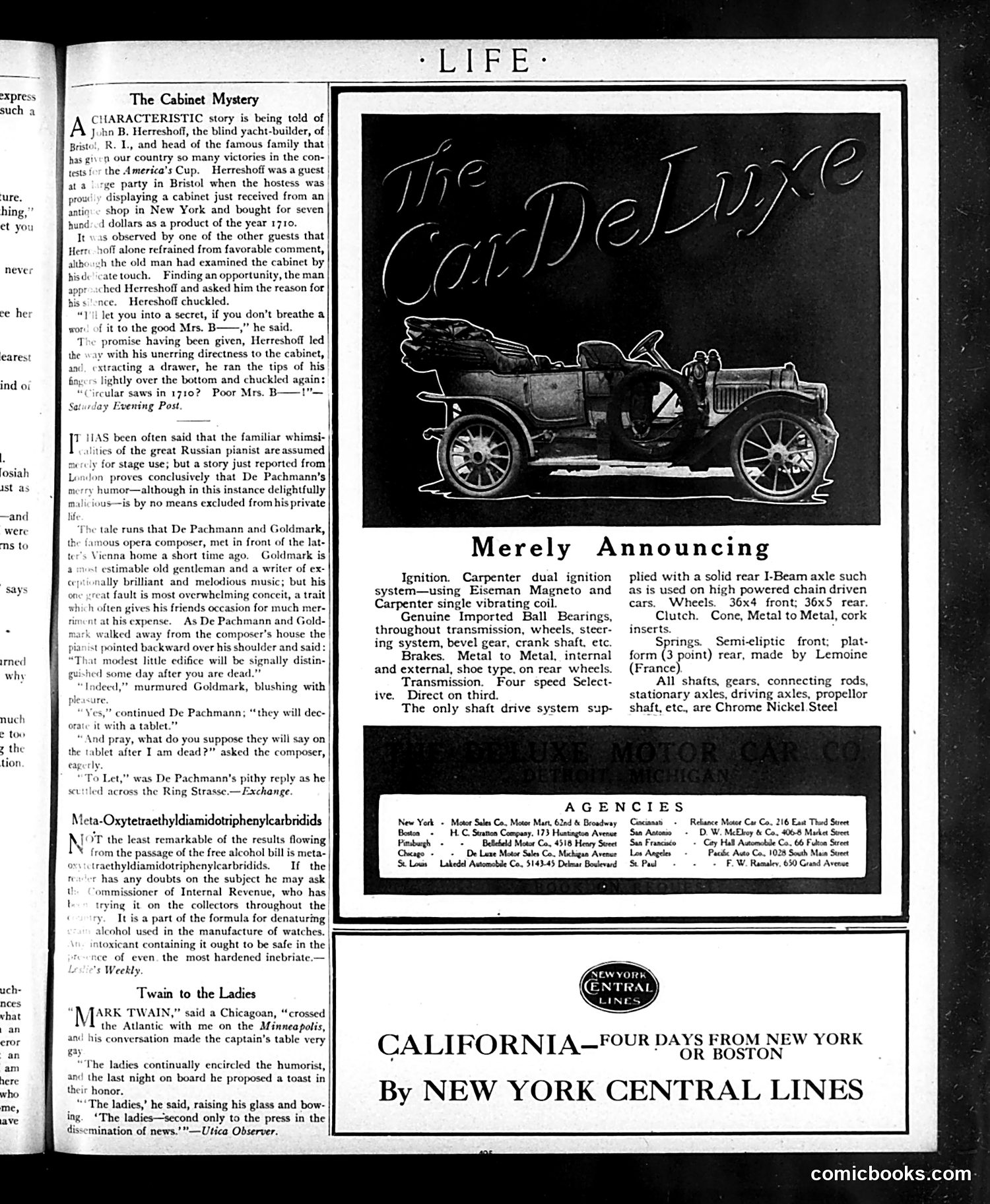
This page contains three humorous anecdotes typical of *Life* magazine's satirical humor: **"The Cabinet Mystery"**: A blind yacht designer (John B. Herreshoff) exposes an antique dealer's fraud by feeling a cabinet's bottom and detecting modern circular saw marks—impossible in 1710. The joke mocks gullible wealthy buyers of "antiques." **De Pachmann anecdote**: Russian pianist De Pachmann deflates composer Goldmark's conceit by suggesting his house will be commemorated after death—with a tablet reading "Goldmark lived here" (implying unremarkable mediocrity). Sharp wit at the expense of arrogance. **"Twain to the Ladies"**: Mark Twain's toast ranking ladies "second only to the press" in importance is presented as flattery, though it's actually backhanded—the press being a frequent target of satire. The page also features a automobile advertisement ("The Car Deluxe") and railroad advertisement. These pieces exemplify *Life's* satirical approach: exposing pretension and foolishness through witty anecdotes about recognizable figures.
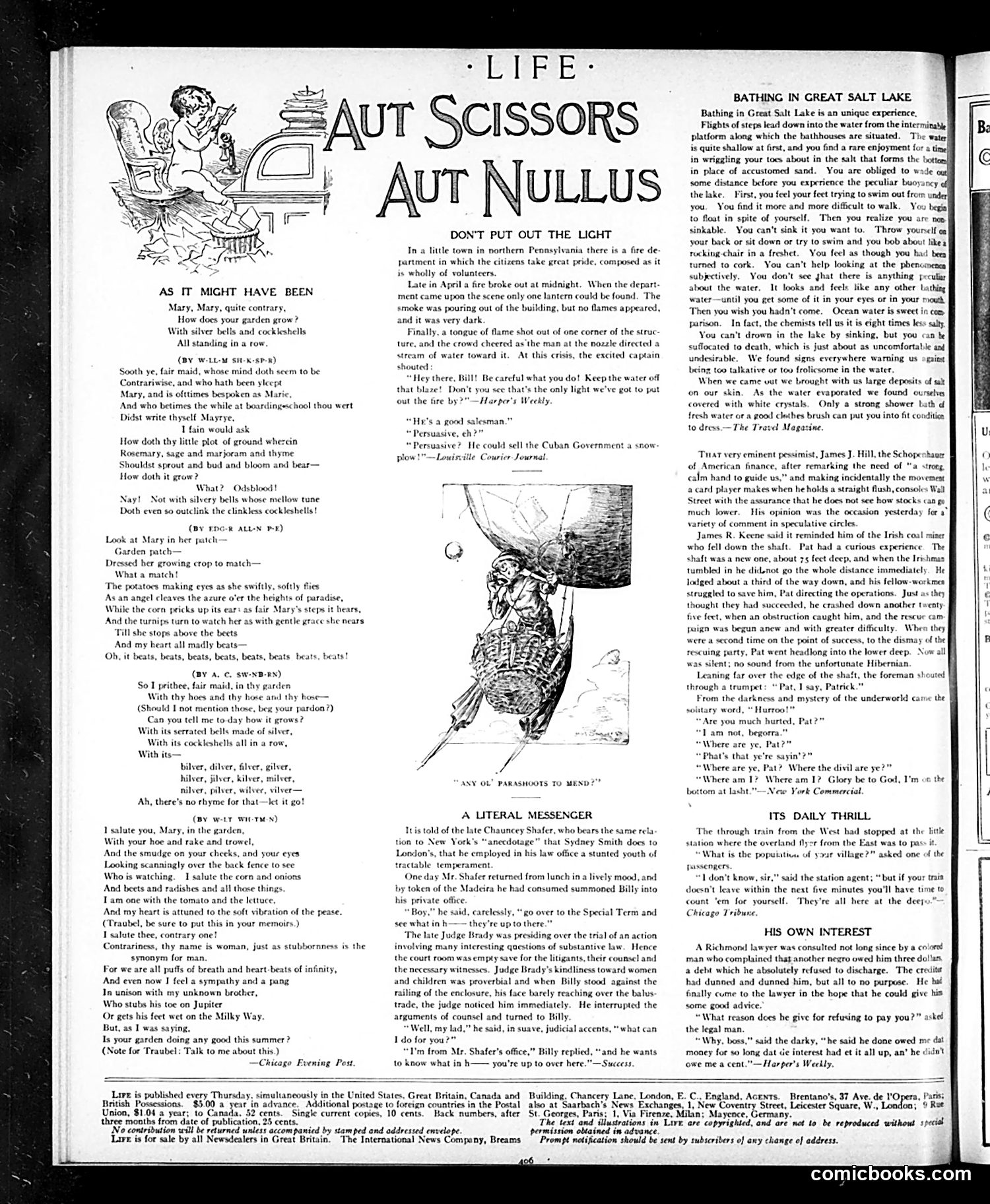
This page contains several satirical pieces typical of *Life* magazine's humor: **"Aut Scissors, Aut Nullus"** mocks the nursery rhyme "Mary, Mary, Quite Contrary" through elaborate mock-Shakespearean poetry, using archaic language to absurdly overanalyze a simple children's verse. It's wordplay-based satire with no specific political target. **"Don't Put Out the Light"** is a brief anecdote joke: a volunteer fire department fighting a nighttime fire realizes their single lantern is also their only light source—extinguishing it to fight the blaze would leave them in darkness. The captain's panicked warning captures the absurd paradox. This satirizes small-town inefficiency. **Other brief jokes** include a salesman who could sell snow to Cuba (mocking absurdly persuasive salesmen) and a reference to "Chauncey Shafer" as New York's wit equivalent to Sydney Smith in London. The page is primarily **literary/wordplay satire** rather than political commentary, typical of *Life's* early 20th-century humor style.
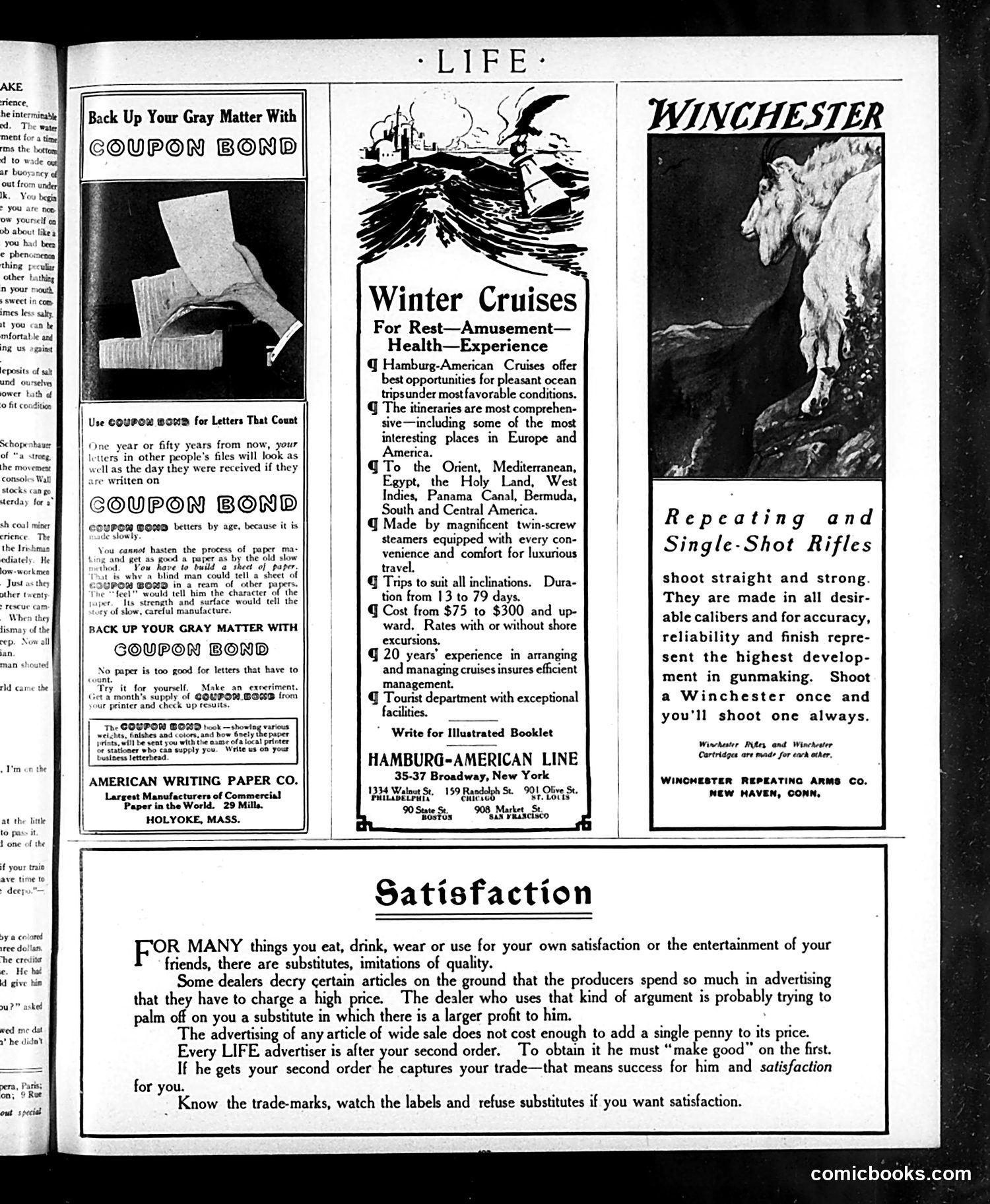
This page consists primarily of **advertisements, not satire or political cartoons**. It contains four distinct ads: 1. **Coupon Bond** (paper company): Promotes durable writing paper for correspondence 2. **Hamburg-American Line**: Advertises luxury ocean cruises to various destinations (Orient, Mediterranean, Holy Land, Caribbean, Central America), ranging 13-79 days and $75-$300+ 3. **Winchester Rifles**: Markets repeating and single-shot rifles, emphasizing accuracy and reliability 4. **"Satisfaction"** (editorial): A prominent boxed statement arguing that heavy advertising doesn't increase product prices—it reflects quality producers confident enough to secure repeat customers The page reflects early 20th-century consumer culture, promoting leisure travel, business supplies, and sporting equipment to a wealthy readership. The "Satisfaction" piece defends advertiser credibility against dealer arguments claiming ads inflate costs.
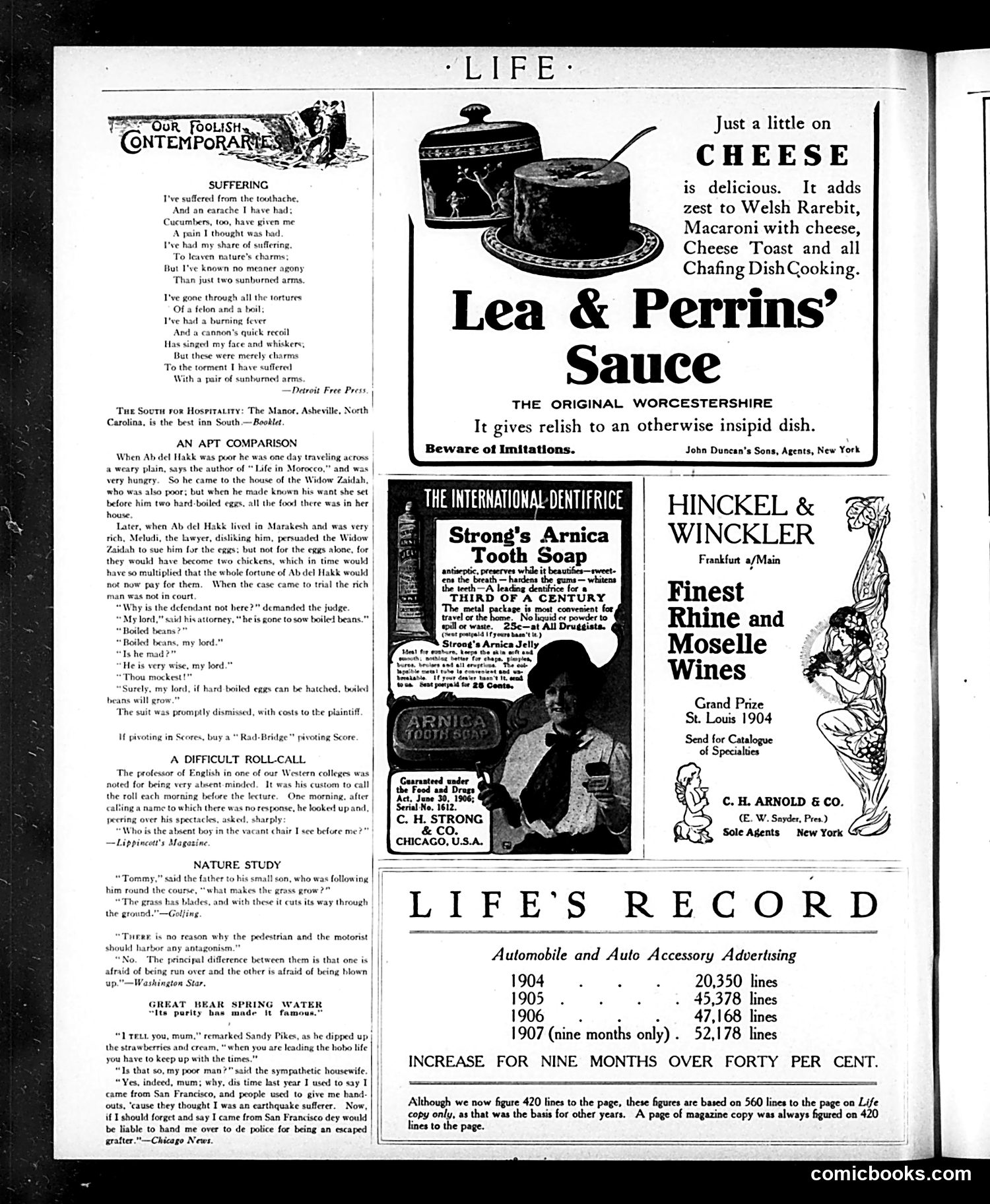
This page is primarily **advertising and light humor**, not political satire. The main content includes: **"Our Foolish Contemporaries"** (top left): A humorous poem about sunburned arms, published in *Detroit Free Press*. It's gentle social commentary on uncomfortable summer experiences. **The anecdotes** ("An Apt Comparison," "A Difficult Roll-Call," "Nature Study") are simple jokes playing on logic, absent-mindedness, and wordplay—typical magazine filler content. **The advertisements** dominate: Lea & Perrins sauce, Hinckel & Winckler wines, and Strong's Arnica products. These occupy substantial space. **"Life's Record"** (bottom) reports automobile advertising growth statistics, showing the magazine tracked industry trends. For modern readers: This reflects an era when magazines blended light humor with substantial advertising revenue. The "foolish contemporaries" humor is gentle social observation rather than pointed political critique.
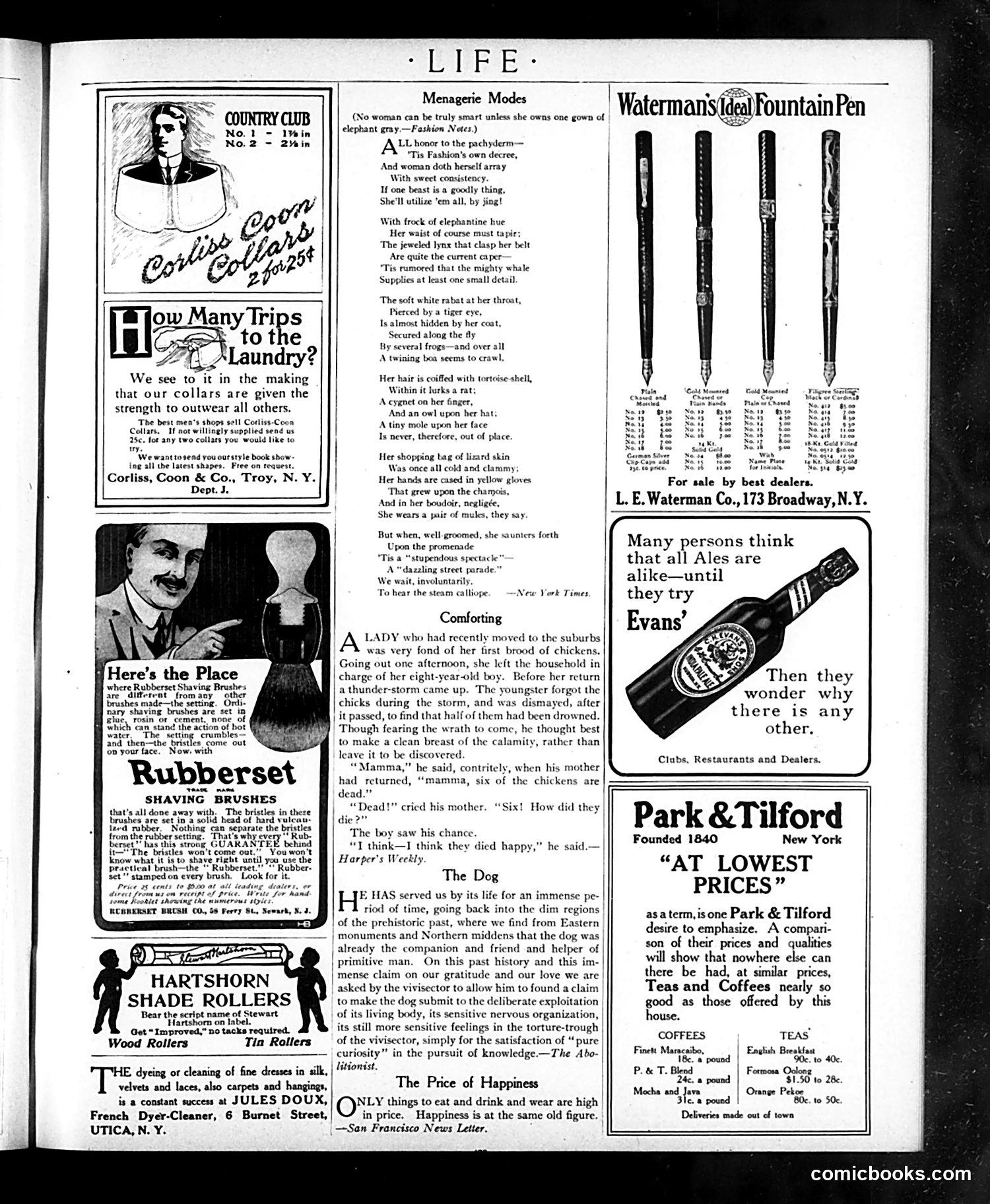
This page's main satirical content is a poem mocking 1910s-era high fashion's excessive use of animal products. "Menagerie Modes" ridicules wealthy women who wear clothing incorporating multiple animal materials—elephant gray fabric, lynx clasps, whale supplies, rabbit trim, tiger eyes, tortoise shell, rats, owls, lizard-skin bags, and chamois gloves. The satire's point: Fashion designers and society women have become absurdly obsessed with adorning themselves with animal-derived materials, creating outfits that resemble literal menageries. The poem's exaggerated description of women as walking collections of dead animals ("A dazzling street parade") highlights the vanity and excess of fashionable society. The accompanying advertisements for collars, shaving brushes, and other products are standard period marketing—unrelated to the satire itself.
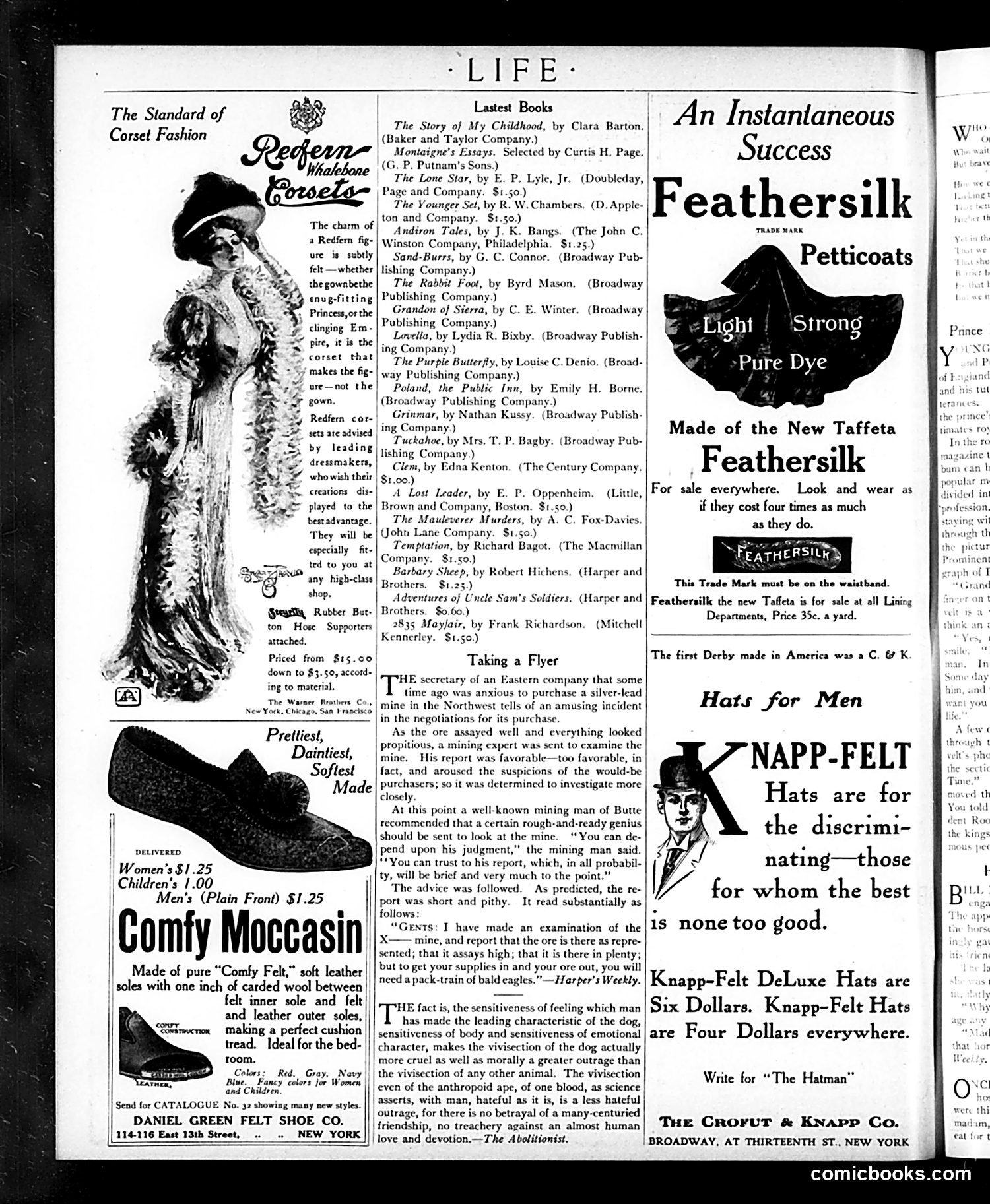
This is primarily an **advertising page**, not political satire. It contains commercial ads for women's corsets, petticoats, felt shoes, and men's hats, alongside a list of newly published books. The only narrative content is "Taking a Flyer"—a humorous anecdote (not a cartoon) about mining negotiations. A company hires an expert to evaluate a silver-lead mine in the Northwest. The expert's report is famously terse: the ore exists and is plentiful, but transporting supplies in and ore out would require "a pack-train of bald eagles"—meaning the location is so remote it's practically inaccessible. The joke satirizes the gap between optimistic business projections and harsh practical reality. It's the sort of tall-tale humor common to American mining folklore of the era. The page reflects early 1900s consumer culture and advertising conventions rather than political commentary.
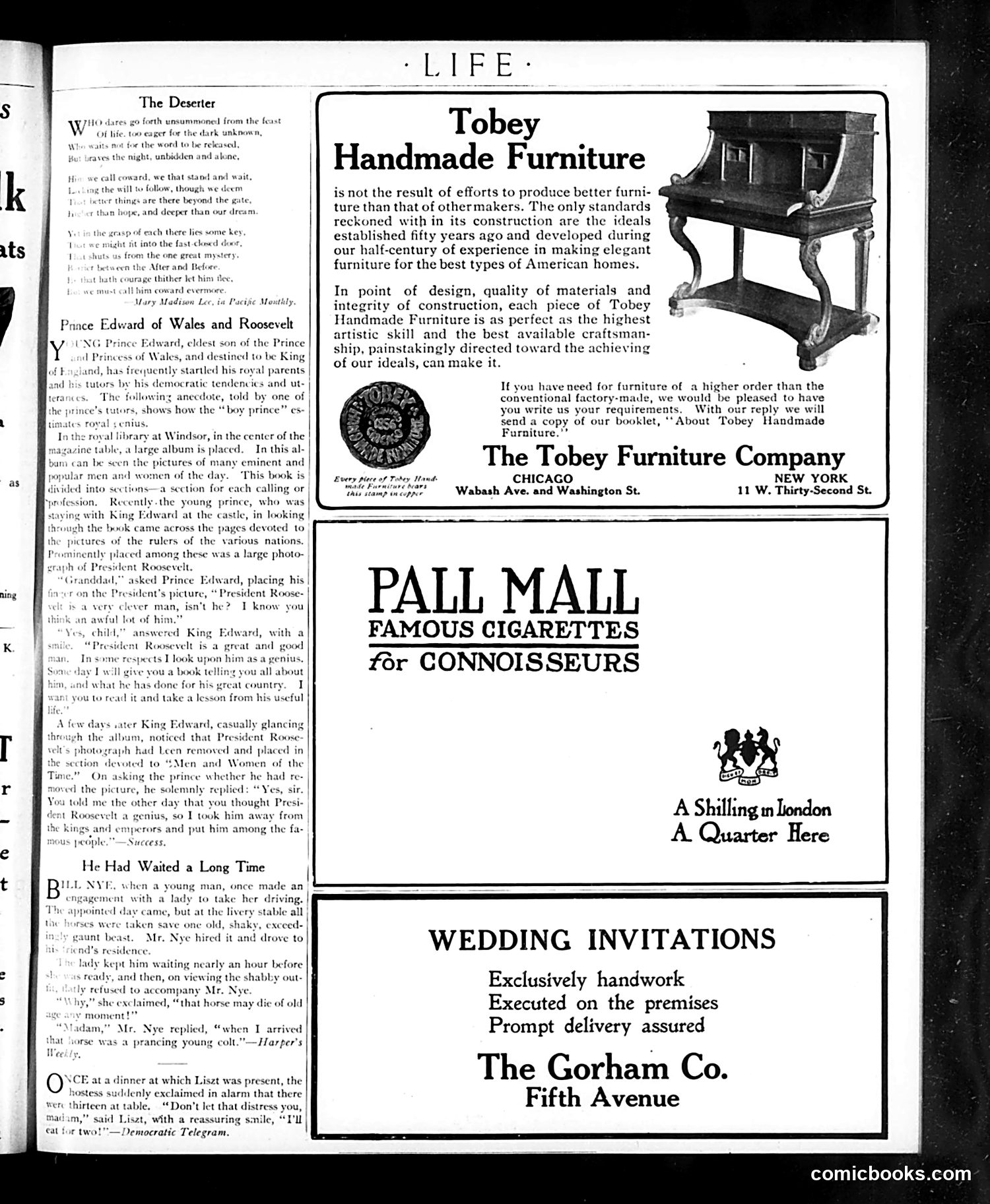
This page is primarily **advertising**, with minimal editorial content. The left column contains two brief anecdotes ("The Deserter" poem and stories about Prince Edward and President Roosevelt), but these are dwarfed by commercial advertisements. The one relevant narrative piece describes Prince Edward (later King Edward VIII) viewing an album at Windsor Castle. When shown a portrait of President Theodore Roosevelt among world leaders, King Edward later moved it to a section labeled "Men and Women of the Time"—suggesting Roosevelt belonged among "famous people" rather than heads of state. This appears to be gentle satire about Roosevelt's celebrity status and unconventional prominence, though the humor is mild. The advertisements dominate: Tobey Handmade Furniture, Pall Mall cigarettes, and Gorham wedding invitations. This layout reflects Life's revenue model—satirical commentary paired with upscale product advertising targeting affluent readers.
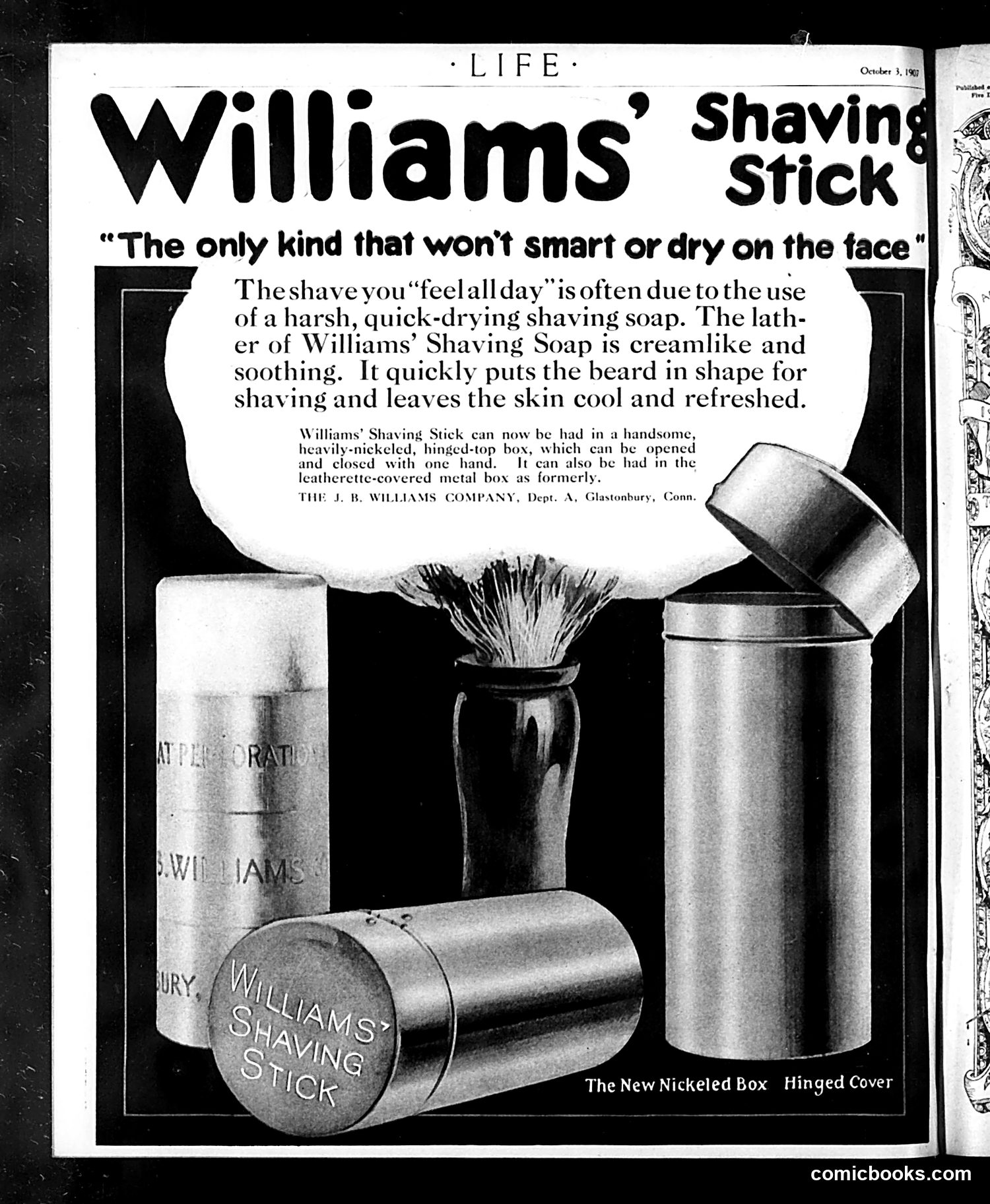
This is a straightforward **product advertisement**, not political satire or a cartoon. It appears in *Life* magazine (dated October 1, 1907) promoting Williams' Shaving Stick. The ad emphasizes that this shaving product, unlike competitors, won't "smart or dry on the face"—addressing a real consumer complaint about harsh shaving soaps of the era that irritated skin. The copy highlights the product's "creamlike and soothing" lather and its convenience. The visual shows the shaving stick in its new "heavily-nickeled, hinged-top box," alongside related grooming items (what appears to be a brush and container). This was a product innovation—the hinged box design allowed one-handed operation, presented as a modern convenience feature. There is no satire or political commentary here; it's simply vintage advertising targeting male consumers concerned with grooming quality and product packaging innovation.