
Life, 1907-10-03 · page 24 of 36
Life — October 3, 1907 — page 24: what you’re looking at
What you’re looking at
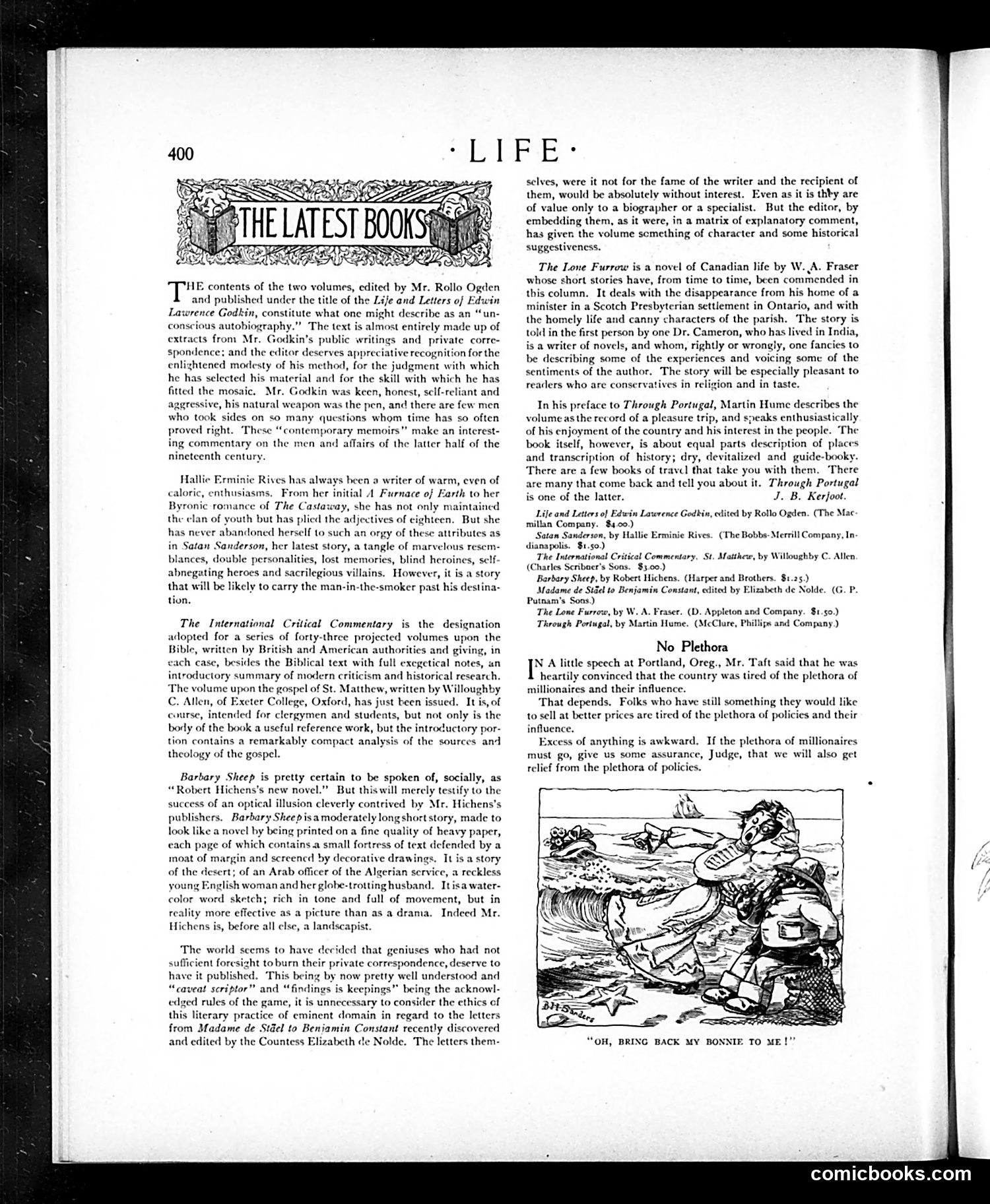
This page is primarily a book review section titled "The Latest Books," discussing several new publications including works by Hallie Ermine Rives and Robert Hichens. The cartoon at the bottom depicts a woman on a beach calling out "OH, BRING BACK MY BONNIE TO ME!" This illustrates a section titled "No Plethora," where Mr. Taft (likely President William Howard Taft) supposedly said at a Portland speech that the country was "tired of the plethora of millionaires." The joke is satirical: the woman's plea to retrieve her "bonnie" (lover/sweetheart) contrasts with the wealthy class's supposed excess. The satire suggests that while people claim to be tired of millionaires' influence, they actually desire wealth and comfort themselves—a commentary on American attitudes toward wealth inequality and the gap between public complaint and private aspiration during the Progressive Era.
📄 Transcribed text from this page (OCR, searchable)
Machine-transcribed from the original scan — historical spelling and the odd misread are preserved.
IEEE * HE contents of the two volumes, edited by Mr. Rollo Ogden and published under the title of the Life and Letters of E vrence Godkin, constitute what one might describe as an conscious autobiography.” The text is almost entirely made up of extracts from Mr. Godkin’s public writings and private corre- spondence; and the editor deserves appreciative recognition for the enlightened modesty of his method, for the judgment with which he has selected his material and for the skill with which he has fitted the mosaic. Mr. Godkin was keen, honest, self-reliant and aggressive, his natural weapon was the pen, and there are few men who took sides on so many questions whom time has so often proved right. These “contemporary memoirs" make an interest- ing commentary on the men and affairs of the latter half of the nineteenth century. Hallie Ermine Rives has always been a writer of warm, even of caloric, enthusiasms. From her initial A Furnace of Earth to her Byronic romance of The Castaway, she has not only the clan of youth but has plied the adjectives of eighteen. But she has never abandoned herself to such an orgy of these attributes as in Satan Sanderson, her latest story, a tangle of marvelous re blances, double personalities, lost memories, blind heroines, self- abnegating heroes and sacrilegious villains. However, it is a story that will be likely to carry the man-in-the-smoker past his destina- tion. The International Critical Commentary is the designation adopted for a series of forty-three projected volumes upon the Bible, written by British and American authorities and giving, in cach case, besides the Biblical text with full exegetical notes, an introductory summary of modern criticism and historical research. The volume upon the gospel of St. Matthew, written by Willoughby C. Allen, of Exeter College, Oxford, has just been issued. It is, of course, intended for clergymen and students, but not only is the borly of the book a useful reference work, but the introductory por- tion contains a remarkably compact analysis of the sources and theology of the gospel. Barbary Sheep is pretty certain to be spoken of, socially, as “Robert Hichens’s new novel.” But thiswill merely testify to the success of an optical illusion cleverly contrived by Mr. Hichens's publishers. Barbary Sheep isa moderately long short story, made to look like a novel by being printed on a fine quality of heavy paper, cach page of which contains.a small fortress of text defended by a moat of margin and screened by decorative drawings. It is a story of the desert; of an Arab officer of the Algerian service, a reckless young English woman and herglobe-trotting husband. It isa water- color word sketch; rich in tone and full of movement, but in reality more effective as a picture than as a drama. Indeed Mr. Hichens is, before all else, a landscapist. ‘The world seems to have decided that geniuses who had not sufficient foresight to burn their private correspondence, deserve to have it published. This being by now pretty well understood and “caveat scriptor” and “findings is keepings” being the acknowl- edged rules of the game, it is unnecessary to consider the ethics of this literary practice of eminent domain in regard to the letters from Madame de Stdel to Beniamin Constant recently discovered and edited by the Countess Elizabeth de Nolde. The letters them- selves, were it not for the fame of the writer and the recipient of them, would be absolutely without interest. Even as it is thy are of value only to a biographer or a specialist. But the editor, by embedding them, as it were, in a matrix of explanatory comment, has given the volume something of character and some historical suggestiveness. The Lone Furrow is a novel of Canadian life by W. A. Fraser whose short stories have, from time to time, been commended in this column. It deals with the disappearance from his home of a minister in a Scotch Presbyterian settlement in Ontario, and with the homely life and canny characters of the parish. The story is told in the first person by one Dr. Cameron, who has lived in India, is a writer of novels, and whom, rightly or wrongly, one fancies to be describing some of the experiences and voicing some of the sentiments of the author. The story will be especially pleasant to reaclers who are conservatives in religion and in taste. In his preface to Through Portugal, Martin Hume describes the volume as the record of a pleasure trip, and speaks enthusiastically of his enjoyment of the country and his interest in the people. ‘The book itself, however, is about equal parts description of places and transcription of history; dry, devitalized and guide-booky. ‘There are a few books of travel th you with them, ‘There are many that come back and tell you about it. Through Portugal is one of the latter. J. B. Kerjoot. Lije and Letters 0} Edwin Lawrence Godkin, edited by Rollo Ogden. (The Mac- millan Company. $4.00.) Satan Sanderson, by Hallie Erminie Rives. (The Bobbs- Merrill Company, In. dianapolis. $1.50.) The International Critical Commentary. St. Matthew, by Willoughby C. Allen. (Charles Scribacr’s Sons. $3.00.) Barbary Sheep, by Robert Hichens. (Harper and Brothers. $1.25.) Madame de Stael to Benjamin Constant, edited by Elizabeth de Nolde. Putnam's Sons.) The Lone Furrow, by W. A. Fraser. (D. Appleton and Company. $1.50.) Through Portugal, by Martin Hume. (McClure, Phillips and Company.) No Plethora ‘A little speech at Portland, Oreg., Mr. Taft said that he wa heartily convinced that the country was tired of the plethora of millionaires and their influence. ‘That depends. Folks who have still something they would like to sell at better prices are tired of the plethora of policies and their influence. Excess of anything is awkward. If the plethora of millionaires must go, give us some assurance, Judge, that we will also get relief from the plethora of policies. “OH, BRING BACK MY BONNIE TO ME!" comicbooks.com