
Life, 1907-10-03 · page 26 of 36
Life — October 3, 1907 — page 26: what you’re looking at
What you’re looking at
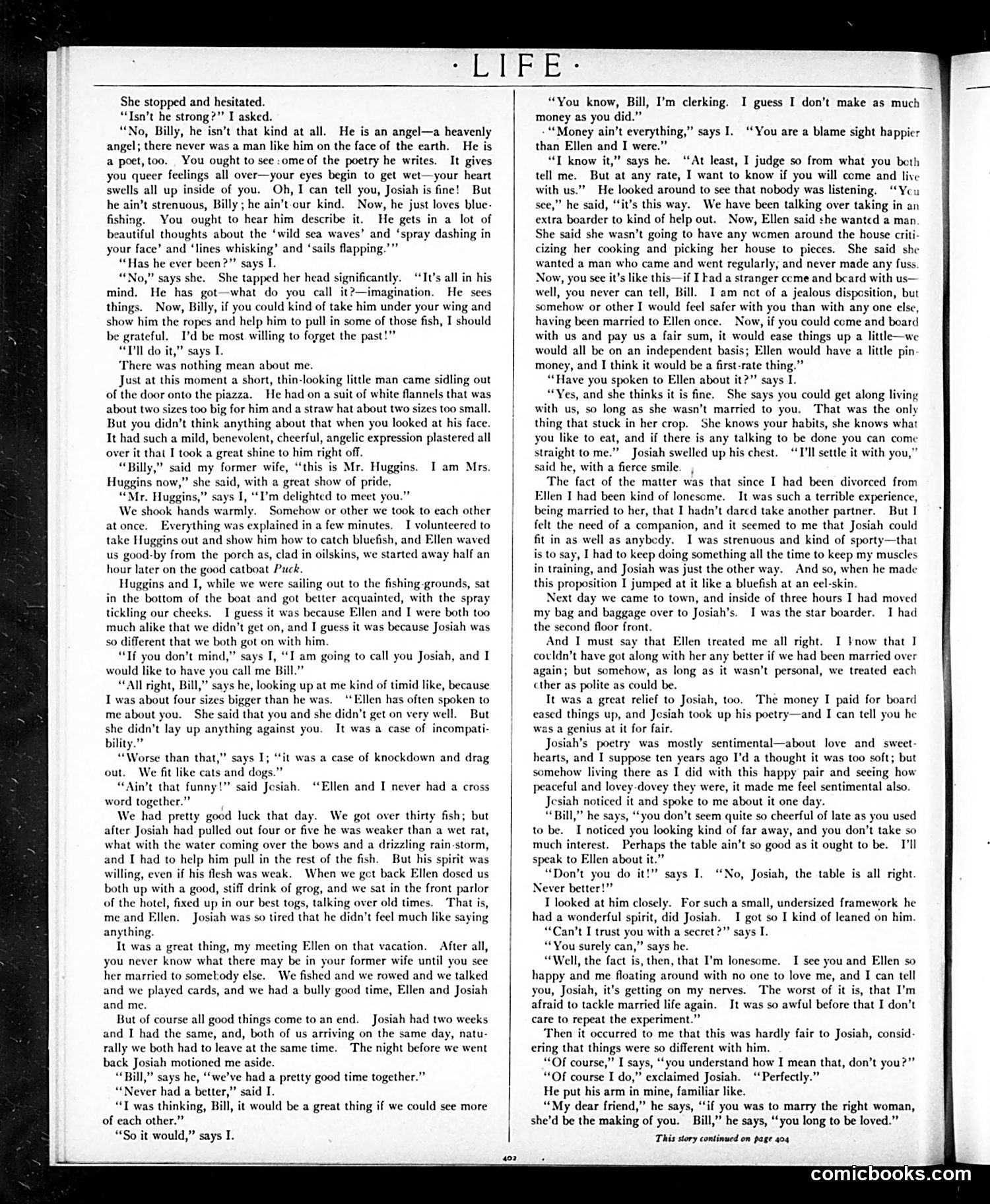
This page contains text from a serialized short story (titled "This story continued on page 604" at bottom), not a political cartoon. The narrative depicts a domestic comedy involving three characters: the narrator "Bill," his ex-wife "Ellen," and her new husband "Josiah Huggins." The satire targets romantic idealization versus practical reality. Josiah is portrayed as a sensitive, poetic dreamer—described as an "angel" with imagination but no real-world competence. When Bill takes him fishing, Josiah becomes physically exhausted after catching just four fish, requiring Bill's assistance. The joke exposes the contrast between Ellen's romanticized view of her new husband (artistic, emotional, kind) and Bill's pragmatic assessment: Josiah is physically weak and impractical despite his spiritual qualities. The story humorously suggests that Bill's rough, capable masculinity may have been undervalued compared to Josiah's refined sensibilities—a common early 20th-century theme about masculinity and marriage expectations.
📄 Transcribed text from this page (OCR, searchable)
Machine-transcribed from the original scan — historical spelling and the odd misread are preserved.
lg Ee Je She stopped and hesitated. “Isn't he strong?” I asked. “No, Billy, he isn’t that kind at all. He is an angel—a heavenly angel; there never was a man like him on the face of the earth. He is a poet, too. You ought to see :ome of the poetry he writes. It gives you queer feelings all over—your eyes begin to get wet—your heart swells all up inside of you. Oh, I can tell you, Josiah is fine! But he ain’t strenuous, Billy; he ain’t-our kind. Now, he just loves blue- fishing. You ought to hear him describe it. He gets in a lot of beautiful thoughts about the ‘wild sea waves’ and ‘spray dashing in your face’ and ‘lines whisking’ and ‘sails flapping.” “Has he ever been?” says I. “No,” says she. She tapped her head significantly. “It’s all in his mind. He has got—what do you call it?—imagination. He sees things. Now, Billy, if you could ‘kind of take him under your wing and show him the ropes and help him to pull in some of those fish, I should be grateful. I’d be most willing to forget the past!” “Tl do it,” says I. ‘There was nothing mean about me. Just at this moment a short, thin-looking little man came sidling out of the door onto the piazza. He had on a suit of white flannels that was about two sizes too big for him and a straw hat about two sizes too small. But you didn’t think anything about that when you looked at his face. It had such a mild, benevolent, cheerful, angelic expression plastered all over it that I took a great shine to him right off. “Billy,” said my former wife, ‘this is Mr. Huggins. I am Mrs. Huggins now,” she said, with a great show of pride, “Mr. Huggins,” I, ‘I'm delighted to meet you.” We shook hands warmly. Somchow or other we took to each other atonce. Everything was explained in a few minutes. I volunteered to take Huggins out and show him how to catch bluefish, and Ellen waved us good-by from the porch as, clad in oilskins, we started away half an hour later on the good catboat Puck, Huggins and I, while we were sailing out to the fishing-grounds, sat in the bottom of the boat and got better acquainted, with the spray tickling our chee! I guess it was because Ellen and I were both too much alike that we didn’t get on, and I guess it was because Josiah was so different that we both got on with him. “If you don’t mind,” says I, “I am going to call you Josiah, and I would like to have you call me Bill.” “All right, Bill,” says he, looking up at me kind of timid like, because I was about four sizes bigger than he was. “Ellen has often spoken to me about you. She said that you and she didn’t get on very well. But she didn’t lay up anything against you. It was a case of incompati- bility.” “Worse than that,” says I; “it was a case of knockdown and drag out. We fit like cats and dogs.” “Ain’t that funnyt? said Josiah. “Ellen and I never had a cross word together.” We had pretty good luck that day. We got over thirty fish; but after Josiah had pulled out four or five he was weaker than a wet rat, what with the water coming over the bows and a drizzling rain-storm, and I had to help him pull in the rest of the fish. But his spirit was willing, even if his flesh was wea When we get back Ellen dosed us both up with a good, stiff drink of grog, and we sat in the front parlor of the hotel, fixed up in our best togs, talking over old times. ‘That is, me and Ellen. Josiah was so tired that he didn’t feel much like saying anything. It was a great thing, my meeting Ellen on that vacation. After all, you never know what there may be in your former wife until you see her married to somebody else. We fished and we rowed and we talked and we played cards, and we had a bully good time, Ellen and Josiah and me. But of course all good things come to an end. Josiah had two weeks and I had the same, and, both of us arriving on the same day, natu- rally we both had to leave at the same time. The night before we went back Josiah motioned me aside. “Bill,” says he, ‘‘we’ve had a pretty good time together.” “Never had a bett said I. “I was thinking, Bill, it would be a great thing if we could see more of each other.” “So it would,” says I. “You know, Bill, I’m clerking. I guess I don’t make as much money as you did.” “Money ain’t everything,” says I. ‘You are a blame sight happier than Ellen and I were.” “I know it,” says he. ‘‘At least, I judge so from what you beth tell me. But at any rate, I want to know if you will come and live with us.” He looked around to see that nobody was listening. “Yeu sce,” he said, “it’s this way. We have been talking over taking in an extra boarder to kind of help out. Now, Ellen said she wanted a man. She said she wasn’t going to have any women around the house criti- cizing her cooking and picking her house to pieces. She said she wanted a man who came and went regularly, and never made any fuss. Now, you see it’s like this—if I kad a stranger come and beard with us— well, you never can tell, Bill. I am net of a jealous disposition, but somehow or other I would feel safer with you than with any one else, having been married to Ellen once. Now, if you could come and board with us and pay us a fair sum, it would ease things up a little—we would all be on an independent basis; Ellen would have a little pin money, and I think it would be a first-rate thing.” “Have you spoken to Ellen about it?” says I. “Yes, and she thinks it is fine. She says you could get along living with us, so long as she wasn’t married to you. ‘That was the only thing that stuck in her crop. She knows your habits, she knows what you like to eat, and if there is any talking to be done you can come straight to me.” Josiah swelled up his chest. “I'll settle it with you,” said he, with a fierce smile. The fact of the matter was that since I had been divorced from Men I had been kind of lonesome. It was such a terrible experience, being married to her, that I hadn’t dared take another partner. But I felt the need of a companion, and it seemed to me that Josiah could fit in as well as anybedy. I was strenuous and kind of sporty—that is to say, I had to keep doing something all the time to keep my muscles in training, and Josiah was just the other way. And so, when he made this proposition I jumped at it like a bluefish at an cel-skin. Next day we came to town, and inside of three hours I had moved my bag and baggage over to Josiah’s. I was the star boarder. I had the second floor front. And I must say that Ellen treated me all right. I }now that I covldn’t have got along with her any better if we had been married over again; but somehow, as long as it wasn’t personal, we treated each cther as polite as could be. It was a great relief to Josiah, too. The money I paid for board cased things up, and Josiah took up his poetry—and I can tell you he genius at it for fair. h’s poetry was mostly sentimental—about love and sweet- hearts, and I suppose ten years ago I'd a thought it was too soft; but somehow living there as I did with this happy pair and secing how peaceful and lovey-dovey they were, it made me feel sentimental also. Jesiah noticed it and spoke to me about it one day. “Bill,” he says, “you don’t seem quite so cheerful of late as you used to be. I noticed you looking kind of far away, and you don’t take so much interest. Perhaps the table ain’t so good as it ought to be. I'll speak to Ellen about it.” “Don’t you do it!” says I. “No, Josiah, the table is all right. Never better!” I looked at him closely. For such a small, undersized framework he had a wonderful spirit, did Josiah. I got so I kind of leaned on him. “Can't I trust you with a secret?” says I. “You surely can,” says he. “Well, the fact is, then, that I’m lonesome. I see you and Ellen so happy and me floating around with no one to love me, and I can tell you, Josiah, it’s getting on my nerves. The worst of it is, that I’m afraid to tackle married life again. It was so awful before that I don’t care to repeat the experiment.” Then it occurred to me that this was hardly fair to Josiah, consid- ering that things were so different with him. “Of course,” I says, “you understand how I mean that, don’t you?” “Of course I do,” exclaimed Josiah. “Perfectly.” He put his arm in mine, familiar like. “My dear friend,” he says, “if you was to marry the right woman, she'd be the making of you. Bill,” he says, ‘‘you long to be loved.” This story continued on page 404 comicbooks.com