
Life, 1907-10-03 · page 13 of 36
Life — October 3, 1907 — page 13: what you’re looking at
What you’re looking at
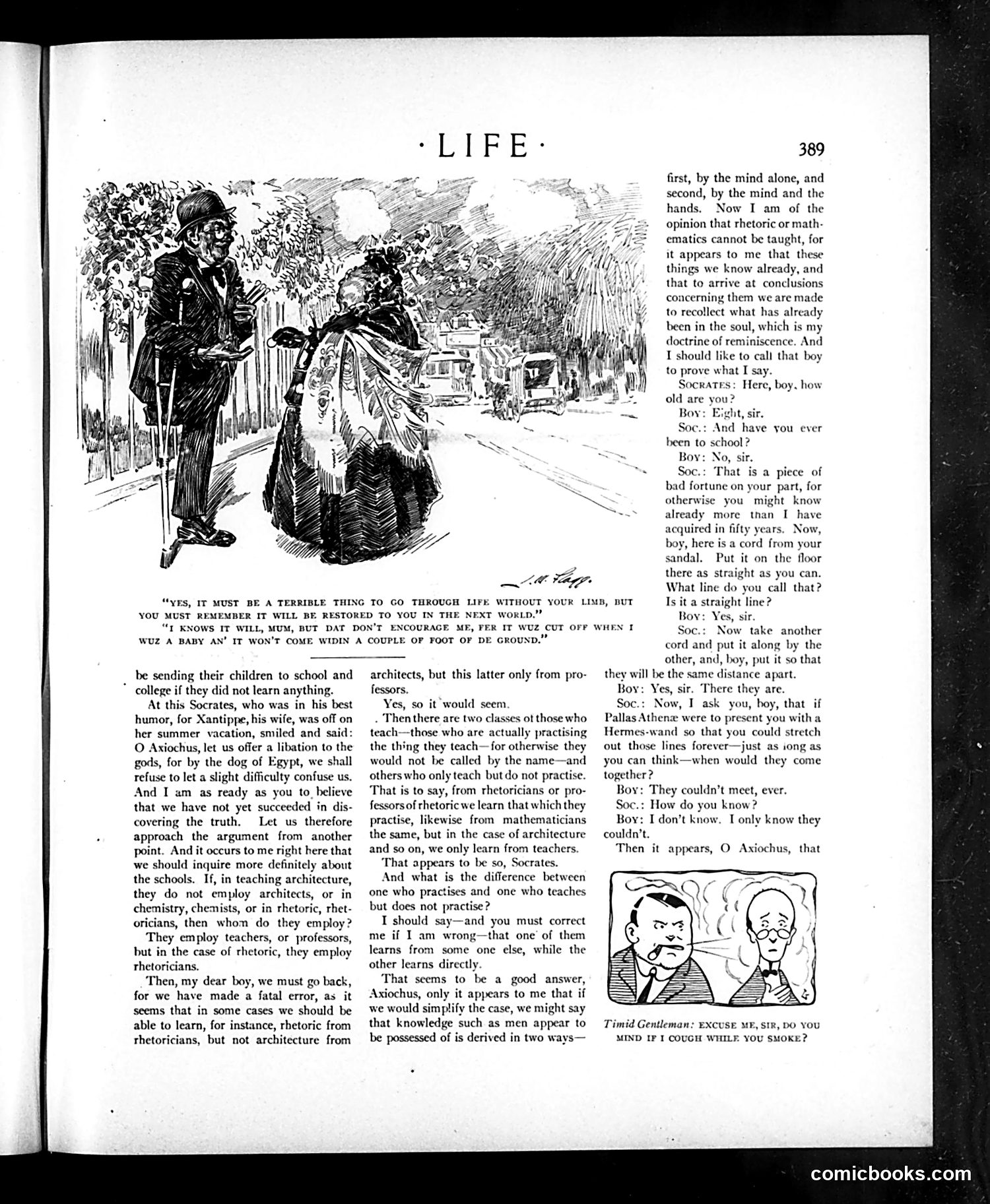
**Main Content:** A Socratic dialogue about education, featuring an older man (Socrates) instructing a young boy about learning and rhetoric. **Large Illustration:** Shows two figures on a street—an elderly man gesturing while speaking to a young boy, with period clothing suggesting classical or historical setting. **Small Cartoon (bottom right):** Two men in conversation; one complains about coughing while smoking, with the caption: "TIMID GENTLEMAN: EXCUSE ME, SIR, DO YOU MIND IF I COUGH WHILE YOU SMOKE?" **The Satire:** The small cartoon mocks social courtesy and hypocrisy—a timid person apologizes for coughing (involuntary) while someone else smokes (voluntary and potentially harmful to others). It satirizes misplaced politeness and the smoker's presumed entitlement. **Historical Context:** This reflects early 20th-century attitudes where smoking was socially acceptable and unquestioned, while a cough was treated as an imposition.
📄 Transcribed text from this page (OCR, searchable)
Machine-transcribed from the original scan — historical spelling and the odd misread are preserved.
“YES, IT MUST BE A TERRIBLE THING TO GO THROUGH LIFE WITHOW REMEMBER IT WILL BE RESTORED TO YOU IN THE NEXT WORLD. MUM, BUT DAT DON'T ENCOURAGE ME, FER IT WUZ CUT OFF WHEN I You Mu! “I KNOWS IT WILL Lae Vag YOUR LIMB, BUT WUZ A BABY AN’ IT WON'T COME WIDIN A COUPLE OF FOOT OF DE GRouND.” be sending their children to school and * college if they did not learn anything. At this Socrates, who was in his best humor, for Xantippe, his wife, was off on her summer vacation, smiled and said: O Axiochus, let us offer a libation to the gods, for by the dog of Egypt, we shall refuse to let a slight difficulty confuse us. And I am as ready as you to, believe that we have not yet succeeded in dis- covering the truth. Let us therefore approach the argument from another point. And it occurs to me right here that we should inquire more definitely about the schools. If, in teaching architecture, they do not employ architects, or in chemistry, chemists, or in rhetoric, rhet- oricians, then whom do they employ? They employ teachers, or professors, but in the case of rhetoric, they employ thetoricians. Then, my dear boy, we must go back, for we have made a fatal error, as it seems that in some cases we should be able to learn, for instance, rhetoric from rhetoricians, but not architecture from architects, but this latter only from pro- fessors. Yes, so it would seem . Then there are two classes ot those who teach—those who are actually practising the thing they teach—for otherwise they would not be called by the name—and others who only teach but do not practise. ‘That is to say, from rhetoricians or pro- fessors of rhetoric we learn that which they practise, likewise from mathematicians the same, but in the case of architecture and so on, we only learn from teachers. ‘That appears to be so, Socrates. And what is the difference between one who practises and one who teaches but does not practise? I should say—and you must correct me if I am wrong—that one’ of them learns from some one else, while the other learns directly. That seems to be a good answer, Axiochus, only it appears to me that if we would simplify the case, we might say that knowledge such as men appear to be possessed of is derived in two w 389 first, by the mind alone, and second, by the mind and the hands. Now I am of the opinion that rhetoric or math- ematics cannot be taught, for it appears to me that these things we know already, and that to arrive at conclusions concerning them we are made to recollect what has already been in the soul, which is my doctrine of reminiscence. And I should like to call that boy to prove what I say. Socrates: Here, boy, how old are you? it, sir, *.: And have you ever been to school? Boy: No, sir. Soc.: That is a piece of bad fortune on your part, for otherwise you might know already more than I have acquired in fifty years. Now, boy, here is a cord from your sandal. Put it on the floor there as straight as you can. What line do you call that? Is it a straight line? Boy: Yes, sir. Soc.: Now take another cord and put it along by the other, and, boy, put it so that they will be the same distance apart. Boy: Yes, sir. There they are. Soc.: Now, I ask you, boy, that if Pallas Athena: were to present you with a Hermes-wand so that you could stretch out those lines forever—just as iong as you can think—when would they come together ? They couldn't meet, Tow do you know? I don't know. I only know they couldn’t. Then it appears, O Axiochus, that Timid Gentleman: EXCUSE ME, SIR, DO YOU MIND IF I COUGH WHILF. YOU SMOKE? comicbooks.com