
Life, 1907-10-03 · page 15 of 36
Life — October 3, 1907 — page 15: what you’re looking at
What you’re looking at
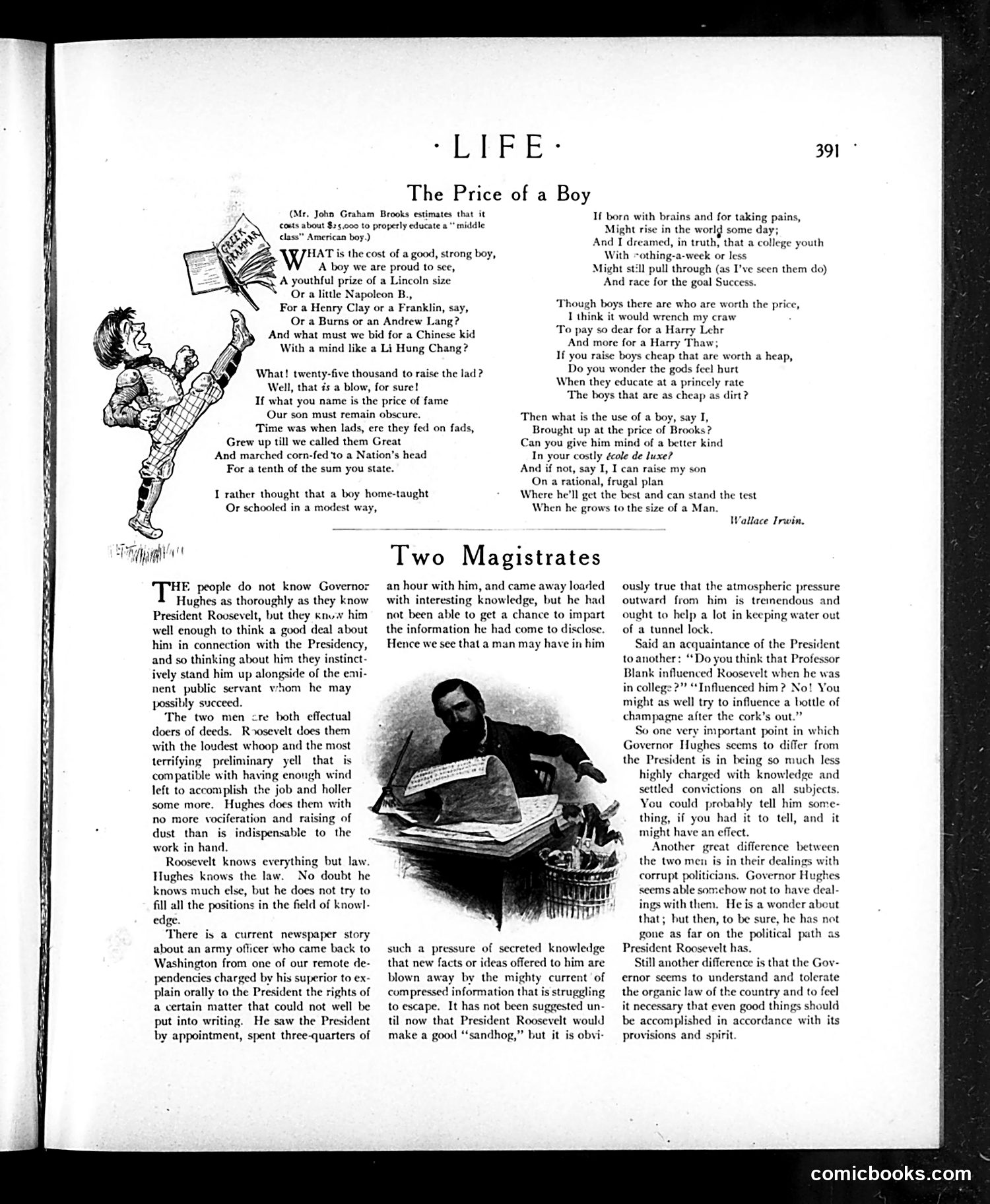
This page contains two distinct pieces of political satire from the early 1900s: **"The Price of a Boy"** (left) mocks economist John Graham Brooks's claim that raising a middle-class American boy costs $25,000. The illustrated figure represents an aspirational parent. The poem sarcastically questions whether expensive education truly produces better men than humble upbringings did historically—referencing figures like Lincoln and Napoleon who rose without such costs. It also satirizes wealthy but morally dubious examples: "Harry Lehr" and "Harry Thaw" (likely wealthy socialites of the era known for scandal or excess). **"Two Magistrates"** (right) compares President Theodore Roosevelt and Governor (later Justice) Charles Evans Hughes. The cartoon caricature shows Hughes studying documents carefully. The text contrasts their styles: Roosevelt is impulsive, loud, and omniscient; Hughes is methodical, restrained, and legally expert. An anecdote illustrates Roosevelt's overwhelming talkativeness—he literally prevents others from speaking. The satire suggests Hughes's quiet competence contrasts favorably with Roosevelt's bombastic approach to governance.
📄 Transcribed text from this page (OCR, searchable)
Machine-transcribed from the original scan — historical spelling and the odd misread are preserved.
PPE * The Price of a Boy (Mr. John Graham Brooks estimates that it Costs about $25,000 to properly educate a" middle class” American boy.) HAT is the cost of a good, strong boy, A boy we are proud to sce, A youthful prize of a Lincoln size Or a little Napoleon B., For a Henry Clay or a Franklin, say, Or a Burns or an Andrew Lang? And what must we bid for a Chinese kid With a mind like a Li Hung Chang? What! twenty-five thousand to raise the lad? Well, that is a blow, for sure! If what you name is the price of fame Our son must remain obscure. ‘Time was when lads, ere they fed on fads, Grew up till we called them Great And marched corn-fed to a Nation’s head For a tenth of the sum you state. I rather thought that a boy home-taught Or schooled in a modest way, If bora with brains and for taking pains, Might rise in the world some day; And T dreamed, in truth, that a college youth With ~othing-a-week or less Might still pull through (as I'v And race for the goal Success. seen them do) ‘Though boys there are who are worth the price, 1 think it would wrench my craw To pay so dear for a Harry Lehr And more for a Harry Thaw; If you raise boys cheap that are worth a heap, Do you wonder the gods fee! hurt When they educate at a princely rate ‘The boys that are as cheap as dirt? ‘Then what is the use of a boy, say I, Brought up at the price of Brooks? Can you give him mind of a better kind In your costly école de luxe? And if not, say I, I can raise my son On a rational, frugal plan Where he'll get the best and can stand the test When he grows to the size of a Man. van Tree people do not know Governor Hughes as thoroughly as they know President Roosevelt, but they Know him well enough to think a good deal about him in connection with the Presidency, and so thinking about him they instinct, ively stand him up alongside of the emi- nent public servant whom he may possibly succeed. The two men cre both effectual doers of deeds. Roosevelt does them with the loudest whoop and the most terrifying preliminary yell that is compatible with having enongh wind left to accomplish the job and holler some more. Hughes does them with no more vociferation and raising of dust than is indispensable to the work in hand. Roosevelt knows everything but law. Hughes knows the law. No doubt he knows much else, but he does not try to fill all the positions in the field of knowl- edge. ‘There is a current newspaper story about an army officer who came back to Washington from one of our remote de- pendencies charged by his superior to ex- plain orally to the President the rights of a certain matter that could not well be put into writing. He saw the President by appointment, spent three-quarters of Two Magistrates an hour with him, and came away loaded with interesting knowledge, but he had not been able to get a chance to impart the information he had come to disclose. Hence we see that a man may have in him such a pressure of secreted knowledge that new facts or ideas offered to him are blown away by the mighty current of compressed information that is struggling to escape. It has not been suggested un- til now that President Roosevelt would make a good “‘sandhog,” but it is obvi- Wallace Irwin, ously true that the atmospheric pressure outward from him is tremendous and ought to help a lot in keeping water out of a tunnel lock. Said an acquaintance of the President toanother: ‘Do you think that Professor Blank influenced Roosevelt when he was in college ?” “Influenced him? No! You might as well try to influence a bottle of champagne after the cork’s out.” So one very important point in which Governor Hughes scems to differ from the President is in being so much less highly charged with knowledge and settled convictions on all subjects. You could probably tell him some- thing, if you had it to tell, and it might have an effect. Another great difference between the two men is in their dealings with corrupt politicians. Governor Hughes seems able somehow not to have deal- ings with them. He is a wonder about that; but then, to be sure, he has not gone as far on the political path President Roosevelt has. Still another difference is that the Gov- ernor seems to understand and tolerate the organic law of the country and to feel it necessary that even good things should be accomplished in accordance with its provisions and spirit. comicbooks.com