
Life, 1907-10-03 · page 12 of 36
Life — October 3, 1907 — page 12: what you’re looking at
What you’re looking at
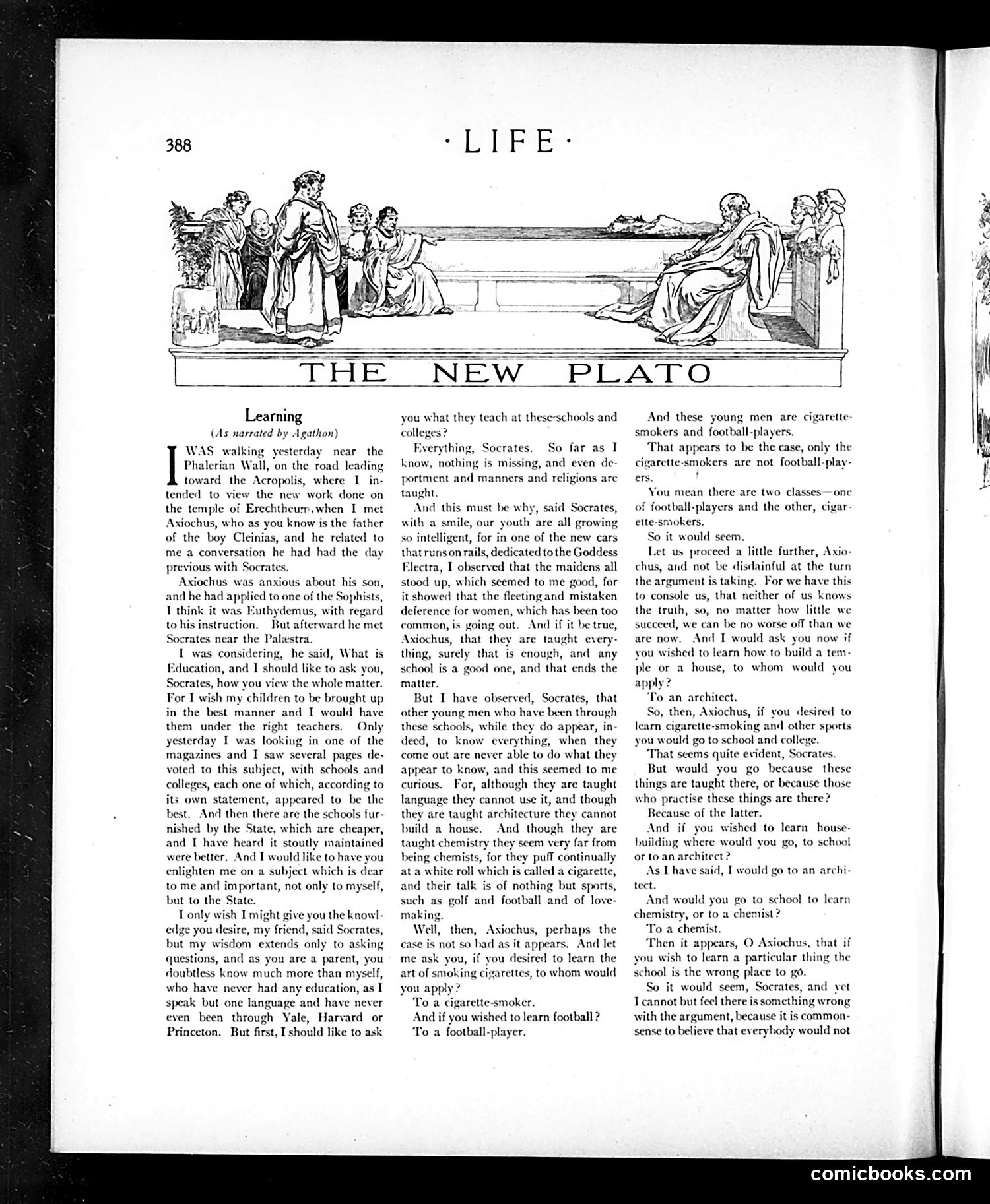
This satirical dialogue titled "The New Plato" critiques modern education by comparing classical Greek philosophy to contemporary schooling. The illustration shows figures in classical dress, mimicking Plato's famous dialogues. The text presents a conversation where Socrates questions what is actually being taught in modern schools. The satire targets the perceived uselessness of education: students learn subjects like architecture and chemistry but cannot practically apply them. The dialogue mocks young men who become "cigarette-smokers and football players" despite formal education. The piece sarcastically suggests that if one truly wants practical knowledge—smoking cigarettes or playing football—formal schooling is unnecessary. The satire implies that modern education fails to provide meaningful, applicable knowledge to students.
📄 Transcribed text from this page (OCR, searchable)
Machine-transcribed from the original scan — historical spelling and the odd misread are preserved.
PLATO Learning (As narrated by Agathon) WAS walking yesterday near the Phalerian Wall, on the road leading toward the Acropolis, where [I in- tended to view the new work done on the temple of Erechtheum,when I met Axiochus, who as you know is the father of the boy Cleinias, and he related to me a conversation he had had the day previous with Socrates. Axiochus was anxious about his son, and he had applied to one of the Sophists, T think it was Euthydemus, with regard to his instruction. But afterward he met Socrates near the Palwstra. I was considering, he said, What is Education, and I should like to ask you, Socrates, how you view the whole matter. For I wish my children to be brought up in the best manner and I would have them under the right teachers. Only yesterday I was looking in one of the magazines and I saw several pages de- voted to this subject, with schools and colleges, each one of which, according to its own statement, appeared to be the best. And then there are the schools fur- nished by the State, which are cheaper, and I have heard it stoutly maintained were better. And I would like to have you enlighten me on a subject which is dear to me and important, not only to myself, but to the State. T only wish I might give you the knowl- edge you desire, my friend, said Socrates, but my wisdom extends only to asking questions, and as you are a parent, you doubtless know much more than myself, who have never had any education, as I speak but one language and have never even been through Yale, Harvard or Princeton. But first, I should like to ask you what they teach at these-schools and coll So far as I know, nothing is missing, and even de- portment and manners and religions are taught And this must be why, said Socrates, with a smile, our youth are all growing so intelligent, for in one of the new cars that runson rails, dedicated tothe Goddess Electra, I observed that the maidens all stood up, which seemed to me good, for it showed that the fleeting and mistaken deference for women, which has been too common, is going out. And if it be true, Axiochus, that they are taught every thing, surely that enough, and any school is a good one, and that ends the matter. But I have observed, Socrates, that other young men who have been through these schools, while they do appear, in deed, to know everything, when they come out are never able to do what they appear to know, and this seemed to me curious. For, although they are taught language they cannot use it, and though they are taught architecture they cannot build a hot And though they are taught chemistry they seem very far from being chemists, for they puff continually ata white roll which is called a cigarette, and their talk is of nothing but sports, such as golf and football and of love- making. Well, then, Axiochus, perhaps the case is not so had as it appears. And let me ask you, if you desired to learn the art of smoking cigarettes, to whom would you apply? To a cigarette-smoker. And if you wished to learn football ? To a football-player. iverything, Socrates. And thes ung men are ci smokers and football-players. That appears to be the case, only the arette-smokers are not football-play You mean there are two classes—one of football-players and the other, cigar ette-smokers. So it would seem. Let us proceed a little further, Axio- chus, and not be disdainful at the turn the argument is taking. For we have this to console us, that neither of us knows the truth, so, no matter how little we succeed, we can be no worse off than we are now. And IT would ask you now if you wished to learn how to build a tem- ple or a house, to whom would you apply? ‘To an architect. So, then, Axiochus, if you desired to learn cigarette-smoking and other sports you would go to school and coll That seems quite evident, But would you go because these things are taught there, or because those who practise these things are there? Recause of the latter. And if you wished to learn house- building where would you go, to school or toan architect ? As [have said, I would go to an archi tect. And would you go to school to learn chemistry, or to a chemist ? ‘To a chemist. ‘Then it appears, O Axiochus, that if you wish to learn a particular thing the school is the wrong place to go. So it would seem, Socrates, and yet T cannot but feel there is something wrong with the argument, because it is common- sense to believe that everybody would not comicbooks.com