
Life, 1907-10-03 · page 21 of 36
Life — October 3, 1907 — page 21: what you’re looking at
What you’re looking at
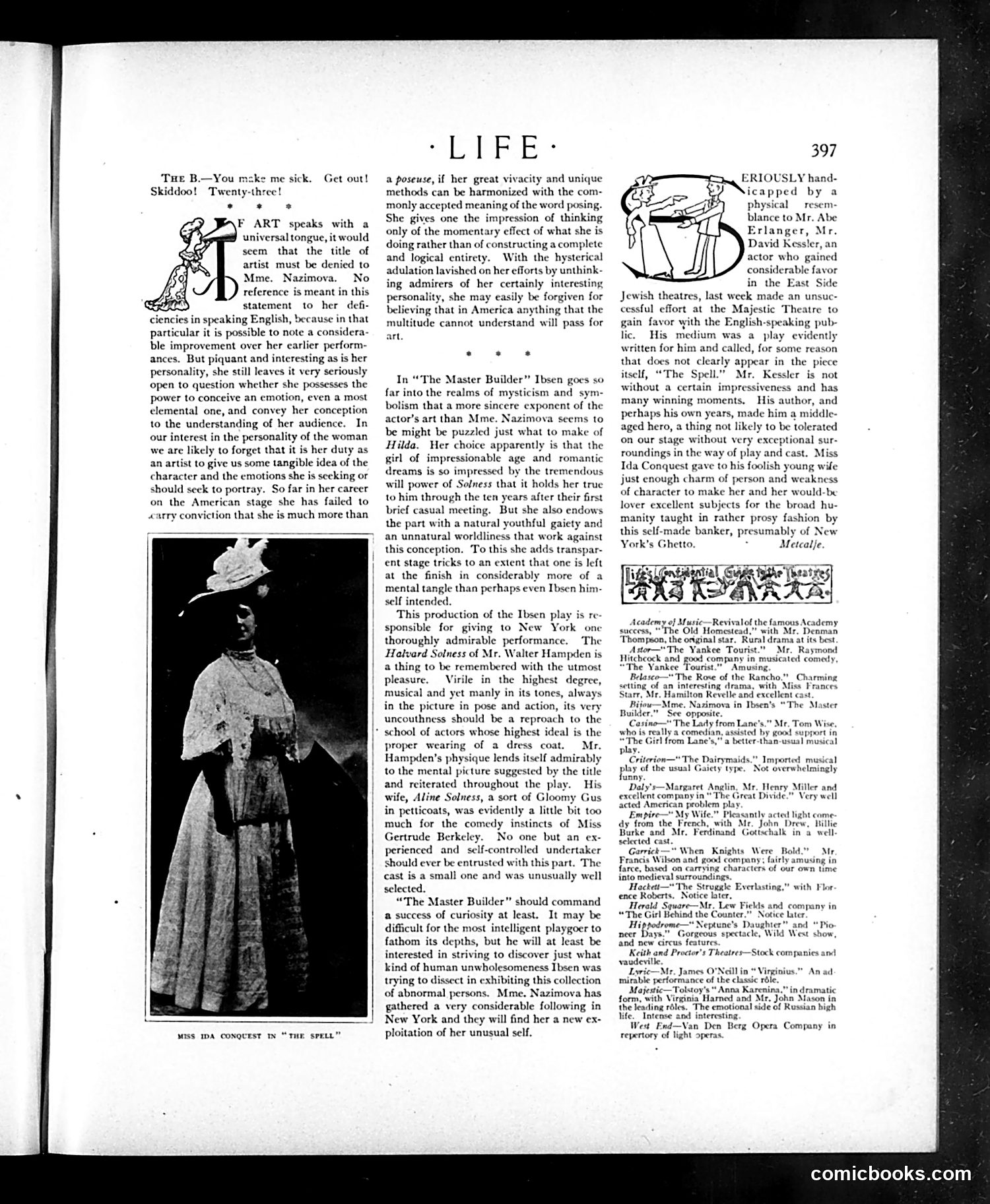
This page reviews Russian-born actress Alla Nazimova's performance in Ibsen's *The Master Builder*. The critic is sharply critical of Nazimova, arguing she is a "poseuse" (poser) concerned only with momentary theatrical effect rather than genuine emotional depth. Though acknowledging her "vivacity and unique methods," the writer contends she lacks the fundamental artistic power to convincingly convey character and emotion to audiences. The review praises Walter Hampden's performance as Solness as "virile" and "manly," contrasting it favorably with Nazimova's approach. The critic suggests Nazimova's popularity with New York audiences stems from their inability to distinguish genuine artistry from mere spectacle—anything the "multitude cannot understand will pass for art." The photograph shows "Miss Ida Conquest in 'The Spell'" (unrelated to the main review).
📄 Transcribed text from this page (OCR, searchable)
Machine-transcribed from the original scan — historical spelling and the odd misread are preserved.
‘THe B.—You me sick. Skiddoo! Twenty-three! * 8 F ART speaks with a universal tongue, it would seem that the title of artist must be denied to Mme. Nazimova. No reference is meant in this statement to her defi- ciencies in speaking English, because in that particular it is possible to note a considera- ble improvement over her earlier perform- ances. But piquant and interesting as is her personality, she still leaves it very seriously open to question whether she possesses the power to conceive an emotion, even a most elemental one, and convey her conception to the understanding of her audience. In our interest in the personality of the woman we are likely to forget that it is her duty as an artist to give us some tangible idea of the character and the emotions she is secking or should seek to portray. So far in her career on the American stage she has failed to «carry conviction that she is much more than Get out! MOSS IDA CONQUEST IN BEE E a poseuse, if her great vivacity and unique methods can be harmonized with the com- monly accepted meaning of the word posing. She gives one the impression of thinking only of the momentary effect of what she is doing rather than of constructing a complete and logical entirety. With the hysterical adulation lavished on her efforts by unthink- ing admirers of her certainly interesting personality, she may easily be forgiven for believing that in America anything that the multitude cannot understand will pass for art. In “The Master Builder” Ibsen goes so far into the realms of mysticism and sym- bolism that a more sincere exponent of the actor’s art than Mme. Nazimova seems to be might be puzzled just what to make of Hilda. Her choice apparently is that the girl of impressionable age and romantic dreams is so impressed by the tremendous will power of Solness that it holds her true to him through the ten years after their first brief casual meeting. But she also endows the part with a natural youthful gaiety and an unnatural worldliness that work against this conception. To this she adds transpar- ent stage tricks to an extent that one is left at the finish in considerably more of a mental tangle than perhaps even Ibsen him- self intended. This production of the Ibsen play is re- sponsible for giving to New York onc thoroughly admirable performance. The Healvard Solness of Mr. Walter Hampden is a thing to be remembered with the utmost pleasure. Virile in the highest degree, musical and yet manly in its tones, always in the picture in pose and action, its very uncouthness should be a reproach to the * school of actors whose highest ideal is the proper wearing of a dress coat, Mr. Hampden’s physique lends itself admirably to the mental picture suggested by the title and reiterated throughout the play. His wife, Aline Solness, a sort of Gloomy Gus in petticoats, was evidently a little bit too much for the comedy instincts of Mi Gertrude Berkeley. No one but an ex- perienced and self-controlled undertaker should ever be entrusted with this part. The cast is a small one and was unusually well selected. “The Master Builder” should command a success of curiosity at least. It may be difficult for the most intelligent playgoer to fathom its depths, but he will at least be interested in striving to discover just what kind of human unwholesomeness Ibsen was trying to dissect in exhibiting this collection of abnormal persons. Mme, Nazimova has gathered a very considerable following in New York and they will find her a new ex- ploitation of her unusual self. 397 ERIOUSLY hand- icapped by a physical resem- blance to Mr. Abe langer, Mr. David Kessler, an actor who gained considerable favor in the East Side Jewish theatres, last week made an unsuc- cessful effort at the Majestic Theatre to gain favor with the English-speaking pub- lic. His medium was a play evidently written for him and called, for some reason that does not clearly appear in the piece itself, “The Spell.” Mr. Kessler is not without a certain impressiveness and has many winning moments, His author, and perhaps his own years, made him a middle- aged hero, a thing not likely to be tolerated on our stage without very exceptional sur- roundings in the way of play and cast. Miss Ida Conquest gave to his foolish young wile just enough charm of person and weakness of character to make her and her would-be lover excellent subjects for the broad hu- manity taught in rather prosy fashion by this self-made banker, presumably of New - Metcalfe Eee wees York's Ghetto. tcademy of Music—Revivalof the famous Academy success, “The Old Homestead,” with Mr. Denman ‘Thompson, the onginal star, Rural drama at its best Astor—"The Yankee Tourist.” Mr. Raymond Hitchcock and good company in musicated comedy, “The Yankee Tourist.” Amusing. Belasco—"The Rose of the Rancho.” Charming ing of an interesting drama, with Miss Frances Starr, Mr. Hamilton Revelle and excellent cast Bijow—Mme. Nazimova in Ibsen's “The Master Builder.” See opposite. Casino—" The Lady from Lane's.” Mr. Tom Wise, who is really a comedian, assisted by goo! sup "The Girl from Lane's," a better-than-usual musical “The Dairymaids.”” ply of the usual Gaiety typ funny Imported musical Not overwhelmingly aret Anglin, Mr. Henry, Miller and excellent company in” The Great Divide.” Very well Empire—" My Wife.” Pleasantly acted light come. dy from the French, with Me. John Drew, Millie Burke and Mr. Ferdinand Gotischalk in a well selected cast. Garrick" When Knights Were Bold.” Mr Francis Wilson and good company; fairly amusing in farce, based on carrying characters of our awn time into medieval surroundings. Hacket—"The Struggle Everlasting,” ence Roberts. Notice later. Herald Square—Mr. Lew Fields and company in “The Girl Behind the Counter.” Notice later Hippodrome—" Neptune's Daugl and “Pio neer Days.” Gorgeous spectacle, Wild West show, and new circus features Keith and Proctor's Theatres vaudeville. Lyric—Mr. James O'Neill in “ Virginius.” An mirable performance of the classic réle. Mojestic—Tolstoy's “Anna Karenina," in dramatic form, with Virginia Harned and Mr. John Mason in he Keading réles.. The emotional side of Russian high life. Intense and interesting West Erd—Van Den Berg repertory of light operas. " with Flor ack companies and Opera Company in comicbooks.com