
A complete issue · 36 pages · 1907
Life — September 5, 1907
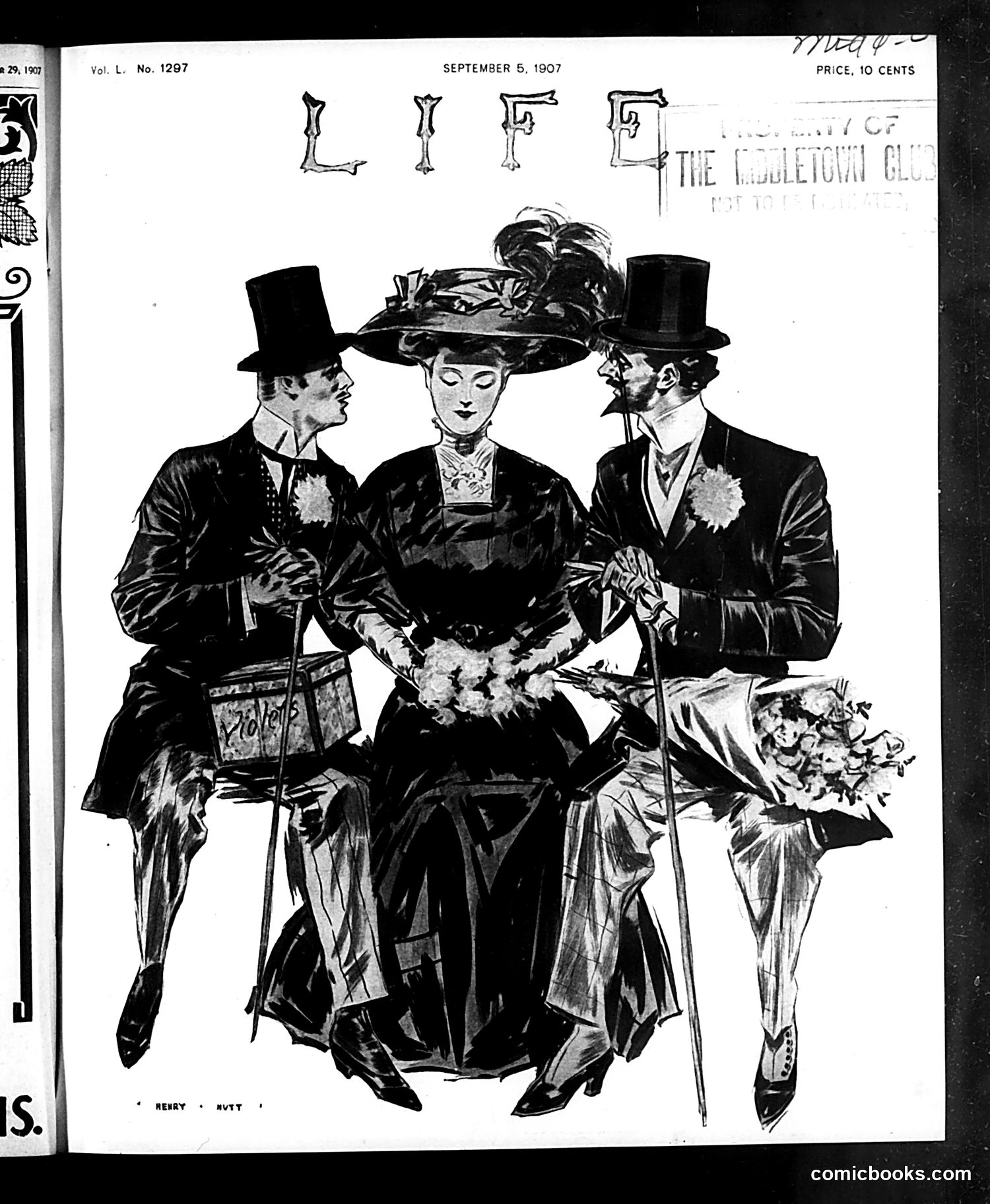
This page features an illustration titled "LIFE" showing three fashionably dressed figures in formal Edwardian attire—two men in top hats flanking a woman in an elaborate wide-brimmed hat. The men hold flowers and appear to be courting or attending a social event with the woman. The satire likely comments on **upper-class social conventions and courtship rituals** of the Edwardian era. The exaggerated formality, the woman's prominent central position despite being surrounded by suitors, and the elaborate fashions suggest mockery of **pretentious high-society behavior** and the theatrical nature of wealthy social interactions. Without additional context or visible artist attribution, the specific social commentary remains unclear, though it appears to critique fashionable Edwardian society conventions.
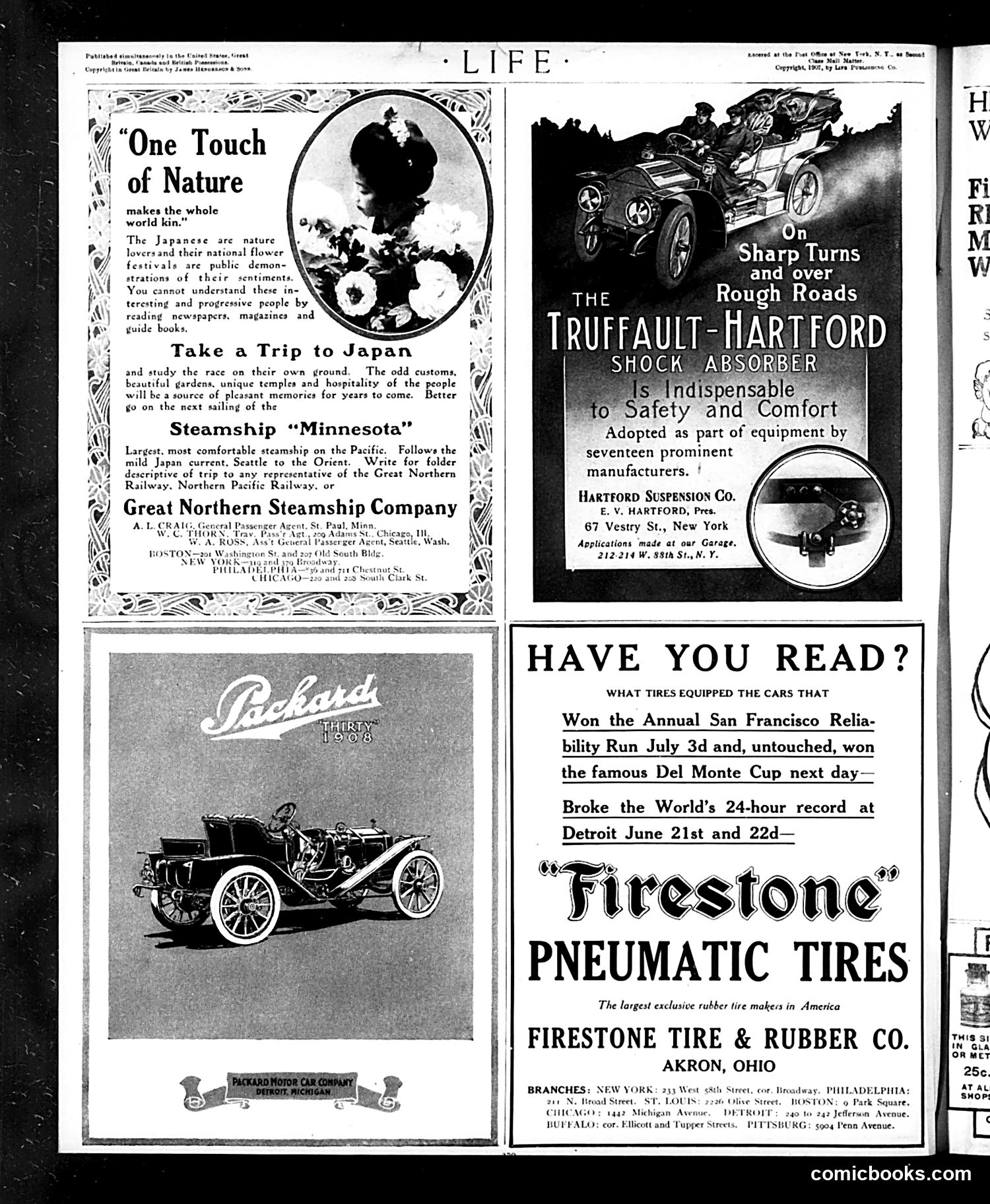
This page contains **primarily advertisements** rather than satirical cartoons. The ads promote: 1. **Great Northern Steamship Company** - advertising trips to Japan via the steamship "Minnesota" 2. **Packard Motor Car Company** - featuring an early automobile 3. **Truffault-Hartford Shock Absorber** - automotive suspension technology, claiming adoption by "seventeen prominent manufacturers" 4. **Firestone Pneumatic Tires** - highlighting racing victories and durability records The page reflects **early 1900s consumer culture**, showcasing luxury travel and emerging automobile technology. The emphasis on racing achievements and manufacturing endorsements reflects how new industries (automobiles, pneumatic tires) competed for credibility. There is no evident political satire—this appears to be a standard advertising section of the magazine.
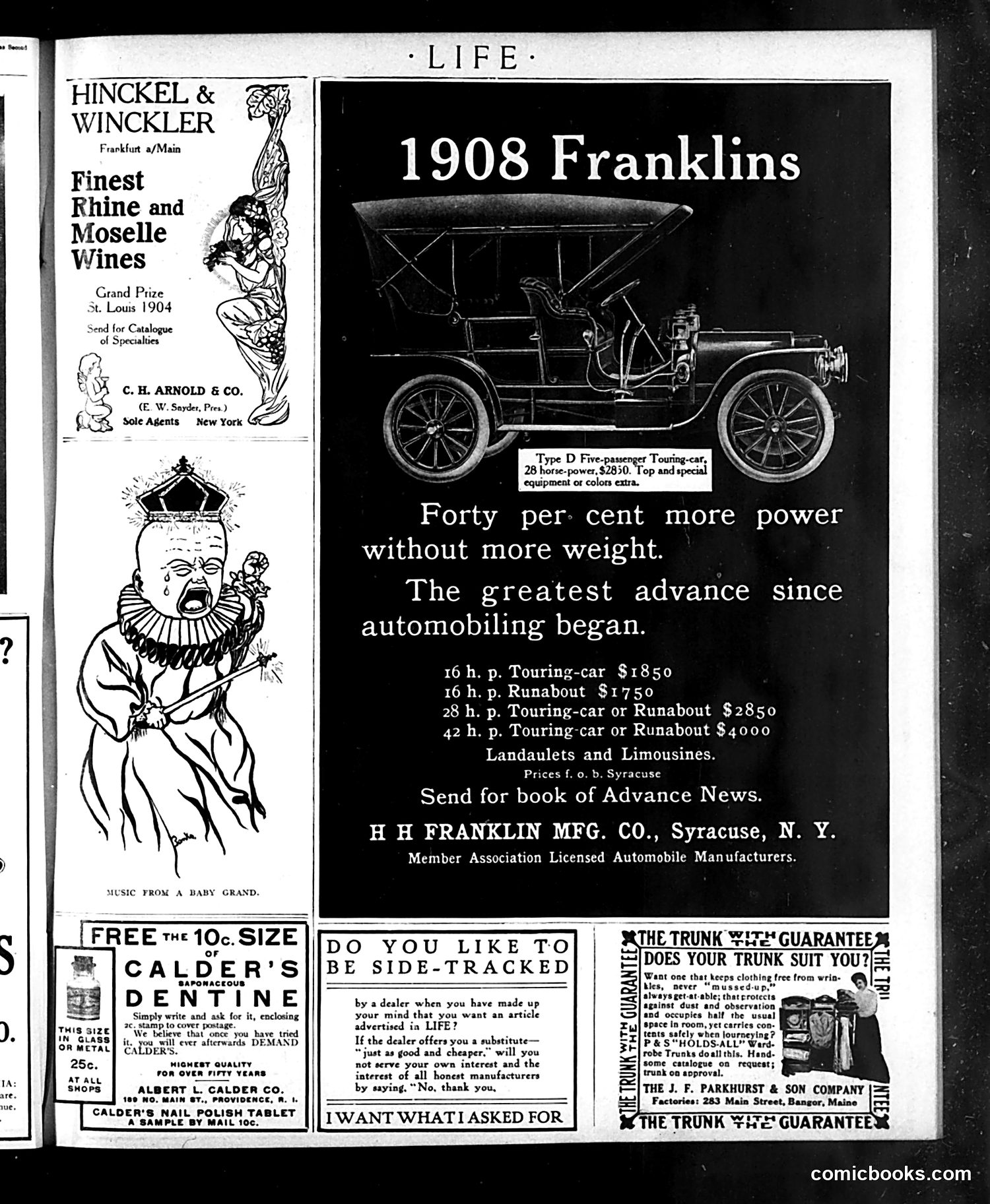
This page is primarily **advertising content** from circa 1908, not political satire. The dominant feature is a Franklin automobile advertisement emphasizing engineering superiority—"forty per cent more power without more weight," marketed as "the greatest advance since automobiling began." The left side contains unrelated ads: a wine merchant (Hinckel & Winckler), Calder's Mail Polish, and a trunk manufacturer. A small cartoon labeled "Music from a Baby Grand" appears beneath the wine ad, but it's unclear what specific joke or reference it contains. The bottom section includes a brief commentary on deceptive advertising practices, advising readers to demand advertised products rather than accept substitutes—a consumer-protection message rather than political satire.
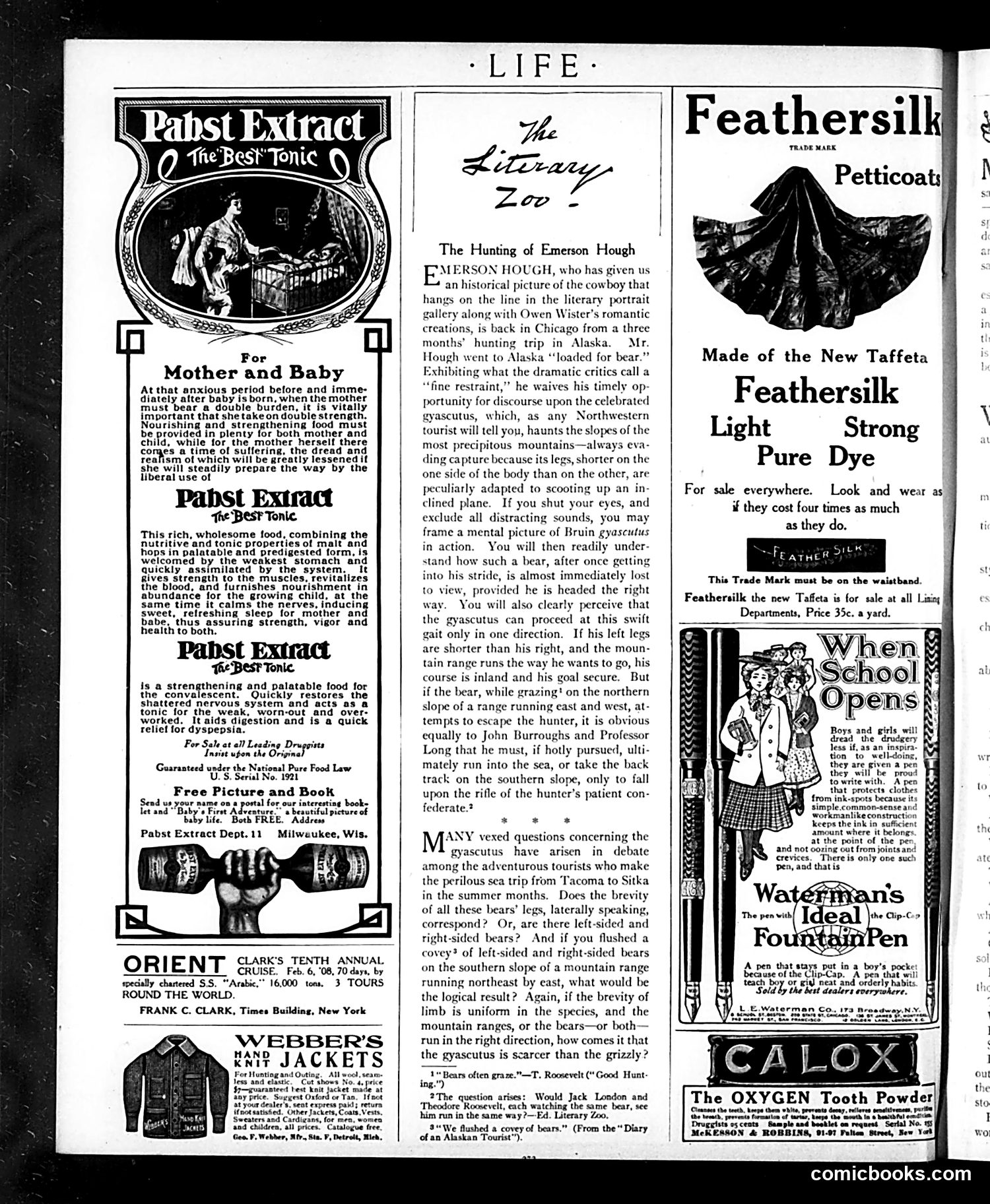
This page is primarily **advertising**, not satirical content. It features prominent ads for: 1. **Pabst Extract** - a nutritional tonic marketed for postpartum mothers and infants, emphasizing nourishment and strength 2. **Feathersilk** - a new fabric product advertised as "light, strong, pure dye" 3. **Waterman's Ideal Fountain Pen** - marketed for school use 4. **Calox Tooth Powder** - an oral hygiene product The center contains "The Literary Zoo," an essay about Emerson Hough's hunting trip to Alaska, discussing grizzly bears' behavior and physiology. There is **no political cartoon or satire** on this page. It represents typical early-20th-century Life magazine format: a mix of editorial content and commercial advertisements targeting middle-class consumers, with particular emphasis on products for mothers, children, and personal health.
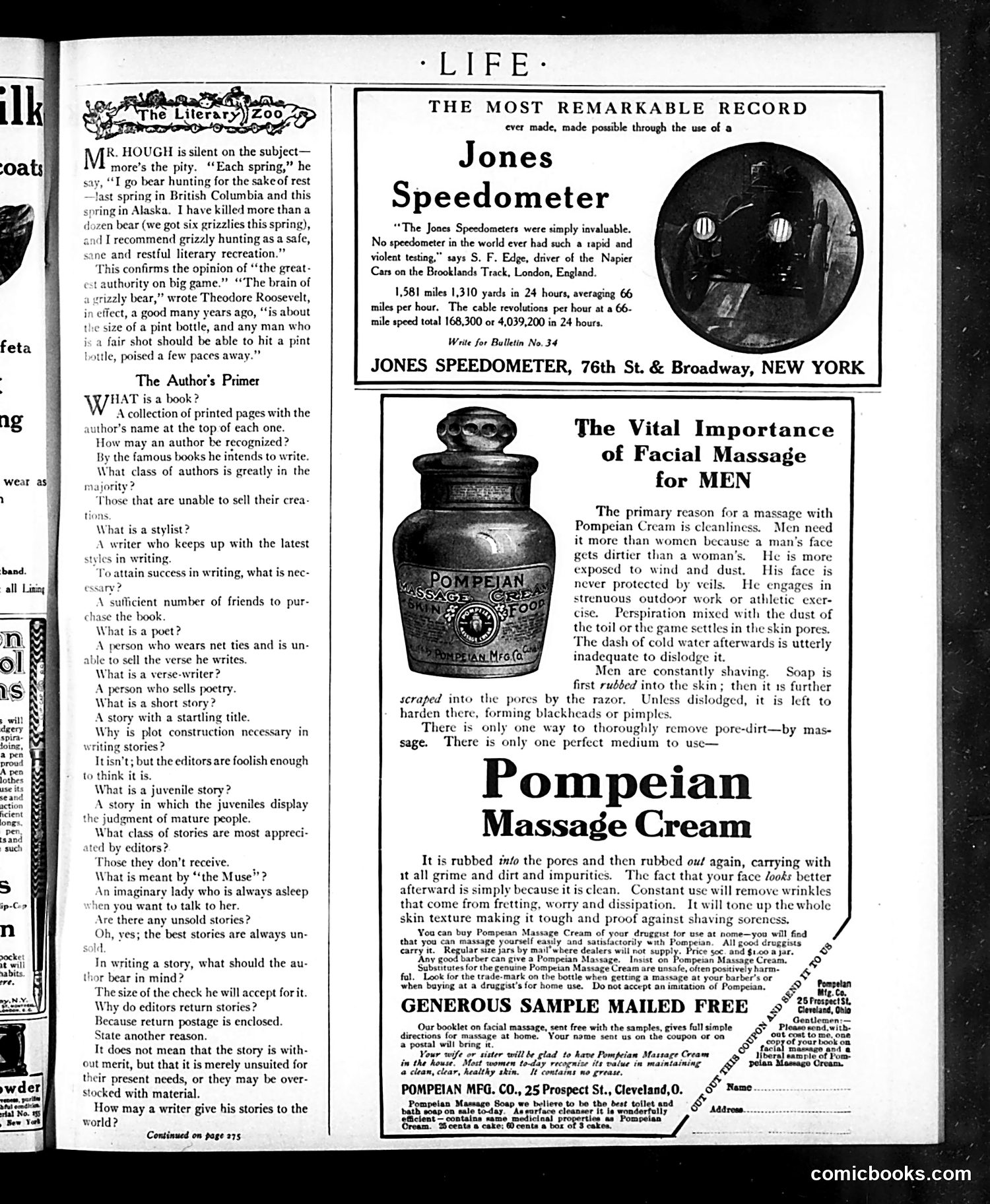
This page contains **primarily advertisements rather than satirical cartoons**. The main content includes: 1. **"The Literary Zoo"** — a column by Mr. Hough discussing bear hunting, presented as humorous editorial content rather than political satire. 2. **"The Author's Primer"** — a Q&A column with writing advice, satirizing literary pretension through rhetorical questions (what makes a poet, stylist, etc.). 3. **Jones Speedometer advertisement** — promoting a speed-measuring device with performance claims. 4. **Pompeian Massage Cream advertisement** — the dominant ad, promoting facial massage for men with detailed sales copy and a free sample offer. The page reflects early 20th-century Life magazine's mix of light satire and advertising. The "Author's Primer" contains gentle mockery of literary ambitions, but no significant political or social satire is evident.
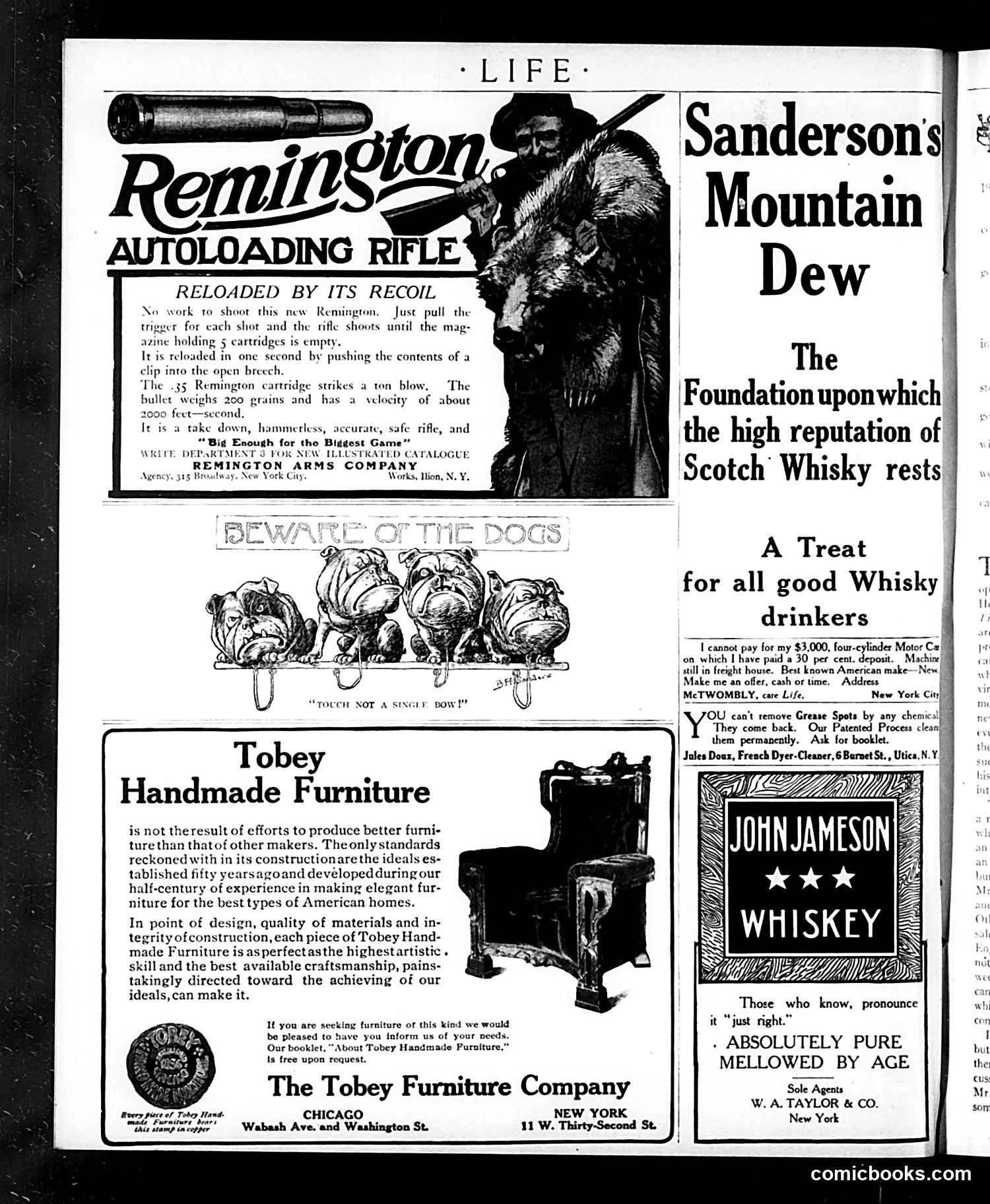
This page is primarily **advertising content**, not satirical editorial material. It contains four distinct advertisements: 1. **Remington Autoloading Rifle** - marketed as requiring no work to shoot, with automatic reloading via recoil 2. **"Beware of the Dogs"** - a humorous illustrated warning featuring bulldogs, likely promoting something (text unclear from image) 3. **Tobey Handmade Furniture** - emphasizing fifty years of craftsmanship and American design quality, with Chicago and New York locations 4. **Whiskey advertisements** - for Sanderson's Mountain Dew and John Jameson whiskey, emphasizing purity and quality The page reflects early 20th-century consumer culture, mixing industrial products, home furnishings, and alcohol marketing. There is no apparent political satire or social commentary visible—this appears to be a standard advertising section from *Life* magazine.
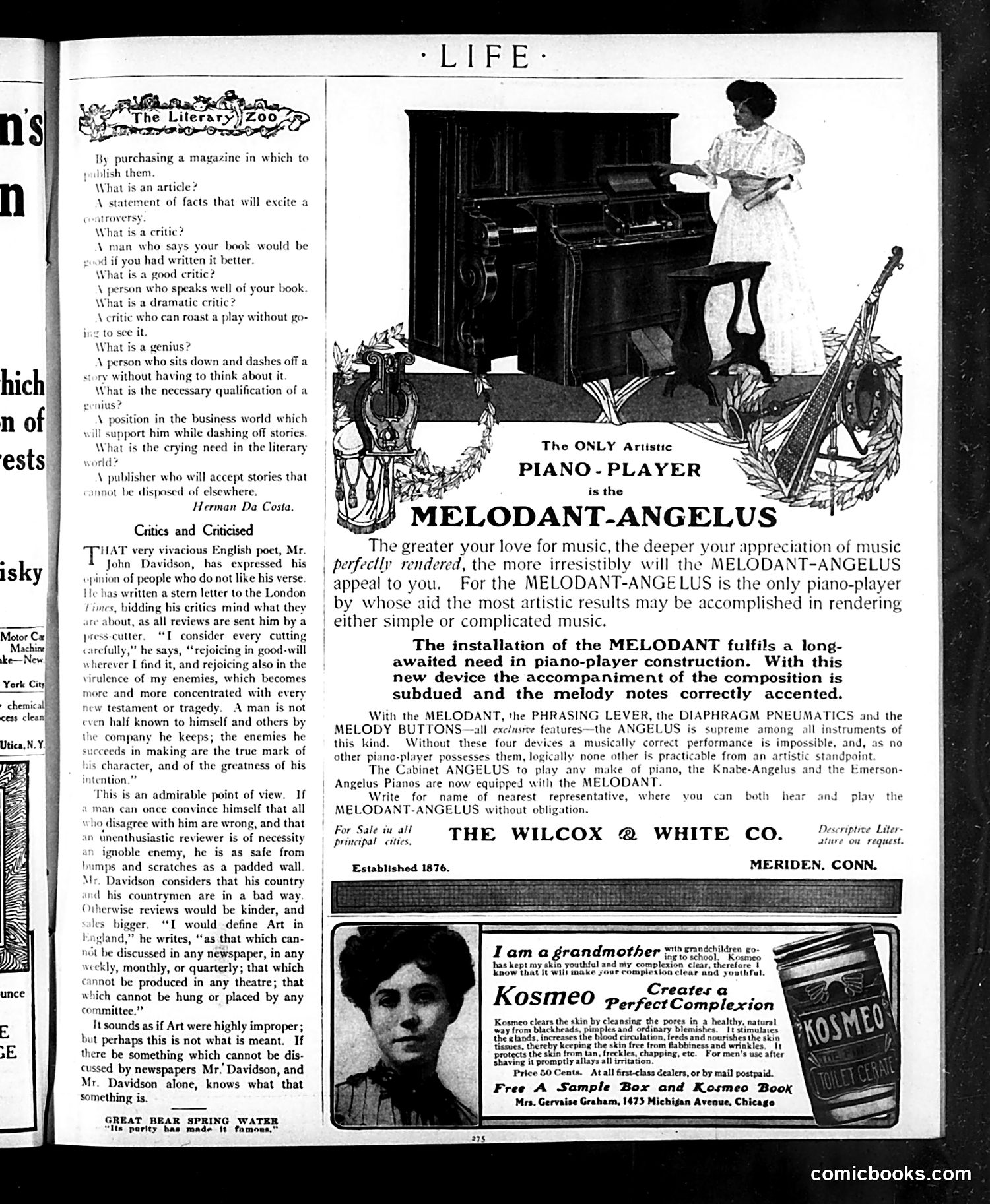
This page is primarily **advertising and editorial content**, not political satire. The main feature is an advertisement for the "Melodant-Angelus," a piano-player mechanism—an early automated music device that allows pianos to play compositions mechanically. The ad emphasizes this as "the ONLY Artistic PIANO-PLAYER," appealing to music lovers by claiming superior artistic rendering of "either simple or complicated music." Below is a separate advertisement for "Kosmeo," a skin cream promising to create a "Perfect Complexion," marketed to women concerned about acne and blackheads. The page's left column contains "The Literary Zoo," a humorous editorial section defining literary terms (articles, critics, geniuses, etc.) and critiquing contemporary literary culture, including commentary on poet John Davidson and newspaper reviews. No political cartoons or caricatures appear here.
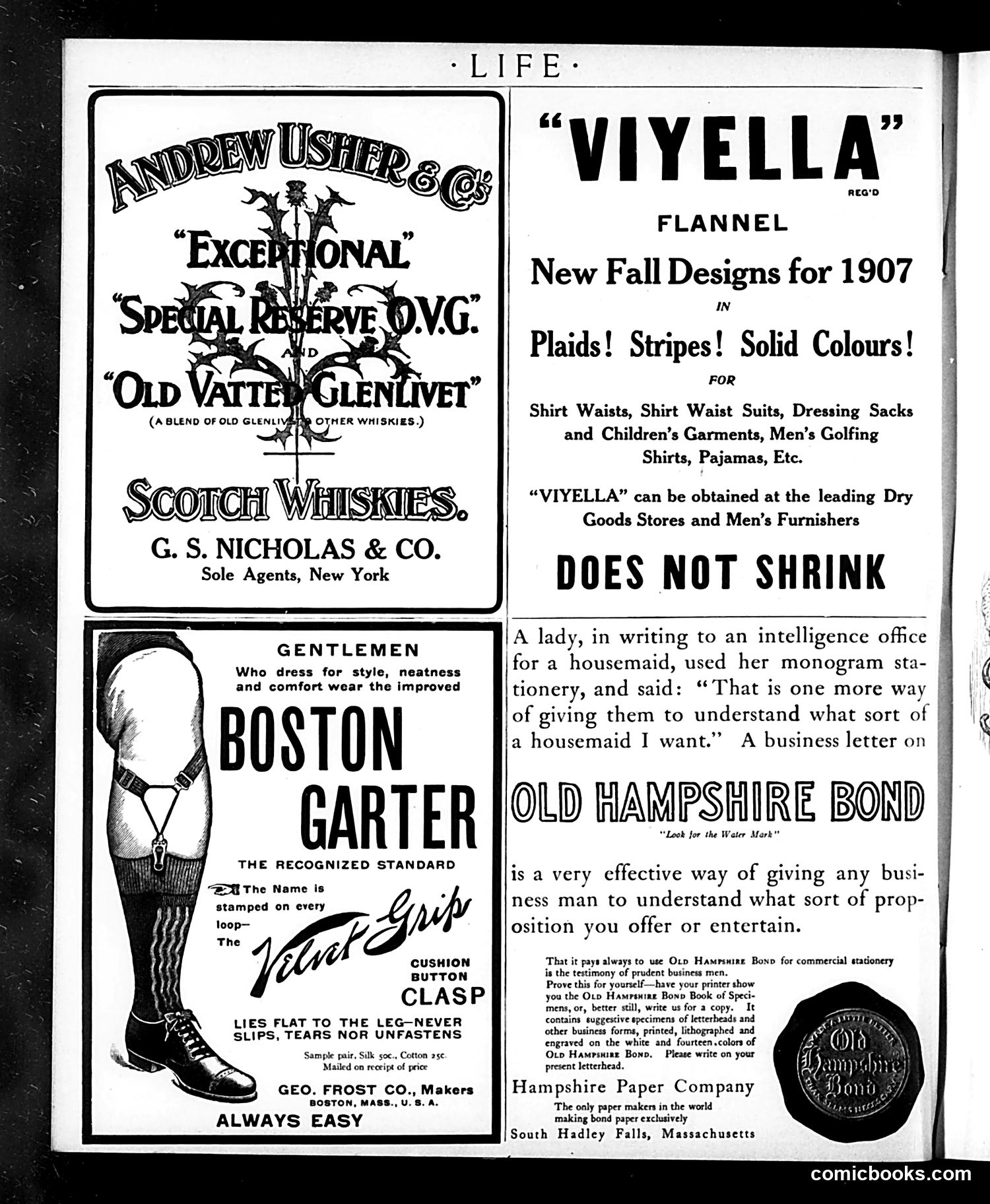
This page is **primarily advertising**, not satirical content. It contains three separate commercial advertisements from circa 1907: 1. **Andrew Usher & Co.** — promotes Scottish whiskies (Exceptional, Special Reserve O.V.G., Old Vatted Glenlivet) 2. **Boston Garter** — advertises men's garters with a detailed illustration showing the product's "Velvet Grip" cushion button clasp, emphasizing it "lies flat to the leg—never slips, tears nor unfastens" 3. **Viyella Flannel** — announces new fall fabric designs in plaids, stripes, and solid colors for clothing; promises the material "does not shrink" The page also includes a brief anecdote about using monogrammed stationery and an advertisement for **Old Hampshire Bond** paper, suggesting quality business correspondence. There is no political satire or social commentary visible—this is a standard advertising page from Life magazine's commercial section.
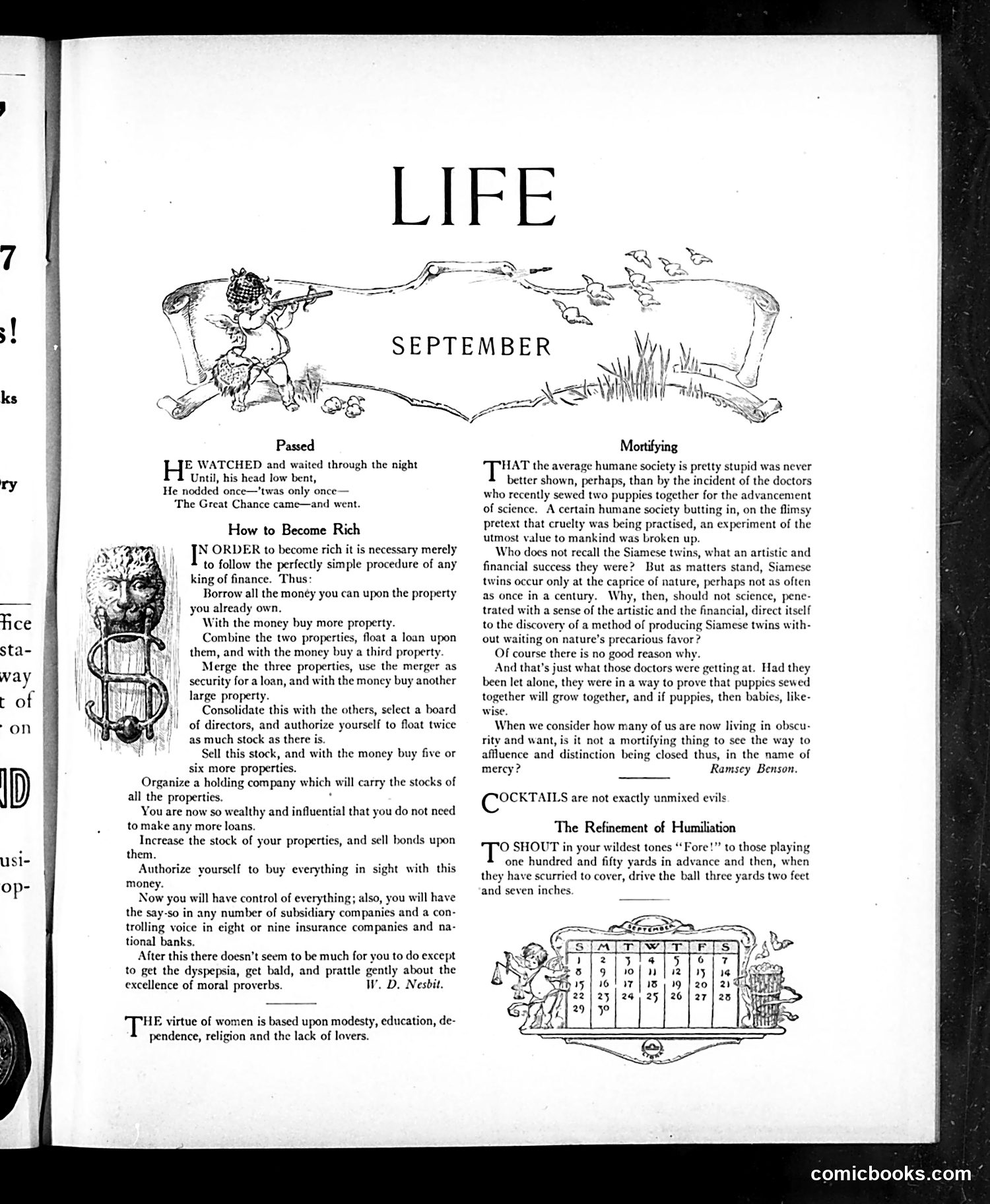
This is a satirical page from Life's September issue featuring three distinct pieces: 1. **"Passed" and "Mortifying"**: Two illustrated vignettes mocking society—one shows a poor man watching "the Great Chance" pass him by; the other satirizes doctors who sewed puppies together as a "scientific experiment," critiquing how the wealthy justify cruelty under the guise of progress. 2. **"How to Become Rich"**: A detailed satirical guide by W.D. Nesbit, mocking financial schemes where one buys property with borrowed money, creates holding companies, and manipulates stocks—exposing how the wealthy accumulate power through circular financial arrangements while claiming moral virtue. 3. **"The Refinement of Humiliation"**: A brief joke about golf, with an accompanying calendar illustration. The page satirizes wealth-building, scientific ethics, and social pretension.
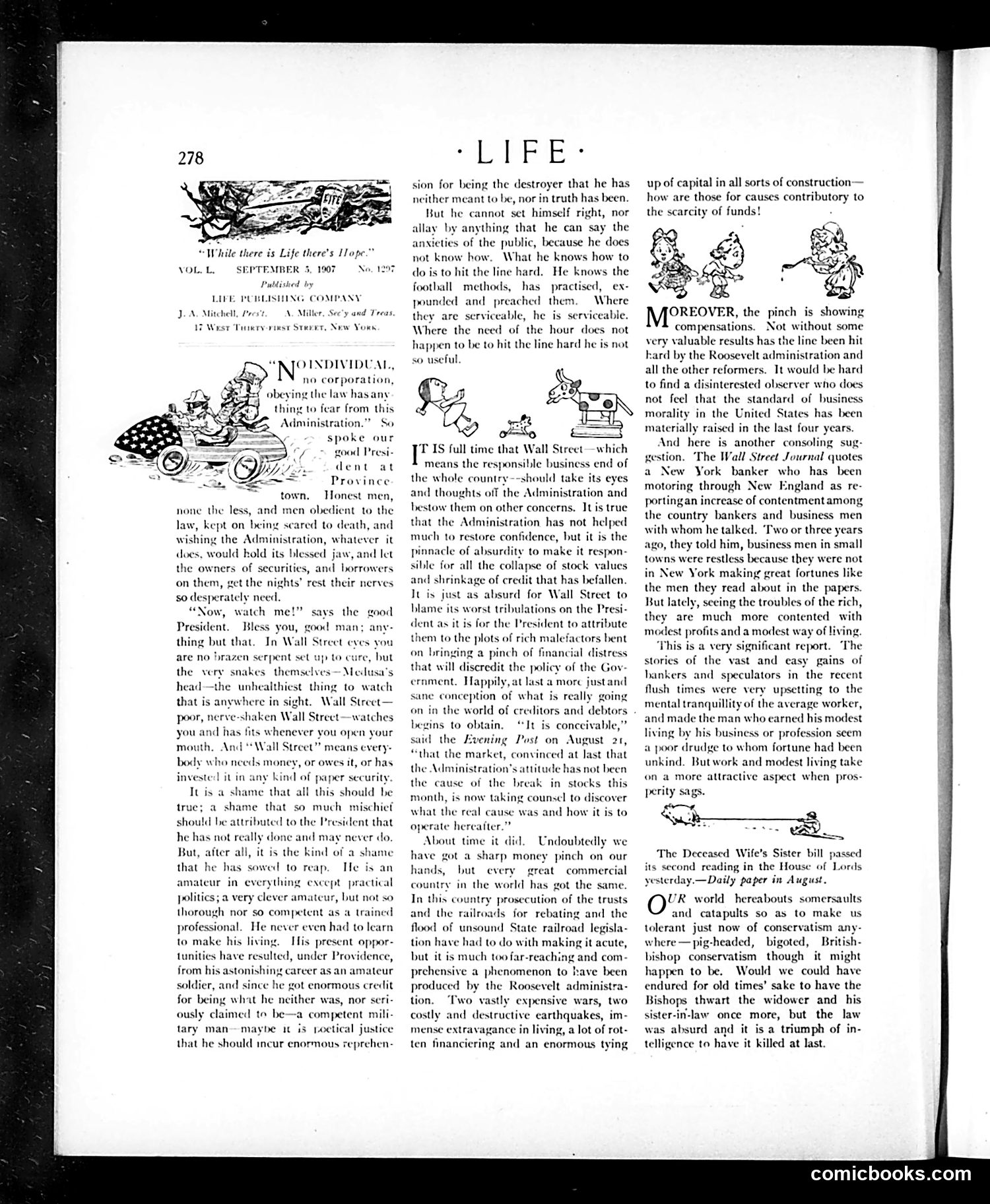
This page from *Life* magazine (Vol. L, September 5) contains editorial commentary criticizing both Wall Street and the Roosevelt administration's response to financial crisis. The cartoon at top-left depicts a figure in a car labeled "Province" being steered recklessly, satirizing poor governance. The accompanying text attacks Wall Street for blaming the administration for stock market collapse, while simultaneously defending the President against accusations of responsibility for financial distress. The editorial argues that both Wall Street speculators and the administration bear shared responsibility for economic problems—neither can credibly blame the other exclusively. It advocates for balanced accountability rather than partisan finger-pointing during this period of economic turmoil and reform.
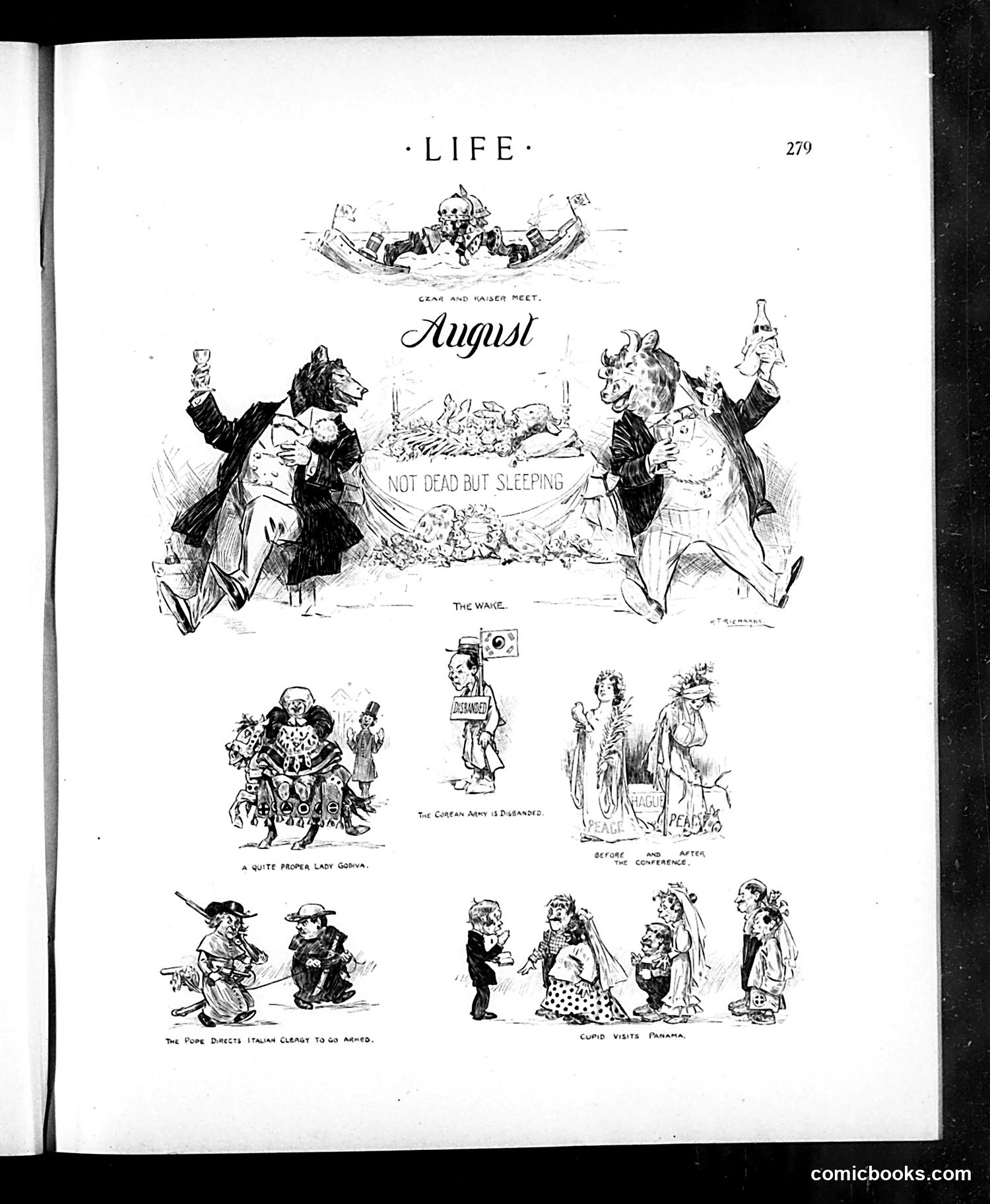
This page satirizes August 1914 events during World War I's outbreak. The central image shows two figures (likely representing major European powers) toasting over a grave labeled "NOT DEAD BUT SLEEPING"—mocking the false hope that the conflict might be brief. The caption "CRAB AND Kaiser MEET" references German leadership. Other panels mock diplomatic pretense: "THE WAVE" suggests the conflict's spreading; "THE KOREAN ARMY IS DAWNING" appears to reference Asian involvement; "CUPID VISITS PANAMA" likely jokes about wartime complications to neutral commerce. "A QUITE PROPER LADY GOSSIP" and "THE POPE DIRECTS ITALIAN CLERGY TO GO ARMED" suggest religious and social disruption from the war. The overall message: August 1914 represented catastrophic upheaval despite initial optimism for quick resolution.
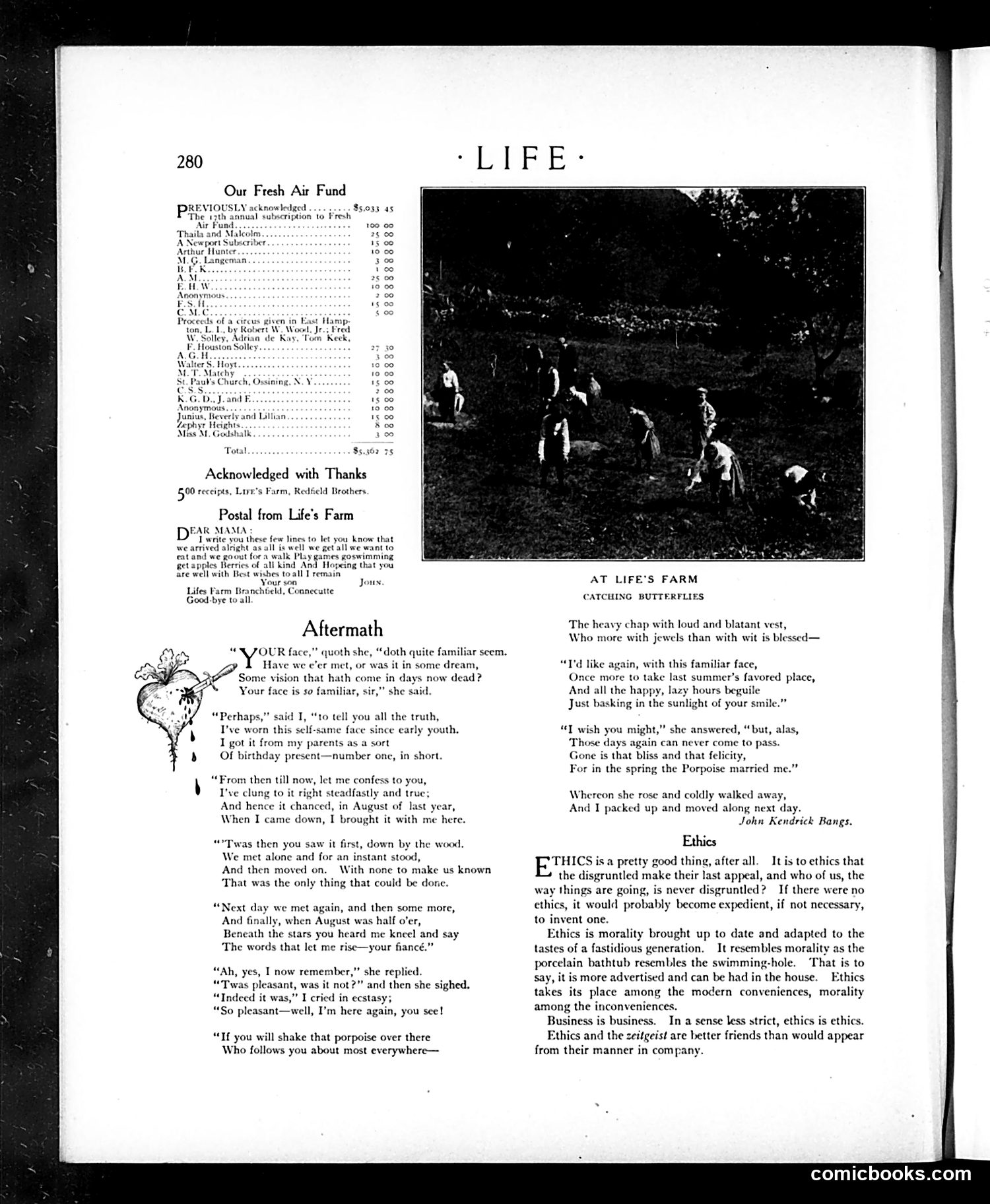
This page contains a poem titled "Aftermath" and an essay on "Ethics," rather than political cartoons. The "Aftermath" poem appears to be a romantic or sentimental narrative involving two people reflecting on a shared memory, with dialogue about a face they've known since youth and past meetings. The photograph shows people at "Life's Farm" catching butterflies—an apparently idyllic pastoral scene. The essay "Ethics" discusses morality in business and modern life, arguing that ethics should adapt to contemporary circumstances, comparing ethical standards to a "swimming-hole" that's become a household bathtub. This page lacks overt political satire or caricature. It represents Life magazine's literary and philosophical content rather than its famous satirical cartoon tradition.
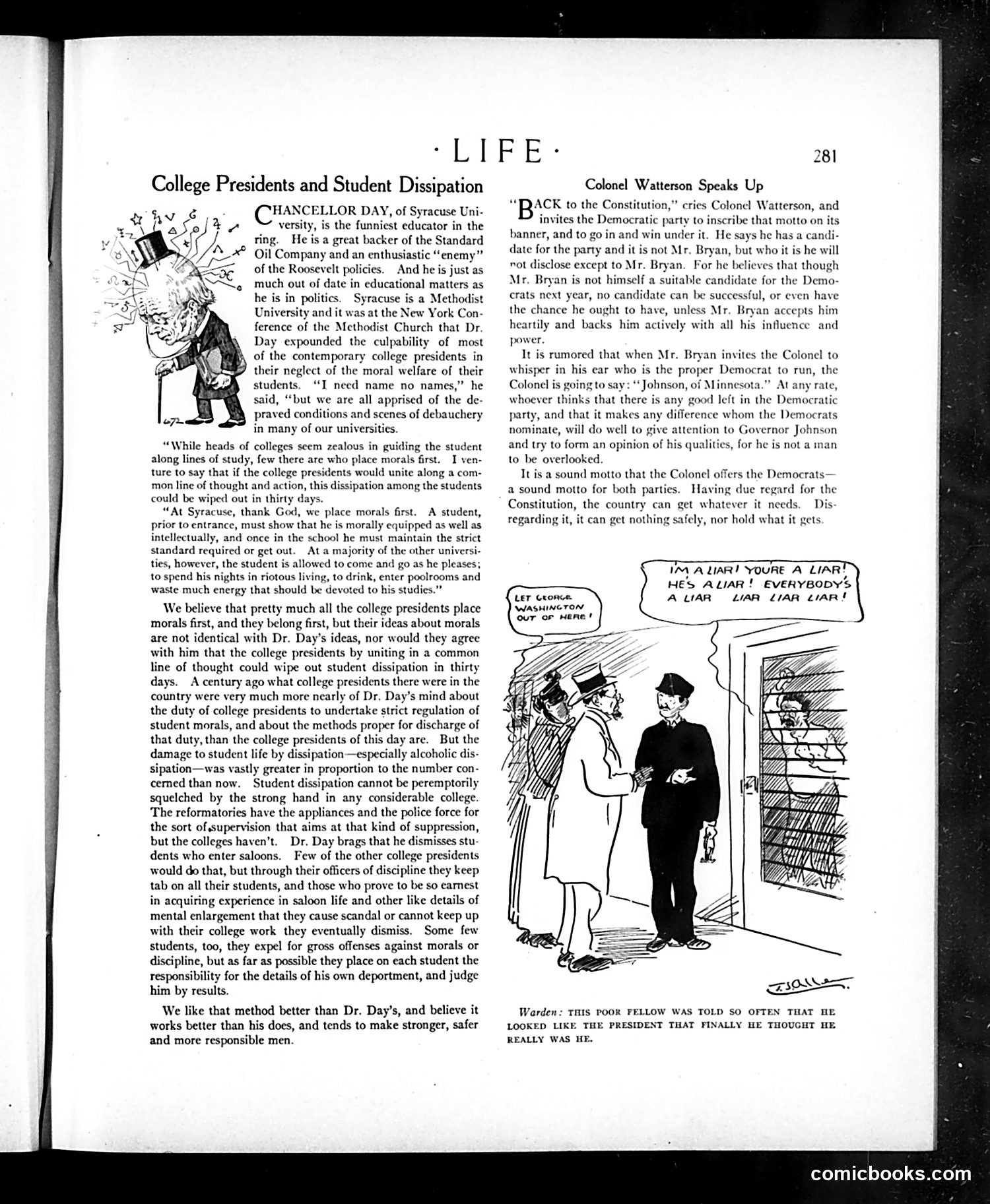
This page contains editorial commentary on college discipline paired with a cartoon satirizing student behavior. **The Text:** The article critiques Syracuse University Chancellor Day's lenient approach to student morality, arguing college presidents should enforce stricter behavioral standards. The author advocates for moral discipline over Day's permissive methods, believing structured accountability produces "stronger, safer and more responsible men." **The Cartoon:** Depicts a warden showing a visitor a prisoner who repeatedly shouts "I'm a liar! You're a liar! Everybody's a liar!" The caption explains this prisoner was "told so often that he looked like the president that finally he thought he really was he." **The Satire:** The joke appears to mock ineffective disciplinary approaches—constant accusation produces a delusional, unstable person rather than genuine reform. This illustrates the editorial's point: poor discipline methods backfire.
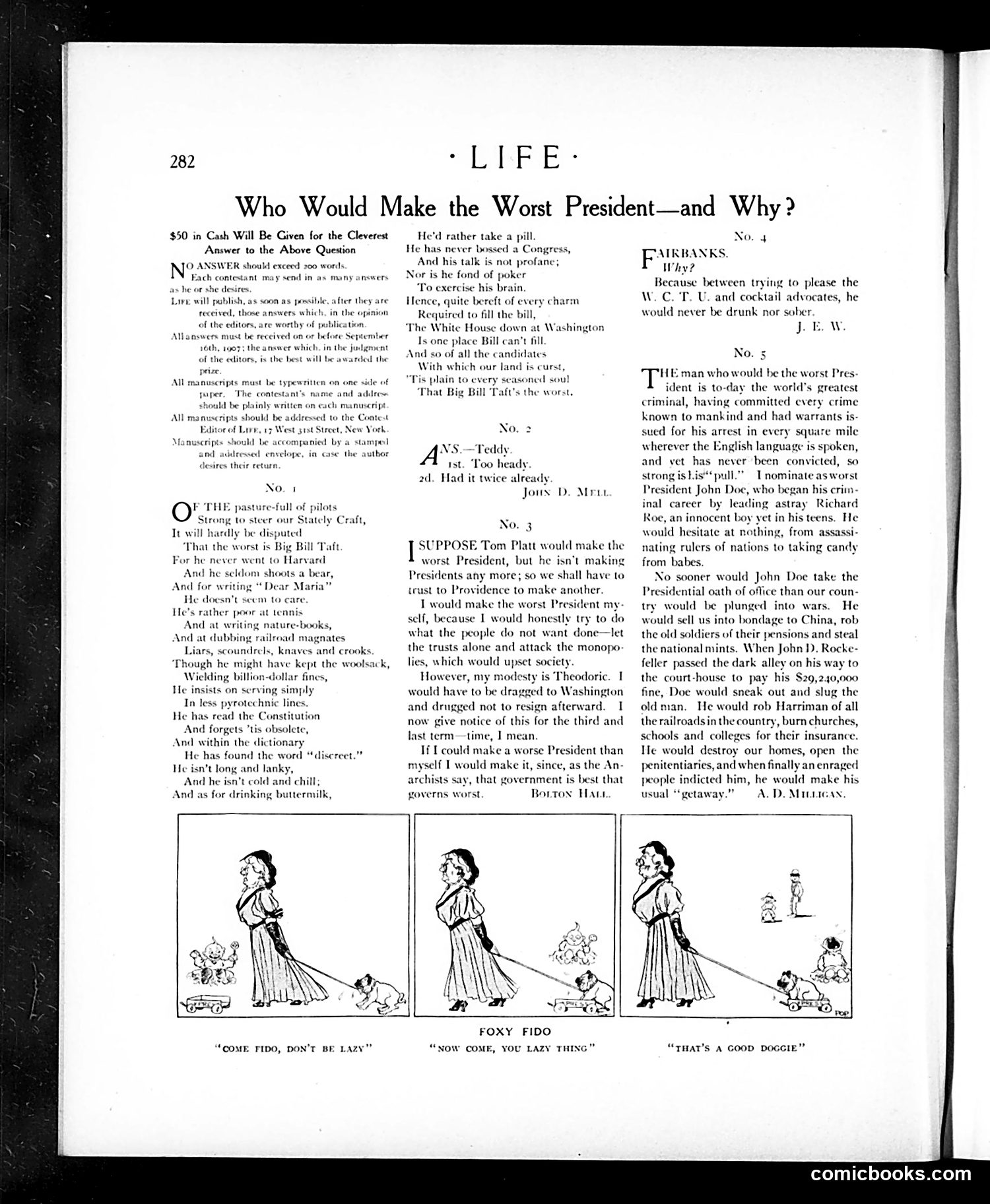
This page presents a contest asking readers: "Who Would Make the Worst President—and Why?" with $50 offered for the cleverest answer. **The entries mock contemporary political figures:** **Entry No. 1** satirizes **William Howard Taft**, the sitting president, by listing his supposed deficiencies: he didn't attend Harvard, doesn't shoot bears, reads the Constitution (presented as outdated), and refuses to engage in corruption or drink heavily—all portrayed as presidential failings. **Entry No. 3** references **Tom Platt**, a New York political boss, suggesting Providence alone could create a worse president. **Entry No. 4** mentions **Fairbanks** (likely Vice President James Sherman or Charles Fairbanks), mocking his inability to satisfy both temperance advocates (W.C.T.U.) and cocktail drinkers. **Entry No. 5** proposes the fictional "John Doe"—a generic criminal representing corruption. The cartoon strips below ("Foxy Fido") are unrelated advertising humor. The satire reflects early-20th-century frustration with presidential leadership and political corruption.
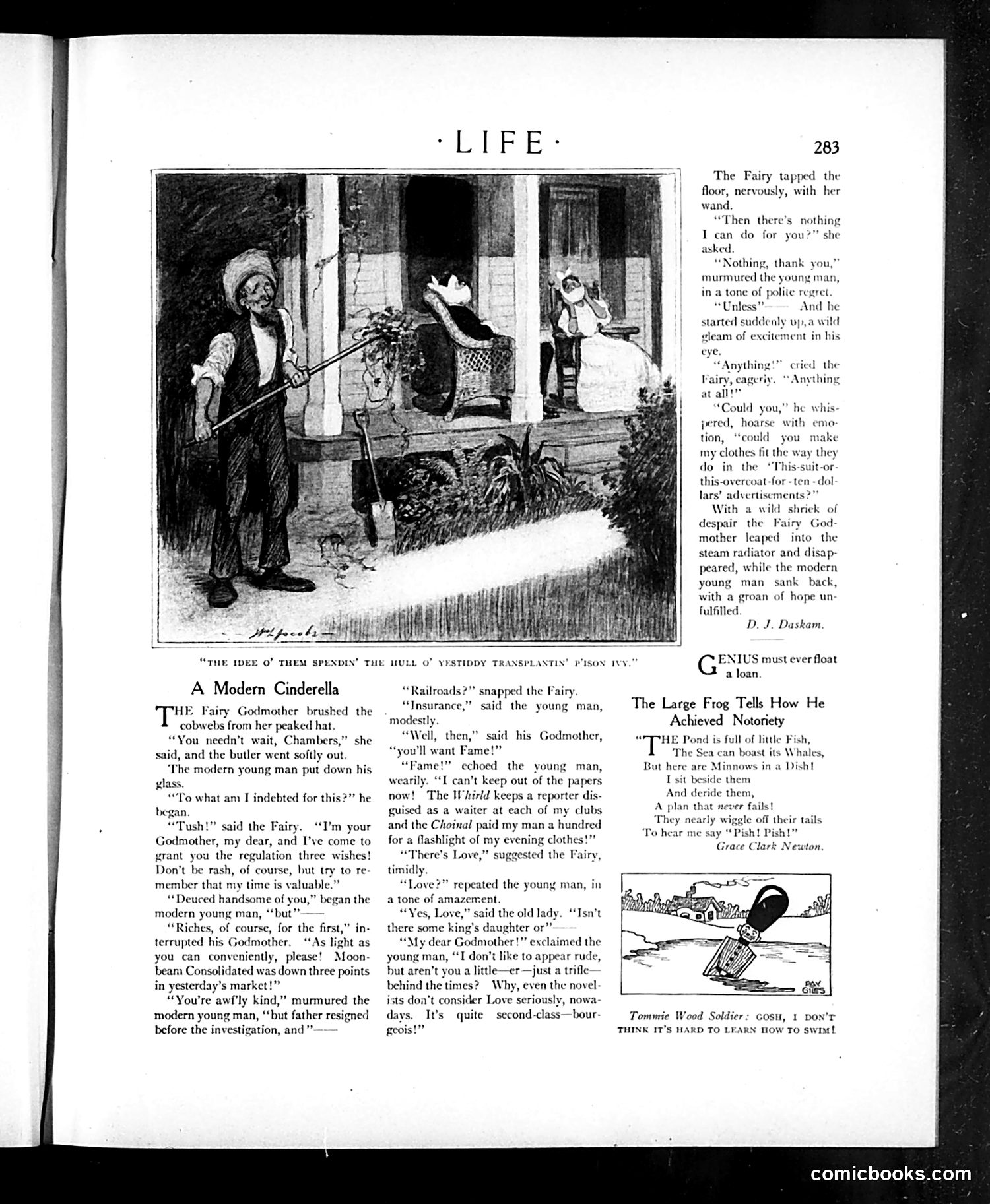
This page contains a satirical short story titled "A Modern Cinderella," illustrated with a cartoon. The story parodies the fairy tale by having a Fairy Godmother offer a modern young man three traditional wishes (riches, fame, love). The satire mocks early 20th-century American materialism and social values. When offered wealth, the man worries about stock market losses. Fame appeals to him only because newspapers constantly cover him. Most pointedly, when Love is suggested, he dismissively dismisses it as old-fashioned—even novelists no longer take it seriously, he claims. The cartoon illustrates the punchline: the Fairy Godmother, horrified that her magic cannot fulfill his only actual request (making cheap-advertisement clothes fit well), disappears in despair. The joke is that modern consumerism and advertising have made even fairy godmothers powerless. The satire reflects Life magazine's recurring critique of shallow materialism, commercialism, and the decline of traditional values in contemporary society.
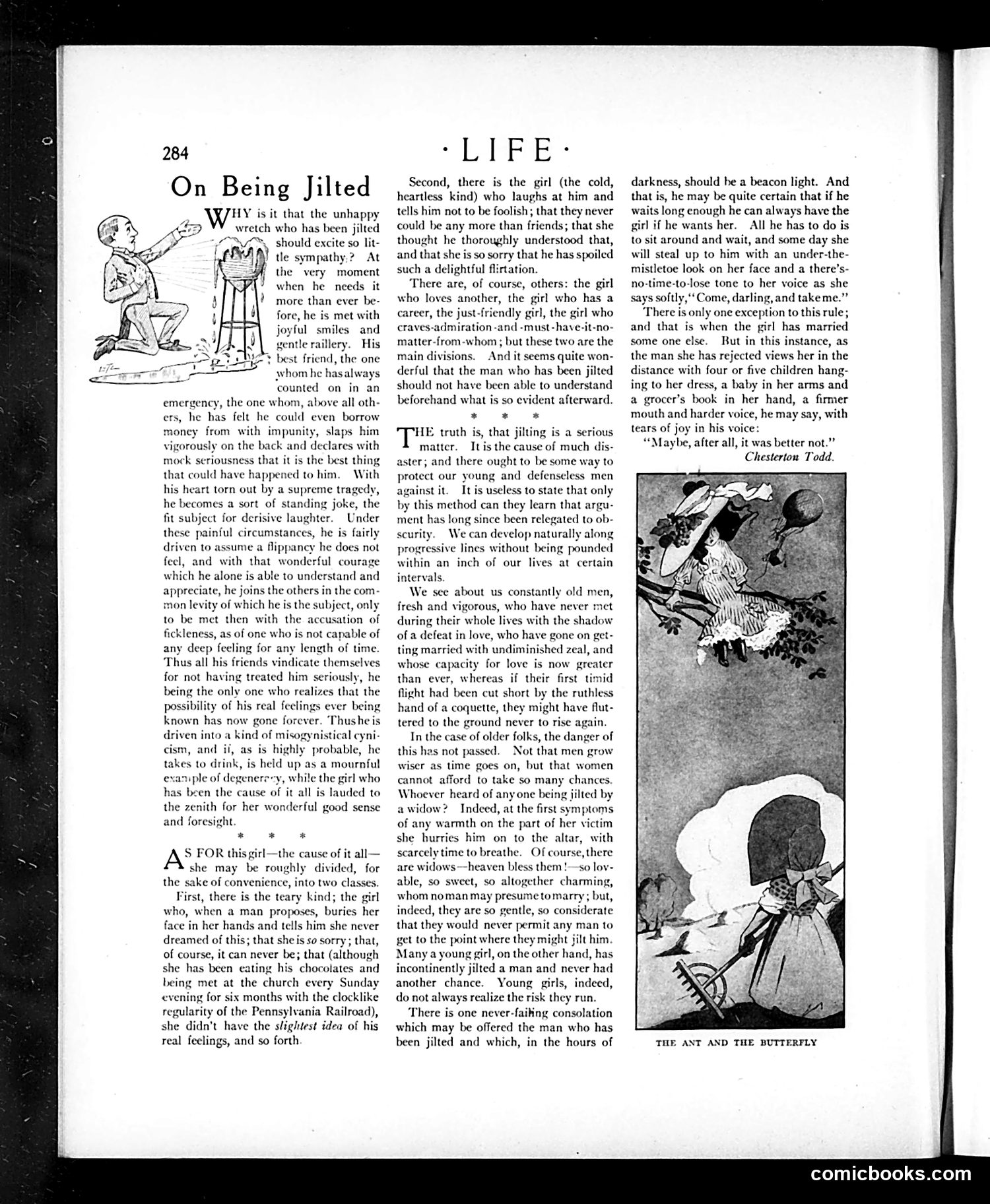
This article satirizes the social double-standard and mockery surrounding romantic rejection in early 20th-century America. The piece argues that jilted men face cruel, contradictory treatment: friends offer false cheer and mock sympathy rather than genuine support, yet also accuse him of fickleness for adopting the expected flippant attitude. This pushes rejected men toward bitterness and drinking, while the woman who rejected him is praised for her "good sense." The author categorizes women who jilt men into types: the "teary kind" (feigning innocence despite months of encouragement) and the "cold heartless kind" (laughing off his proposal). The satire suggests men cannot win—either destroyed by rejection or blamed for their destruction—while society celebrates women's rejections as wisdom. The accompanying illustration "The Ant and the Butterfly" (visible but not detailed here) likely reinforces themes of vulnerability and social hierarchy in romantic dynamics.
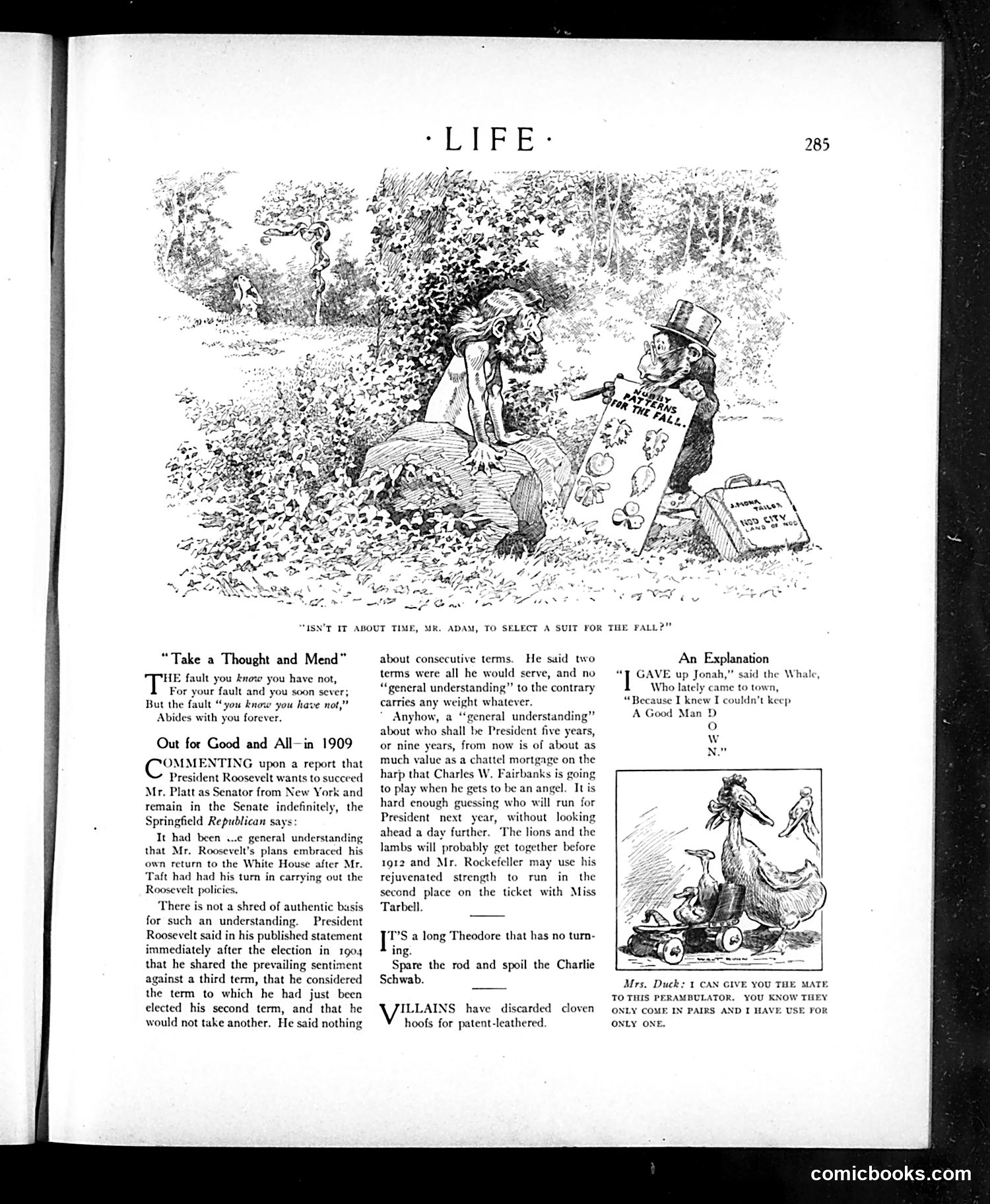
The top cartoon depicts a tailor measuring a figure (labeled "Mr. Adam") for a fall suit—a visual pun on the biblical Adam and the autumn season, likely satirizing political preparations for upcoming elections. The accompanying text mocks speculation about President Theodore Roosevelt's political future. After winning election in 1904, Roosevelt publicly pledged not to seek a third term. However, rumors circulated that he might pursue a Senate seat or remain politically active. The Springfield Republican editorial ridicules this gossip as baseless, sarcastically comparing political forecasting to predicting that Charles Fairbanks (Vice President) would play a harp in heaven, or that John D. Rockefeller might run as a vice-presidential candidate with investigative journalist Ida Tarbell. The page includes humorous animal-themed quips (about a whale, duck, and Charlie Schwab) that appear unrelated to the main political commentary—typical of Life's miscellaneous satirical content.
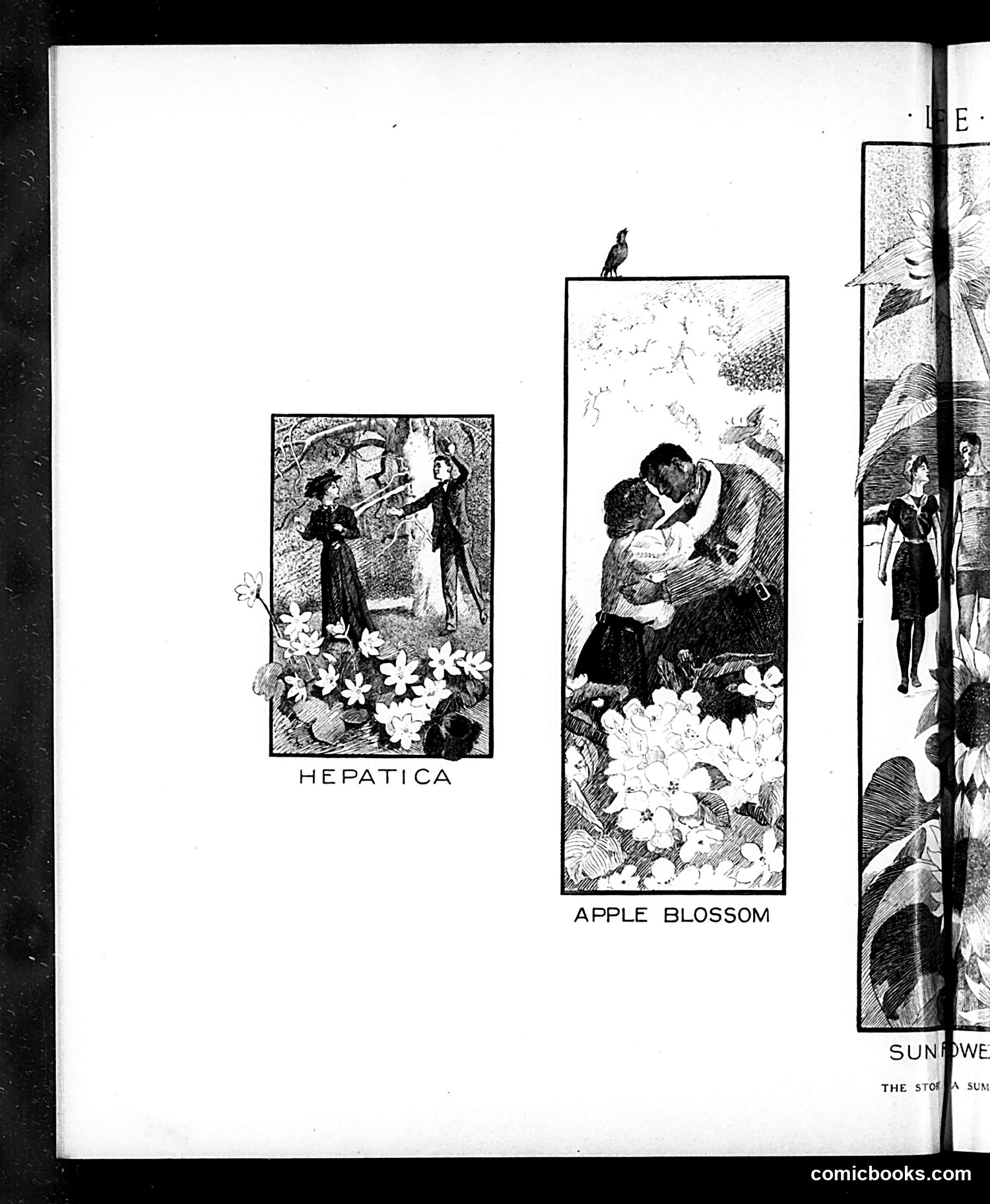
This appears to be a page from *Life* magazine featuring three illustrated panels labeled with flower names: "Hepatica," "Apple Blossom," and partially visible "Sunflower." Each panel depicts romantic or sentimental scenes with couples and flowering plants rendered in detailed pen-and-ink style. The leftmost image shows figures among hepatica flowers; the center shows an embracing couple surrounded by apple blossoms; the right panel shows figures near sunflowers. These appear to be decorative illustrations rather than political satire—likely part of a series celebrating spring flowers paired with romantic imagery, a common literary device of the era. Without additional context about the publication date or surrounding content, the specific satirical intent remains unclear, though the juxtaposition of sentimental romance with botanical subjects was typical of turn-of-the-century magazine aesthetics.
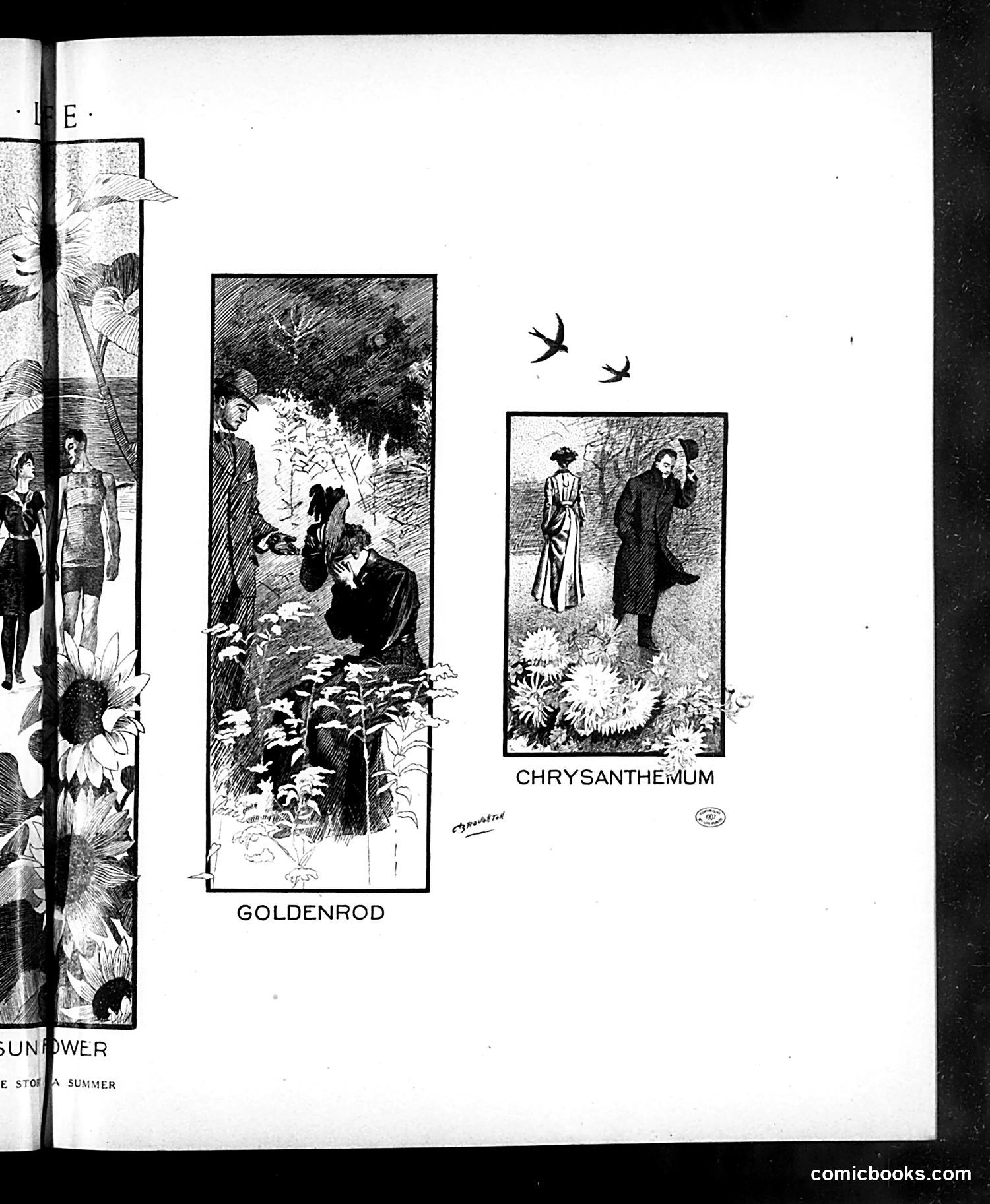
This page displays three illustration panels labeled with flower names: "Goldenrod," "Chrysanthemum," and what appears to be "Sunflower" (partially visible). Each panel depicts figures in a garden or natural setting rendered in detailed pen-and-ink style. The illustrations appear to be decorative or thematic artwork rather than political satire. They show fashionably-dressed people (appearing to be from the early-to-mid 20th century based on clothing styles) posed among flowering plants. The text fragment "E STOR BA SUMMER" suggests this may be part of a summer fashion or lifestyle feature. Without additional context or complete text, the specific satirical point—if any—is unclear. This appears to be editorial illustration accompanying seasonal content rather than explicit political commentary.
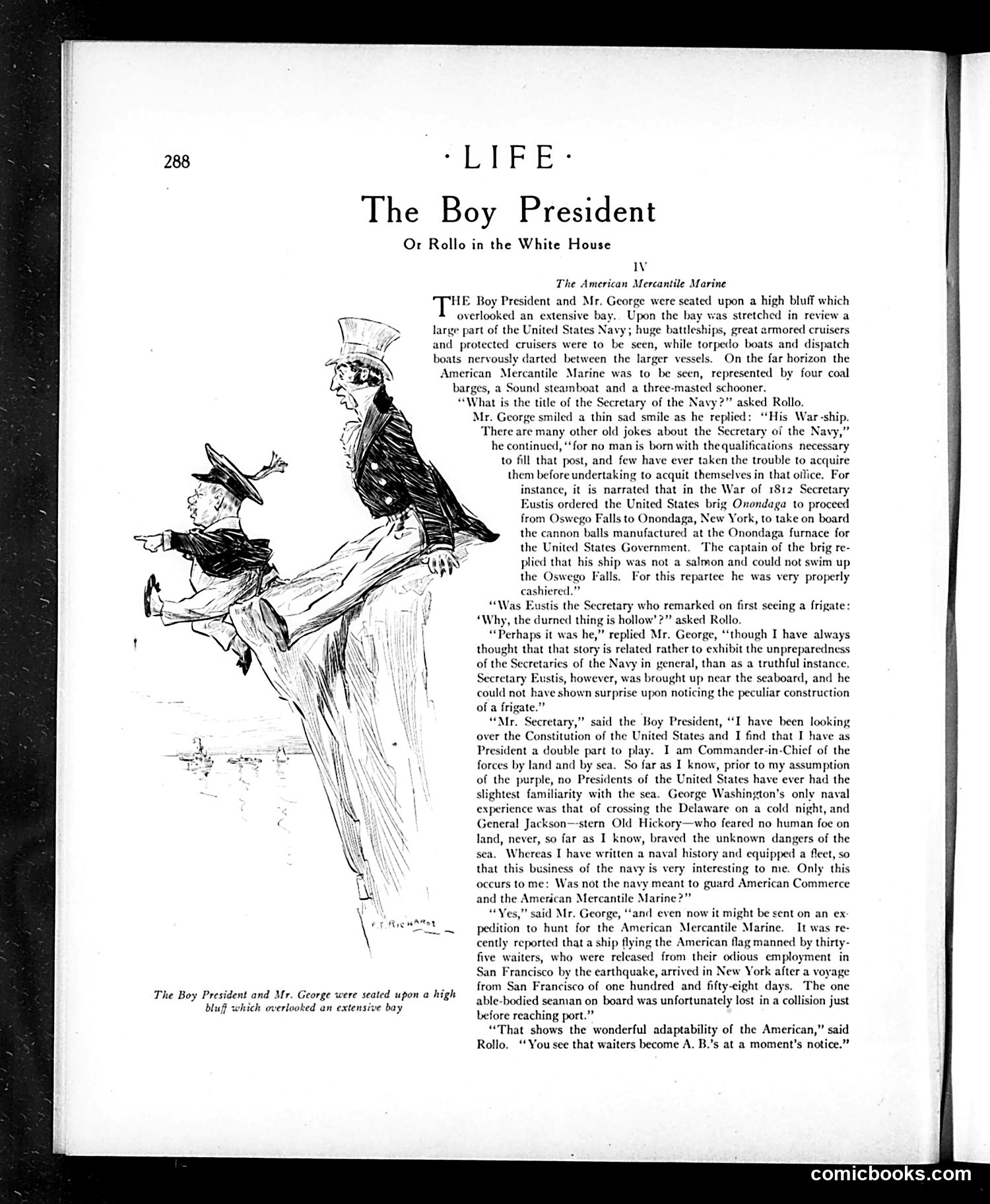
This Life magazine piece satirizes an unnamed young U.S. President (the "Boy President," likely a contemporary political figure) through dialogue with "Mr. George." The satire targets the President's naval inexperience and incompetence. The cartoon depicts the President as childlike and naive, sitting atop a naval official who bears him. The text mocks how the President claims constitutional authority over military forces despite having no practical experience—contrasting him with historical figures like Washington and Jackson. The joke centers on America's weak merchant marine: while the Navy displays impressive warships, the actual American commercial fleet consists only of four coal barges, a steamboat, and a schooner. The President naively questions whether the Navy should protect American commerce, revealing his ignorance of naval purpose. The anecdote about earthquake refugees becoming sailors lampoons American improvisation and desperation. Overall, the satire criticizes a young, unqualified President commanding forces he doesn't understand.
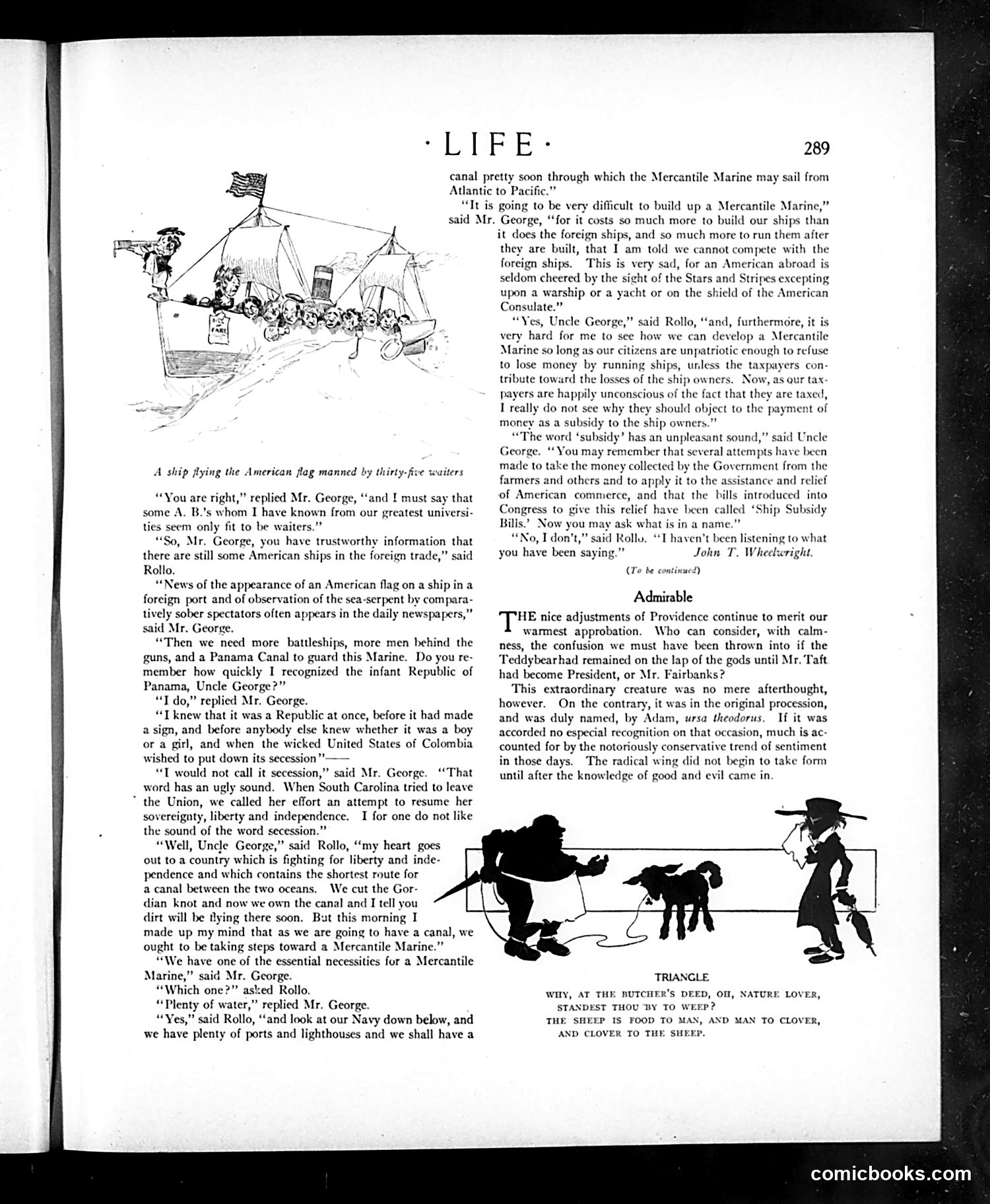
This page satirizes early 1900s American debates over shipping subsidies and naval power. The dialogue between "Uncle George" (likely representing an older, skeptical politician) and "Rollo" (an eager younger imperialist) mocks contemporary arguments for government support of American merchant ships. The satire targets: 1. **Ship Subsidy Bills**: Rollo advocates subsidizing American ship owners with taxpayer money, which "Uncle George" notes had repeatedly failed in Congress because the term "subsidy" sounded unpopular. 2. **Panama Canal**: Rollo boasts about quickly recognizing Panama's independence (the 1903 U.S.-backed separation from Colombia), viewing it as securing a canal route for American commerce. 3. **American Naval Weakness**: The joke about a ship "manned by thirty-five waiters" mocks the scarcity of American merchant vessels—so rare their sightings rival sea-serpent reports. The cartoon critiques American imperialist overreach and corporate welfare dressed in patriotic language, while "Uncle George" represents skeptical restraint.
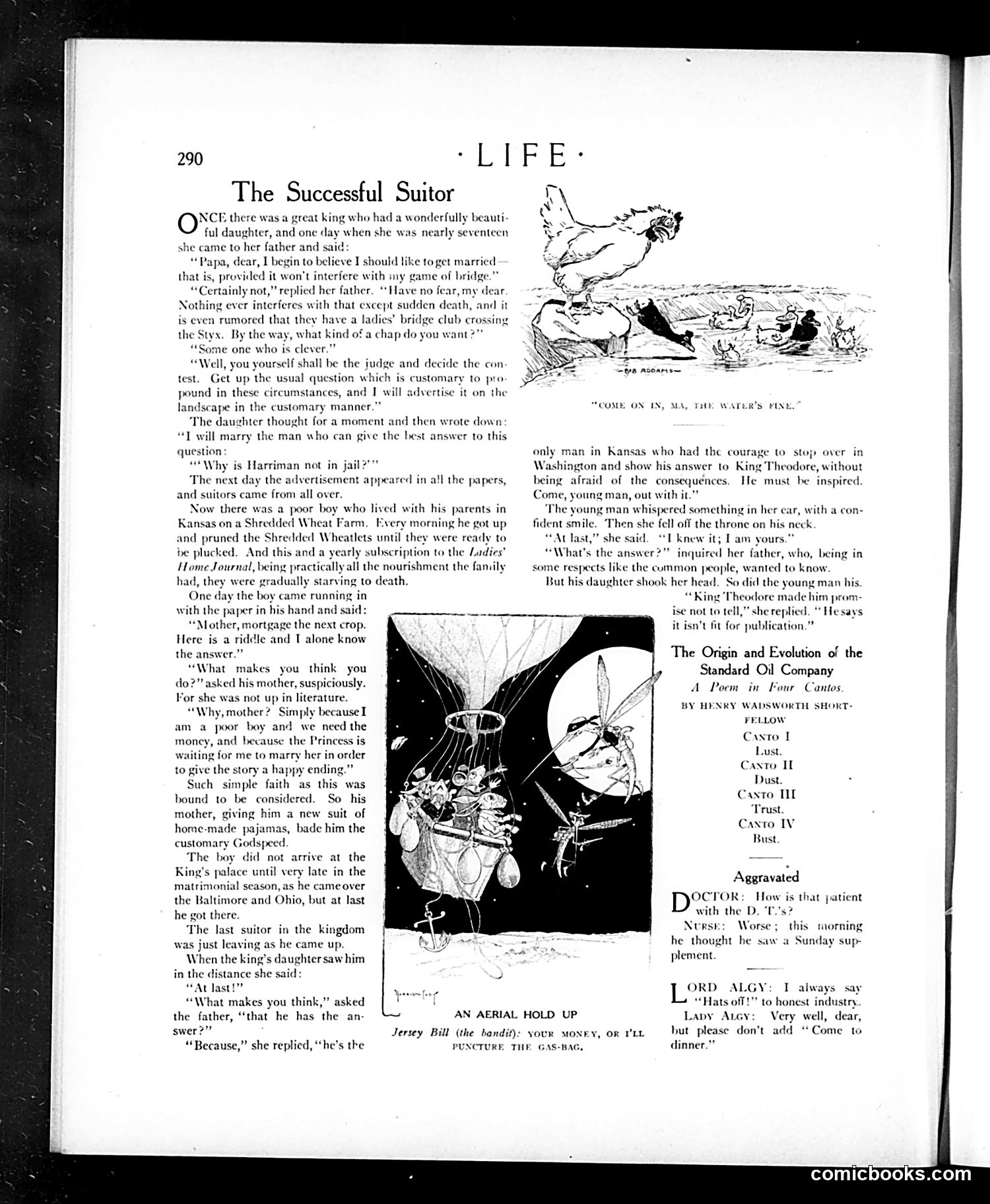
This fairy tale parody satirizes **E.H. Harriman**, a powerful railroad magnate of the early 1900s. The riddle—"Why is Harriman not in jail?"—references public outrage over his corporate practices and suspected criminality that went unpunished due to his wealth and influence. The joke: a poor Kansas farm boy (likely representing honest, ordinary Americans) wins the princess by being the only one brave enough to approach President Theodore Roosevelt directly with the answer, bypassing normal channels. The princess's refusal to publish the answer mocks the idea that Harriman's real offenses were too scandalous for public discussion. The accompanying cartoon about Standard Oil Company and the "Aggravated" jokes mock wealthy industrialists' untouchability. The satire targets the Gilded Age problem of ultra-rich monopolists operating above the law while common people starved.
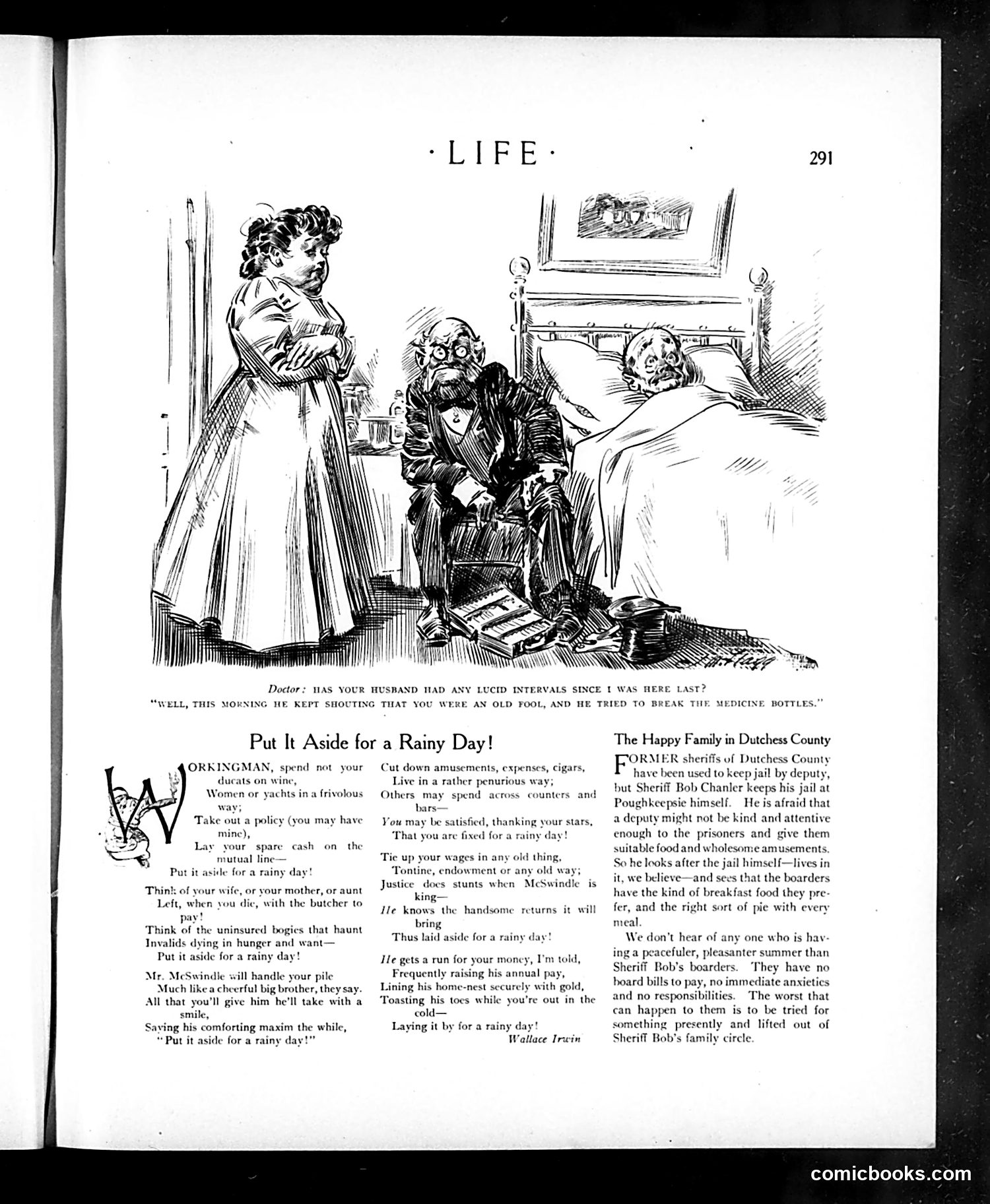
This page contains two satirical pieces: **"Put It Aside for a Rainy Day!"** (left) is a poem by Wallace Irwin mocking financial schemes targeting working-class men. It critiques insurance salesmen like "Mr. McSwindle" who pressure laborers to sacrifice everyday pleasures (wine, cigars, amusements) for policies and savings plans. The satire suggests these salesmen enrich themselves while their clients live in deprivation—the "rainy day" never comes for ordinary workers, only for the agents collecting fees. **"The Happy Family in Dutchess County"** (right) is a humorous anecdote about Sheriff Bob Chanler, who personally manages his jail in Poughkeepsie rather than delegating to a deputy. The satire is gentler here: it portrays the jail as oddly pleasant, with good food and pie, suggesting prisoners live better than free citizens. The piece gently mocks this unusual hands-on approach to incarceration. The top cartoon depicts a doctor visiting a delirious patient, with the wife reporting her husband's lucid moment involved insulting the doctor and attacking medicine bottles—dark humor about medical incompetence.
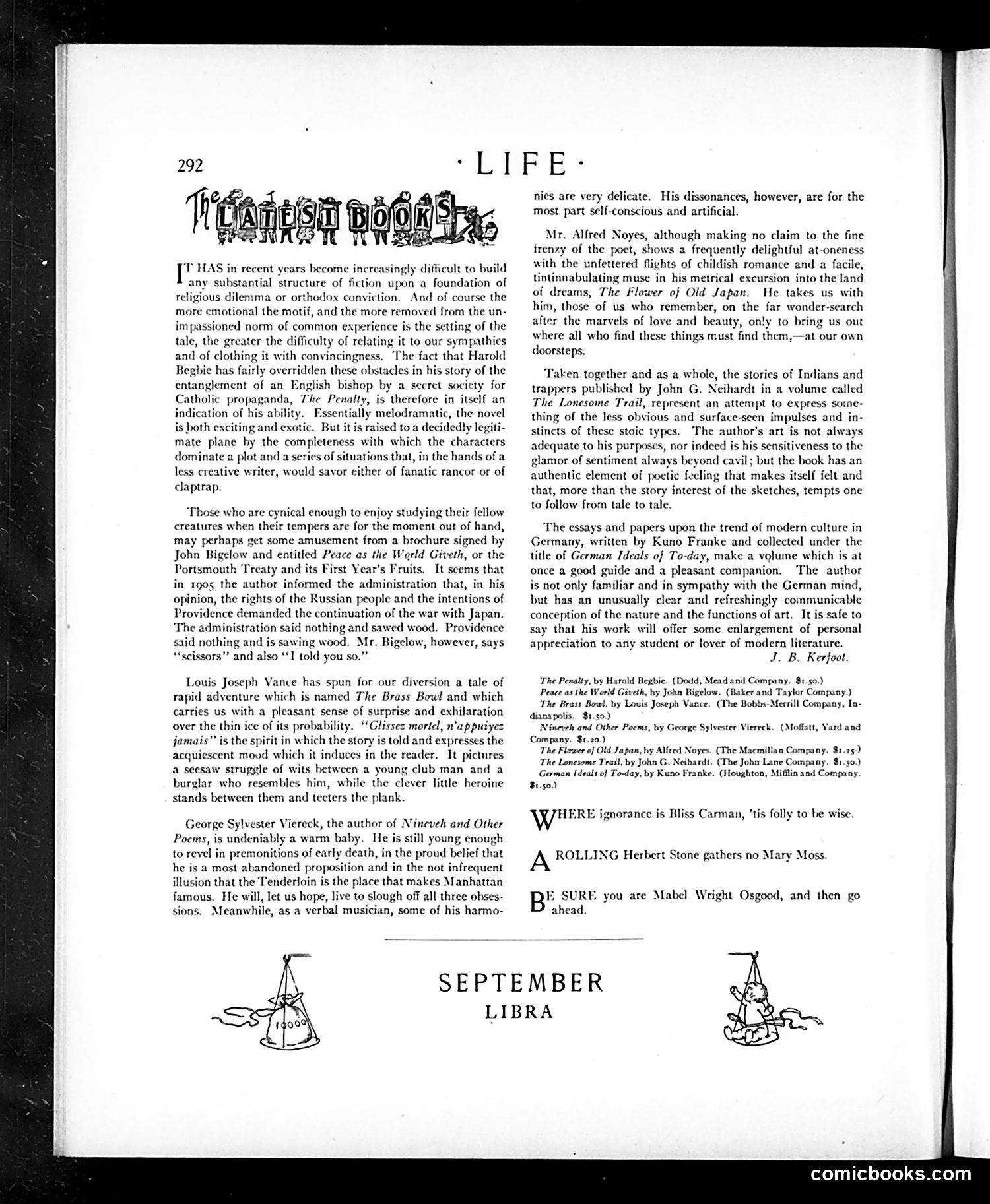
This page from *Life* magazine contains literary reviews and three brief satirical verses at the bottom, each mocking a contemporary figure through wordplay: 1. **"WHERE ignorance is Bliss Carman"** — A pun on poet Bliss Carman's name, suggesting he is foolish. 2. **"A ROLLING Herbert Stone gathers no Mary Moss"** — A play on the proverb "a rolling stone gathers no moss," substituting names of people (Herbert Stone, Mary Moss) to create nonsensical social commentary. 3. **"BE SURE you are Mabel Wright Osgood, and then go ahead"** — Another name-based pun, unclear without knowing who Mabel Wright Osgood was. The upper portion reviews recent literary works by Harold Begbie, John Bigelow, Louis Joseph Vance, George Sylvester Viereck, Alfred Noyes, and others—typical magazine content. The satirical verses represent *Life's* signature style: using clever name-play to gently mock contemporary cultural figures.
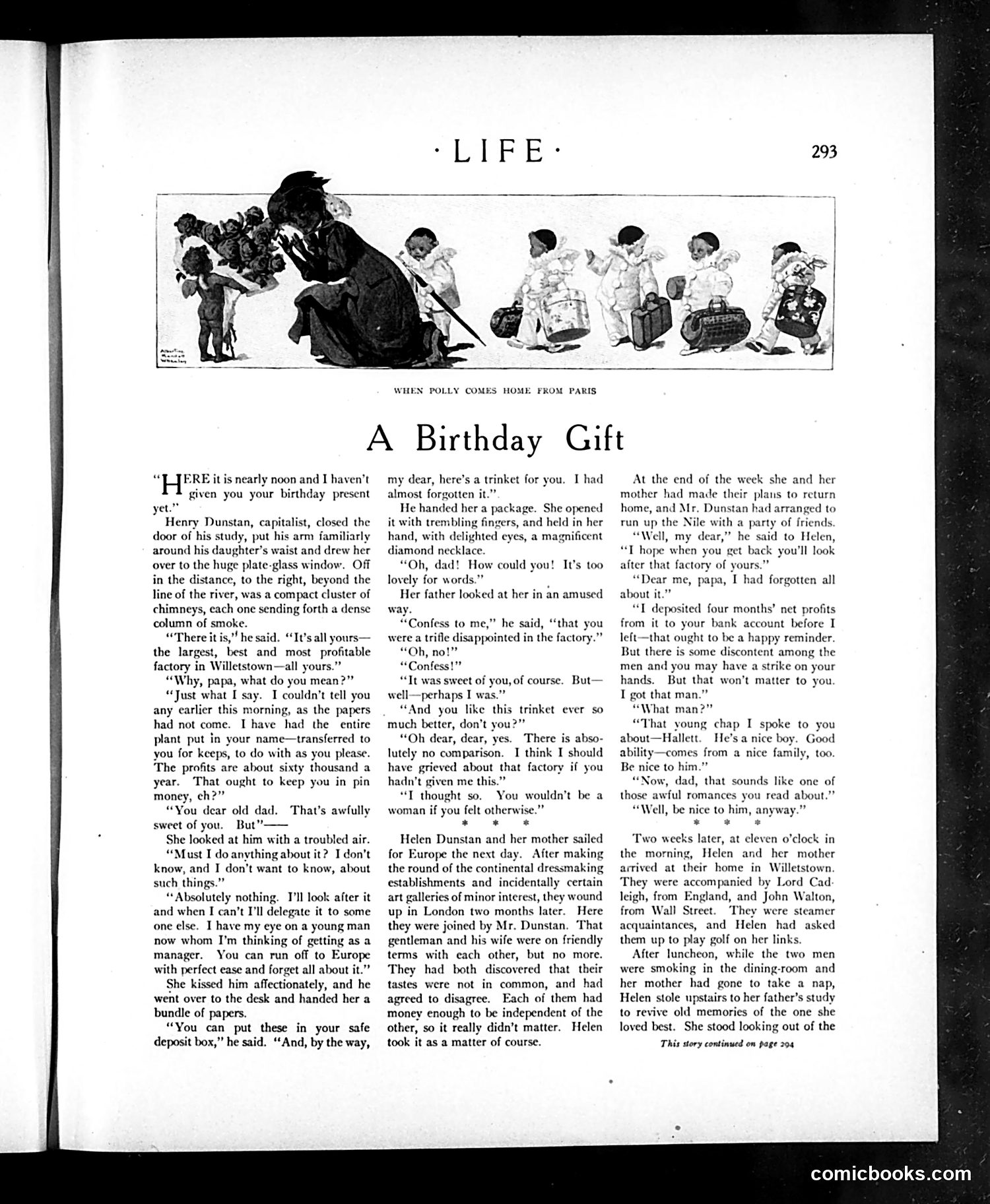
This story satirizes wealthy industrialists' casual approach to managing labor and property. Henry Dunstan, a capitalist, gives his daughter Helen a massive factory as a birthday present—but she's far more delighted by a diamond necklace, revealing the story's central joke: women of her class care nothing for actual business or workers' welfare. The satire deepens when Dunstan casually mentions labor unrest ("discontent among the men") and a potential strike, yet dismisses it as inconsequential to Helen. He's appointed a manager (Hallett) to actually run operations, allowing his daughter to enjoy profits while remaining willfully ignorant of factory conditions. The piece mocks both the indifference of wealthy heiresses toward their inherited businesses and capitalists' detachment from labor problems—suggesting that factory management requires neither knowledge nor genuine concern, only the right manager and passive income collection.
This page contains a serialized short story (not a political cartoon) depicting a class-conflict narrative. The plot centers on Helen Dunstan, a wealthy, frivolous young woman whose father owns a factory currently experiencing a labor strike. The factory manager, Hallett, visits to request she evacuate her home for safety, citing escalating tensions. Helen dismissively refuses—she's preoccupied with a golf tournament and uninterested in the workers' plight. The story critiques upper-class indifference to labor issues. Notably, Hallett himself expresses sympathy for the strikers' demands for eight-hour workdays, yet feels bound by fiduciary duty to oppose them. This suggests the story examines the tension between moral conviction and economic obligation during the early 20th-century labor movement in America. Helen's casual cruelty and obliviousness—her shock that workers dare "disturb the peace"—represents the satirical target: wealthy privilege disconnected from working-class struggle.
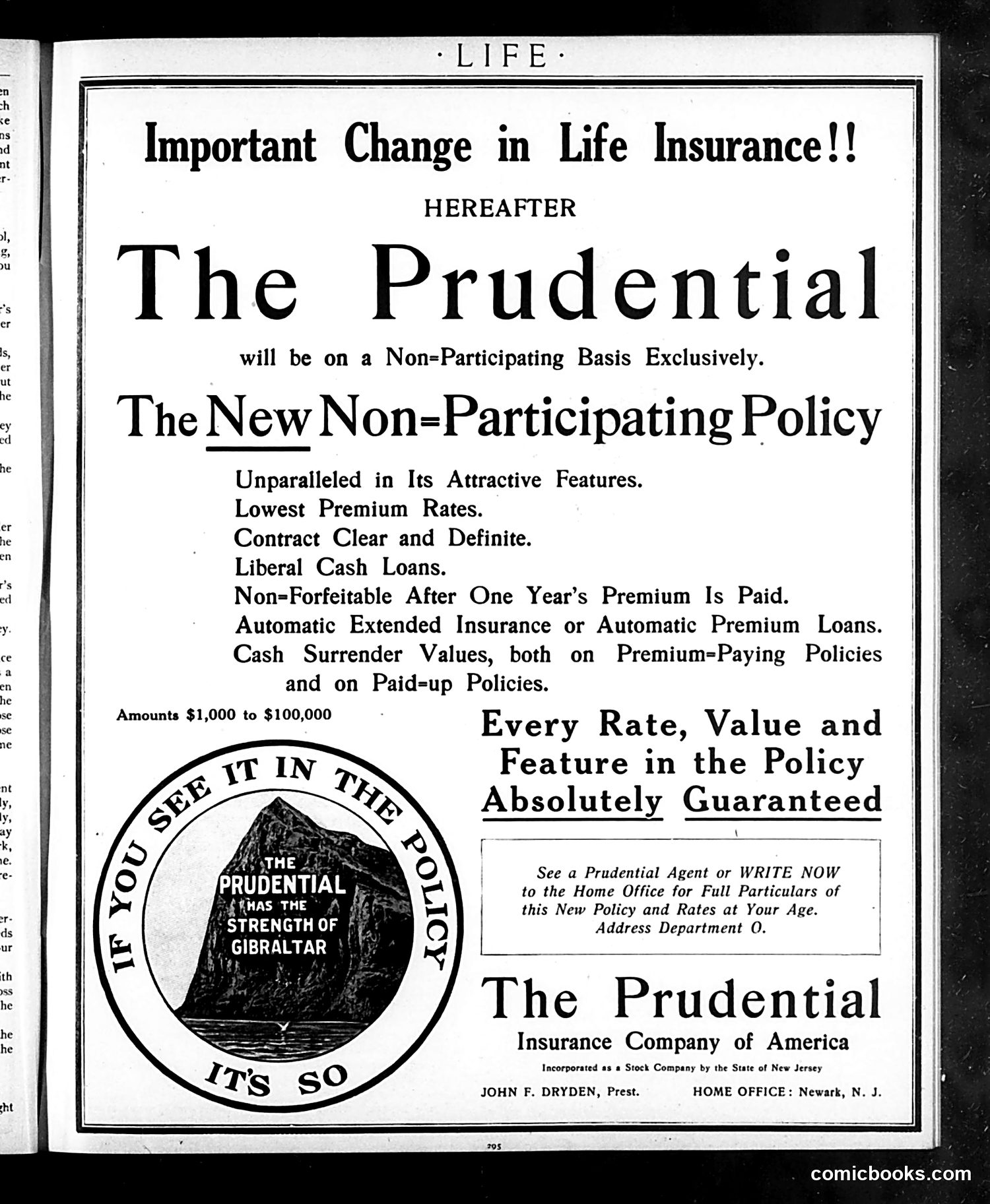
This page is **advertising, not satire or editorial content**. It announces The Prudential Insurance Company's shift to offering non-participating (non-dividend) life insurance policies exclusively. The circular logo features the Rock of Gibraltar with the slogan "It you see it in the policy, it's so"—a straightforward branding claim about policy reliability, not a political or social reference. The Gibraltar imagery was common in insurance advertising to suggest strength and permanence. The advertisement emphasizes competitive advantages: lowest premiums, clear contracts, liberal cash loans, and guaranteed rates. This was a genuine business announcement about a shift in Prudential's product lineup, not satirical commentary. For modern readers: this represents early-20th-century insurance marketing before regulatory disclosure requirements, where companies could make sweeping claims about their stability and terms directly to consumers through magazine ads.
This page is primarily **advertising with embedded fiction narrative**, not satire or political commentary. The advertisements promote "Onyx" hosiery and Pond's Extract Soap, using period beauty-culture messaging about correcting facial blemishes and fabric durability. The main text is a serialized short story about class conflict and romance. Helen, an wealthy factory owner, dismisses her manager Hallett after overhearing critical remarks. He's then shot (apparently by strikers during labor unrest mentioned in dinner conversation), and Helen nurses him back to health—suggesting reconciliation and romance across class lines. The "strike" references appear to be backdrop for the melodramatic plot rather than satirical commentary on labor politics. The story reflects early 20th-century anxieties about industrial conflict and the redemptive power of upper-class benevolence toward working-class men.
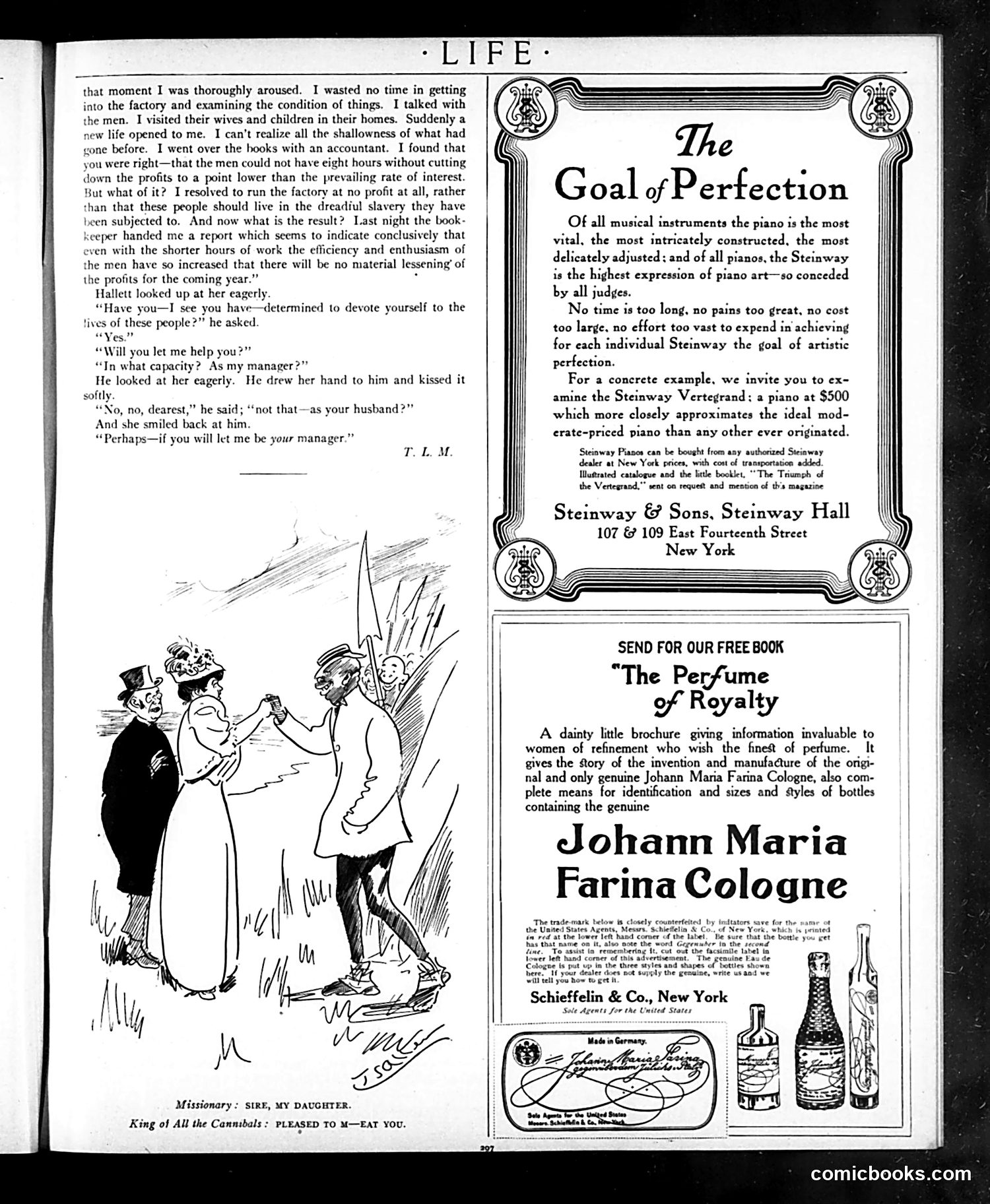
This page combines a serialized story with vintage advertisements. **The Cartoon/Story:** The small illustration labeled "Missionary: SIRE, MY DAUGHTER" and "King of All the Cannibals: PLEASED TO M—EAT YOU" depicts a crude colonial-era joke playing on cannibalism stereotypes. A missionary is offering his daughter to a tribal leader; the "joke" relies on the double meaning of "eat" (literally consuming flesh versus a euphemism for sexual relations). This reflects early 20th-century attitudes stereotyping non-Western peoples as savage and cannibalistic—deeply racist by modern standards. **The Story Excerpt:** The main text appears to be a morality tale about factory reform. A protagonist discovers workers toiling in poor conditions and, against business logic, reduces hours without profit—only to find efficiency and output actually *increase*. The narrative champions worker welfare over pure capitalism, concluding with a romantic proposal where the female character gains managerial authority. **The Advertisements:** Two full-page ads for Steinway pianos and Johann Maria Farina Cologne occupy the right side, using appeals to quality and refinement typical of luxury goods marketing of the era.
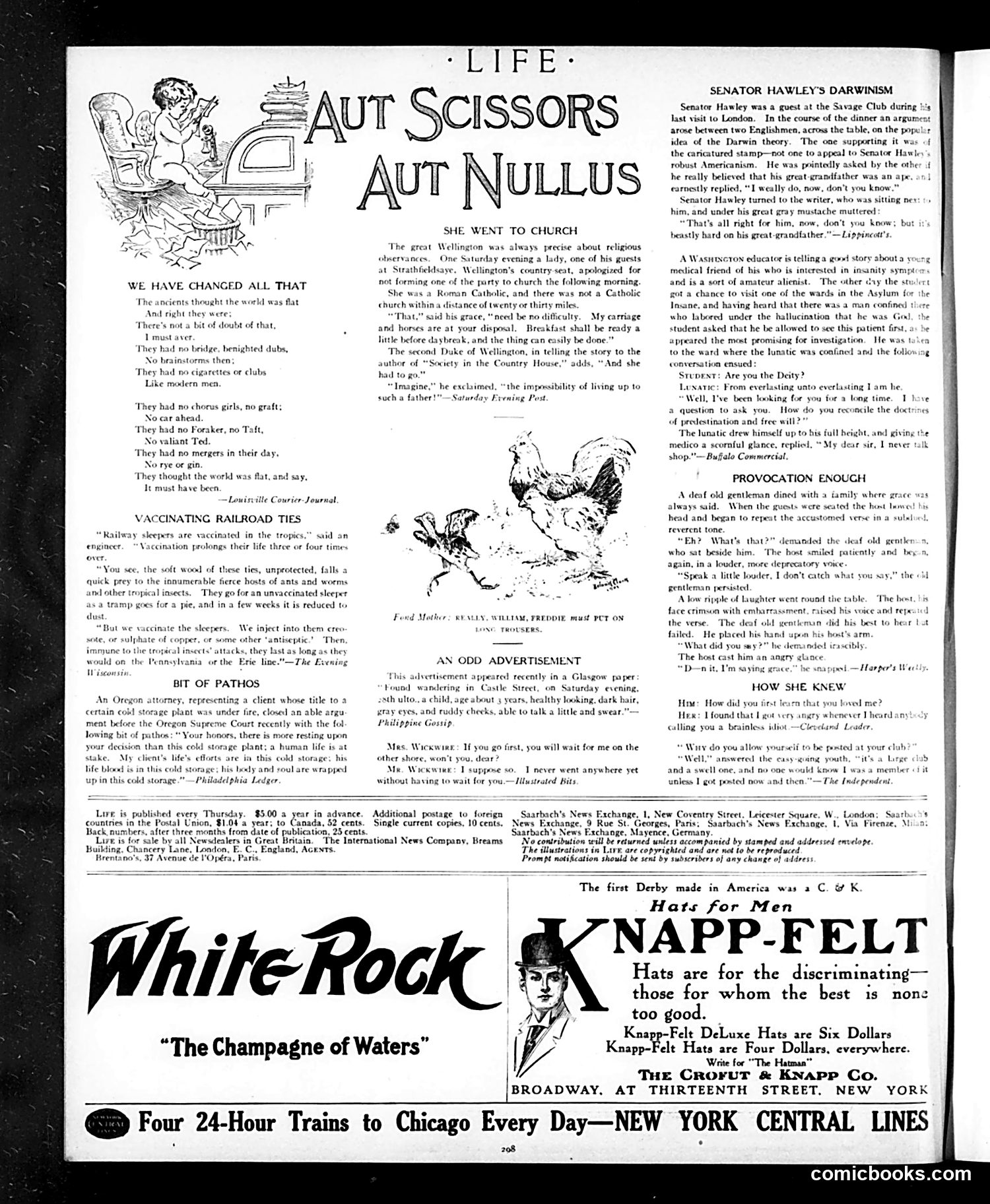
This page from Life magazine contains several humorous pieces mocking modern civilization and contemporary figures: **Main Cartoons/Articles:** 1. **"We Have Changed All That"** - A satirical poem contrasting ancient simplicity with modern complications (railroads, politicians like Foraker and Taft, stock mergers, automobiles). The joke: progress hasn't necessarily improved humanity. 2. **"Vaccinating Railroad Ties"** - Anecdote about treating wooden railroad ties with creosote to prevent insect damage in tropical climates, presented as absurdly technical problem-solving. 3. **"She Went to Church"** - Anecdote about the Duke of Wellington offering his carriage to a Catholic guest unable to attend services, highlighting Victorian propriety and religious accommodation. 4. **"Bit of Pathos"** - A lawyer's emotional appeal in court, emphasizing human stakes over mere property disputes. 5. **"Senator Hawley's Darwinism"** - References a debate at London's Savage Club about Darwin's theory (visible in header). The page satirizes late-19th/early-20th century American society, technological obsession, and political figures through humorous anecdotes rather than visual cartoons.
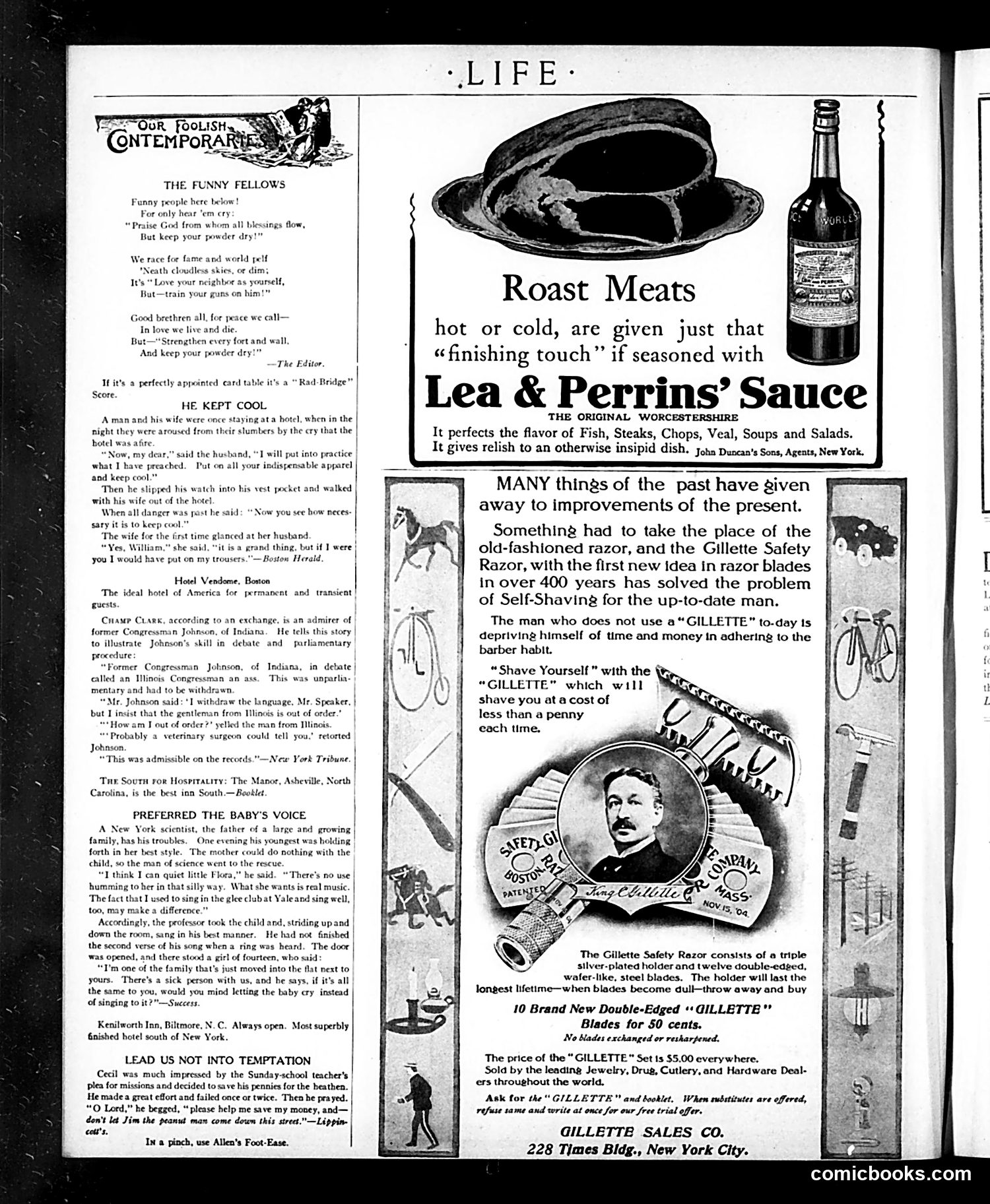
This is primarily an **advertising and humor page** rather than political satire. The content includes: **Left column:** Humorous anecdotes and poems about everyday life—a husband forgetting his trousers during a hotel emergency, a congressman's witty parliamentary insult, a scientist's singing disturbing neighbors, and a child's prayer to avoid temptation from a peanut vendor. These are light social observations rather than political commentary. **Top left:** "Our Foolish Contemporary" is a brief satirical poem mocking hypocrisy—people preach peace and Christian virtue ("Love your neighbor") while simultaneously preparing for war ("keep your powder dry"). This critiques the contradiction between religious/moral rhetoric and military preparation, likely reflecting early 20th-century tensions. **Right side:** Full-page advertisements for Lea & Perrins' Sauce and Gillette Safety Razors—the latter emphasizing modernity and convenience over old-fashioned barbering. The page reflects *Life's* mix of gentle social humor and consumer advertising typical of the era.
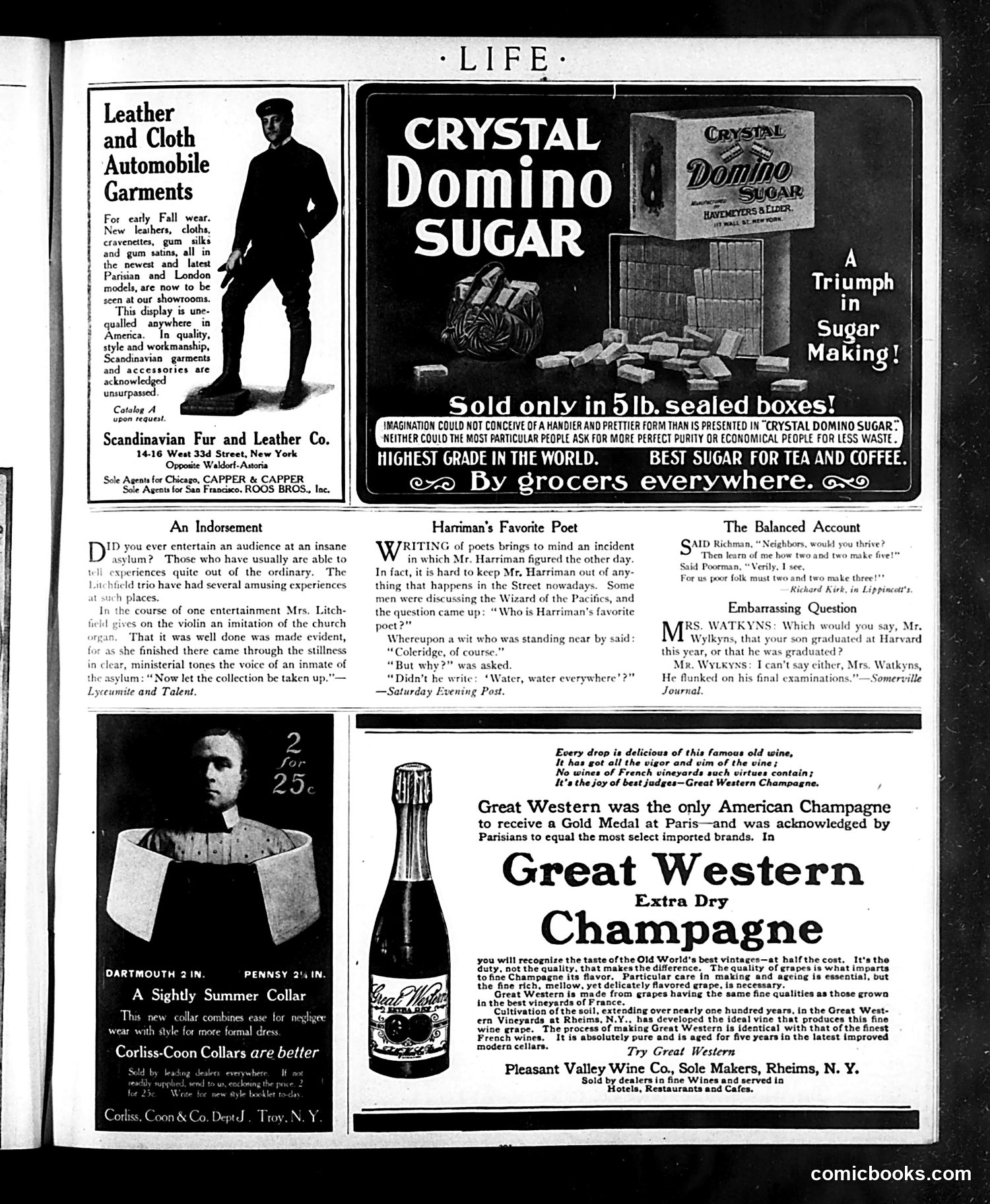
This is primarily an **advertising page** from Life magazine, not a political cartoon. The page contains multiple unrelated advertisements and brief humorous anecdotes typical of early 20th-century magazines. The notable content includes: **"Harriman's Favorite Poet"** — A joke about railroad magnate E.H. Harriman. Someone quips that his favorite poet is Coleridge, claiming he wrote "Water, water everywhere" (actually Coleridge's line), as a play on Harriman's railroad wealth and influence—suggesting he controls everything, even water. **"Embarrassing Question"** — A Harvard graduate's father admits his son flunked his final exams, subverting expectations of academic achievement. **"The Balanced Account"** — A satirical poem about how poor people's arithmetic differs from the wealthy: the rich claim "two and two make five," while the poor must accept "two and two make three"—critiquing class inequality and dishonesty in accounting. The remainder consists of period advertisements for automobiles, sugar, collars, and champagne.
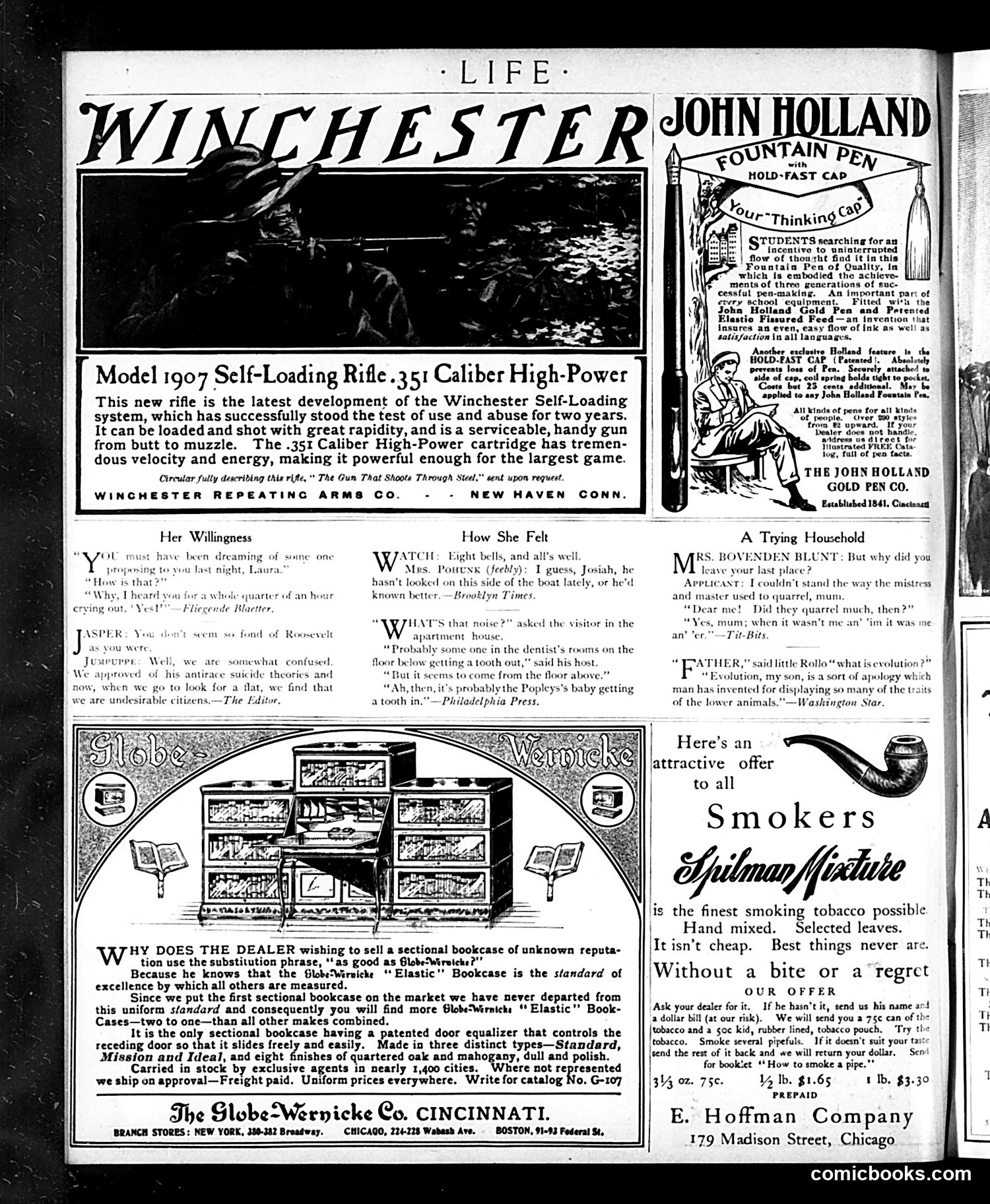
This page is primarily **advertising**, not satire or political commentary. It contains product advertisements typical of early 1900s Life magazine: 1. **Winchester rifle** (top left): Promotes the 1907 Model self-loading rifle, emphasizing its power and reliability for hunting large game. 2. **John Holland fountain pen** (top right): Markets a quality pen to students, highlighting patented features like the "hold-fast cap" and reliable ink flow. 3. **Globe-Wernicke bookcase** (center): Advertises sectional bookcases, claiming superiority over competitors through standardized quality and a patented door mechanism. 4. **Spilman Mixture tobacco** (right): Offers smoking tobacco with a promotional deal—customers can try it risk-free. The small comic vignettes interspersed ("Her Willingness," "How She Felt," etc.) are brief humorous sketches unrelated to the advertisements, typical of Life's format as a satirical magazine mixing humor with advertising content.
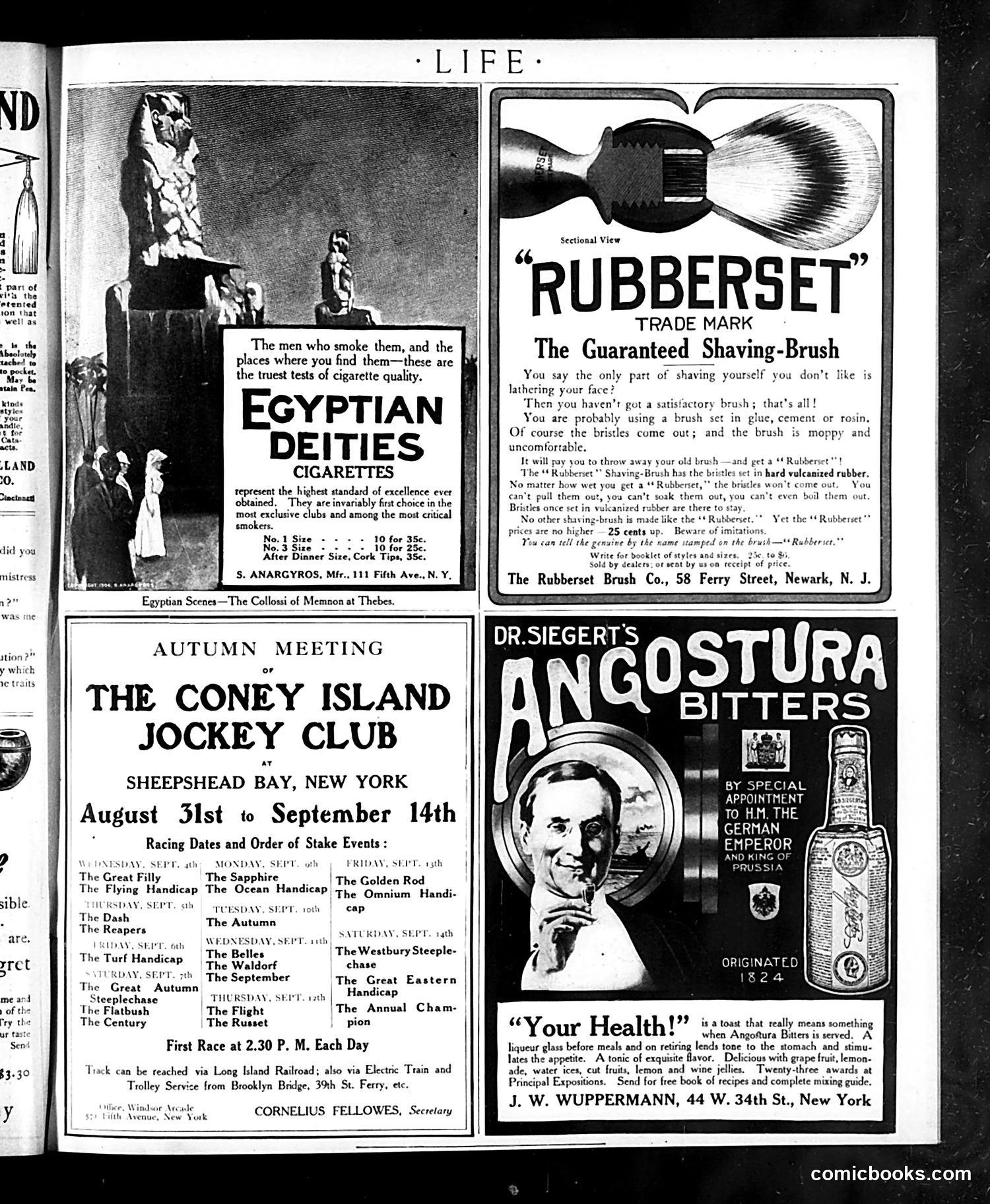
This page from *Life* magazine is primarily **advertising**, not satirical content. It contains four commercial advertisements: 1. **Egyptian Deities Cigarettes** — Appeals to luxury consumers by claiming the brand is "first choice in the most exclusive clubs," using snobbish language about "critical smokers" to market cigarettes. 2. **Rubberset Shaving Brush** — Advertises vulcanized rubber bristles as superior to glue/cement-set alternatives, positioning the product as scientifically advanced and durable. 3. **Coney Island Jockey Club** — Announces horse racing events at Sheepshead Bay, New York for August-September. 4. **Dr. Siegert's Angostura Bitters** — Markets digestive bitters as a health tonic, featuring imperial endorsements ("By Special Appointment to H.M. The German Emperor"). The page reflects early 20th-century advertising strategies: **appeals to exclusivity, pseudoscientific claims, and imperial/aristocratic authority** to sell products to aspirational middle and upper-class readers.
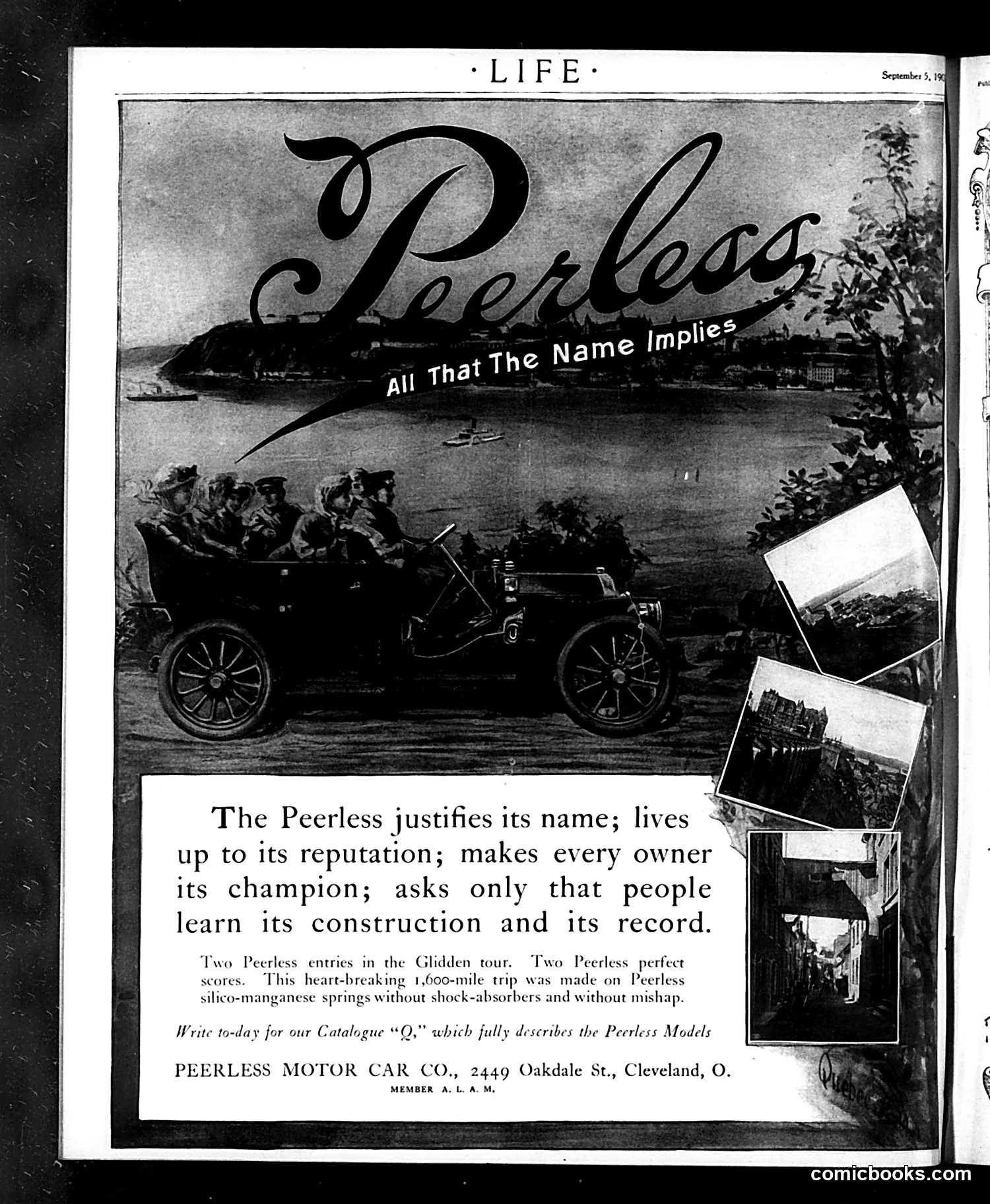
This is **not a political cartoon or satirical content**—it's a full-page automobile advertisement from Life magazine (September 5, 1912). The page promotes the **Peerless Motor Car**, manufactured in Cleveland, Ohio. The large stylized text "Peerless" with the tagline "All That The Name Implies" dominates the upper portion. Below is an illustration of an early open-air automobile with passengers, set against a scenic landscape with water and buildings. The ad emphasizes the car's reliability by referencing its performance in the "Glidden tour"—a real, prestigious long-distance automobile reliability competition of that era. The text claims two Peerless vehicles achieved "perfect scores" on a grueling 1,600-mile journey without mishap, despite using only springs and no shock-absorbers. Three small photographs on the right show scenic tour locations. The advertisement concludes with a call-to-action encouraging readers to request a catalog. This represents typical early automotive advertising: emphasizing durability and mechanical achievement to build consumer confidence in emerging automobile technology.