
Life, 1907-09-05 · page 20 of 36
Life — September 5, 1907 — page 20: what you’re looking at
What you’re looking at
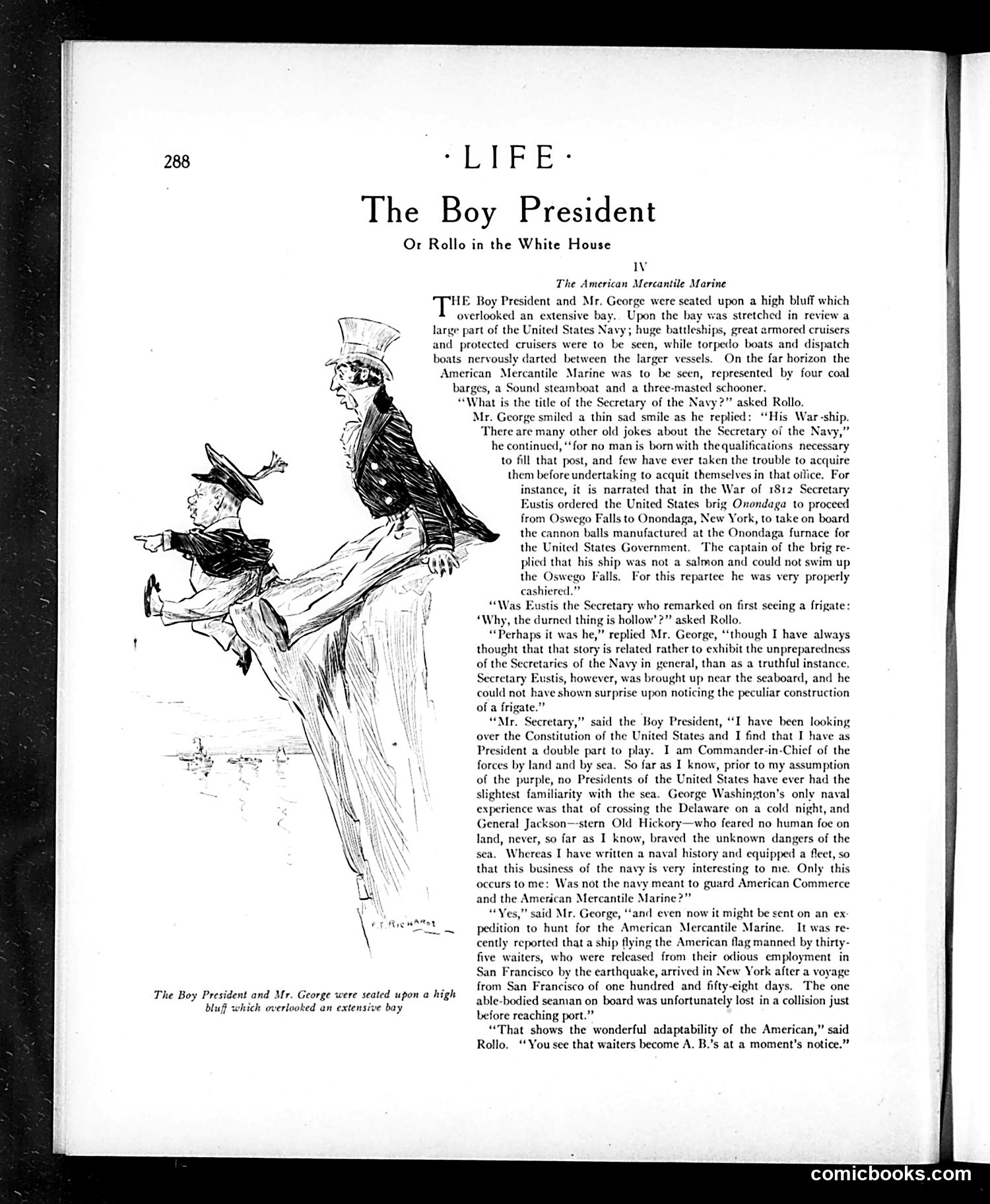
This Life magazine piece satirizes an unnamed young U.S. President (the "Boy President," likely a contemporary political figure) through dialogue with "Mr. George." The satire targets the President's naval inexperience and incompetence. The cartoon depicts the President as childlike and naive, sitting atop a naval official who bears him. The text mocks how the President claims constitutional authority over military forces despite having no practical experience—contrasting him with historical figures like Washington and Jackson. The joke centers on America's weak merchant marine: while the Navy displays impressive warships, the actual American commercial fleet consists only of four coal barges, a steamboat, and a schooner. The President naively questions whether the Navy should protect American commerce, revealing his ignorance of naval purpose. The anecdote about earthquake refugees becoming sailors lampoons American improvisation and desperation. Overall, the satire criticizes a young, unqualified President commanding forces he doesn't understand.
📄 Transcribed text from this page (OCR, searchable)
Machine-transcribed from the original scan — historical spelling and the odd misread are preserved.
bTPE The Boy President Or Rollo in the White House Vv The American Mercantile Marine HE Boy President and Mr. George were seated upon a high bluff which overlooked an extensive bay. Upon the bay was stretched in review a large part of the United States ; huge battleships, great armored cruisers and protected cruisers were to be seen, while torpedo boats and dispatch boats nervously darted between the larger vessels. On the far horizon the American Mercantile Marine was to be seen, represented by four coal barges, a Sound steamboat and a three-masted schooner. “What is the title of the Secretary of the Navy?” asked Rollo. Mr. George smiled a thin sad smile as he replied: ‘‘His War -ship. There are many other old jokes about the Secretary of the Navy,” he continued, ‘‘for no man is born with the qualifications necessary to fill that post, and few have ever taken the trouble to acquire them before undertaking to acquit themselves in that ollice. For instance, it is narrated that in the War of 1812 Secretary Eustis ordered the United States brig Onondaga to proceed from Oswego Falls to Onondaga, New York, to take on board the cannon balls manufactured at the Onondaga furnace for the United States Government. The captain of the brig re- plied that his ship was not a salmon and could not swim up the Oswego Falls, For this repartee he was very properly cashiered.” tis the Secretary who remarked on first seeing a frigate: ‘Why, the durned thing is hollow’ ?” asked Rollo. “Perhaps it was he,” replied Mr. George, “though I have always thought that that story is related rather to exhibit the unpreparedness of the Secretaries of the Navy in general, than as a truthful instance. Secretary Eustis, however, was brought up near the seaboard, and he could not have shown surprise upon noticing the peculiar construction of a frigate.” “Mr. Secretary,” said the Boy President, “I have been looking over the Constitution of the United States and I find that I have as President a double part to play. I am Commander-in-Chief of the forces by land and by sea. So far as 1 know, prior to my assumption of the purple, no Presidents of the United States have ever had the slightest familiarity with the sea. George Washington’s only naval experience was that of crossing the Delaware on a cold night, and General Jackson—stern Old Hickory—who feared no human foe on land, never, so far as I know, braved the unknown dangers of the is I have written a naval history and equipped a fleet, so that this business of the navy is very interesting to me. Only this occurs tome: Was not the navy meant to guard American Commerce and the American Mercantile Marine?” “Yes,” said Mr. George, “and even now it might be sent on an ex pedition to hunt for the American Mercantile Marine. It was re- cently reported that a ship flying the American flag manned by thirty five waiters, who were released from their odious employment in San Francisco by the earthquake, arrived in New York after a voyage from San Francisco of one hundred and fifty-eight days. The one able-bodied seaman on board was unfortunately lost in a collision just before reaching port.” “That shows the wonderful adaptability of the American,” said Rollo. ‘You see that waiters become A. B.’s at a moment's notice.” 5 Rig hAtor The Boy President and Mr. George were seated upon a high bluff which overlooked an extensive bay comicbooks.com