
Life, 1907-09-05 · page 21 of 36
Life — September 5, 1907 — page 21: what you’re looking at
What you’re looking at
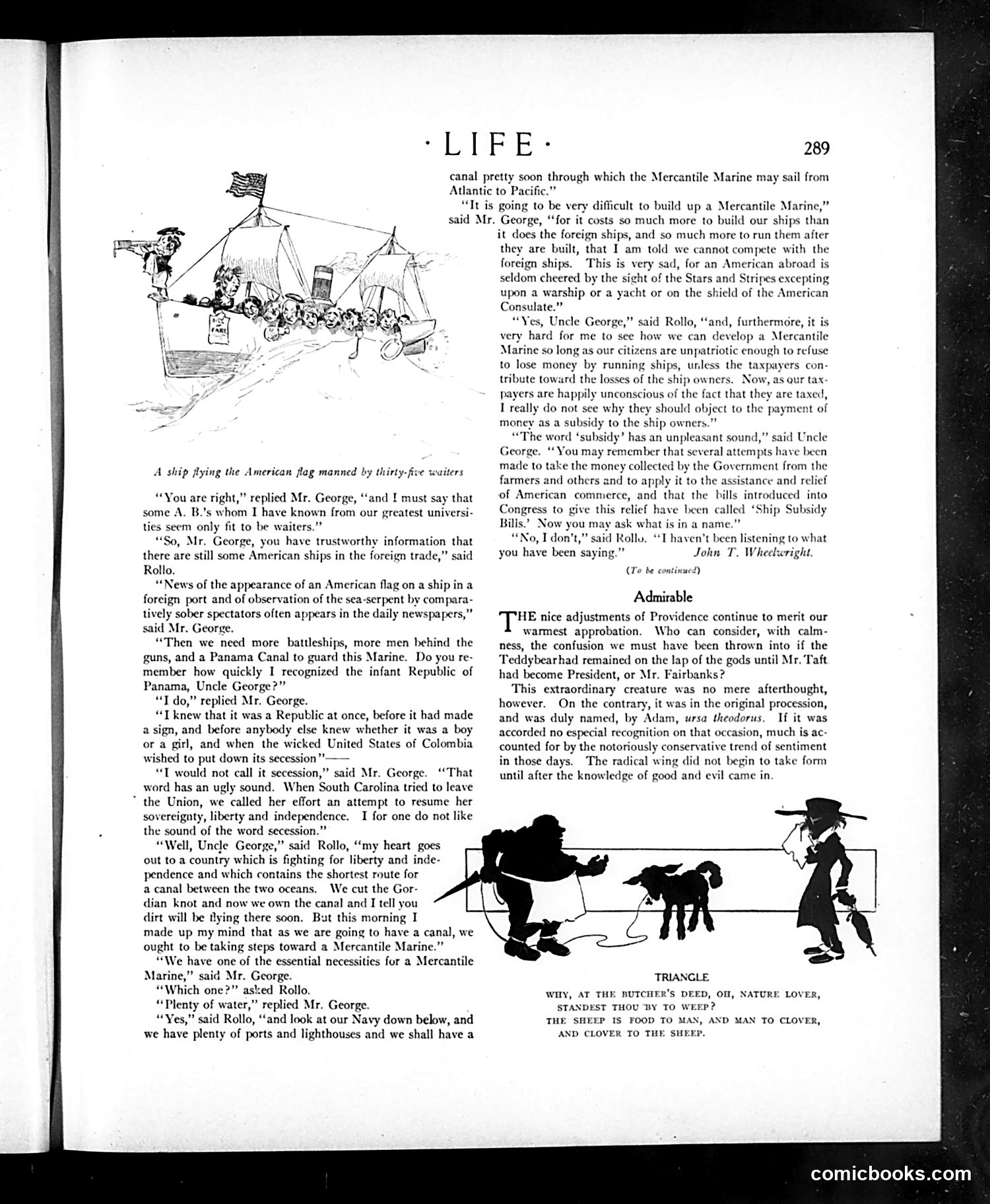
This page satirizes early 1900s American debates over shipping subsidies and naval power. The dialogue between "Uncle George" (likely representing an older, skeptical politician) and "Rollo" (an eager younger imperialist) mocks contemporary arguments for government support of American merchant ships. The satire targets: 1. **Ship Subsidy Bills**: Rollo advocates subsidizing American ship owners with taxpayer money, which "Uncle George" notes had repeatedly failed in Congress because the term "subsidy" sounded unpopular. 2. **Panama Canal**: Rollo boasts about quickly recognizing Panama's independence (the 1903 U.S.-backed separation from Colombia), viewing it as securing a canal route for American commerce. 3. **American Naval Weakness**: The joke about a ship "manned by thirty-five waiters" mocks the scarcity of American merchant vessels—so rare their sightings rival sea-serpent reports. The cartoon critiques American imperialist overreach and corporate welfare dressed in patriotic language, while "Uncle George" represents skeptical restraint.
📄 Transcribed text from this page (OCR, searchable)
Machine-transcribed from the original scan — historical spelling and the odd misread are preserved.
ERE * 289 canal pretty soon through which the Mercantile Marine may sail from Atlantic to Pacific.” “Tt is going to be very difficult to build up a Mercantile Marine,” said Mr. George, ‘for it costs so much more to build our ships than A ship fying the American flag manned by thirty-five waiters “You are right,” replied Mr. George, ‘and I must say that some A. B.’s whom I have known from our greatest universi- ties seem only fit to be waiters.” So, Mr. George, you have trustworthy information that there are still some American ships in the foreign trade,” said Rollo. “News of the appearance of an American flag on a ship ina foreign port and of observation of the sea-serpent by compara- tively sober spectators often appears in the daily newspapers,” said Mr. George. “Then we need more battleships, more men behind the guns, and a Panama Canal to guard this Marine. Do you re- member how quickly I recognized the infant Republic of Panama, Uncle George?” “I do,” replied Mr. George. “I knew that it was a Republic at once, before it had made a sign, and before anybody else knew whether it was a boy or a girl, and when the wicked United States of Colombia wished to put down its secession ”’—— “T would not call it secession,” said Mr. George. ‘That word has an ugly sound. When South Carolina tried to leave * the Union, we called her effort an attempt to resume her sovereignty, liberty and independence. I for one do not like the sound of the word secession.” Well, Uncle George,” said Rollo, ‘my heart goes out to a country which is fighting for liberty and inde- pendence and which contains the shortest route for a canal between the two oceans. We cut the Gor- dian knot and now we own the canal and I tell you dirt will be fying there soon. But this morning I made up my mind that as we are going to have a canal, we ought to be taking steps toward a Mercantile Marine.” “We have one of the essential necessities for a Mercantile Marine,” said Mr. George. “Which one?” asked Rollo. “Plenty of water,” replied Mr. George. “Yes,” said Rollo, ‘‘and look at our Navy down below, and we have plenty of ports and lighthouses and we shall have a it does the foreign ships, and so much more to run them after they are built, that I am told we cannot compete with the foreign ships. sad, for an American abroad i seldom cheered by the sight of the Stars and Stripes excepting upon a warship or a yacht or on the shield of the American Consulate.” “Yes, Uncle George,” said Rollo, ‘and, furthermore, it i very hard for me to see how we can develop a Mercantile Marine so long as our citizens are unpatriotic enough to refuse to lose money by running ships, unless the taxpayers con- tribute toward the losses of the ship owners. Now, as our tax payers are happily unconscious of the fact that they are taxed, I really do not see why they should object to the payment of money as a subsidy to the ship owners.” “The word ‘subsidy’ has an unpleasant sound,” said Uncle George. ‘You may remember that several attempts have been made to take the money collected by the Government from the farmers and others and to apply it to the assistance and relief of American commerce, and that the bills introduced into Congress to give this relief have been called ‘Ship Subsidy Bills.’ Now you may ask what is in a name.” “No, Tdon’t,” said Rollu, “I haven't bee you have been saying.” John 1 (To be continued) Admirable TH nice adjustments of Providence continue to merit our warmest approbation. Who can consider, with calm- ness, the confusion we must have been thrown into if the Teddybearhad remained on the lap of the gods until Mr. Taft had become President, or Mr. Fairbanks? This extraordinary creature was no mere afterthought, however. On the contrary, it was in the original procession, and was duly named, by Adam, ursa theodorus, If it was accorded no especial recognition on that occasion, much is ac- counted for by the notoriously conservative trend of sentiment in those d: The radical wing did not begin to take form until after the knowledge of good and evil came in. listening to what Wheelwright. TRIANGLE WHY, AT THE BUTCHER'S DEED, OH, NATURE LOVER, STANDEST THOU BY TO WEEP? THE SHEEP IS FOOD TO MAN, AND MAN TO CLOVER, AND CLOVER TO THE SHEEP. comicbooks.com