
Life, 1907-09-05 · page 28 of 36
Life — September 5, 1907 — page 28: what you’re looking at
What you’re looking at
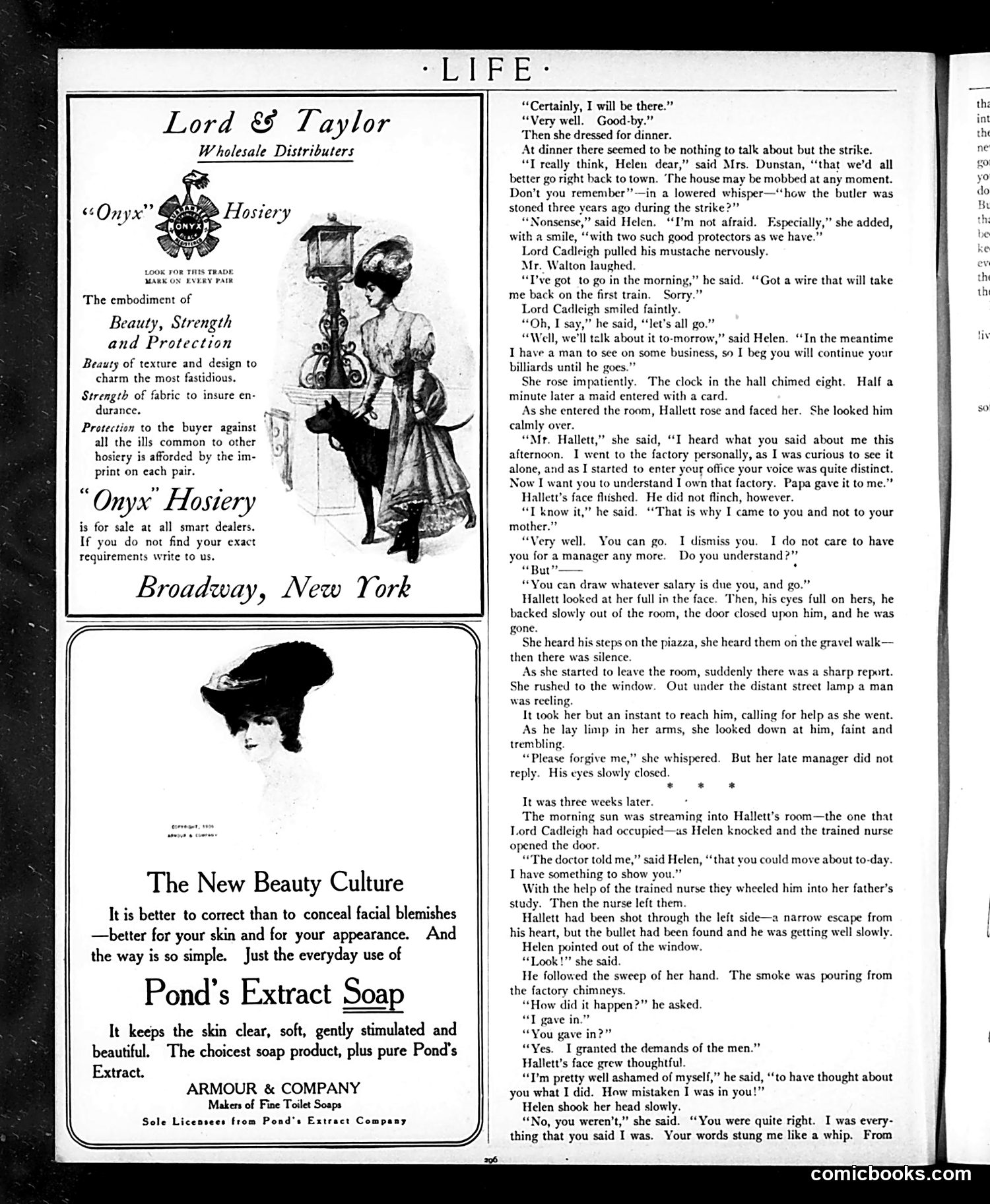
This page is primarily **advertising with embedded fiction narrative**, not satire or political commentary. The advertisements promote "Onyx" hosiery and Pond's Extract Soap, using period beauty-culture messaging about correcting facial blemishes and fabric durability. The main text is a serialized short story about class conflict and romance. Helen, an wealthy factory owner, dismisses her manager Hallett after overhearing critical remarks. He's then shot (apparently by strikers during labor unrest mentioned in dinner conversation), and Helen nurses him back to health—suggesting reconciliation and romance across class lines. The "strike" references appear to be backdrop for the melodramatic plot rather than satirical commentary on labor politics. The story reflects early 20th-century anxieties about industrial conflict and the redemptive power of upper-class benevolence toward working-class men.
📄 Transcribed text from this page (OCR, searchable)
Machine-transcribed from the original scan — historical spelling and the odd misread are preserved.
Lord & Taylor Wholesale Distributers LOOK FOR THIS TRADE MARK ON EVERY PALE The embodiment of Beauty, Strength and Protection Beauty of texture and design to charm the most fastidious. Strength of fabric to insure en- durance. Protection to the buyer against all the ills common to other hosiery is afforded by the im- print on each pair. “Onyx Hostery is for sale at all smart dealers. If you do not find your exact requirements write to us. Broadway, New York The New Beauty Culture It is better to correct than to conceal facial blemishes —better for your skin and for your appearance. And the way is so simple. Just the everyday use of Pond’s Extract Soap It keeps the skin clear, soft, gently stimulated and beautiful. The choicest soap product, plus pure Pond’s Extract. ARMOUR & COMPANY Makers of Fine Toilet Soaps Sole Licensees from Pond’s Extract Company “Certainly, I will be there.” “Very well. Good-by.” Then she dressed for dinner. At dinner there seemed to be nothing to talk about but the strike. “T really think, Helen dear,” said Mrs. Dunstan, ‘that we’d all better go right back to town. ‘The house may be mobbed at any moment. Don't you remember”—in a lowered whisper—“how the butler was stoned three years ago during the strike?” “Nonsense,” said Helen. ‘I’m not afraid. Especially,” she added, with a smile, “with two such good protectors as we have.” Lord Cadleigh pulled his mustache nervously. Mr. Walton laughed. “T've got to go in the morning,” he said. ‘Got a wire that will take me back on the first train. Sorry.” Lord Cadleigh smiled faintly. “Oh, I say,” he said, ‘let's all go.”” “Well, we'll talk about it to-morrow,” said Helen. “In the meantime I have a man to sce on some business, so I beg you will continue your billiards until he goes.” She rose impatiently. The clock in the hall chimed eight. Half a minute later a maid entered with a card. As she entered the room, Hallett rose and faced her. She looked him calmly over. “Mr. Hallett,” she said, “I heard what you said about me this afternoon. I went to the factory personally, as I was curious to see it alone, and as I started to enter your office your voice was quite distinct. Now I want you to understand I own that factory. Papa gave it to me.”” Hallett’s face flished. He did not flinch, however. “T know it,” he said. ‘That is why I came to you and not to your mother.” “Very well. You can go. I dismiss you. I do not care to have you fora manager any more. Do you understand?” “But”— . “You can draw whatever salary is due you, and go.” Hallett looked at her full in the face. Then, his eyes full on hers, he backed slowly out of the room, the door closed upon him, and he was gone. She heard his steps on the piazza, she heard them on the gravel walk— then there was silence. As she started to leave the room, suddenly there was a sharp report. She rushed to the window. Out under the distant strect lamp a man was reeling. It took her but an instant to reach him, calling for help as she went. As he lay limp in her arms, she looked down at him, faint and trembling, “Please forgive me,” she whispered. But her late manager did not reply. His eyes slowly closed. * * «* It was three weeks later. The morning sun was streaming into Hallett’s room—the one that Lord Cadleigh had occupit s Helen knocked and the trained nurse opened the door. “The doctor told me,” said Helen, “that you could move about to-day. I have something to show you.” With the help of the trained nurse they wheeled him into her father’s study. Then the nurse left them. Hallett had been shot through the left side—a narrow escape from his heart, but the bullet had been found and he was getting well slowly. Helen pointed out of the window. “Look!” she said. He followed the sweep of her hand. The smoke was pouring from the factory chimneys. “How did it happen?” he asked. “T gave in.” “You gave in?” “Yes. I granted the demands of the men.” Hallett’s face grew thoughtful. “I’m pretty well ashamed of myself,” he said, “‘to have thought about you what I did. How mistaken I was in you!” Helen shook her head slowly. “No, you weren't,” she said. “You were quite right. I was every- thing that you said I was. Your words stung me like a whip. From comicbooks.com