
Life, 1907-09-05 · page 16 of 36
Life — September 5, 1907 — page 16: what you’re looking at
What you’re looking at
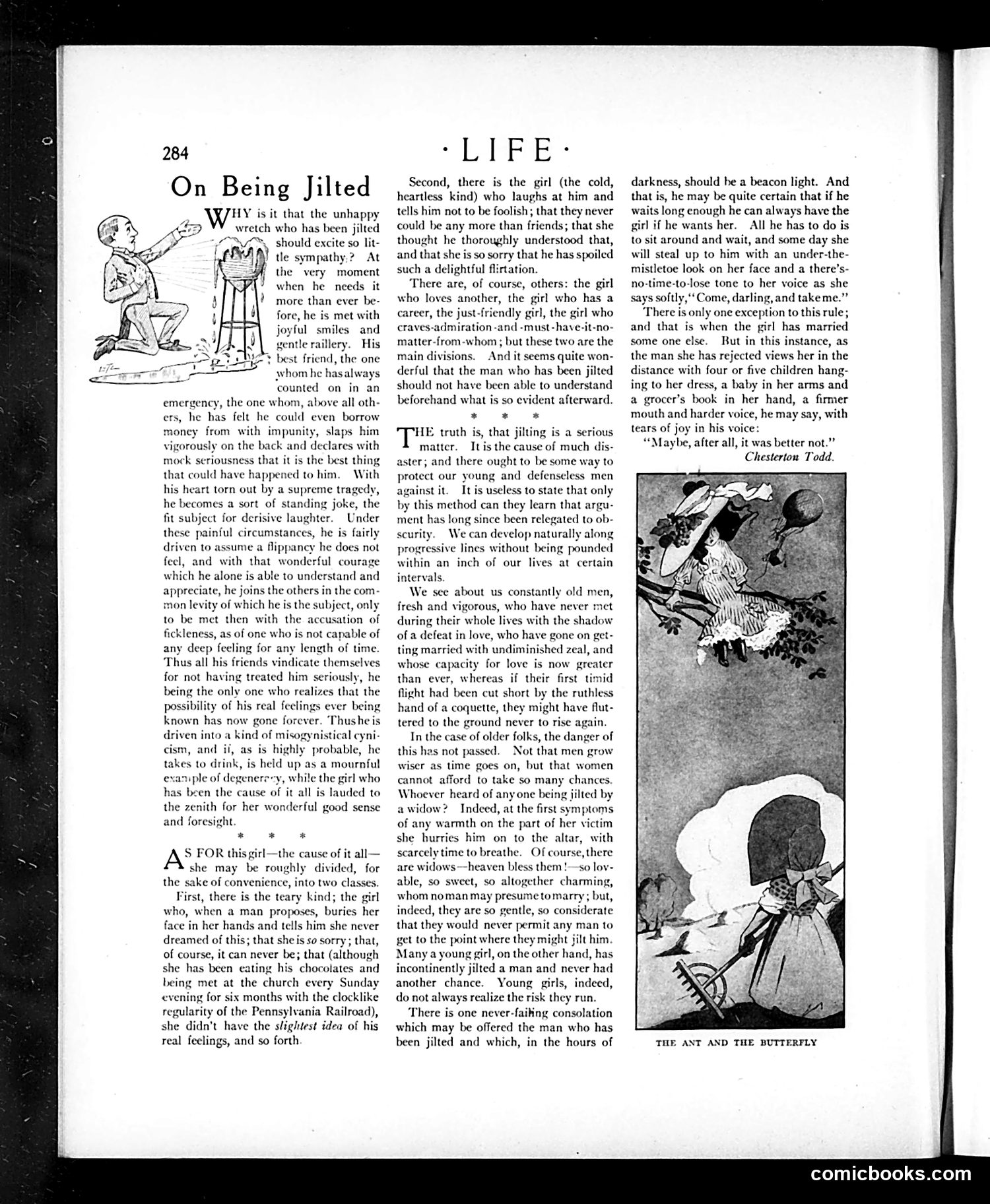
This article satirizes the social double-standard and mockery surrounding romantic rejection in early 20th-century America. The piece argues that jilted men face cruel, contradictory treatment: friends offer false cheer and mock sympathy rather than genuine support, yet also accuse him of fickleness for adopting the expected flippant attitude. This pushes rejected men toward bitterness and drinking, while the woman who rejected him is praised for her "good sense." The author categorizes women who jilt men into types: the "teary kind" (feigning innocence despite months of encouragement) and the "cold heartless kind" (laughing off his proposal). The satire suggests men cannot win—either destroyed by rejection or blamed for their destruction—while society celebrates women's rejections as wisdom. The accompanying illustration "The Ant and the Butterfly" (visible but not detailed here) likely reinforces themes of vulnerability and social hierarchy in romantic dynamics.
📄 Transcribed text from this page (OCR, searchable)
Machine-transcribed from the original scan — historical spelling and the odd misread are preserved.
284 On Being Jilted HY is it that the unhappy wretch who has been jilted should excite so lit- tle sympathy,? At the very moment when he needs it more than ever be- fore, he is met with joyful smiles and gentle raillery. His best friend, the one ywhom he has alw counted on in an emergency, the one whom, above all oth- ers, he has felt he could even borrow money from with impunity, slaps him vigorously on the back and declares with mock seriousness that it is the best thing that could have happened to him. With his heart torn out by a supreme tragedy, he becomes a sort of standing joke, the fit subject for derisive laughter. Under these painful circumstances, he is fairly driven to assume a flippancy he does not feel, and with that wonderful courage which he alone is able to understand and appreciate, he joins the others in the com- mon levity of which he is the subject, only to be met then with the accusation of fickleness, as of one who is not capable of any deep feeling for any length of time. Thus all his friends vindicate themselves for not having treated him seriously, he being the only one who realizes that the possibility of his real feelings ever being known has now gone forever. Thushe is driven into a kind of misogynistical cyni- cism, and ii, as is highly probable, he takes to drink, is held up as a mournful dle of degenereey, while the girl who, s been the cause of it all is lauded to the zenith for her wonderful good sense and foresight. * * S FOR this girl—the cause of it all— she may be roughly divided, for the sake of convenience, into two classes. First, there is the teary kind; the girl who, when a man proposes, buries her face in her hands and tells him she never dreamed of this; that sheis so sorry ; that, of course, it can never be; that (although she has been eating his chocolates and being met at the church every Sunday evening for six months with the clocklike regularity of the Pennsylvania Railroad), she didn’t have the slightest idea of his real feelings, and so forth ‘LIFE* Second, there is the girl (the cold, heartless kind) who laughs at him and tells him not to be foolish; that they never could be any more than friends; that she thought he thoroughly understood that, and that she is so sorry that he has spoiled such a delightful flirtation. There are, of course, others: the girl who loves another, the girl who has a carcer, the just-friendly girl, the girl who craves-admiration -and -must-have-it-no- matter-from-whom ; but these two are the main divisions. And it seems quite won- derful that the man who has been jilted should not have been able to understand beforehand what is so evident afterward. + * HE truth is, that jilting is a serious matter. It is the cause of much dis- aster; and there ought to be some way to protect our young and defenseless men against it. It is useless to state that only by this method can they learn that argu- ment has long since been relegated to ob- scurity. We can develop naturally along progressive lines without being pounded within an inch of our lives at certain interval: We see about us constantly old men, fresh and vigorous, who have never met during their whole lives with the shadow of a defeat in love, who have gone on get- ting married with undiminished zeal, and whose capacity for love is now greater than ever, whereas if their first timid flight had been cut short by the ruthless hand of a coquette, they might have flut- tered to the ground never to rise again. In the case of older folks, the danger of this has not passed. Not that men grow wiser as time goes on, but that women cannot afford to take so many chances. Whoever heard of any one being jilted by a widow? Indeed, at the first symptoms of any warmth on the part of her victim she hurries him on to the altar, with scarcely time to breathe. Of course, there are widows—heaven bless them! able, so sweet, so altogether charming, whom noman may presume tomarry ; but, indeed, they are so gentle, so considerate that they would never permit any man to get to the point where they might jilt him Many a young girl, on the other hand, has incontinently jilted a man and never had another chance. Young girls, indeed, do not always realize the risk they run. There is one never-faiting consolation which may be offered the man who has been jilted and which, in the hours of so lov- darkness, should be a beacon light. And that is, he may be quite certain that if he waits long cnough he can always have the girl if he wants her. All he has to do is t around and wait, and some day she will steal up to him with an under-the- mistletoe look on her face and a there’s- no-time-to-lose tone to her voice as she says softly,““Come, darling, and takeme.” ‘There is only one exception to this rule; and that is when the girl has married some one else. But in this instance, as the man she has rejected views her in the distance with four or five children hang- ing to her dress, a baby in her arms and a grocer’s book in her hand, a firmer mouth and harder voice, he may say, with tears of joy in his voice: “Maybe, after all, it was better not.” Chesterton Todd. THE ANT AND THE BUTTERFLY comicbooks.com