
Life, 1907-09-05 · page 24 of 36
Life — September 5, 1907 — page 24: what you’re looking at
What you’re looking at
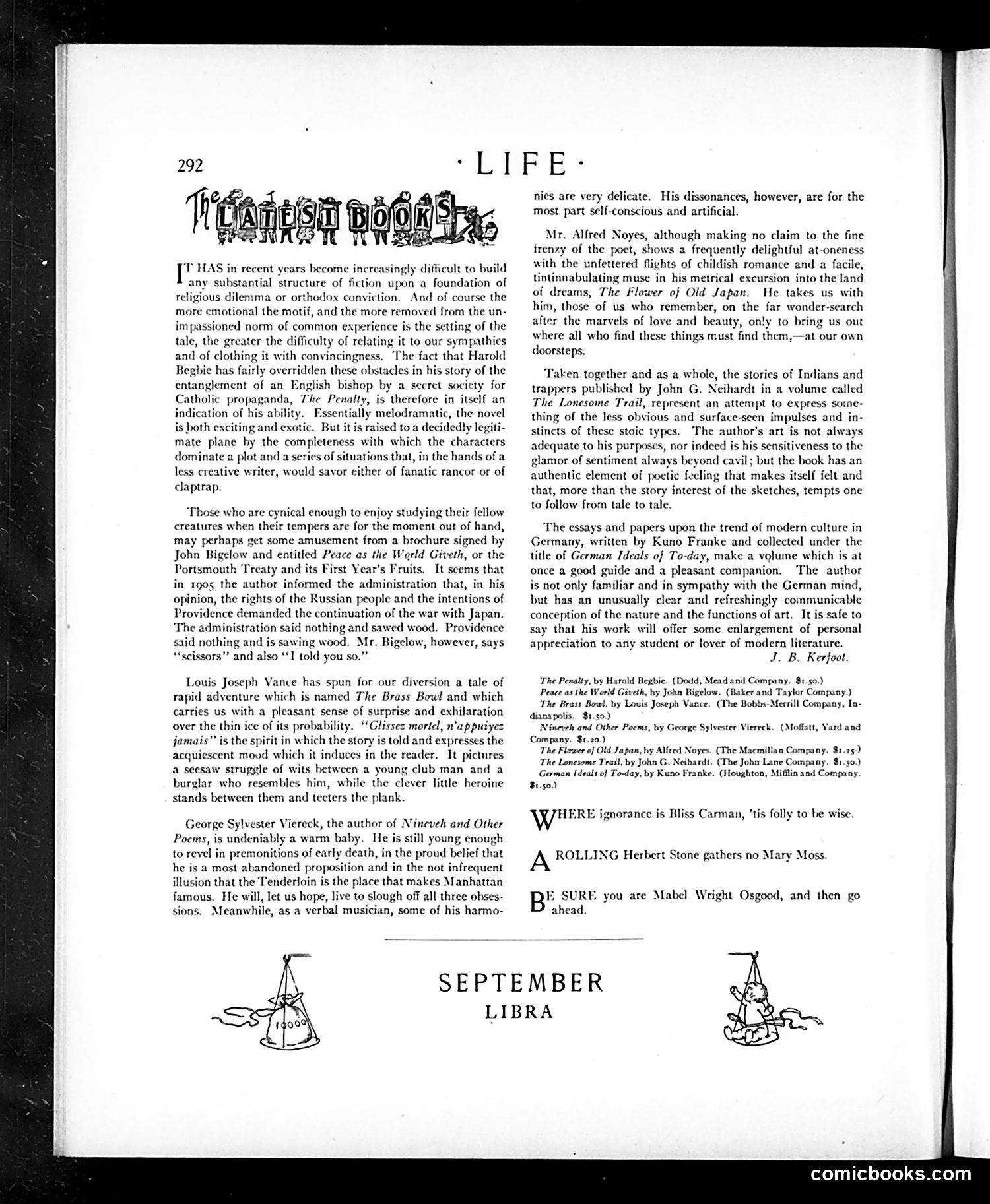
This page from *Life* magazine contains literary reviews and three brief satirical verses at the bottom, each mocking a contemporary figure through wordplay: 1. **"WHERE ignorance is Bliss Carman"** — A pun on poet Bliss Carman's name, suggesting he is foolish. 2. **"A ROLLING Herbert Stone gathers no Mary Moss"** — A play on the proverb "a rolling stone gathers no moss," substituting names of people (Herbert Stone, Mary Moss) to create nonsensical social commentary. 3. **"BE SURE you are Mabel Wright Osgood, and then go ahead"** — Another name-based pun, unclear without knowing who Mabel Wright Osgood was. The upper portion reviews recent literary works by Harold Begbie, John Bigelow, Louis Joseph Vance, George Sylvester Viereck, Alfred Noyes, and others—typical magazine content. The satirical verses represent *Life's* signature style: using clever name-play to gently mock contemporary cultural figures.
📄 Transcribed text from this page (OCR, searchable)
Machine-transcribed from the original scan — historical spelling and the odd misread are preserved.
‘LPP E.* Ni T HAS in recent years become increasingly difficult to build ny substantial structure of fiction upon a foundation of religious dilemma or orthodox conviction. And of course the more emotional the motif, and the more removed from the un- impassioned norm of common experience is the setting of the tale, the greater the difficulty of relating it to our sympathies and of clothing it with convincingness. ‘The fact that Harold Begbie has fairly overridden these obstacles in his story of the entanglement of an English bishop by a secret socicty for atholic propaganda, The Penalty, is therefore in itself an indication of his ability. Essentially melodramatic, the novel is both exciting and exotic. But it is raised to a decidedly legiti- mate plane by the completeness with which the characters dominate a plot and a series of situations that, in the hands of a SS creative Ww claptrap. er, would savor either of fanatic rancor or of ‘Those who are cynical enough to enjoy studying their fellow creatures when their tempers are for the moment out of hand, may perhaps get some amusement from a brochure signed by John Bigelow and entitled Peace as the Werld Giveth, or the Portsmouth Treaty and its First Year’s Fruits. It seems that in 1905 the author informed the administration that, in his opinion, the rights of the Russian people and the intentions of Providence demanded the continuation of the war with Japan. The administration said nothing and sawed wood. Providence said nothing and is sawing wood. Mr. Bigelow, however, says “scissors” and also ‘‘I told you so.’ Louis Joseph Vance has spun for our diversion a tale of rapid adventure which is named The Brass Bowl and which carries us with a pleasant sense of surprise and exhilaration over the thin ice of its probability. “Glissez mortel, n'ap puiyes jamais” is the spirit in which the story is told and expresses the acquiescent mood which it induces in the reader. It pictures a seesaw struggle of wits between a young club man and a burglar who resembles him, while the clever little heroine stands between them and tecters the plank. George Sylvester Viereck, the author of Nineveh and Other Poems, is undeniably a warm baby. He is still young enough to revel in premonitions of early death, in the proud belief that he is a most abandoned proposition and in the not infrequent illusion that the Tenderloin is the place that makes Manhattan famous. He will, let us hope, live to slough off all three obses- sions. Meanwhile, as a verbal musician, some of his harmo- nies are very delicate. His dissonances, however, are for the most part self-conscious and artificial. Mr. Alfred Noyes, although making no claim to the fine frenzy of the poet, shows a frequently delightful at-oneness with the unfettered flights of childish romance and a facile, tintinnabulating muse in his metrical excursion into the land of dreams, The Flower of Old Japan. He takes us with him, those of us who remember, on the far wonder-search after the marvels of love and beauty, only to bring us out where all who find these things must find them,—at our own doorsteps. Taken together and as a whole, the stories of Indians and trappers published by John G. Neihardt in a volume called The Lonesome Trail, represent an attempt to express some- thing of the less obvious and surface-seen impulses and in- stincts of these stoic types. The author’s art is not alway adequate to his purposes, nor indeed is his sensitiveness to the glamor of sentiment always beyond cavil; but the book has an authentic element of poetic fecling that makes itself felt and that, more than the story interest of the sketches, tempts one to follow from tale to tale. ‘The essays and papers upon the trend of modern culture in Germany, written by Kuno Franke and collected under the title of German Ideals of To-day, make a volume which is at once a good guide and a pleasant companion. ‘The author is not only familiar and in sympathy with the German mind, but has an unusually clear and refreshingly communicable conception of the nature and the functions of art. It is safe to say that his work will offer some enlargement of personal appreciation to any student or lover of modern literature. J. B. Kerjoot. The Penalty, by Harold Begbie. (Dodd, Mead and Company. $1.50.) Peace as the World Giveth, by John Bigelow. (Baker and Taylor Company.) The Brass Bowl, by Louis Joseph Vance. (The Bobbs-Merrill Company, In- dianapolis. $1.50.) Nineveh and Other Poems, by George Sylvester Viereck. (Moffatt, Yard and Company. $1.20.) The Flower of Old Japan, by Alfred Noyes. (The Macmillan Company. $1.25: The Lonesome Trail, by John G. Neihardt. (The Joha Lane Company. $1.50.) German Ideals 0} To-day, by Kuno Franke. (Houghton, Mifflin and Company $1.50) WHERE ignorance is Bliss Carman, ’tis folly to be wise. A ROLLING Herbert Stone gathers no Mary Moss. SURE. you are Mabel Wright Osgood, and then go ead. SEPTEMBER LIBRA comicbooks.com