
Life, 1907-09-05 · page 25 of 36
Life — September 5, 1907 — page 25: what you’re looking at
What you’re looking at
This story satirizes wealthy industrialists' casual approach to managing labor and property. Henry Dunstan, a capitalist, gives his daughter Helen a massive factory as a birthday present—but she's far more delighted by a diamond necklace, revealing the story's central joke: women of her class care nothing for actual business or workers' welfare. The satire deepens when Dunstan casually mentions labor unrest ("discontent among the men") and a potential strike, yet dismisses it as inconsequential to Helen. He's appointed a manager (Hallett) to actually run operations, allowing his daughter to enjoy profits while remaining willfully ignorant of factory conditions. The piece mocks both the indifference of wealthy heiresses toward their inherited businesses and capitalists' detachment from labor problems—suggesting that factory management requires neither knowledge nor genuine concern, only the right manager and passive income collection.
📄 Transcribed text from this page (OCR, searchable)
Machine-transcribed from the original scan — historical spelling and the odd misread are preserved.
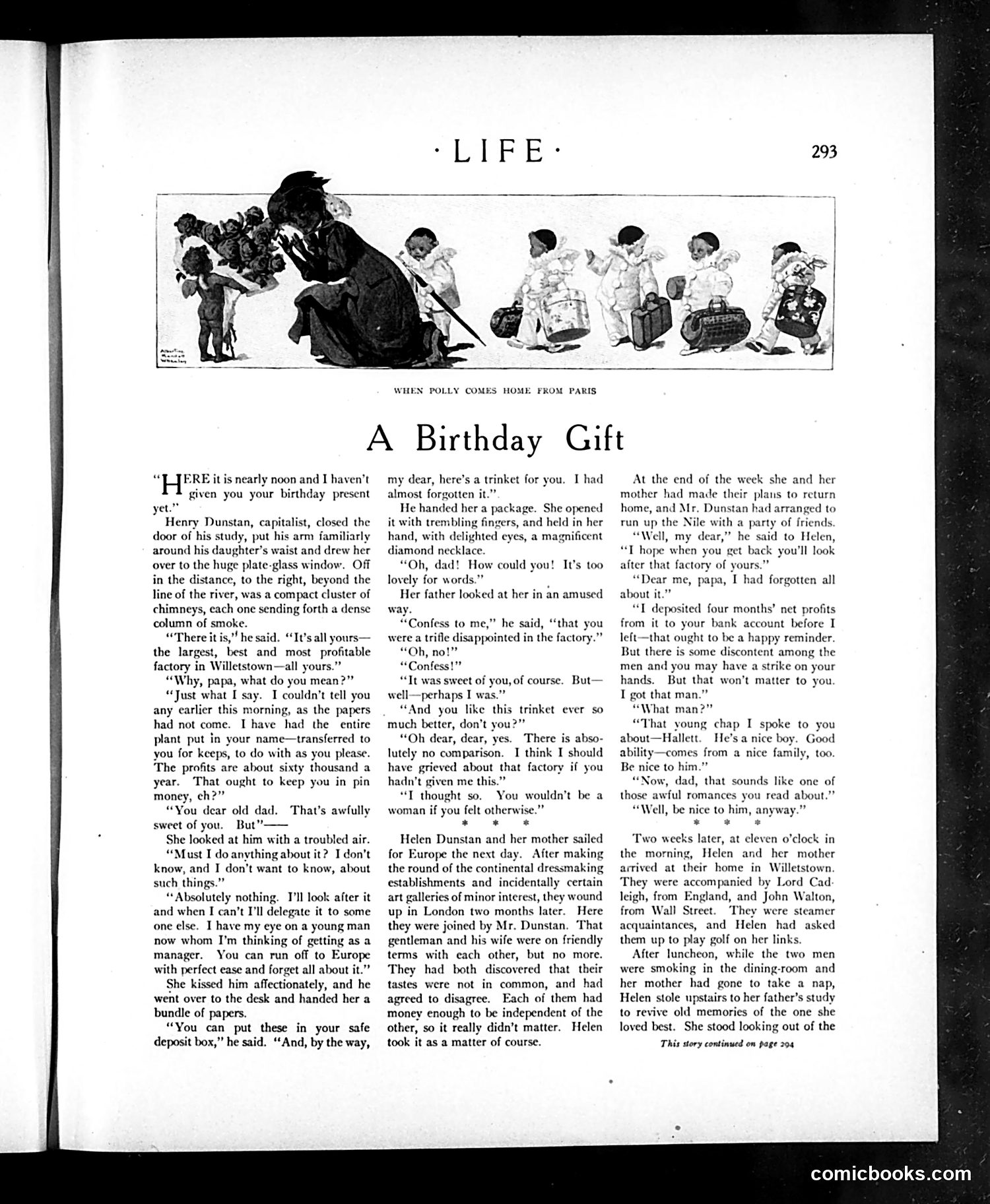
WHEN POLLY COMES HOME FROM PARIS A Birthday Gift RE it is nearly noon and I haven't given you your birthday present yet.” Henry Dunstan, capitalist, closed the door of his study, put his arm familiarly around his daughter’s waist and drew her over to the huge plate-glass window. Off in the distance, to the right, beyond the line of the river, was a compact cluster of chimneys, cach one sending forth a dense column of smoke. “There it is,” he said. “It’s all yours— the largest, best and most profitable factory in Willetstown—all yours.” “Why, papa, what do you mean?” “Just what I say. I couldn’t tell you any earlier this morning, as the papers had not come. I have had the entire plant put in your name—transferred to you for keeps, to do with as you pleas The profits are about sixty thousand a year. That ought to keep you in pin money, ch?” You dear old dad. sweet of you. But"”—— She looked at him with a troubled air. “Must I do anything about it? I don’t know, and I don’t want to know, about such things. “Absolutely nothing. I'll look after it and when I can’t I'll delegate it to some one else. I have my eye on a young man now whom I’m thinking of getting as a manager. You can run off to Europe with perfect ease and forget all about it.” She kissed him affectionately, and he went over to the desk and handed her a bundle of papers. “You can put these in your safe deposit box,” he said. ‘And, by the way, That’s awfully my dear, here’s a trinket for you. I had almost forgotten it.” He handed her a package. She opened it with trembling fingers, and held in her hand, with delighted eyes, a magnificent diamond necklace. “Oh, dad! How could you! It’s too lovely for words.” : Her father looked at her in an amused to me,” he said, “that you were a trifle disappointed in the factory.” “Oh, no!” “Confess!” “Tt was sweet of you, of course. But— well—perhaps I was.” “And you like this trinket ever so. much better, don’t you?” “Oh dear, dear, yes. There is abso- lutely no comparison. I think I should have grieved about that factory if you hadn’t given me this.” “T thought so. You wouldn’t be a woman if you felt otherwis * * « Helen Dunstan and her mother sailed for Europe the next day. After making the round of the continental dressmaking establishments and incidentally certain art galleries of minor interest, they wound up in London two months later. Here they were joined by Mr. Dunstan. ‘That gentleman and his wife were on friendly terms with each other, but no more. They had both discovered that their tastes were not in common, and had agreed to disagree. Each of them had money enough to be independent of the other, so it really didn’t matter. Helen took it as a matter of course. At the end of the week she and her mother had made their plans to return home, and Mr. Dunstan had arranged to run up the Nile with a party of friends. “Well, my dear,” he said to Helen, “T hope when you get back you'll look after that factory of yours.” “Dear me, papa, I had forgotten all about it.” “T deposited four months’ net profits from it to your bank account before I left—that ought to be a happy reminder. But there is some discontent among the men and you may have a strike on your hands. But that won't matter to you I got that man.” “What man?” “That young chap I spoke to you about—Hallett. He’s a nice boy. Good ability—comes from a nice family, too. Be nice to him.” Now, dad, that sounds like one of ¢ awful romances you read about.” “Well, be nice to him, any sd + * 8 Two weeks later, at cleven o'clock in the morning, Helen and her mother arrived at their home in Willetstown. They were accompanied by Lord Cad leigh, from England, and John Walton, from Wall Street. They were steamer acquaintances, and Helen had asked them up to play golf on her links. After luncheon, while the two men were smoking in the dining-room and her mother had gone to take a nap, Helen stole upstairs to her father’s study to revive old memories of the one she loved best. She stood looking out of the This story continued on page 204 comicbooks.com