
A complete issue · 32 pages · 1907
Life — June 20, 1907
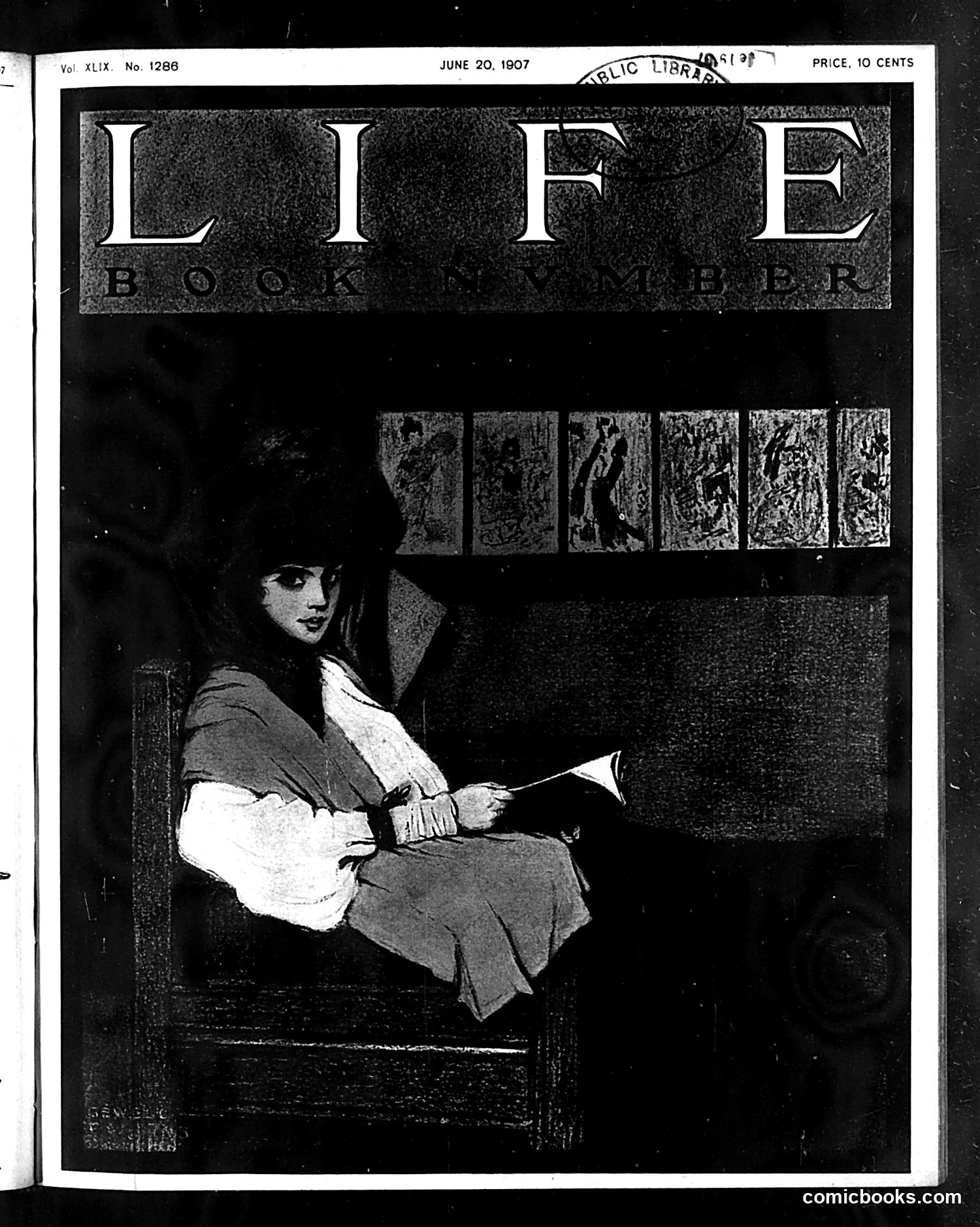
This is a cover illustration rather than a political cartoon. It depicts a fashionable woman in early 1900s dress, wearing a large hat and holding what appears to be a fan or program, seated and looking over her shoulder. The six small panels above her seem to show sequential scenes, though their specific content is difficult to discern in this reproduction. The cover represents typical *Life* magazine cover art of the period—satirizing contemporary high society and fashion rather than politics. The composition and the woman's pose suggest commentary on women's social rituals, leisure activities, or theatrical entertainment that would have been recognizable to the magazine's upper-class readership. Without clearer text or captions identifying the specific subject, the precise satirical point remains unclear.
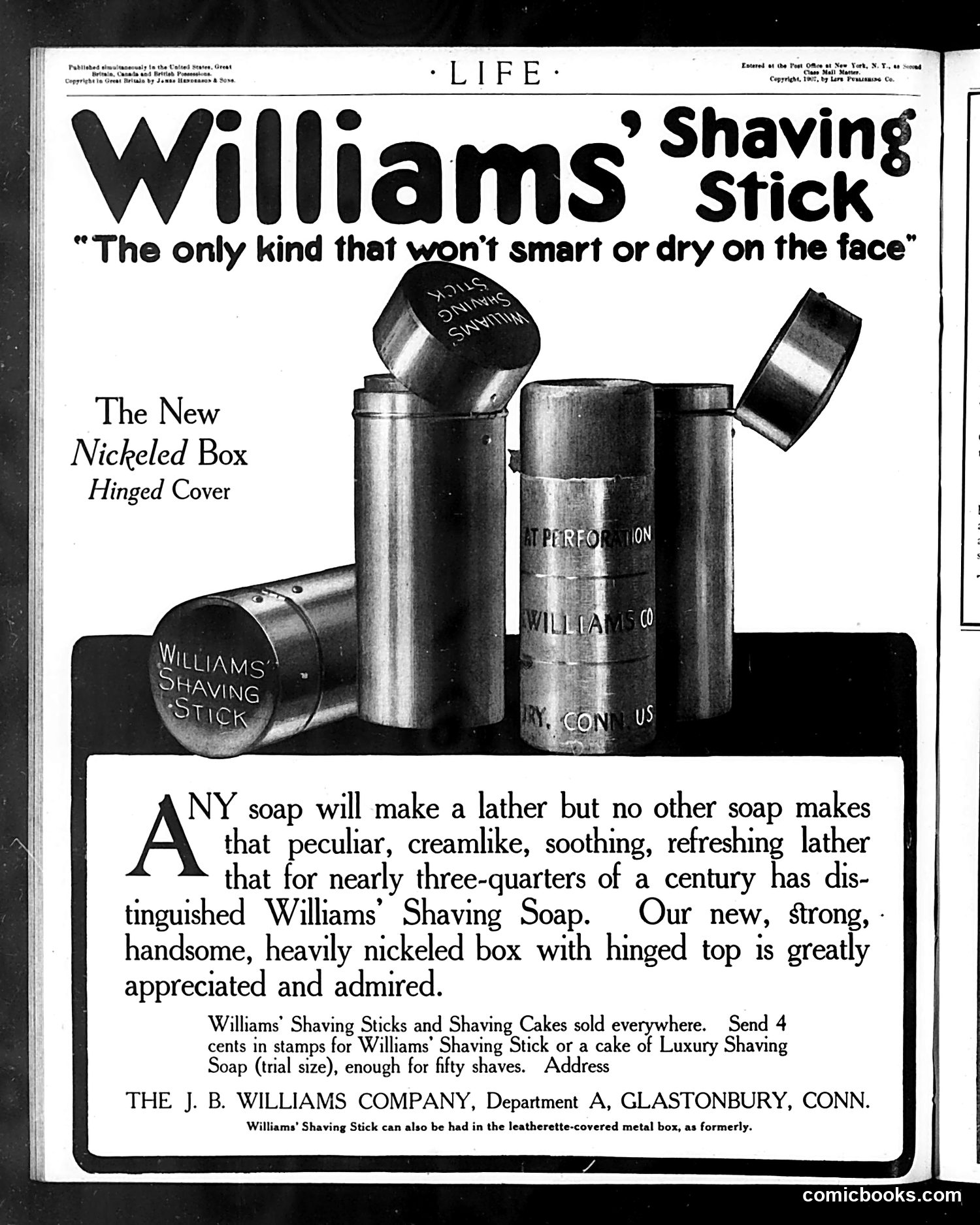
This is **not a political cartoon or satire**—it's a straightforward advertisement for Williams' Shaving Stick, a grooming product by The J.B. Williams Company of Glastonbury, Connecticut. The ad emphasizes that Williams' shaving soap produces a superior lather that won't "smart or dry on the face," distinguishing it from competitors over nearly three-quarters of a century. The visual displays the product in its new "nickeled box with hinged cover." The only noteworthy detail is the promotional offer: customers could send 4 cents in stamps for a trial-size stick or cake of "Luxury Shaving Soap" sufficient for fifty shaves. This represents typical early 20th-century marketing practice—offering samples to build brand loyalty. The page contains period advertising copy rather than editorial satire.
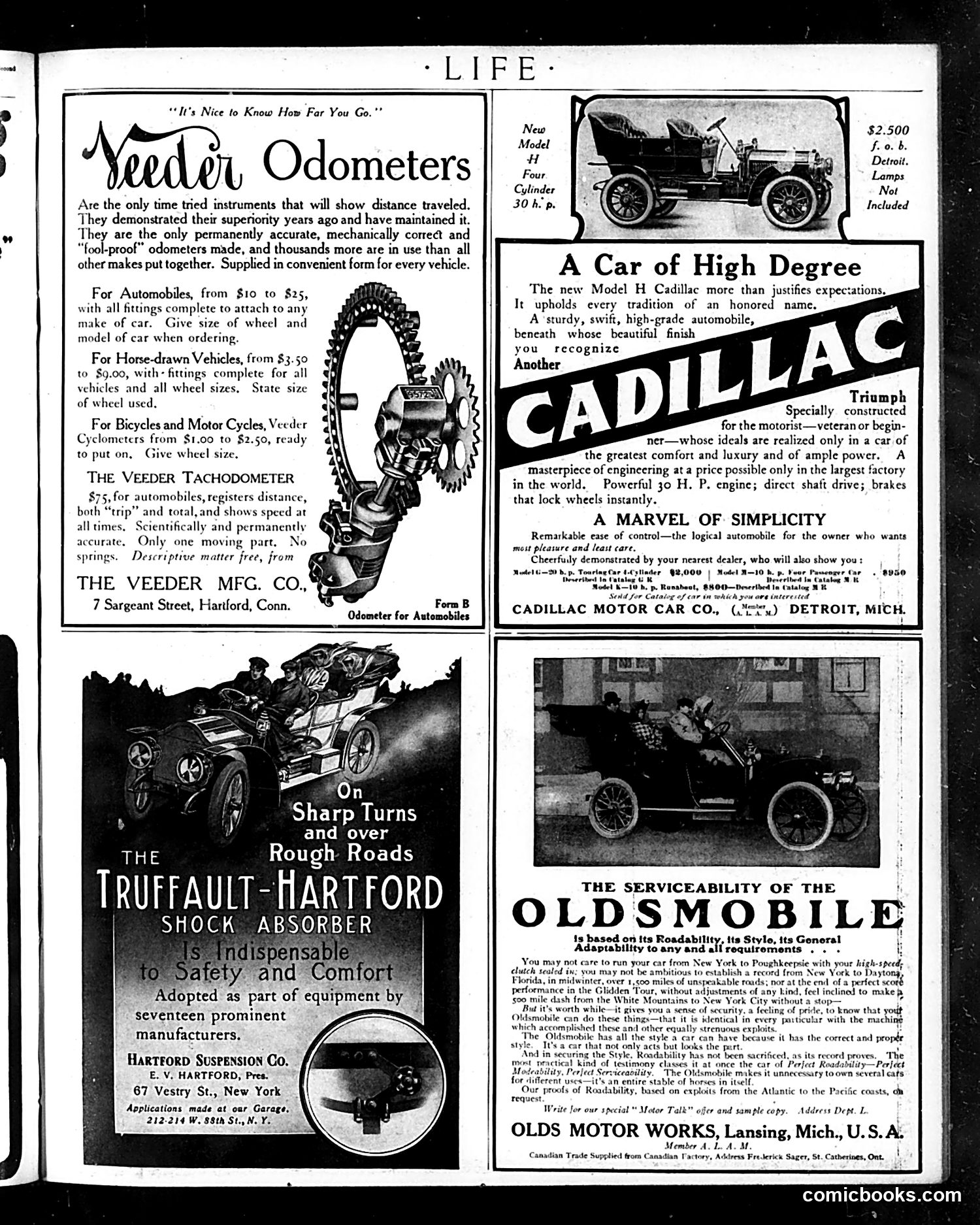
This page is **primarily advertisements**, not satirical content. It contains four automobile-related ads from the early 1900s: 1. **Veeder Odometers** — promoting distance-tracking instruments for cars 2. **Cadillac Model H** — advertising a new luxury automobile with a 4-cylinder engine, positioning it as combining power, comfort, and simplicity 3. **Truffault-Hartford Shock Absorber** — promoting suspension technology for rough roads 4. **Oldsmobile** — emphasizing reliability and cross-country capability The ads reflect early automotive industry competition and marketing strategies. Rather than satire, they showcase genuine product innovation and sales messaging typical of Life magazine's advertising pages during the automobile's emergence as consumer technology. The dramatic imagery of cars navigating challenging terrain was standard promotional rhetoric of the era.
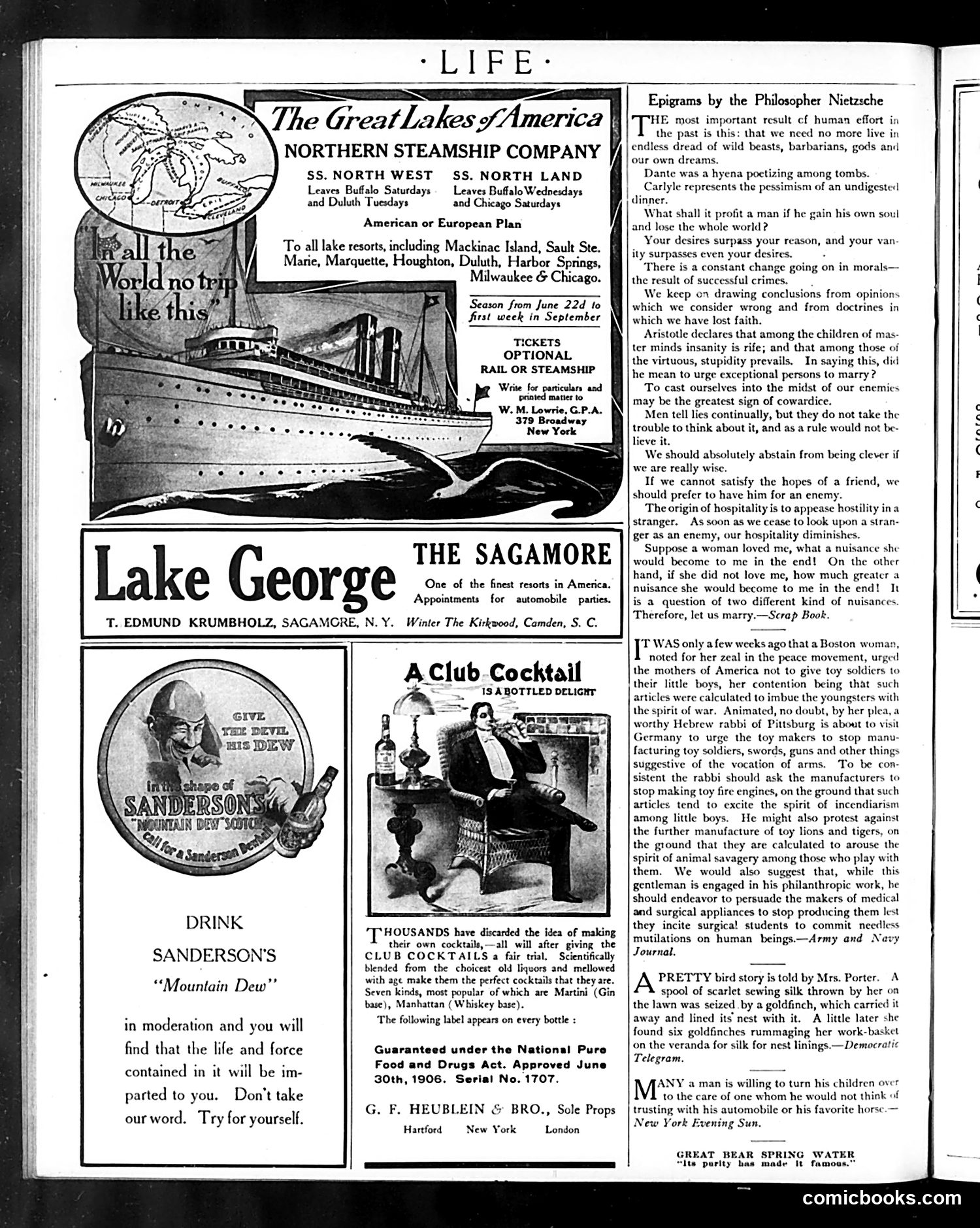
This LIFE magazine page is primarily **advertising and philosophical commentary** rather than political satire. The ads promote steamship travel on the Great Lakes, Lake George resort accommodations, Sanderson's "Mountain Dew" liquor, and a "Club Cocktail" recipe. The right column features **Nietzsche epigrams** and moral essays—likely satirizing early 20th-century American attitudes toward pacifism, marriage, and materialism. One piece mocks a Boston woman's peace activism, another discusses hospitality and friendship philosophically. The "Club Cocktail" illustration shows a well-dressed man mixing drinks, **likely satirizing** Prohibition-era attempts to make homemade cocktails, presented as scientific sophistication. Overall, this reflects Life magazine's role as a venue for social commentary mixed with commercial advertising, targeting educated, affluent readers.
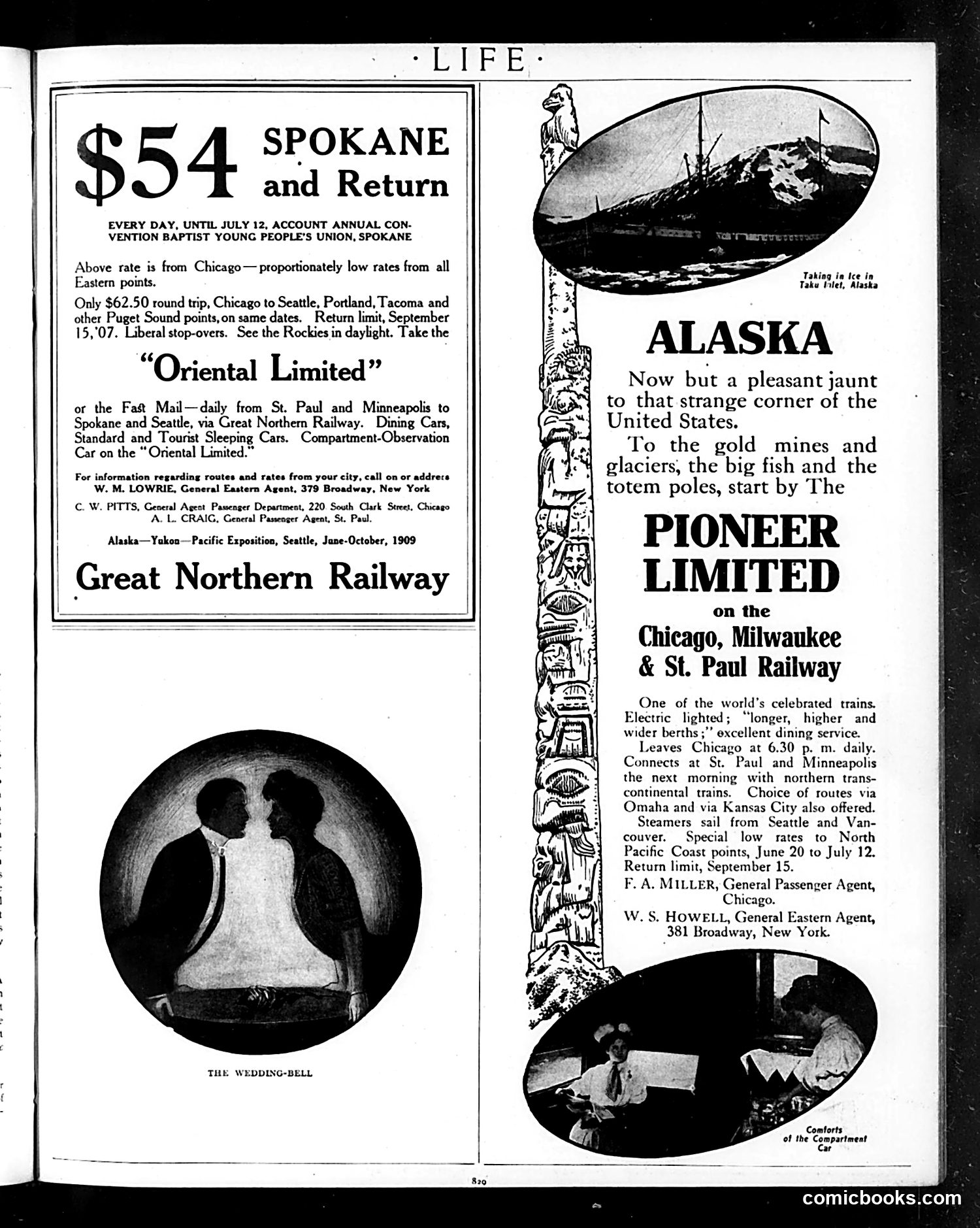
This page is **primarily advertising** for railroad travel to Alaska and the Pacific Northwest, not satirical content. The left advertisement promotes Great Northern Railway's "$54 Spokane and Return" fare and the "Oriental Limited" train service. The circular image labeled "The Wedding-Bell" appears to be decorative rather than satirical—likely symbolizing celebration or the journey itself. The right side advertises the "Pioneer Limited" train on the Chicago, Milwaukee & St. Paul Railway, featuring an elaborate totem pole design (representing Alaska/Indigenous culture) and images of Alaskan scenery and train amenities. The text emphasizes luxury features: electric lighting, dining service, and connections to Alaska. The overall purpose is tourism promotion, capitalizing on early-20th-century interest in Alaska following the 1897 Gold Rush and the 1909 Alaska-Yukon Pacific Exposition mentioned in the text.
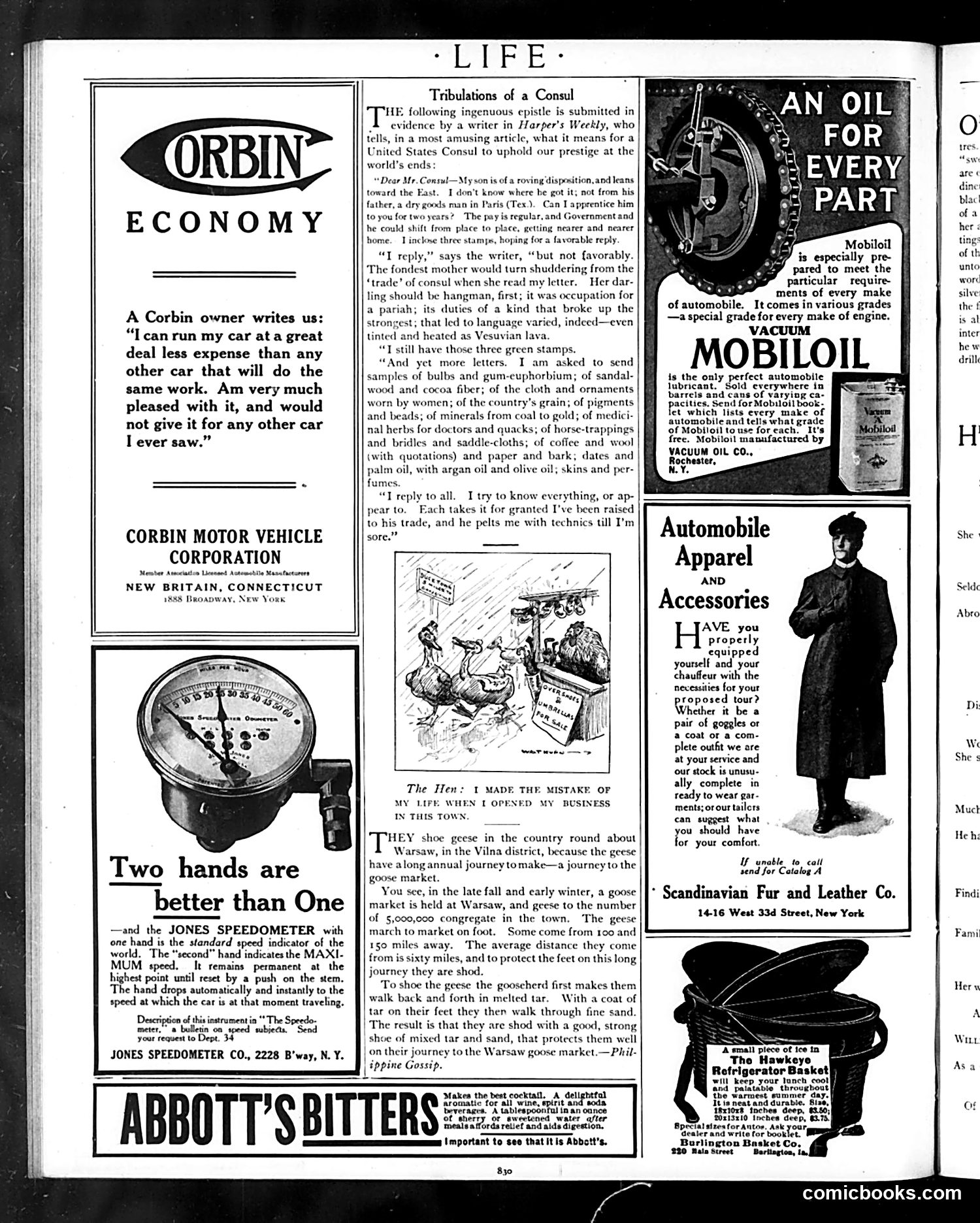
This page is primarily **advertisements with one satirical article**. The main content is "Tribulations of a Consul," a humorous epistolary piece where a U.S. Consul abroad complains about his job's absurdities. The writer describes receiving ridiculous requests from constituents—including samples of bullets, gum-opium, sandals, and various trade goods—all from Americans expecting consular assistance with commercial matters. The satire targets **American entitlement and consular service misuse**: citizens treating diplomatic officials as personal shopping agents or business facilitators rather than understanding proper governmental functions. The surrounding ads (Corbin automobiles, Mobiloil, Abbott's Bitters, etc.) are period commercial content, not satirical. The cartoon illustrating the article shows the harried consul dealing with impossible demands, emphasizing the piece's comedic frustration.
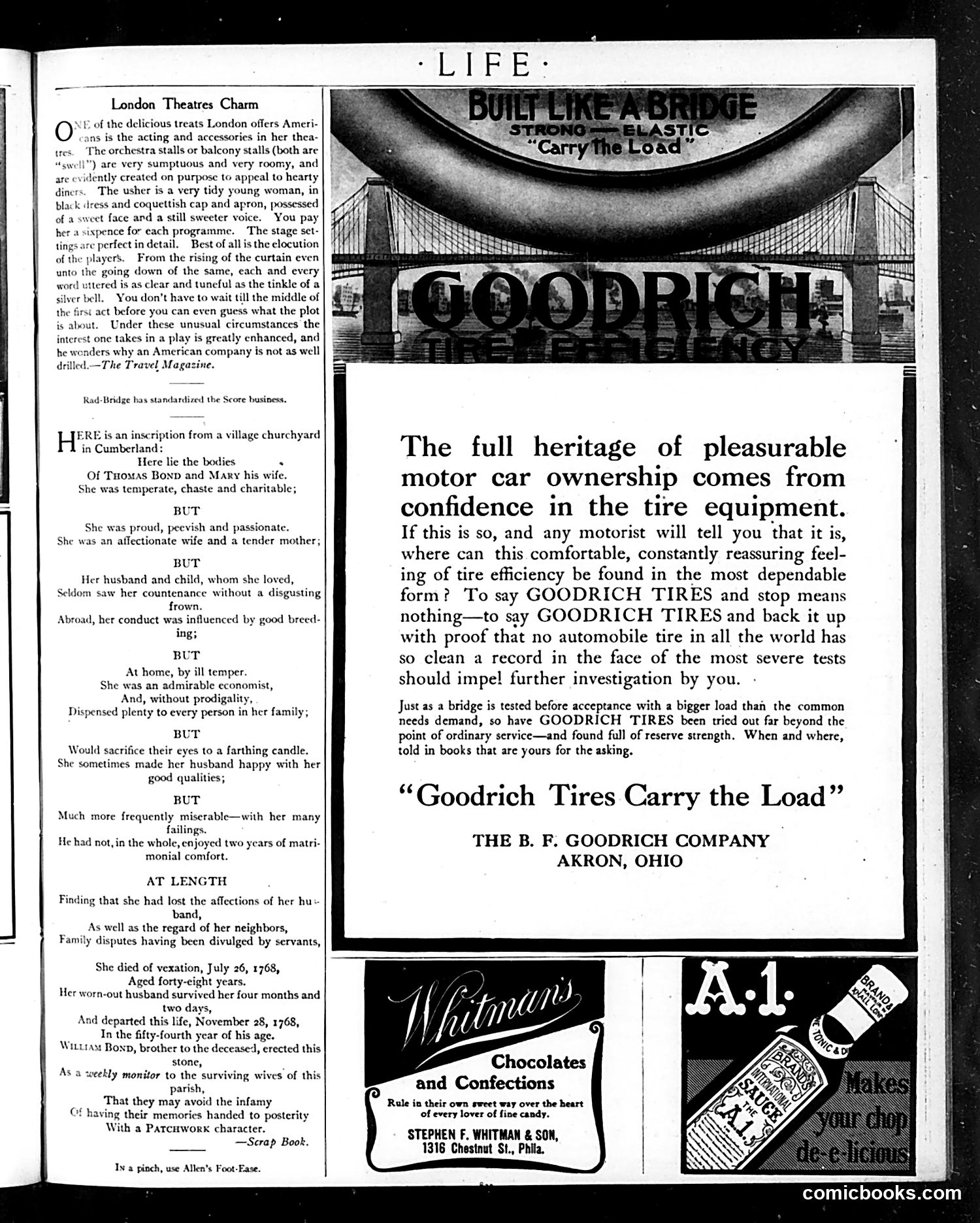
This page is primarily **advertising**, not satire or political commentary. The main content includes: 1. **"London Theatres Charm"** - An editorial piece praising American theater companies' performances in London, highlighting stage design and usher service. 2. **Large Goodrich Tires advertisement** - Dominates the right side, using a bridge metaphor ("Built Like a Bridge") to promote tire reliability and durability under stress. 3. **Minor ads** - Whitman's Chocolates and A.I. brand products appear at bottom. The page reflects early-20th-century advertising strategy: establishing brand credibility through comparisons to engineering (bridges), emphasizing safety and testing, and using dramatic imagery. There is no discernible political satire or social commentary present.
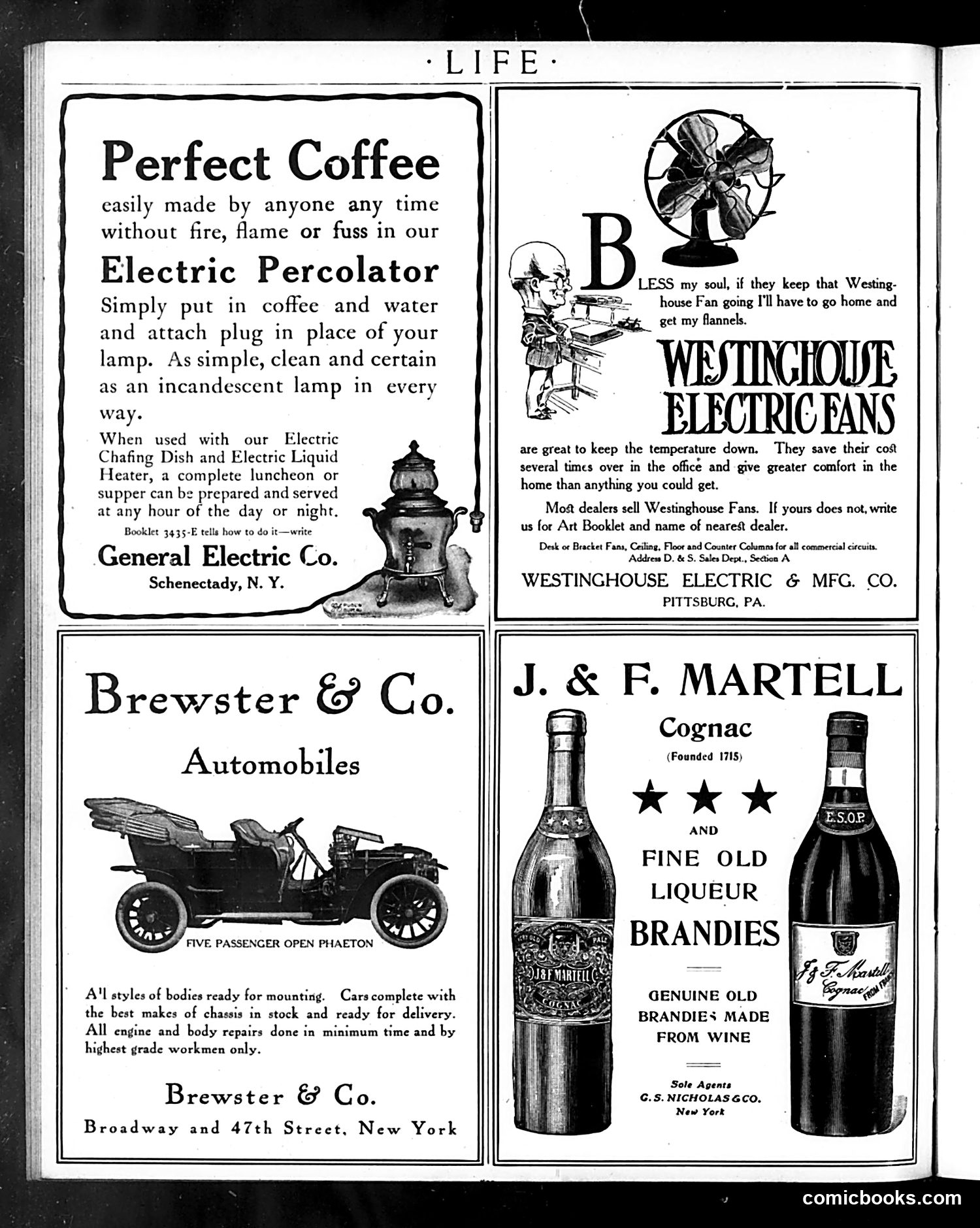
This page consists primarily of **advertisements**, not satirical cartoons. There are four product ads: 1. **General Electric Electric Percolator** — promotes coffee-making convenience by plugging into a lamp socket 2. **Westinghouse Electric Fans** — features a cartoon figure complaining about heat, suggesting fans provide comfort and economy 3. **Brewster & Co. Automobiles** — advertises a five-passenger open phaeton with quality chassis 4. **J. & F. Martell Cognac** — displays brandy and liqueur bottles The Westinghouse ad contains the only satirical element: a character humorously threatening to leave home if not provided a fan, mocking domestic comfort demands. Otherwise, the page reflects early 20th-century consumer culture, emphasizing electrical appliances and luxury goods as modern conveniences.
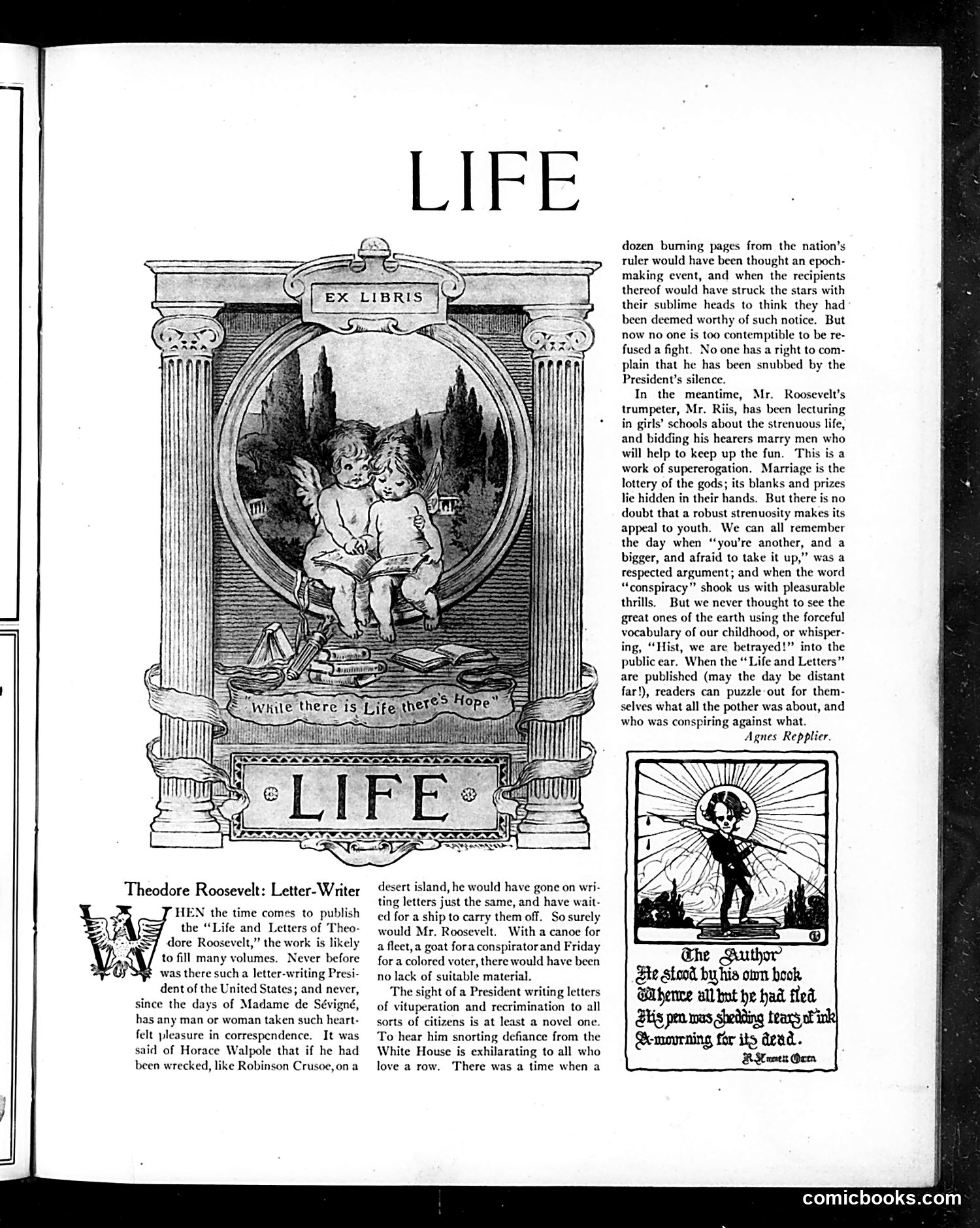
This page satirizes **Theodore Roosevelt's upcoming publication of "Life and Letters of Theodore Roosevelt."** The main article criticizes Roosevelt for being a prolific letter-writer—a president who enjoyed corresponding more than any previous chief executive. The satire's point: Roosevelt's letters allegedly contain "vituperation and recrimination," and publishing them risks embarrassing revelations. The author (Agnes Repplier, bylined at bottom right) suggests Roosevelt used letters to attack political opponents, and that his silence on the publication is conspicuous. The decorative **ex libris** image (top left) and author illustration (bottom right) are period design elements. The overall tone is mocking Roosevelt's combative personality and suggesting his correspondence might reveal unflattering political schemes.
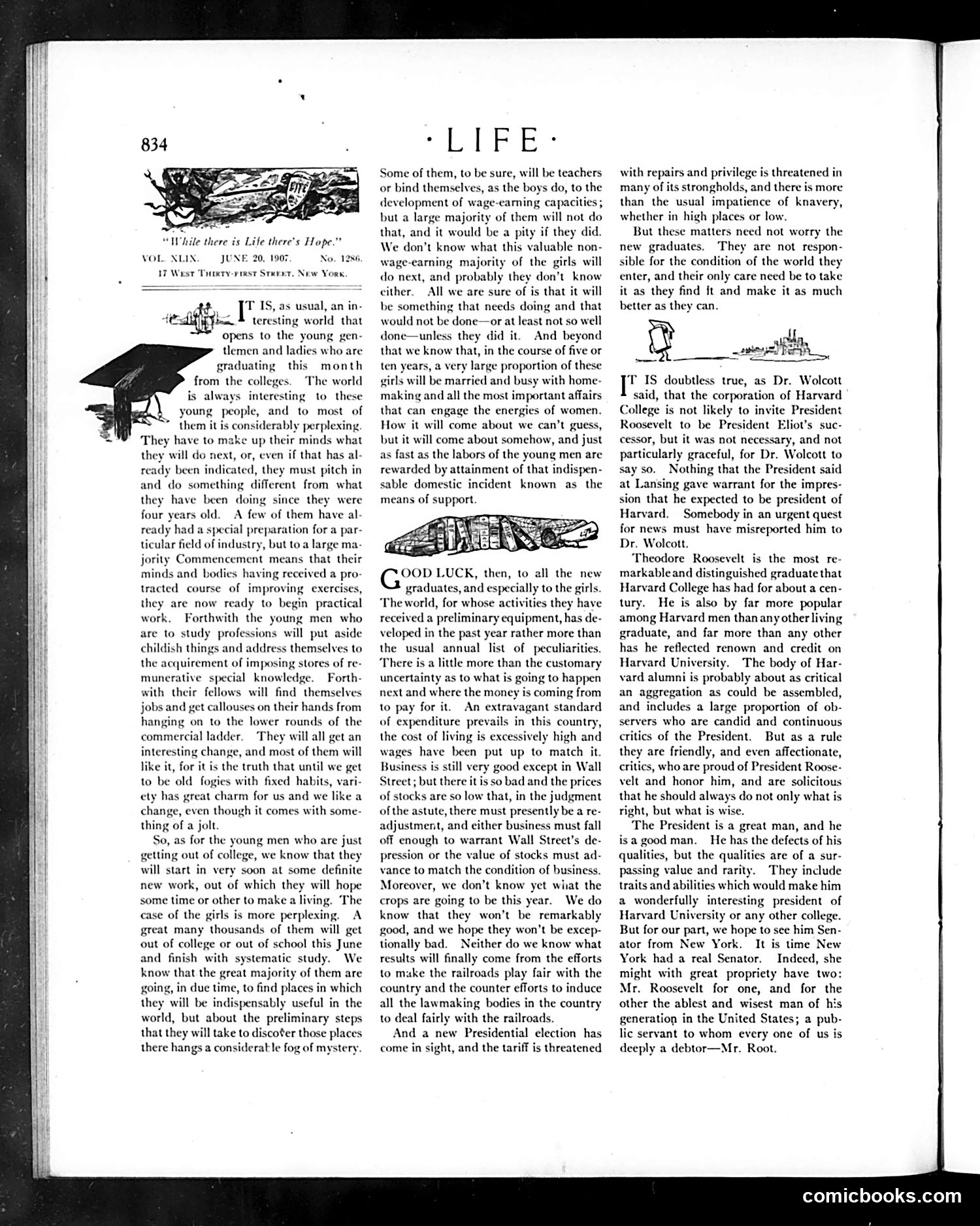
This page contains editorial commentary on recent college graduates entering the workforce, particularly women. The small illustration shows a mortarboard and diploma, symbolizing graduation. The text discusses the uncertainty facing new graduates about employment prospects and financial stability. It mentions President Theodore Roosevelt favorably, noting Harvard College's pride in his success. The piece addresses anxieties about the job market, business conditions, and railroad labor disputes—suggesting economic instability in 1907. The cartoons and illustrations are decorative rather than satirical, accompanying earnest advice to graduates about practical work and self-improvement. The tone is paternalistic, typical of early-1900s editorializing about young people entering adulthood.
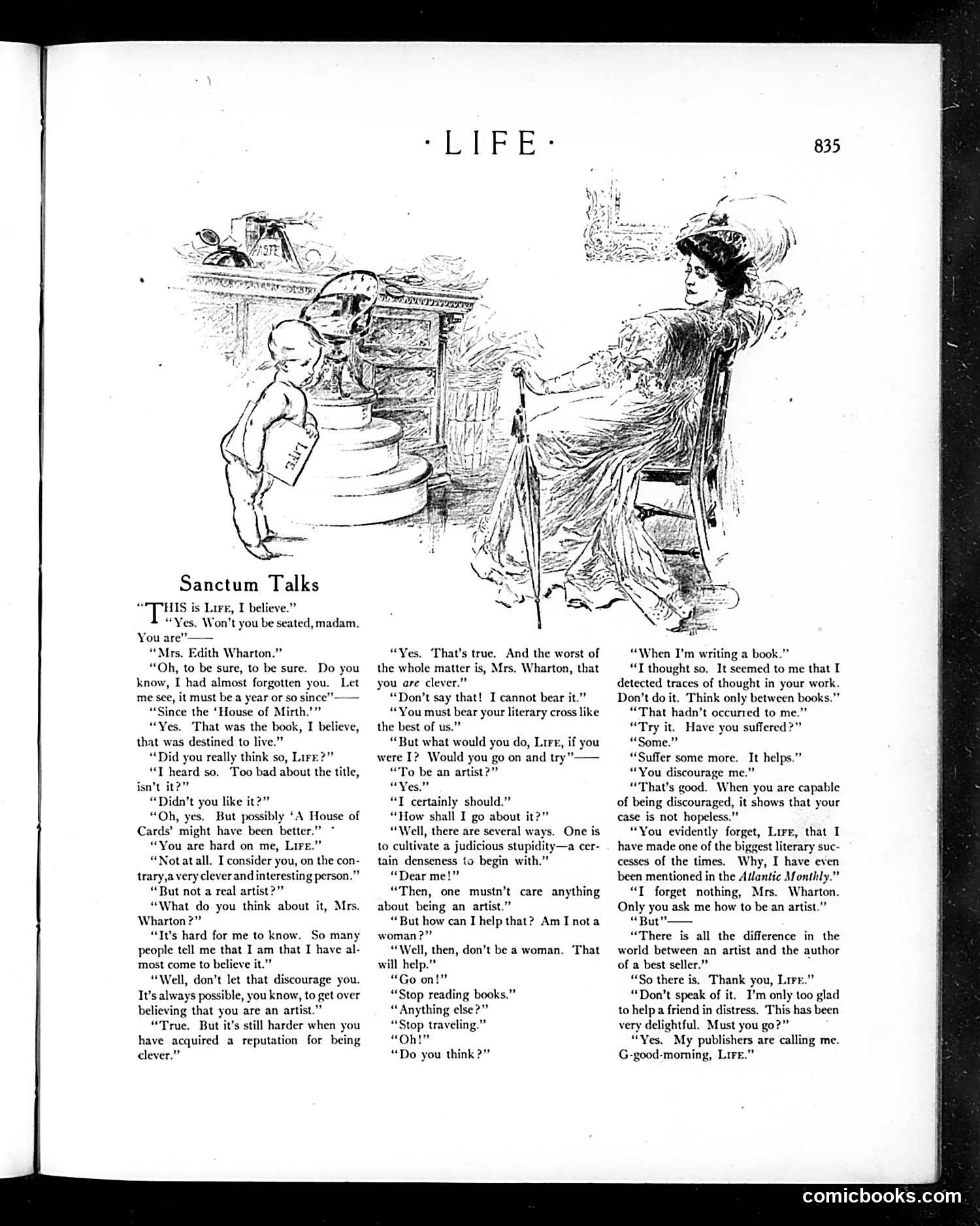
This is a satirical dialogue between "Life" (the magazine, personified as a woman) and Mrs. Edith Wharton, the famous novelist. The sketch mocks the pretensions of literary celebrities and the tension between commercial success and artistic credibility. Wharton complains she's nearly forgotten despite her accomplishments. Life suggests she pursue art instead of writing, provoking Wharton's indignation at being told to stop writing books. The satire ridicules both Wharton's anxiety about relevance and Life's flippant suggestion that she abandon her actual profession. The cartoon also jabs at the gulf between "artists" and "authors of bestsellers"—implying commercial literary success undermines serious artistic reputation, a common early-1900s literary snobbery that Life mocks here.
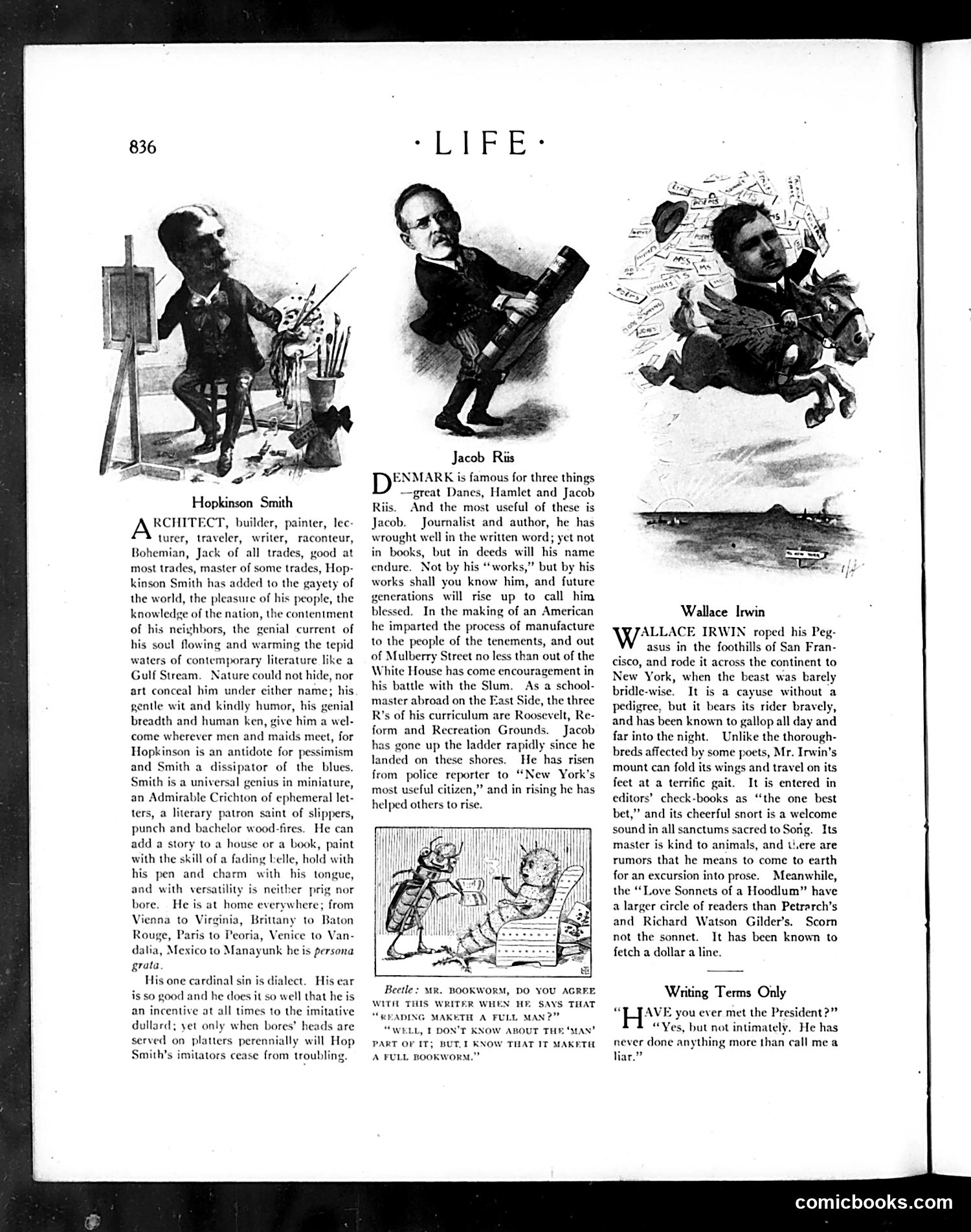
This page presents three biographical sketches with caricatures: **Hopkinson Smith** is celebrated as a versatile "master of some trades"—architect, traveler, writer, raconteur—praised for his gentle wit and genial nature. The text calls him a "universal genius in miniature." **Jacob Riis** is noted as Denmark's contribution to journalism and social reform, having written about tenement life and influenced manufacturing practices on Mulberry Street and the White House. **Wallace Irwin** is humorously described as having "roped his Pegasus" (his creative inspiration) in San Francisco, with references to his whimsical writing style and the "Scorn" sonnet, which apparently "fetch[ed] a dollar a line." The page concludes with a brief satirical dialogue about meeting the President.
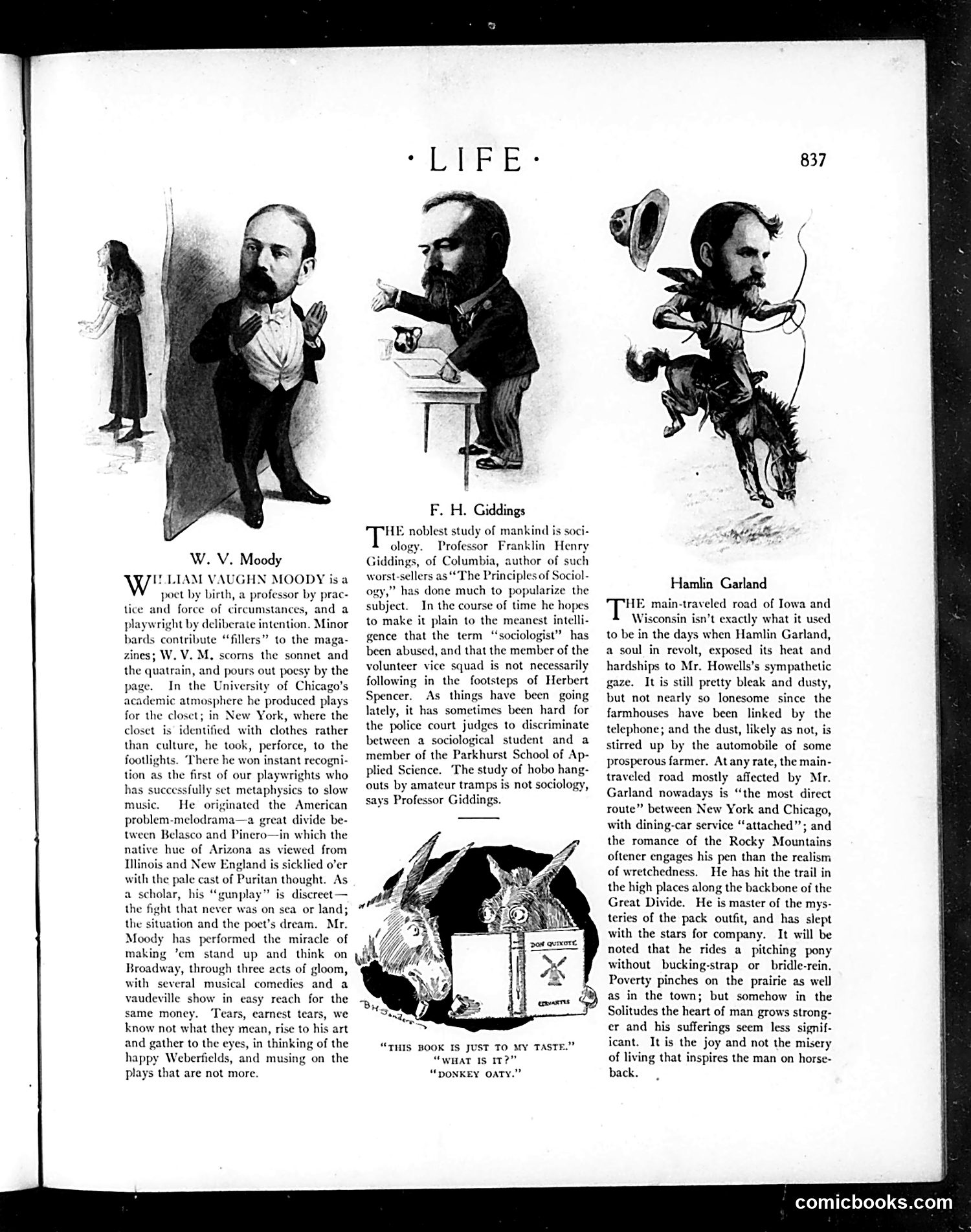
This page features three caricatured figures from early 20th-century American public life: **W. V. Moody** (left): A poet and playwright criticized for producing overly intellectual work unsuitable for popular audiences. **F. H. Giddings** (center): A Columbia University sociology professor mocked for popularizing the term "sociologist" and for attempting to distinguish between legitimate sociological study and amateur hobbyist investigation. **Hamlin Garland** (right): A writer satirized for his romanticized portrayals of the American Midwest and frontier life, particularly regarding hardship and rural existence. The central cartoon shows a donkey reading a book labeled "Donkey Oaty," captioned "This book is just to my taste. What is it?"—mocking the pretension and disconnect between these intellectuals' work and ordinary people's interests. The satire suggests these figures produce work more suited to animals than general audiences.
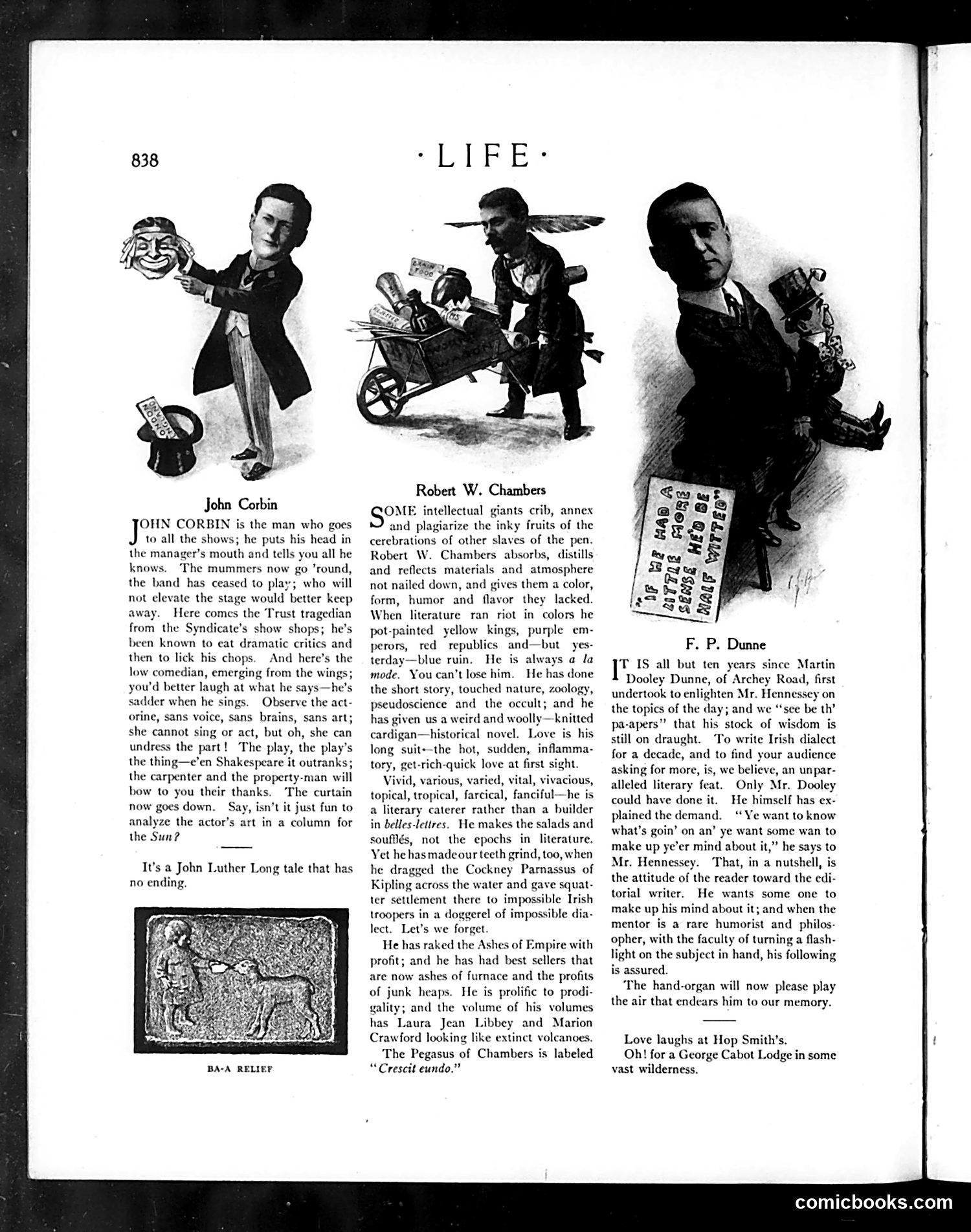
This page mocks three prolific American writers through caricature and critical commentary: **John Corbin** (left) is depicted as a theater critic who attends all shows and pronounces judgments. The satire suggests he's superficial—putting "his head in the manager's mouth" to deliver opinions. **Robert W. Chambers** (center) is criticized as a literary copycat and trend-chaser who "crib[s], annex[es] and plagiarize[s]" others' work. The text attacks his productivity as mere "literary catering"—producing salads and soufflés rather than substantive literature. His work is dismissed as derivative, ranging opportunistically across genres (historical novels, adventure fiction). **F.P. Dunne** (right), creator of the "Mr. Dooley" character, receives gentler treatment. The satire acknowledges his decade-long success writing Irish-dialect humor, crediting his appeal to readers' desire for someone to "make up ye'er mind" about current events—positioning him as a wise commentator disguised as entertainment. All three represent different literary sins: shallow criticism, derivative productivity, and populist simplification.
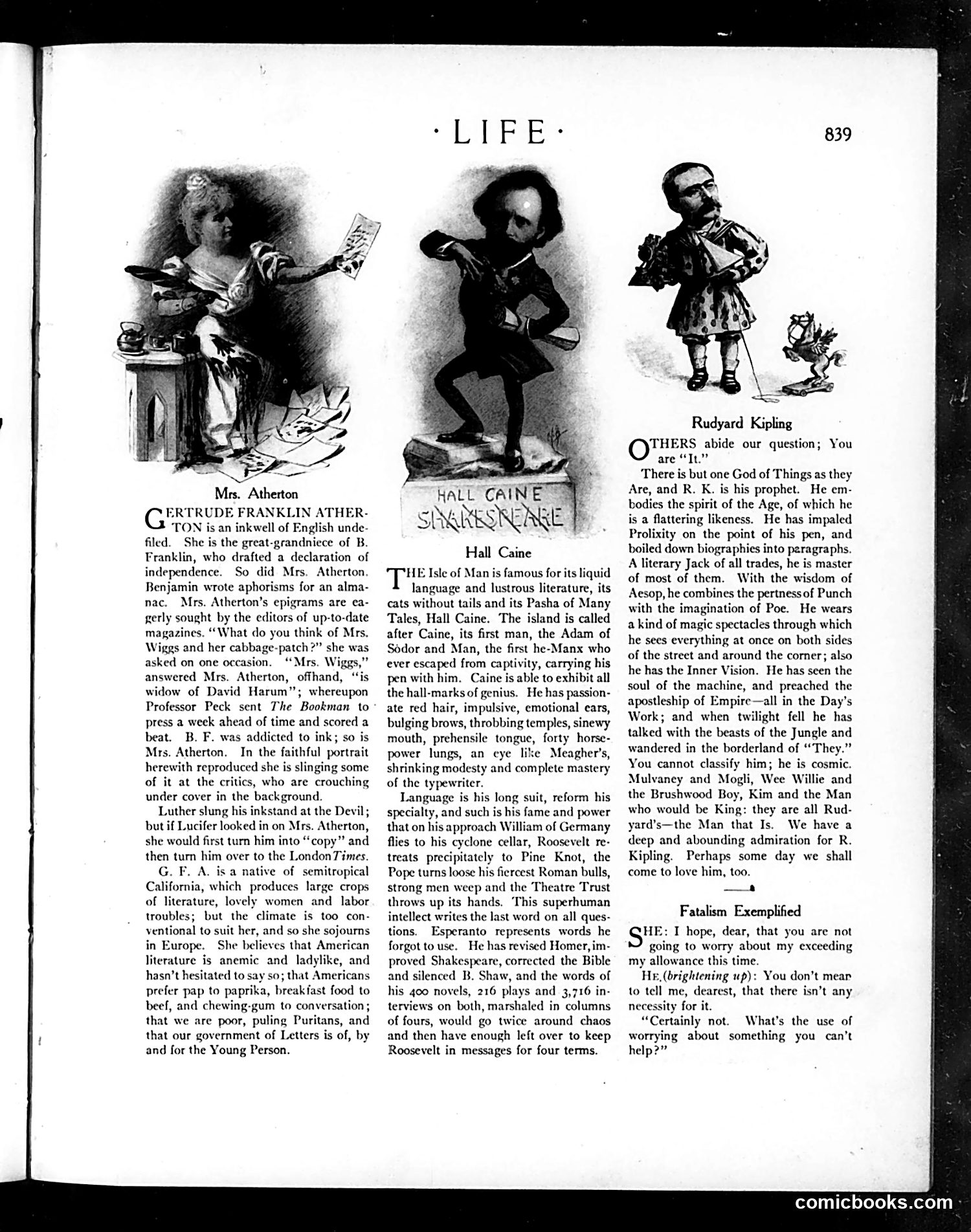
This page profiles three literary figures through satirical biographical sketches and caricatures: **Mrs. Atherton** (left): A writer descended from Benjamin Franklin, depicted flinging ink at critics. The satire mocks her sharp wit and scathing literary criticism—she's portrayed as aggressively combative toward reviewers. **Hall Caine** (center): An Isle of Man author whose prolific output and grandiose self-importance are ridiculed. The text sarcastically credits him with such vast literary accomplishment that world leaders flee in fear of his influence, and his words could "twice around chaos"—absurdist exaggeration of his ego and productivity. **Rudyard Kipling** (right): Praised as a literary prophet who sees everything at once with "magic spectacles" and "Inner Vision." Unlike the others, his satire is largely admiring—he's positioned as the supreme arbiter of modern thought and literature. The humor relies on readers' familiarity with these then-prominent writers and their reputations for critical severity, prolific writing, or cultural influence.
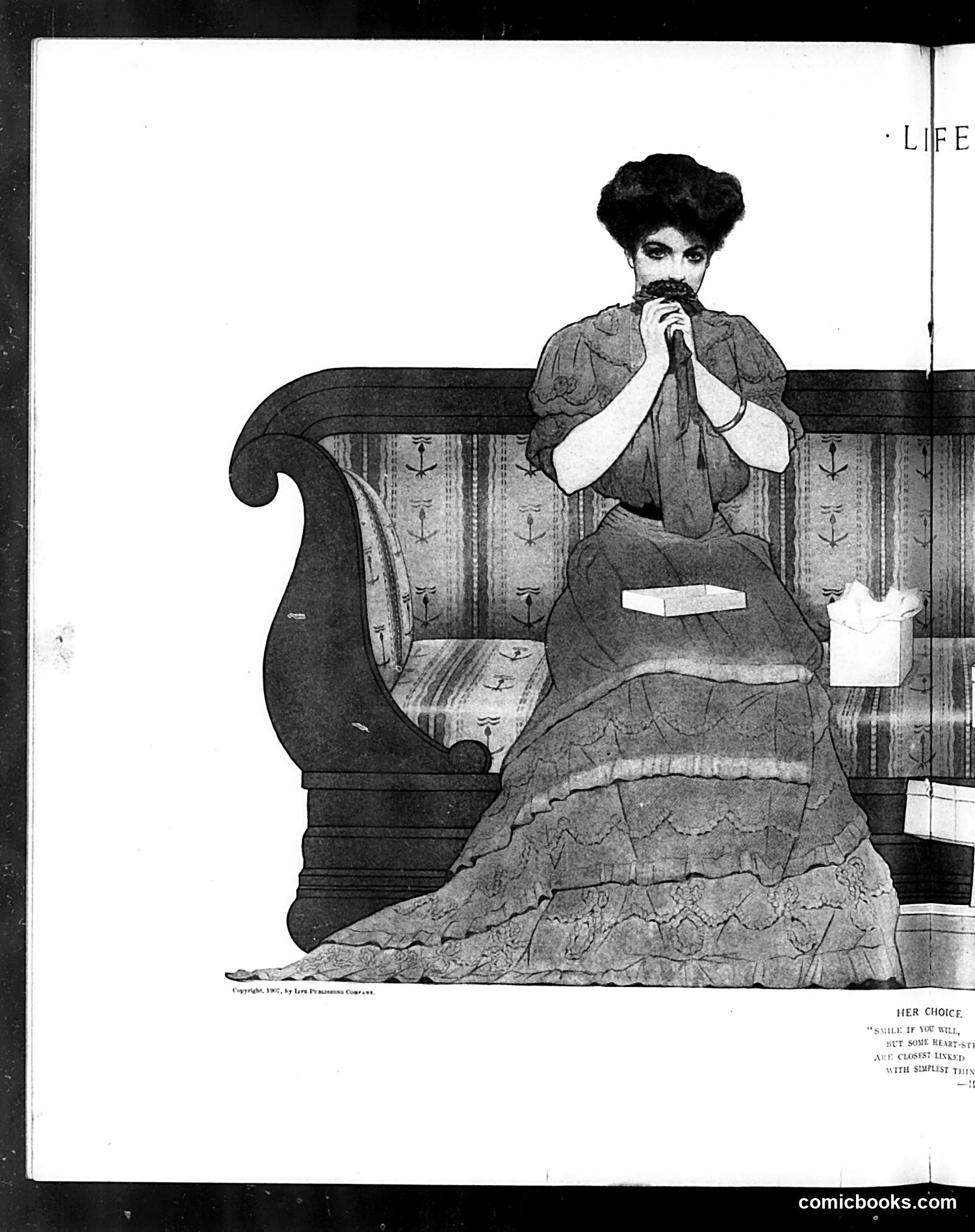
This satirical illustration depicts a well-dressed woman sitting on an ornate couch, holding a handkerchief to her face in an exaggerated pose of contemplation or distress. The caption reads: "Smile if you will, but some beast-si are closer linked with sophist thin—" The incomplete text suggests social commentary on women's choices regarding romantic or marital partners. The woman's theatrical pose—combined with the partial caption implying criticism of her decision-making—appears to mock female romanticism or poor judgment in choosing unsuitable men. The "beast" reference likely suggests she's chosen an unworthy partner despite warning signs. This reflects early 20th-century satirical humor common to *Life* magazine, often targeting women's perceived gullibility in matters of the heart. The illustration's style and tone are characteristic of period gender-based social satire.
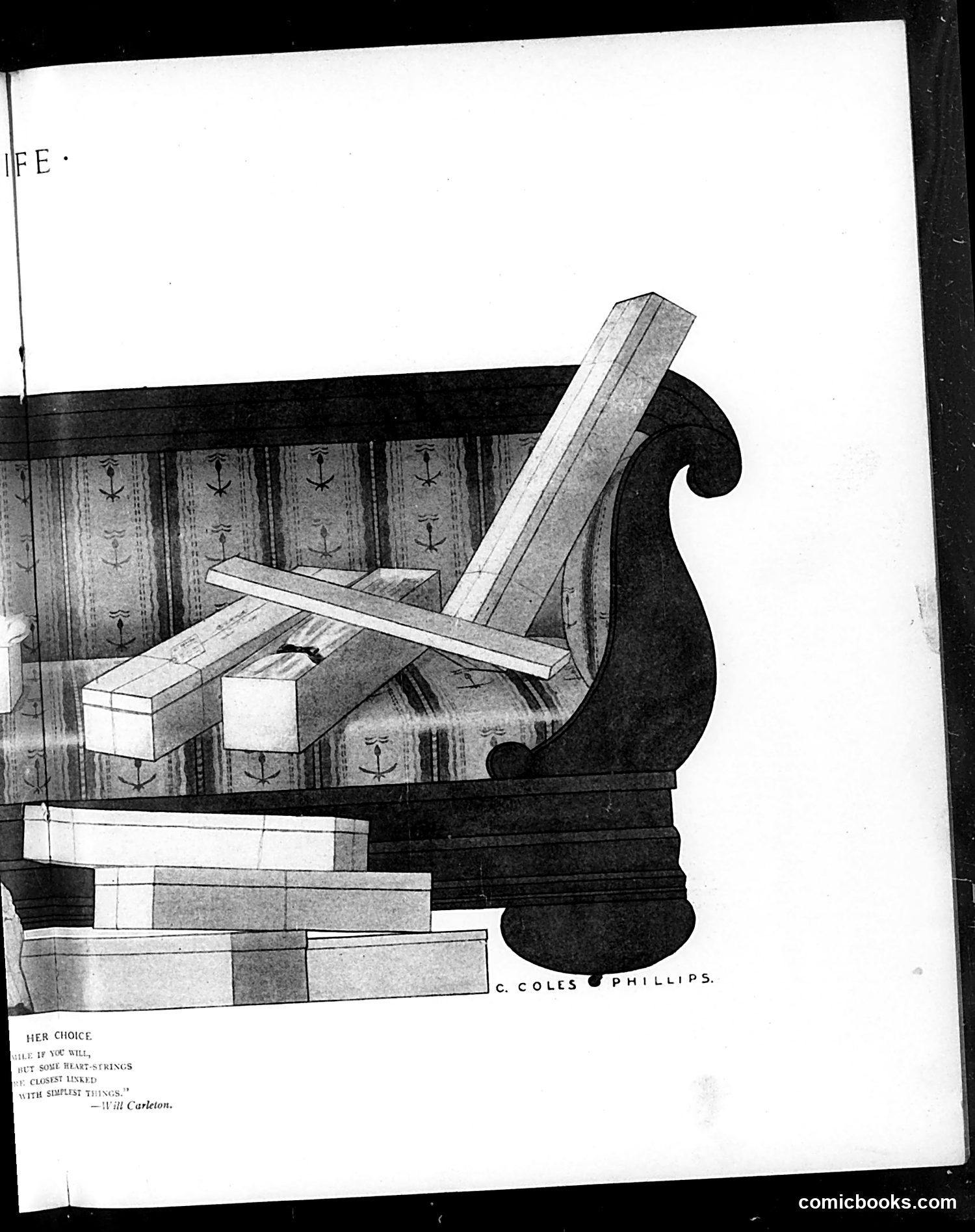
This is an advertisement for C. Coles Phillips, a prominent illustrator of the early 20th century. The image shows a stylized female figure in profile, rendered in Phillips's characteristic "fadeaway" technique where portions of the figure blend seamlessly into the background. The accompanying text quote—"Her Choice / If you will, / Some heart-strings / Best linked / With Simplest Things" attributed to Will Carleton—appears to be romantic or sentimental verse. The advertisement itself doesn't promote a specific product but rather showcases Phillips's artistic style and reputation, likely appearing in *Life* magazine to establish his credentials as a sought-after commercial artist and illustrator of the era. The anchor patterns visible on the wallpaper suggest a nautical or maritime theme, which was popular decorative motif of the period.
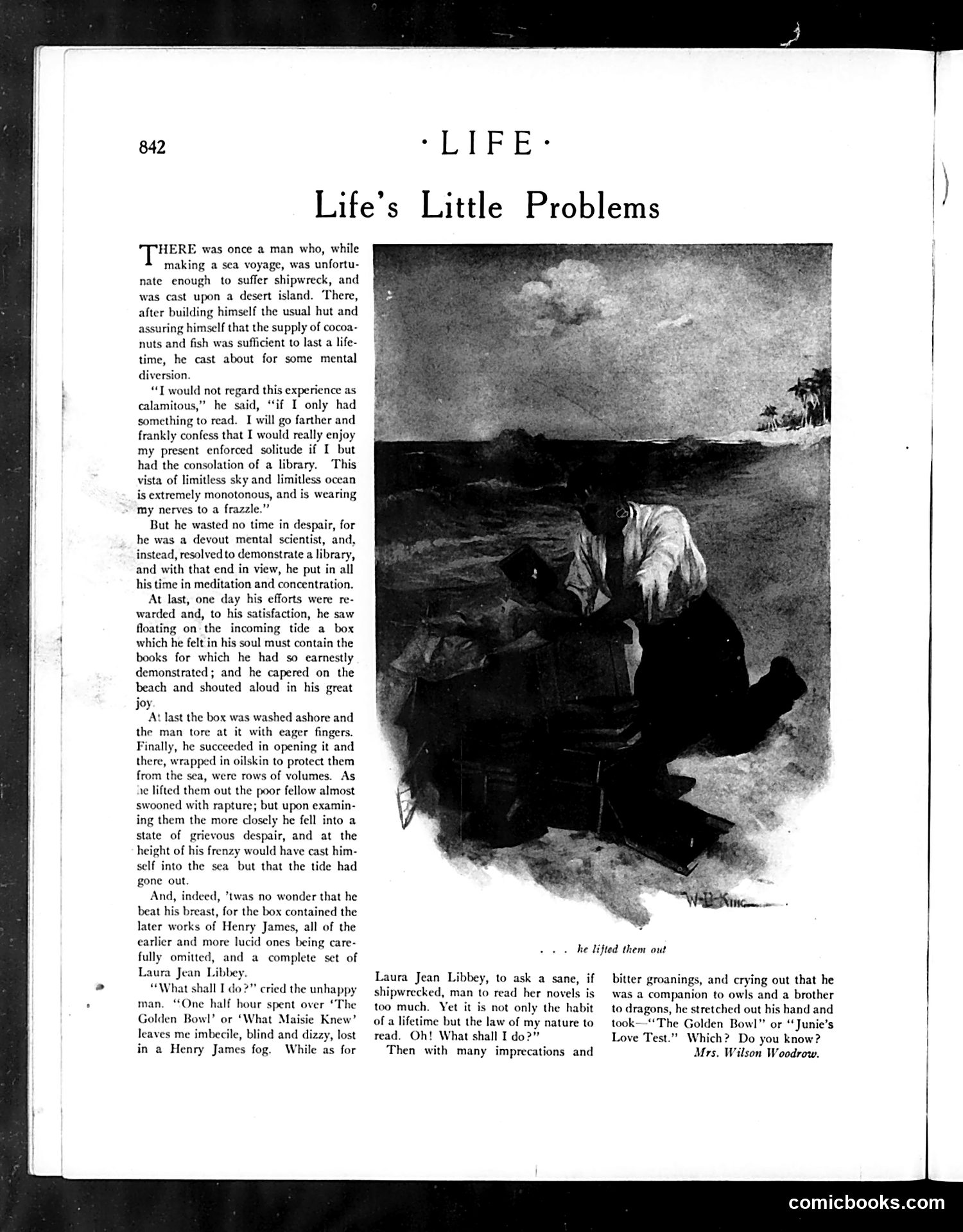
This humorous story satirizes early 20th-century literary pretension and the divide between "difficult" and "popular" fiction. A shipwrecked man, using "mental science" (likely referencing New Thought philosophy), miraculously manifests a library—only to despair at its contents. The joke targets **Henry James**, whose late novels ("The Golden Bowl," "What Maisie Knew") were notoriously dense and obscure, leaving readers "imbecile, blind and dizzy." Contrasted against him is **Laura Jean Libbey**, a prolific writer of sentimental romance novels considered lowbrow. The castaway faces an impossible choice: intellectually taxing "serious" literature or intellectually unchallenging popular fiction. The author (Mrs. Wilson Woodrow) leaves the ending ambiguous, mocking readers' inability to reconcile literary snobbery with actual readability—a dig at those who prize difficult authors like James despite finding them unreadable.
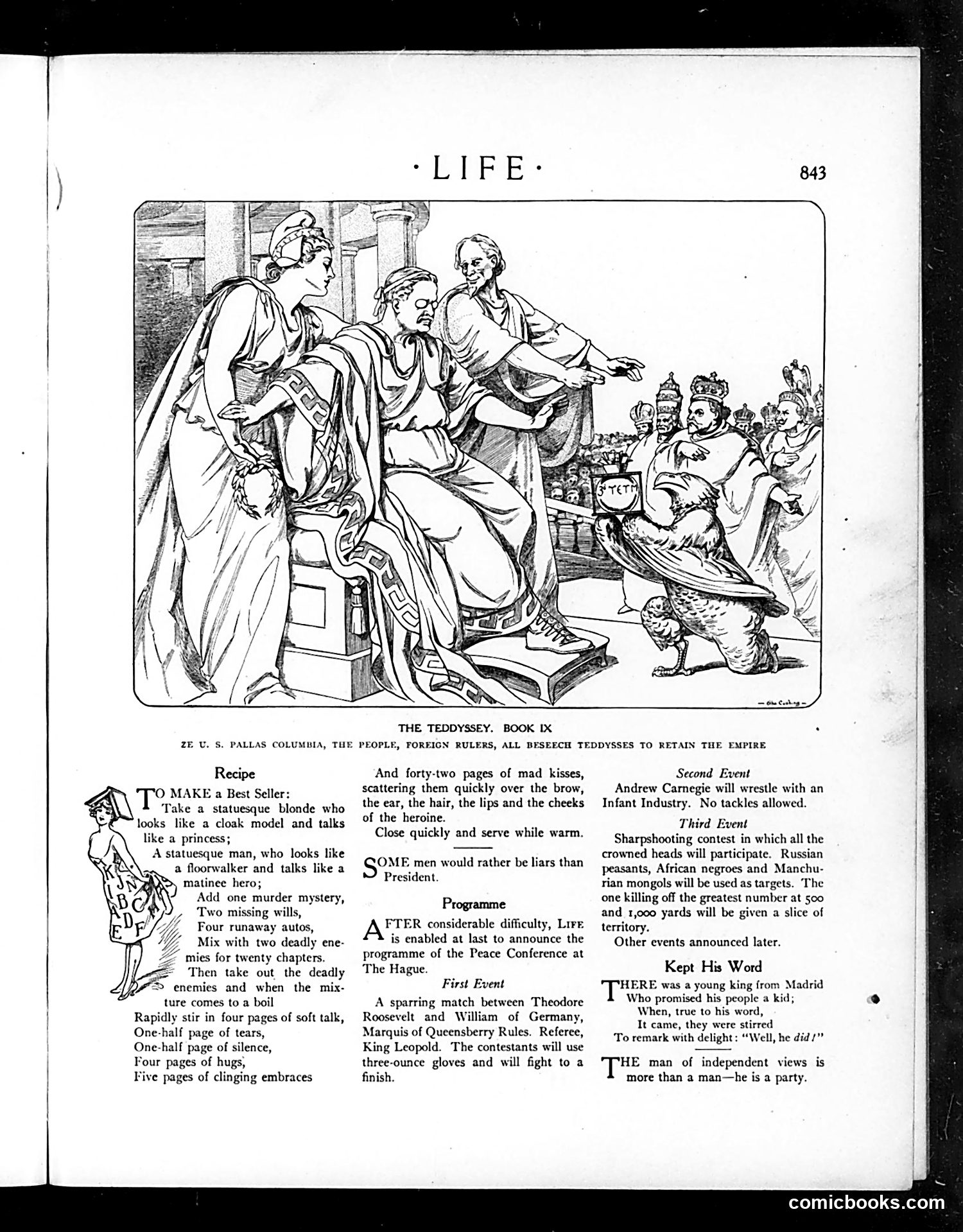
This page mixes literary mockery with political commentary on the Peace Conference at The Hague (likely 1907). **The "Recipe" section** satirizes popular bestselling novels—formulaic romantic tales featuring attractive protagonists, melodrama, and excessive sentimentality ("forty-two pages of mad kisses"). **"The Teddyssey" mock program** parodies the Peace Conference through absurdist "events": - **Theodore Roosevelt** (referred to as "Teddysses") appears as a boxing combatant against the German Kaiser—a jab at Roosevelt's aggressive "big stick" diplomacy versus peaceful negotiation - The "sharpshooting contest" cruelly mocks imperial powers treating colonized peoples (Russian peasants, African negroes, Manchurian mongols) as disposable targets for territorial conquest - **Andrew Carnegie** wrestling an "Infant Industry" likely criticizes capitalist monopolies The short poems mock political hypocrisy: a king who keeps his word by producing offspring, and commentary on politicians claiming independence while serving party interests. The overall message: the Peace Conference will accomplish nothing; world powers remain committed to violence, imperialism, and self-interest.
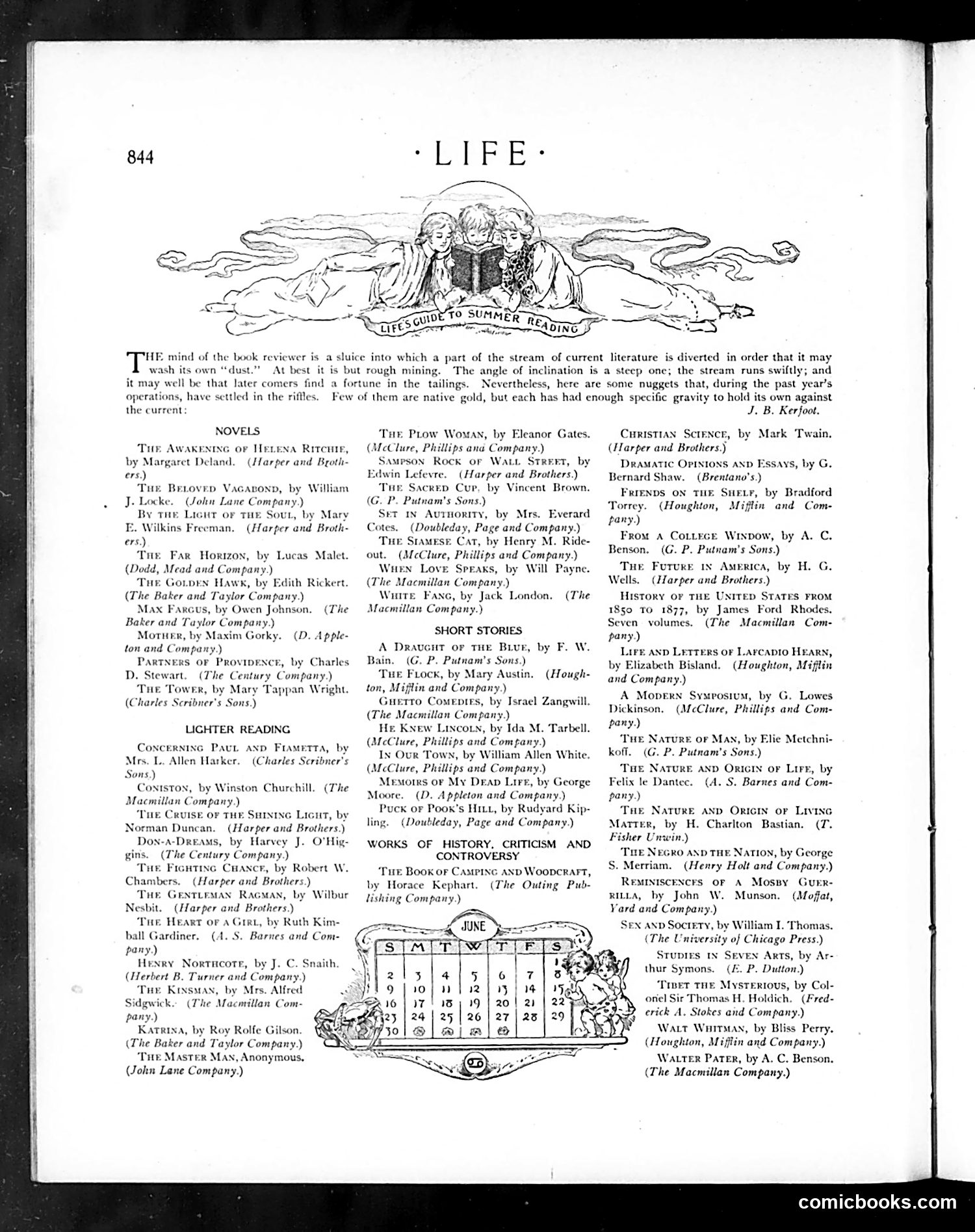
This page is primarily a **book recommendation list**, not a political cartoon. It's titled "Life's Guide to Summer Reading" and presents J.B. Kerfoot's metaphorical introduction comparing book reviewing to mining: reviewers sift through literature's "stream," discarding "dust" to find occasional "nuggets of gold." The page catalogs contemporary novels, short stories, and works of history/criticism from 1906, organized by category (Novels, Lighter Reading, Short Stories, Works of History). Notable authors include Mark Twain, Jack London, Rudyard Kipling, George Bernard Shaw, and H.G. Wells. A decorative June calendar appears at bottom center. This is essentially **editorial content guiding educated readers toward worthwhile summer books**—reflecting Life's role as a literary journal for literate Americans, not primarily satirical commentary on this particular page.
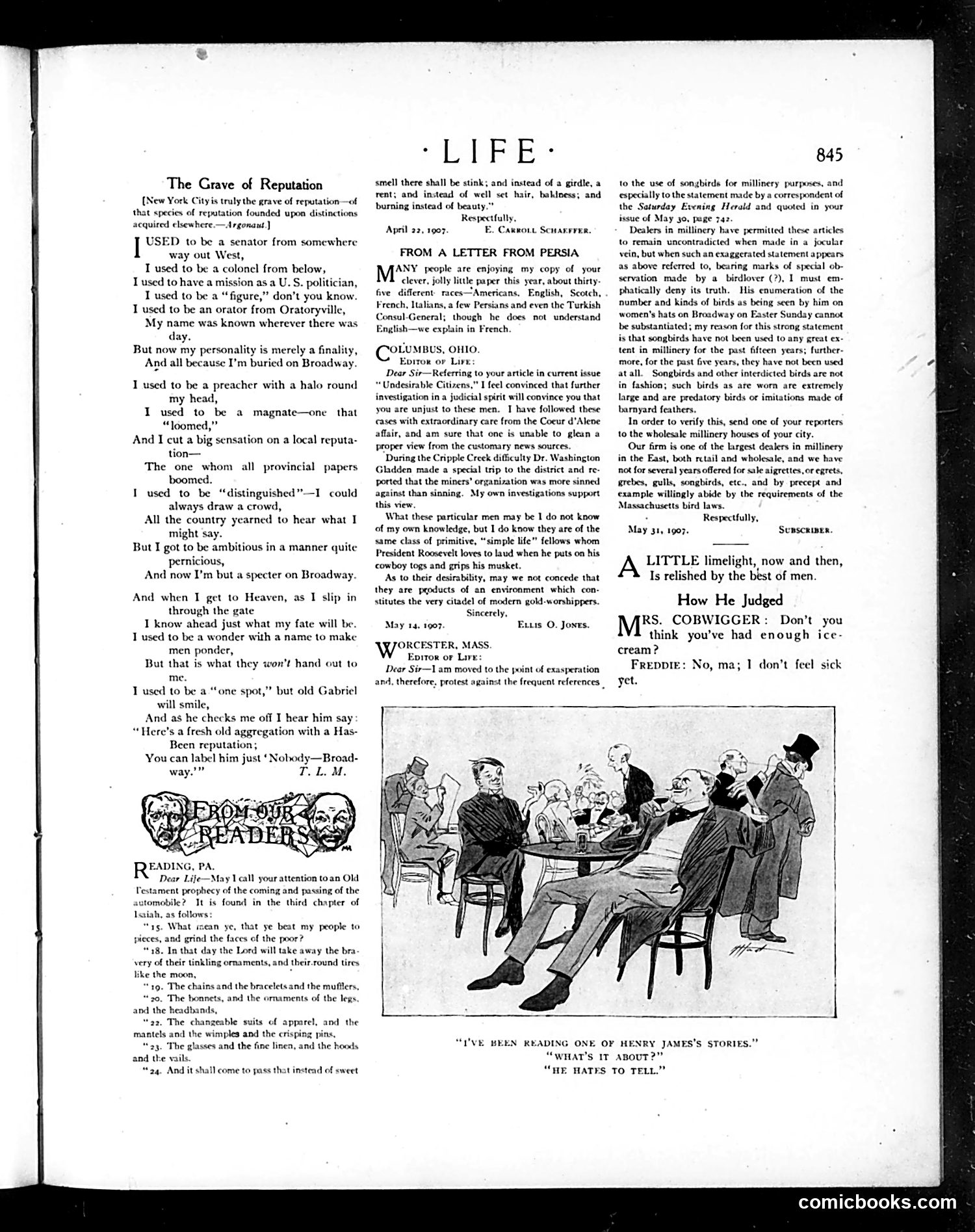
The cartoon depicts a social gathering where one man tells another he's been reading a Henry James story. When asked "What's it about?", he responds "He hates to tell"—a joke about Henry James's famously dense, lengthy, and difficult prose style. James was known for intricate narratives and elaborate psychological exploration that left readers struggling to understand basic plot points. The humor lies in the implication that after reading James, the man cannot summarize the story because James's writing is so convoluted that comprehension itself becomes questionable. This reflects early 20th-century literary culture where James was celebrated but also mocked for his impenetrability.
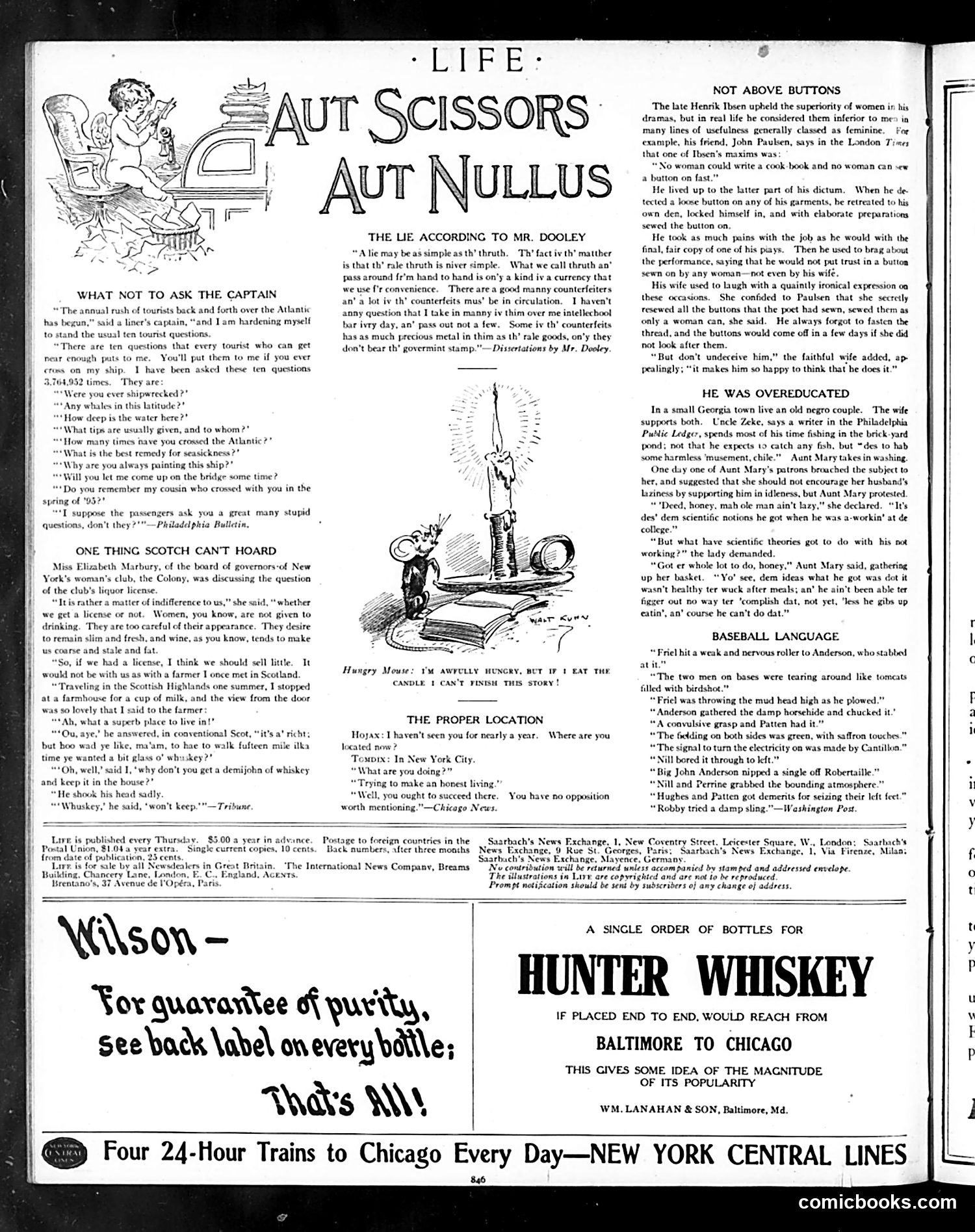
This page from Life magazine (appears to be early 20th century) contains several humorous anecdotes mocking human foibles: **"Aut Scissors Aut Nullus"** satirizes ship captains' frustration with repetitive tourist questions about maritime experiences. **"One Thing Scotch Can't Hoard"** ridicules Scottish frugality through a woman's anecdote about a Scottish farmer unwilling to keep whiskey available, suggesting Scots are so miserly they won't even enjoy their own resources. **"The Lie According to Mr. Dooley"** presents Irish-dialect philosophy about truth being merely convenient currency, with counterfeits circulating freely—social commentary on dishonesty in everyday life. **"Not Above Buttons"** recounts playwright Henrik Ibsen's obsessive, elaborate button-sewing despite claiming women inferior at domestic tasks—ironic self-contradiction. The cartoons accompany these text pieces, using ethnic stereotypes (Scots as miserly, Irish as philosophical drinkers) common to early Life's humor. The page is primarily satirical commentary on vanity, prejudice, and human inconsistency.
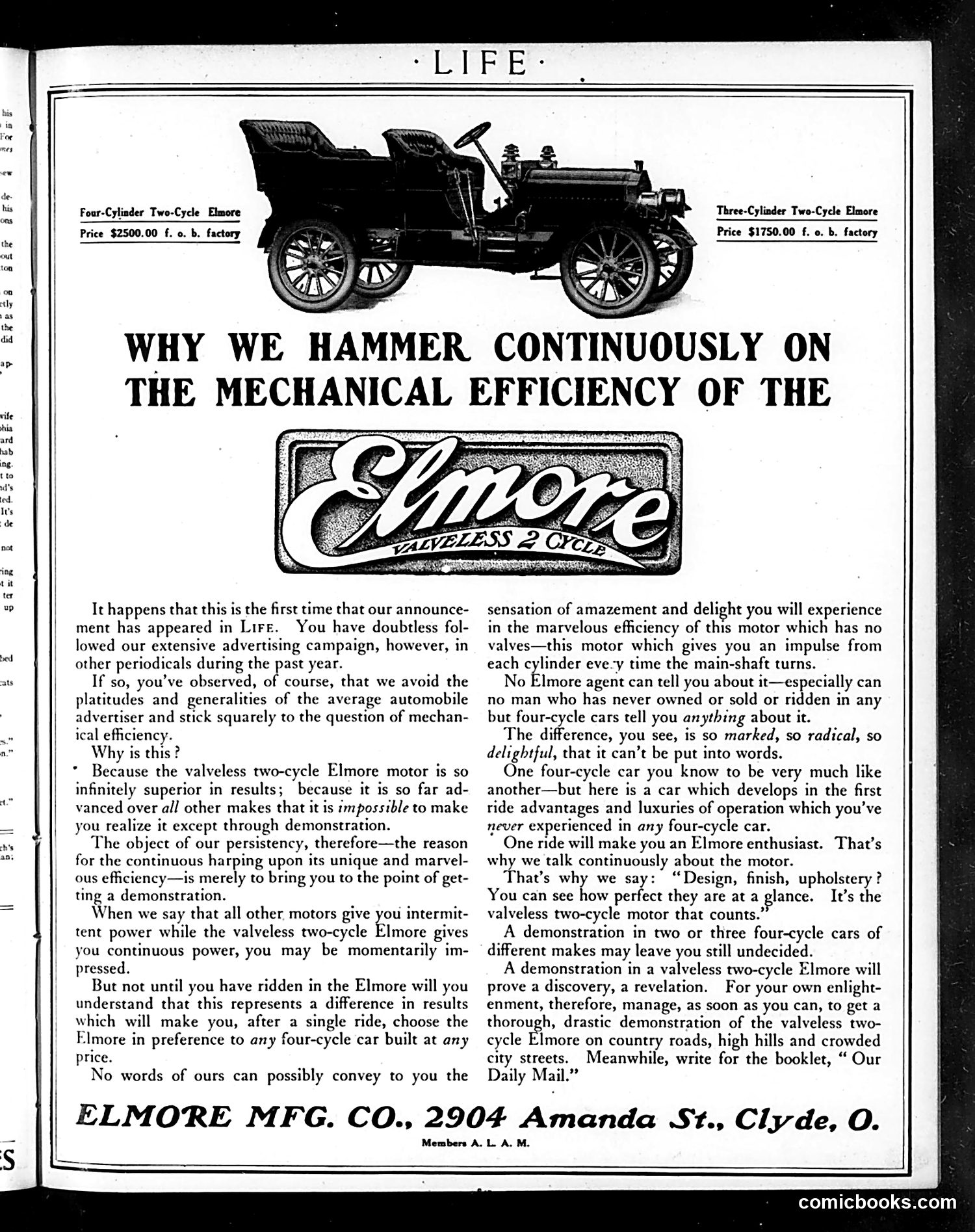
This is **not a cartoon or satirical content**—it's a straightforward automobile advertisement placed in *Life* magazine. The page advertises the Elmore automobile, manufactured in Clyde, Ohio. Two models are shown: a four-cylinder priced at $2,500 and a three-cylinder at $1,750 (f.o.b. factory). The ad's central claim is that the Elmore's "valveless two-cycle motor" delivers continuous power superior to competitors' intermittent four-cycle engines. The manufacturer argues their repeated emphasis on mechanical efficiency (rather than design or upholstery) reflects the motor's genuinely revolutionary superiority—so significant that words cannot convey it; only a test drive can. The ad urges readers to request a demonstration, positioning the Elmore as a transformative automotive experience that will convert skeptics into "enthusiasts." This represents early 1900s automotive marketing strategy: emphasizing technical innovation as competitive advantage.
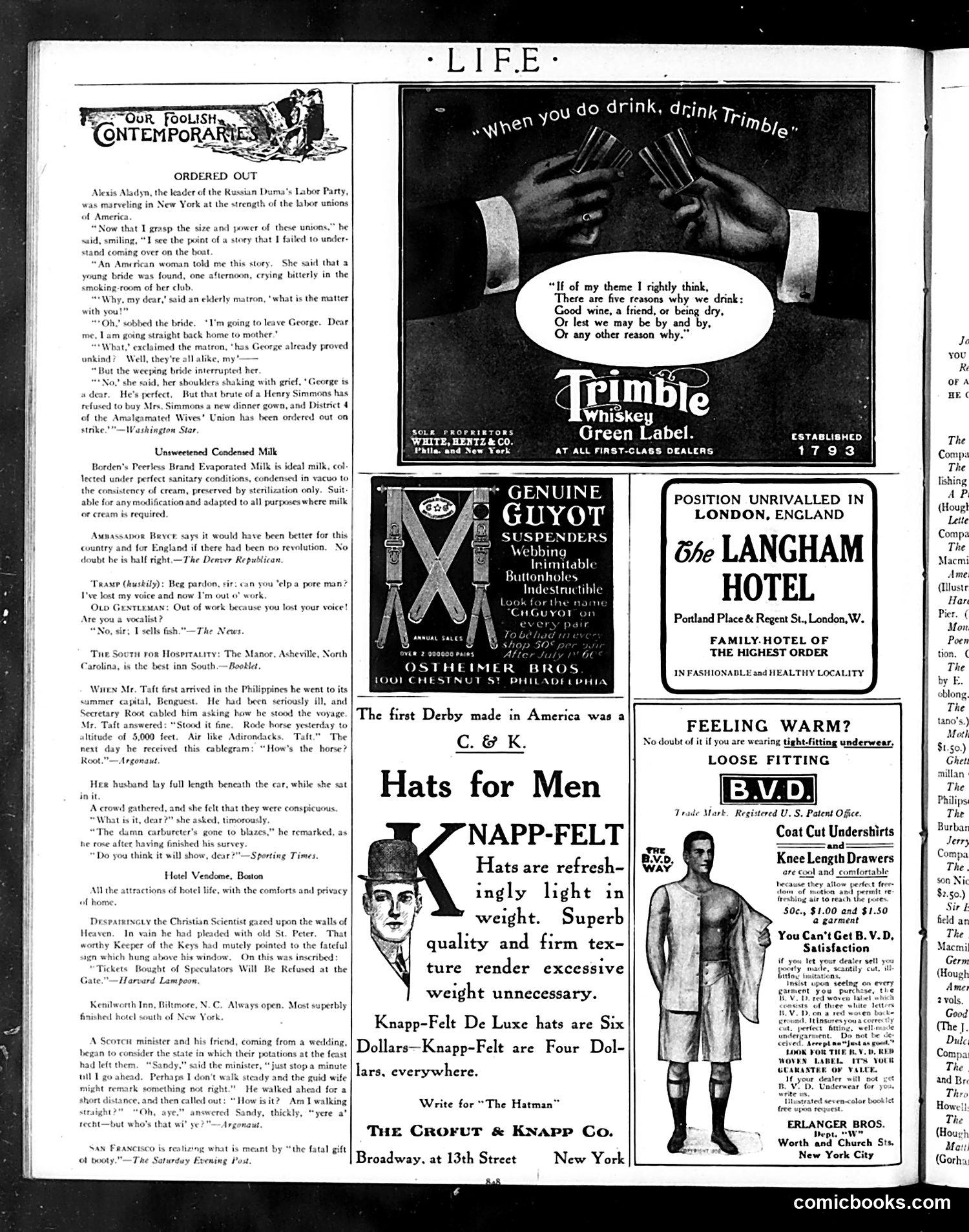
This satirical piece mocks Russian labor organizer Alexis Malyn's observations about American labor unions. The joke: Malyn marvels at union power in America, then hears a story about a young bride leaving her husband because Henry Simmons won't buy his wife a new dinner gown—prompting the "Amalgamated Wives' Union" to strike. The satire targets both American union militancy (portrayed as absurdly powerful and quick to strike) and the domestic discord it supposedly causes. By attributing a marital crisis to union action rather than actual abuse or incompatibility, the piece ridicules unions as intrusive forces disrupting family life over trivial matters. The page also contains various brief humorous anecdotes and period advertisements (Trimble Whiskey, Knapp-Felt hats, B.V.D. underwear, The Langham Hotel). These are typical of *Life* magazine's format during this era.
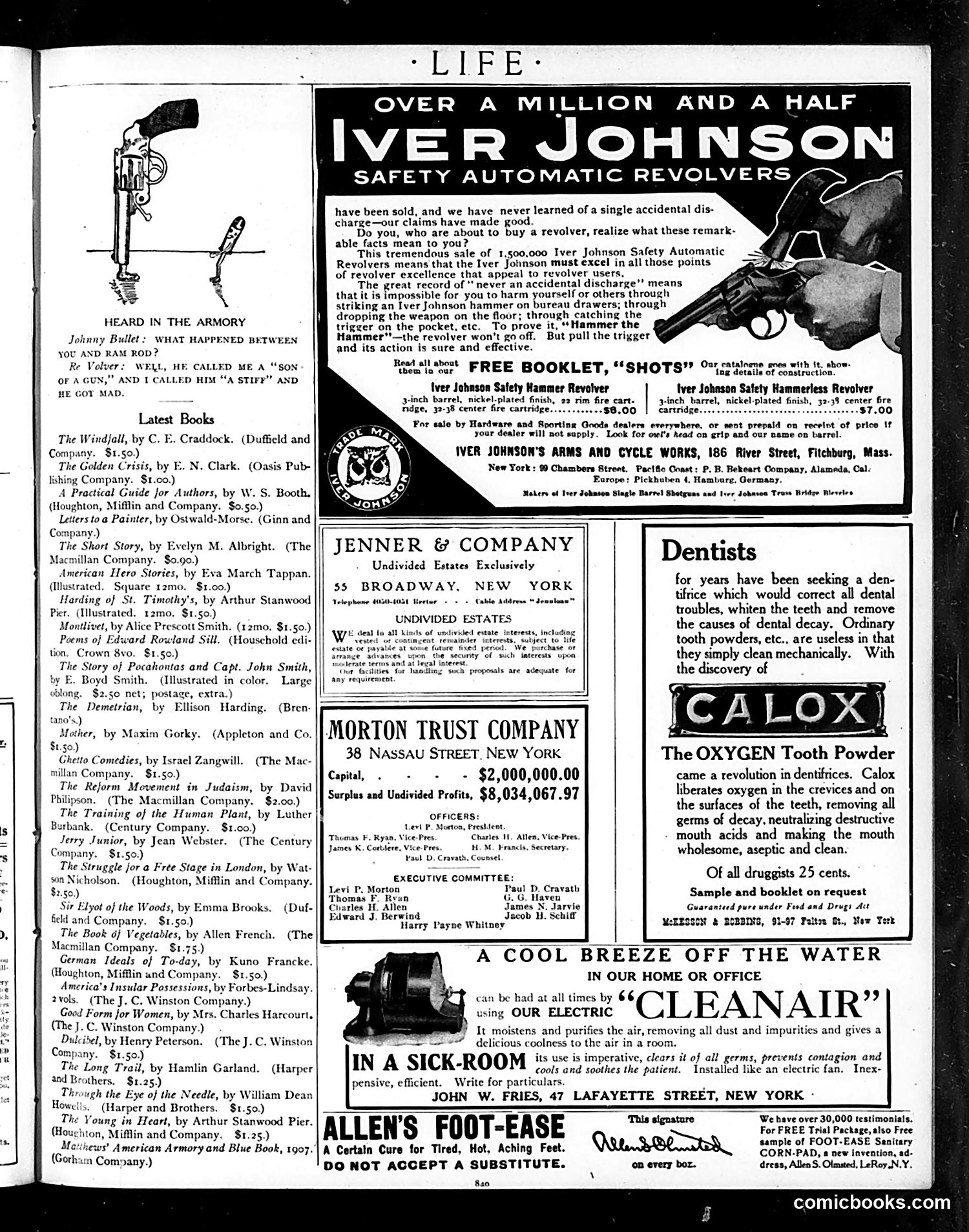
This small cartoon illustrates a wordplay joke playing on revolver terminology. Two characters—"Johnny Bullet" and "Ram Rod"—have a heated exchange where they insult each other using gun-related slang. "Son of a gun" and "stiff" are period insults, but the humor depends on the characters' names themselves being gun parts (bullet, ram rod, revolver). The joke is relatively straightforward: it's a visual pun leveraging the anthropomorphized gun components as characters trading insults at an armory. The cartoon appears designed as light filler content alongside the page's dominant advertisements—particularly the lengthy Iver Johnson Safety Automatic Revolvers ad above it, which emphasizes the revolver's safety features and claims never to have caused accidental discharge.
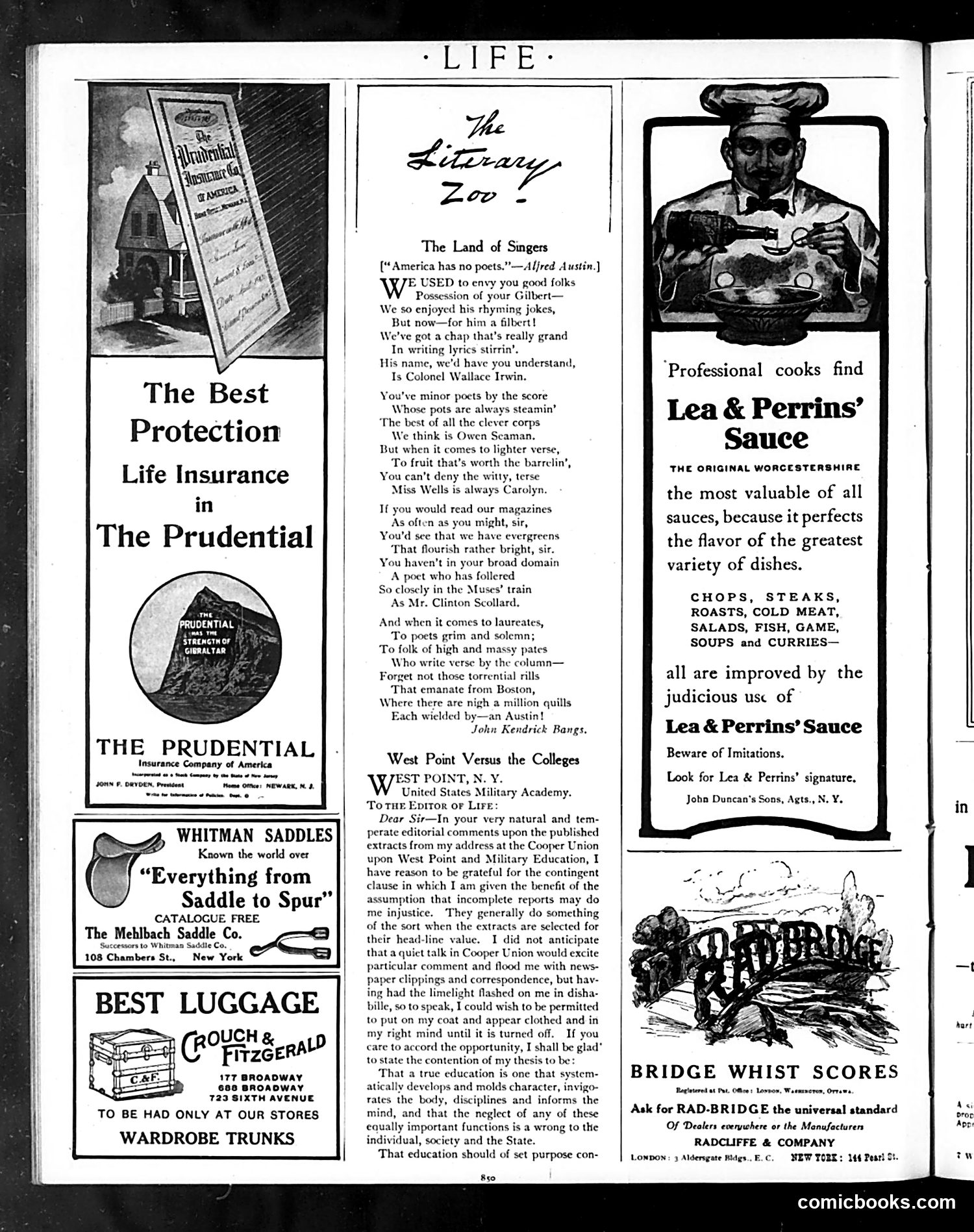
This page is primarily **advertising with one substantial satirical article**. The central piece, "The Land of Singers" by John Kendrick Bangs, is a humorous poem responding to Alfred Austin's dismissive claim that "America has no poets." **The Satire's Point:** Bangs defends American literary talent by naming contemporary American poets and writers—Colonel Wallace Irwin, Owen Seaman, Miss Wells (Carolyn), Clinton Scollard, and others—while pointedly contrasting them with British figures like Gilbert (W.S. Gilbert). The poem's tone is mock-indignant pride, listing American versifiers as proof against Austin's slight. **Historical Context:** This reflects early 20th-century Anglo-American cultural rivalry, when American intellectuals were still establishing literary credibility against British dominance. The piece is both defensive and boastful—acknowledging America's "minor poets" while asserting homegrown talent worthy of respect. The surrounding advertisements (insurance, saddles, luggage, sauce) are period-typical magazine filler with no satirical content.
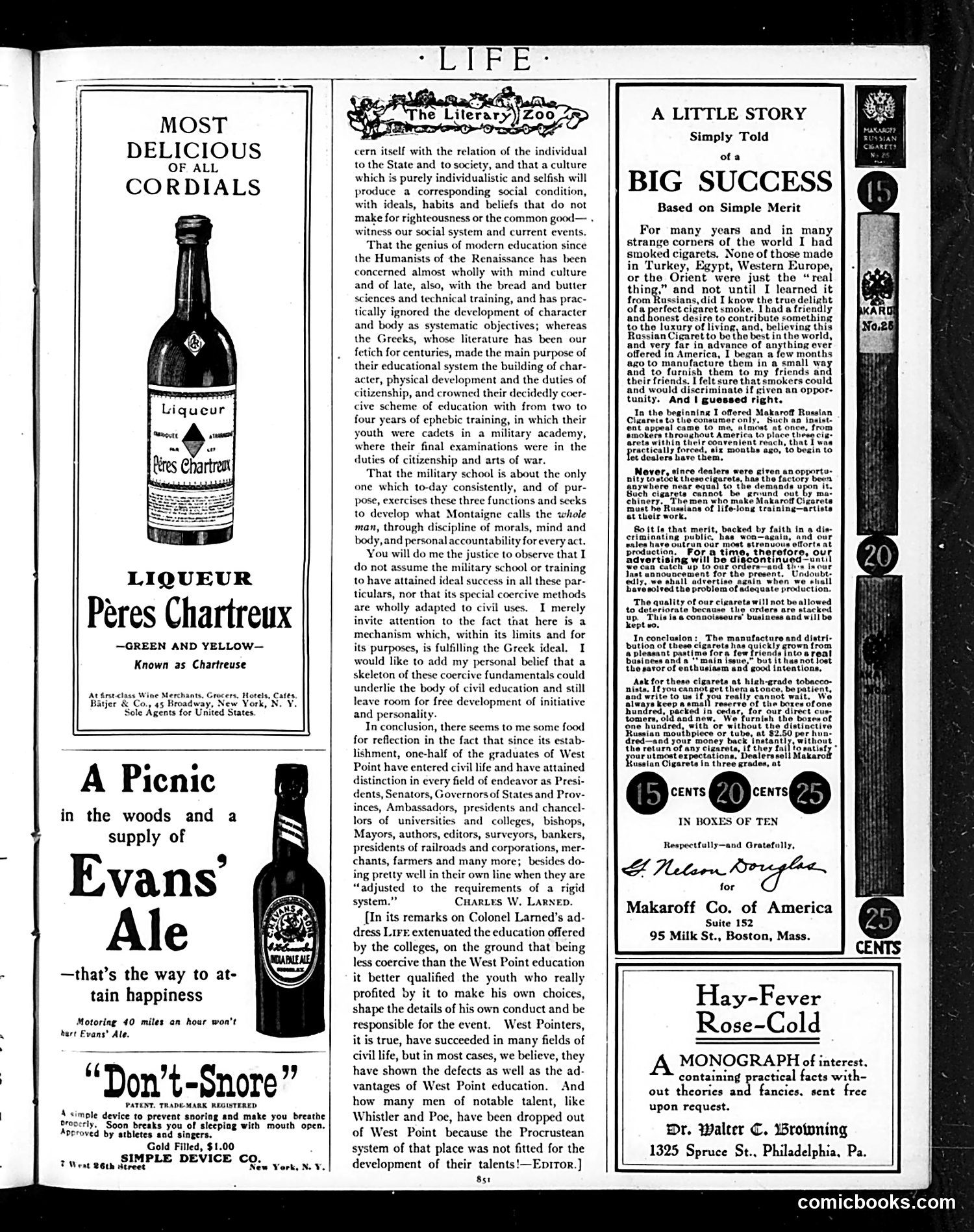
This page is primarily **advertisements and editorial content**, not political cartoons. The main text is a serious essay by Charles W. Lamed defending military education (specifically West Point) as superior to civilian college education. **The argument**: Lamed contends that West Point successfully develops character, physical fitness, and civic duty—following the Greek educational ideal—whereas colleges focus only on mind and technical training while ignoring moral development. He cites West Point graduates' success in civilian fields (presidents, senators, judges, etc.) as proof the military system works. **The Life editor's response** (in brackets) disputes this, arguing that *less* coercive civilian education actually produces more capable citizens who can make independent choices. The page also features period advertisements for liqueur, ale, and a "Don't-Snore" anti-snoring device—typical of early 20th-century magazines. **For modern readers**: This reflects a historical debate about whether authoritarian discipline or individual freedom better prepares citizens, with the magazine taking the progressive side favoring autonomy.
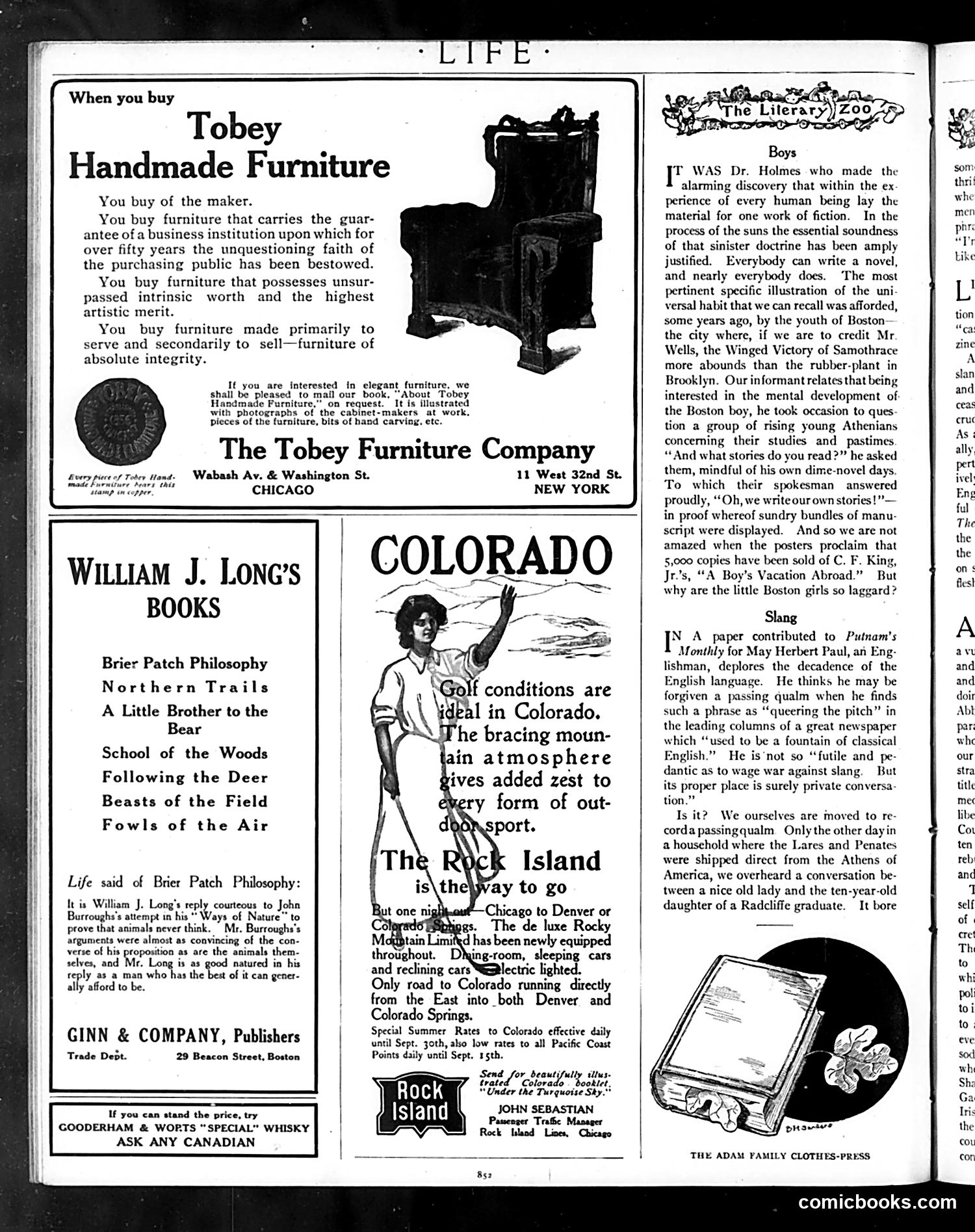
This page is primarily **advertisements and literary commentary** rather than political satire. **Main Content:** - **Tobey Handmade Furniture ad**: Emphasizes craftsmanship and integrity over mass production - **William J. Long's Books**: Publisher advertisement listing nature/philosophy titles - **Colorado/Rock Island Railway ad**: Promotes train travel to Colorado, highlighting golf and mountain scenery **Literary Section ("The Literary Zoo"):** A humorous essay criticizing young Bostonians' literary pretensions. The author relates how Boston children claim to *write* their own stories rather than read established literature—presented as charming but misguided enthusiasm. A secondary note mocks an English contributor to *Putnam's Monthly* who complains about American newspaper language degrading English, yet the editor humorously notes slang appears everywhere, even in "refined" households. **The satire is gentle**: poking fun at American provincial attitudes toward culture and proper English usage, not serious political commentary. The page reflects early 20th-century middle-class concerns about literature, craftsmanship, and refinement.
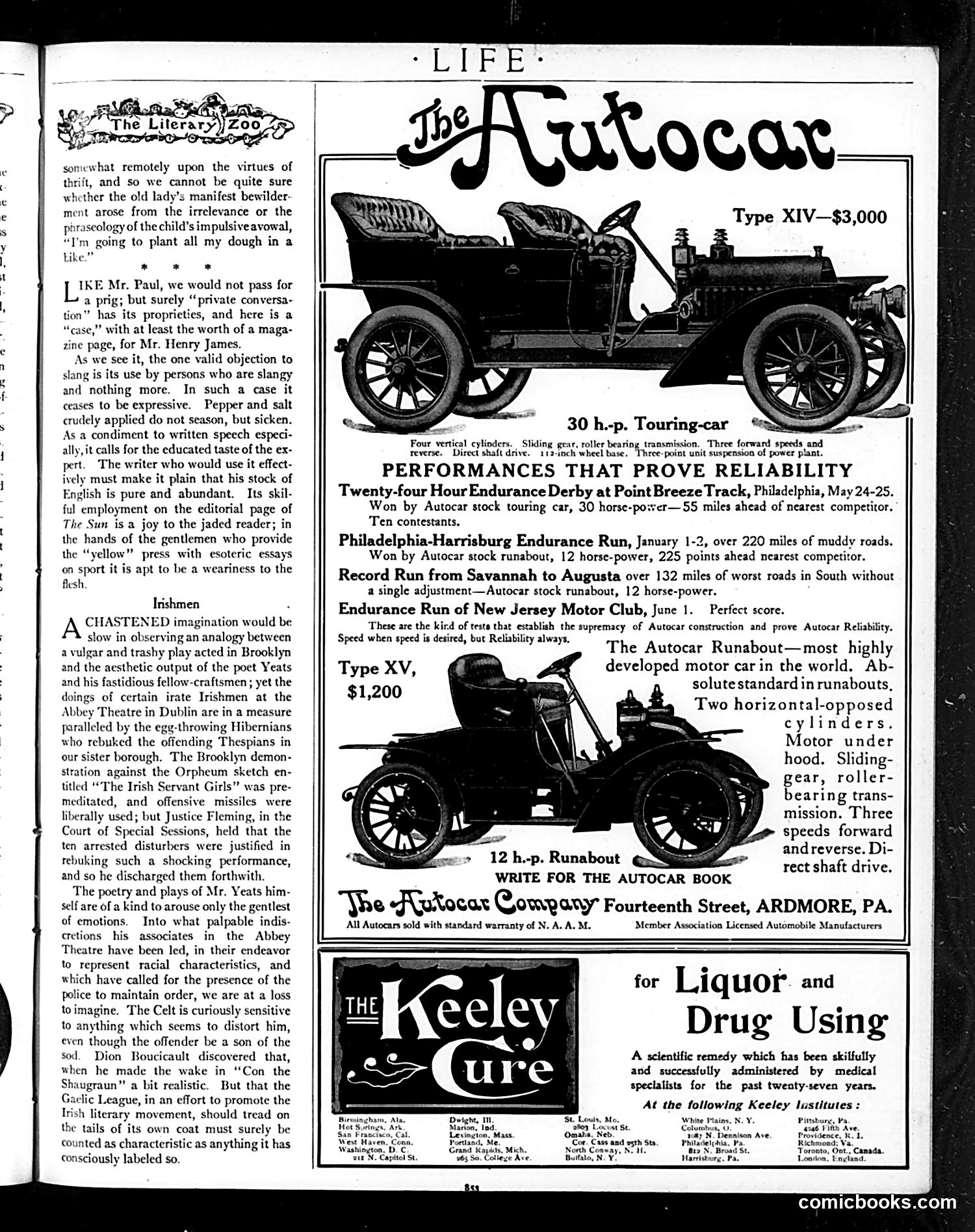
This is primarily an **advertising page** for the Autocar automobile company, with two editorial pieces in the left column. The editorials discuss: 1. **"The Literary Zoo"** — a brief comment on slang usage, arguing it should only be employed by writers with sufficient education and vocabulary to use it effectively as seasoning, not as a crutch. 2. **"Irishmen"** — commentary on Irish nationalist protests at the Abbey Theatre in Dublin (and a parallel Brooklyn incident involving "The Irish Servant Girls" sketch). The author notes that Irish audiences and the Gaelic League are sensitive to stereotypical portrayals of Irish character, yet ironically the League itself engages in questionable artistic choices. The reference to poet W.B. Yeats establishes the Abbey Theatre's literary reputation, contrasting it with the crude material that provoked protests. The **Autocar advertisements** showcase two vehicle models with performance records from endurance races and long-distance runs, emphasizing reliability and engineering quality.
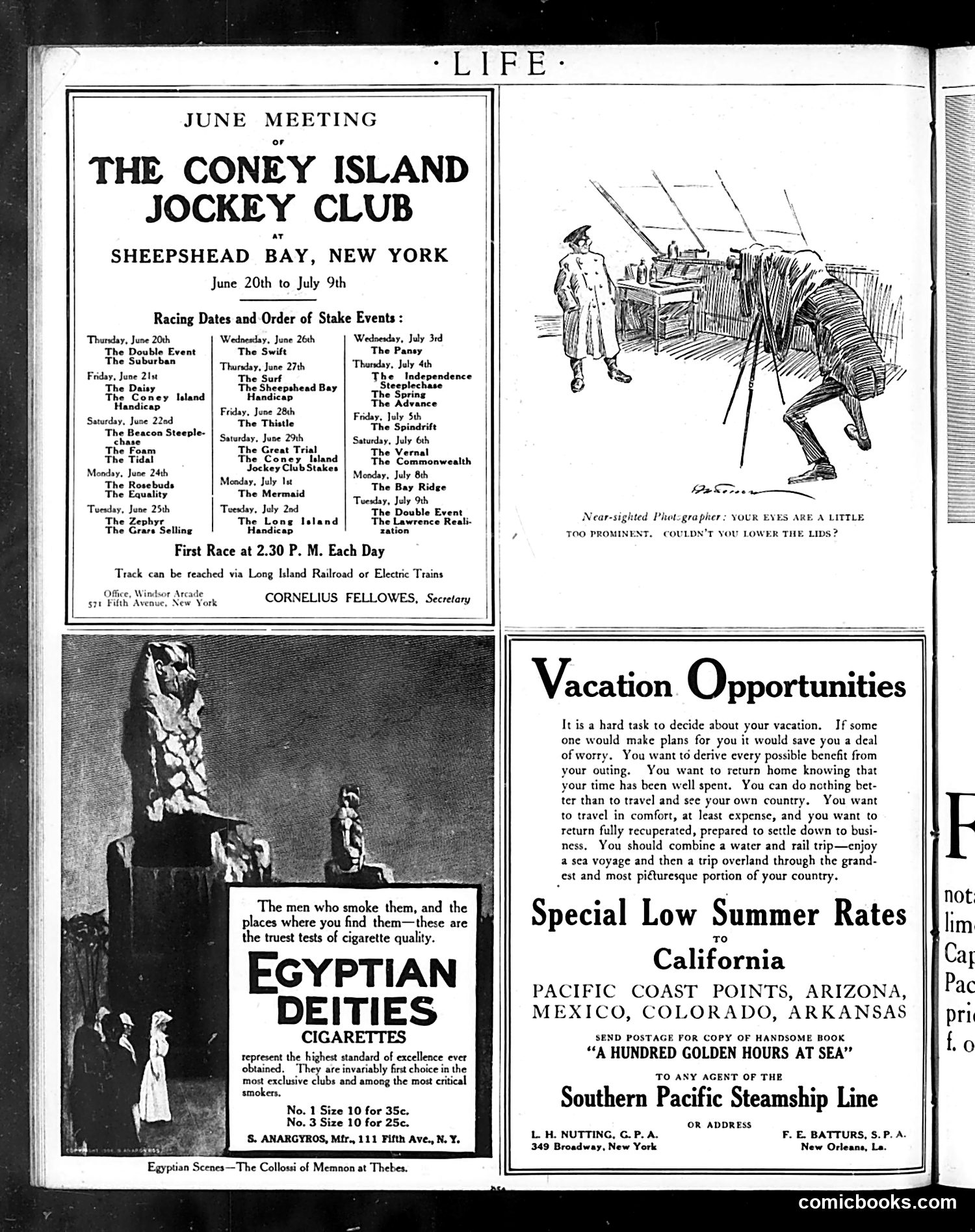
This page is primarily **advertising and event announcements** rather than political satire. The content includes: **Main Content:** - Large advertisement for the Coney Island Jockey Club's June racing schedule at Sheepshead Bay, New York - Detailed listing of stake races and dates - Advertisement for Egyptian Deities Cigarettes, emphasizing their use in "exclusive clubs" among "critical smokers" - Vacation travel advertisement for Southern Pacific Steamship Line promoting California and western U.S. travel **Cartoon:** The small illustration labeled "Near-sighted Photographer" shows a photographer asking a subject to lower their eyelids because their eyes are "too prominent." This is a gentle visual joke about photographic vanity and the absurdity of trying to minimize one's natural features. **Historical Context:** The page reflects early 20th-century leisure culture: horse racing as elite entertainment, cigarette smoking as a status symbol, and rail/steamship travel as vacation standards.
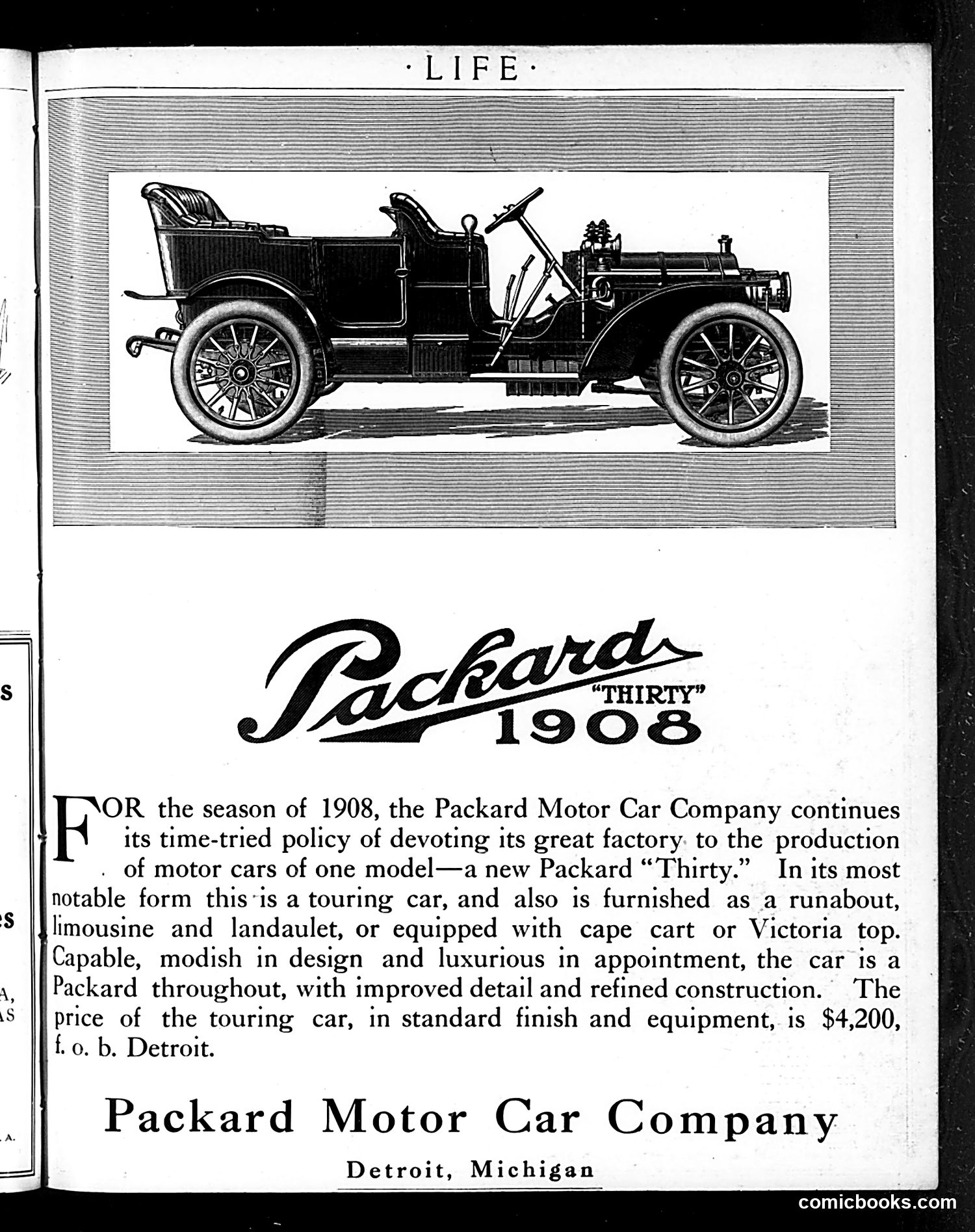
This is primarily **advertising, not satire or political commentary**. The page features a full-page advertisement for the 1908 Packard "Thirty" automobile, published in *Life* magazine. The image shows a detailed technical illustration of the luxury touring car in side profile. The accompanying text emphasizes Packard's manufacturing philosophy of focusing production on a single, refined model rather than diversifying. It highlights the car's availability in multiple configurations (touring car, runabout, limousine, landaulet) and emphasizes qualities like "modish design" and "luxurious appointment." The $4,200 price point (f.o.b. Detroit) positioned this as an expensive, premium vehicle for wealthy buyers—substantial money in 1908. This is straightforward product promotion, not satirical content, reflecting *Life*'s role as both humor and lifestyle magazine of its era.
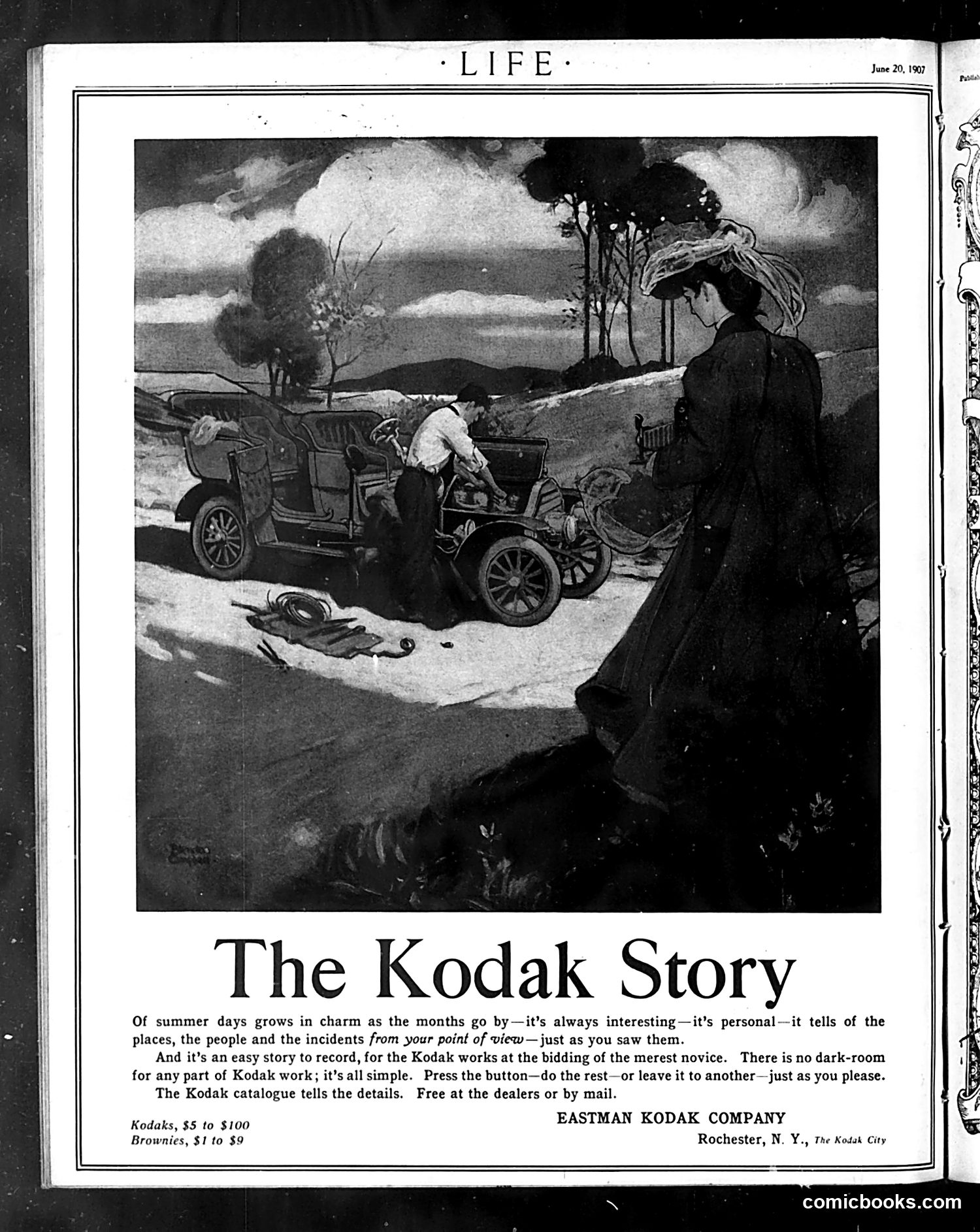
This is primarily a **Kodak advertisement**, not political satire. The page shows a romantic illustration of an early 1900s automobile scene: two women in period dress encounter a broken-down car on a rural road. The ad's message is straightforward product promotion: Kodak cameras are so simple that anyone—even a "merest novice"—can use them to capture life's moments. The automobile breakdown scene serves as the narrative hook: this is exactly the kind of memorable incident you'd want to photograph. The phrase "Press the button—do the rest" was Kodak's actual famous slogan, emphasizing ease of use. The price range ($5-$100 for Kodaks, $1-$9 for Brownies) indicates these were consumer products for middle-class buyers. There is no satirical content or political reference here—it's straightforward early advertising capitalizing on the novelty of personal photography and automobiles as markers of modern leisure.