
Life, 1907-06-20 · page 15 of 32
Life — June 20, 1907 — page 15: what you’re looking at
What you’re looking at
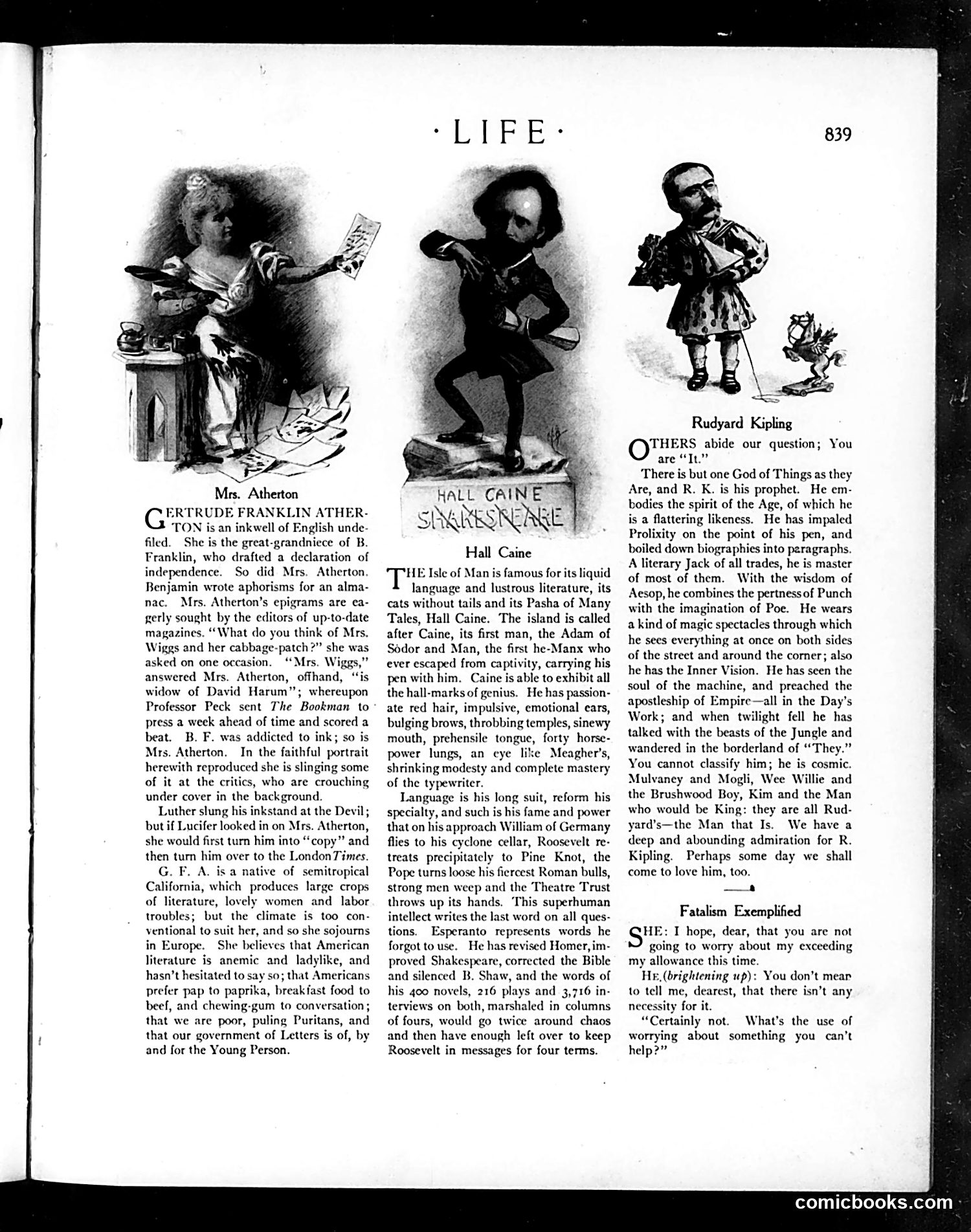
This page profiles three literary figures through satirical biographical sketches and caricatures: **Mrs. Atherton** (left): A writer descended from Benjamin Franklin, depicted flinging ink at critics. The satire mocks her sharp wit and scathing literary criticism—she's portrayed as aggressively combative toward reviewers. **Hall Caine** (center): An Isle of Man author whose prolific output and grandiose self-importance are ridiculed. The text sarcastically credits him with such vast literary accomplishment that world leaders flee in fear of his influence, and his words could "twice around chaos"—absurdist exaggeration of his ego and productivity. **Rudyard Kipling** (right): Praised as a literary prophet who sees everything at once with "magic spectacles" and "Inner Vision." Unlike the others, his satire is largely admiring—he's positioned as the supreme arbiter of modern thought and literature. The humor relies on readers' familiarity with these then-prominent writers and their reputations for critical severity, prolific writing, or cultural influence.
📄 Transcribed text from this page (OCR, searchable)
Machine-transcribed from the original scan — historical spelling and the odd misread are preserved.
Irs. Atherton GERTRUDE FRANKLIN ATHER- TON is an inkwell of English unde- filed. She is the great-grandniece of B. Franklin, who drafted a declaration of independence. So did Mrs, Atherton, Benjamin wrote aphorisms for an alma- nac. Mrs. Atherton’s epigrams are ca- gerly sought by the editors of up-to-date magazines. “What do you think of Mrs. Wiggs and her cabbage-patch?” she was asked on one occasion. “Mrs. Wiggs, answered Mrs. Atherton, offhand, ‘is widow of David Harum”; whereupon Professor Peck sent The Bookman to press a week ahead of time and scored a beat. B. F. was addicted to ink; so is Mrs. Atherton, In the faithful portrait herewith reproduced she is slinging some of it at the critics, who are crouching under cover in the background. Luther slung his inkstand at the Devil; but if Lucifer looked in on Mrs. Atherton, she would first turn him into “copy” and then turn him over to the London Times. G. F. A. is a native of semitropical California, which produces large crops of literature, lovely women and labor troubles; but the climate is too con- ventional to suit her, and so she sojourns in Europe. She believes that American literature is anemic and ladylike, and hasn’t hesitated to say so; that Americans prefer pap to paprika, breakfast food to beef, and chewing-gum to conversation ; that we are poor, puling Puritans, and that our government of Letters is of, by and for the Young Person. HALL CAIN E “a Hall Caine if Festa Isle of Man is famous for its liquid language and lustrous literature, its cats without tails and its Pasha of Many Tales, Hall Caine. The island is called after Caine, its first man, the Adam of Sodor and Man, the first he-Manx who ever escaped from captivity, carrying his pen with him. Caine is able to exhibit all the hall-marks of genius. He has passion- ate red hair, impulsive, emotional cars, bulging brows, throbbing temples, sinewy mouth, prehensile tongue, forty horse- power lungs, an eye like Meagher’s, shrinking modesty and complete mastery of the typewriter. Language is his long suit, reform his specialty, and such is his fame and power that on his approach William of Germany flies to his cyclone cellar, Roosevelt re- treats precipitately to Pine Knot, the Pope turns loose his fiercest Roman bulls, strong men weep and the Theatre Trust throws up its hands. ‘This superhuman intellect writes the last word on all ques- tions. Esperanto represents words he forgot to use. He has revised Homer, im- proved Shakespeare, corrected the Bible and silenced B. Shaw, and the words of his 400 novels, 216 plays and 3,716 in- terviews on both, marshaled in columns of fours, would go twice around chaos and then have enough left over to keep Roosevelt in messages for four terms. Rudyard Kipling @THERS abide our question; You are “It.” ‘There is but one God of Things as they Are, and R. K. is his prophet. He em- bodies the spirit of the Age, of which he is a flattering likeness. He has impaled Prolixity on the point of his pen, and boiled down biographies into paragraphs. A literary Jack of all trades, he is master of most of them. With the wisdom of Aesop, he combines the pertness of Punch with the imagination of Poe. He wears a kind of magic spectacles through which he sees everything at once on both sides of the street and around the corner; also he has the Inner Vision. He has seen the soul of the machine, and preached the apostleship of Empire—all in the Day’s Work; and when twilight fell he has talked with the beasts of the Jungle and wandered in the borderland of “They.” You cannot classify him; he is cosmic. Mulvaney and Mogli, Wee Willie and the Brushwood Boy, Kim and the Man who would be King: they are all Rud- yard’s—the Man that Is. We have a deep and abounding admiration for R. Kipling. Perhaps some day we shall come to love him, too. easy Fatalism Exemplified HE: I hope, dear, that you are not going to worry about my exceeding my allowance this time. He, (brightening up): You don’t mean to tell me, dearest, that there isn’t any necessity for it. “Certainly not. What’s the use of worrying about something you can’t help?” comicbooks.com -