
Life, 1907-06-20 · page 13 of 32
Life — June 20, 1907 — page 13: what you’re looking at
What you’re looking at
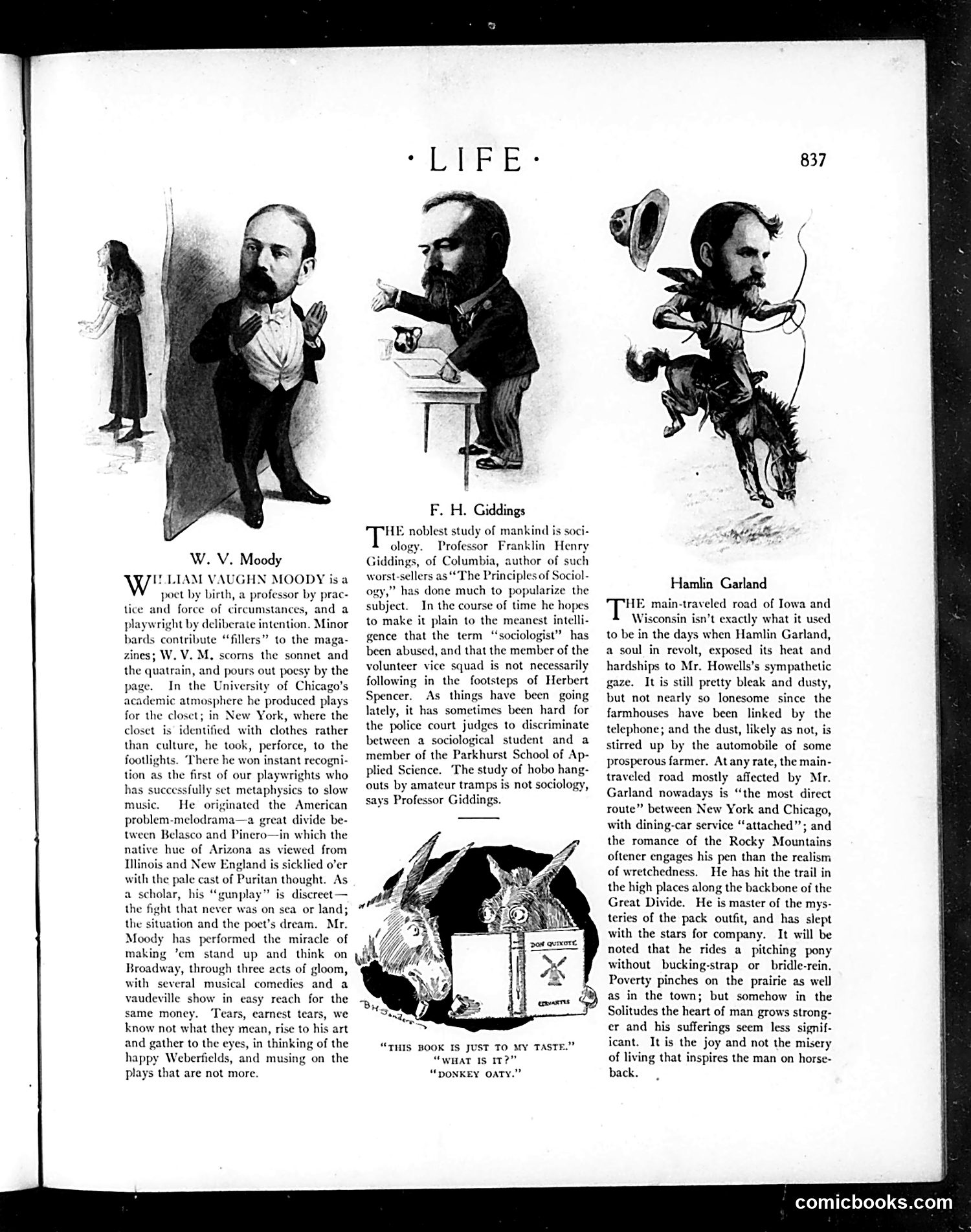
This page features three caricatured figures from early 20th-century American public life: **W. V. Moody** (left): A poet and playwright criticized for producing overly intellectual work unsuitable for popular audiences. **F. H. Giddings** (center): A Columbia University sociology professor mocked for popularizing the term "sociologist" and for attempting to distinguish between legitimate sociological study and amateur hobbyist investigation. **Hamlin Garland** (right): A writer satirized for his romanticized portrayals of the American Midwest and frontier life, particularly regarding hardship and rural existence. The central cartoon shows a donkey reading a book labeled "Donkey Oaty," captioned "This book is just to my taste. What is it?"—mocking the pretension and disconnect between these intellectuals' work and ordinary people's interests. The satire suggests these figures produce work more suited to animals than general audiences.
📄 Transcribed text from this page (OCR, searchable)
Machine-transcribed from the original scan — historical spelling and the odd misread are preserved.
3HN MOODY isa poct by birth, a professor by prac- tice and force of circumstances, and a playwright by deliberate intention. Minor bards contribute “fillers” to the maga- zines; W. V. M, scorns the sonnet and the quatrain, and pours out poesy by the page. In the University of Chicago’s academic atmosphere he produced pl for the closet; in New York, where the closet is identified with clothes rather than culture, he took, perforce, to the footlights. There he won instant recogni- tion as the first of our playwrights who has successfully set metaphysics to slow sinated the American problem-melodrama—a great divide be- tween Belasco and Pinero—in which the native hue of Arizona as y Illinois and New En: land is sieklied over with the pale a scholar, his s the fight that never was on s the situation and the poet’s dream. Moody has performed the miracle of making ’em stand up and think on Broadway, through three acts of gloom, with several musical comedies and a vaudeville show in easy reach for the same money. ‘Tears, earnest tears, we know not what they mean, rise to his art and gather to the eyes, in thinking of the happy Weberficlds, and musing on the plays that are not more. F. H. Giddings HE noblest study of mankind is soci- ology. Professor Franklin Henry Giddings, of Columbia, author of such ellers as “The Principles of Sociol- s done much to popularize the In the course of time he hopes to make it plain to the meanest intelli- gence that the term “sociologist” has been abused, and that the member of the volunteer vice squad is not necessarily following in the footsteps of Herbert Spencer. s things have been going lately, it has sometimes been hard for the police court judges to discriminate between a sociological student and a member of the Parkhurst School of Ap- plied Science. The study of hobo hang- outs by amateur tramps is not sociology, says Professor Giddings. “THIS BOOK IS JUST TO MY TASTE.” “WHAT Is IT?” “DONKEY OATY.” Hamlin Garland HE main-traveled road of Iowa and Wisconsin isn’t exactly what it used to be in the days when Hamlin Garland, a soul in revolt, exposed its heat and hardships to Mr. Howells’s sympathetic gaze. It is still pretty bleak and dusty, but not nearly so lonesome since the farmhouses have been linked by the telephone; and the dust, likely as not, is stirred up by the automobile of some prosperous farmer. At any rate, the main- traveled road mostly affected by Mr. Garland nowadays is “the most direct route” between New York and Chicago, with dining-car service “attached”; and the romance of the Rocky Mountains oftener engages his pen than the realism of wretchedness. He has hit the trail in the high places along the backbone of the Great Divide. He is master of the mys- teries of the pack outfit, and has slept with the stars for company. It will be noted that he rides a pitching pony without bucking-strap or bridle-rein. Poverty pinches on the prairie as well as in the town; but somehow in the Solitudes the heart of man grows strong- er and his sufferings seem less signif- icant. It is the joy and not the misery of living that inspires the man on horse- back. comicbooks.com