
Life, 1907-06-20 · page 11 of 32
Life — June 20, 1907 — page 11: what you’re looking at
What you’re looking at
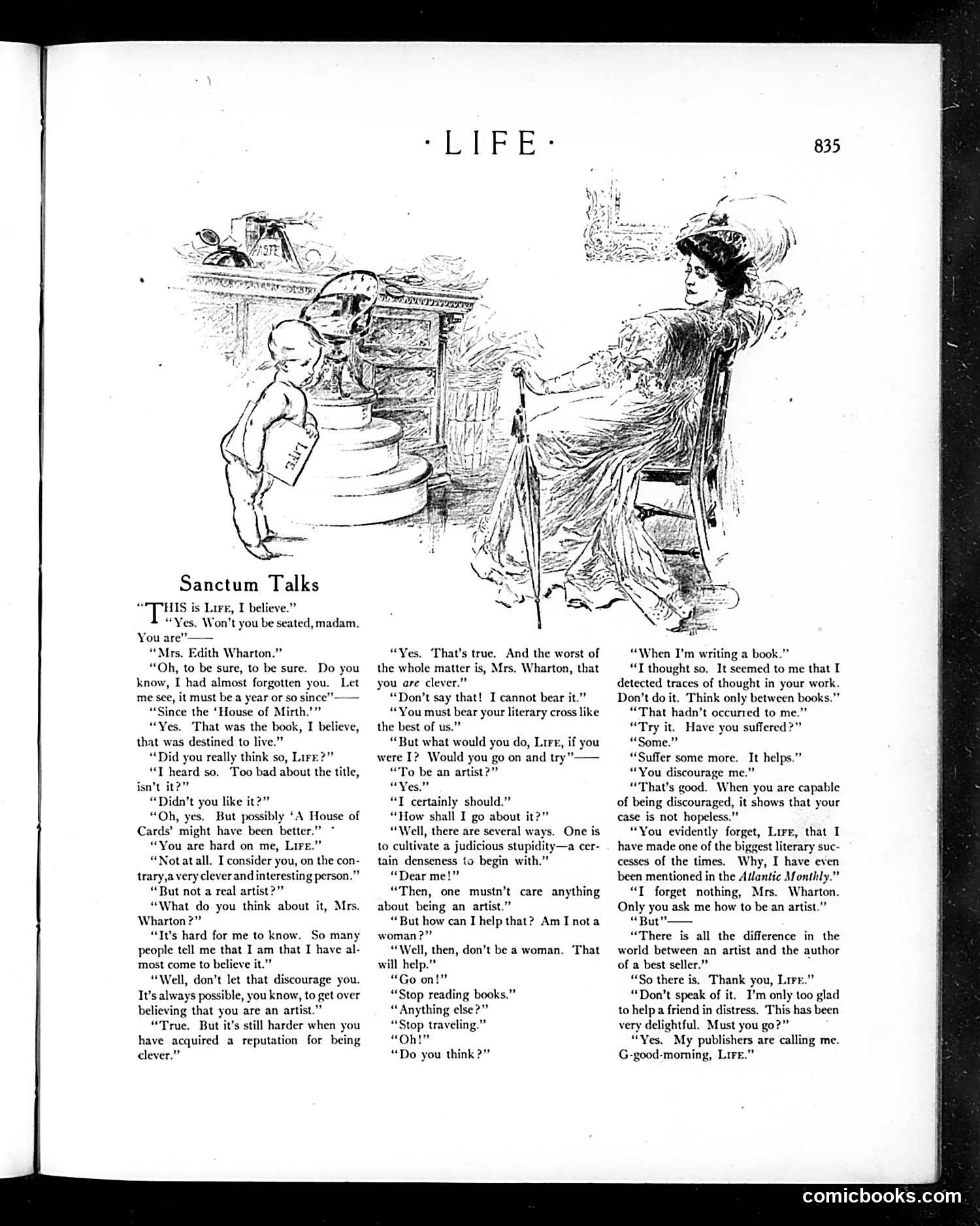
This is a satirical dialogue between "Life" (the magazine, personified as a woman) and Mrs. Edith Wharton, the famous novelist. The sketch mocks the pretensions of literary celebrities and the tension between commercial success and artistic credibility. Wharton complains she's nearly forgotten despite her accomplishments. Life suggests she pursue art instead of writing, provoking Wharton's indignation at being told to stop writing books. The satire ridicules both Wharton's anxiety about relevance and Life's flippant suggestion that she abandon her actual profession. The cartoon also jabs at the gulf between "artists" and "authors of bestsellers"—implying commercial literary success undermines serious artistic reputation, a common early-1900s literary snobbery that Life mocks here.
📄 Transcribed text from this page (OCR, searchable)
Machine-transcribed from the original scan — historical spelling and the odd misread are preserved.
Lire, I believe.” Won't you be seated, madam. You are”—— “Mrs. Edith Wharton.” “Oh, to be sure, to be sure. Do you know, I had almost forgotten you. Let me see, it must be a year or so since” —— “Since the ‘House of Mirth.’” “Yes. That was the book, I believe, that was destined to live.” “Did you really think so, Lr “T heard so. Too bad about the title, isn’t it?” “Didn't you like it?” “Oh, yes. But possibly ‘A House of Cards’ might have been better.” * “You are hard on me, Lire.” “Notatall. I consider you, on the con- trary,a very clever and interesting person.” “But not a real artist?” “What do you think about it, Mrs. Wharton?” “It’s hard for me to know. So many people tell me that I am that I have al- most come to believe it.” “Well, don’t let that discourage you. It’s always possible, you know, to get over believing that you are an artist.” “True. But it’s still harder when you have acquired a reputation for being clever.” “Yes. That’s true, And the worst of the whole matter is, Mrs. Wharton, that you are clever.” “Don’t say that! I cannot bear it.” “You must bear your literary cross like the best of us.” “But what would you do, Lire, if you ? Would you go on and try” —— o be an artist?” “Yes.” “TI certainly should.” “How shall I go about it?” “Well, there are several ways. One is to cultivate a judicious stupidity—a cer- tain denseness to begin with.” “Dear me!” “Then, one mustn’t care anything about being an artist.” “But how can I help that? Am I nota woman?” “Well, then, don’t be a woman. That will help.” “Go on!” “Stop reading books.” “Anything else?” “Stop traveling.” “Oh!” “Do you think?” “When I’m writing a book.” “T thought so. It seemed to me that I detected traces of thought in your work. Don’t do it. Think only between books.” “That hadn’t occurred to me.” “Try it. Have you suffered?” “Some.” “Suffer some more. It helps.” “You discourage me.” “That's good. When you are capable of being discouraged, it shows that your case is not hopeless.” “You evidently forget, Lire, that I have made one of the biggest literary suc- cesses of the times. Why, I have even been mentioned in the Allantic Monthly.” “I forget nothing, Mrs. Wharton. Only you ask me how to be an artist.” “But”?— “There is all the difference in the world between an artist and the author of a best seller.” : “So there is. Thank you, Lirr.” “Don’t speak of it. I’m only too glad to helpa friend in distress. ‘This has been very delightful. Must you go?” “Yes. My publishers are calling me. G-good-morming, Lirr.” comicbooks.com