
Life, 1907-06-20 · page 10 of 32
Life — June 20, 1907 — page 10: what you’re looking at
What you’re looking at
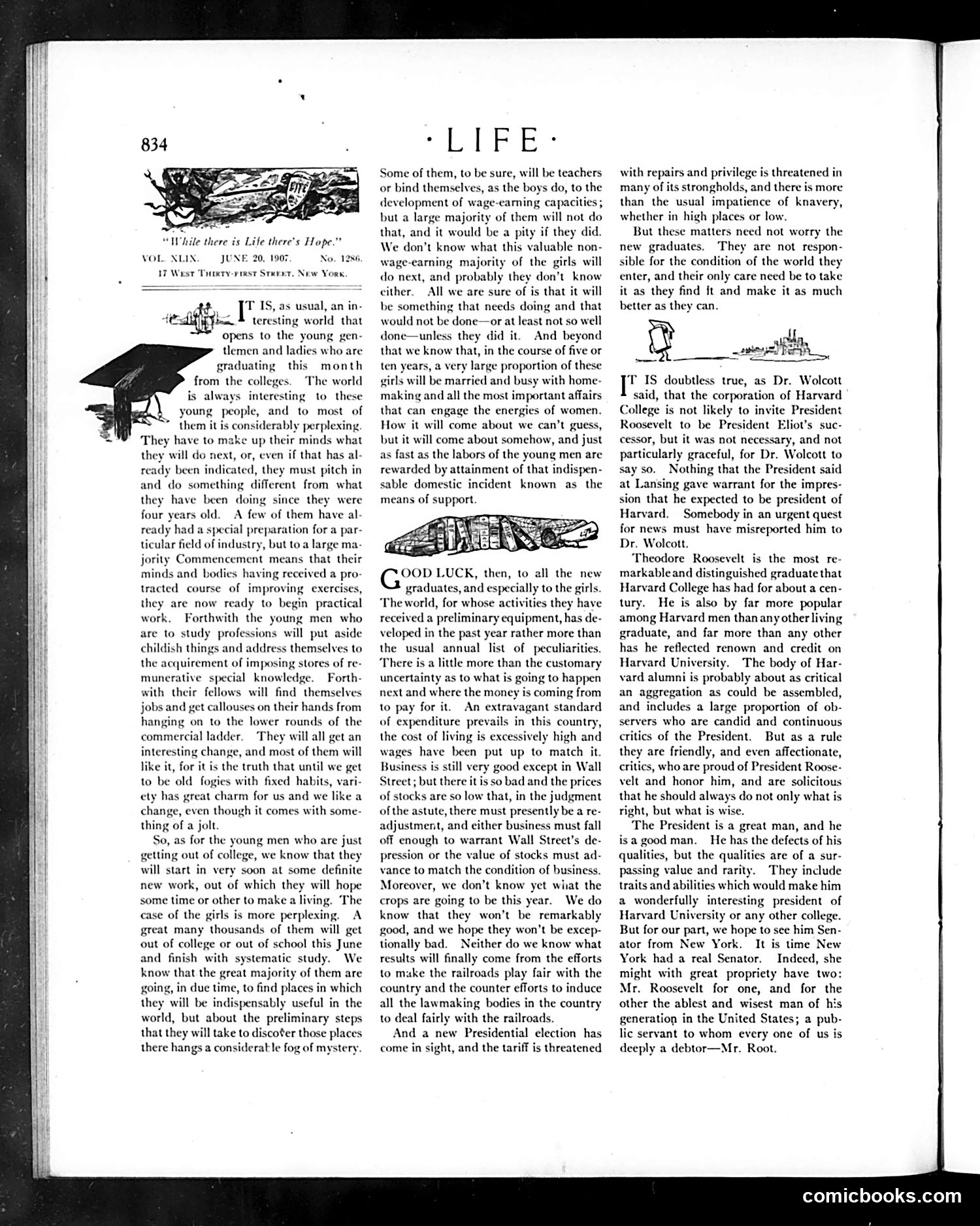
This page contains editorial commentary on recent college graduates entering the workforce, particularly women. The small illustration shows a mortarboard and diploma, symbolizing graduation. The text discusses the uncertainty facing new graduates about employment prospects and financial stability. It mentions President Theodore Roosevelt favorably, noting Harvard College's pride in his success. The piece addresses anxieties about the job market, business conditions, and railroad labor disputes—suggesting economic instability in 1907. The cartoons and illustrations are decorative rather than satirical, accompanying earnest advice to graduates about practical work and self-improvement. The tone is paternalistic, typical of early-1900s editorializing about young people entering adulthood.
📄 Transcribed text from this page (OCR, searchable)
Machine-transcribed from the original scan — historical spelling and the odd misread are preserved.
“While there is Life there's Hope.” VOL XLIX. JUNE 20, 1907, 17 West Titery-riest Stenet, New York, No. 1286. C IS, as usual, an in- jie. * teresting world that opens to the young gen- tlemen and ladies who are graduating this month from the colleges. The world is always interesting to these young people, and to most of them it is considerably perplexing ave to make up their minds what they will do next, or, even if that has al- ready been indicated, they must pitch in and do something different from what nce they were of them have al- ation for a par- but toa large ma- y Commencement means that their minds and bodies having received a pro- tracted course of improving exercises, they are now ready to begin practical work. Forthwith the young men who are to study professions will put aside childish things and address themselves to the acquirement of imposing stores of re- munerative special knowledge. Forth- with their fellows will find themselves jobs and get callouses on their hands from hanging on to the lower rounds of the commercial ladder. They will all get an interesting change, and most of them will like it, for it is the truth that until we get to be old fogies with fixed habits, vari- ety has great charm for us and we like a change, even though it comes with some- thing of a jolt. So, as for the young men who are just getting out of college, we know that th will start in very soon at some definite new work, out of which they will hope some time or other to make a living. The case of the girls is more perplexing. great many thousands of them will get out of college or out of s and finish with systematic study. know that the great majority of them are going, in due time, to find places in which they will be indispensably useful in the world, but about the preliminary steps that they will take to discoter those places there hangs a considerate fog of mystery. they have been doing s A fer "LLP E - Some of them, to be sure, will be teachers or bind themselves, as the boys do, to the development of w: ming capacities; but a large majority of them will not do that, and it would be a pity if they did. We don’t know what this valuable non- wage-earning majc will do next, and probabl either. All we are sure of is that it will be something that needs doing and that would not be done—or at least not so well done—unless they did it. And beyond that we know that, in the course of five or ten years, a very large proportion of these girls will be married and busy with home- making and all the most important affairs that can engage the energies of women. How it will come about we can’t guess, but it will come about somehow, and just as fast as the labors of the young men are rewarded by attainment of that indispen- sable domestic incident known as_ the means of support. OOD LUCK, then, to all the new graduates, and especially to the girls. ‘The world, for whose activities they have received a preliminary equipment, has de- veloped in the past year rather more than the usual annual list of peculiarities. ‘There is a little more than the customary uncertainty as to what is going to happen next and where the money is coming from to pay for it. An extravagant standard of expenditure prevails in this country, the cost of living is excessively high and wages have been put up to match it. Business is still very good except in Wall Street ; but there it is so bad and the prices of stocks are so low that, in the judgment of the astute, there must presently be a re- adjustment, and either business must fall off enough to warrant Wall Street’s de- pression or the value of stocks must ad- vance to match the condition of business. Moreover, we don’t know yet wiat the crops are going to be this year. We do know that they won’t be remarkably good, and we hope they won't be excep- tionally bad. Neither do we know what results will finally come from the efforts to make the railroads play fair with the country and the counter efforts to induce all the lawmaking bodies in the country to deal fairly with the railroads. And a new Presidential election has come in sight, and the tariff is threatened with repairs and privilege is threatened in many of its strongholds, and there is more than the usual impatience of knavery, whether in high places or low. But these matters need not worry the new graduates, They are not respon- sible for the condition of the world th enter, and their only care need be to take it as they find it and make it as much better as they can. i olf I IS doubtless true, as Dr. Wolcott said, that the corporation of Harvard College is not likely to invite President Roosevelt to be President Eliot’s suc- cessor, but it was not necessary, and not particularly graceful, for Dr. Wolcott to say so, Nothing that the President said at Lansing gave warrant for the impres- sion that he expected to be president of Harvard. Somebody in an urgent quest for news must have misreported him to Dr. Wolcott. Theodore Roosevelt is the most re- markableand distinguished graduate that Harvard College has had for about a cen- tury. He is also by far more popular among Harvard men than any other living graduate, and far more than any other has he reflected renown and credit on Harvard University. The body of Har- vard alumni is probably about as critical an aggregation as could be assembled, and includes a large proportion of ob- servers who are candid and continuous critics of the President. But as a rule they are friendly, and even affectionate, critics, who are proud of President Roose- velt and honor him, and are solicitous that he should always do not only what is right, but what is wise. The President is a great man, and he isa good man. He has the defects of his qualities, but the qualities are of a sur- passing value and rarity. They include traits and abilities which would make him a wonderfully interesting president of Harvard University or any other colleg But for our part, we hope to see him Sen- ator from New York. It is time New York had a real Senator. Indeed, she might with great propriety have two: Mr. Roosevelt for one, and for the other the ablest and wisest man of his generation in the United States; a pub- lic servant to whom every one of us is deeply a debtor—Mr. Root. comicbooks.com