
Life, 1907-06-20 · page 14 of 32
Life — June 20, 1907 — page 14: what you’re looking at
What you’re looking at
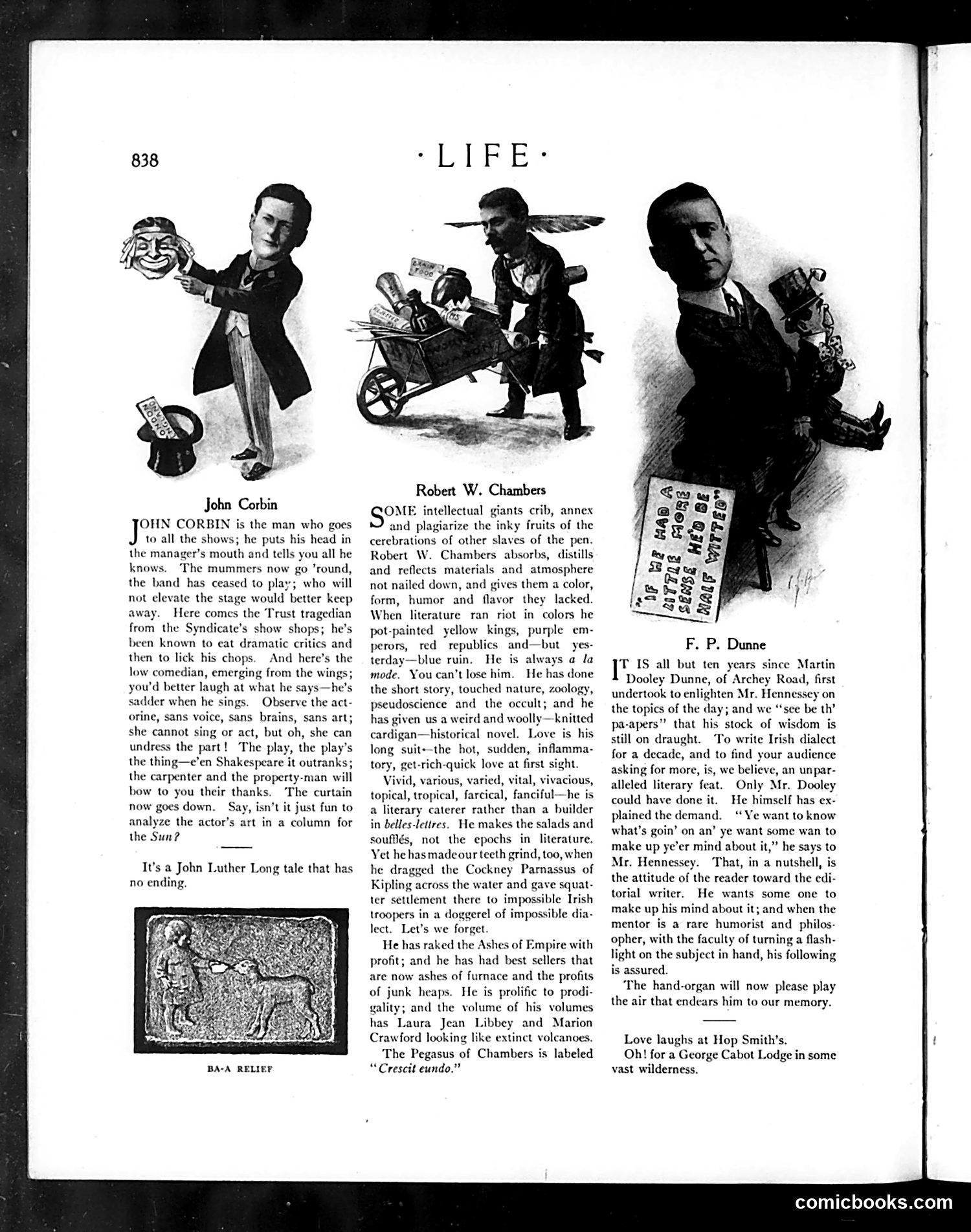
This page mocks three prolific American writers through caricature and critical commentary: **John Corbin** (left) is depicted as a theater critic who attends all shows and pronounces judgments. The satire suggests he's superficial—putting "his head in the manager's mouth" to deliver opinions. **Robert W. Chambers** (center) is criticized as a literary copycat and trend-chaser who "crib[s], annex[es] and plagiarize[s]" others' work. The text attacks his productivity as mere "literary catering"—producing salads and soufflés rather than substantive literature. His work is dismissed as derivative, ranging opportunistically across genres (historical novels, adventure fiction). **F.P. Dunne** (right), creator of the "Mr. Dooley" character, receives gentler treatment. The satire acknowledges his decade-long success writing Irish-dialect humor, crediting his appeal to readers' desire for someone to "make up ye'er mind" about current events—positioning him as a wise commentator disguised as entertainment. All three represent different literary sins: shallow criticism, derivative productivity, and populist simplification.
📄 Transcribed text from this page (OCR, searchable)
Machine-transcribed from the original scan — historical spelling and the odd misread are preserved.
John Corbin OHN CORBIN is the man who goes to all the shows; he puts his head in the manager’s mouth and tells you all he knows. The mummers now go 'round, who will not elevate the stage would better keep away. Here comes the Trust tragedian from the Syndicate’s show shops; he's been known to eat dramatic critics and then to lick his chops. And here’s the low comedian, emerging from the wings; you'd better laugh at what he says—he’s sadder when he sings. Observe the act- orine, sans voice, sans brains, sans art; she cannot sing or act, but oh, she can undress the part! The play, the play’s the thing—e’en Shakespeare it outrank: the carpenter and the property-man will bow to you their thanks. ‘The curtain now goes down. Say, isn’t it just fun to analyze the actor’s art in a column for the Sun? the band has ceased to play; It’s a John Luther Long tale that has no ending. BA-A RELIEF Robert W. Chambers OME intellectual giants crib, annex and plagiarize the inky fruits of the cerebrations of other slaves of the pen. absorbs, distills and reflects materials and atmosphere not nailed down, and gives them a color, form, humor and flavor they lacked. When literature ran riot in colors he pot-painted yellow kings, purple em- perors, red republics and—but _yes- terday—blue ruin. He is always a la mode. You can’t lose him. He has done the short story, touched nature, zoology, pseudoscience and the occult; and he has given us a weird and woolly—knitted cardigan—historical novel. Love is his. long suit--the hot, sudden, inflamma- tory, get-rich-quick love at first Vivid, various, varied, vital, v topical, tropical, farcical, fanciful—he is a literary caterer rather than a builder in belles-lettres. He makes the salads and souflés, not the epochs in literature, Yet he hasmadeour tecth grind, too, when he dragged the Cockney Parnassus of Kipling across the water and gave squat- ter settlement there to impossible Irish troopers in a doggerel of impossible dia- lect. Let’s we forget. He has raked the Ashes of Empire with profit; and he has had best sellers that are now ashes of furnace and the profits of junk heaps. He is prolific to prodi- gality; and the volume of his volumes has Laura Jean Libbey and Marion Crawford looking like extinct volcanoes. The Pegasus of Chambers is labeled “Crescit eundo.” T IS all but ten years since Martin Dooley Dunne, of Archey Road, first undertook to enlighten Mr. Hennesscy on the topics of the day; and we “sce be th’ pa-apers” that his stock of wisdom is still on draught. To write Irish dialect for a decade, and to find your audience asking for more, is, we believe, an unpar- alleled literary feat. Only Mr. Dooley could have done He himself has ex- plained the demand. “Ye want to know what’s goin’ on an’ ye want some wan to make up ye’er mind about it,” he says to Mr. Hennessey. That, in a nutshell, is the attitude of the reader toward the edi- torial writer. He wants some one to make up his mind about it; and when the mentor is a rare humorist and_philos- opher, with the faculty of turning a flash- light on the subject in hand, his following is assured. ‘The hand-organ will now please play the air that endears him to our memory. Love laughs at Hop Smith's. Oh! for a George Cabot Lodge in some vast wilderness. comicbooks.com