
A complete issue · 36 pages · 1907
Life — February 21, 1907
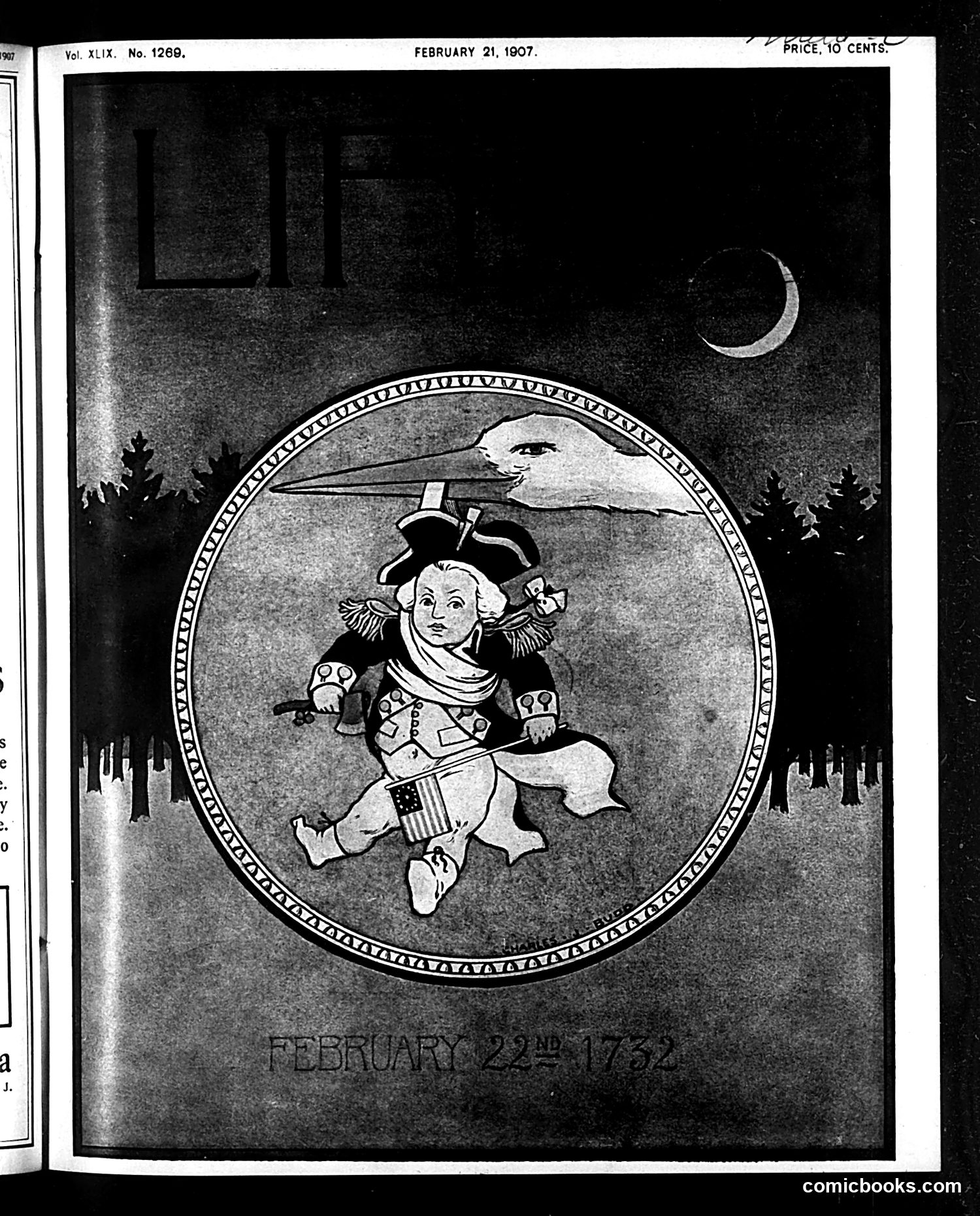
This *Life* magazine cover from February 21, 1907 depicts a cherubic figure in military dress with elaborate epaulettes and a sword, positioned within a circular frame. The figure appears to represent a young military leader or potential successor, suggested by the formal military regalia and childlike features. The date "FEBRUARY 22ND 1732" inscribed below likely references George Washington's birthday, connecting this to American political themes. The nighttime setting with a crescent moon and silhouetted trees creates a whimsical, allegorical atmosphere. Without additional context text visible, the exact political reference remains unclear, though the juxtaposition of childish innocence with military authority suggests satirical commentary on American military or political leadership of that era.
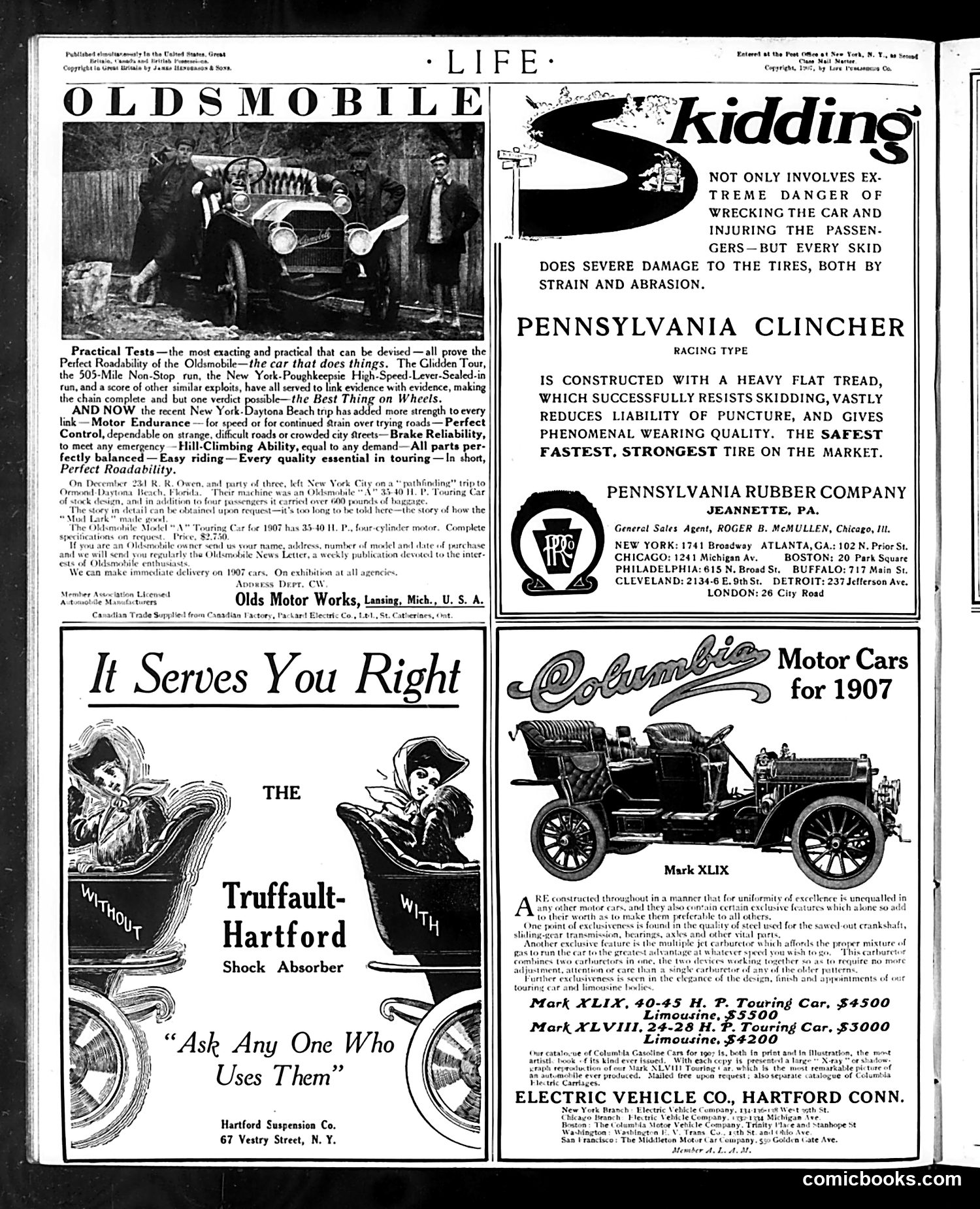
This page is **primarily automobile advertising** from approximately 1907, with minimal satirical content. The advertisements showcase early motorcar brands: Oldsmobile, Pennsylvania Clincher tires, Columbia automobiles, and Truffault-Hartford shock absorbers. Each ad emphasizes reliability, safety, and durability—concerns for early automobile adopters. The only potentially satirical element is the **Truffault-Hartford ad** (lower left), which depicts two figures in cars experiencing opposite outcomes: one "WITHOUT" the shock absorber appears distressed, while one "WITH" it appears comfortable. The tagline "Ask Any One Who Uses Them" is humorous advertising copy rather than political satire. The page reflects early 1900s consumer culture and emerging automobile industry competition, not political commentary.
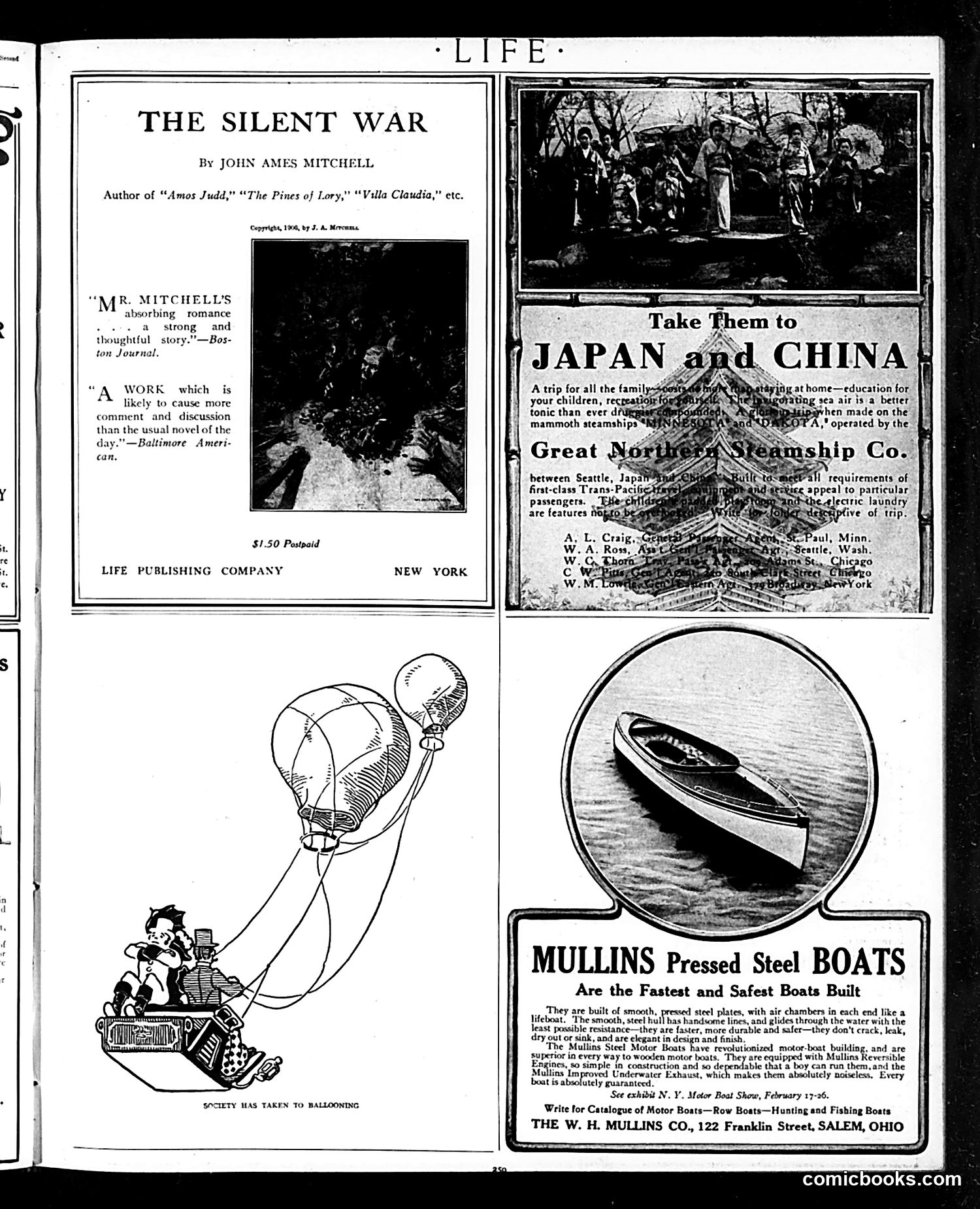
This Life magazine page is primarily **advertising, not political satire**. The left side advertises John James Mitchell's novel "The Silent War" (published 1906), with reviews praising it as absorbing romance and provocative social commentary. Below that is a whimsical illustration captioned "Society Has Taken to Ballooning"—a humorous social observation showing fashionable people in a hot air balloon basket, likely mocking the upper class's adoption of ballooning as a leisure activity. The right side contains two unrelated advertisements: one for Great Northern Steamship Co.'s cruises to Japan and China, and another for Mullins Pressed Steel Boats. The page reflects early 1900s consumer culture and leisure activities among the wealthy, with gentle social humor rather than political critique.
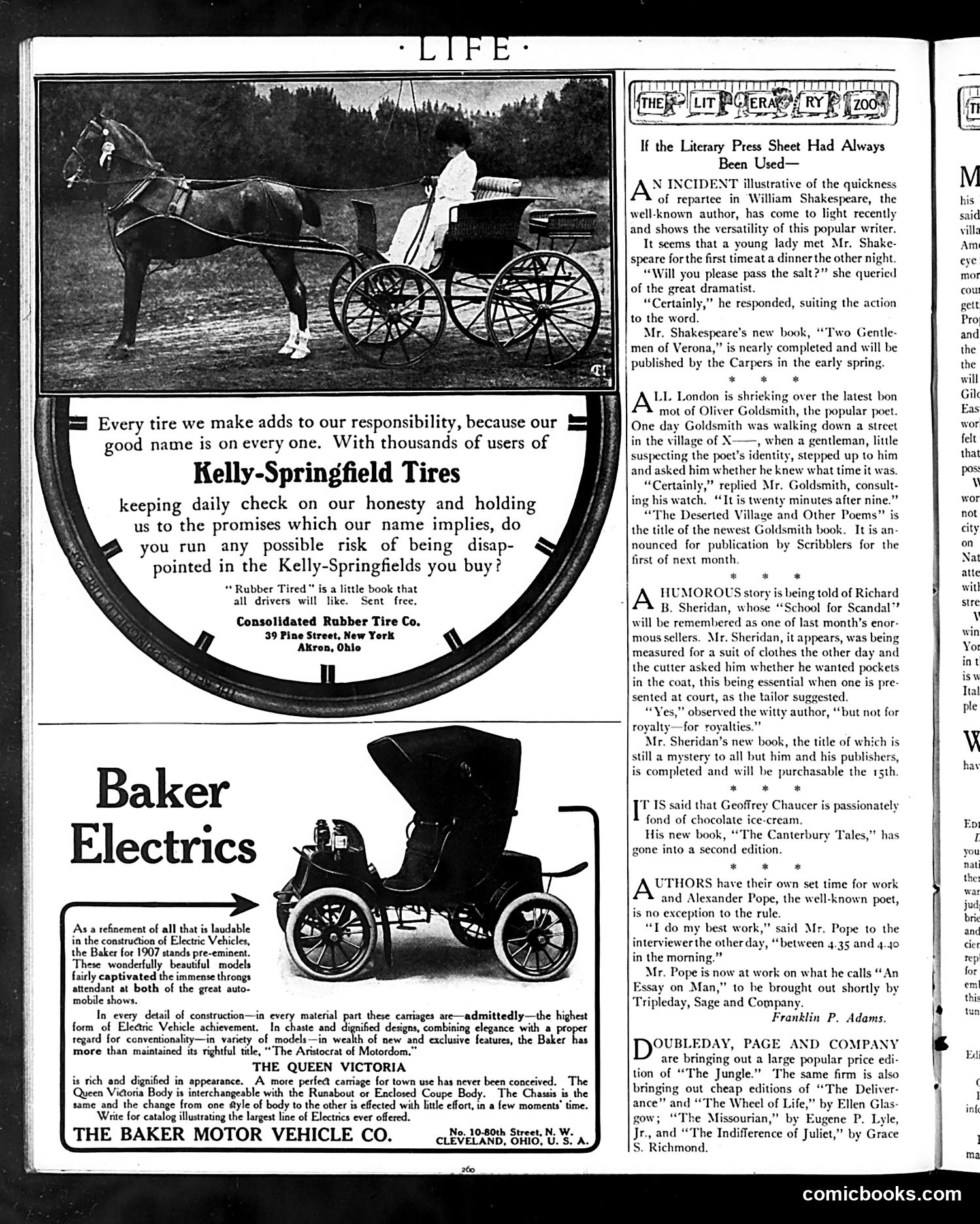
This page is primarily **advertising and literary gossip**, not political satire. The main visual content includes ads for **Kelly-Springfield Tires** (featuring a horse-drawn carriage) and **Baker Electrics** (an early automobile). These ads emphasize product reliability and craftsmanship. The right column contains **"Literary Press Sheet"** gossip about contemporary authors. Items mention William Shakespeare's quick wit, Oliver Goldsmith anecdotes, Richard Sheridan's humor, and Geoffrey Chaucer's love of chocolate ice cream. The tone is lighthearted celebrity commentary. There is **no political cartoon** on this page. The content reflects early 1900s consumer advertising and literary society chitchat—essentially the magazine's mix of commerce and entertainment journalism aimed at educated, affluent readers.
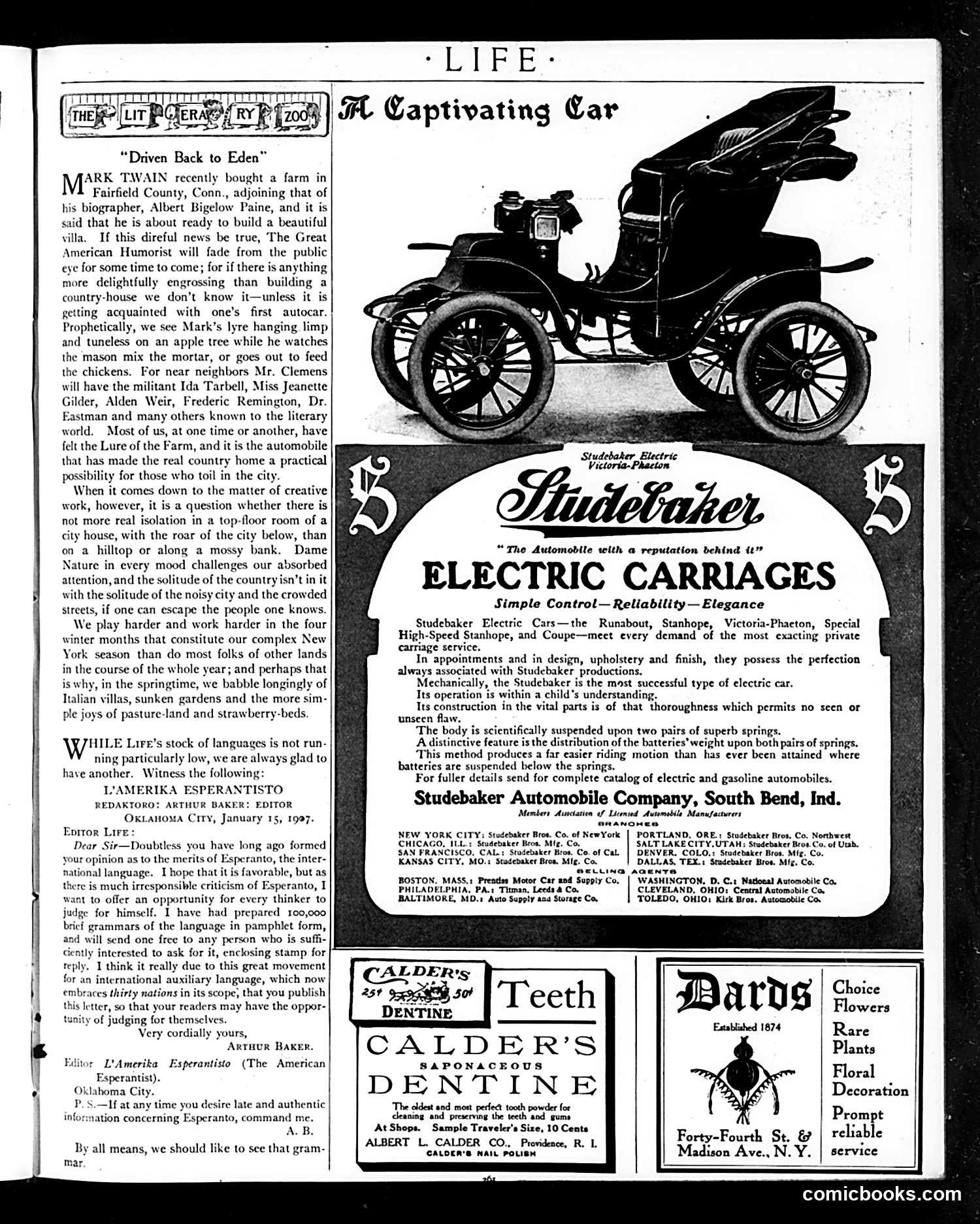
This page is **primarily advertising**, not satire or political cartooning. The main content is a large advertisement for Studebaker Electric Carriages, featuring an illustration of an early automobile. The ad emphasizes features like "Simple Control—Reliability—Elegance" and lists various carriage models (Runabout, Stanhope, Victoria-Phaeton). The editorial content above discusses Mark Twain's recent farm purchase in Connecticut and his potential retreat from public life—presented as a gentle, humorous observation rather than satire. Letters to the editor follow, including one about creating an international auxiliary language called "Esperanto." Below the main ad are smaller advertisements for dental powder, tooth polish, and floral services—typical commercial content for the era. The page reflects early 1900s concerns: automobiles as novelty luxury items, and international language reform movements.
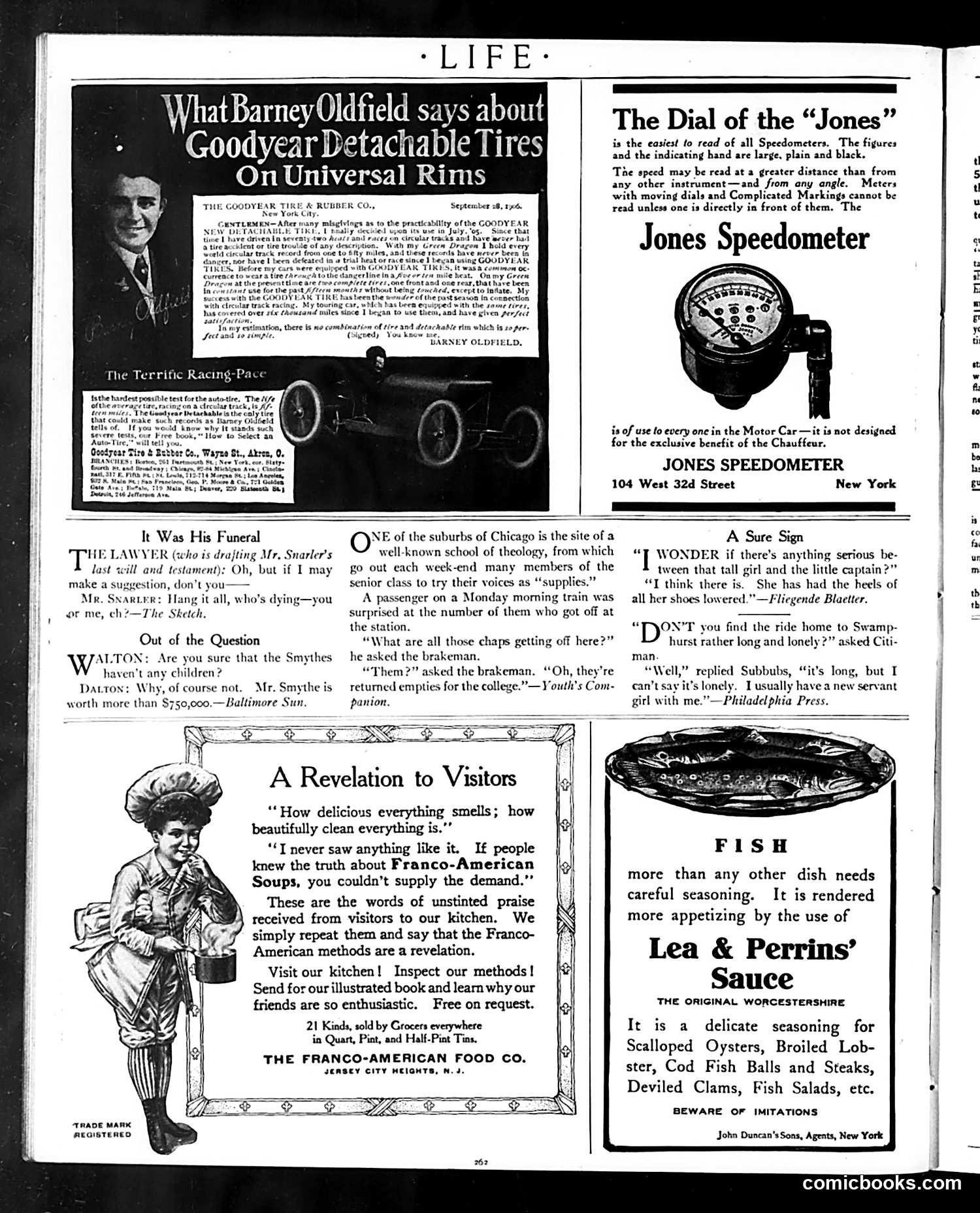
This page is primarily **advertising and light humor**, not political satire. The main items are: - **Goodyear Tire endorsement** by "Barney Oldfield" (a famous racing driver) promoting detachable tires - **Jones Speedometer advertisement** - **Franco-American Soup ad** with a cook figure - **Lea & Perrins Sauce advertisement** The humor sections are minor anecdotes: - "It Was His Funeral" — a joke about a lawyer misreading a will - "Out of the Question" — wordplay about Mr. Smythe's worth - "A Sure Sign" — brief dialogue about a girl's shoes and a servant There's no identifiable political cartoon or satire. This is a typical early-20th-century Life magazine page mixing consumer advertisements with light domestic humor and jokes—representative of the magazine's shift toward commercial content.
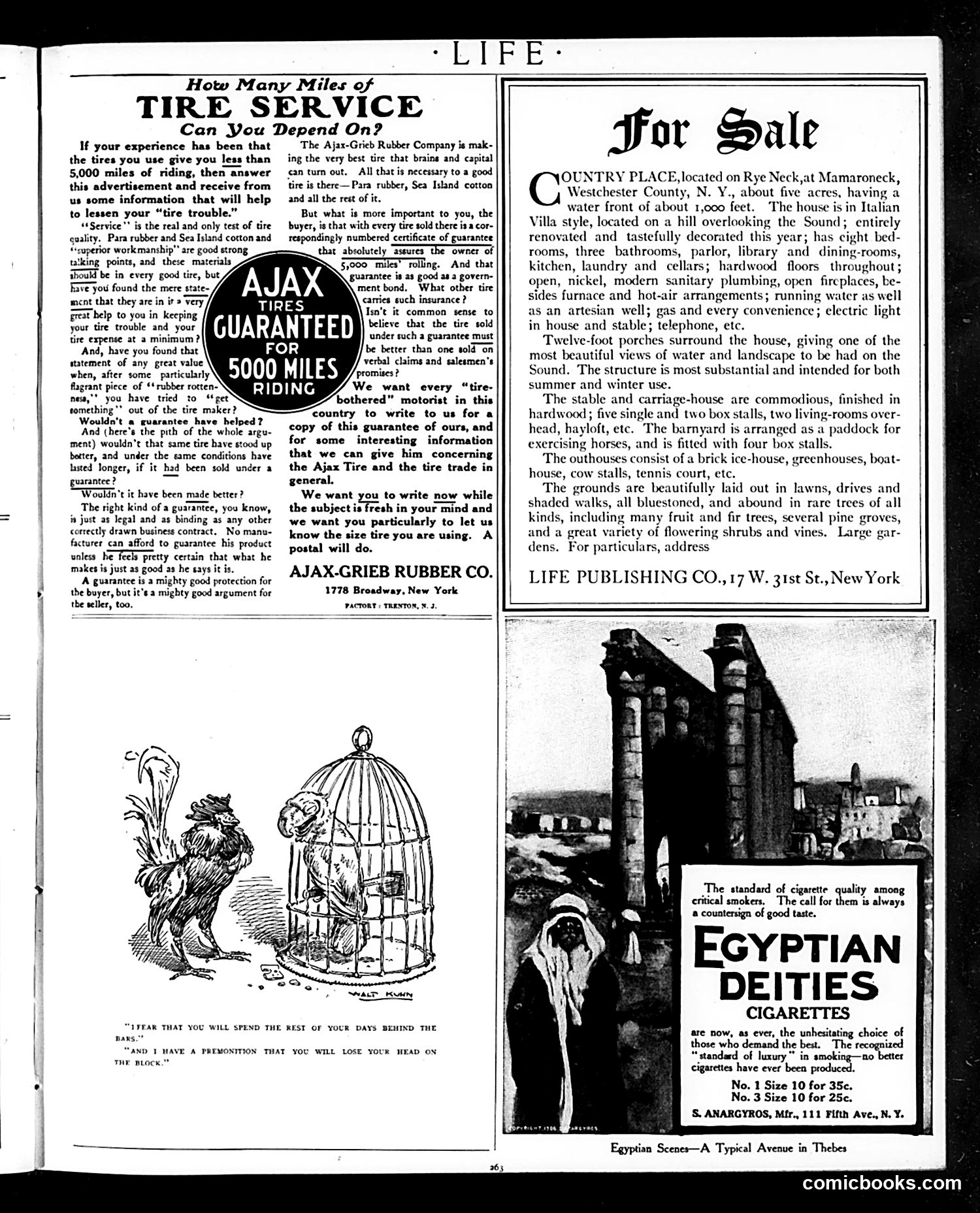
This page is primarily **advertising**, not political satire. The left side features an Ajax-Grier Rubber Company advertisement promoting tire guarantees for 5,000 miles of riding. The small cartoon below (showing a rooster and birdcage) appears to be a generic joke about confinement, with the caption warning against spending one's days "behind the bars" and losing one's "head on the block"—likely a metaphor for avoiding restrictive situations. The right side advertises a country estate for sale on Rye Neck and Egyptian Deities cigarettes. There is **no meaningful political commentary** on this page. It represents typical early 20th-century magazine layout mixing commercial advertisements with light humor.
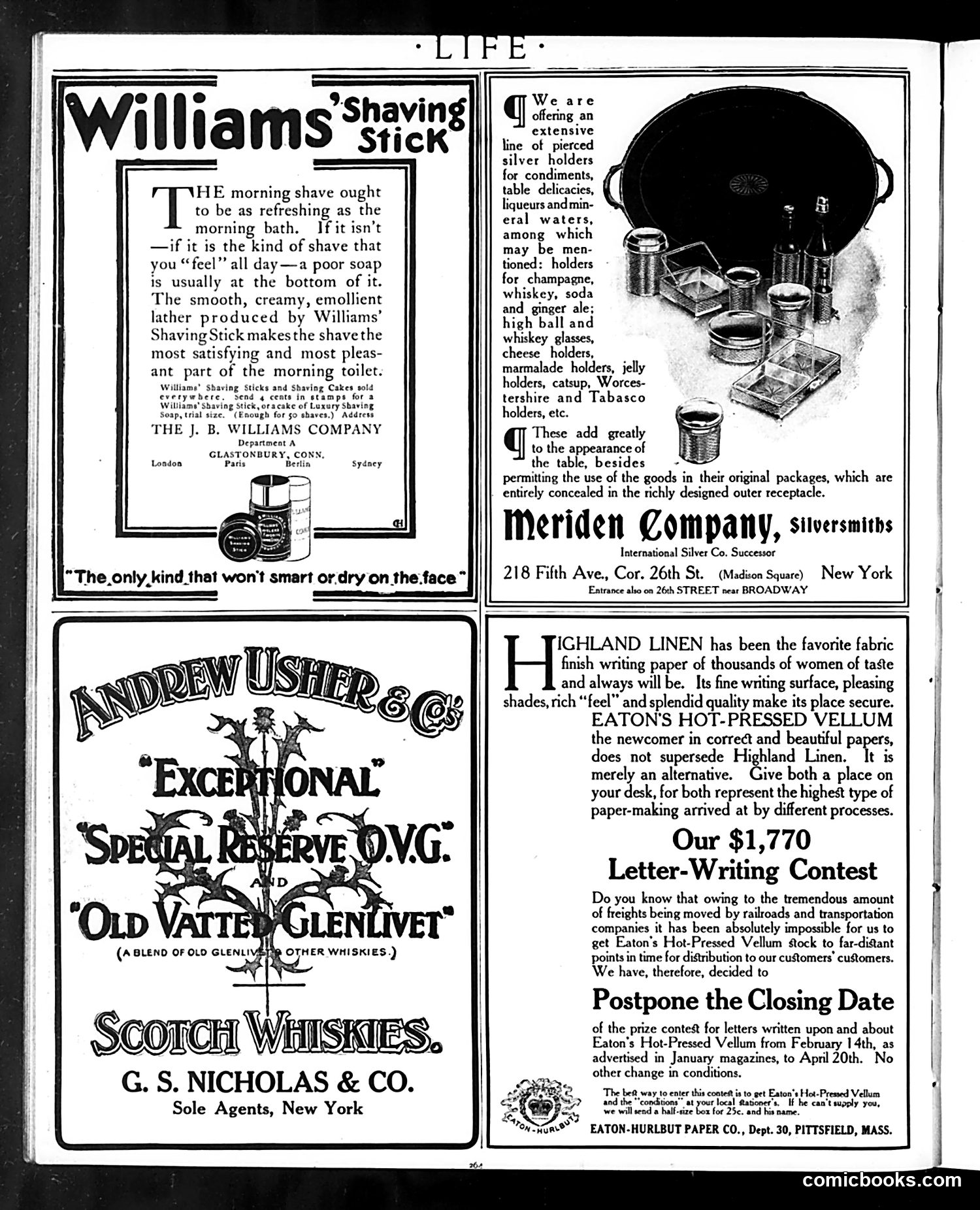
This page is primarily **advertising**, not satire or political commentary. It contains four distinct advertisements: 1. **Williams' Shaving Stick** — promotes a soap product with the claim it won't "smart or dry on the face" 2. **Meriden Company Silversmiths** — showcases pierced silver holders for condiments and beverages 3. **Andrew Usher & Co. Scotch Whiskies** — advertises whisky brands including "Old Vatted Glenlivet" 4. **Eaton-Hurlbut Paper Co.** — announces a $1,770 letter-writing contest, postponing the deadline from February 14th to April 20th due to railroad freight disruptions affecting paper stock delivery The page reflects early 20th-century consumer goods marketing and wartime logistics constraints (the freight delays suggest WWI-era conditions).
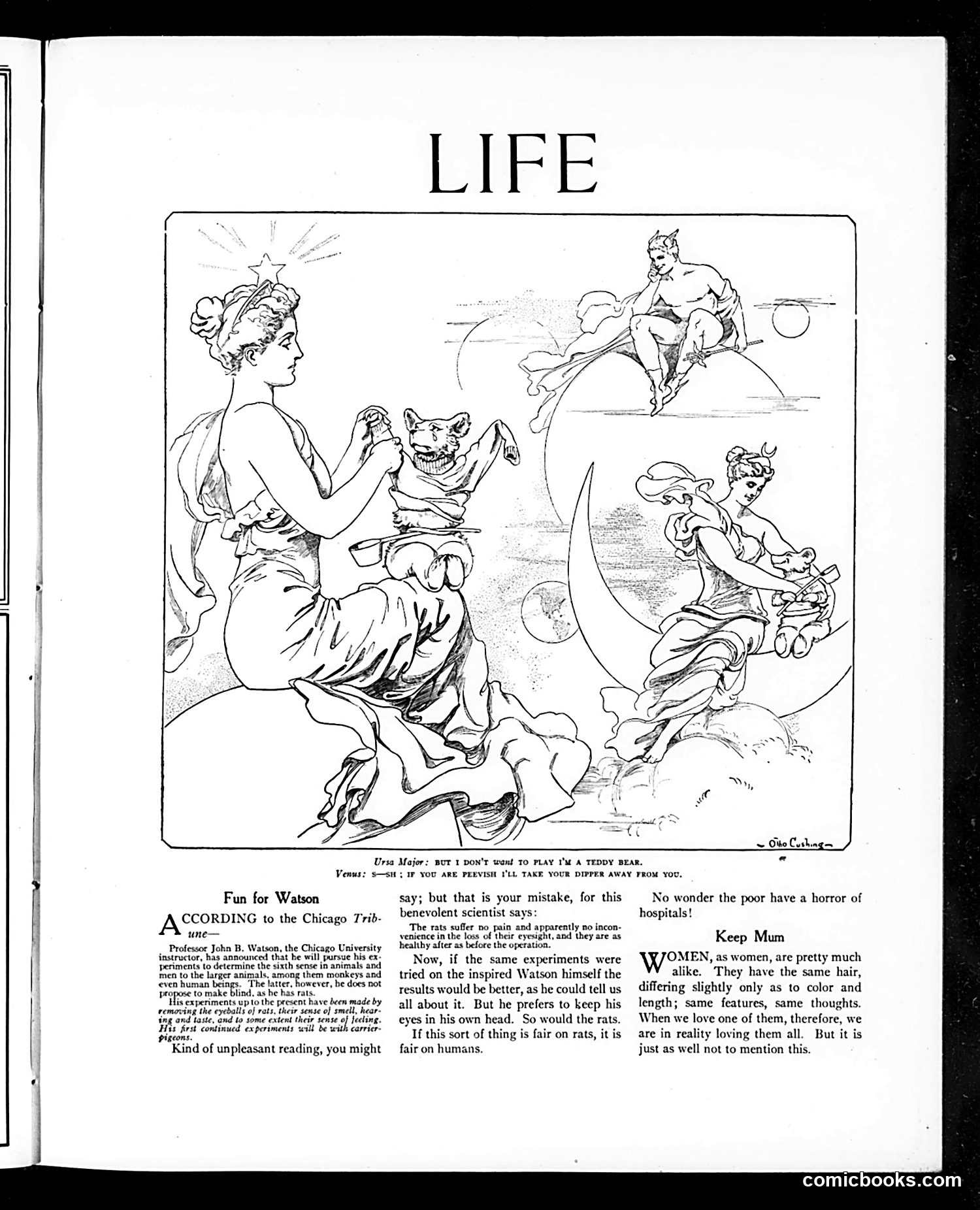
This page from *Life* magazine features a satirical illustration titled "LIFE" showing classical and mythological figures—a woman with a star (likely representing Life or Liberty), cherubs, and demonic creatures engaged in various activities. Below are two brief commentary pieces: "Fun for Watson" critiques Dr. Watson from the University of Chicago, who announced plans to make infants blind as part of scientific experiments on humans. The article sarcastically argues that if Watson won't experiment on himself, such experiments are unfair to conduct on humans—a pointed critique of unethical experimental practices. "Keep Mum" offers brief observations about women, suggesting they share similar characteristics despite variations in appearance.
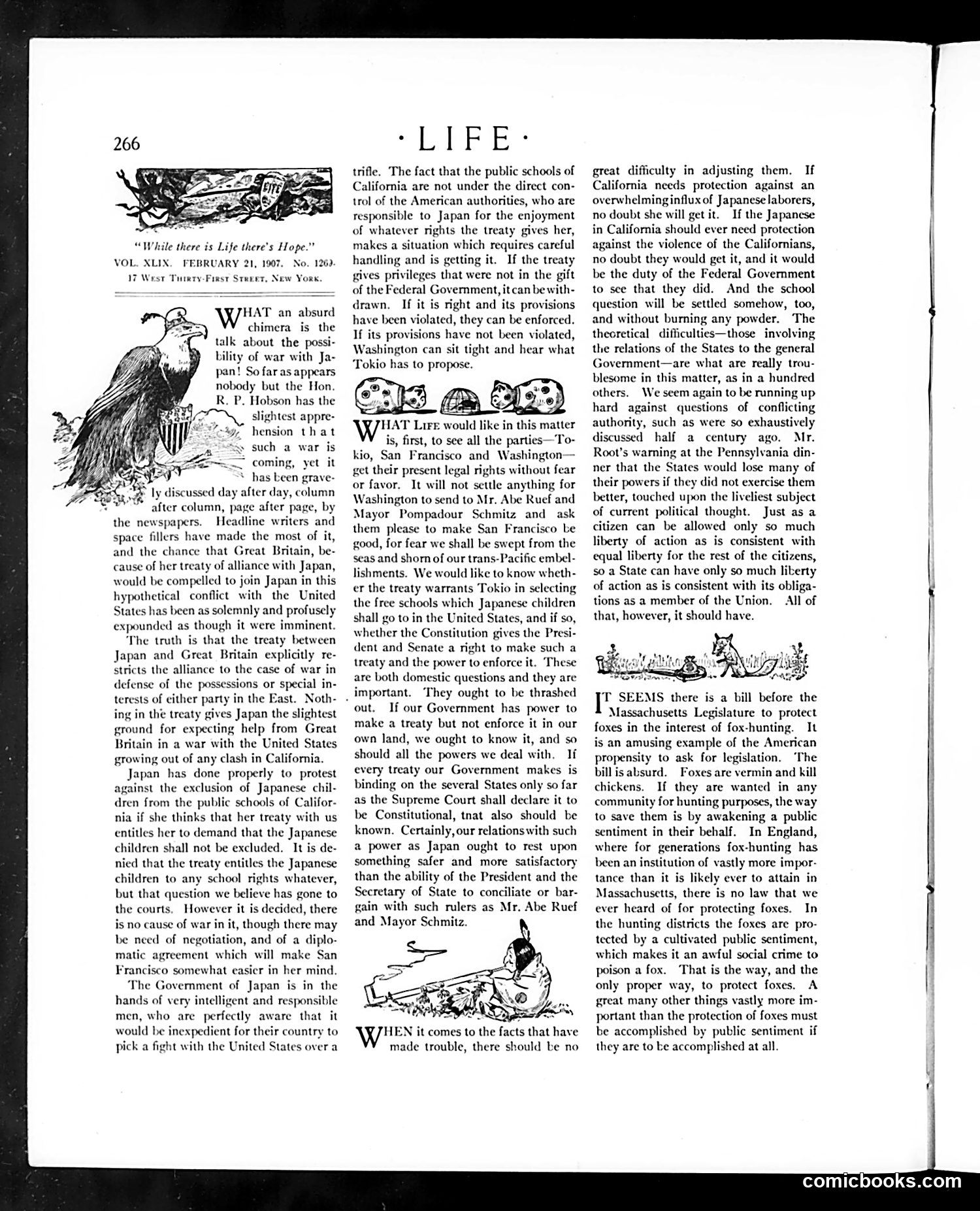
This page critiques U.S.-Japan relations during a period of diplomatic tension. The editorial addresses disputes over Japanese children's school attendance in California and treaty enforcement between nations. The cartoons feature **an eagle** (representing America) and **a fox** (representing Japan or cunning politicians). These animals illustrate the satirical point: just as foxes require legal protection to prevent hunting, so too do international agreements require enforcement mechanisms. The text mocks the absurdity of debating whether Japan deserves school access for its children while avoiding the core issue—whether treaties are actually enforceable. It criticizes both the U.S. Government and Japanese authorities (mentioning "Mr. Ruef and Mayor Schmitz") for theatrical diplomacy rather than addressing substantive constitutional questions about federal versus state power in treaty matters.
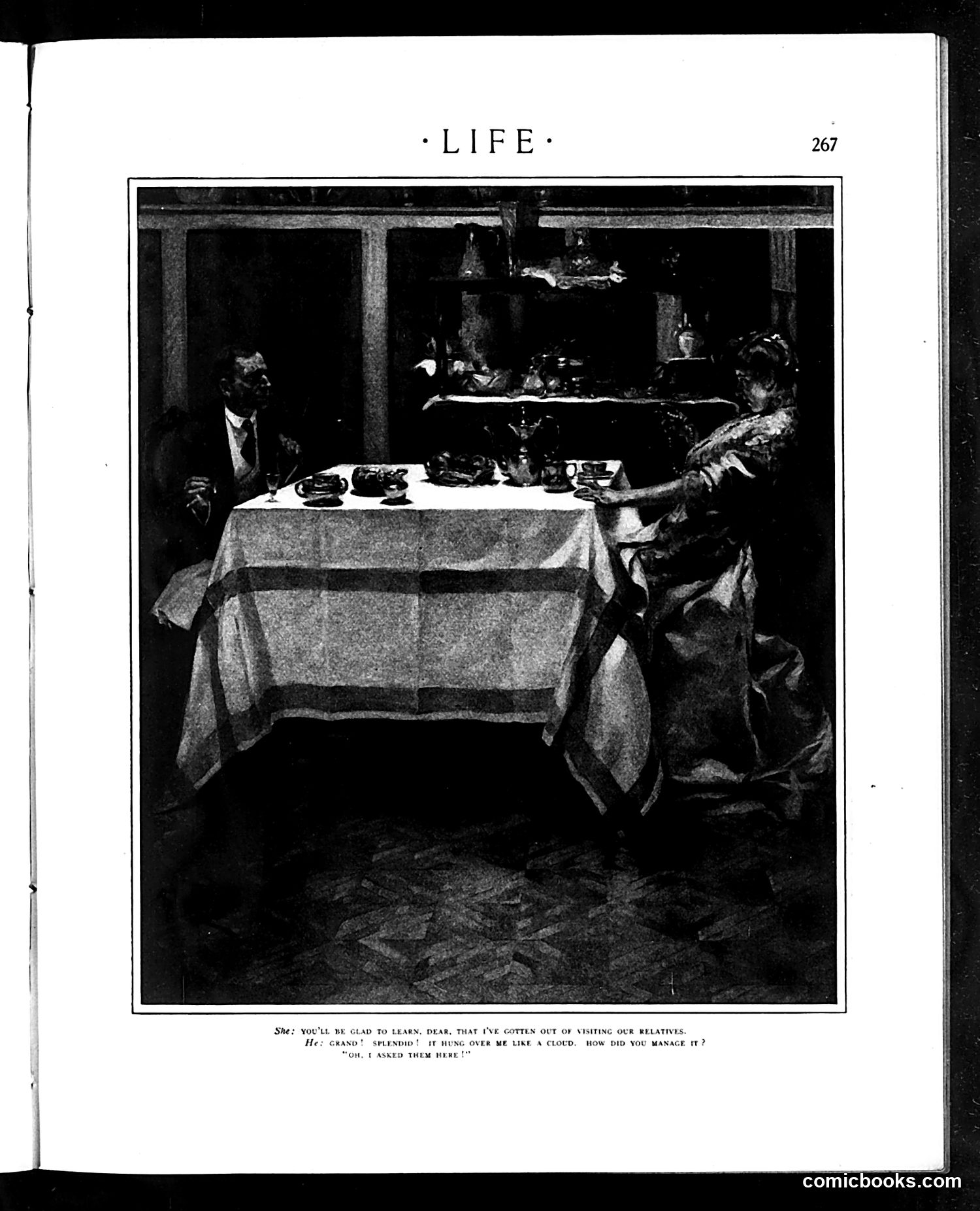
This is a single-panel domestic comedy cartoon from *Life* magazine (page 267). The scene shows a couple at a dining table in what appears to be a modest home interior. **The Setup:** The woman tells her husband she's "glad to learn" she's "gotten out of visiting our relatives." **His Response:** The husband exclaims it's "grand! Splendid! It hung over me like a cloud. How did you manage it?" **She replies:** "Oh, I asked them here!" **The Joke:** The satire targets the universal dread of obligatory family visits. The husband finds the prospect so unbearable that when his wife reverses it—inviting relatives to *their* home instead—he considers it a victory. The humor lies in the absurdity: he's relieved to host unwanted guests rather than visit them, suggesting home-hosting feels like the lesser evil.
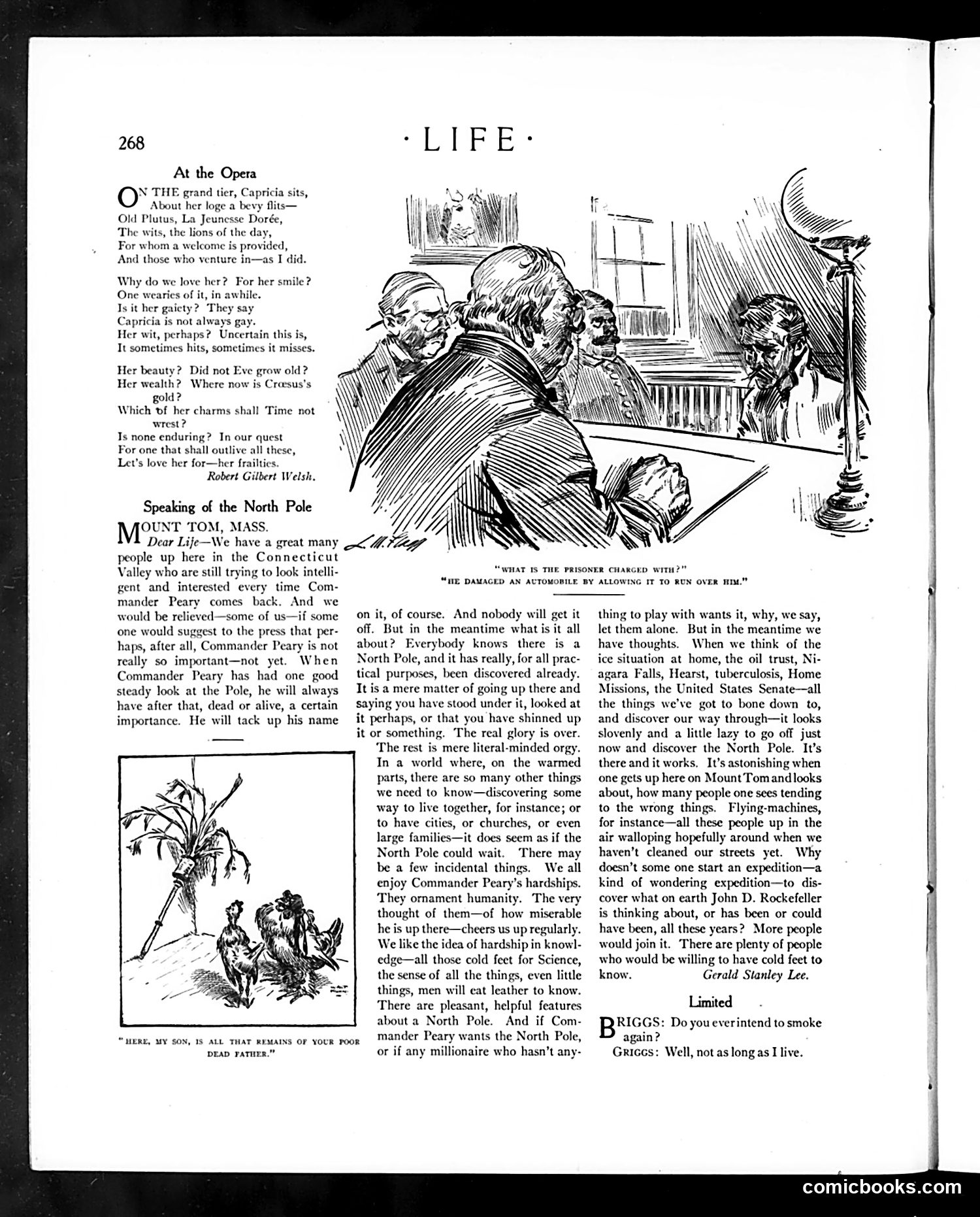
The page contains two distinct pieces: 1. **"At the Opera"** - A poem by Robert Gilbert Welch mocking the superficiality of opera-goers, particularly women. The accompanying sketch shows society figures in an opera box, satirizing their pretense and shallow interest in cultural events. 2. **"Speaking of the North Pole"** - A letter from Mount Tom, Massachusetts, humorously defending Commander Peary's North Pole expedition against criticism. The writer argues that Arctic exploration, though seemingly pointless, provides humanity with noble purpose and discovery—better than mundane earthly concerns. The accompanying sketch depicts polar hardship. Both pieces use satire to comment on American society: one mocking urban elite vanity, the other defending scientific ambition against practical skepticism.
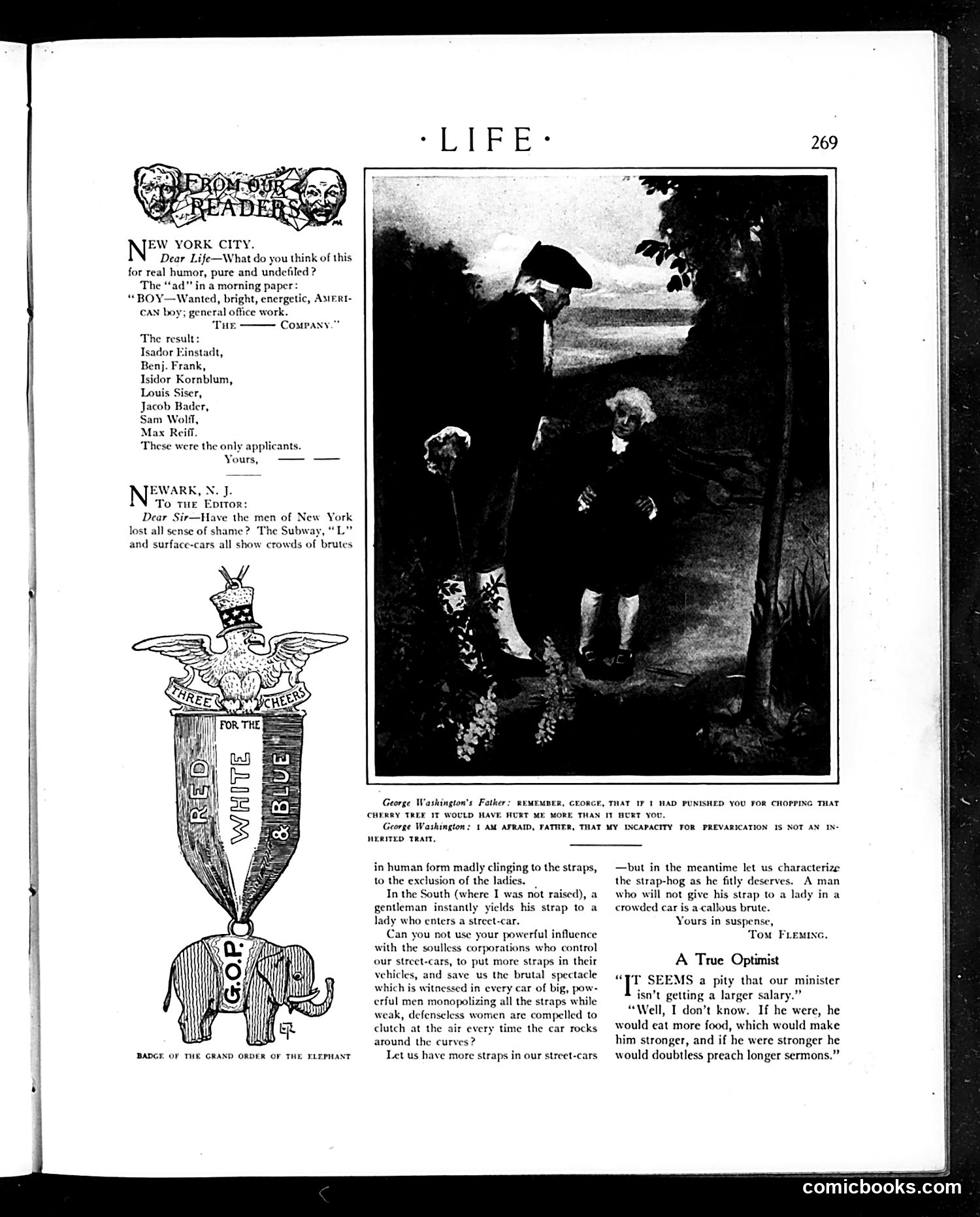
This page contains reader letters and social commentary rather than political cartoons. The main image shows what appears to be a scene depicting George Washington's father disciplining young George for chopping down a cherry tree—referencing the famous (likely apocryphal) American legend about honesty. The letters address urban social problems: one from New York City complains about inadequate public transit ("Subway, 'L'"), while a Newark reader criticizes crowded conditions and lack of shame among men, urging corporations to install more handholds in streetcars to protect women from assault during transit. The final item, "A True Optimist," is a brief joke about a minister seeking a salary increase. The page reflects Progressive Era concerns about public safety and urban conditions.
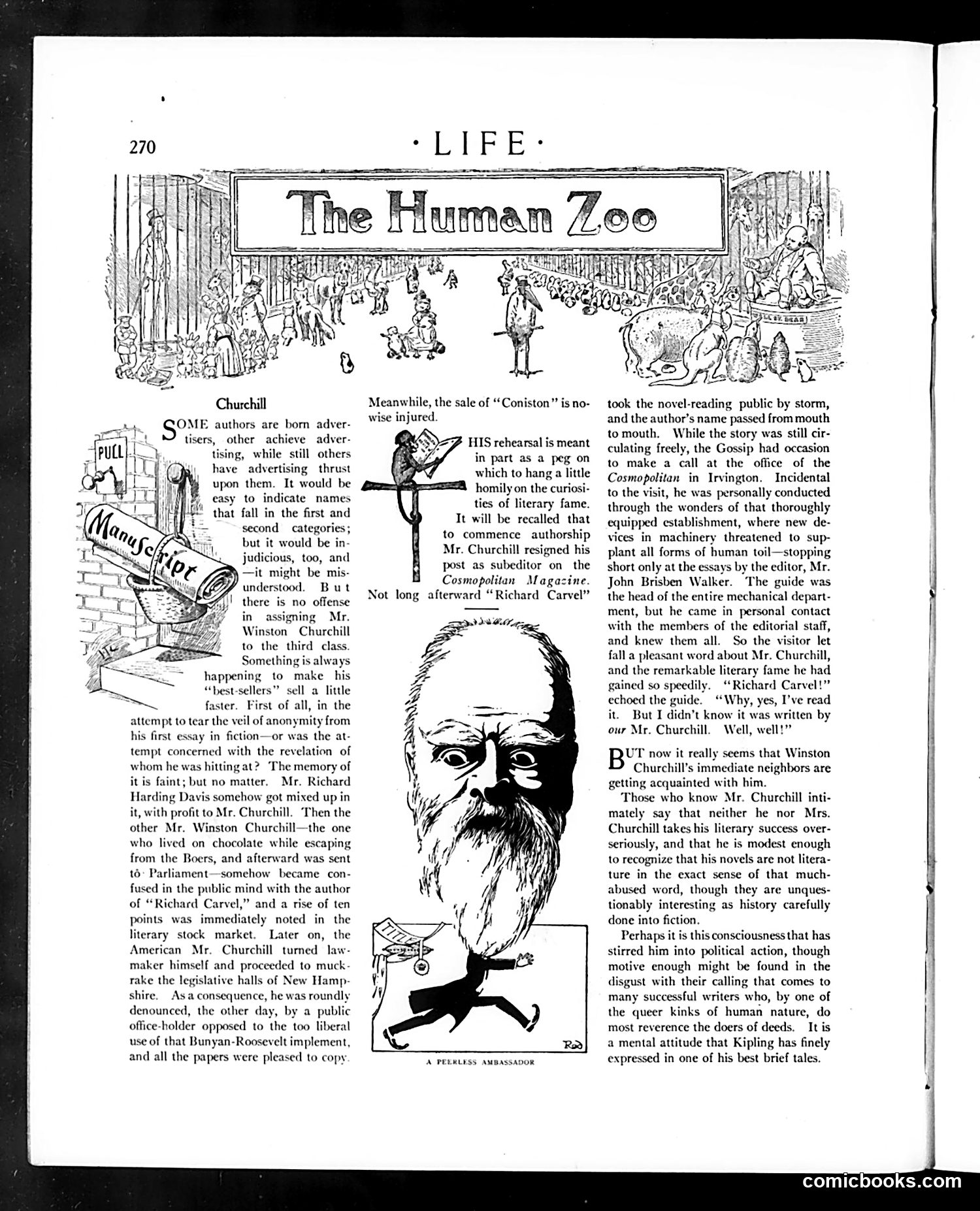
This satirical piece discusses the confusion surrounding author Winston Churchill's sudden fame. The article explains how Churchill resigned from his editorial post at *Cosmopolitan Magazine* to write fiction. His novel *Richard Carvel* became wildly popular, but the public confused him with the British politician **Winston Churchill** (who had recently escaped Boer captivity and entered Parliament). This mistaken identity boosted sales of Churchill's books by ten points on the "literary stock market." The cartoon caricature labeled "A Peerless Ambassador" depicts the author Churchill. The satire mocks how literary fame operates through accident and confusion rather than merit. The piece notes that Churchill's neighbors are only now learning he's a writer, and concludes that his modest awareness that his novels are "not literature" but "history carefully done into fiction" may have motivated him toward politics—where he could engage in "deeds" rather than mere words.
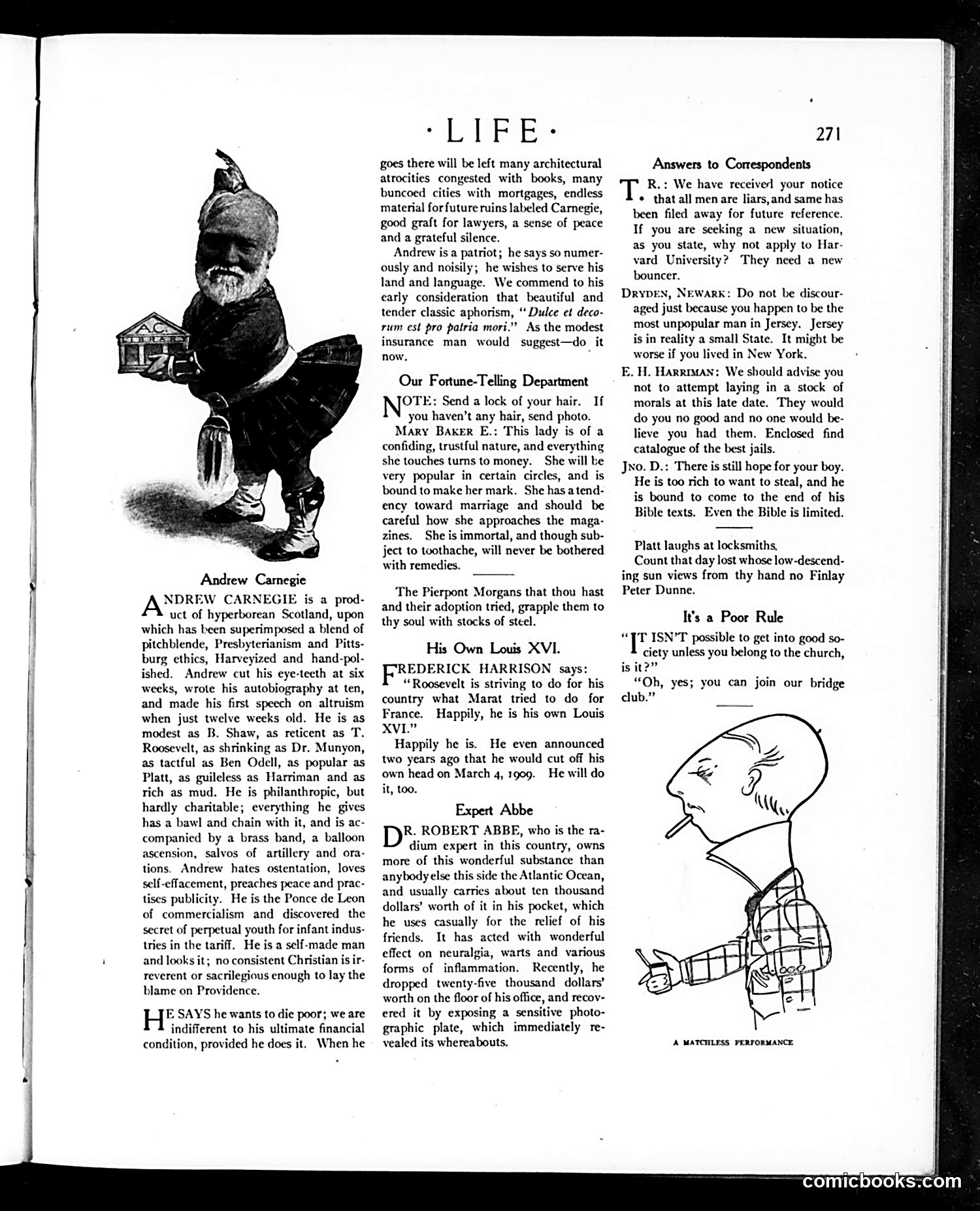
This page satirizes prominent American figures through biting character sketches and humor advice. **Andrew Carnegie** (main caricature): The steel magnate is mocked for performative philanthropy—his donations always come with "a bawl and chain," accompanied by publicity stunts. Life accuses him of hypocrisy: he preaches peace while practicing self-promotion, hates ostentation while seeking attention. The satire culminates in a dark joke suggesting he should fulfill his stated wish to "die poor"—implying his death would be society's gain. **Other targets** include Mary Baker Eddy (Christian Science founder), President Theodore Roosevelt (compared to the French revolutionary Marat), and radium expert Dr. Robert Abbe (whose casual ownership of a fortune in radioactive material is treated as absurd). The **"Answers to Correspondents"** section uses mock advice-column format for additional jabs at prominent institutions and regional stereotypes. The humor relies on readers' familiarity with these public figures' reputations and recent news—making it difficult for modern audiences without contemporary context.
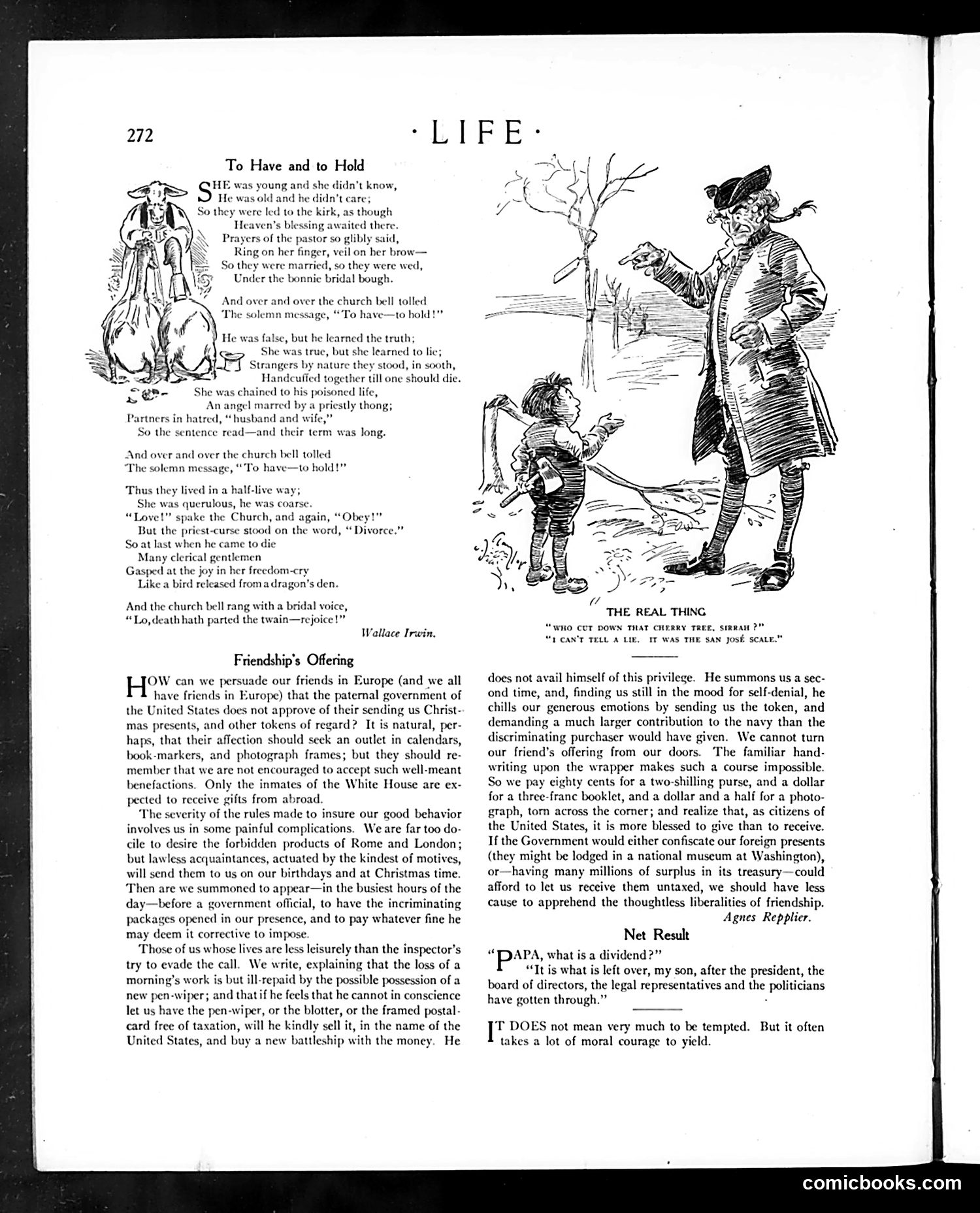
This page satirizes three American social issues: **"To Have and to Hold"** (poem by Wallace Irwin): Attacks the indissolubility of marriage. A young woman marries an older, indifferent man; they become mutual prisoners trapped in hatred. The church bells mockingly repeat "to have—to hold," treating marriage as lifelong bondage. Only death provides escape. The satire targets both forced marriages and the church's opposition to divorce as inhumane. **"Friendship's Offering"**: Mocks U.S. tariff laws and customs regulations that penalize citizens receiving gifts from European friends. The piece argues these rules are absurdly bureaucratic—forcing people to either pay steep duties on modest gifts or endure repeated government summons, while the proceeds theoretically fund battleships. **"The Real Thing"** (cartoon, bottom right): A child, asked who cut down the cherry tree, blames the "San José Scale" (a destructive agricultural pest) rather than admitting guilt. This deflates the famous George Washington anecdote, suggesting Americans now habitually shirk responsibility.
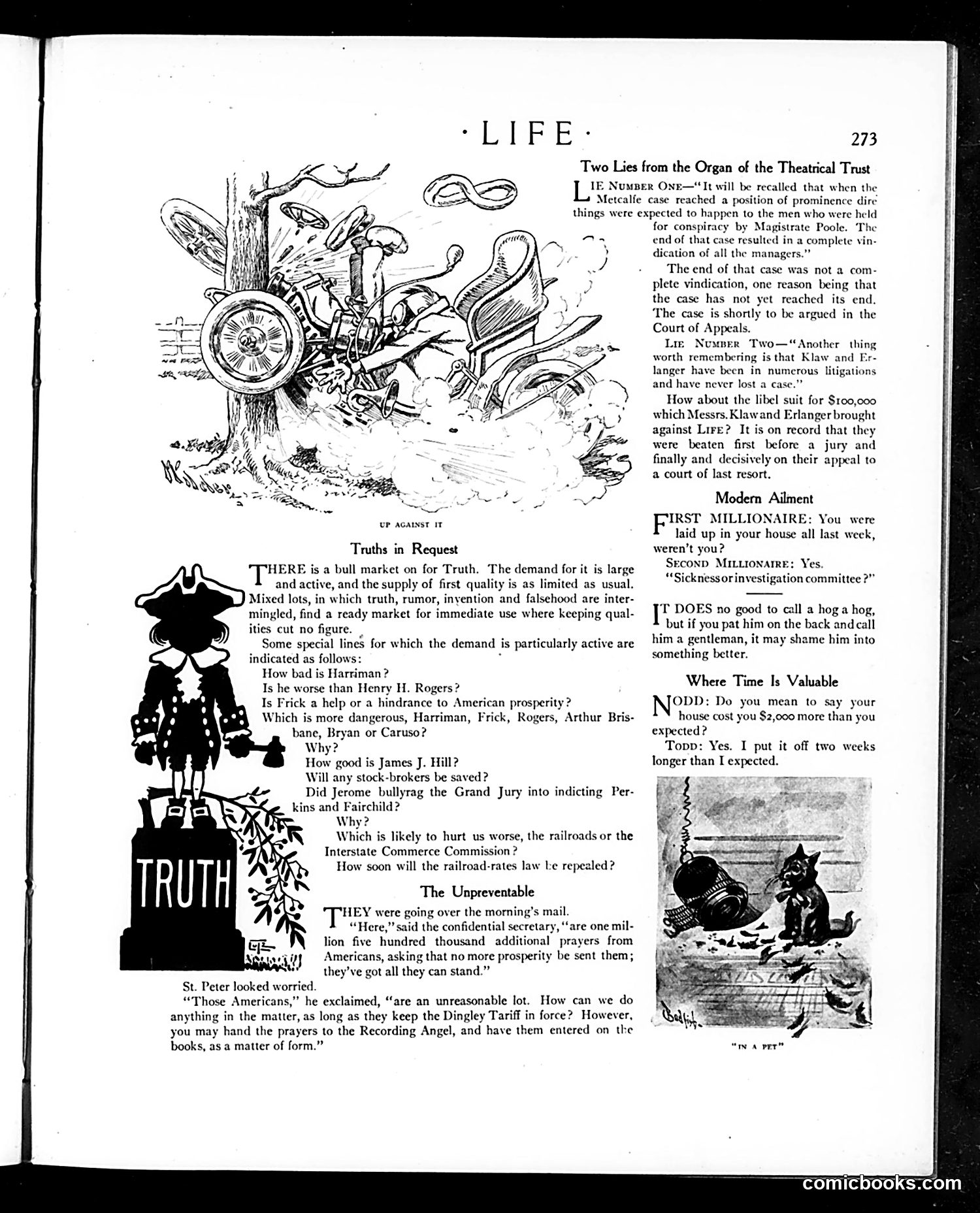
This page satirizes prominent figures and institutions of the early 1900s. The main cartoon, "Truths in Request," mocks a "bull market" in truth-telling by listing popular questions Americans obsessively debate: whether railroad magnates like Harriman, Rogers, and Frick harm prosperity; whether District Attorney Jerome pressured a Grand Jury; and whether the Interstate Commerce Commission or railroads pose greater danger. The "Unpreventable" cartoon jokes that Americans pray prosperity will stop—they have "all they can stand"—but St. Peter notes the Dingley Tariff (protective trade policy) prevents divine intervention. Other brief satirical pieces mock: millionaires hiding illness behind euphemisms like "investigation committee"; the theatrical trust's litigation claims; and wealthy homeowners' casual overspending on construction. The cartoons criticize wealthy industrialists, protective tariffs, and the era's litigious business culture while mocking public obsession with scandals.
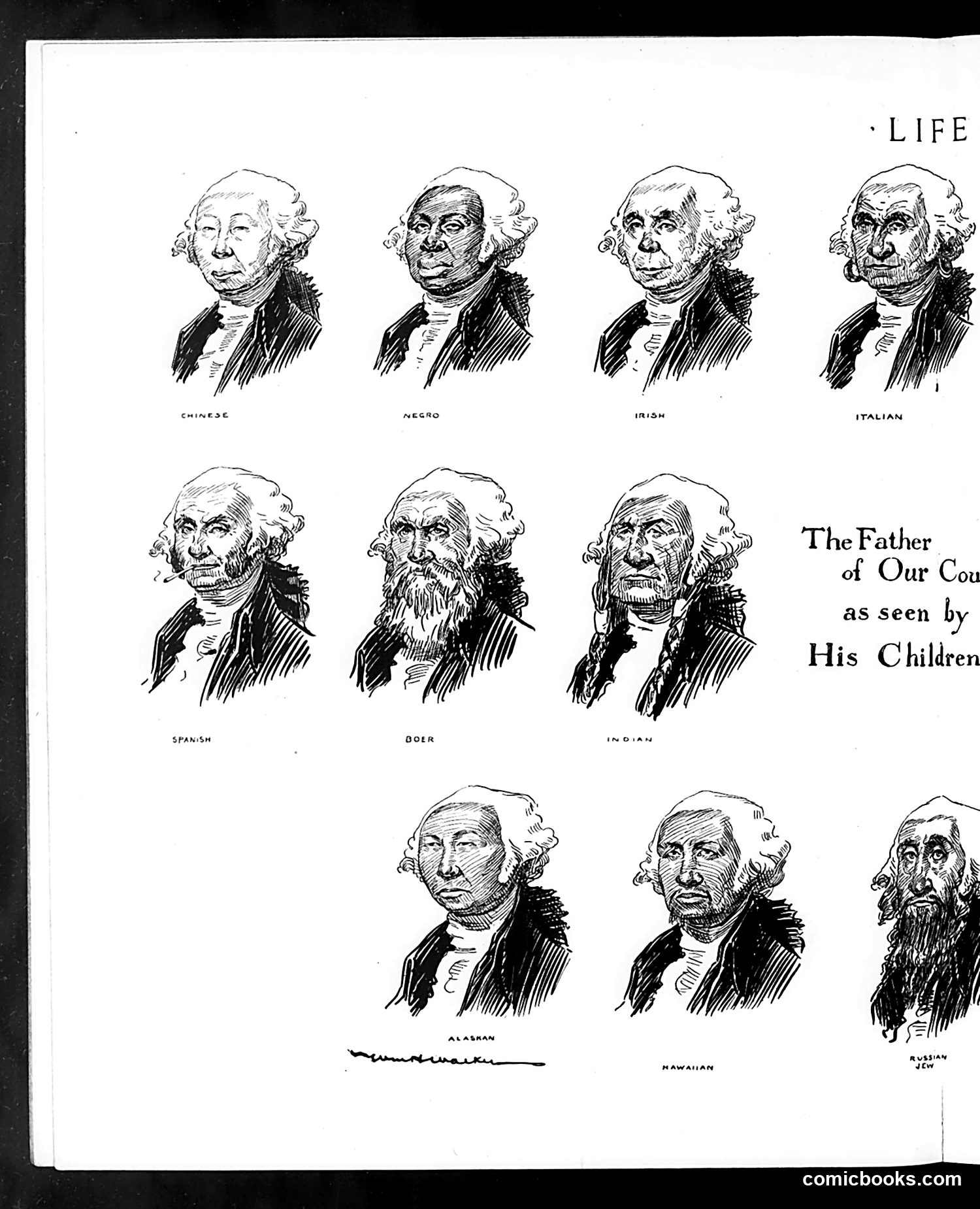
This satirical illustration depicts how different ethnic groups or nationalities perceive America's founding father (likely George Washington, referenced as "Father of Our Country"). Each caricatured portrait is labeled with an ethnicity: Chinese, Negro, Irish, Italian, Spanish, Boer, Indian, Alsatian, Hawaiian, and Russian Jew. The satire suggests that immigrants and people of different backgrounds literally "see" the same American founding figure differently—their visual perception shaped by their own cultural identity. This reflects early 20th-century American attitudes about ethnic diversity and assimilation, implying that different groups have distinct, even conflicting interpretations of American identity and values. The caricatures employ period-typical stereotypes that would be considered offensive today.
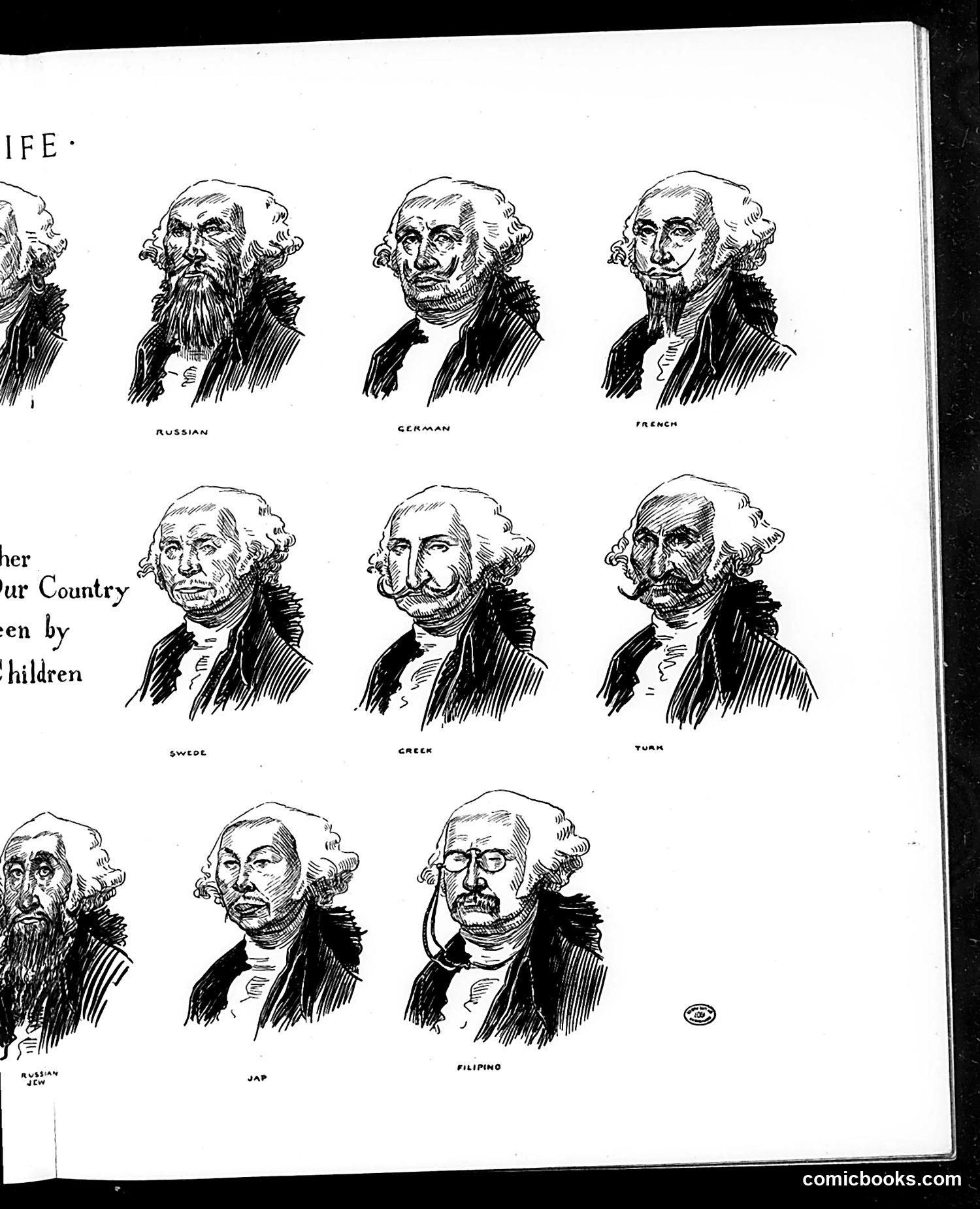
This page presents nine portrait caricatures labeled by nationality: Russian, German, French, Swede, Greek, Turk, and others including Japanese and Filipino. The partial visible text references "our Country" and "children," suggesting this satirizes how different ethnic or national groups are perceived as influences on America. This appears to be **ethnic stereotyping satire**, likely from the early 20th century when immigration and nativism were contentious issues. The exaggerated facial features—particularly pronounced in the non-European figures—reflect period prejudices. The cartoon likely mocks American anxieties about foreign "corruption" of national character, presenting these caricatures as supposedly threatening influences on American youth. The specific historical context remains unclear without the complete text.
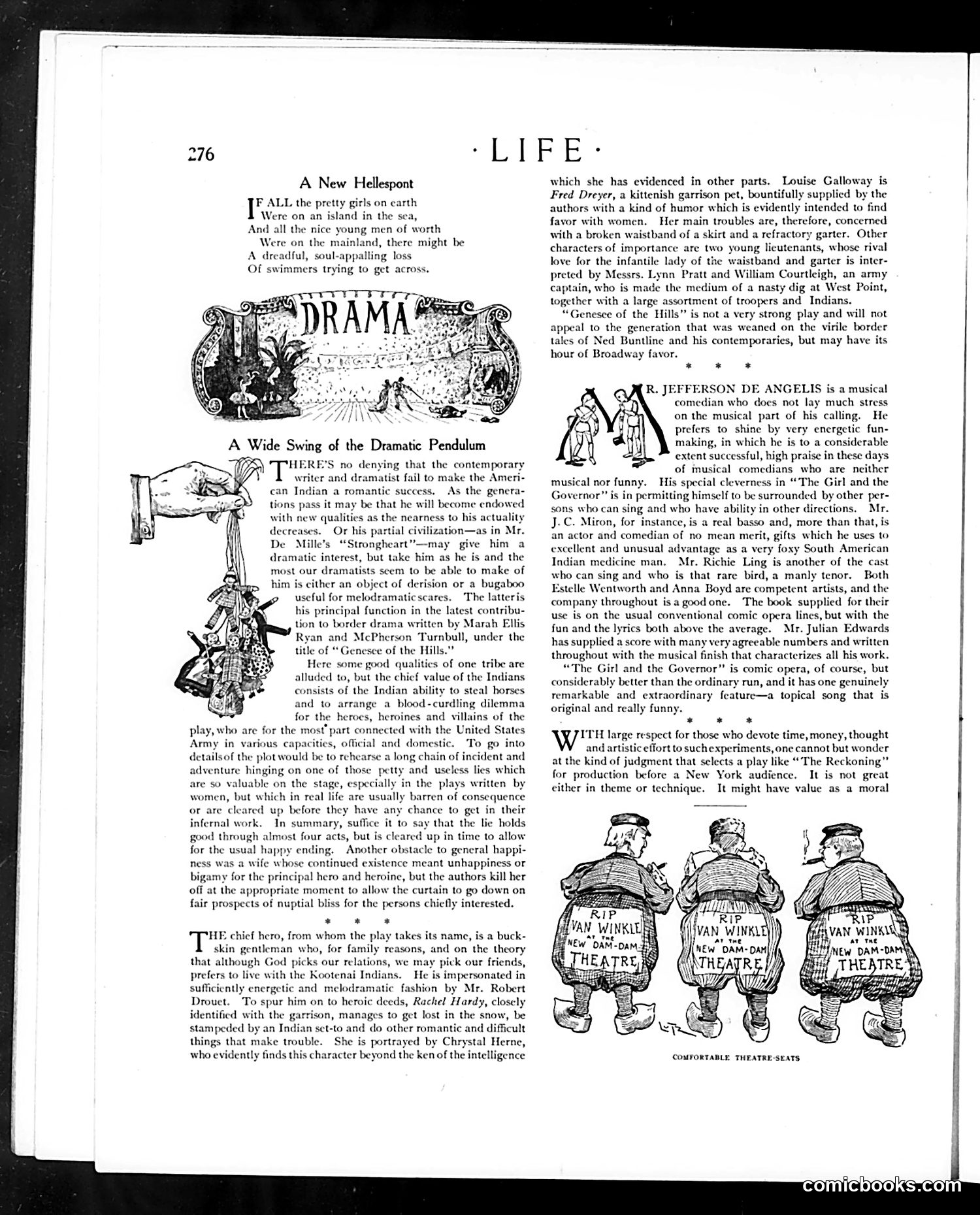
This page reviews two theatrical productions. The main article criticizes "Genesee of the Hills," a border drama featuring Native Americans as plot devices—either comic relief or melodramatic villains. The author argues American playwrights fail to portray Indians meaningfully; they're reduced to stealing horses and creating contrived crises. The plot hinges on a pointless lie sustained through four acts before convenient resolution. The review mocks the female lead (Chrystal Herne) as miscast and finds the comedic subplot about Louise Galloway's wardrobe malfunctions (broken waistband, troublesome garter) beneath the caliber of classic frontier tales by Ned Buntline. A brief poem at top ("A New Hellespont") makes a light joke about separation of attractive people and swimming. The page also briefly discusses "The Girl and the Governor," praising its musical performances, particularly R. Jefferson De Angelis's comedic talents. This represents typical early 20th-century theatrical criticism in a satirical magazine context.
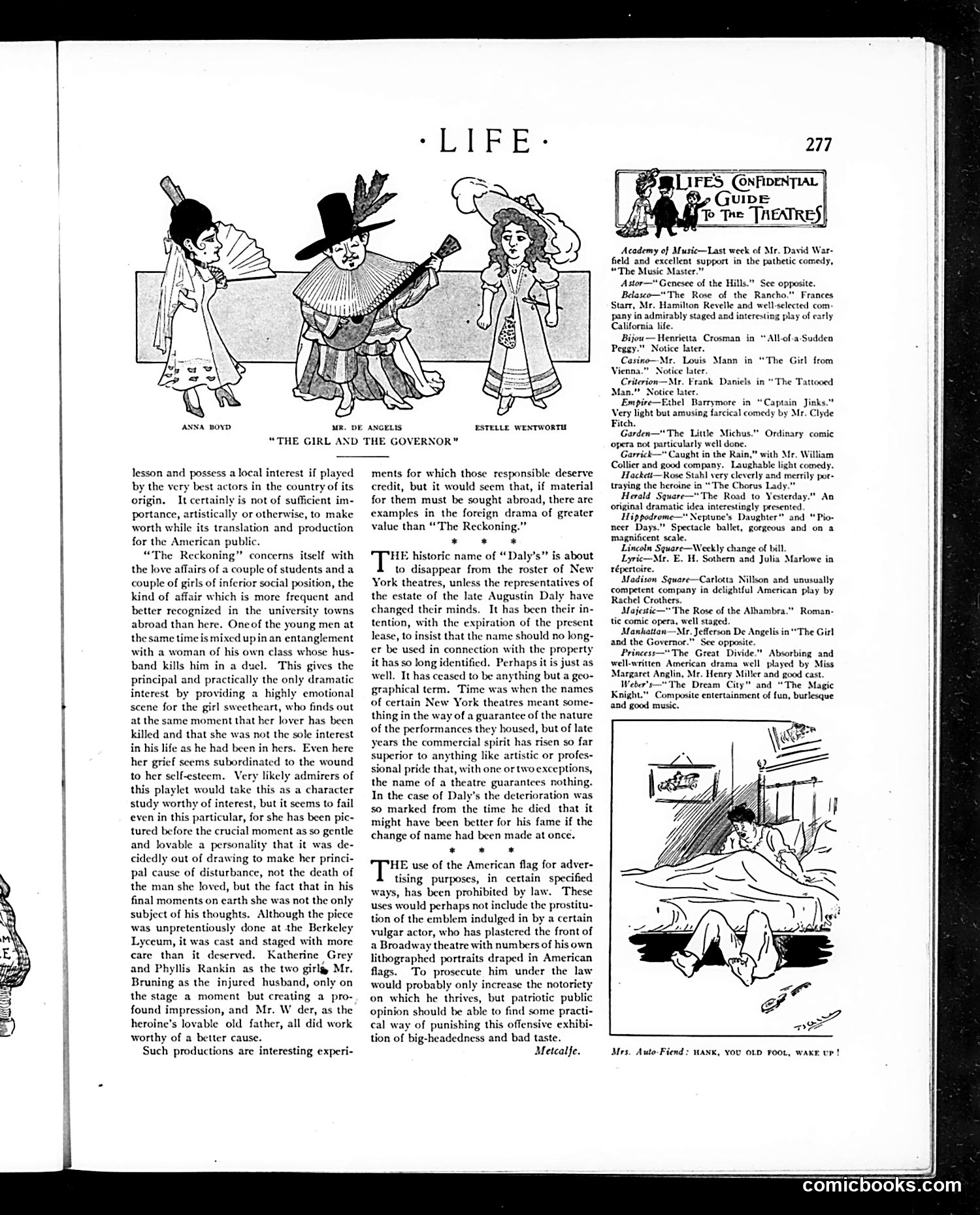
This page contains theater reviews and commentary, not political cartoons. The top illustration shows three figures from "The Girl and the Governor," identifying actors Anna Boyd, Mr. Dean, and Estelle Wentworth in a theatrical scene. The text critiques theatrical productions: a play called "The Reckoning" is dismissed as unworthy of American production despite competent acting. More significantly, the page discusses the impending removal of the name "Daly's" from a New York theater—historically important when Augustin Daly controlled it, but now merely a commercial venue lacking artistic merit. The final section satirizes a "vulgar actor" who has draped American flags around lithographed portraits advertising himself on a Broadway theater. The author argues prosecution would increase notoriety, suggesting patriotic public opinion should instead shame him into stopping. The cartoon at bottom right appears illustrative rather than satirical—captioned "Mrs. Auto Fiend: 'HANK, YOU OLD FOOL, WAKE UP!'"
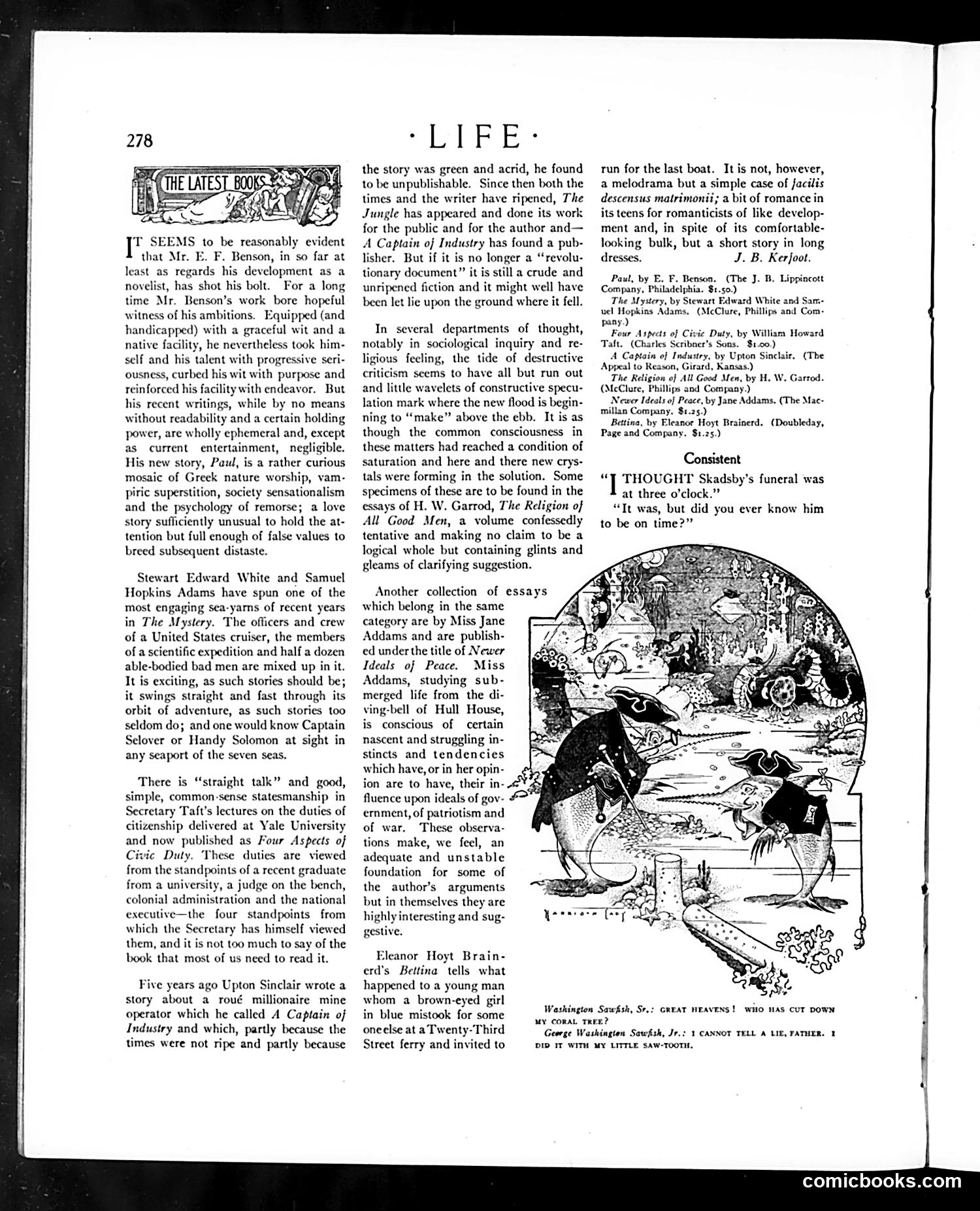
This page contains literary criticism of contemporary books, not political cartoons. The reviews critique recent works by established and emerging authors: **E.F. Benson's decline**: The critic argues Benson's novel *Paul* represents artistic exhaustion—mixing Greek nature worship, vampire superstition, and psychology without coherent purpose. **Upton Sinclair's *A Captain of Industry***: Five years after writing this manuscript about a corrupt millionaire mine operator, Sinclair finally found a publisher post-*The Jungle*. The critic dismisses it as "crude and unripened," suggesting it should have remained unpublished. **Secretary Taft's civic lectures**: Praised as straightforward, common-sense guidance on citizenship duties. The page also reviews essays by H.W. Garrod and Jane Addams on religion and peace—representing a cultural shift from "destructive" criticism toward "constructive speculation." The small illustration shows a humorous domestic scene unrelated to the text reviews.
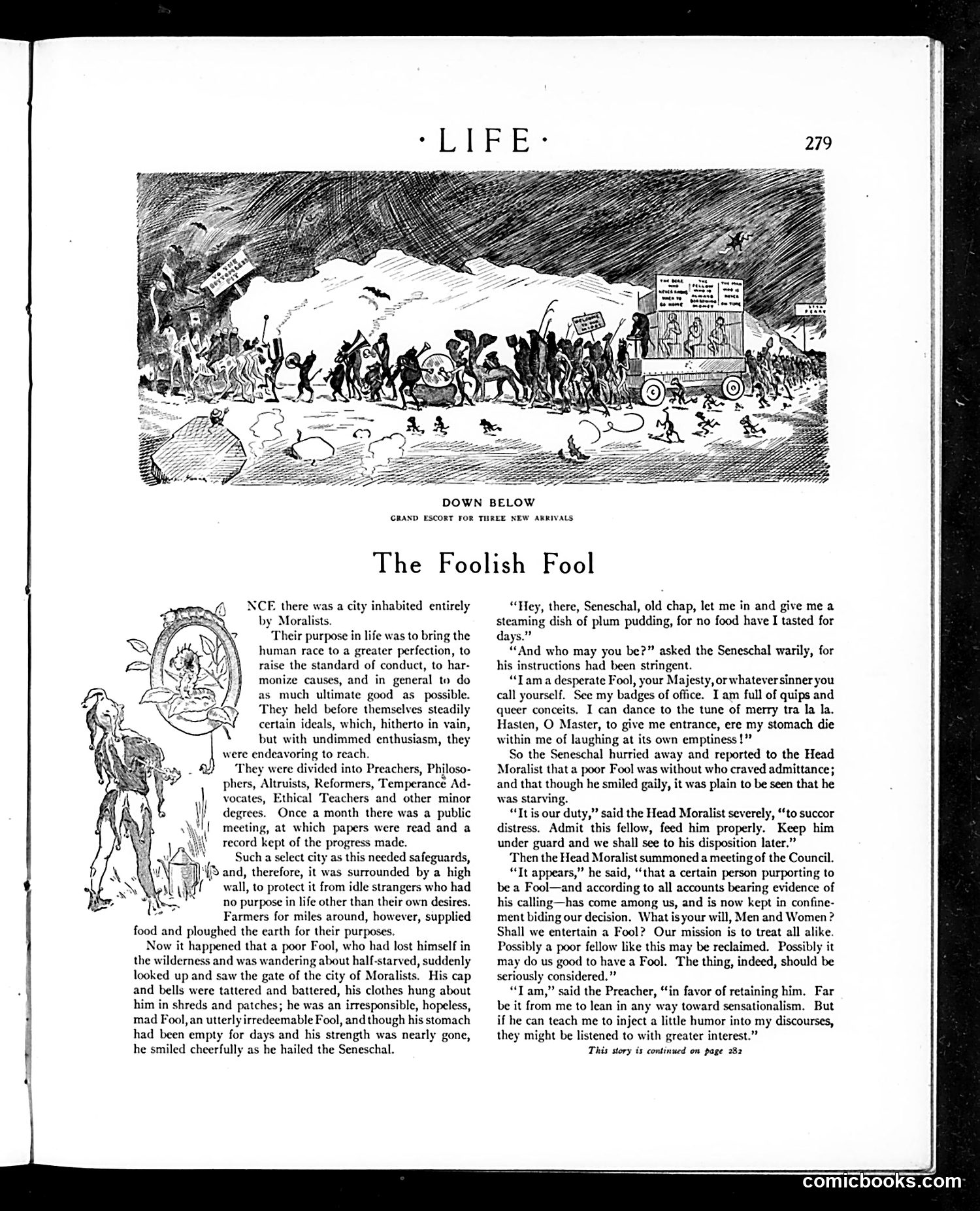
This is an allegorical story mocking self-righteous reformers and moral crusaders. The illustration shows a "City of Moralists" — a walled community of Preachers, Philosophers, Altruists, and Temperance Advocates obsessed with perfecting humanity and maintaining moral standards. A starving Fool (a traditional figure of truth-telling in satire) arrives seeking basic charity. Though the Head Moralist agrees to feed him on principle, the Council debates whether to "retain" him — not out of genuine compassion, but to exploit him. The Preacher explicitly wants to use the Fool to make his sermons more entertaining. The satire targets the hypocrisy of moral reformers: they're more interested in appearing virtuous and using worthy causes to advance themselves than in actual kindness. The Fool represents reality and human need, which the Moralists view as something to be managed and studied rather than genuinely helped. The continued story promises to explore this tension further.
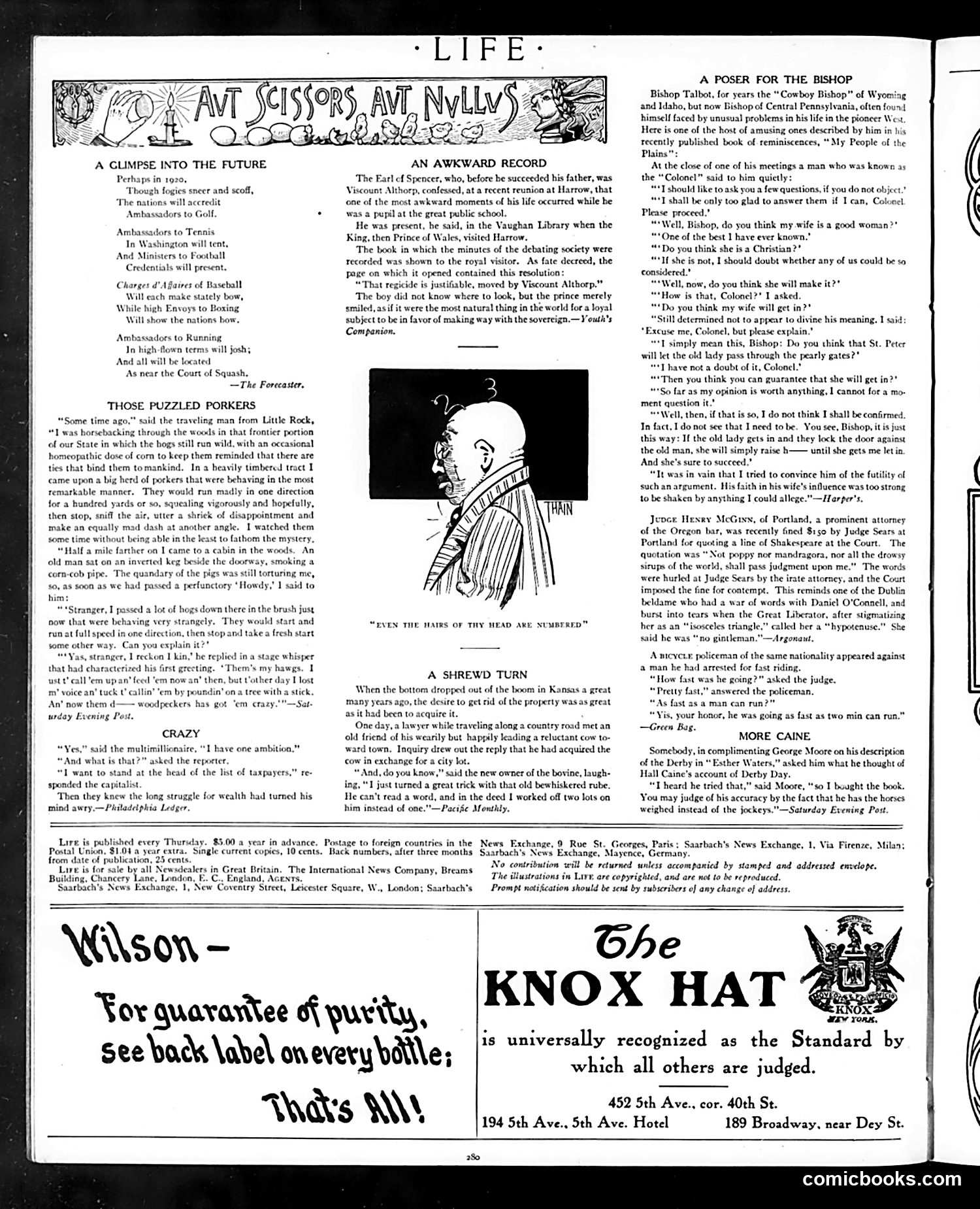
This page from the satirical magazine *Life* contains several humorous pieces mocking early 20th-century American society and institutions. **"A Glimpse Into the Future"** satirizes the proliferation of diplomatic positions by imagining absurd "ambassadors" to sports and games—golf, tennis, football, baseball, boxing—with formal credentials and protocols. The joke targets bureaucratic expansion and the trivialization of serious diplomatic roles. **"Those Puzzled Porkers"** is a tall tale where a farmer's pigs behave erratically because he trained them to respond to woodpecker sounds rather than his voice. The humor lies in rural ingenuity gone comically wrong. **"An Awkward Record"** recounts an embarrassing moment when the Prince of Wales encountered a school debate resolution supporting regicide—ironic given the speaker later became a peer. The anecdote mocks awkward social situations and archaic educational debates. **"Crazy"** features a wealthy capitalist expressing ambition to top the taxpayer list, suggesting extreme wealth has driven him insane—satire on capitalist excess and tax burden resentment. The page also includes period advertisements, including the Knox Hat company.
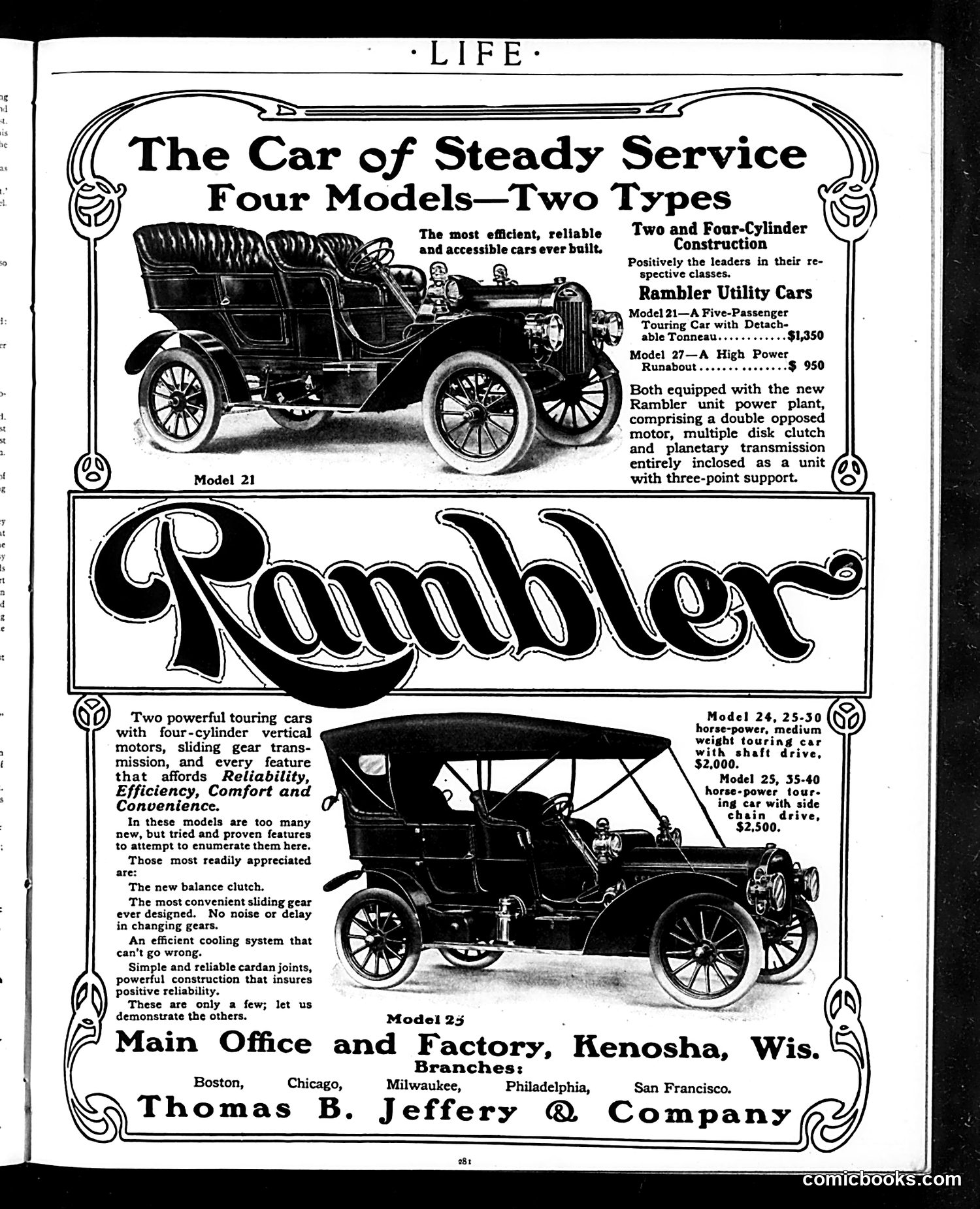
This is **not a cartoon or satire**—it's a straightforward automobile advertisement from an early 1900s Life magazine. The page promotes Rambler utility cars manufactured by Thomas B. Jeffery & Company in Kenosha, Wisconsin. The ad showcases four models across two engine types (2 and 4-cylinder), with prices ranging from $950 to $2,500. It emphasizes practical features like the "new balance clutch" and "sliding gear" transmission—innovations that would impress contemporary buyers unfamiliar with automotive technology. The decorative Art Nouveau borders and period typography are typical of early 20th-century advertising design. There are no political references or satirical elements—this is simply a vintage car advertisement positioned within Life magazine's pages, likely from around 1910 or earlier based on the vehicle designs and manufacturing claims.
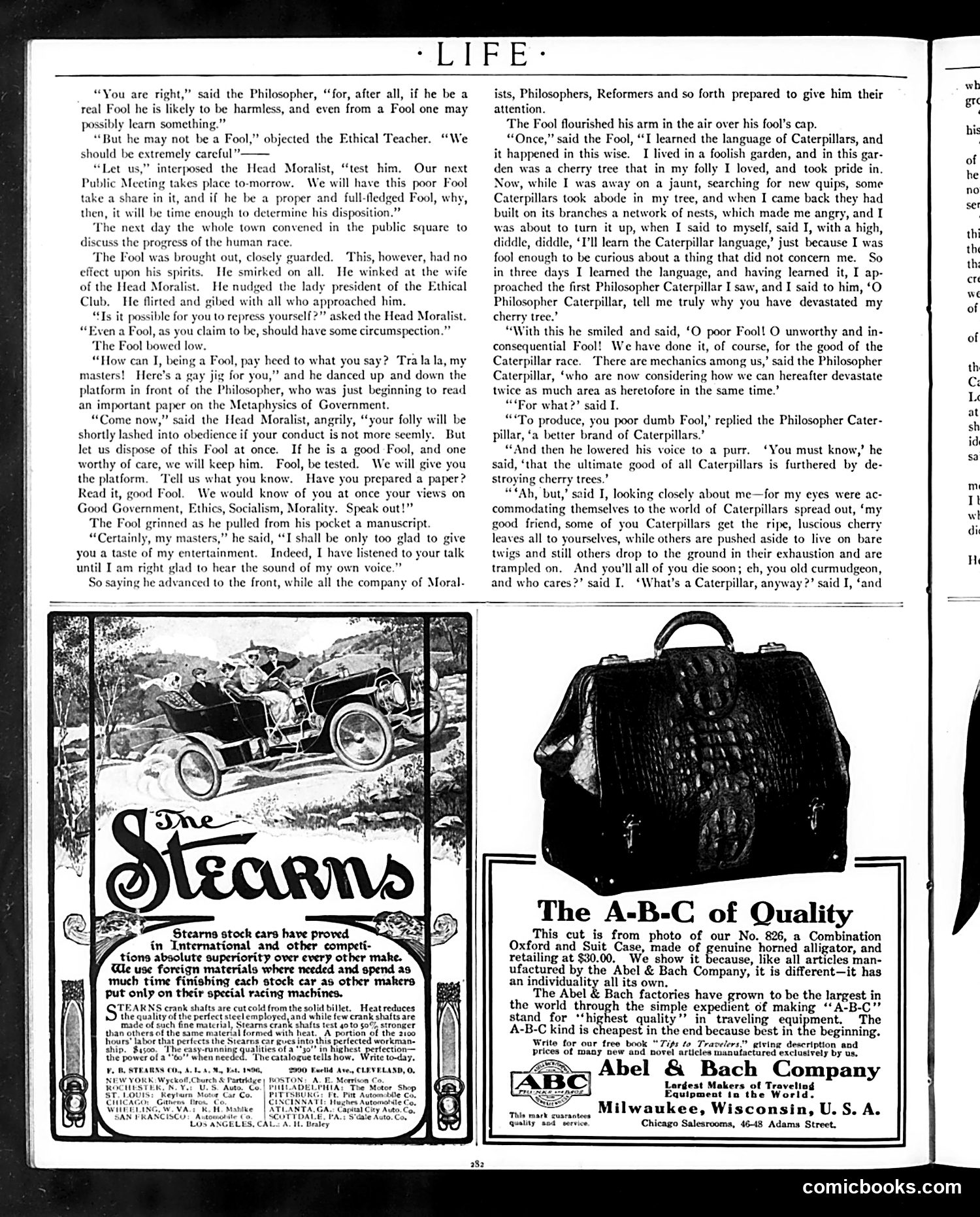
This page presents a philosophical dialogue mocking self-righteous reformers and moralists. A "Fool" is brought before a town assembly of pompous figures (labeled "Philosopher," "Ethical Teacher," "Head Moralist") who condescend to test his worthiness. The satire's point emerges in the Fool's parable about caterpillars destroying his cherry tree. When he learns their language, the caterpillars reveal they're deliberately devastating crops to breed a "better brand of Caterpillars"—a transparent allegory for progressives and reformers who justify destructive policies under the guise of human improvement and social progress. The joke: the supposedly foolish protagonist possesses more common sense than the self-important "wise" men lecturing about Government, Ethics, and Socialism. Life magazine—a satirical publication—is skewering the era's confident reformist ideology as short-sighted rationalization for harm, regardless of good intentions. The Fool sees clearly what the "masters" cannot.
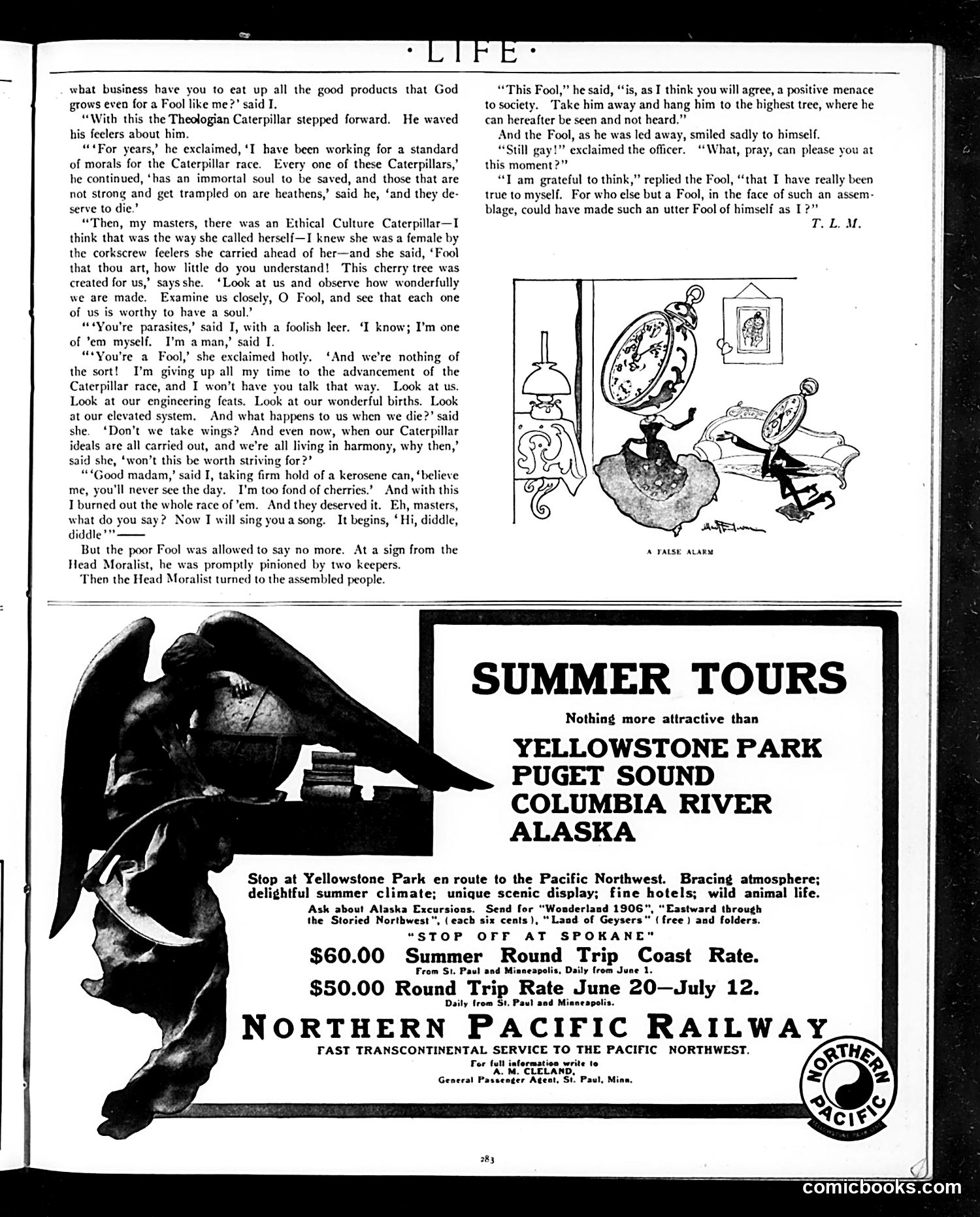
This page contains a story-based satirical allegory criticizing various philosophical and ideological movements of the early 1900s. The unnamed narrator encounters three types of "Caterpillars" representing distinct worldviews: a Theologian preaching moral salvation and condemning the weak as "heathens"; an Ethical Culture advocate promoting self-worth and progressive harmony; and the narrator himself, a self-described "Fool" who rejects all pretense and destroys them with kerosene—the only honest response to what he sees as hypocrisy. The story mocks both religious moralizing and progressive idealism as parasitic philosophies. When the Fool is executed by the "Head Moralist," the satire's point crystallizes: authority silences those who expose society's contradictions. The Fool's final contentment suggests that truth-telling and individual authenticity matter more than survival under corrupt systems. The cartoon (labeled "A False Alarm") appears to be separate visual satire, though its specific target is unclear from this image alone.
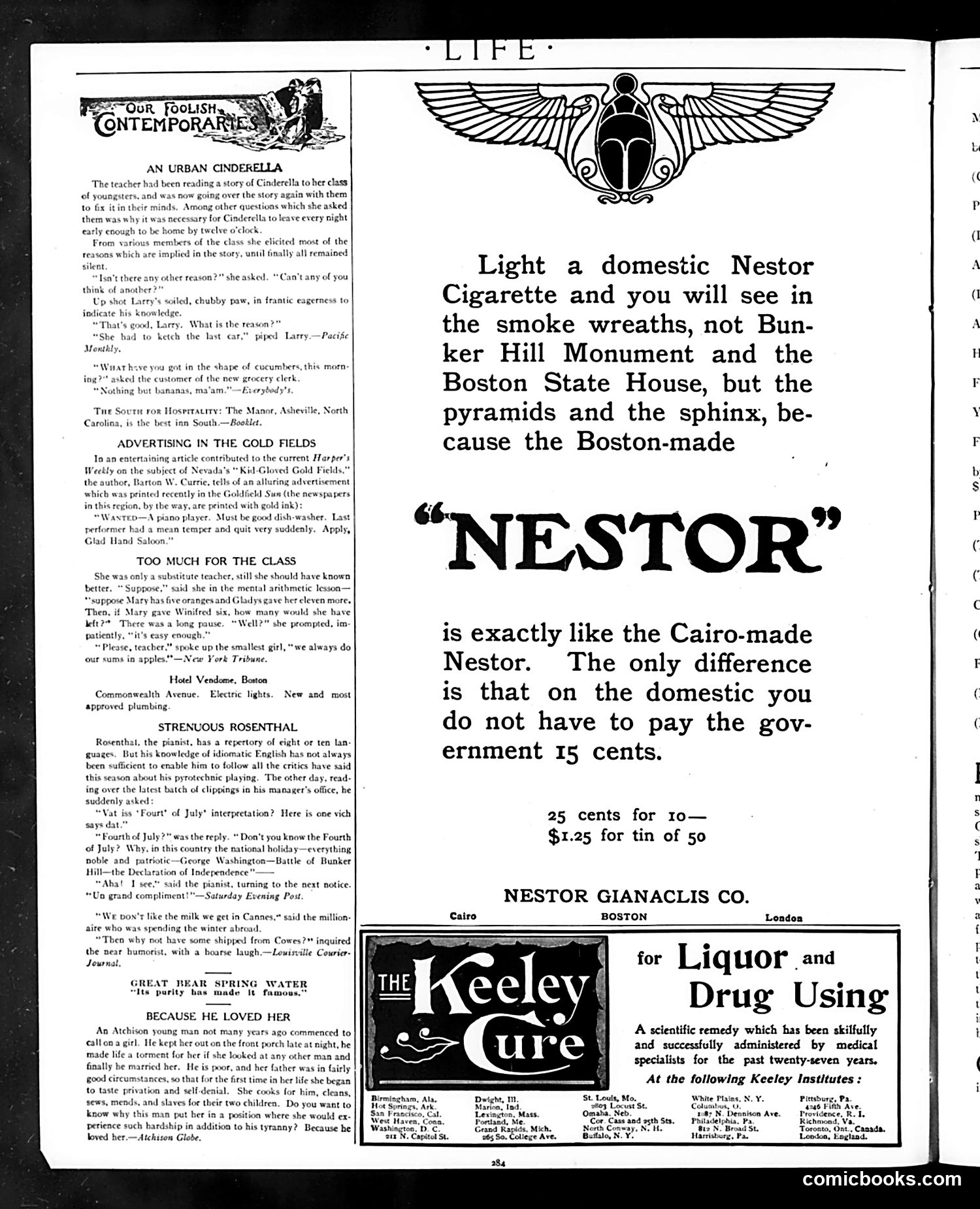
This page is primarily **advertising** for Nestor cigarettes, with several brief humorous anecdotes in the margins. The main advertisement features Nestor cigarettes, a Boston-made product, comparing itself favorably to imported Egyptian cigarettes ("Cairo-made Nestor"). The ad's central claim is that domestic Nestor cigarettes are "exactly like" their Egyptian equivalents but cost 15 cents less due to avoiding government tariffs—a reference to **trade protectionism debates** of the era. The surrounding content includes satirical short jokes typical of Life magazine: - "An Urban Cinderella" mocks a child who thinks Cinderella needed the "last car" home - "Too Much for the Class" jokes about a substitute teacher - "Strenuous Rosenthal" depicts a pianist confused by American patriotic terminology The page also advertises the Keeley Institute, a real contemporary facility treating "Liquor and Drug Using" addiction. The humor is gentle, domestic, and class-conscious—typical of early 20th-century American magazine satire targeting middle-class readers.
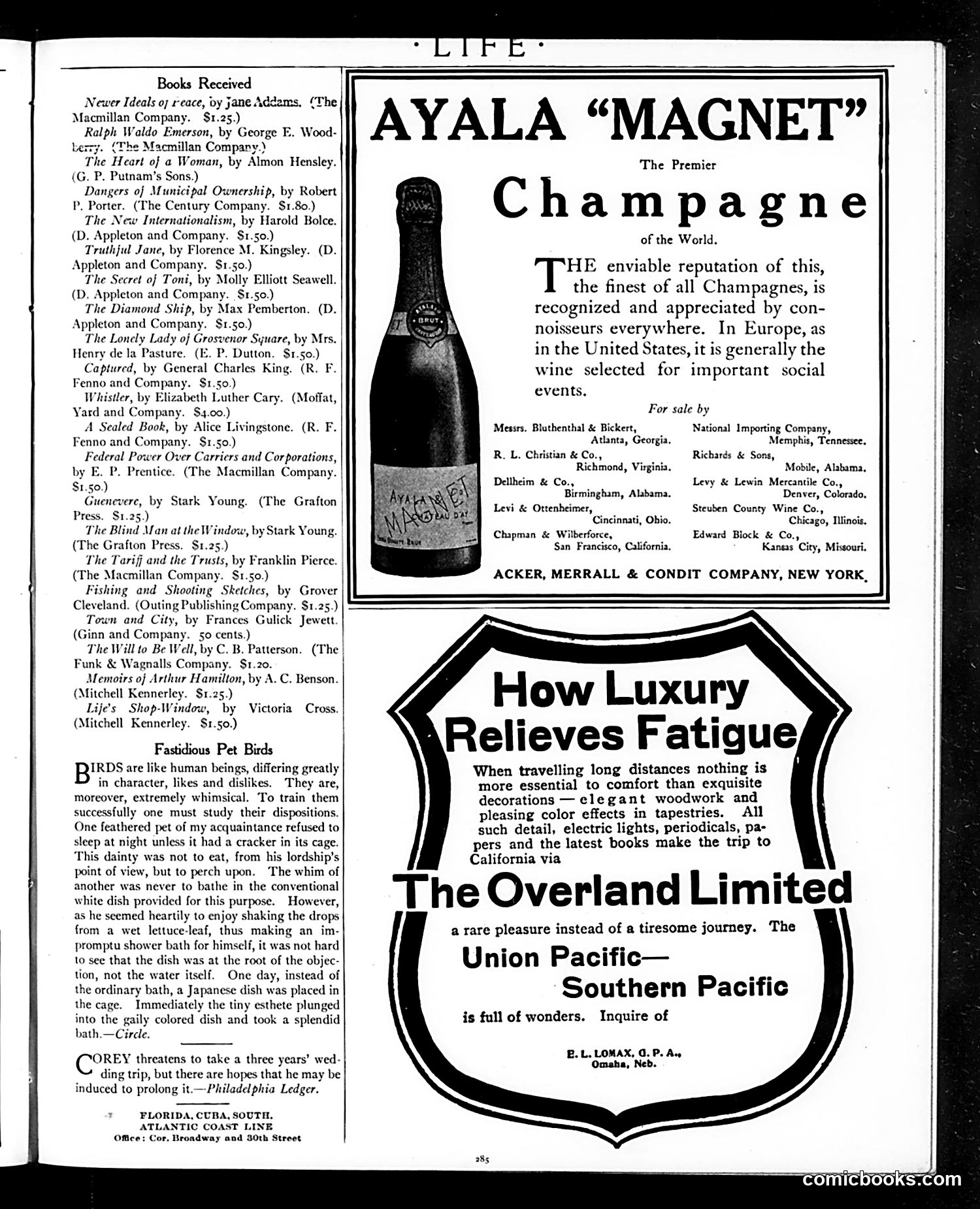
This page is primarily **advertisements and book reviews**, not satirical content. The main elements are: **Left column**: Book reviews listing recent publications on progressive topics (Jane Addams on peace, municipal governance, tariffs) and a humorous short item about "Fastidious Pet Birds"—anecdotes about finicky bird behavior, notably one refusing a conventional bath dish until given a Japanese one instead. **Right side**: Two full-page advertisements—one for Ayala "Magnet" champagne (marketed as the premier champagne for important social events) and one for the Overland Limited train service (Union Pacific–Southern Pacific), emphasizing luxury travel comforts. The bird story appears mildly satirical in its anthropomorphizing of refined tastes. The advertisements reflect early-20th-century American affluence and leisure culture. No political cartoons or significant satire appears on this page.
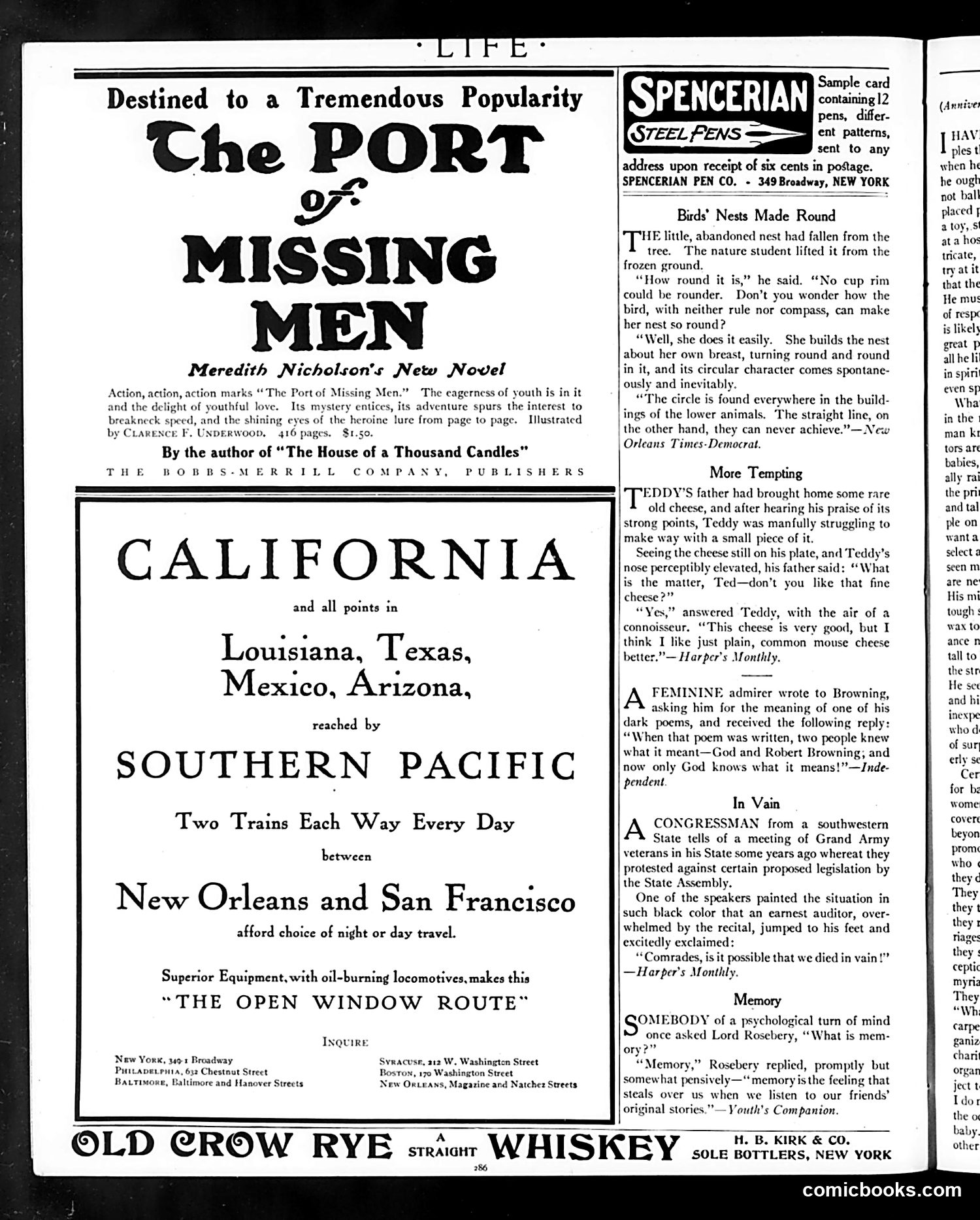
This page is primarily **advertising and literary promotion** rather than political satire or comics. The main content includes: 1. **Book Advertisement**: Promotes Meredith Nicholson's novel "The Port of Missing Men," emphasizing action, youth, mystery, and romance—typical marketing language for adventure fiction of the era. 2. **Travel Advertisement**: Southern Pacific Railroad promotes the "Open Window Route" connecting New Orleans to San Francisco, highlighting modern oil-burning locomotives and comfortable travel options. 3. **Miscellaneous Humor Pieces**: Short, lighthearted anecdotes about nature (bird nests), children (Teddy's cheese preference), and famous figures (Robert Browning's cryptic poetry, Lord Rosebery on memory). These are gentle, moralistic tales typical of *Life* magazine's family-friendly humor. 4. **Pen Advertisement**: Spencerian steel pens with sample cards. There is no political cartoon or satirical commentary—this is a commercial/entertainment page showcasing products and publishing alongside brief humorous sketches.
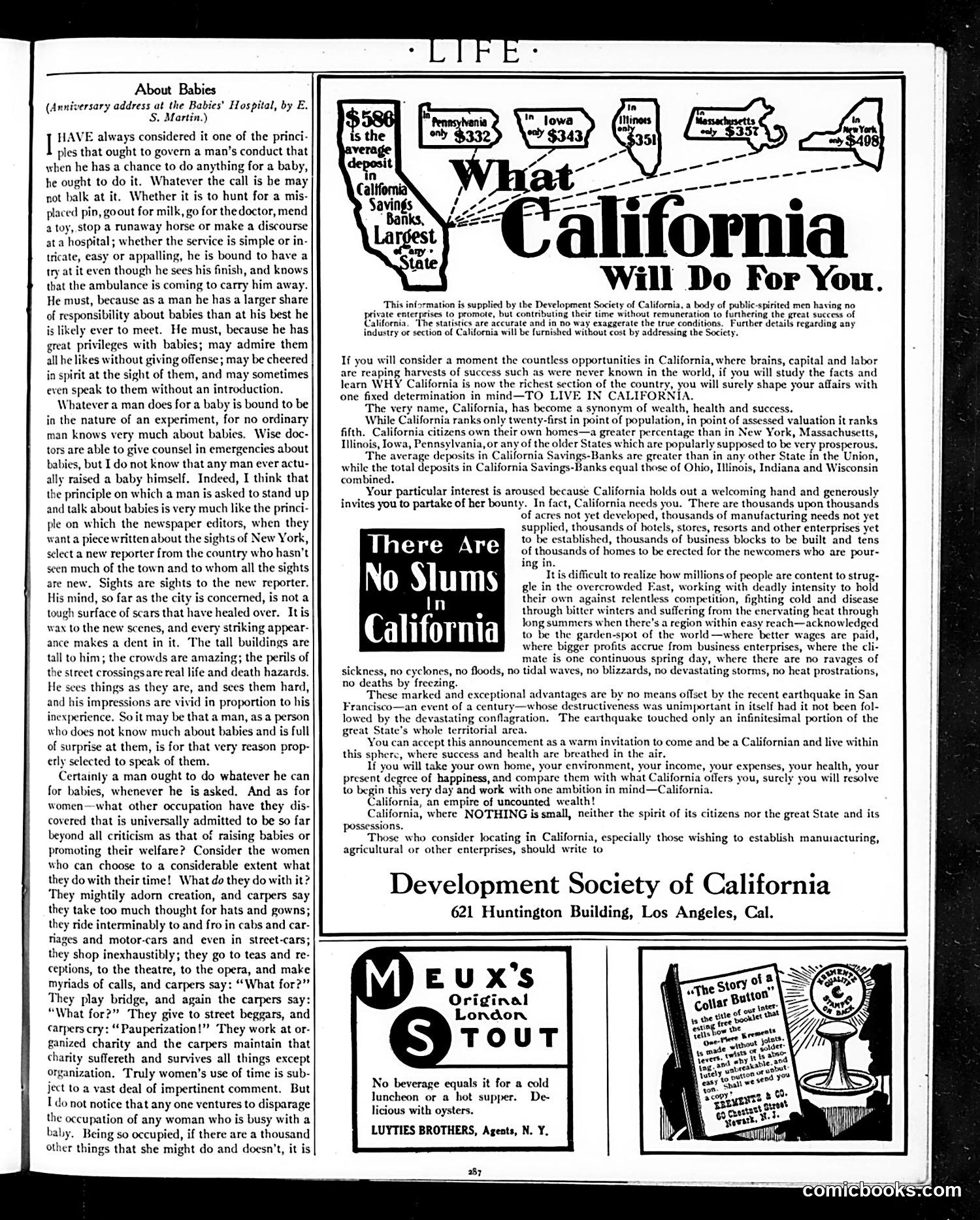
This is a mixed-content page from Life magazine combining editorial and advertising material. The main article, "About Babies," is an anniversary address by E.S. Martin delivered at a Babies' Hospital. It's a humorous essay arguing that men should help with babies despite knowing little about them—precisely because their inexperience makes them observe babies freshly, like a country reporter seeing New York for the first time. Martin also praises women's work with babies as the one occupation universally beyond criticism, while gently mocking women's other leisure activities (shopping, theater, bridge, charity work) as subject to constant complaint. The large central advertisement promotes California as an economic opportunity, featuring statistics about savings bank deposits and claiming the state has "no slums." It's a boosterist pitch to encourage relocation and investment. Below are smaller ads for Meux's London Stout beer and what appears to be a children's book or publication. The page reflects early 20th-century attitudes about gender roles, babies, and American regional promotion.
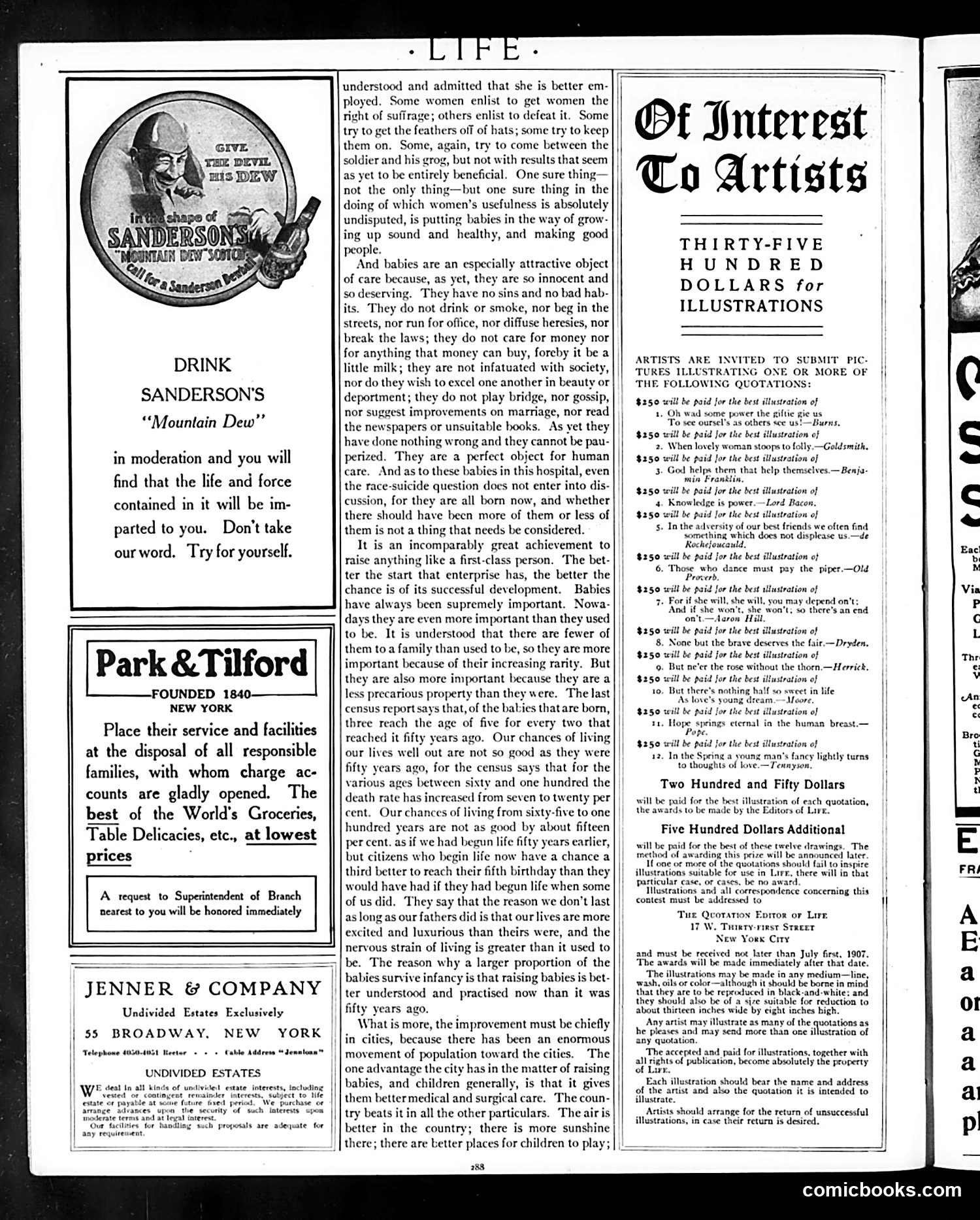
This page is primarily **advertising and editorial content**, not political satire. The dominant elements are liquor and financial services ads (Sanderson's Mountain Dew, Park & Tilford grocers, Jenner & Company real estate). The substantive text is a lengthy **pro-natalist essay** addressing women's roles during what appears to be the WWI era. It dismisses various women's causes—suffrage, hat feather reform, temperance activism—as less important than women's "true" purpose: bearing and raising healthy babies. The essay's argument: babies are society's most worthy objects of care because they're innocent and can't be corrupted. It cites census data showing infant survival has improved dramatically (3 of 5 now reach age five versus 2 of 5 fifty years prior). **The implicit satire/social commentary**: This reflects early 20th-century conservative anxiety about women's expanding social activism. By praising motherhood as women's supreme achievement while dismissing suffrage and social reform as distractions, the piece defends traditional gender roles against feminist progress—though it does so obliquely through praise rather than overt criticism.
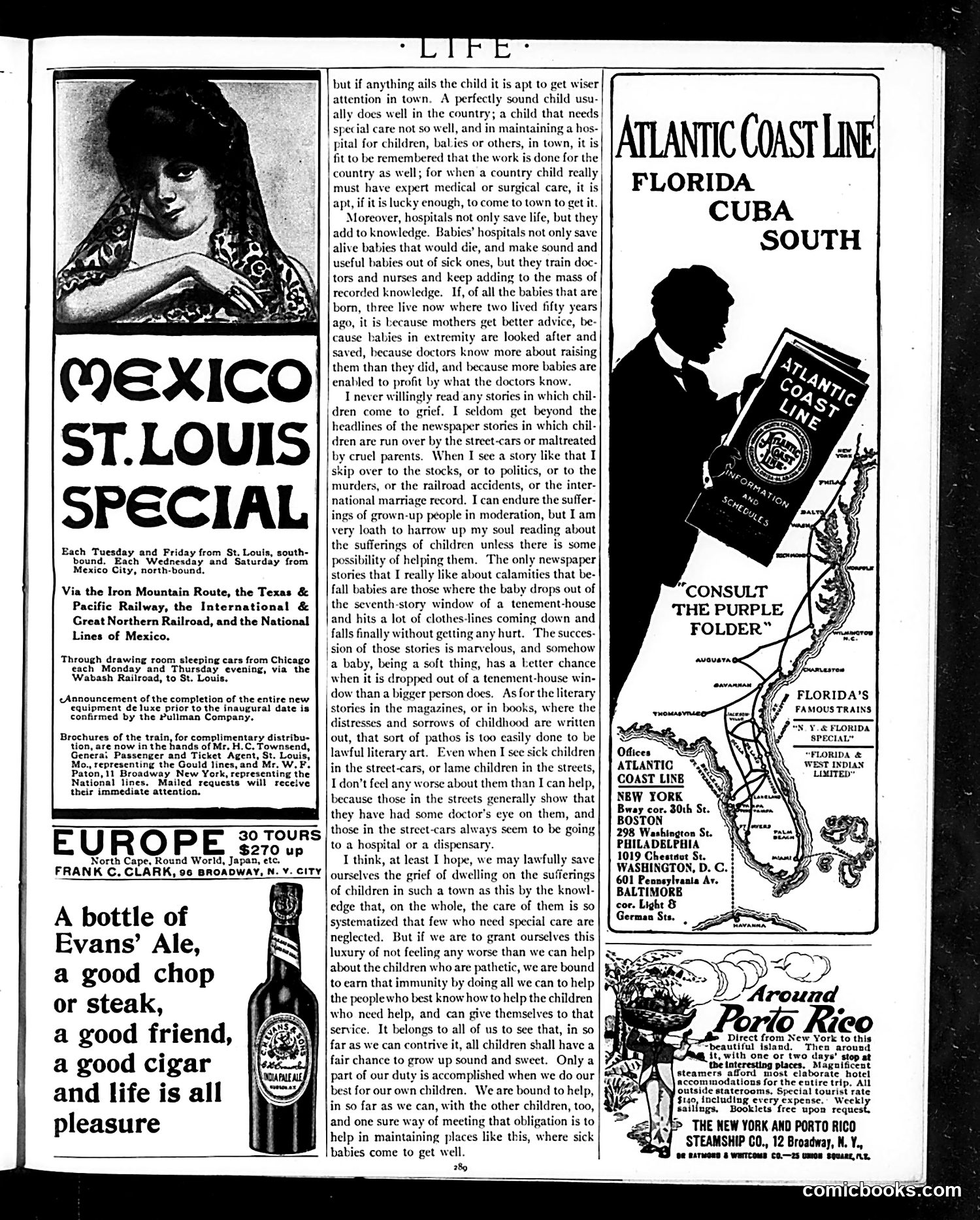
This page is primarily **advertising and travel promotion** with a substantial **editorial essay** on child welfare. **Left side:** Advertisements for luxury rail travel (Mexico-St. Louis Special, European tours via Frank C. Clark, Evans' Ale) targeting wealthy readers. **Center/Right:** The main content is an **essay advocating for children's hospitals and medical care**. The author argues that: - Country children do well naturally, but sick children need urban medical expertise - Hospitals save lives AND advance medical knowledge (citing improved infant survival rates) - The author refuses to read newspaper stories about child suffering unless there's a possibility of helping - Street children showing signs of medical attention are reassuring **Right side:** Advertisement for Atlantic Coast Line steamship routes to Florida, Cuba, and Puerto Rico. The essay reflects **Progressive Era concern** (early 1900s) with public health infrastructure and child welfare—contemporary social reform issues. There is **no political cartoon** on this page.
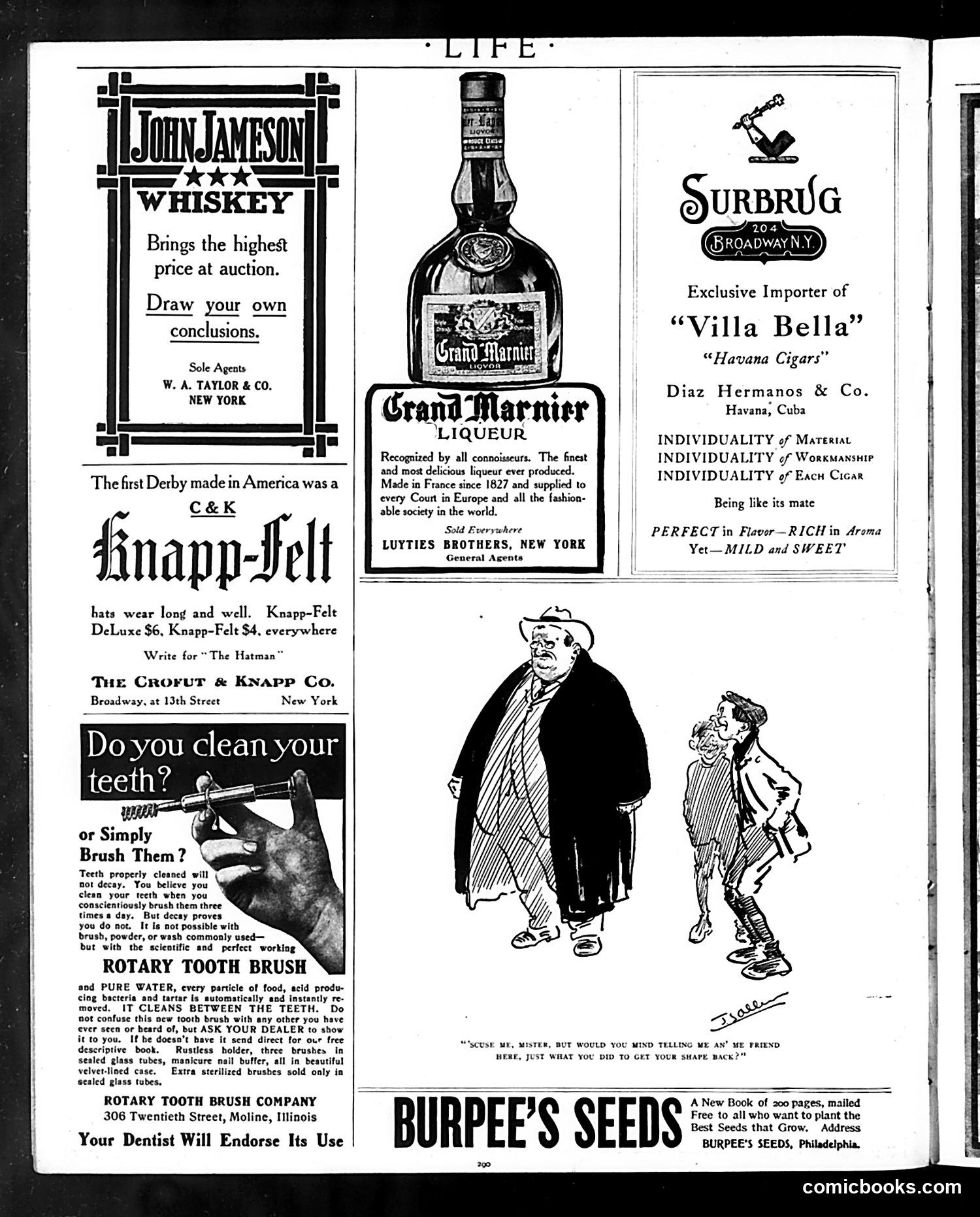
This page is primarily **advertisements** with one small cartoon illustration. The cartoon depicts two working-class men (drawn in caricatured style with exaggerated features typical of early 20th-century depictions) addressing a well-dressed, portly gentleman. One says: "Excuse me, mister, but would you mind telling me an' me friend here, just what you did to get your shape back?" **The satire**: The joke mocks the gentleman's obvious weight and suggests he's recently lost and regained it, implying his lifestyle and consumption habits are absurd or comedic. The working-class characters' crude speech contrasts with his appearance, highlighting class differences. The page otherwise features period advertisements for John Jameson Whiskey, Grand Marnier liqueur, Knapp-Felt hats, Surbrug cigars, a Rotary Tooth Brush, and Burpee's Seeds—typical of Life magazine's revenue model blending satire with commercial messaging.
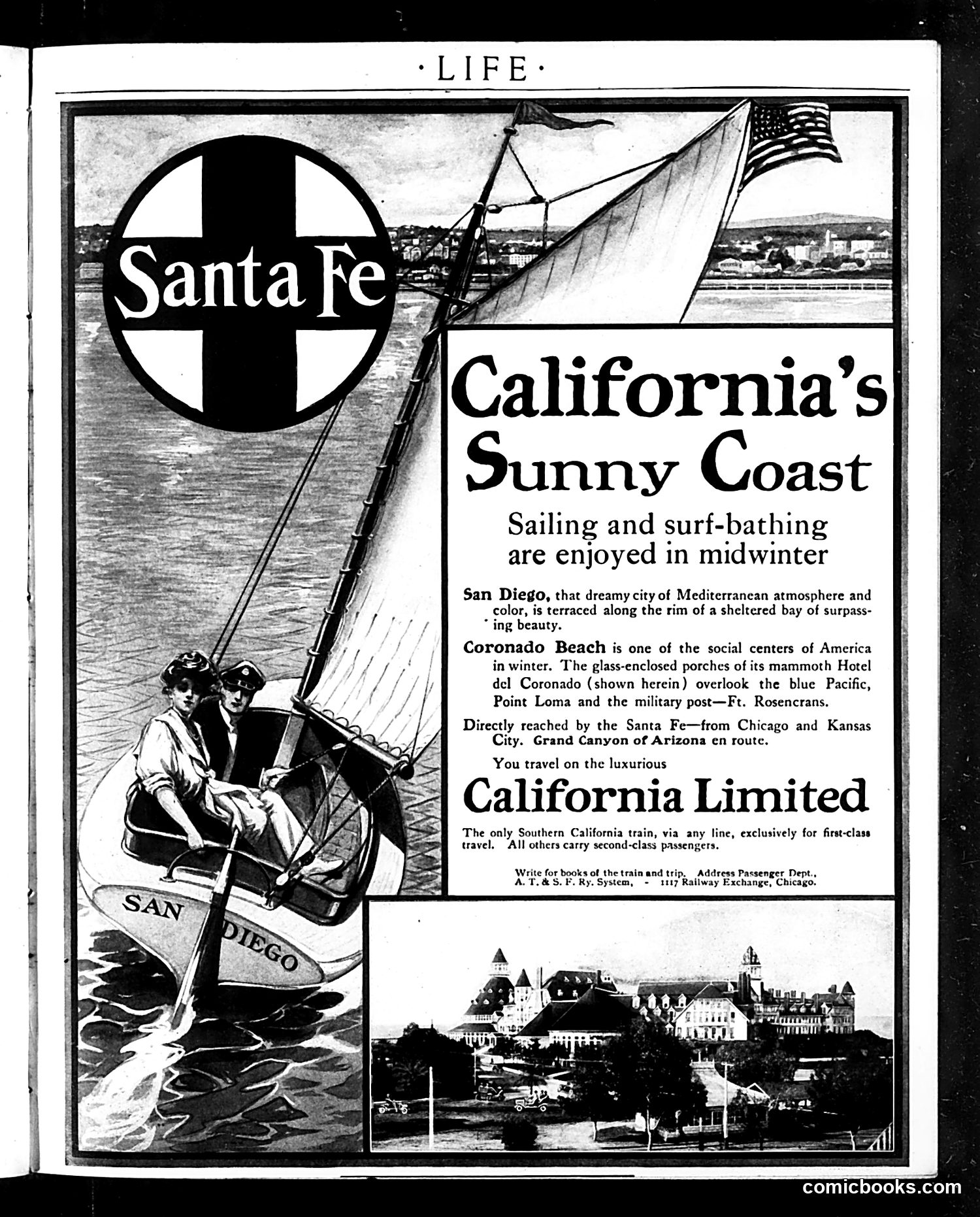
This is **not a political cartoon or satire**—it's a straightforward advertisement, not editorial content. The page promotes the Santa Fe Railway's "California Limited" train service to Southern California. The imagery depicts a woman sailing near San Diego, emphasizing recreational leisure ("sailing and surf-bathing are enjoyed in midwinter"). The Santa Fe cross logo and steamship imagery underscore the journey itself as a luxury experience. The ad highlights Coronado Beach and the Hotel del Coronado as premier winter destinations for affluent Americans, positioning the train as the exclusive conveyance for "first-class travel" (explicitly contrasting with other lines carrying "second-class passengers"). The rhetoric appeals to early-20th-century leisure culture and aspirational middle/upper-class tourism. No satire is present—this is period marketing emphasizing California's Mediterranean climate and accessibility via rail.
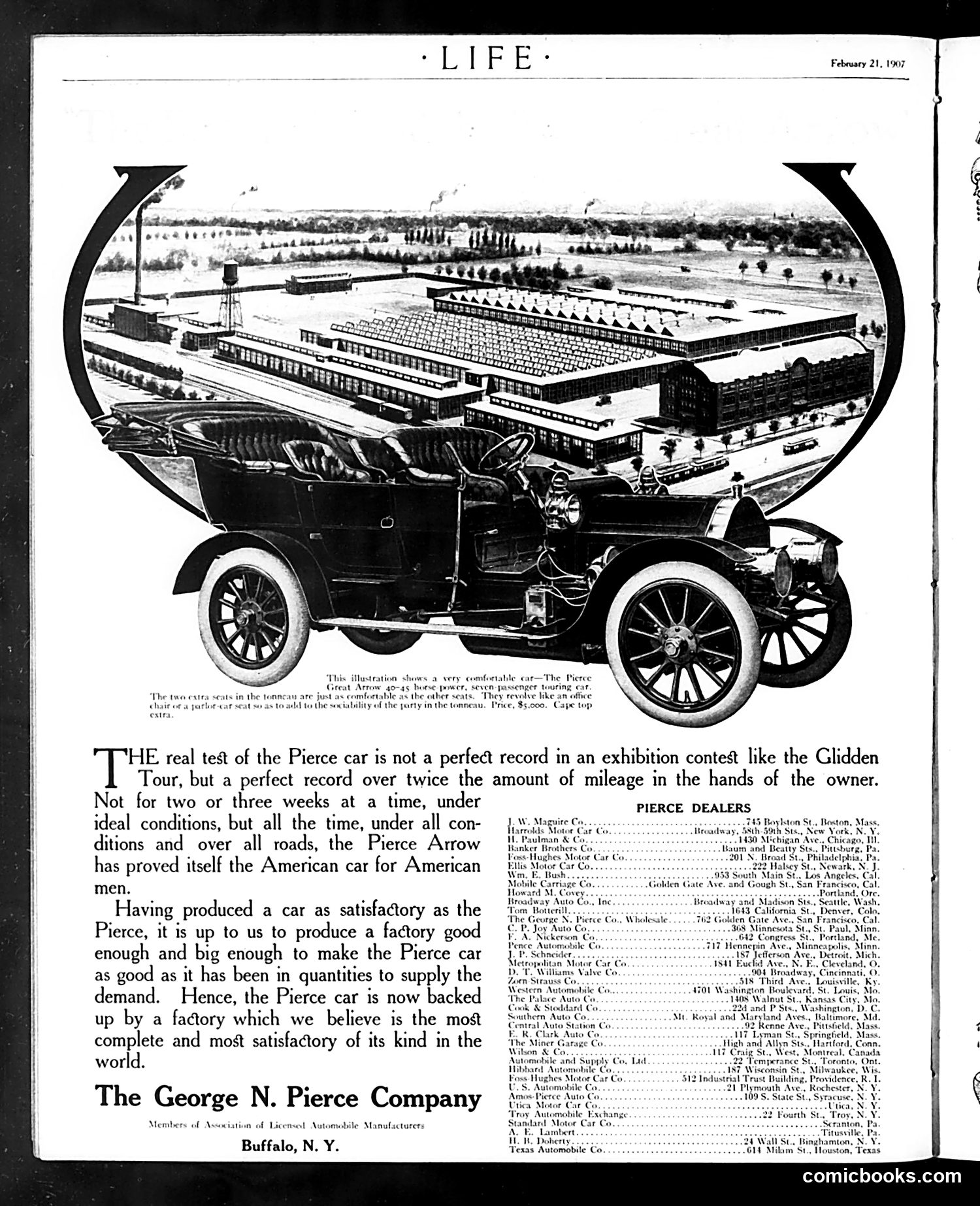
This is **not a cartoon or satire, but a straightforward automobile advertisement** for the Pierce Arrow car by the George N. Pierce Company of Buffalo, New York. The image shows a luxury touring car of the era with an inset photograph of the company's manufacturing facility. The advertisement emphasizes reliability and American manufacturing quality, contrasting the Pierce Arrow favorably against competition (particularly referencing the Glidden Tour, a famous endurance racing event of the period). The text argues that real automotive merit isn't proven in exhibition contests, but through consistent ownership performance "over all roads" and "under all conditions." It boasts of the company's expanded factory capacity to meet demand. The accompanying dealer list shows Pierce Arrow's national distribution network across major American cities, indicating it was a premium, established automobile brand competing in the early automotive market.