
Life, 1907-02-21 · page 20 of 36
Life — February 21, 1907 — page 20: what you’re looking at
What you’re looking at
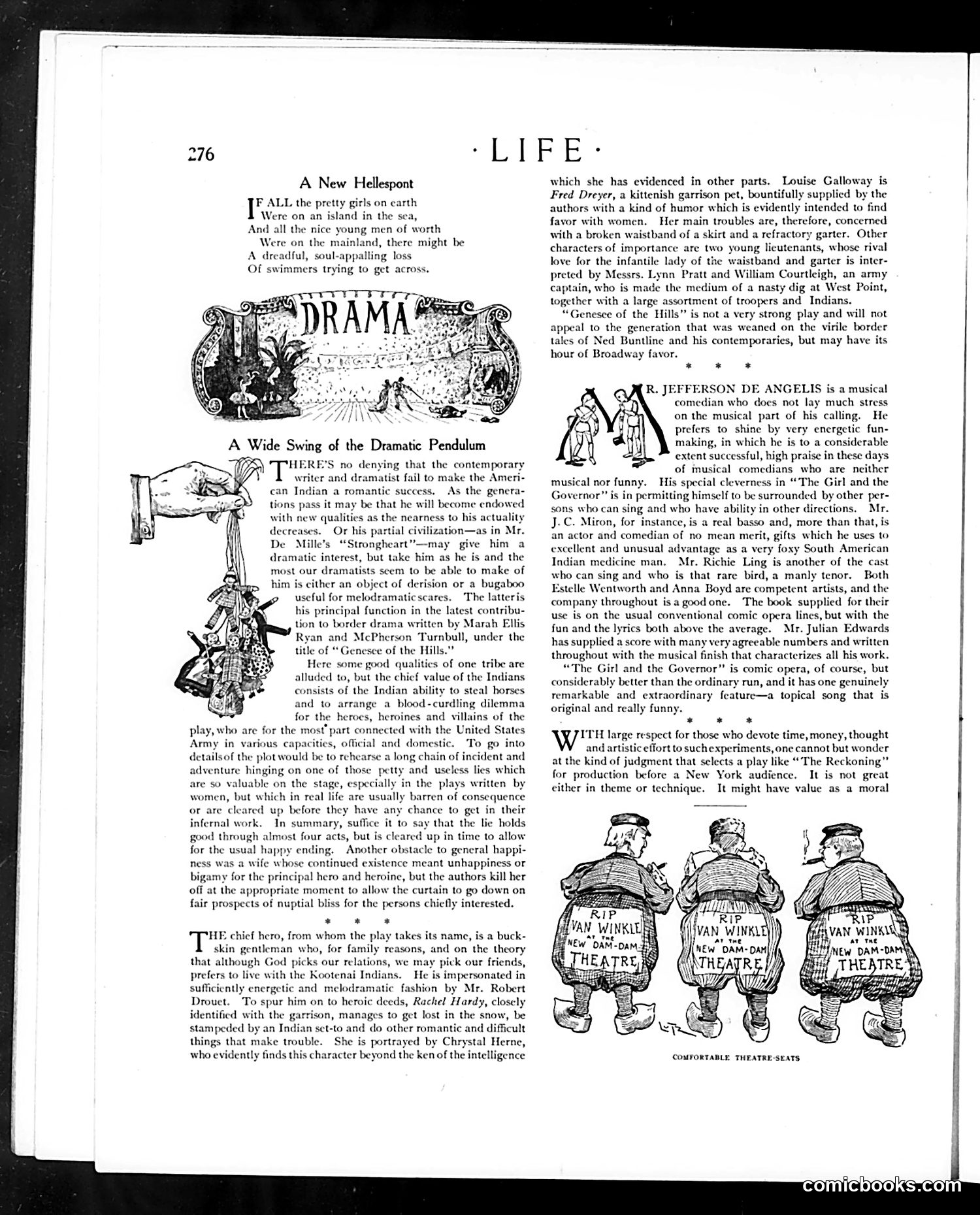
This page reviews two theatrical productions. The main article criticizes "Genesee of the Hills," a border drama featuring Native Americans as plot devices—either comic relief or melodramatic villains. The author argues American playwrights fail to portray Indians meaningfully; they're reduced to stealing horses and creating contrived crises. The plot hinges on a pointless lie sustained through four acts before convenient resolution. The review mocks the female lead (Chrystal Herne) as miscast and finds the comedic subplot about Louise Galloway's wardrobe malfunctions (broken waistband, troublesome garter) beneath the caliber of classic frontier tales by Ned Buntline. A brief poem at top ("A New Hellespont") makes a light joke about separation of attractive people and swimming. The page also briefly discusses "The Girl and the Governor," praising its musical performances, particularly R. Jefferson De Angelis's comedic talents. This represents typical early 20th-century theatrical criticism in a satirical magazine context.
📄 Transcribed text from this page (OCR, searchable)
Machine-transcribed from the original scan — historical spelling and the odd misread are preserved.
LIP E A New Hellespont F ALL the pretty girls on earth Were on an island in the sea, And all the nice young men of worth Were on the mainland, there might be A dreadful, soul-appalling loss Of swimmers trying to get across. no denying that the contemporary writer and dramatist fail to make the Ameri- can Indian a romantic success, As the genera- tions pass it may be that he will become with new ies as the nearness to h deer Or his partial civilization—as in Mr. De Mille’s “Stronghe: may give him a dramatic interest, but take him as he is and the most our dramatists scem to be able to make of him is cither an object of derision or a bugaboo useful for melodramaticscares. ‘The latteris his principal function in the latest contribu- tion to border drama written by Marah Ellis Ryan and McPherson Turnbull, under the ce of the Hills.” Here some good qualitics of one tribe are alluded to, but the chief value of the Indians consists of the Indian ability to steal horses and to arrange a blood-curdling dilemma for the herocs, heroines and villains of the play, who are for the most’ part connected with the United States my in various capacities, official and domestic. To go into detailsof the plot would be to rehearse a long chain of incident and adventure hinging on one of those petty and useless lies which are so valuable on the stage, especially in the plays written by women, but which in real life are usually barren of consequence or are cleared up before they have any chance to get in their infernal work. In summary, suffice it to say that the lie holds good through almost four acts, but is cleared up in time to allow for the usual happy ending. Another obstacle to general happi- ness was a wife whose continued existence meant unhappiness or bigamy for the principal hero and heroine, but the authors kill her off at the appropriate moment to allow the curtain to go down on fair prospects of nuptial bliss for the persons chiefly interested. * 8 8 HE chief hero, from whom the play takes its name, is a buck- skin gentleman who, for family reasons, and on the theory that although God picks our relations, we may pick our friends, prefers to live s impersonated in sufficiently energetic and melodramatic fashion by Mr. Robert Drouct. To spur him on to heroic deeds, Rachel Hardy, closely identified with the garrison, manages to get lost in the snow, be stampeded by an Indian sct-to and do other romantic and difficult things that make trouble. She is portrayed by Chrystal Herne, who evidently finds this character beyond the ken of the intelligence which she has evidenced in other parts. Louise Galloway is Fred Dreyer, a kittenish garrison pet, bountifully supplied by the authors with a kind of humor which is evidently intended to find favor with women, Her main troubles are, therefore, concerned with a broken waistband of a skirt and a refractory garter. Other characters of importance are two young licutenants, whose riv: love for the infantile lady of the waistband and garter is inter preted by Messrs. Lynn Pratt and William Courtleigh, an army captain, who is made the medium of a nasty dig at West Point, together with a large assortment of troopers and Indians. “Genesee of the Hills” is not a very strong play and will not appeal to the generation that was weaned on the virile border tales of Ned Buntline and his contemporaries, but may have its hour of Broadway favor. so * 8 RSON DE ANGELIS is a musical comed who does not lay much stre: on the musical part of his calling. He prefers to shine by very energetic fun- making, in which he is to a considerable extent successful, high praise in these days of musical comedians who are neither musical nor funny. His special cleverness in “The Girl and the Governor” is in permitting himself to be surrounded by other pe sons who can sing and who have ability in other directions. Mr. J.C. Miron, for instance, is a real basso and, more than that, an actor and comedian of no mean merit, gifts which he uses to excellent and unusual advantage as a very foxy South American Indian medicine man. Mr. Richie Ling is another of the cast who can sing and who is that rare bird,a manly tenor. Both elle Wentworth and Anna Boyd are competent artists, and the company throughout isa goodone. The book supplied for their use is on the usual conventional comic opera lines, but with the fun and the lyrics both above the average. Mr. Julian Edwards has supplied a score with many very agreeable numbers and written throughout with the musical finish that characterizes all his work. “The Girl and the Governor” is comic opera, of course, but considerably better than the ordinary run, and it has one genuinely remarkable and extraordinary feature—a topical song that is original and really funny. * * * W' H large respect for those who devote time, moncy, thought and artistic effort to suchexperiments, one cannot but wonder at the kind of judgment that selects a play like “The Reckoning” for production before a New York audience. It is not great cither in theme or technique. It might have value as a moral RIP \ van WINKL AY tne ee ‘DAM: DAM h He \OIHEATR i ue fi NEW OAM-DAM. COMFORTABLE THRATRE-SEATS VAN WINK 3]