
Life, 1907-02-21 · page 14 of 36
Life — February 21, 1907 — page 14: what you’re looking at
What you’re looking at
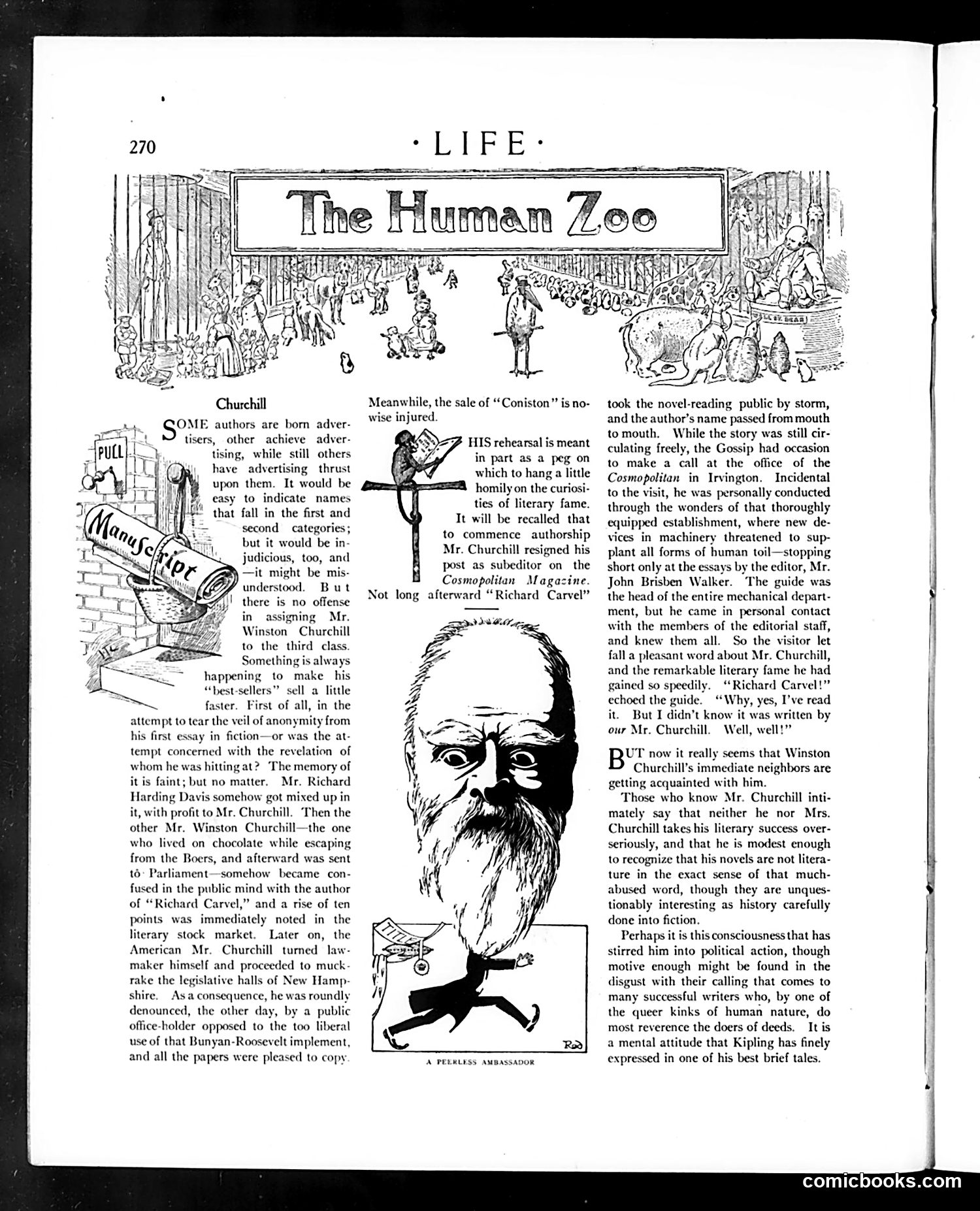
This satirical piece discusses the confusion surrounding author Winston Churchill's sudden fame. The article explains how Churchill resigned from his editorial post at *Cosmopolitan Magazine* to write fiction. His novel *Richard Carvel* became wildly popular, but the public confused him with the British politician **Winston Churchill** (who had recently escaped Boer captivity and entered Parliament). This mistaken identity boosted sales of Churchill's books by ten points on the "literary stock market." The cartoon caricature labeled "A Peerless Ambassador" depicts the author Churchill. The satire mocks how literary fame operates through accident and confusion rather than merit. The piece notes that Churchill's neighbors are only now learning he's a writer, and concludes that his modest awareness that his novels are "not literature" but "history carefully done into fiction" may have motivated him toward politics—where he could engage in "deeds" rather than mere words.
📄 Transcribed text from this page (OCR, searchable)
Machine-transcribed from the original scan — historical spelling and the odd misread are preserved.
EB SOME authors are born adver- sy A tisers, other achieve adver- tising, while still others have advertising thrust upon them. It would be easy to indicate names that fall in the first and second categories; but it would be in- judicious, too, and —it might be mis- understood. But s no offense ssigning Mr. Winston Churchill to the third class. Something is always happening to make his “best-si faster. First of attempt to tear the veil of anonymity from his first essay in fiction—or was the at- tempt concerned with the revelation of whom he was hitting at? The memory of it is faint; but no matter. Mr. Richard Harding Davis somehow got mixed up in it, with profit to Mr. Churchill. Then the other Mr. Winston Churchill—the one who lived on chocolate while escaping from the Boers, and afterward was sent t6: Parliament—somehow became con- fused in the public mind with the author of “Richard Carvel,” and a rise of ten points was immediately noted in the literary stock market. Later on, the American Mr. Churchill turned law- maker himself and proceeded to muck- rake the legislative halls of New Hamp- shire, Asa consequence, he was roundly denounced, the other day, by a public office-holder opposed to the too liberal use of that Bunyan-Roosevelt implement, and all the papers were pleased to copy Meanwhile, the sale of “Coniston” is no- wise injured. HIS rehearsal is meant in part as a peg on which to hang a little homily on the curiosi- ties of literary fame. It will be recalled that to commence authorship Mr. Churchill resigned his post as subeditor on the Cosmopolitan Magazine. Not long afterward “Richard Carvel” YING ieas, A PEERLESS AMBASSADOR took the novel-reading public by storm, and the author’s name passed from mouth tomouth. While the story was still cir- culating freely, the Gossip had occasion to make a call at the office of the Cosmopolitan in Irvington. Incidental to the visit, he was personally conducted through the wonders of that thoroughly equipped establishment, where new de- vices in machinery threatened to sup- plant all forms of human toil—stopping short only at the essays by the editor, Mr. John Brisben Walker. The guide was the head of the entire mechanical depart- ment, but he came in personal contact with the members of the editorial staff, and knew them all. So the visitor let fall a pleasant word about Mr. Churchill, and the remarkable literary fame he had gained so speedily. “Richard Carvel!” echoed the guide. “Why, yes, I’ve read it. But I didn’t know it was written by our Mr. Churchill. Well, well!” UT now it really seems that Winston Churchill’s immediate neighbors are getting acquainted with him. Those who know Mr. Churchill inti- mately say that neither he nor Mrs. Churchill takes his literary success over- seriously, and that he is modest enough to recognize that his novels are not litera- ture in the exact sense of that much- abused word, though they are unques- tionably interesting as history carefully done into fiction. Perhaps it is this consciousness that has stirred him into political action, though motive enough might be found in the disgust with their calling that comes to many successful writers who, by one of the queer kinks of human nature, do most reverence the doers of deeds. It is a mental attitude that Kipling has finely expressed in one of his best brief tales. comicbooks.com ee i