
Life, 1907-02-21 · page 21 of 36
Life — February 21, 1907 — page 21: what you’re looking at
What you’re looking at
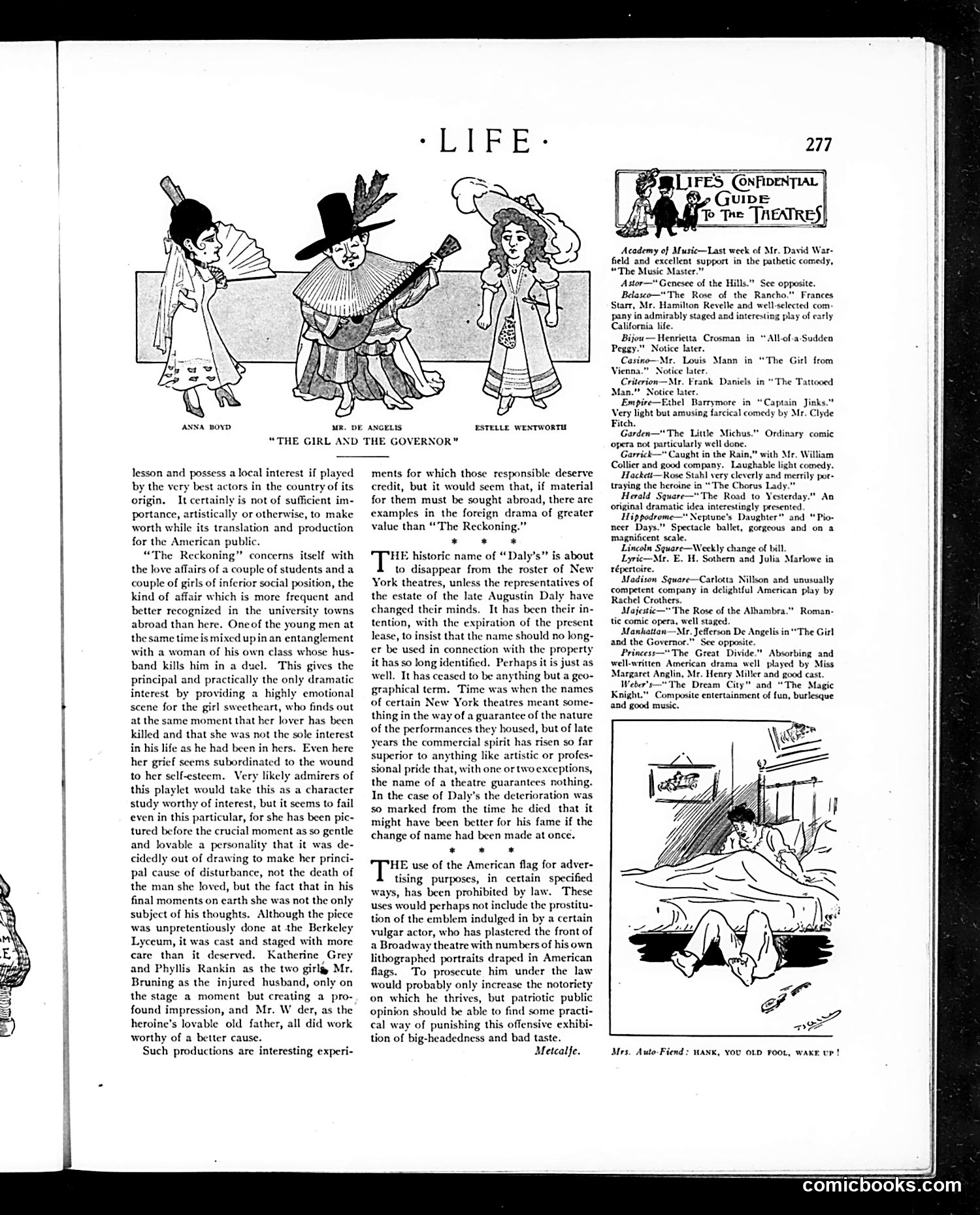
This page contains theater reviews and commentary, not political cartoons. The top illustration shows three figures from "The Girl and the Governor," identifying actors Anna Boyd, Mr. Dean, and Estelle Wentworth in a theatrical scene. The text critiques theatrical productions: a play called "The Reckoning" is dismissed as unworthy of American production despite competent acting. More significantly, the page discusses the impending removal of the name "Daly's" from a New York theater—historically important when Augustin Daly controlled it, but now merely a commercial venue lacking artistic merit. The final section satirizes a "vulgar actor" who has draped American flags around lithographed portraits advertising himself on a Broadway theater. The author argues prosecution would increase notoriety, suggesting patriotic public opinion should instead shame him into stopping. The cartoon at bottom right appears illustrative rather than satirical—captioned "Mrs. Auto Fiend: 'HANK, YOU OLD FOOL, WAKE UP!'"
📄 Transcribed text from this page (OCR, searchable)
Machine-transcribed from the original scan — historical spelling and the odd misread are preserved.
lesson and possess a local interest if played by the very best actors in the country of its origin. It certainly is not of sufficient im- portance, artistically or otherwise, to make worth while its translation and production for the American public. “The Reckoning” concerns itself with the love affairs of a couple of students and a couple of girls of inferior social position, the kind of affair which is more frequent and better recognized in the university towns abroad than here. Oneof the young men at the same time is mixed up in an entanglement with a woman of his own class whose hus- band kills him in a ducl. This gives the principal and practically the only dramatic interest by providing a highly emotional scene for the girl sweetheart, who finds out at the same moment that her lover has been killed and that she was not the sole interest in his life as he had been in hers. Even here her grief seems subordinated to the wound to her self-esteem. Very likely admirers of this playlet would take this as a character study worthy of interest, but it seems to fail even in this particular, for she has been pic- tured before the crucial moment as so gentle and lovable a perso y that it was de- cidedly out of drawing to make her princi- pal cause of disturbance, not the death of the man she loved, but the fact that in his final moments on earth she was not the only subject of his thoughts. Although the piece was unpretentiously done at the Berkeley Lyceum, it was cast and staged with more care than it deserved. Katherine Grey and Phyllis Rankin as the two girly Mr. Bruning as the injured husband, only on the stage a moment but creating a pro- found impression, and Mr. W der, as the heroine’s lovable old father, all did work worthy of a better cause. Such productions are interesting experi- NA BOYD MR. DEAN “THE GIRL AND TH ELIS ESTELLE WENTWORTH. GOVERNOR” ments for which those responsible deserve credit, but it would seem that, if material for them must be sought abroad, there are examples in the foreign drama of greater value than “The Reckoning.” * 8 & 'HE historic name of “Daly’s” is about to disappear from the roster of New York theatres, unless the representatives of the estate of the late Augustin Daly have changed their minds. It has been their in- tention, with the expiration of the present lease, to insist that the name should no long- er be used in connection with the property it has so long identified. Perhaps it is just as well. It has ceased to be anything but a geo- graphical term. Time was when the names of certain New York theatres meant some- thing in the way of a guarantee of the nature of the performances they housed, but of late years the commercial spirit has risen so far superior to anything like artistic or profes- sional pride that, with one or two exceptions, the name of a theatre guarantees nothing. In the case of Daly's the deterioration was so marked from the time he died that it might have been better for his fame if the change of name had been made at once. + 8 HE use of the American flag for adver- tising purposes, in certain specified ways, has been prohibited by law. These uses would perhaps not include the prostitu tion of the emblem indulged in by a cert: vulgar actor, who has plastered the front of a Broadway theatre with numbers of his own lithographed portraits draped in American flags. To prosecute him under the law would probably only increase the notoriety on which he thrives, but patriotic public opinion should be able to find some practi- cal way of punishing this offensive exhibi- tion of big-headedness and bad taste. Metcalfe. 277 LIFES (nfbenTiAL GuIbE Pe Tee TAEATRES) Academy of Music—Last week of Mr. David War- field and excellent support in the pathetic comedy, “The Music Master.” Asstor— Genesee of the Hills.” See opposite. Belasco—"The Rose of the Rancho.” Frances Starr, Mr. Hamilton Revelle and well-selected com: pany in admirably staged and interesting play of early California life. * Alof-a-Suddeo Casino—Mr. Louis Mann in “The Girl from Vienna.” Notice later Criterion—Mr. Frank Daniels in “The Tattooed Man." Notice later. Empire—Ethel Barrymore in “Captain Jink Very light but amusing farcical comedy by Mr. Clyde Fitch. Garden—"The Little Michus."" Ordinary comic opera not particularly well done. Garrick—" Caught in the Rain,” with Mr. William Collier and good company. Laughable light comedy. Hackett—Rose Stahl very cleverly and n traying the heroine in “The Chorus Lady. Herald Square—"The Road to Yesterday.” An original dramatic idea interestingly presented Hippodrome—" Neptune's Daughter" and “Pio- neer Days.” Spectacle ballet, gorgeous and on a magnificent scale. Lincoln Square—Weckly change of bill Lyric—Mr. E. H. Sothern and Julia Marlowe in répertoire. Medison Square—Carlotta Nillson and unusually competent company in delightful American play by Rachel Crothers. Majestic—*"The Rose of the Alhambra.” Roman. tic comic opera, well staged. Manhattan—Mr. Jefferson De Angelis in “The Girl and the Governor."” See opposite. Princess—"The Great Divide.” Absorbing and well-written American drama well played by Miss Margaret Anglin, Mr. Henry Miller and good cast. Weter's—""The Dream City” and “The Magic Knight." Composite entertainment of fun, burlesque and good music, Mrs. Auto-Fiend : WANK, YOU OLD FOOL, WAKE UP! comicbooks.com