
Life, 1907-02-21 · page 12 of 36
Life — February 21, 1907 — page 12: what you’re looking at
What you’re looking at
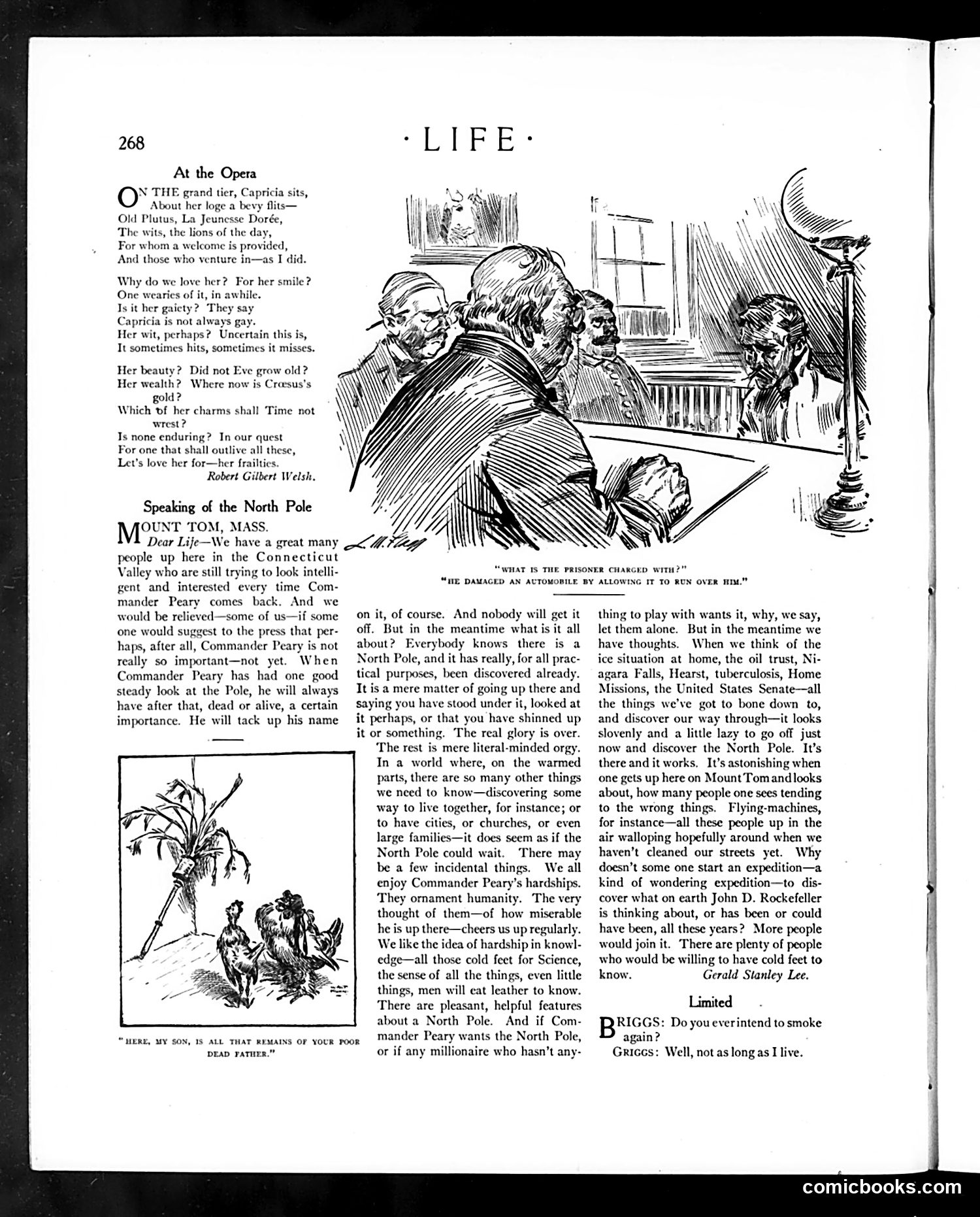
The page contains two distinct pieces: 1. **"At the Opera"** - A poem by Robert Gilbert Welch mocking the superficiality of opera-goers, particularly women. The accompanying sketch shows society figures in an opera box, satirizing their pretense and shallow interest in cultural events. 2. **"Speaking of the North Pole"** - A letter from Mount Tom, Massachusetts, humorously defending Commander Peary's North Pole expedition against criticism. The writer argues that Arctic exploration, though seemingly pointless, provides humanity with noble purpose and discovery—better than mundane earthly concerns. The accompanying sketch depicts polar hardship. Both pieces use satire to comment on American society: one mocking urban elite vanity, the other defending scientific ambition against practical skepticism.
📄 Transcribed text from this page (OCR, searchable)
Machine-transcribed from the original scan — historical spelling and the odd misread are preserved.
268 At the Opera N THE grand tier, Capricia sits, About her loge a bevy flits— Old Plutus, La Jeunesse Dorée, The wits, the lions of the day, For whom a welcome is provided, And those who venture in—as I did. Why do we love her? For her smile? One wearies of it, in awhile. Is it her gaicty? ‘They say Capricia is not always ga Her wit, perhaps? Uncertain this is, It sometimes hits, sometimes it misses. Her beauty? Did not Eve grow old? Her wealth? Where now is Crovsus's Id? Which vf her charms shall Time not wrest? Is none enduring? In our quest For one that shall outlive all these, Let's love her for—her frailties. Robert Gilbert Welsh, Speaking of the North Pole OUNT TOM, MASS. Dear Life—We have a great many 5 <U g@ \ people up here in the Connecticut Valley who are still trying to look intelli- gent and interested every time Com- mander Peary comes back. And we would be relieved—some of us—if some one would suggest to the press that per- haps, after all, Commander Peary is not really so important—not yet. When Commander Peary has had one good steady look at the Pole, he will always have after that, dead or alive, a certain importance. He will tack up his name “MERE, MY SON, 18 ALL THAT REMAINS OF YOUR POOR DEAD raTHER.” “WHAT IS THE PRISONER CHARGED wiTH?” “ITE DAMAGED AN AUTOMOBILE on it, of course. And nobody will get it off. But in the meantime what is it all about? Everybody knows there is a North Pole, and it has really, for all prac- tical purposes, been discovered already. It is a mere matter of going up there and saying you have stood under it, looked at it perhaps, or that you have shinned up it or something. The real glory is over. ‘The rest is mere literal-minded orgy. In a world where, on the warmed parts, there are so many other things we need to know—discovering some way to live together, for instance; or to have ci or churches, or even large families—it does seem as if the North Pole could wait. There may be a few incidental things. We all enjoy Commander Peary’s hardships. They ornament humanity. The very thought of them—of how miserable he is up there—cheers us up regularly. We like the idea of hardship in knowl- edge—all those cold feet for Science, the sense of all the things, even little things, men will cat leather to know. There are pleasant, helpful features about a North Pole. And if Com- mander Peary wants the North Pole, or if any millionaire who hasn’t any- ¥ ALLOWING IT TO RUN OVER HIM.” thing to play with wants it, why, we say, let them alone. But in the meantime we have thoughts. When we think of the ice situation at home, the oil trust, Ni- agara Falls, Hearst, tuberculosis, Home Missions, the United States Senate—all the things we've got to bone down to, and discover our way through—it looks slovenly and a little lazy to go off just now and discover the North Pole. It’s there and it works, It’s astonishing when one gets up here on Mount Tomandlooks about, how many people one sees tending to the wrong things. Flying-machines, for instance—all these people up in the air walloping hopefully around when we haven’t cleaned our streets yet. Why doesn’t some one start an expedition—a kind of wondering expedition—to dis- cover what on earth John D. Rockefeller is thinking about, or has been or could have been, all these years? More people would join it. There are plenty of people who would be willing to have cold feet to know. Gerald Stanley Lee. Limited Briccs: Do you everintend to smoke again? Griccs: Well, not as long as I live. comicbooks.com