
Life, 1907-02-21 · page 10 of 36
Life — February 21, 1907 — page 10: what you’re looking at
What you’re looking at
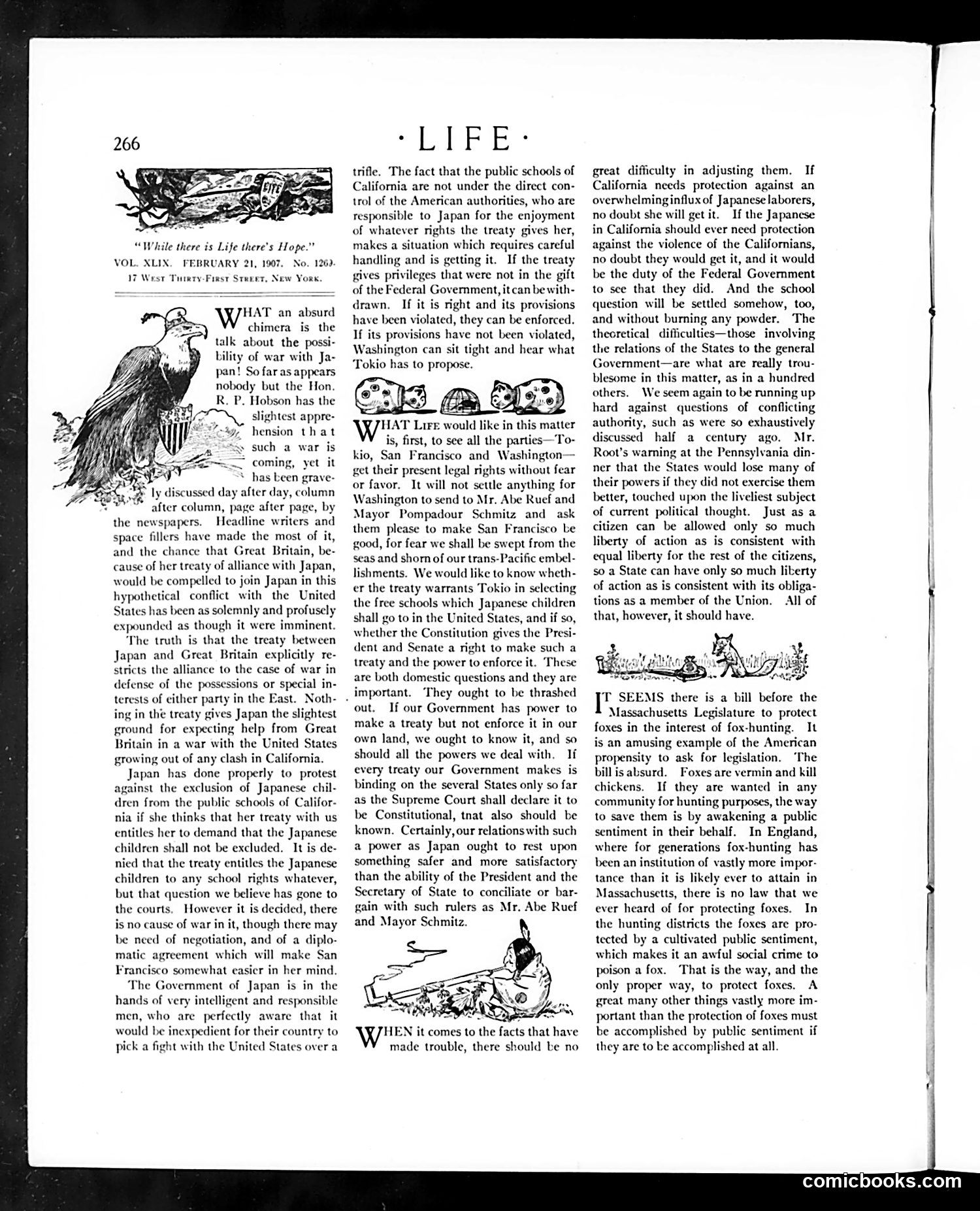
This page critiques U.S.-Japan relations during a period of diplomatic tension. The editorial addresses disputes over Japanese children's school attendance in California and treaty enforcement between nations. The cartoons feature **an eagle** (representing America) and **a fox** (representing Japan or cunning politicians). These animals illustrate the satirical point: just as foxes require legal protection to prevent hunting, so too do international agreements require enforcement mechanisms. The text mocks the absurdity of debating whether Japan deserves school access for its children while avoiding the core issue—whether treaties are actually enforceable. It criticizes both the U.S. Government and Japanese authorities (mentioning "Mr. Ruef and Mayor Schmitz") for theatrical diplomacy rather than addressing substantive constitutional questions about federal versus state power in treaty matters.
📄 Transcribed text from this page (OCR, searchable)
Machine-transcribed from the original scan — historical spelling and the odd misread are preserved.
“While there is Life there's Hope.” VOL. XLIX. FEBRUARY 21, 1907. No. 1263. 17 West Turery-Finst Steet, New Yor. HAT an absurd chimera is the talk about the possi- bility of war with Ja- pan! So faras appears nobody but the Hon. R. P. Hobson has the slightest appre- yy hension that such a war is coming, yet it \ has been grave- ussed day after day, column after column, page after pa; the newspapers. Headline writers space fillers have made the most of it, and the chance that Great Britain, be- cause of her treaty of alliance with Japan, would be compelled to join Japan in this hypothetical conflict with’ the United States has been as solemnly and profusely expounded as though it were imminent. ‘The truth is that the treaty between Japan and Great Britain explicitly re- stricts the alliance to the case of war in defense of the possessions or special in- terests of cither party in the East. Noth- ing in the treaty gives Japan the slightest ground for expecting help from Great Britain in a war with the United States growing out of any clash in California. Japan has done properly to protest against the exclusion of Japanese chil- dren from the public schools of Califor- nia if she thinks that her treaty with us entitles her to demand that the Japanese children shall not be excluded. It is de- nied that the treaty entitles the Japanese children to any school rights whatever, but that question we believe has gone to the courts. However it is decided, there is no cause of war in it, though there may be need of negotiation, and of a diplo- matic agreement which will make San Francisco somewhat easier in her mind, The Government of Japan is in the hands of very intelligent and responsible men, who are perfectly aware that it would be inexpedient for their country to pick a fight with the United States over a «LEP E * trifle. The fact that the public schools of California are not under the direct con- trol of the American authorities, who are responsible to Japan for the enjoyment of whatever rights the treaty gives her, makes a situation which requires careful handling and is getting it. If the treaty gives privileges that were not in the gift of the Federal Government, it can be with- drawn. If it is right and its provisions have been violated, they can be enforced. If its provisions have not been violated, Washington can sit tight and hear what Tokio has to propose. Cis @ SD T Lire would like in this matter is, first, to see all the parties—To- kio, San Francisco and Washington— get their present legal rights without fear or favor. It will not settle anything for Washington to send to Mr. Abe Ruef and Mayor Pompadour Schmitz and ask them please to make San Francisco be good, for fear we shall be swept from the seas and shorn of our trans-Pacific embel- lishments. We would like to know wheth- er the treaty warrants Tokio in selecting the free schools which Japanese children shall go to in the United States, and if so, whether the Constitution gives the Presi- dent and Senate a right to make such a treaty and the power to enforce it. These are both domestic questions and they are _ important. They ought to be thrashed out. If our Government has power to make a treaty but not enforce it in our own land, we ought to know it, and so should all the powers we deal with. If every treaty our Government makes is binding on the several States only so far as the Supreme Court shall declare it to be Constitutional, tnat also should be known. Certainly, our relations with such a power as Japan ought to rest upon something safer and more satisfactory than the ability of the President and the Secretary of State to conciliate or bar- gain with such rulers as Mr. Abe Ruef and Mayor Schmitz. HE) made trouble, there should ke no great difficulty in adjusting them, If California needs protection against an overwhelminginflux of Japanese laborers, no doubt she will get it. If the Japanese in California should ever need protection against the violence of the Californians, no doubt they would get it, and it would be the duty of the Federal Government to see that they did. And the school question will be settled somehow, too, and without burning any powder. The theoretical difficulties—those involving the relations of the States to the general Government—are what are really trou- blesome in this matter, as in a hundred others. We seem again to be running up. hard against questions of conflicting authority, such as were so exhaustively discussed half a century ago. Mr. Root’s waming at the Pennsylvania din- ner that the States would lose many of their powers if they did not exercise them better, touched upon the liveliest subject of current political thought. Just as a citizen can be allowed only so much liberty of action as is consistent with equal liberty for the rest of the citizens, so a State can have only so much lib of action as is consistent with its obliga- tions as a member of the Union. All of that, however, it should have. T SEEMS there is a bill before the Massachusetts Legislature to protect foxes in the interest of fox-hunting. It is an amusing example of the American propensity to ask for legislation. ‘The bill is absurd. Foxes are vermin and kill chickens. If they are wanted in any community for hunting purposes, the way to save them is by awakening a public sentiment in their behalf. In England, where for generations fox-hunting has been an institution of vastly more impor- tance than it is likely ever to attain in Massachusetts, there is no law that we ever heard of for protecting foxes. In the hunting districts the foxes are pro- tected by a cultivated public sentiment, which makes it an awful social crime to poison a fox. ‘That is the way, and the only proper way, to protect foxes. A great many other things vastly more im- portant than the protection of foxes must be accomplished by public sentiment if they are to ke accomplished at all comicbooks.com re