
Life, 1907-02-21 · page 23 of 36
Life — February 21, 1907 — page 23: what you’re looking at
What you’re looking at
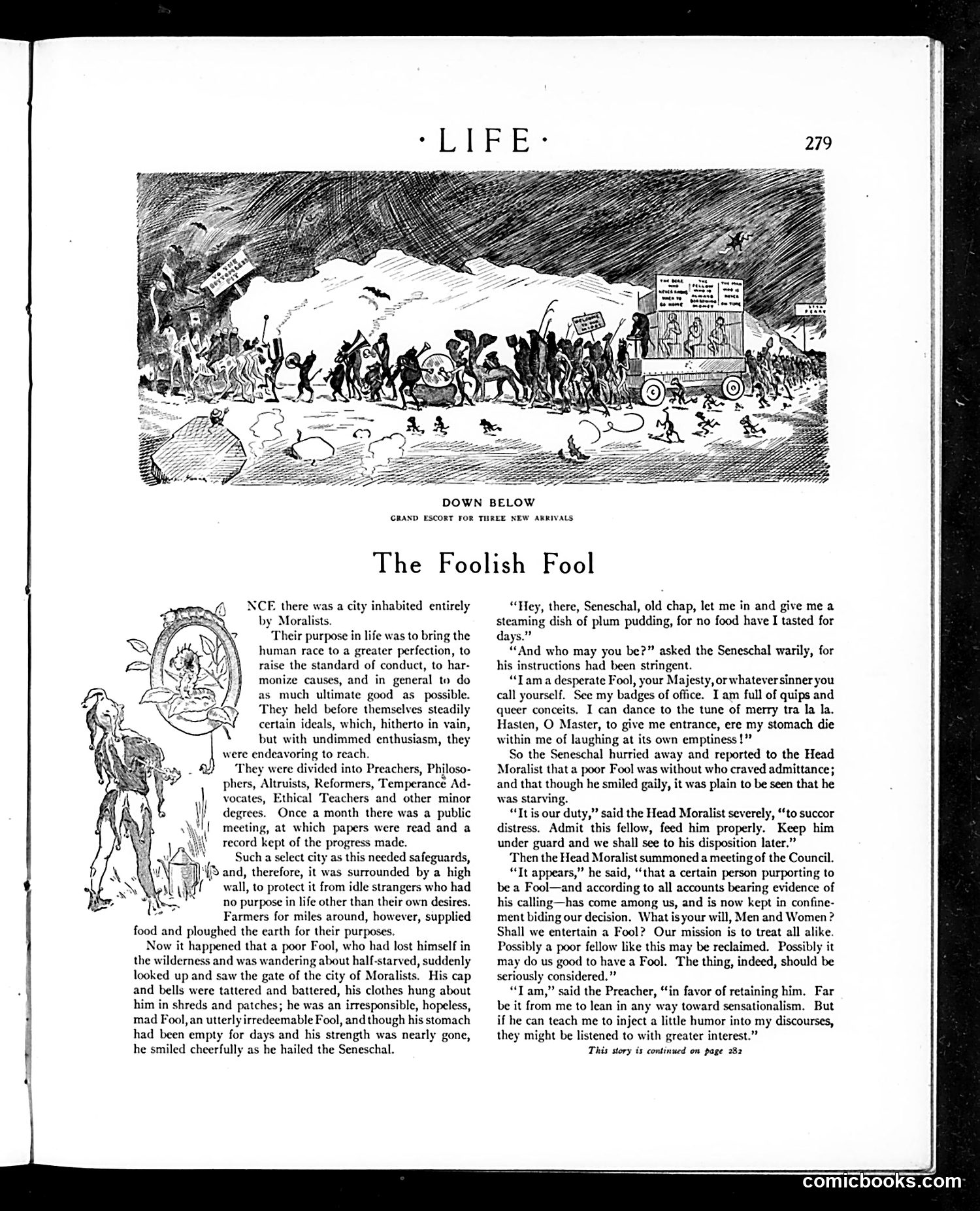
This is an allegorical story mocking self-righteous reformers and moral crusaders. The illustration shows a "City of Moralists" — a walled community of Preachers, Philosophers, Altruists, and Temperance Advocates obsessed with perfecting humanity and maintaining moral standards. A starving Fool (a traditional figure of truth-telling in satire) arrives seeking basic charity. Though the Head Moralist agrees to feed him on principle, the Council debates whether to "retain" him — not out of genuine compassion, but to exploit him. The Preacher explicitly wants to use the Fool to make his sermons more entertaining. The satire targets the hypocrisy of moral reformers: they're more interested in appearing virtuous and using worthy causes to advance themselves than in actual kindness. The Fool represents reality and human need, which the Moralists view as something to be managed and studied rather than genuinely helped. The continued story promises to explore this tension further.
📄 Transcribed text from this page (OCR, searchable)
Machine-transcribed from the original scan — historical spelling and the odd misread are preserved.
DOWN BELOW GRAND ESCORT FOR THREE NEW ARRIVALS The Foolish Fool NCE there was a city inhabited entirely by Moralists. Their purpose in life was to bring the human race to a greater perfection, to raise the standard of conduct, to har- monize causes, and in general to do as much ultimate good as_ possible. They held before themselves steadily certain ideals, which, hitherto in vain, but with undimmed enthusiasm, they were endeavoring to reach. They were divided into Preachers, Philoso- phers, Altruists, Reformers, Temperance Ad- vocates, Ethical Teachers and other minor degr Once a month there was a public meeting, at which papers were read and a record kept of the progress made. Such a select city as this needed safeguards, (> and, therefore, it was surrounded by a high wall, to protect it from idle strangers who had no purpose in life other than their own desires. Farmers for miles around, however, supplied food and ploughed the earth for their purposes. Now it happened that a poor Fool, who had lost himself in the wilderness and was wandering about half-starved, suddenly looked up and saw the gate of the city of Moralists. His cap and bells were tattered and battered, his clothes hung about him in shreds and patches; he was an irresponsible, hopeless, 4 mad Fool, an utterly irredeemable Fool, and though his stomach had been empty for days and his strength was nearly gone, he smiled cheerfully as he hailed the Seneschal. ee “Hey, there, Seneschal, old chap, let me in and give me a steaming dish of plum pudding, for no food have I tasted for days.” And who may you be?” asked the Seneschal warily, for his instructions had been stringent. “Tam a desperate Fool, your Majesty, or whatever sinner you call yourself. See my badges of office. I am full of quips and queer conceits. I can dance to the tune of merry tra la la. Hasten, O Master, to give me entrance, ere my stomach die within me of laughing at its own emptiness !”” So the Seneschal hurried away and reported to the Head Moralist that a poor Fool was without who craved admittance; and that though he smiled gaily, it was plain to be seen that he was starving. “Tt is our duty,” said the Head Moralist severely, ‘to succor distress. Admit this fellow, feed him properly. Keep him under guard and we shall see to his disposition later.” ‘Then the Head Moralist summoned a meeting of the Council. “Tt appears,” he said, “that a certain person purporting to be a Fool—and according to all accounts bearing evidence of his calling—has come among us, and is now kept in confine- ment biding our decision. What isyour will, Men and Women ? Shall we entertain a Fool? Our mission is to treat all alike. Possibly a poor fellow like this may be reclaimed. Possibly it may do us good to have a Fool. The thing, indeed, should be seriously considered.” “Tam,” said the Preacher, ‘‘in favor of retaining him. Far be it from me to lean in any way toward sensationalism. But if he can teach me to inject a little humor into my discourses, they might be listened to with greater interest.” This story is continued on page 282 comicbooks.com