
Life, 1907-02-21 · page 22 of 36
Life — February 21, 1907 — page 22: what you’re looking at
What you’re looking at
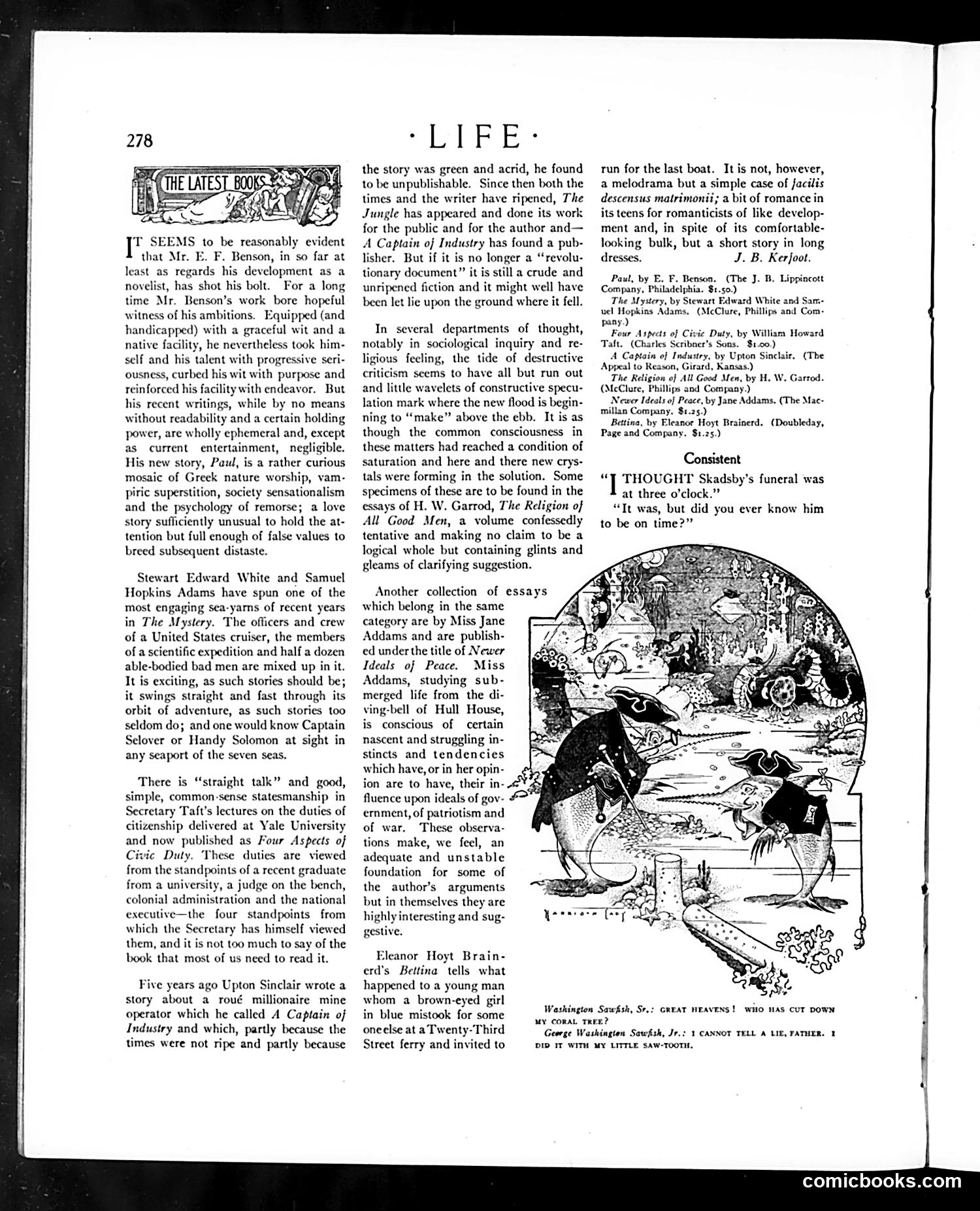
This page contains literary criticism of contemporary books, not political cartoons. The reviews critique recent works by established and emerging authors: **E.F. Benson's decline**: The critic argues Benson's novel *Paul* represents artistic exhaustion—mixing Greek nature worship, vampire superstition, and psychology without coherent purpose. **Upton Sinclair's *A Captain of Industry***: Five years after writing this manuscript about a corrupt millionaire mine operator, Sinclair finally found a publisher post-*The Jungle*. The critic dismisses it as "crude and unripened," suggesting it should have remained unpublished. **Secretary Taft's civic lectures**: Praised as straightforward, common-sense guidance on citizenship duties. The page also reviews essays by H.W. Garrod and Jane Addams on religion and peace—representing a cultural shift from "destructive" criticism toward "constructive speculation." The small illustration shows a humorous domestic scene unrelated to the text reviews.
📄 Transcribed text from this page (OCR, searchable)
Machine-transcribed from the original scan — historical spelling and the odd misread are preserved.
T SEEMS to be reasonably evident that Mr. E. F. Benson, in so far at least as regards his development as a novelist, has shot his bolt. For a long time Mr. Benson’s work bore hopeful witness of his ambitions. Equipped (and handicapped) with a graceful wit and a native facility, he nevertheless took him- self and his talent with progressive seri- ousness, curbed his wit with purpose and reinforced his facility with endeavor. But his recent writings, while by no means without readability and a certain holding power, are wholly ephemeral and, except as current entertainment, negligible. His new story, Paul, is a rather curious mosaic of Greek nature worship, vam- piric superstition, society sensationalism and the psychology of remorse; a love story sufficiently unusual to hold the at- tention but full enough of false values to breed subsequent distaste. Stewart Edward White and Samuel Hopkins Adams have spun one of the most engaging sea-yarns of recent years in The Mystery. The officers and crew of a United States cruiser, the members. of a scientific expedition and half a dozen able-bodied bad men are mixed up in it. It is exciting, as such stories should be; it swings straight and fast through its orbit of adventure, as such stories too seldom do; and one would know Captain Selover or Handy Solomon at sight in any seaport of the seven seas, There is “straight talk” and good, simple, common-sense statesmanship in Secretary Taft’s lectures on the duties of citizenship delivered at Yale University and now published as Four Aspects of Civic Duty. These duties are viewed from the standpoints of a recent graduate from a university, a judge on the bench, colonial administration and the national executive—the four standpoints from which the Secretary has himself viewed them, and it is not too much to say of the book that most of us need to read it. Five years ago Upton Sinclair wrote a story about a roué millionaire mine operator which he called A Captain of Industry and which, partly because the times were not ripe and partly because “LPP E* the story was green and acrid, he found to be unpublishable. Since then both the times and the writer have ripened, The Jungle has appeared and done its work for the public and for the author and— A Captain of Industry has found a pub- lisher. But if it is no longer a “revolu- tionary document” it is still a crude and unripened fiction and it might well have been let lie upon the ground where it fell. In several departments of thought, notably in sociological inquiry and re- ligious feeling, the tide of destructive m seems to have all but run out and little wavelets of constructive specu- lation mark where the new flood is begin- ning to “make” above the ebb. It is as though the common consciousness in these matters had reached a condition of saturation and here and there new crys- tals were forming in the solution. Some specimens of these are to be found in the essays of H. W. Garrod, The Religion of All Good Men, a volume confessedly tentative and making no claim to be a logical whole but containing glints and gleams of clarifying suggestion. Another collection of essays which belong in the same category are by Miss Jane Addams and are publish- ed under the title of Newer Ideals of Peace. Miss Addams, studying sub- merged life from the di- ving-bell of Hull House, is conscious of certain nascent and struggling in- stincts and tendencies which have, or in her opin- ion are to have, their in- fluence upon ideals of gov- ernment, of patriotism and of war, These observa- tions make, we feel, an adequate and unstable foundation for some of the author’s arguments but in themselves they are highly interesting and sug- gestive. Eleanor Hoyt Brain- erd’s Bettina tells what happened to a young man whom a brown-eyed girl in blue mistook for some oneclse at a Twenty-Third Street ferry and invited to run for the last boat. It is not, however, a melodrama but a simple case of facilis descensus matrimonii; a bit of romance in its teens for romanticists of like develop- ment and, in spite of its comfortable- looking bulk, but a short story in long dresses. J.B. Kerfoot. Paul, by E. F. Benson. (The J. B. Lippincott Company, Philadelphia. $1.50.) The Mystery, by Stewart Edward White and S: uel Hopkins Adams. (McClure, Phillips and Com- pany.) Four Aspects of Civie Duty, by William Howard Taft. (Charles Scribner's Sons. $1.00.) A Captain of Industry, by Upton Sinclair, (The Appeal to Reason, Girard, Kansas.) The Religion of All Good Men, by H. W. Garrod. (McClure, Phillips and Company.) Newer Ideals o] Peace, by Jane Addams. (The Mac- millan Company. $1.25.) Bettina, by Eleanor Hoyt Brainerd. (Doubleday, Page and Company. $1.25.) Consistent “1 THOUGHT Skadsby’s funeral was at three o'clock.” “Tt was, but did you ever know him to be on time?” Washington Sawhsh, Sr.: GREAT HEAVENS! WHO NAS CUT DOWN MY CORAL TREE? George Washington Sawhsh, Jr.: DID IT WITH MY LITTLE sAW-TooTH, 1 CANNOT TELL A LIE, FATHER. 1 comicbooks.com