
A complete issue · 40 pages · 1906
Life — July 5, 1906
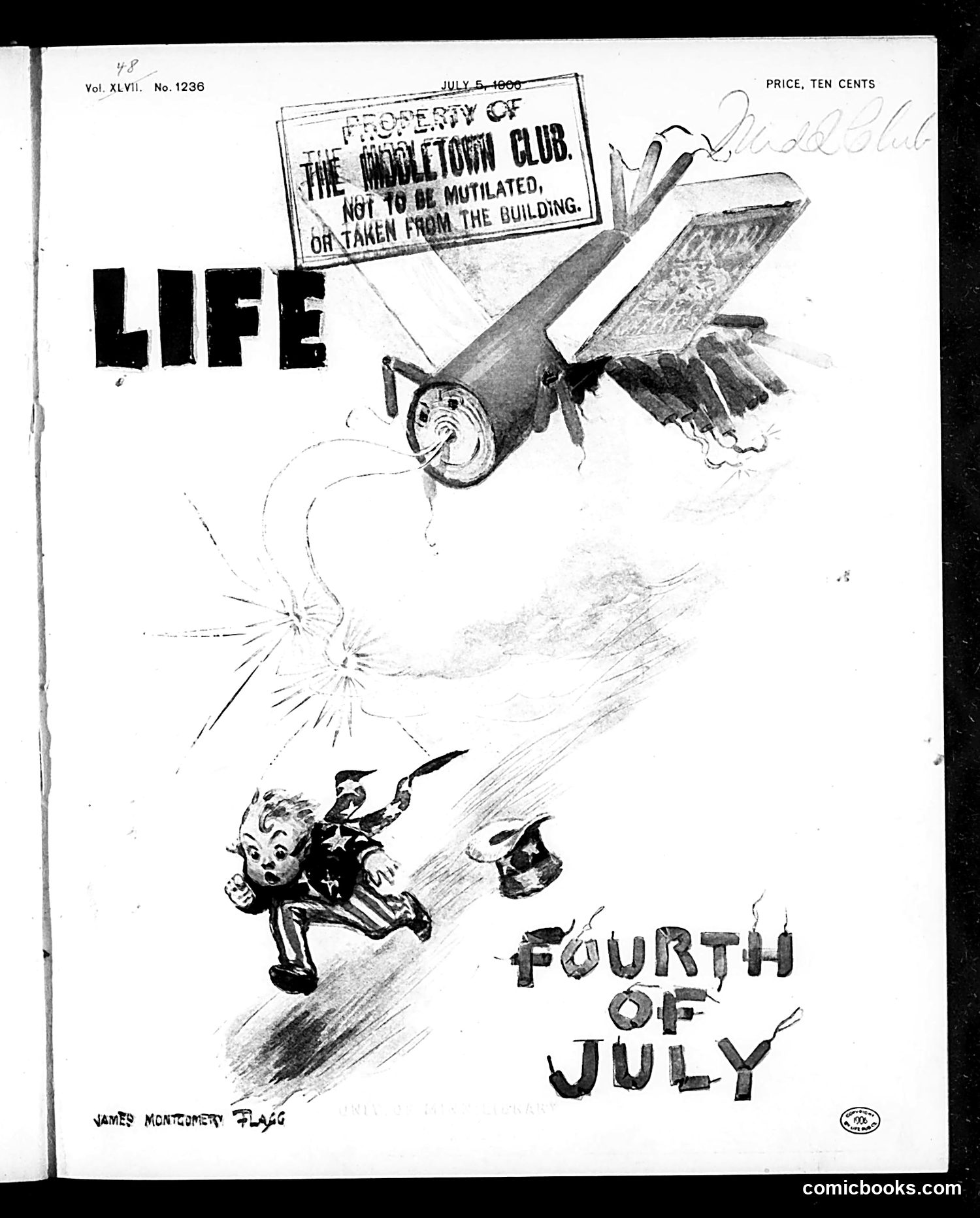
This is the cover of Life magazine for July 5, 1906, priced at ten cents. The illustration depicts a chaotic Fourth of July celebration gone wrong. The central image shows a firecracker or explosive device exploding dangerously, with a small figure (appears to be a child or imp-like character) fleeing in panic below. The "FOURTH OF JULY" text anchors the holiday theme. The stamp reading "PROPERTY OF THE MIDDLETOWN CLUB / NOT TO BE MUTILATED OR TAKEN FROM THE BUILDING" suggests this particular copy belonged to a club library. The satire likely critiques the dangers of Fourth of July fireworks celebrations—a common concern in early 20th-century America when firecracker injuries were widespread. The chaotic, violent imagery serves as commentary on holiday safety hazards.
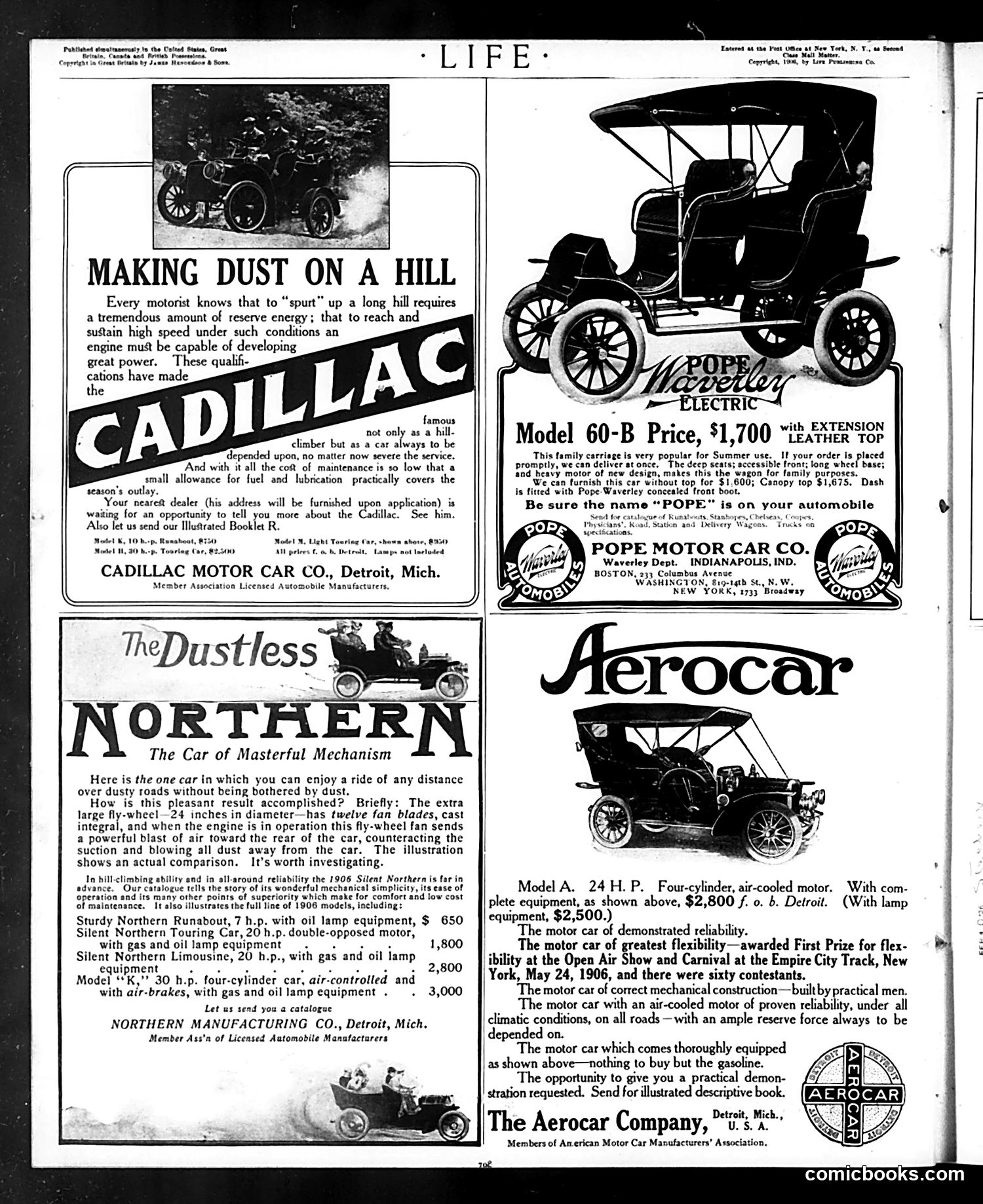
This page is **primarily automobile advertising**, not satire or political commentary. It contains four car advertisements from circa 1906: 1. **Cadillac** - emphasizes engine power for hill-climbing 2. **Pope-Waverley Electric** - a family carriage priced at $1,700 3. **Northern Silent** - highlights a dustless ride via large fan blades that blow dust away 4. **Aerocar** - a motor car emphasizing reliability and mechanical construction These ads reflect early 1900s automotive concerns: hill-climbing ability, dust control (major issue on unpaved roads), electric vehicles as practical family transport, and mechanical reliability as a selling point. There is no political cartoon or satire present. The page documents automotive technology and marketing during the era when automobiles were luxury items and competing manufacturers emphasized different technical advantages.
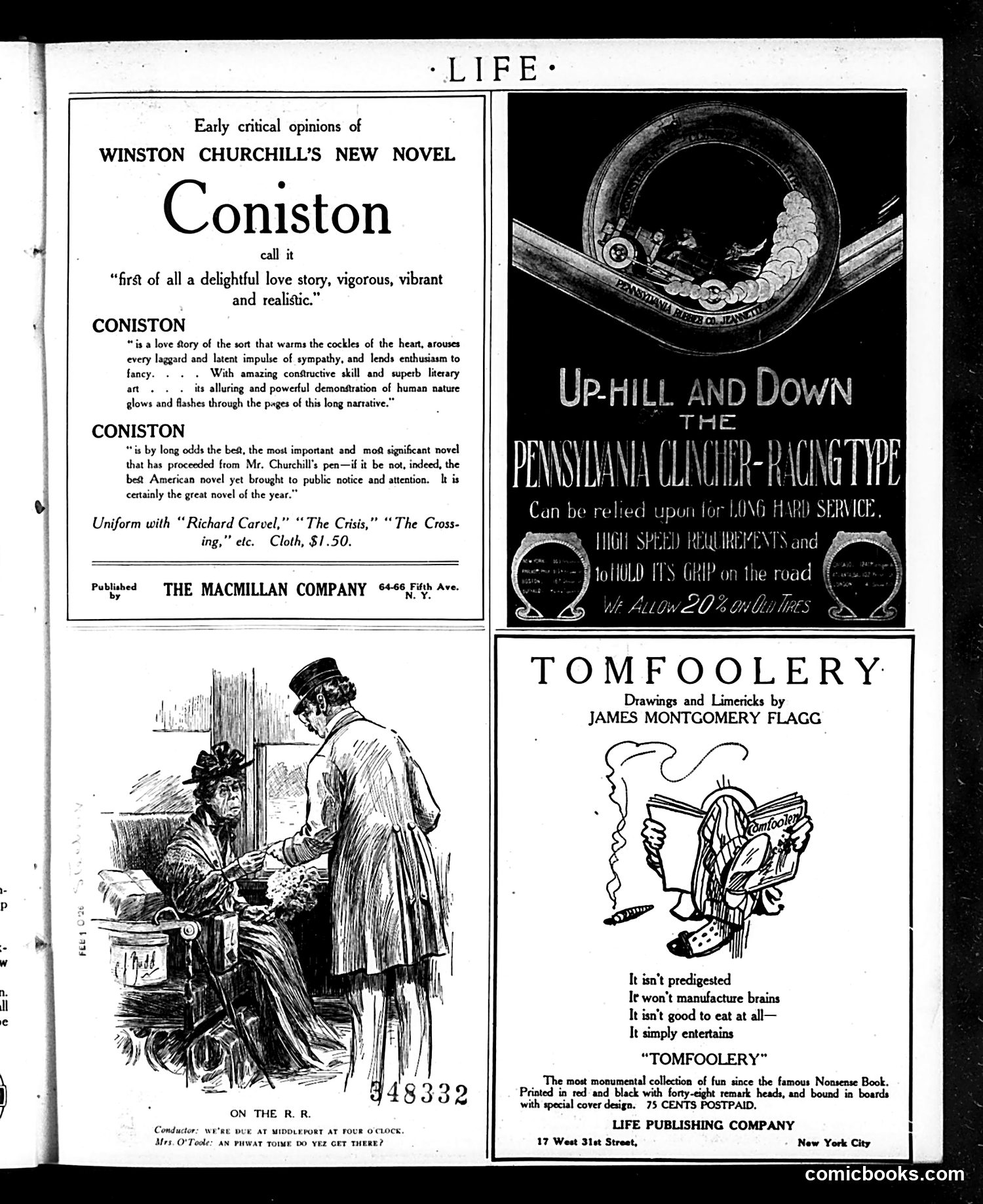
This page contains three advertisements rather than satirical content. The top left advertises Winston Churchill's novel *Coniston* through The Macmillan Company. The upper right promotes a Pennslyvania Clenger-Racing Type automobile with details about durability and grip. The bottom section advertises *Tomfoolery*, a collection of humorous drawings and limericks by James Montgomery Flagg, published by Life Publishing Company for 75 cents. The only illustration with potential satirical content is the sketch labeled "On the R.R." (Railroad), showing two figures in what appears to be a train setting, though without additional context, the specific satirical meaning remains unclear.
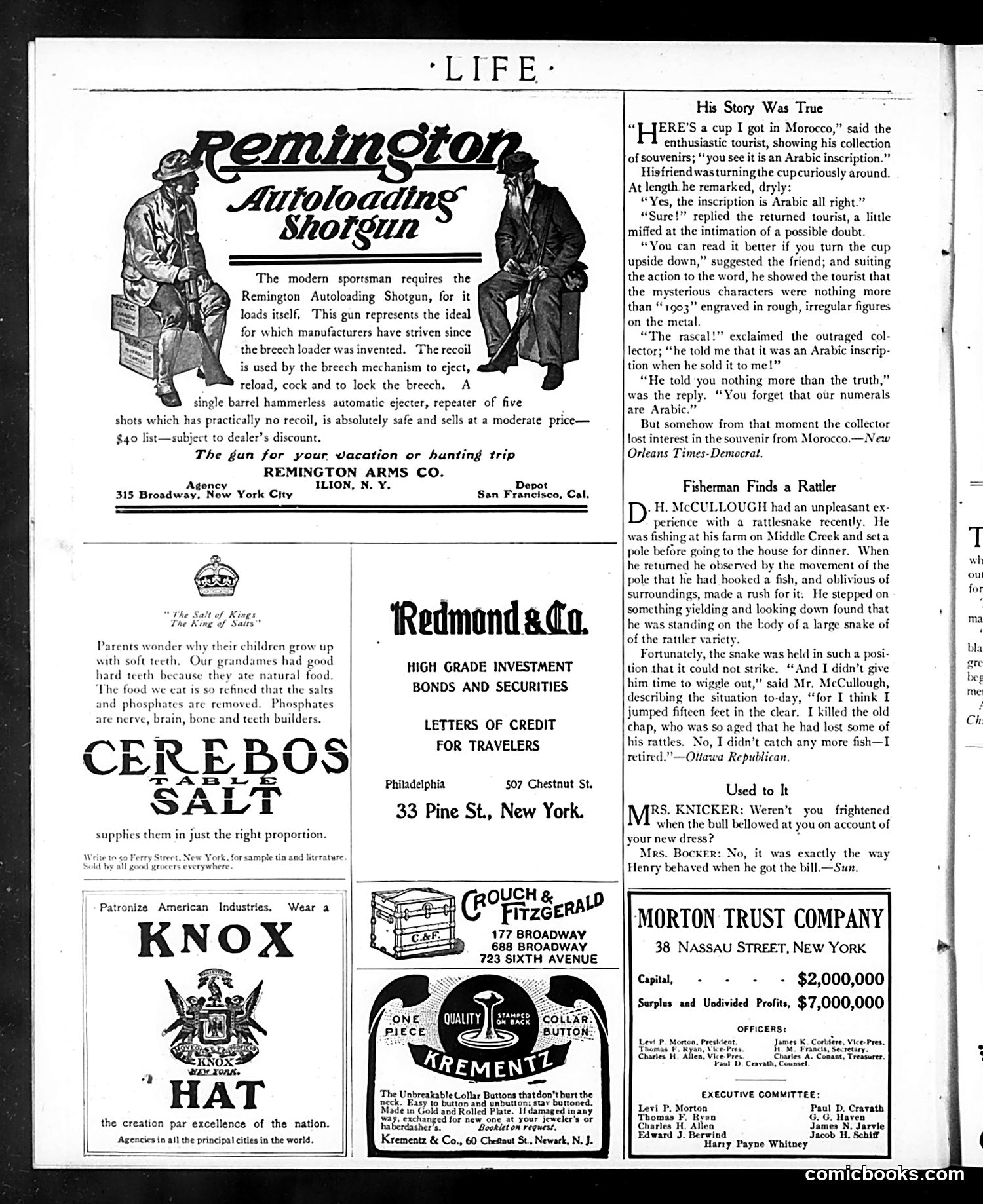
This page is **primarily advertisements** with minimal satirical content. The main ad features a Remington Autoloading Shotgun, marketed to sportsmen for "vacation or hunting trip," emphasizing its safety and moderate price ($49). Below are ads for Cerebos Salt, Knox Hat, Crouch & Fitzgerald luggage, Krementz collar buttons, and Morton Trust Company. On the right side are three brief anecdotal stories: "His Story Was True" (about a tourist's Arabic-inscribed Moroccan cup), "Fisherman Finds a Rattler" (a humorous snake encounter), and "Used to It" (a domestic joke about a husband's reaction to a bill). These aren't political cartoons but rather light humor pieces typical of Life magazine's satirical tradition. The page reflects early 20th-century American consumer culture and domestic comedy.
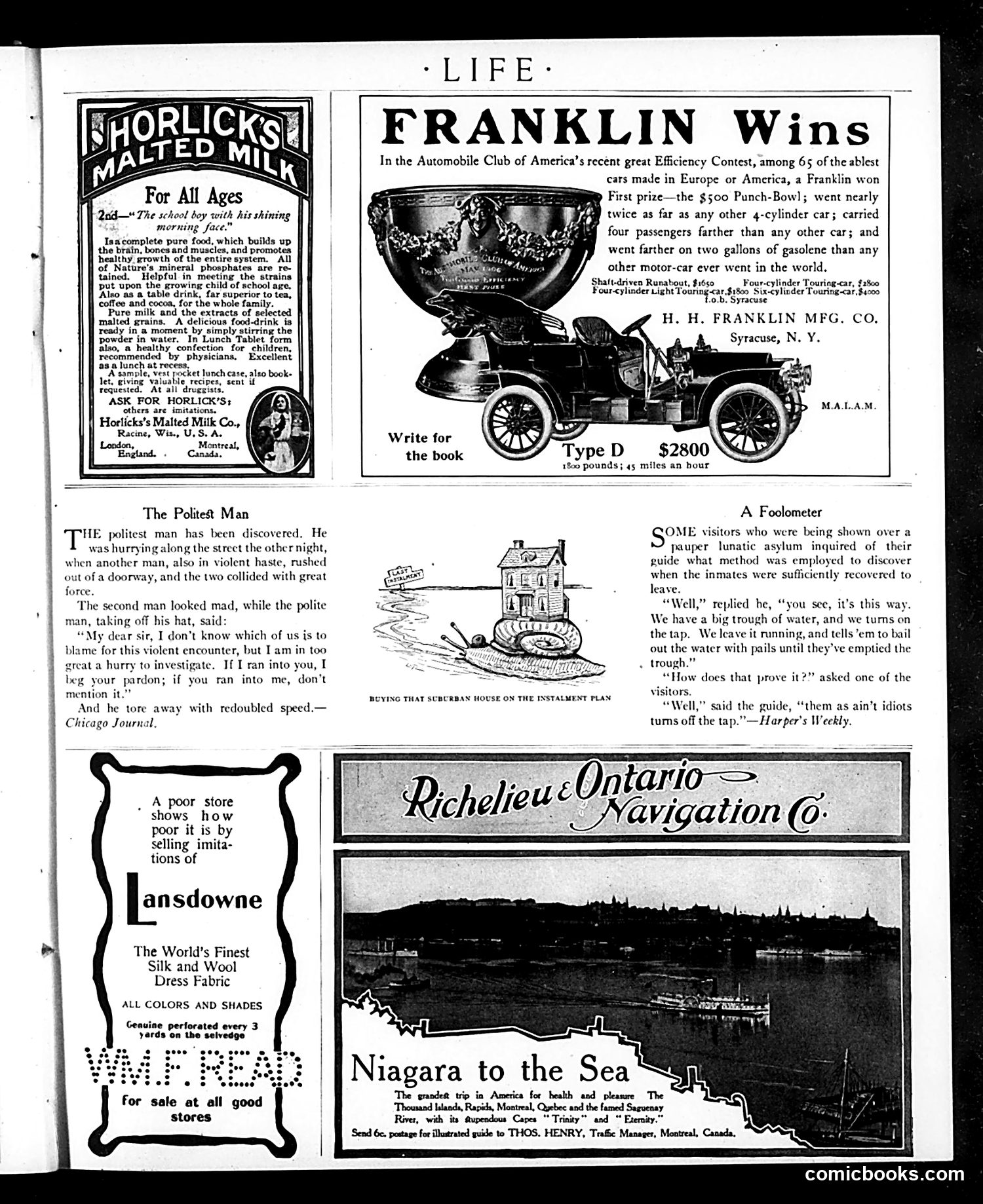
This page is primarily **advertising and light humor**, not political commentary. The main content includes: 1. **Horlick's Malted Milk ad** - a health product marketed for children 2. **Franklin automobile ad** - promoting a car that won first prize in an Automobile Club efficiency contest 3. **"The Politest Man" anecdote** - a brief humorous story about two men in a street altercation where one deliberately de-escalates by apologizing and leaving quickly, the joke being his politeness masks his desire to avoid trouble 4. **"A Foolometer" joke** - visitors to an asylum learn the facility drains water from a trough to measure how foolish visitors are 5. **Lansdowne fabric and Richelieu Ontario Navigation Company ads** The page reflects early 20th-century advertising and genteel humor typical of *Life* magazine's satirical tone.
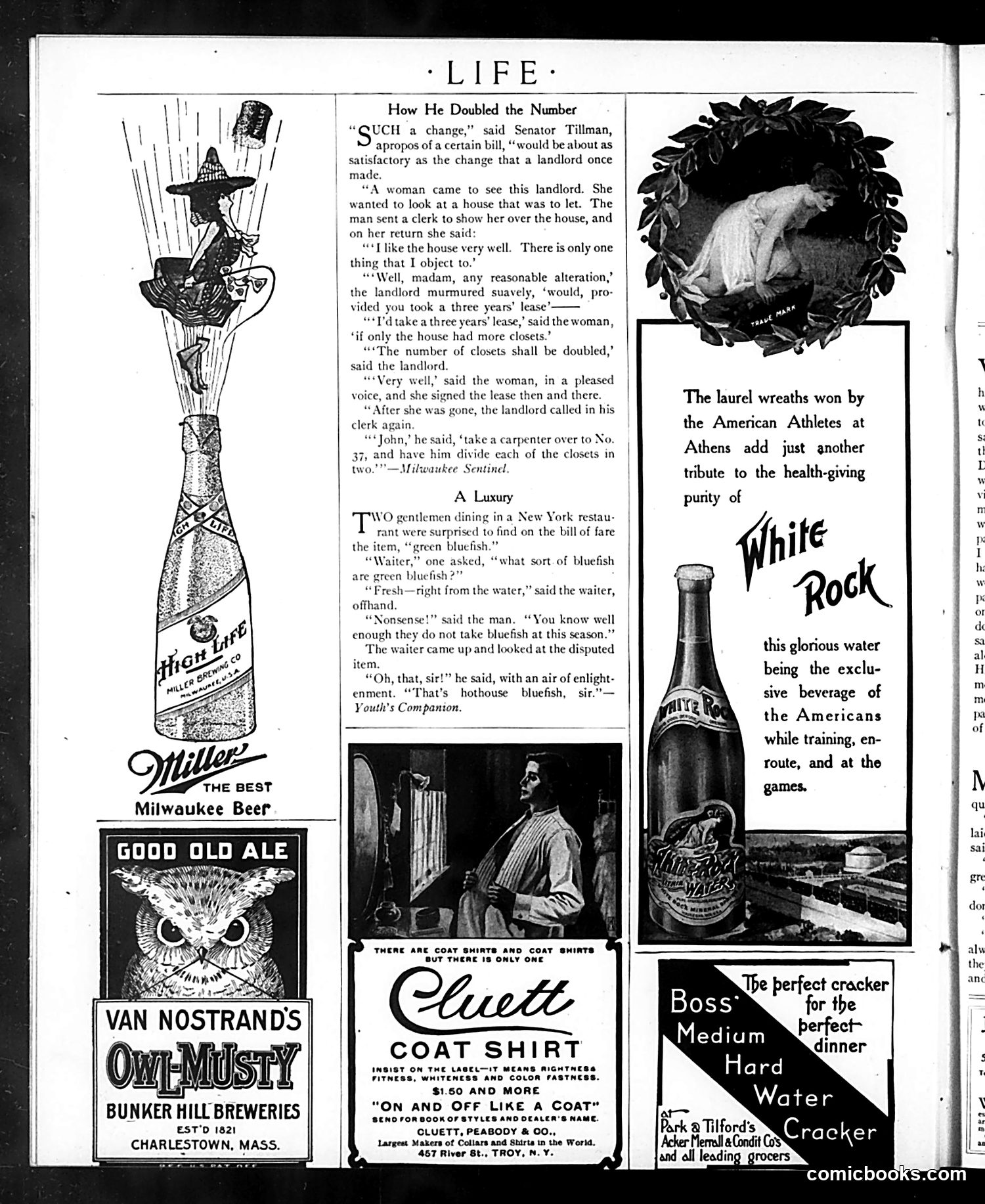
This Life magazine page is primarily **advertising** rather than satirical content. The left side features beer advertisements (Miller High Life, Van Nostrand's Owl-Musty ale), while the right promotes White Rock mineral water and Boss Hard Water crackers. The center contains a brief humorous anecdote titled "How He Doubled the Number of Closets," where a landlord agrees to double closet space by simply dividing existing closets in half—a wordplay joke about literal versus practical solutions. The top right shows an Olympic-themed advertisement linking White Rock water to American athletes' success at the Athens games, positioning the beverage as health-conscious and patriotic. The page reflects early 20th-century advertising strategies blending humor, health claims, and nationalist appeals.
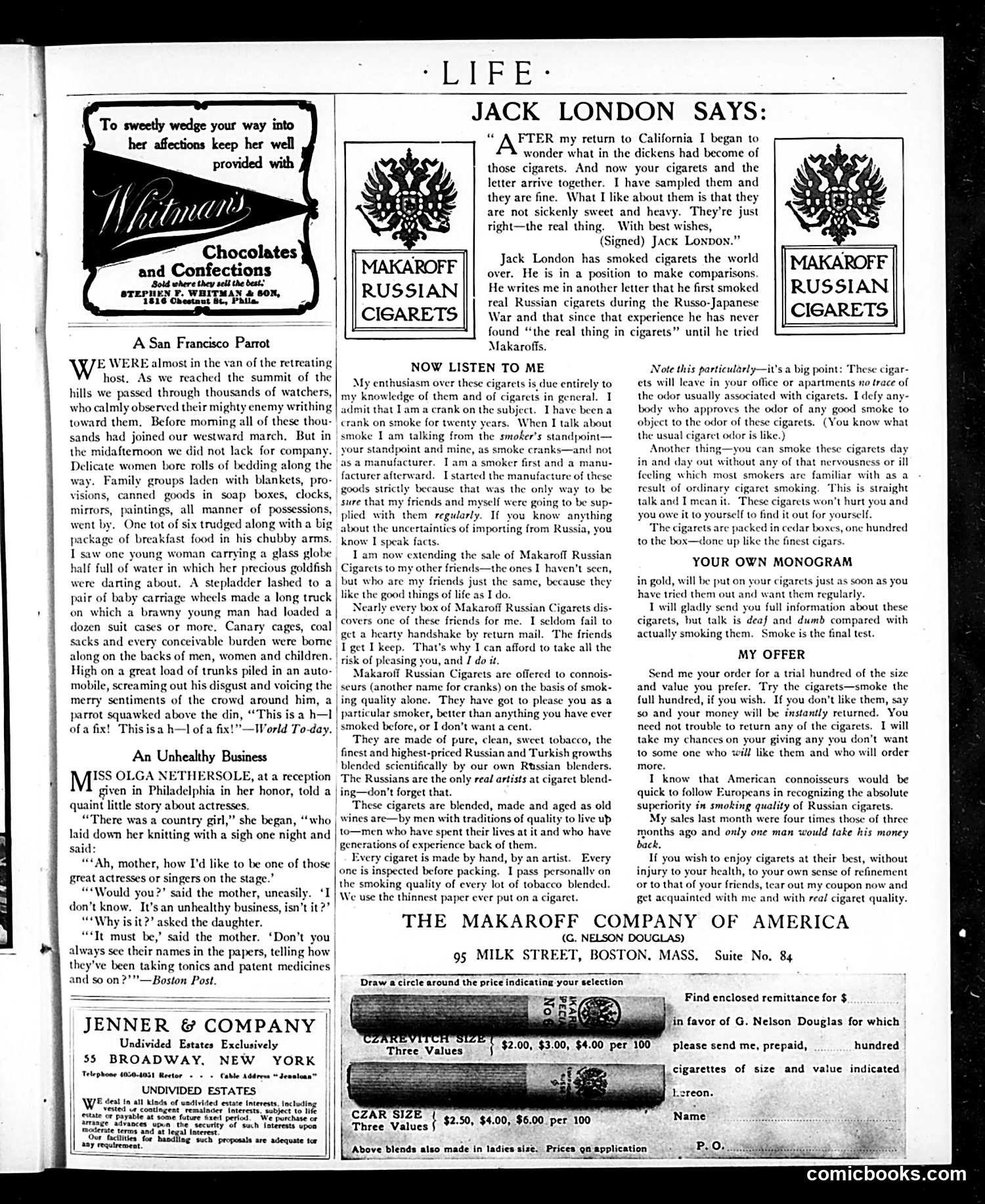
This page is **primarily advertising** rather than editorial satire. The dominant content is a multi-section advertisement for Makaroff Russian Cigarettes, featuring an endorsement from author Jack London. The ads include: - Whitman's Chocolates (small upper left) - Jenner & Company real estate (lower left) - The bulk of the page: Makaroff Russian Cigarettes with London's testimonial claiming superior quality compared to other Russian cigarettes he's smoked worldwide The two brief satirical pieces ("A San Francisco Parrot" and "An Unhealthy Business") appear as filler content between advertisements. They contain light social humor about San Francisco crowds and actresses seeking stage careers, but these are minor editorial matter amid the commercial content. The page reflects early 20th-century advertising conventions where celebrity endorsements and lengthy testimonials were standard marketing practice.
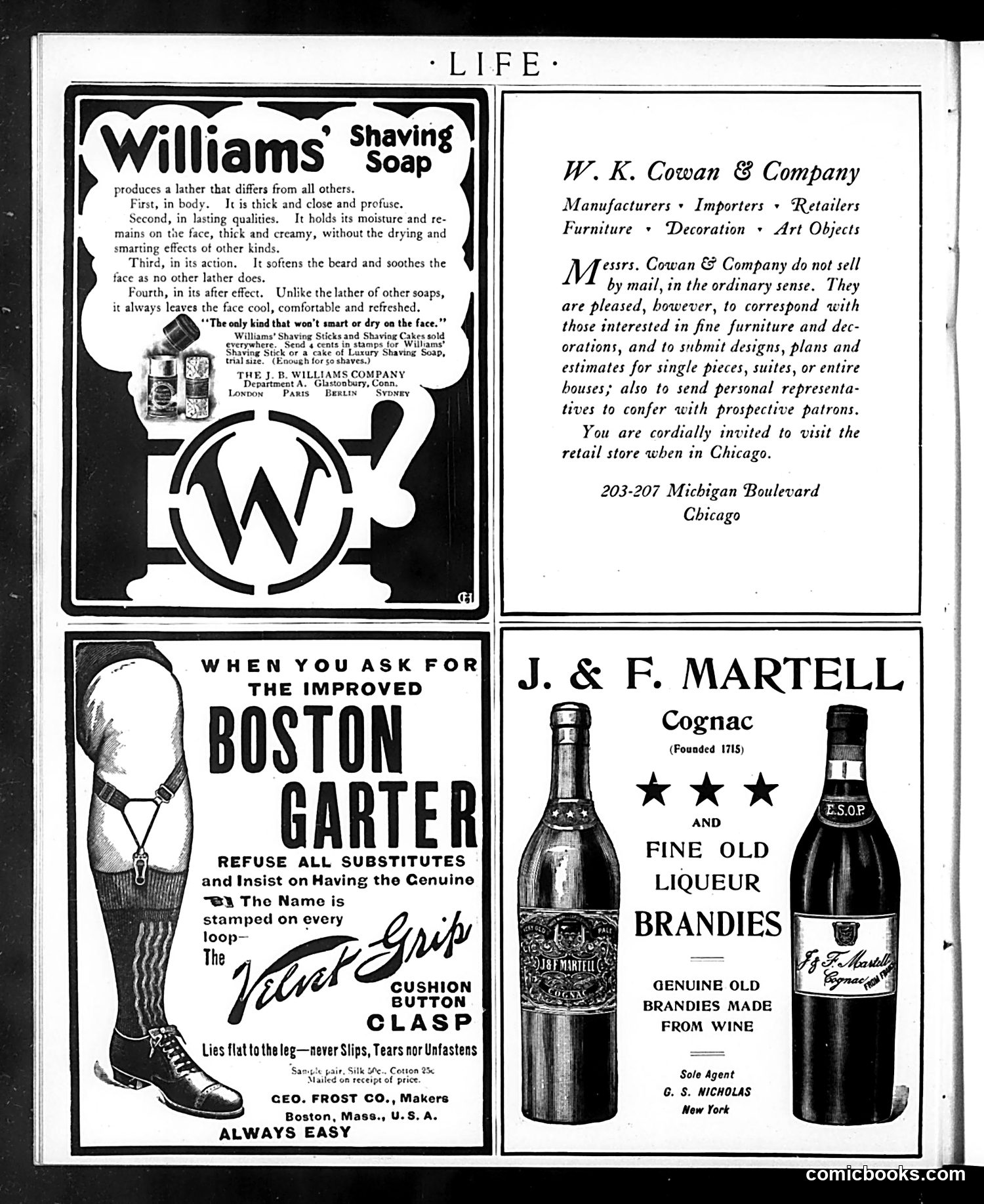
This page consists primarily of advertisements rather than satirical cartoons. The ads promote: 1. **Williams' Shaving Soap** — emphasizing its superior body, lather quality, and moisturizing properties compared to competitors. 2. **Boston Garter** — a leg garter with "Velvet Grip" cushion button clasp, marketed as staying secure without slipping or tearing. The illustration shows a woman's leg. 3. **J. & F. Martell Cognac and Brandies** — liquor advertisements featuring bottle images. 4. **W. K. Cowan & Company** — furniture and decoration retailers in Chicago. These are standard early 20th-century commercial advertisements with no apparent political satire or social commentary. The page demonstrates typical Life magazine advertising content from this era.
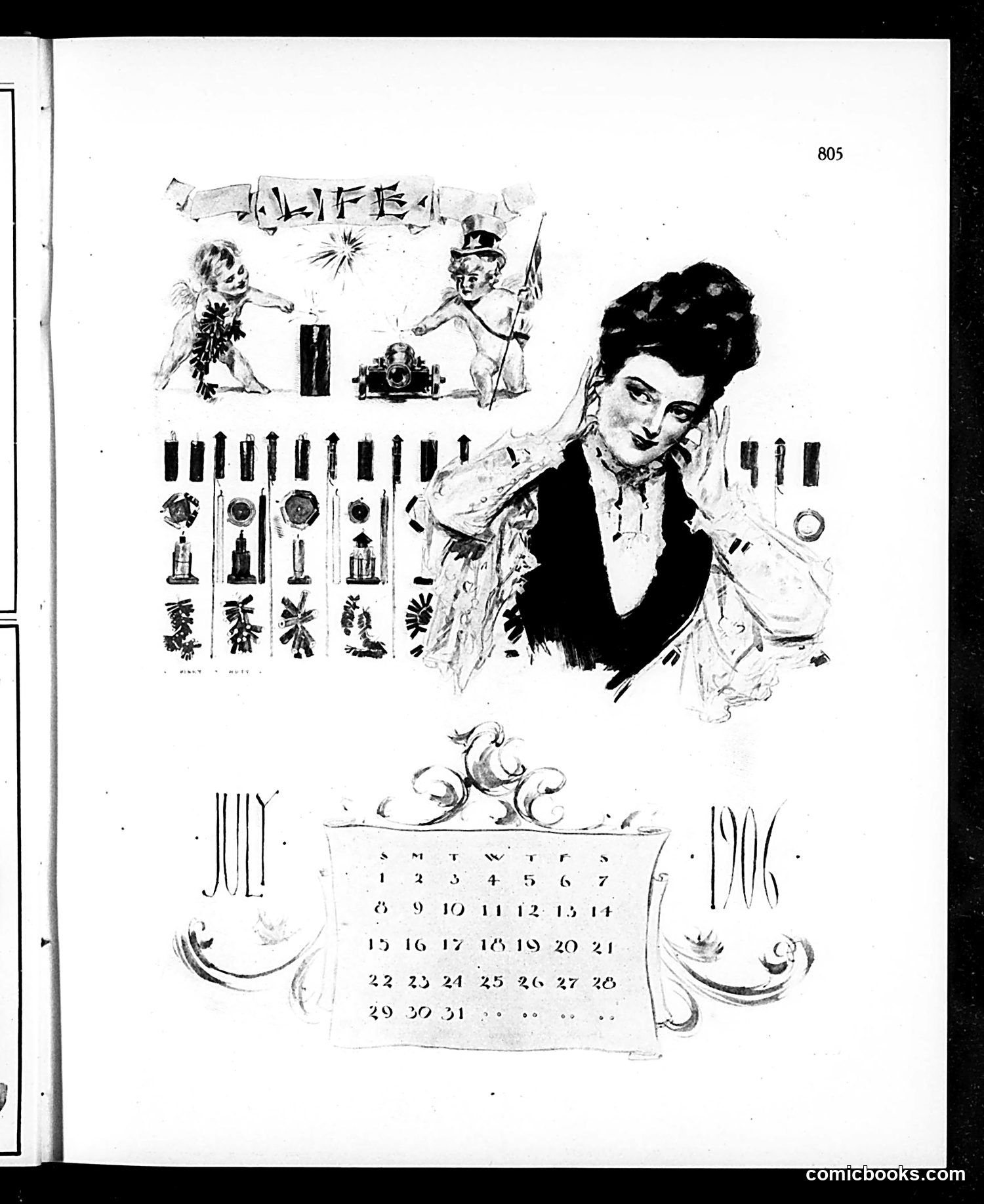
This appears to be a calendar page for July 1906 from *Life* magazine. The main illustration shows a elegantly dressed woman in period fashion (early 1900s) positioned above a grid of what appear to be cosmetic or beauty products—likely lipsticks or similar items arranged in rows with decorative botanical elements below each. The satirical point seems to target the growing cosmetics industry and women's consumption of beauty products. The woman's glamorous presentation, combined with the systematic display of numerous nearly-identical products, likely mocks either: - The proliferation of similar beauty products marketed as distinct items - Women's supposed obsession with cosmetics and appearance - Commercial exploitation of feminine vanity The tone suggests genteel satire typical of *Life* magazine's social commentary on contemporary consumer culture and gender.
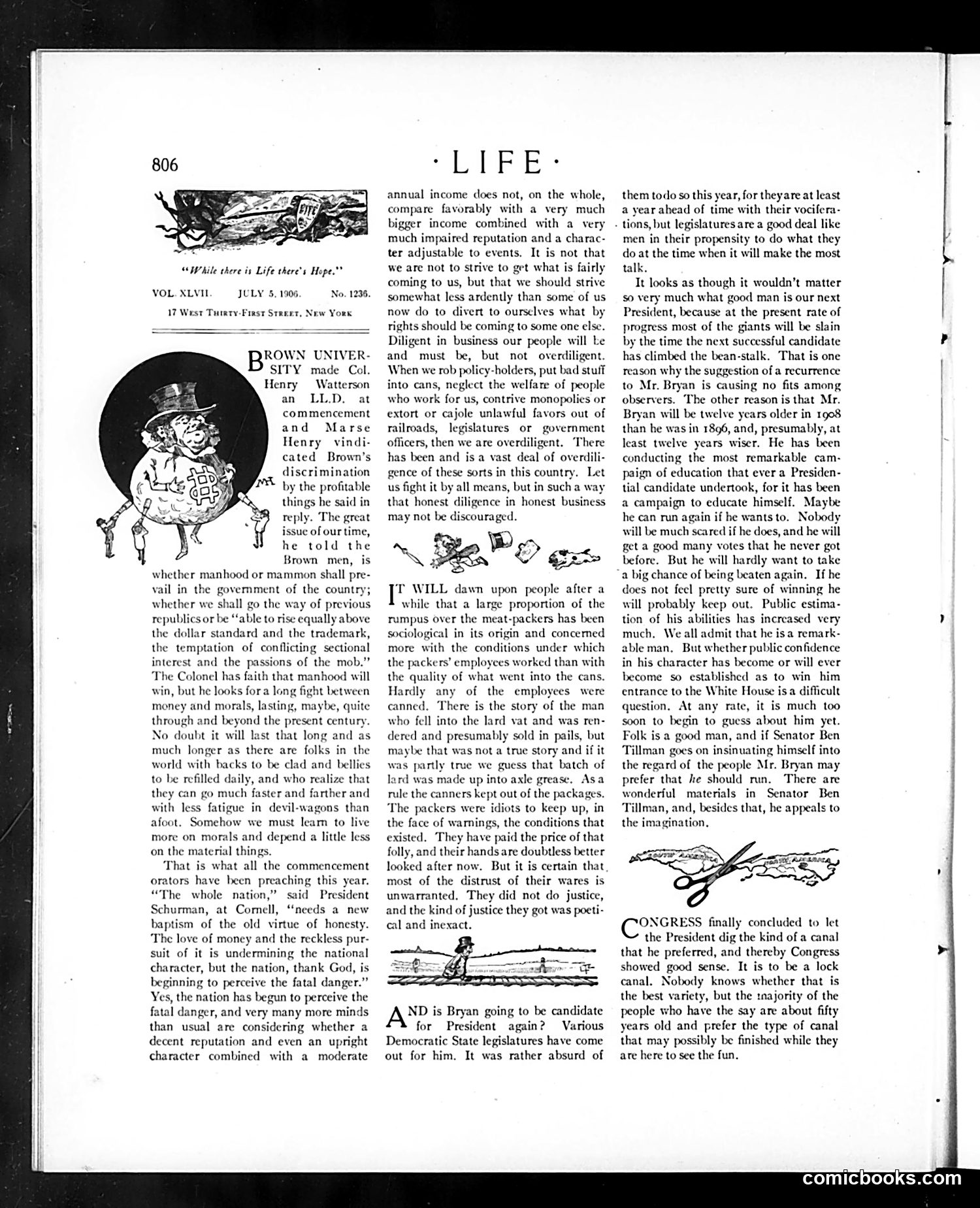
This page contains editorial commentary rather than political cartoons. The text discusses Brown University's commencement address by Col. Henry Watterson (an L.L.D. honoree), emphasizing themes of honesty, manhood, and moral character in business and government. The main illustration shows a rotund, caricatured figure (likely representing a corrupt businessman or politician) being manipulated like a puppet by unseen forces—a visual metaphor for how dishonest interests control public figures. The editorial goes on to discuss William Jennings Bryan's potential 1908 presidential candidacy, questioning whether his reputation has recovered enough to win. The overall message criticizes business monopolies, government corruption, and urges "honest diligence" in public service during the Progressive Era.
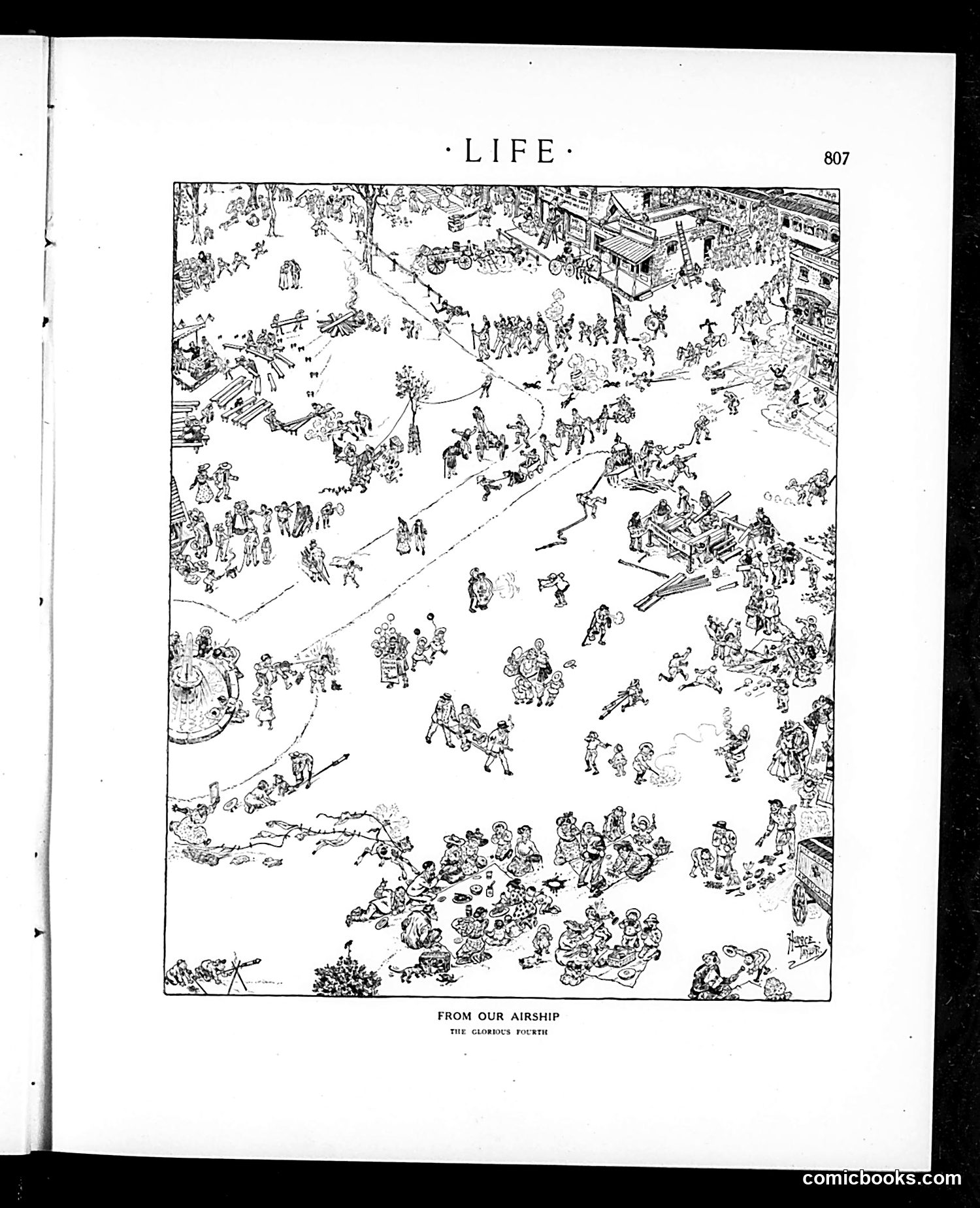
This is a bird's-eye view cartoon depicting an Independence Day (Fourth of July) celebration, likely from the early 20th century. The title "From Our Airship" suggests the vantage point of viewing from an aircraft—a relatively novel perspective at that time. The image shows a crowded public space with numerous small figures engaged in typical Fourth of July activities: picnicking, playing, gathering in groups, and celebrating. Various recreational structures and gathering areas are visible throughout the composition. The satire appears to rest on the humorous contrast between the grand, patriotic ideals of Independence Day and the chaotic, mundane reality of actual public celebration—crowds, disorder, and everyday human behavior replacing heroic commemoration. The aerial perspective emphasizes the scale and disorder of mass participation in American civic life.
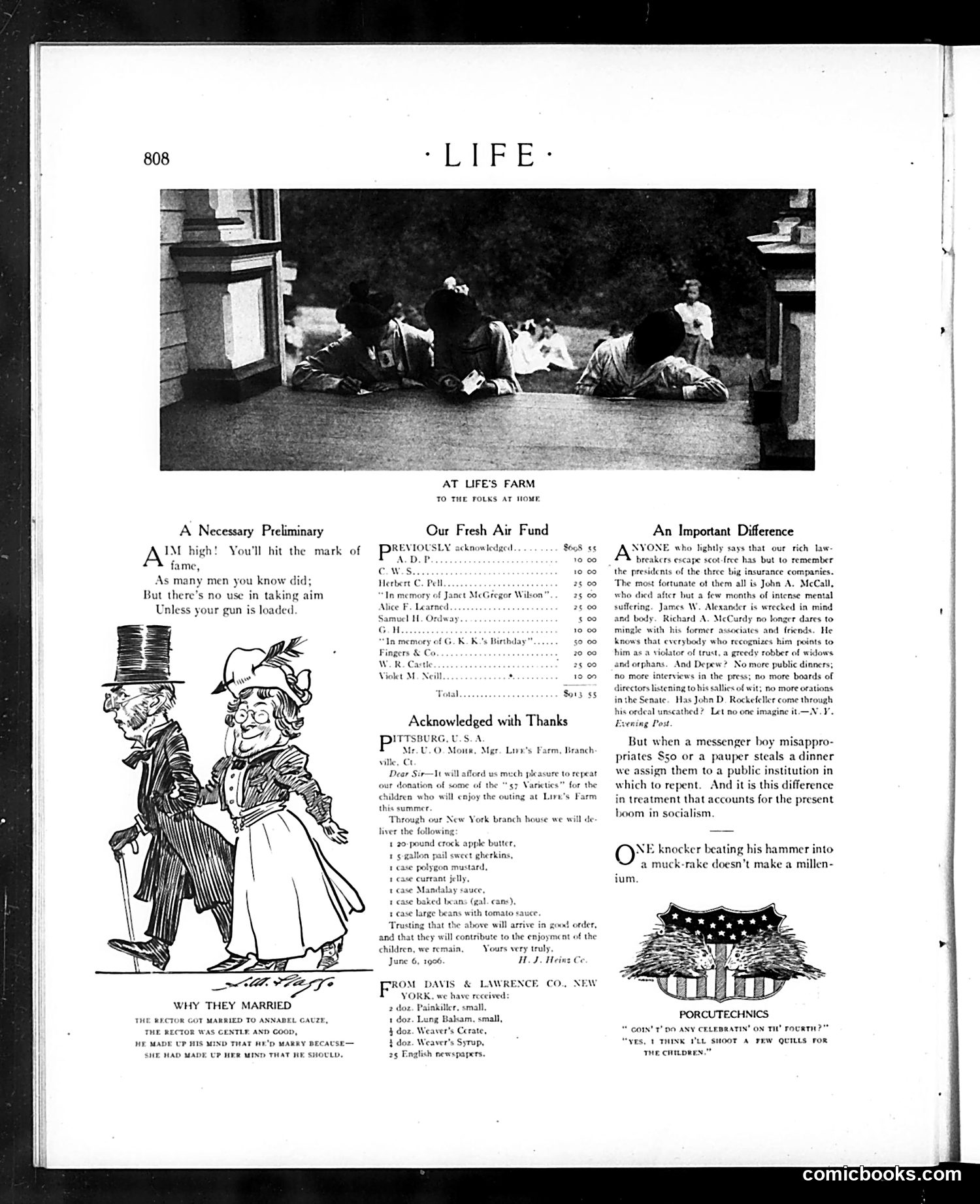
This page combines charitable fundraising with political satire. The top photograph shows children at "Life's Farm," part of a Fresh Air Fund campaign to support underprivileged children's health. The left cartoon depicts two caricatured political figures (likely representing different political positions or parties) in exaggerated dress, with text below reading "WHY THEY MARRIED" — a satirical commentary on political alliances or compromises. The page includes fundraising acknowledgments and donation lists from various organizations and individuals supporting the Fresh Air Fund. The right side contains an editorial piece titled "An Important Difference," criticizing institutional treatment of the poor, contrasting it with Life's Farm's more humane approach. A small cartoon at bottom labeled "PORCUPINICS" makes a pun-based joke about quills/porcupines. Overall, the page mixes satire with progressive-era social welfare advocacy.
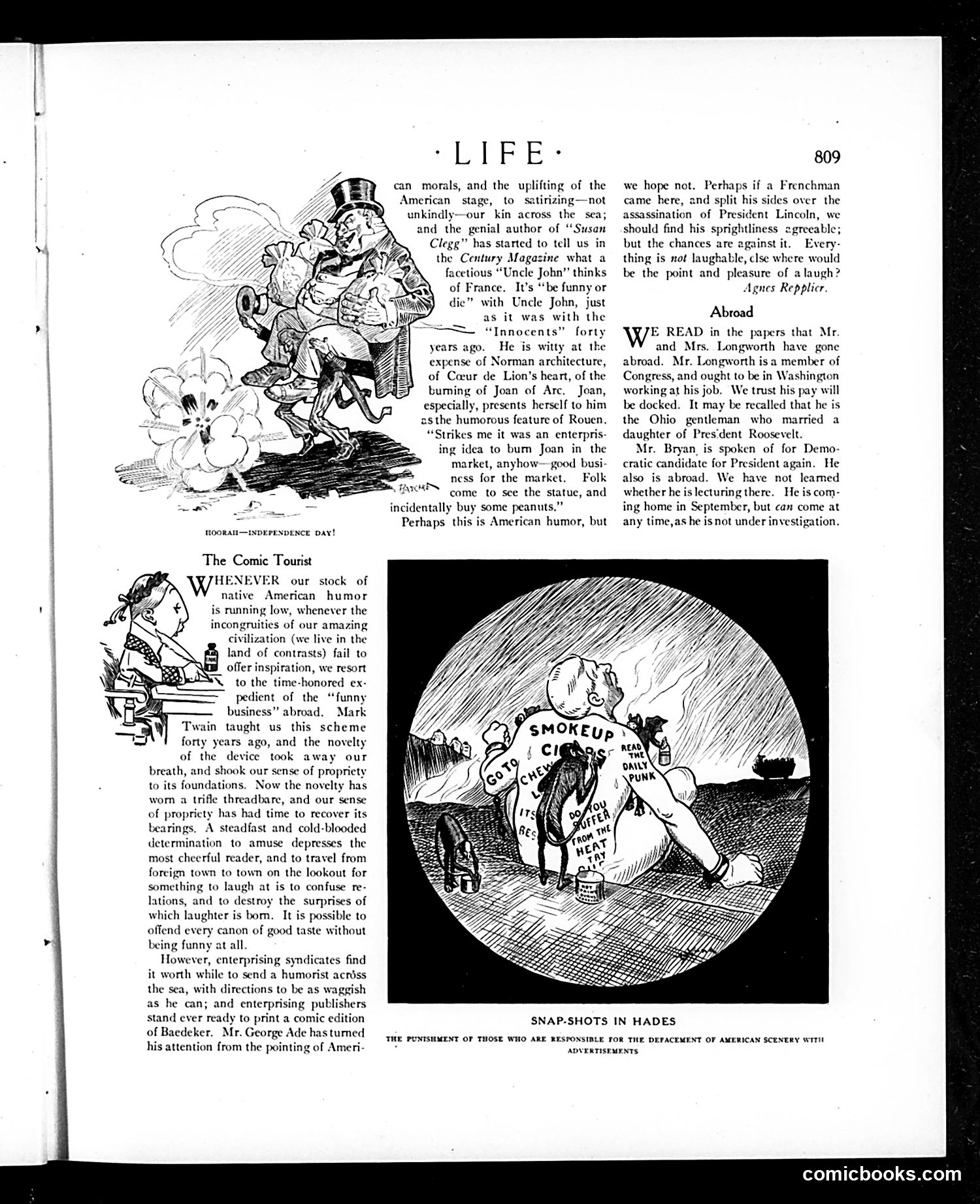
**Top Cartoon ("Hooray—Independence Day!"):** Shows a rotund figure in Uncle Sam attire setting fire to a Joan of Arc statue. The text explains this satirizes "Uncle John" (apparently a recurring humorist character), mocking his wit at the expense of French cultural icons. The joke plays on American mockery of French tastes and Norman architecture, presented as crude but "good business for the market." **"The Comic Tourist" Section:** Discusses how American humor relies on exposing civilizational contradictions. It references Mark Twain's similar satirical approach. **Bottom Cartoon ("Snap-Shots in Hades"):** Appears to depict someone labeled with American business/advertising references as punishment in the underworld—satirizing American commercial excess and defacement of cultural decency through advertisements.
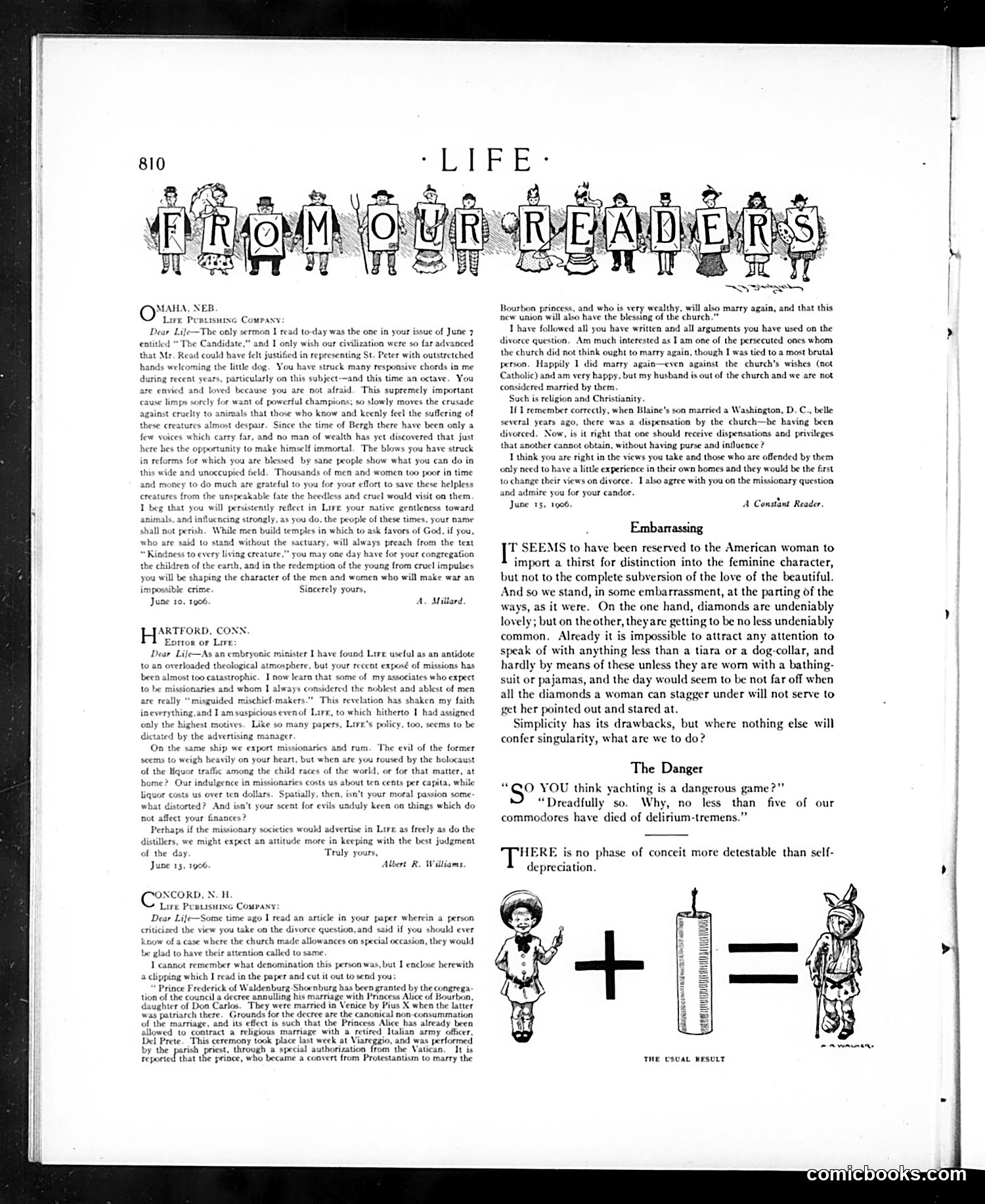
This page contains reader letters responding to Life's recent editorial content, along with a small cartoon about materialism. **The Letters:** Readers praise Life's advocacy for animal welfare (referencing a recent article by Mr. Read defending compassion toward animals). Another writer criticizes Life's exposés of missionary work as "catastrophic," arguing the magazine is hypocritical—it criticizes missionaries while accepting lucrative liquor advertisements. The writer points out Life costs ten cents per capita while liquor costs ten dollars, questioning Life's moral priorities. **The Cartoon:** The simple illustration at bottom shows a plus sign (representing a woman with diamonds) equaling a minus sign (a woman stripped of distinction). It satirizes American women's pursuit of material luxury and jewelry as the primary path to femininity and status—the accompanying text calls this "embarrassing" and laments that women are reducing themselves to mere acquisitiveness rather than developing character. The overall page reflects Progressive Era debates about materialism, morality, and hypocrisy in American institutions.
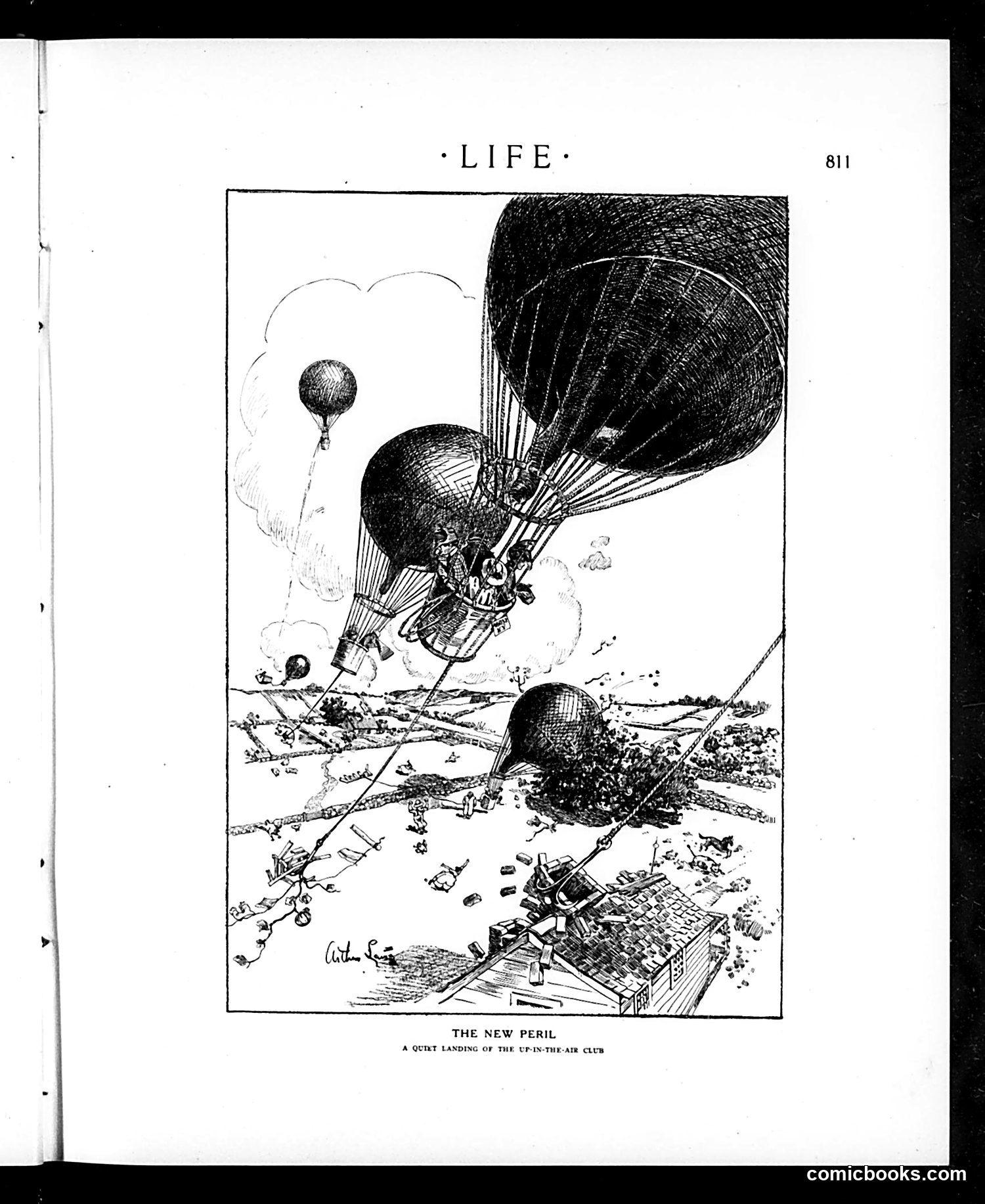
This satirical cartoon depicts the early aviation era's dangers. The image shows hot air balloons landing chaotically in a rural landscape, with one balloon basket crashed or overturned on the ground while others descend precariously. The caption "The New Peril" and subtitle reference "The Up-in-the-Air Club," suggesting a satirical jab at aviation enthusiasts or early aviators. The satire likely mocks the recklessness of ballooning as a recreational activity—treating dangerous aerial vehicles as a fashionable "club" pursuit. The cartoon's chaotic scene emphasizes the unpredictability and hazards of early flight, presenting ballooning as more perilous than adventurous. This reflects contemporary anxieties about emerging aviation technology and the perceived foolhardiness of those participating in it during the early twentieth century.
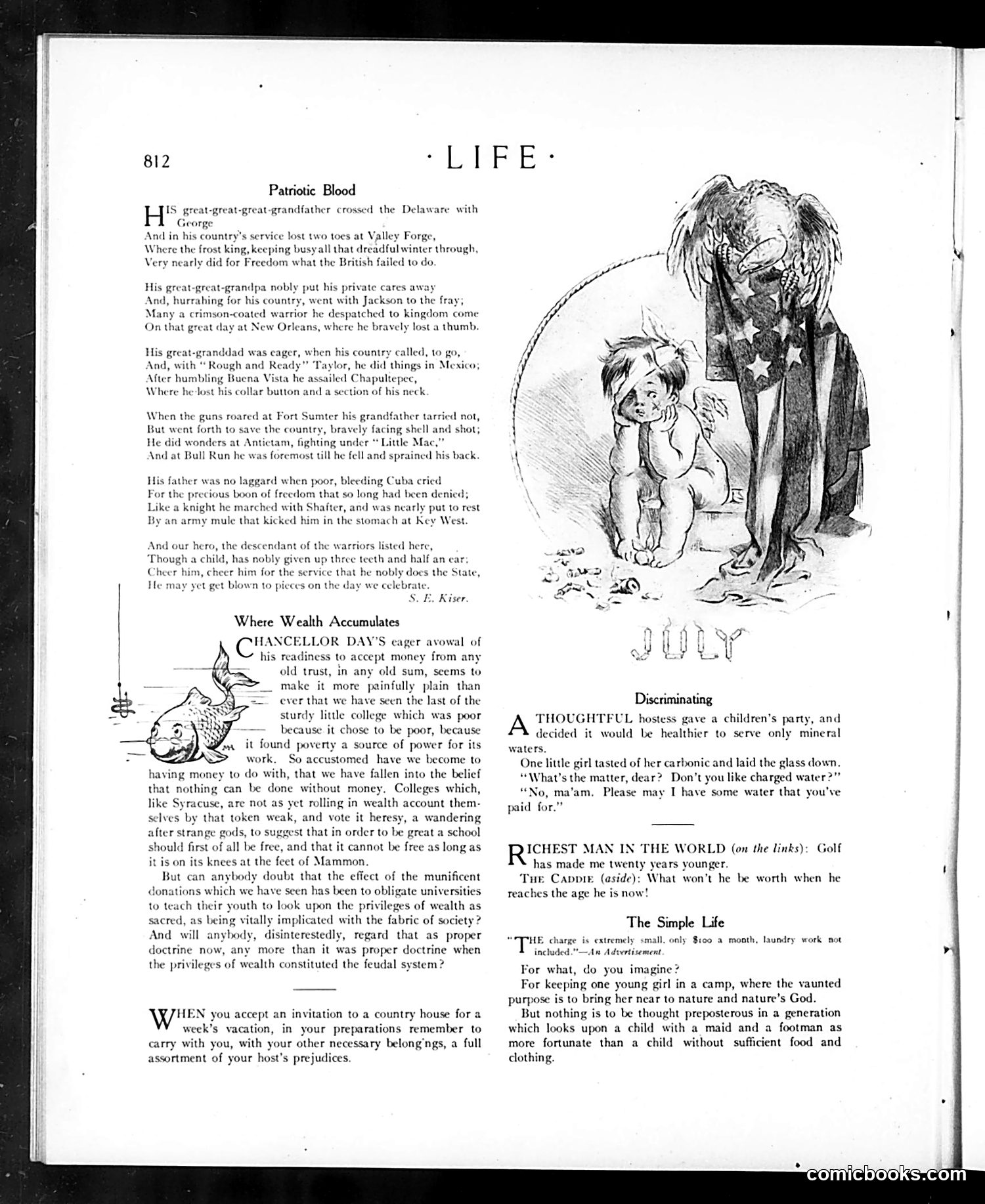
This page contains three distinct satirical pieces from Life magazine: **"Patriotic Blood"** (poem with illustration): A mock-heroic genealogy tracing a boy's ancestry through American wars—from the Revolutionary War through the Civil War to the Spanish-American War (Cuba). The joke: each ancestor lost increasingly trivial body parts (toes, thumb, collar button, teeth, ear), with the current generation having contributed nothing but injuries. The satire mocks both hollow patriotic boasting and the absurdity of glorifying military sacrifice. **"Where Wealth Accumulates"**: Criticizes colleges accepting donations from trusts/wealthy donors, arguing this compromises their independence and teaches students to revere wealth as sacred—paralleling feudalism. The illustration shows a pig labeled with money-worship. **"Discriminating"**: A brief anecdote satirizing wealthy hosts' pretension: a girl at a fancy party prefers tap water to expensive "charged water," asking for "water that you've paid for"—exposing the hollowness of status-conscious hospitality. All three pieces critique American society's unexamined reverence for militarism, wealth, and social pretension.
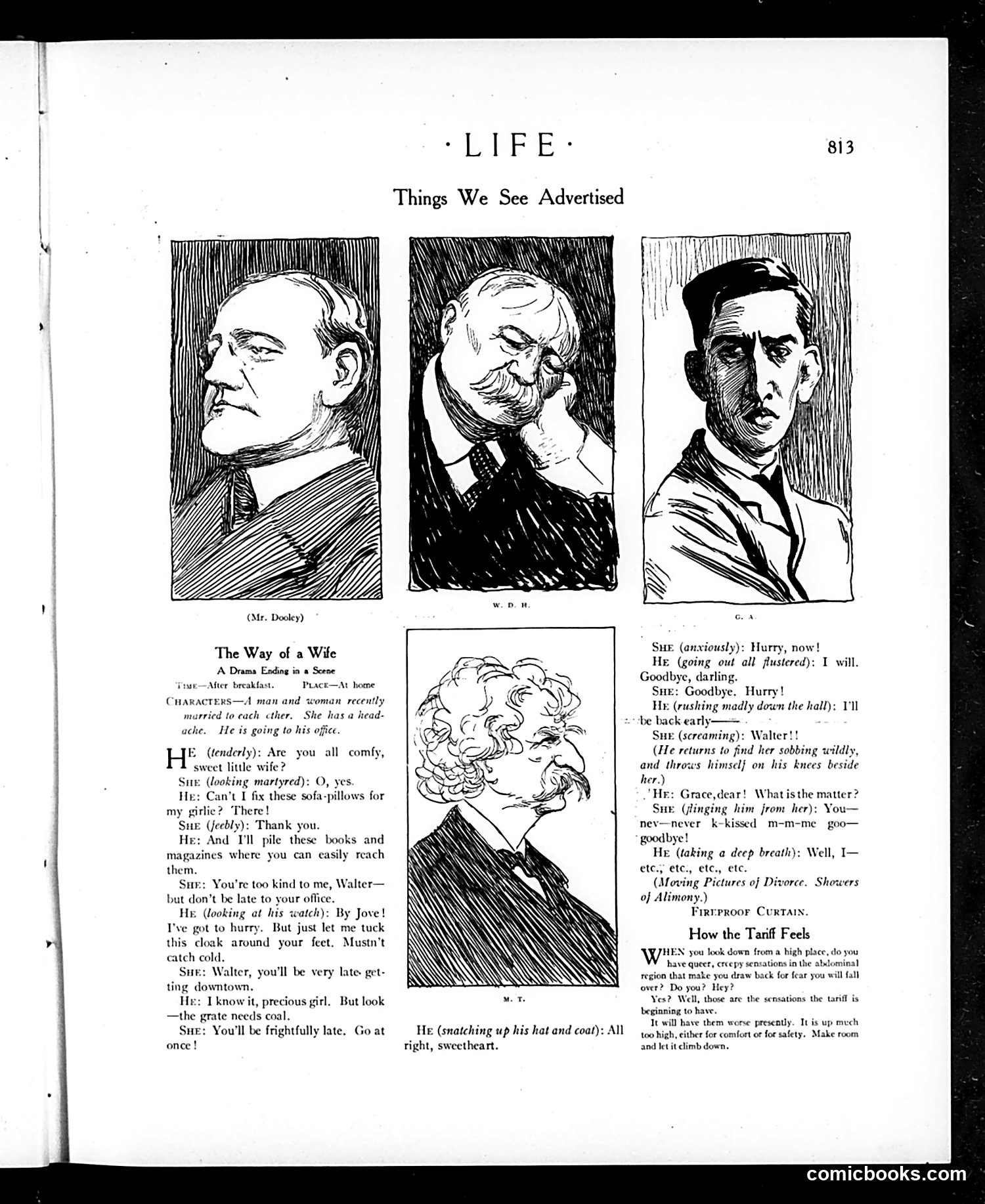
This page satirizes two contemporary concerns: **"The Way of a Wife"** parodies melodramatic silent film divorce narratives. A newly married couple engages in exaggerated domestic theater—the husband fusses over his wife's comfort while she repeatedly urges him to leave for work, only to dramatically call him back for an unseen kiss. The sketch mocks how Hollywood films portrayed marriages ending in divorce through overwrought emotion and theatrical miscommunication. The "Moving Pictures of Divorce. Showers of Alimony" subtitle suggests Life is criticizing sensationalized movie depictions of marital breakdown. **"How the Tariff Feels"** uses vertigo metaphor to critique protective tariffs as economically precarious policy. The passage compares high tariffs to standing at dangerous heights—they create unsustainable tension and must inevitably "climb down" for safety. This reflects early 20th-century American debate over trade protectionism versus free trade, with Life apparently advocating for tariff reduction.
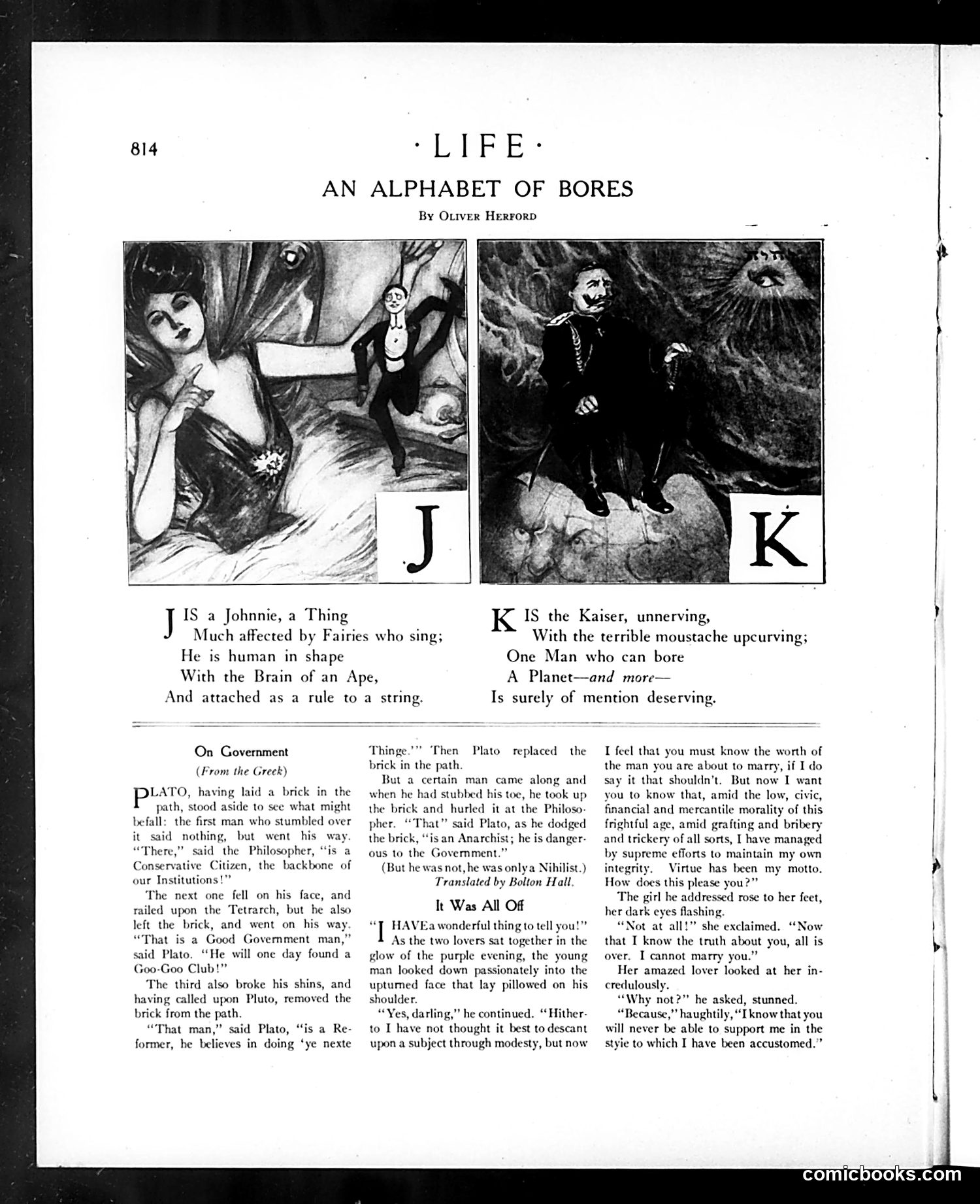
This page presents satirical character sketches. The "J" entry mocks affected aesthetes influenced by the Decadent movement—vain men obsessed with fairy tales and artistic pretension despite lacking intelligence. The "K" entry targets Kaiser Wilhelm II of Germany, caricatured with his famous upturned mustache as a tedious, dangerous bore capable of causing planetary-scale destruction. The Plato anecdote ridicules different political responses: the conservative accepts injustice passively; the reformer removes obstacles to progress; the anarchist/nihilist violently rejects the system itself. Plato's dismissal of the brick-thrower as dangerous despite being "only a Nihilist" suggests satirical confusion about revolutionary movements. The final story mocks self-righteous hypocrisy: a man boasts of maintaining integrity amid universal corruption, only to be rejected by his fiancée, who reveals her real concern—she needs his *money*, not his virtue, to sustain her lifestyle.
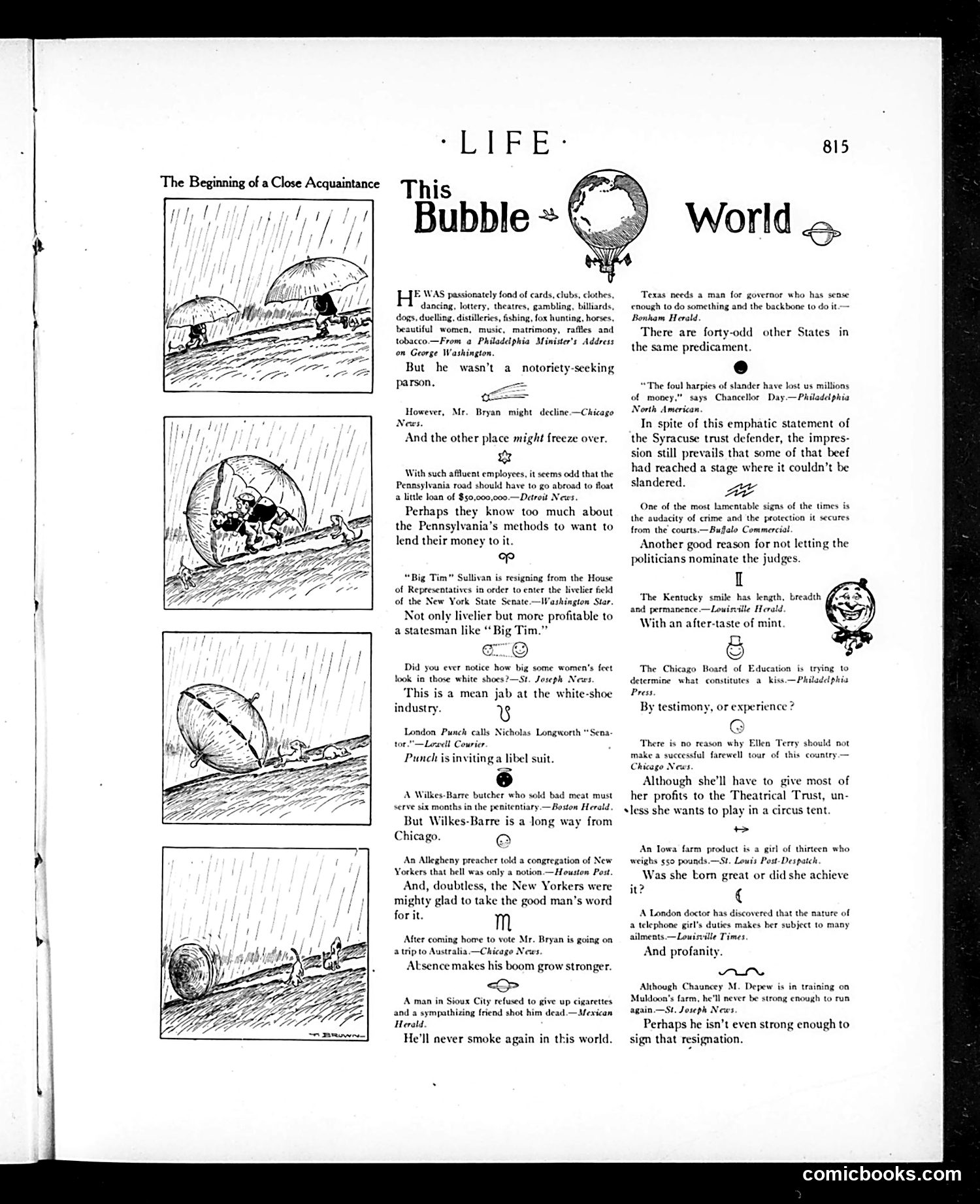
This page from *Life* magazine consists of four sequential cartoon panels (left) depicting a person sheltering under an umbrella in rain, paired with a column of satirical quips about contemporary figures and events. The cartoons illustrate "The Beginning of a Close Acquaintance"—likely a visual metaphor for forced proximity or unexpected encounters. The text comprises brief satirical jabs at politicians and public figures of the era, including William Jennings Bryan (who "might decline" something), "Big Tim" Sullivan (a New York politician criticized for seeking Senate office for profit), and Nicholas Longworth (the Kentucky congressman, mocked by London *Punch*). Other quips target the Pennsylvania Railroad's financial troubles, the Syracuse trust scandal, Ellen Terry's theatrical tour, and politician Chauncey M. Depew's physical fitness. The humor relies on insider knowledge of contemporary scandals, political figures, and business controversies—most now historically obscure to modern readers.
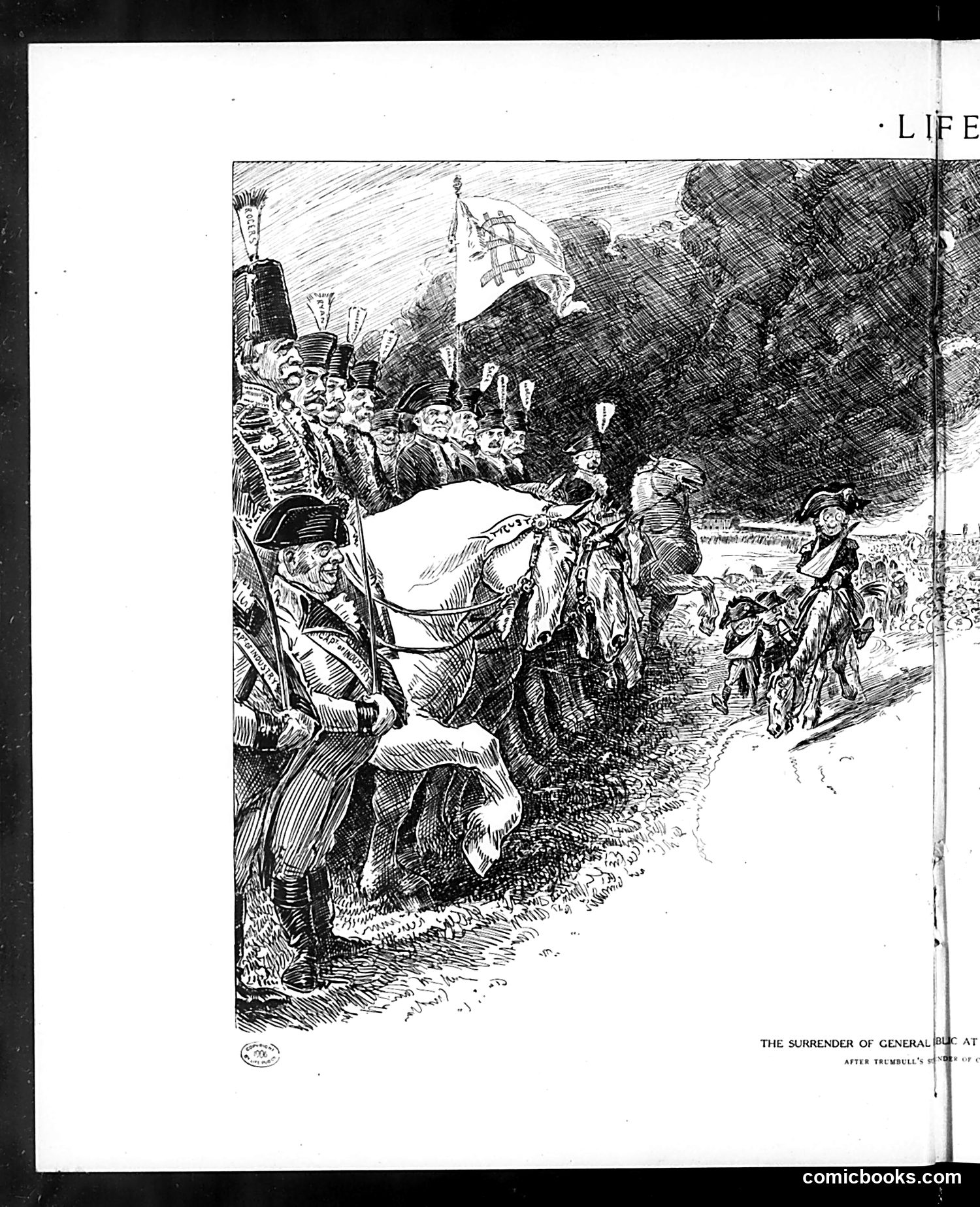
This is a historical satirical illustration depicting a military surrender scene. The caption reads "THE SURRENDER OF GENERAL [name unclear due to OCR error]" and references "after Teuputt's [unclear]." The engraving shows a uniformed officer on horseback in the foreground, facing a crowd of soldiers and officials. Flags are visible in the background. The detailed cross-hatching technique and style suggest this is 19th-century political satire, likely commenting on a specific military defeat or surrender. However, **the OCR text is too corrupted to identify the specific general, battle, or historical event** being referenced. Without clearer text or additional context, I cannot definitively explain which surrender is depicted or what political point the satire intended to make. The illustration technique and composition suggest it was meant as commentary on military or political failure.
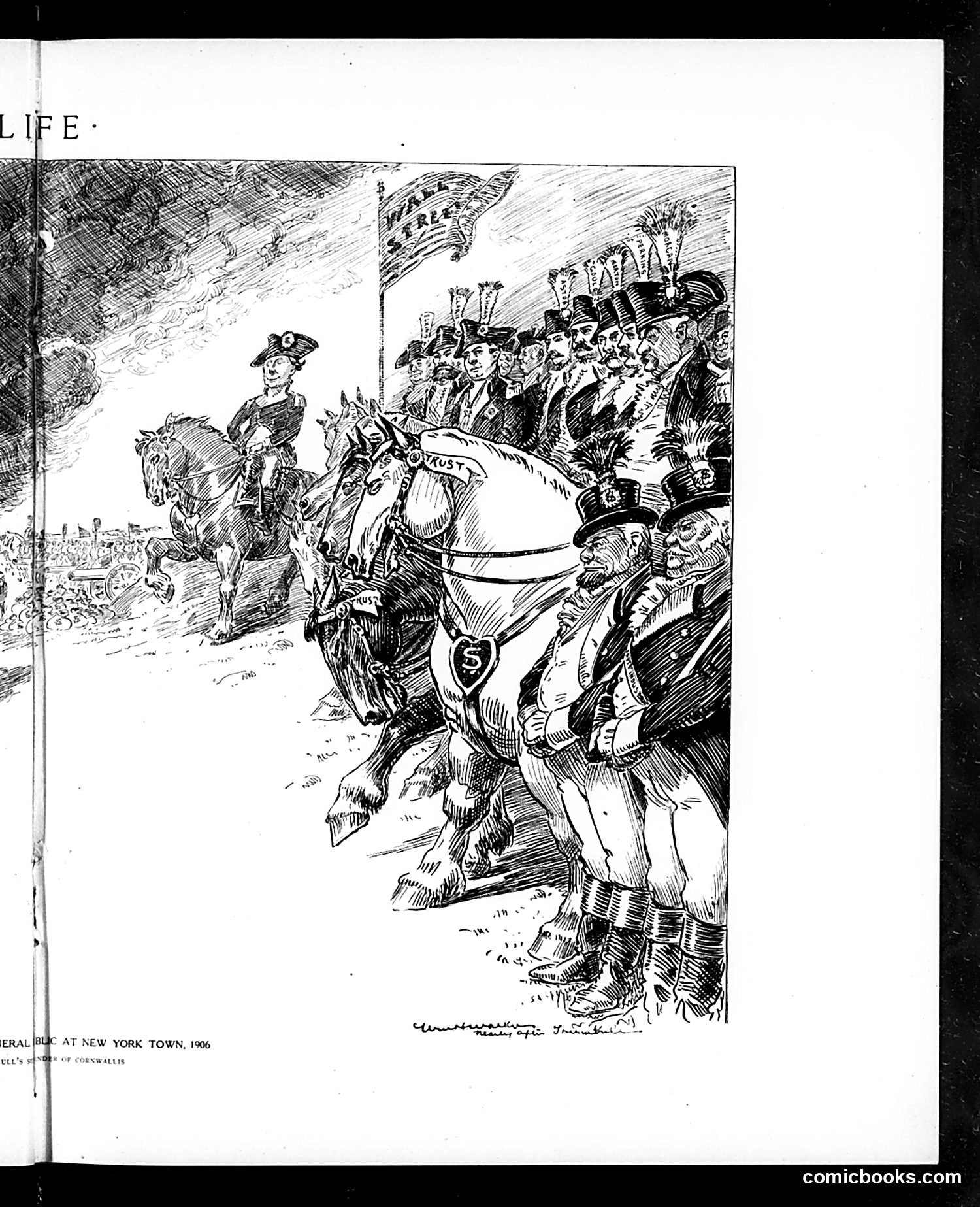
This 1906 Life magazine illustration depicts a military scene with clear historical reference. A solitary figure on horseback (left) observes a large group of uniformed men on horseback approaching from the right, carrying flags and weapons. The caption references "Cornwallis" and "New York Town, 1906," invoking the American Revolutionary War general Lord Cornwallis. The contrast between the lone figure and the advancing military force suggests commentary on American military or political power circa 1906—likely referencing Theodore Roosevelt's presidency or contemporary military expansion. The specific identities of the figures remain unclear without additional context, but the composition clearly uses historical analogy to comment on contemporary American military or political authority and its display of power.
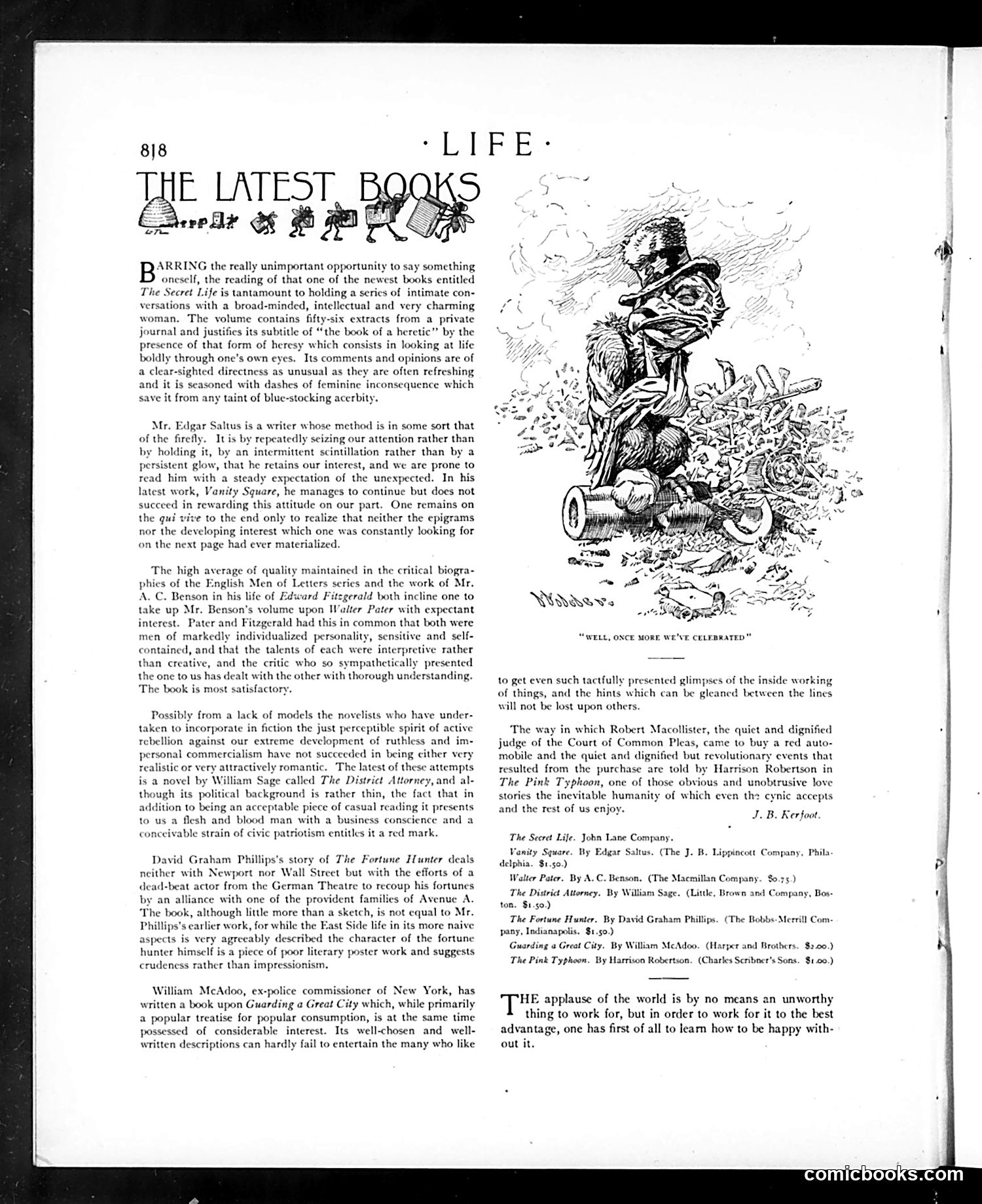
This page is primarily a **book review section**, not political satire. The single cartoon shows a figure celebrating atop what appears to be a wheeled vehicle or wagon, captioned "Well, once more we've celebrated"—likely mocking the repetitive, hollow nature of social celebrations or commemorations. The text reviews recent novels and non-fiction works, including *The Secret Life*, *Vanity Square* by Edgar Saltus, and *The Fortune Hunter* by David Graham Phillips. The reviews praise some works (like Benson's biography of Walter Pater) while critiquing others as poorly constructed or lacking substance. The cartoon's modest humor seems to satirize the cyclical, performative aspects of social ritual rather than targeting specific political figures or events. The page reflects early 20th-century literary culture and Life's role as a vehicle for both satire and cultural commentary.
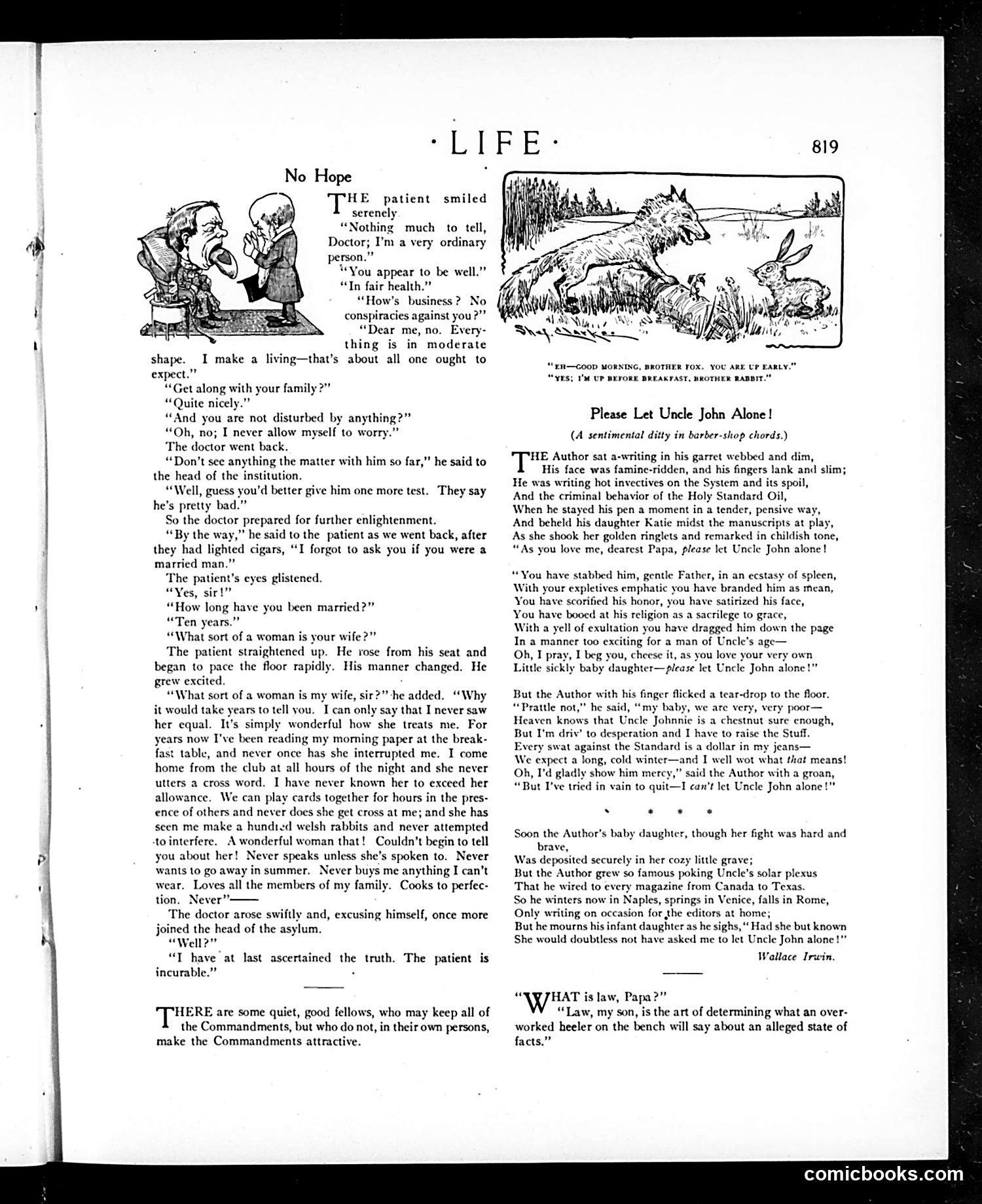
This page contains two satirical pieces mocking different targets. **"No Hope"** depicts a doctor's examination of a psychiatric patient. The patient claims perfect contentment—ordinary life, good business, harmonious family. When asked about his wife, he becomes animated, gushing praises: she never interrupts his newspaper reading, never complains about his late nights, never exceeds her allowance. The doctor concludes the patient is "incurable"—the satire being that a man so perfectly satisfied with his wife's subservience is hopelessly insane. This mocks contemporary gender relations and the idealized, passive "perfect wife." **"Please Let Uncle John Alone!"** satirizes muckraking journalists and social critics (likely referencing attacks on Standard Oil and wealthy industrialists). A struggling writer attacks "Uncle John" (appears to represent a wealthy businessman) in print for profit, while his daughter pleads he spare this "chestnut" target. The satire criticizes sensationalistic reform writing motivated by poverty rather than principle—hitting the same wealthy villain repeatedly for income.
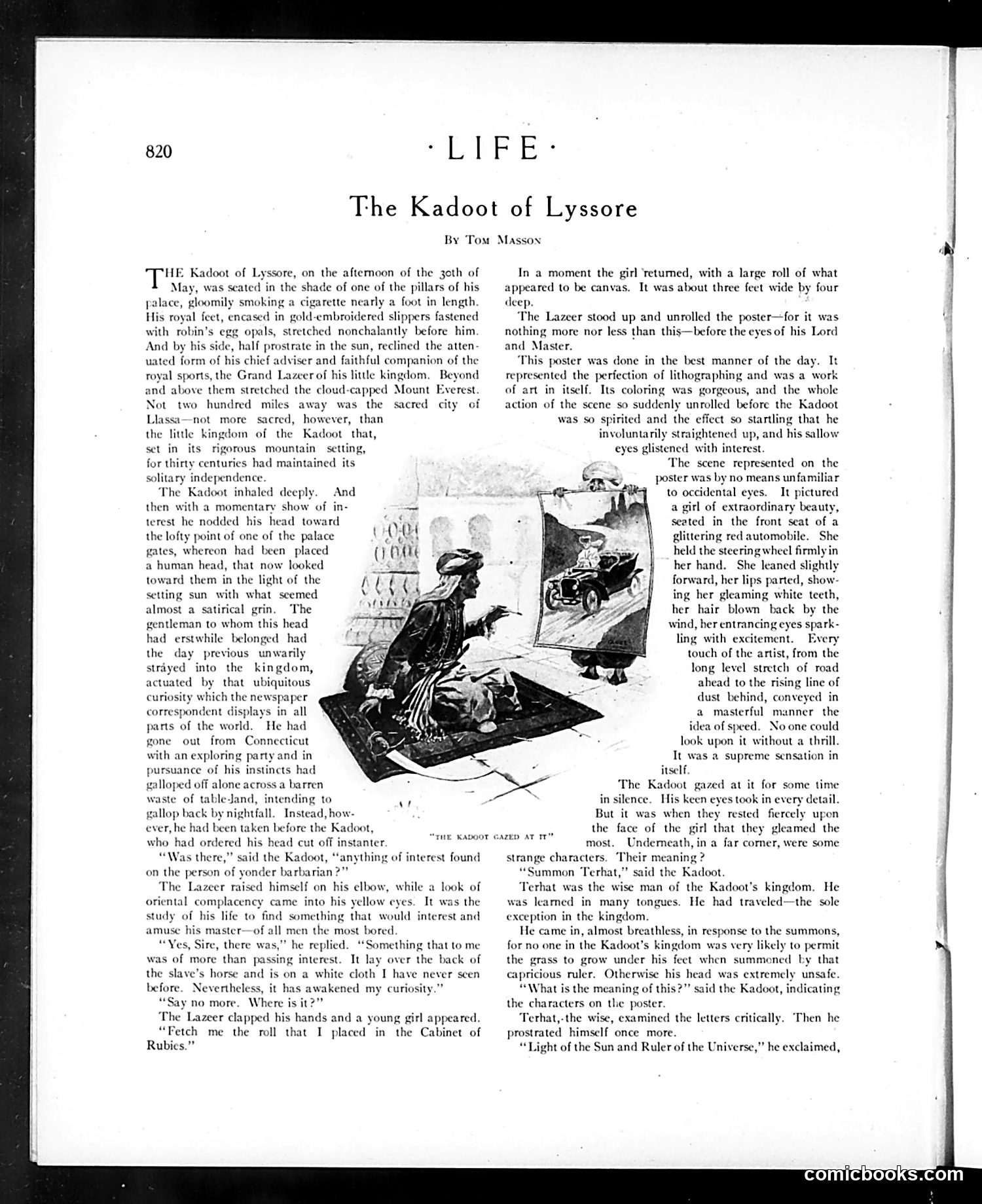
This is a satirical story (not a political cartoon) about an isolated Eastern ruler encountering Western modernity. The "Kadoot" represents a fictional Asian potentate living in rigid tradition for "thirty centuries" in a remote mountain kingdom. The satire centers on his discovery of an **automobile advertisement poster** brought by a dead American journalist. The poster depicts a woman driving a red car—embodying Western progress, speed, and female independence. The Kadoot's reaction to this image of modernity is the joke's focus. The humor targets both the isolated, bored Eastern ruler unfamiliar with Western industrial culture, and perhaps Western presumptions about introducing such "civilization" to the East. The beheaded journalist represents the fatal clash between Western curiosity and Eastern sovereignty. The story mocks orientalist stereotypes while satirizing American expansionism and cultural imperialism.
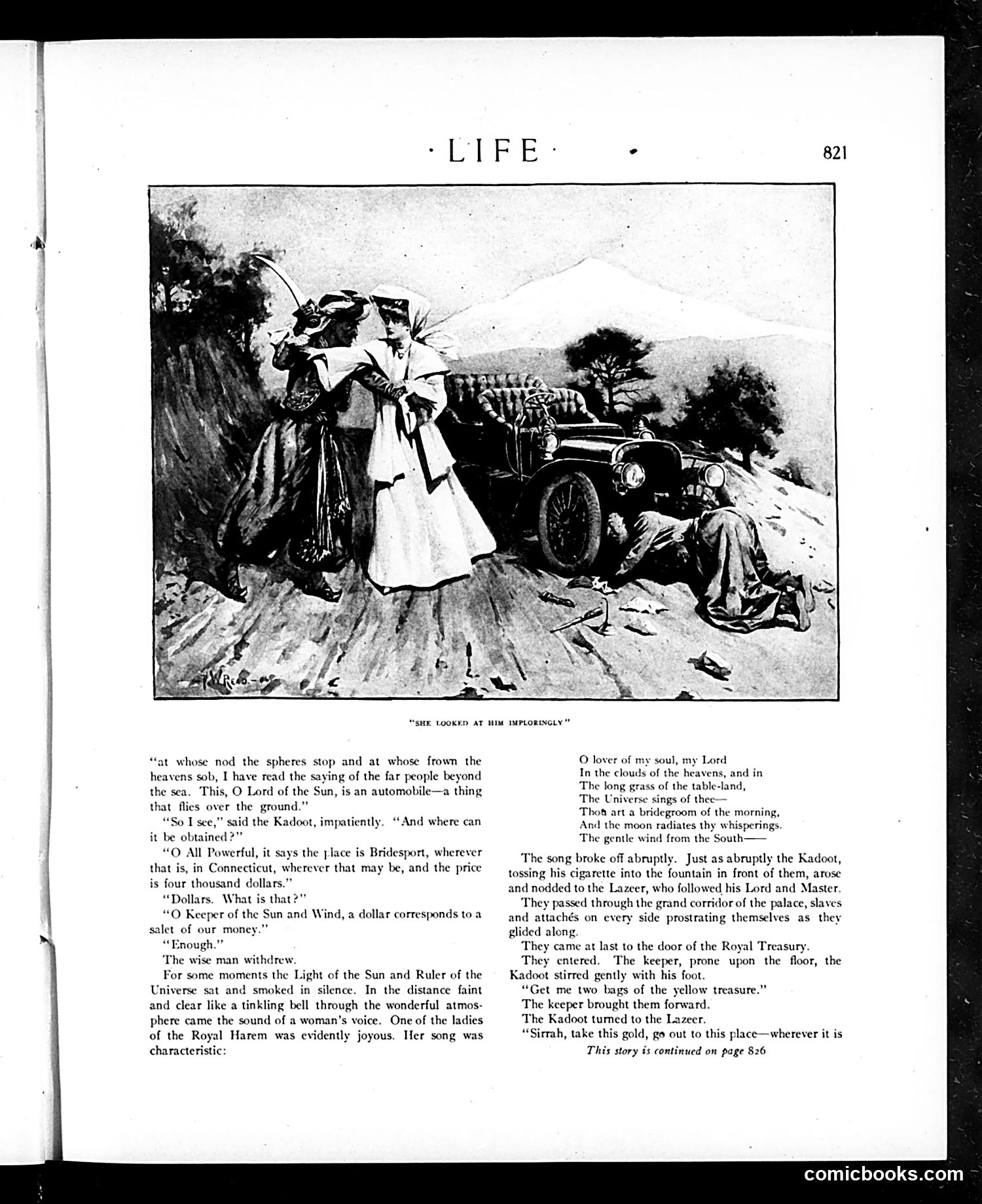
This is a satirical story illustrated with a dramatic scene showing an exotic Eastern ruler (called "the Kadoot") encountering a modern automobile. The humor lies in the clash between ancient, ornate Eastern monarchy and 1920s American consumer culture. The setup: A wise man describes an automobile to an Eastern potentate using flowery, reverential language—treating the car as if it were a miraculous divine object. The ruler, accustomed to absolute power and exotic luxury, casually decides to purchase it from Bridgeport, Connecticut for $4,000 (equivalent to a substantial fortune in local currency). The satire mocks: - **American commercialism**: Even exotic Eastern despots are susceptible to American sales pitches - **Orientalist stereotypes**: The exaggerated, romanticized portrayal of Eastern rulers - **Industrial progress**: Positioning the automobile as civilization's ultimate achievement The illustration emphasizes this contrast—the opulently-dressed figures and palace setting juxtaposed against the modern motorcar on a dusty road.
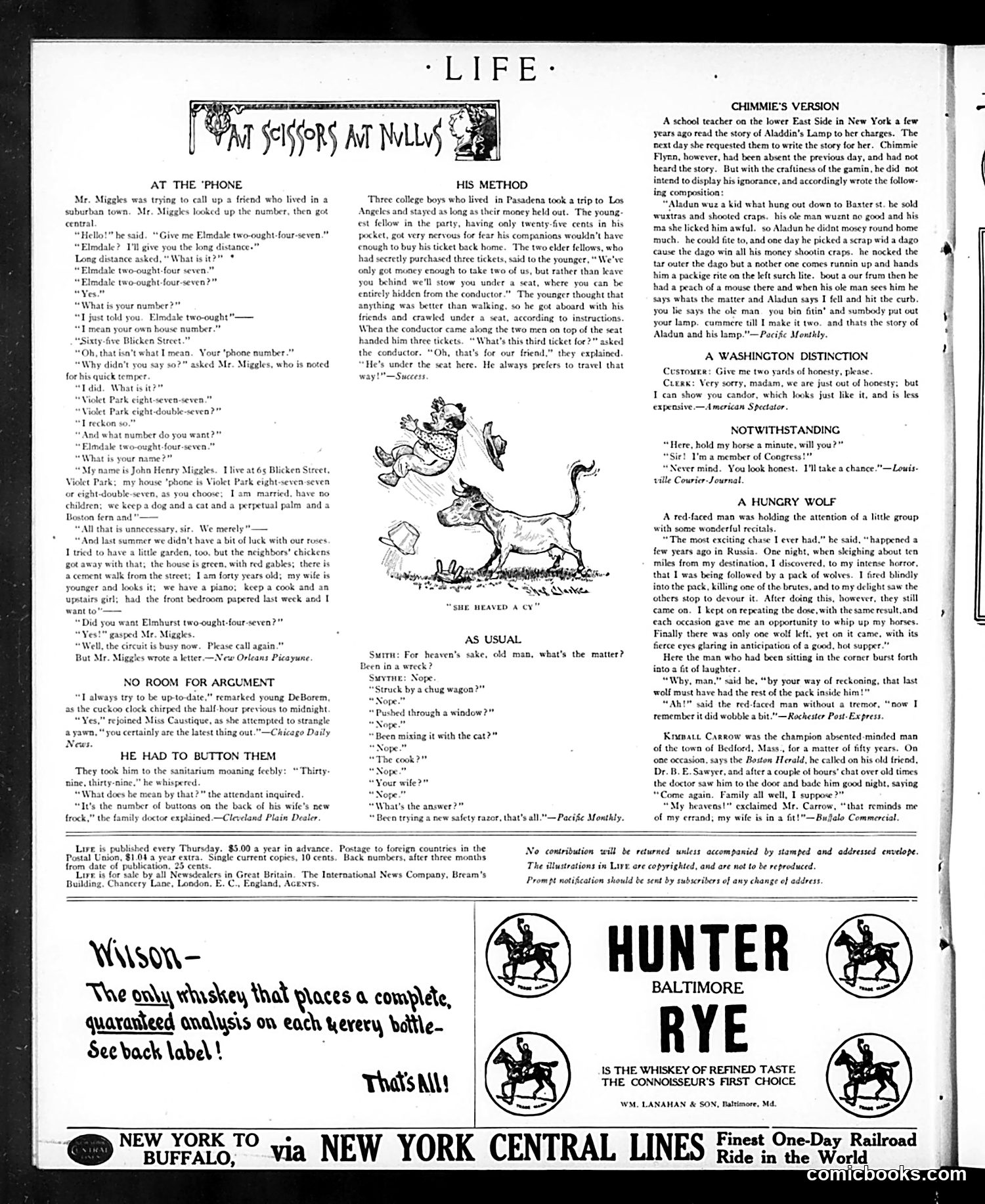
This page from *Life* magazine contains several brief humorous anecdotes illustrating early 20th-century urban frustrations and domestic comedy. **"At the Phone"** satirizes the confusion of early telephone systems, where operators needed both a caller's home address AND phone number—a redundancy that frustrated impatient Mr. Miggles. The joke reflects confusion during the transition from operator-connected calls to direct dialing. **"He Had to Button Them"** jokes about a husband's mental breakdown over his wife's new dress with thirty-eight buttons—exaggerating male anxiety about women's fashion expenses. **"His Method"** depicts college boys smuggling an underfunded friend onto a train hidden under a seat, presenting deception as practical cleverness. The remaining sketches use similar light domestic humor—marital tension, fashion obsession, and technological confusion—typical of *Life*'s satirical approach to middle-class American life circa 1910s. The advertisements (whiskey, railroad services) reflect period consumer culture.
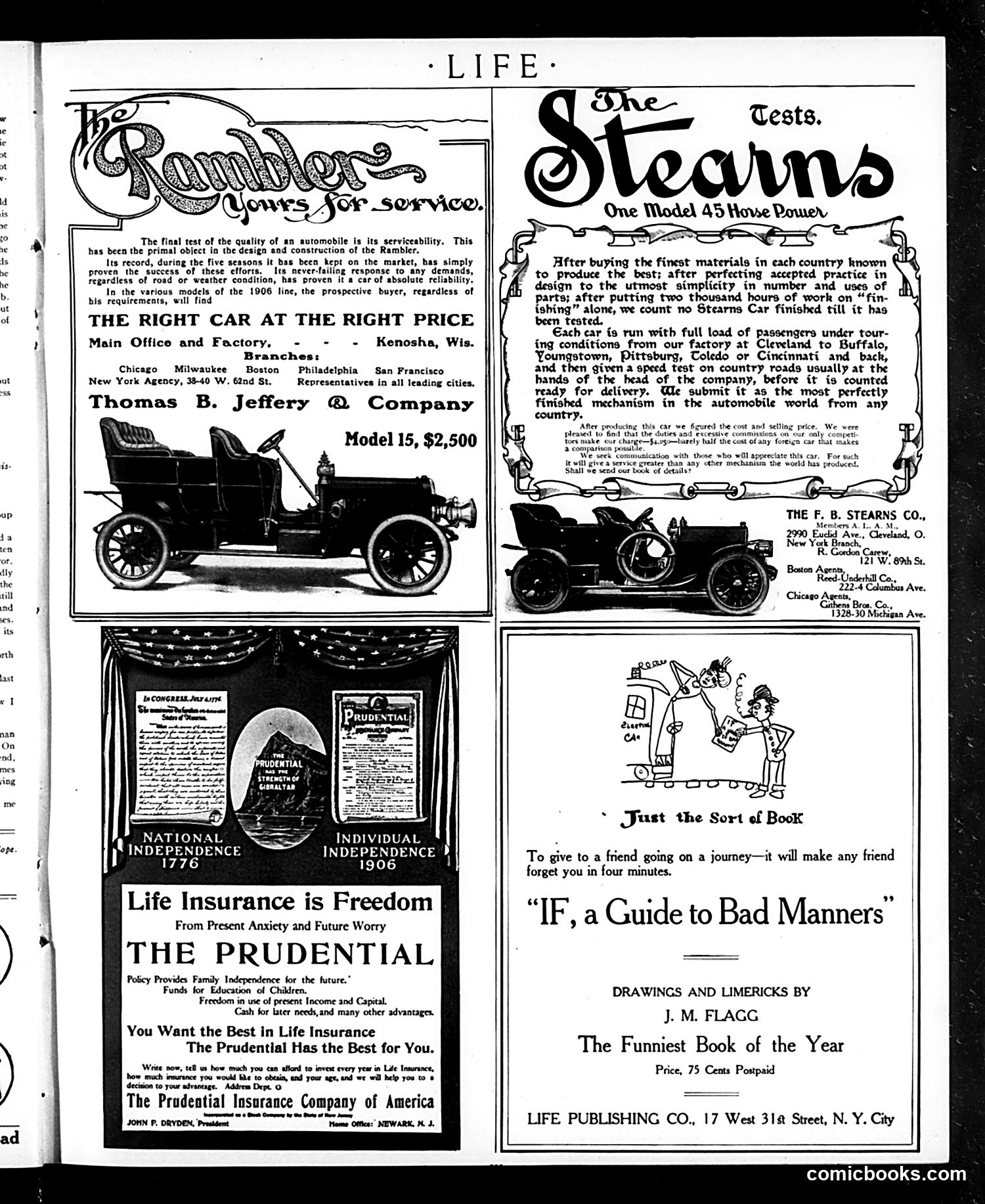
This page is primarily **advertising**, not satire or political commentary. It contains four distinct ads: 1. **Rambler automobile** (top left): Promotes the 1906 Model 15 at $2,500, emphasizing reliability and serviceability as the car's key selling points. 2. **Stearns automobile** (top right): Describes rigorous testing procedures—driving finished cars from Cleveland to Buffalo under full passenger load before delivery—to demonstrate quality and durability. 3. **Prudential Life Insurance** (bottom left): Uses patriotic imagery comparing "Individual Independence" in 1906 to 1776, positioning life insurance as providing family security and financial freedom. 4. **"If, a Guide to Bad Manners" book** (bottom right): A humorous gift book with illustrations by J.M. Flagg, priced at 75 cents. The page reflects early-1900s consumer culture, emphasizing automobiles as luxury goods requiring proof of quality, insurance as modern necessity, and mass-market humor literature. No political satire is present.
This page from *Life* magazine contains a section titled "Our Foolish Contemporaries"—a regular satirical feature mocking contemporary figures and absurd statements. The jokes are brief, witty jabs at foolish remarks or situations. The left column collects humorous anecdotes: a soldier exaggerating his war service (claiming bravery while driving an ammunition wagon), a woman boasting about life insurance to impress a man, and a schoolboy's illogical reasoning about the Earth's shape. Other quips mock poor hotel service, absurd financial logic, and gender stereotypes. The recurring satirical target is **human foolishness and pretension**—people making ridiculous claims, misunderstanding situations, or displaying faulty logic. The magazine's role was exposing such contemporary silliness for educated readers' amusement. The right side features travel and whiskey advertisements, typical for the era's magazines. The overall tone is genteel mockery of middle-class American society's everyday absurdities.
This page is primarily **book reviews and advertisements** rather than political cartoons. The top section lists recently published books across various genres—literature, history, philosophy—typical of Life's literary coverage in the early 1900s. The advertisements focus on **sporting and domestic goods**: Winchester ammunition ("Brush" shells for bird shooting), Whitman saddles, Gunn furniture and book cases, Brighton garters, and Old Crow whiskey. These ads reflect the interests of Life's affluent readership. There are **no political cartoons or satirical commentary** visible on this page. The content is straightforward—a book-review column paired with period advertising. The page demonstrates Life's role as a magazine for educated, moneyed Americans interested in literature, field sports, and quality merchandise. No particular satire or political message is apparent.
This is a serialized fiction story (not a political cartoon) satirizing early 20th-century American consumer culture and orientalist stereotypes. The plot concerns an Eastern ruler (the "Grand Lazeer of Lyssore") who has been commanded by his monarch to fetch an automobile and a girl. He arrives in the American town of Bridesport and sees a Globe automobile advertisement featuring a woman. Taking the ad literally, he attempts to purchase both the car and the girl in the poster. The satire mocks: - **American advertising**: The poster's imagery is so effective it deceives a literal-minded foreigner - **Orientalist exotica**: Eastern rulers are depicted as comically naive and autocratic - **Consumer culture**: The idea that anything—including women—can be commodified and purchased The humor relies on the clash between the Lazeer's feudal worldview (where commands are absolute) and American capitalist logic.
This is primarily an **advertising page**, not a satirical cartoon. It contains four product advertisements typical of early 20th-century American magazines: 1. **Smith Premier Typewriter** — highlights a ribbon-changing mechanism as a modern innovation 2. **A.B.C. Traveling Trunks** — showcases luggage designed for travelers, emphasizing convenience (clothes hang inside like a wardrobe; no unpacking needed) 3. **Club Cocktail** — promotes a bottled, pre-mixed cocktail as a ready-made alternative to homemade drinks 4. **Smith, Gray & Co. Liveries** — tailored uniforms for servants and chauffeurs **For modern readers:** These ads reflect a wealthy consumer class concerned with travel convenience, labor-saving devices, and servant management. The "cocktail in a bottle" is notable as an early convenience product. The focus on livery uniforms reveals the class structure of the era—detailed attention to servants' appearance was considered essential to household prestige. There is no political satire here; this is straightforward period advertising.
This page is part of a serialized fiction story (continued on page 830) satirizing American materialism and immigration anxieties circa early 1900s. **The Setup:** Patrick Murphy, a working-class Irish contractor and political boss, discovers his wife Nora has responded to a newspaper advertisement offering $4,000 for a woman to become a "queen" to the "Grand Lazeer of Lyssore" (an Indian ruler). She's been sold and departed for India. **The Satire:** The story mocks: - Working-class marriages as transactional - Women's desperation for escape from brutal husbands - American willingness to literally sell citizens - Orientalist fantasies about exotic rulers - Period anxieties about foreign seduction of American women **Murphy's Character:** Initially presented as a brutal, neglectful husband, his sudden realization he loves Nora—only after losing her—satirizes male obliviousness and late remorse. The racial and ethnic stereotypes (Irish "dago" references, Indian caricatures) reflect the publication's period prejudices while ostensibly entertaining middle-class readers.
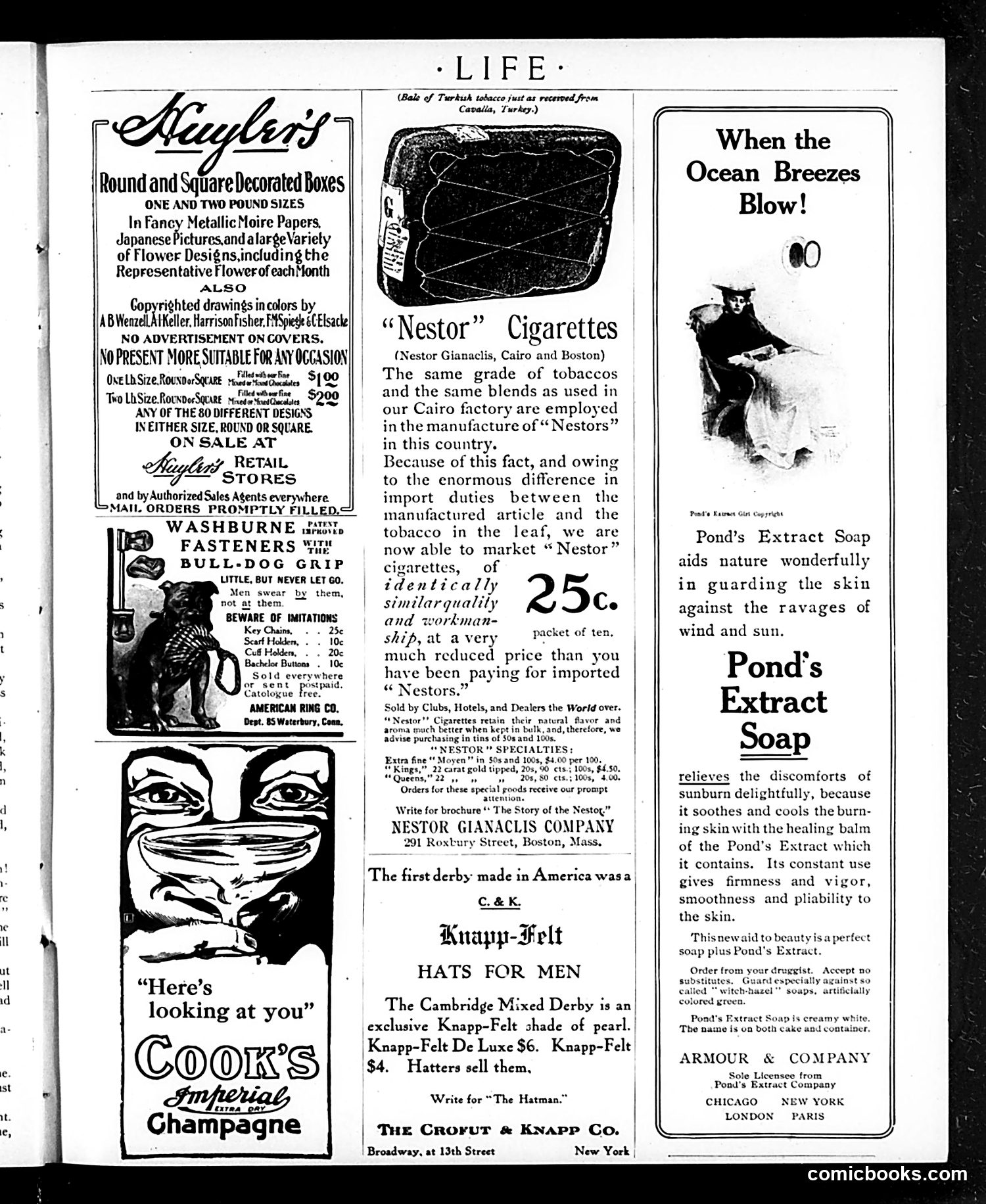
This is primarily a **advertising page** with no political cartoons or satire requiring historical context. The content consists of commercial advertisements typical of early 20th-century Life magazine. The notable items include: **Nestor Cigarettes** (center): An ad explaining that Nestor cigarettes manufactured in Boston use the same Egyptian tobacco as imports, but cost less (25¢) due to lower duty on manufactured goods versus leaf tobacco. This exploits tariff differences to undercut competitors. **Cook's Champagne** (lower left): Features a stylized face with the slogan "Here's looking at you"—straightforward promotional copy. **Pond's Extract Soap** (right): Advertises skincare benefits for sun and wind protection. Other ads promote **Hayley's decorated boxes**, **Washburne fasteners**, **Knapp-Felt hats**, and miscellaneous merchandise. The page reflects period marketing strategies emphasizing product quality, price advantages, and practical benefits—no satire or political commentary is present.
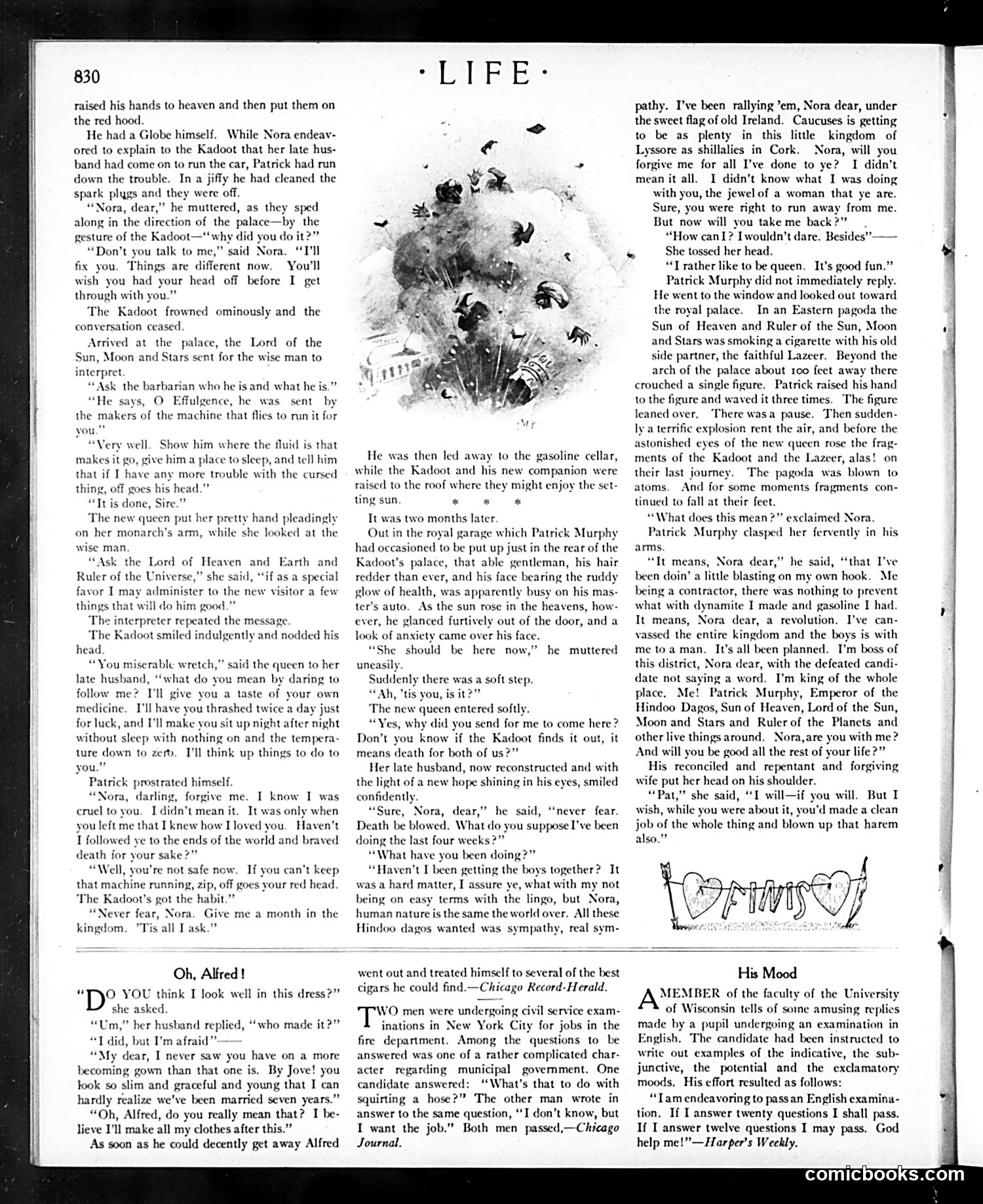
This page contains serialized fiction rather than political cartoons. The narrative follows Patrick Murphy, an Irishman who has traveled to an exotic kingdom (ruled by "the Kadoot"—likely a satirical depiction of an Eastern potentate) to repair an automobile. The story satirizes early 20th-century attitudes about technology, imperialism, and gender dynamics. Patrick's ex-wife Nora, now the Kadoot's queen, threatens him with torture while he pleads forgiveness. The humor derives from the absurd juxtaposition: a primitive "Eastern" ruler who demands an Irishman fix his flying machine, combined with domestic marital comedy transplanted to a fantastical setting. The smaller item "Oh, Alfred!" jokes about a husband's flattery regarding his wife's new dress—a lighthearted jab at marital dynamics. The "His Mood" snippet concerns a university examination candidate's anxiety about answering essay questions. These represent typical Life magazine content: humorous fiction and anecdotes mocking contemporary society and human nature.
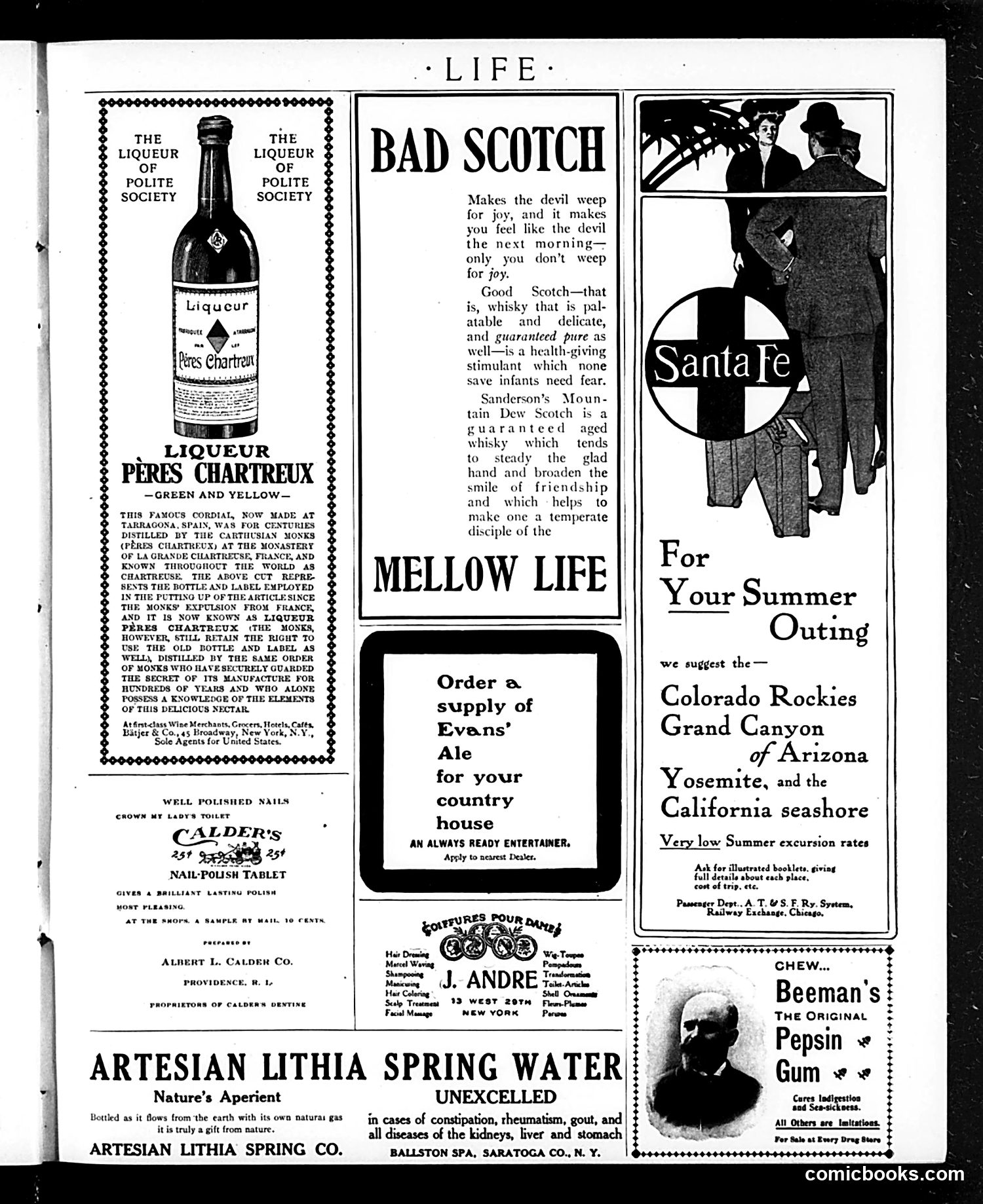
This is primarily an **advertising page** rather than editorial content or political satire. The page contains seven distinct advertisements from circa early 20th century. The main advertised products include: - **Liqueurs** (Pères Chartreux and Evans' Ale) — marketed with claims about quality and health benefits - **Santa Fe Railway** — promoting summer tourist destinations (Colorado Rockies, Grand Canyon, Yosemite) - **Patent medicines and personal care** — nail polish, pepsin gum, and spring water, each claiming therapeutic or health benefits **The satirical element** appears implicit rather than explicit: the page reflects the era's casual marketing of alcohol and dubious patent medicines as health tonics. Alcohol is advertised alongside other "remedies," reflecting pre-Prohibition attitudes and the prevalence of unregulated medicinal claims. There are **no identifiable political figures or caricatures**. The Santa Fe illustration shows silhouetted travelers, but they're generic promotional imagery rather than specific commentary. The humor for modern readers lies in recognizing how openly these products made health claims that would be illegal today.
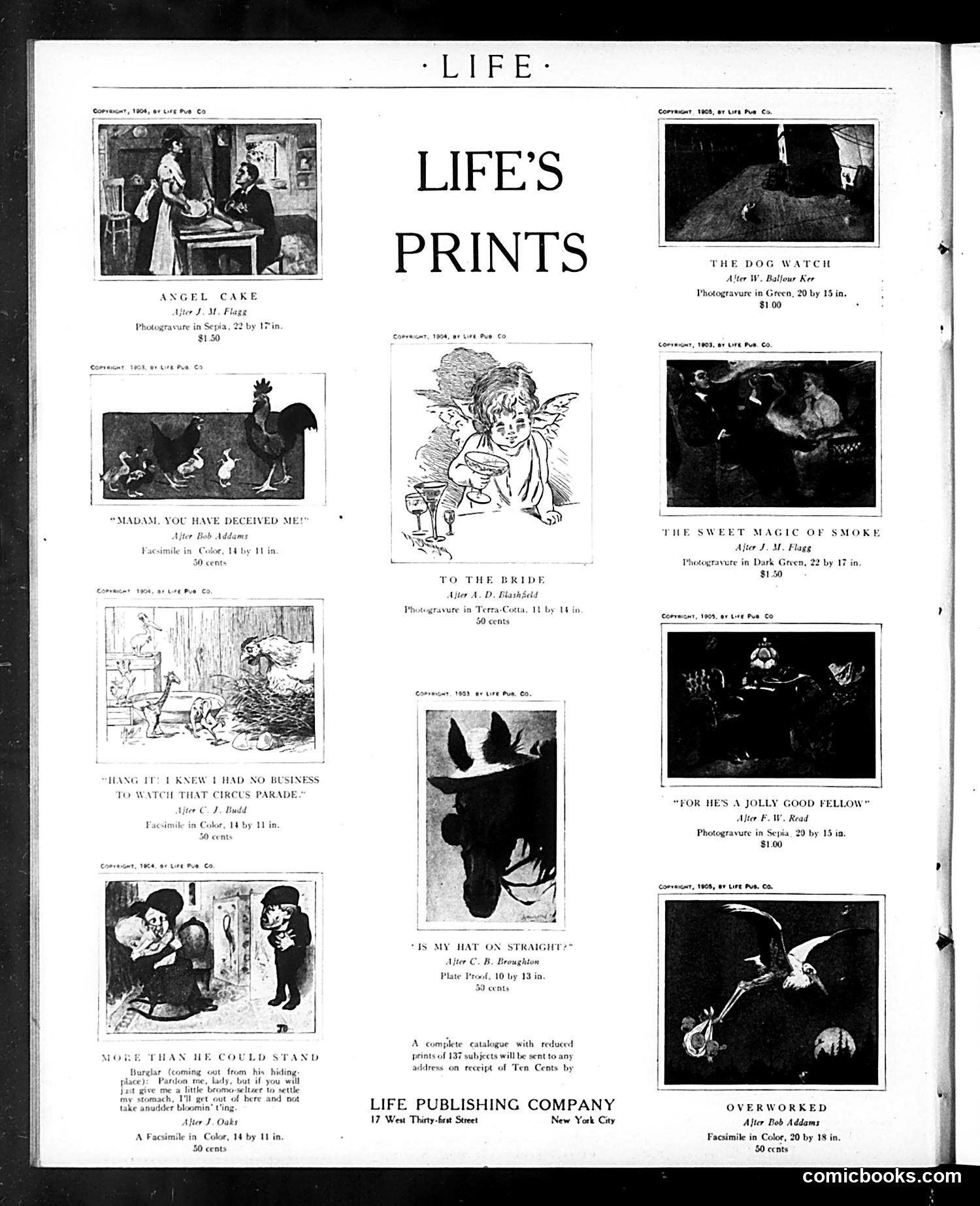
This is a catalog page advertising prints and photogravures for sale by Life Publishing Company (early 1900s). Rather than editorial cartoons, it showcases humorous illustrations available for purchase—ranging from 50 cents to $1.50. The images depict domestic and social comedy: a woman baking an "Angel Cake," a man sneaking from his hiding place during a circus parade, a bride concerned about her hat, a dog watching (likely a naval reference), and figures enjoying tobacco smoke. One print shows an overworked figure. These aren't political satire but rather genteel humor reflecting turn-of-century middle-class life—capturing relatable domestic mishaps and social awkwardness. The advertisements emphasize that Life magazine produced collectible art prints for home display, a common business model before mass-market reproduction became standard. The satire is gentle and sentimental rather than pointed social commentary.
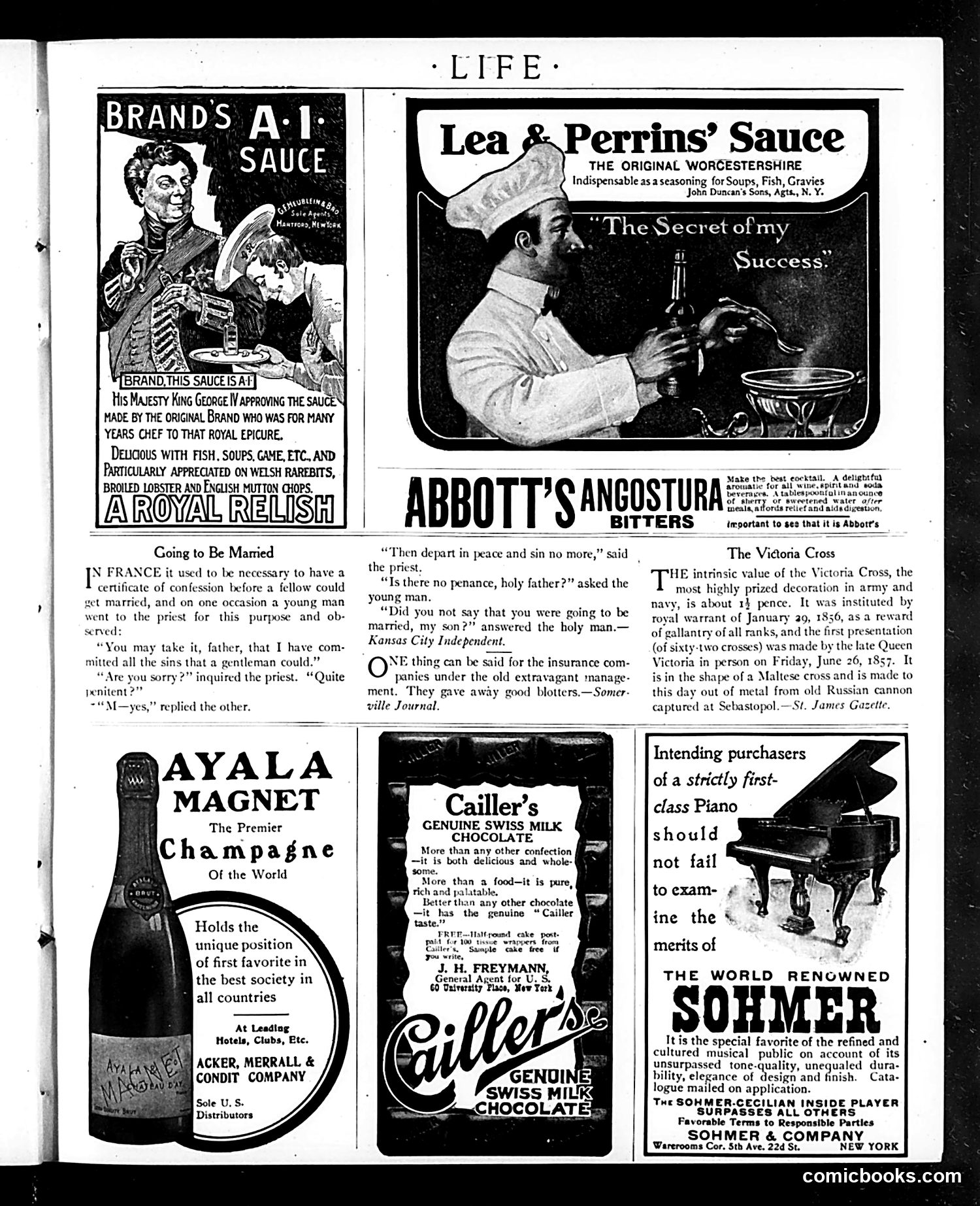
This page is primarily **advertising**, not satirical content. It contains product endorsements typical of early 20th-century magazines. The notable items are: **Brand's A.1. Sauce**: Features King George IV's approval, leveraging royal endorsement—a common advertising tactic claiming the sauce was made by the king's former chef. **Lea & Perrins' Worcestershire Sauce**: Uses a chef character claiming "The Secret of my Success," anthropomorphizing the product through a cooking authority figure. **Abbott's Angostura Bitters**: Similar endorsement strategy. **Other ads**: Ayala champagne, Cailler's chocolate, and Sohmer pianos all claim superiority through refinement appeals ("first favorite in best society"). The small satirical piece, "Going to Be Married," is a lighthearted joke about a young Frenchman's confession to a priest—unrelated to the advertisements. The **Victoria Cross** entry is historical trivia, not satire. Overall, this reflects period advertising's reliance on celebrity endorsement and class aspiration rather than product features.
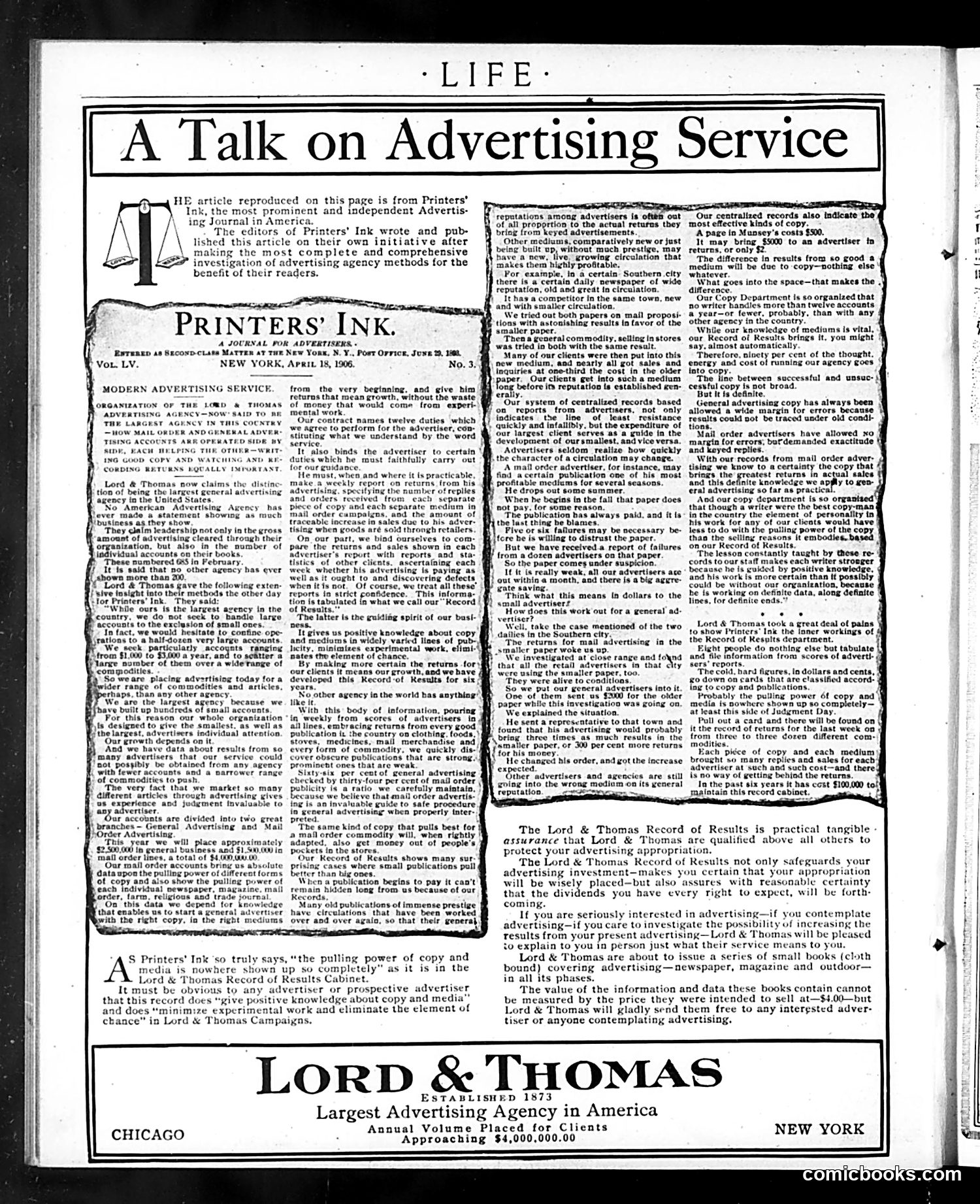
This is primarily a **trade advertisement and article**, not a political cartoon. The page reproduces an article from *Printers' Ink* (an advertising trade journal) discussing Lord & Thomas, which claims to be America's largest advertising agency. The content outlines Lord & Thomas's business model: they handle both large and small accounts across diverse product categories, using data from mail-order campaigns to inform general advertising strategy. The agency emphasizes systematic record-keeping, performance tracking, and detailed service contracts with clients. The small scales-of-justice icon at top suggests fairness and accountability in their methods. **Context for modern readers**: This reflects early 20th-century advertising professionalization—when agencies were transitioning from informal brokers to data-driven service organizations. The emphasis on measurable results and systematic testing was novel for the era. The page is essentially a sponsored promotional article dressed as journalism.
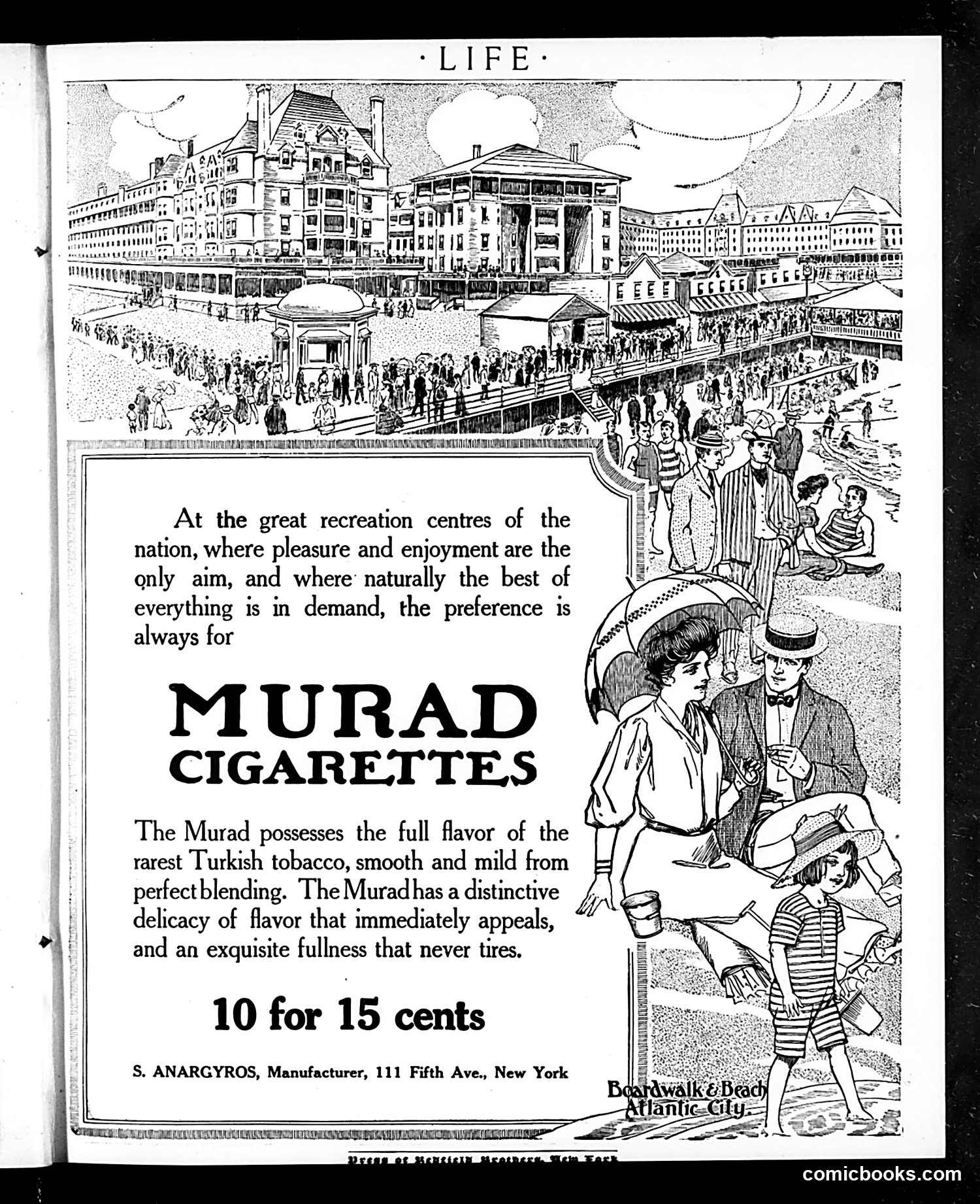
This is primarily a **cigarette advertisement**, not political satire. The page features an illustration of a bustling seaside resort or boardwalk (likely Atlantic City, given the credit line) with crowds enjoying leisure activities. The ad claims Murad cigarettes are preferred at "great recreation centres of the nation" where people seek the "best of everything." It emphasizes the product's Turkish tobacco, smooth flavor, and affordable price (10 for 15 cents). **Context for modern readers:** This represents early 20th-century advertising before cigarette health warnings. The appeal to recreation, pleasure, and social prestige was standard marketing. The seaside resort imagery associates smoking with leisure, glamour, and social status—tactics that would later face regulatory restrictions. There is **no political cartoon or satire** present on this page.
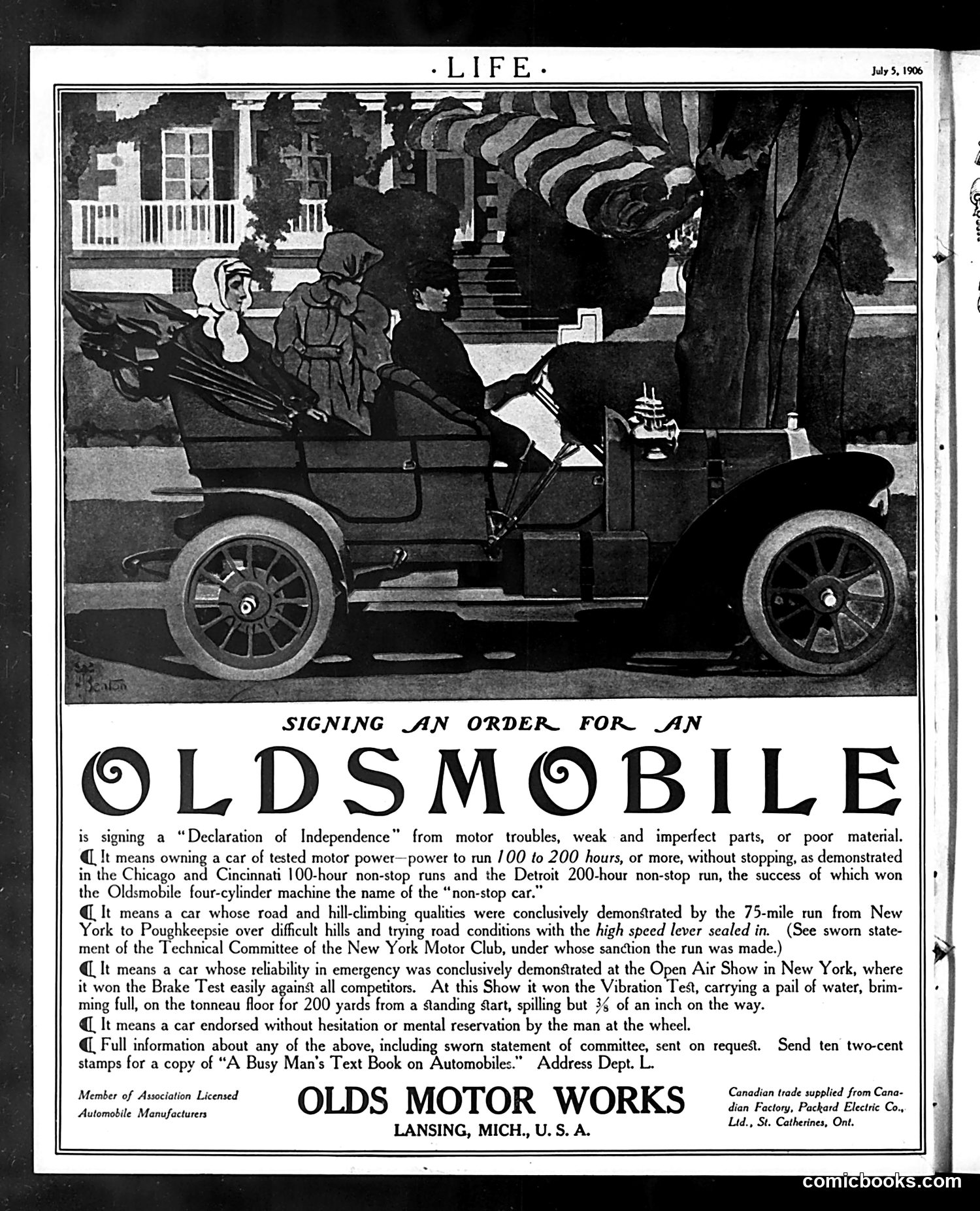
This is primarily an **advertisement**, not satire. It's a 1906 Oldsmobile marketing piece using patriotic imagery to sell cars. The illustration shows a woman "signing an order" for an Oldsmobile, playfully invoking the Declaration of Independence metaphor. The ad claims purchasing an Oldsmobile represents freedom from "motor troubles, weak and imperfect parts, or poor material." The text then lists performance achievements: 100-200 hour non-stop runs in Chicago, Cincinnati, and Detroit; a 75-mile hill climb from New York to Poughkeepsie with sealed throttle; brake and vibration tests won at an auto show; and a water-spill test demonstrating stability. For modern readers: this reflects early automotive marketing emphasizing **reliability and durability**—key consumer concerns when cars were still novel and mechanically unreliable. The "Declaration of Independence" hook attempts to associate the product with American ideals and independence, a common advertising strategy then and now.