
Life, 1906-07-05 · page 23 of 40
Life — July 5, 1906 — page 23: what you’re looking at
What you’re looking at
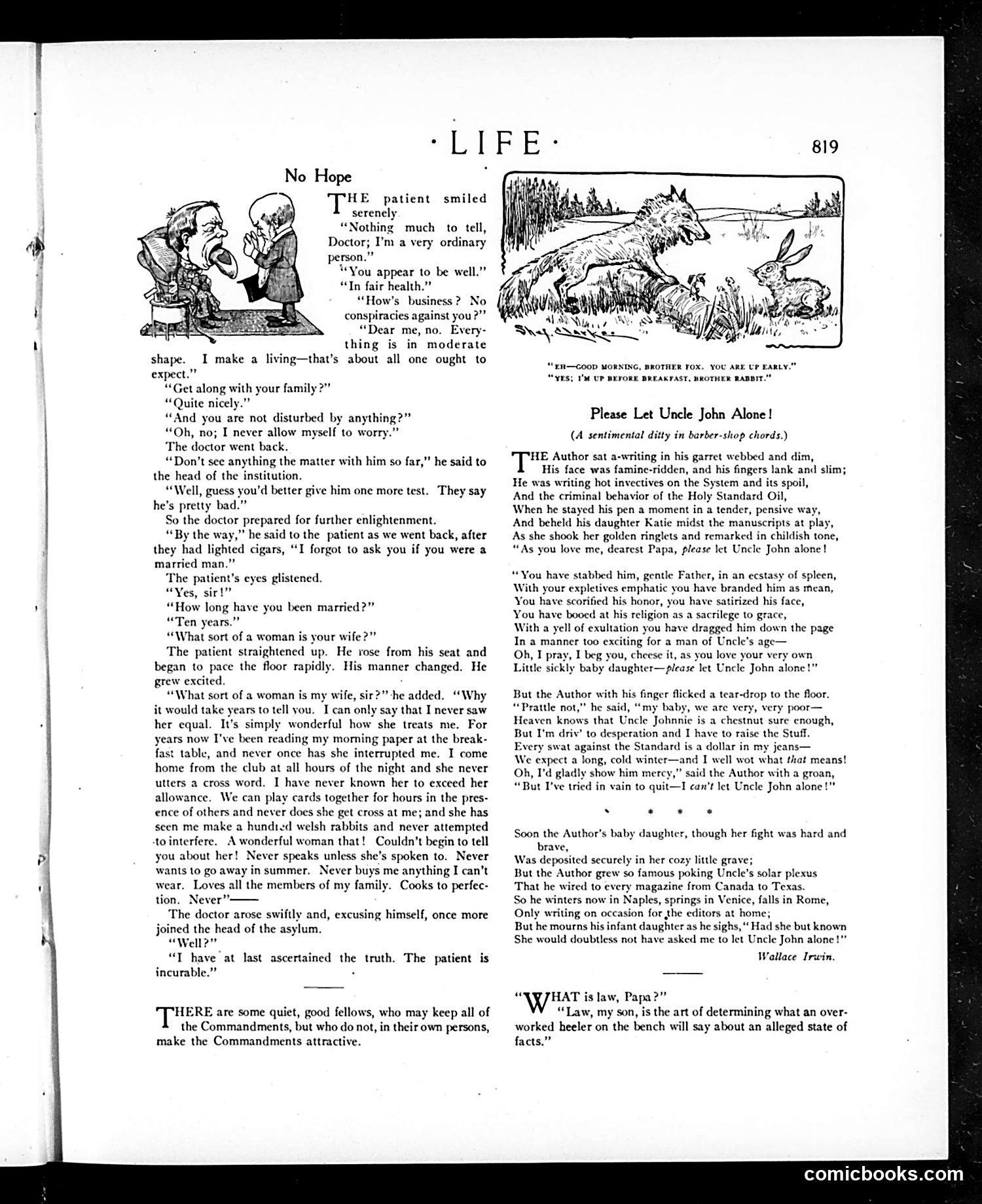
This page contains two satirical pieces mocking different targets. **"No Hope"** depicts a doctor's examination of a psychiatric patient. The patient claims perfect contentment—ordinary life, good business, harmonious family. When asked about his wife, he becomes animated, gushing praises: she never interrupts his newspaper reading, never complains about his late nights, never exceeds her allowance. The doctor concludes the patient is "incurable"—the satire being that a man so perfectly satisfied with his wife's subservience is hopelessly insane. This mocks contemporary gender relations and the idealized, passive "perfect wife." **"Please Let Uncle John Alone!"** satirizes muckraking journalists and social critics (likely referencing attacks on Standard Oil and wealthy industrialists). A struggling writer attacks "Uncle John" (appears to represent a wealthy businessman) in print for profit, while his daughter pleads he spare this "chestnut" target. The satire criticizes sensationalistic reform writing motivated by poverty rather than principle—hitting the same wealthy villain repeatedly for income.
📄 Transcribed text from this page (OCR, searchable)
Machine-transcribed from the original scan — historical spelling and the odd misread are preserved.
Hope HE patient smiled serenely “Nothing much to tell, Doctor; I’m a very ordinary person.” “You appear to be well.” “In fair health.” “How's business ? No conspiracies against you?” “Dear me, no. Every- thing is in moderate shape. I make a living—that’s about all one ought to expect.” “Get along with your family?” “Quite nicely.” “And you are not disturbed by anything?” “Oh, no; I never allow myself to worry.” The doctor went back. “Don’t see anything the matter with him so far,” he said to the head of the institution. “Well, guess you'd better give him one more test. They say he’s pretty bad.” So the doctor prepared for further enlightenment. “By the way,” he said to the patient as we went back, after they had lighted cigars, “I forgot to ask you if you were a married man.” The patient’s eyes glistened. “Yes, sir!” “How long have you been married?” “Ten years.” “What sort of a woman is your wife?” The patient straightened up. He rose from his seat and began to pace the floor rapidly. His manner changed. He grew excited. “What sort of a woman is my wife, sir?’ -he added. “‘Why it would take years to tell you. Ian only say that I never saw her equal. It’s simply wonderful how she treats me. For years now I've been reading my moming paper at the break- fast table, and never once has she interrupted me. I come home from the club at all hours of the night and she never utters a cross word. I have never known her to exceed her allowance. We can play cards together for hours in the pres- ence of others and never does she get cross at me; and she has seen me make a hundied welsh rabbits and never attempted -to interfere. A wonderful woman that! Couldn’t begin to tell you about her! Never speaks unless she’s spoken to. Never ‘wants to go away in summer. Never buys me anything I can’t wear. Loves all the members of my family. Cooks to perfec- tion. Never”. The doctor arose swiftly and, excusing himself, once more joined the head of the asylum. “Well?” “T have at last ascertained the truth. The patient is incurable.” ’ THERE are some quiet, good fellows, who may keep all of the Commandments, but who do not, in their own persons, make the Commandments attractive. “'EN—COOD MORNING, BROTHER FOX. YOU ARE UP EARLY.” “YES; I'M UP BEYORE BREAKYAST, BROTHER RABBIT.” Please Let Uncle John Alone! (A sentimental ditty in barber-shop chords.) HE Author sat a-writing in his garret webbed and dim, His face was famine-ridden, and his fingers lank and slim; He was writing hot invectives on the System and its spoil, And the criminal behavior of the Holy Standard Oil, When he stayed his pen a moment in a tender, pensive way, And beheld his daughter Katie midst the manuscripts at play, As she shook her golden ringlets and remarked in childish tone, “As you love me, dearest Papa, please let Uncle John alone! “You have stabbed him, gentle Father, in an ecstasy of spleen, With your expletives emphatic you have branded him as mean, You have scorified his honor, you have satirized his face, You have booed at his religion as a sacrilege to grace, With a yell of exultation you have dragged him down the page In a manner too exciting for a man of Uncle's age— Oh, I pray, I beg you, cheese it, as you love your very own Little sickly baby daughter—please let Uncle John alone!" But the Author with his finger flicked a tear-drop to the floor. “Prattle not,” he said, “my baby, we are very, very poor— Heaven knows that Uncle Johnnie is a chestnut sure cnough, But I'm driv’ to desperation and I have to raise the Stuff. ery swat against the Standard is a dollar in my jeans— We expect a long, cold winter—and I well wot what that means! Oh, I’d gladly show him mercy,” said the Author with a groai “But I've tried in vain to quit—I can't let Uncle John alone Soon the Author's baby daughter, though her fight was hard and brave, Was deposited securely in her cozy little grave; But the Author grew so famous poking Uncle’s solar plexus That he wired to every magazine from Canada to Texas. So he winters now in Naples, springs in Venice, falls in Rome, Only writing on occasion for the editors at home; But he mourns his infant daughter as he sighs, “Had she but known She would doubtless not have asked me to let Uncle John alone !"” Wallace Irwin. “wrt is law, Papa?” “Law, my son, is the art of determining what an over- worked heeler on the bench will say about an alleged state of facts.” comicbooks.com