
Life, 1906-07-05 · page 24 of 40
Life — July 5, 1906 — page 24: what you’re looking at
What you’re looking at
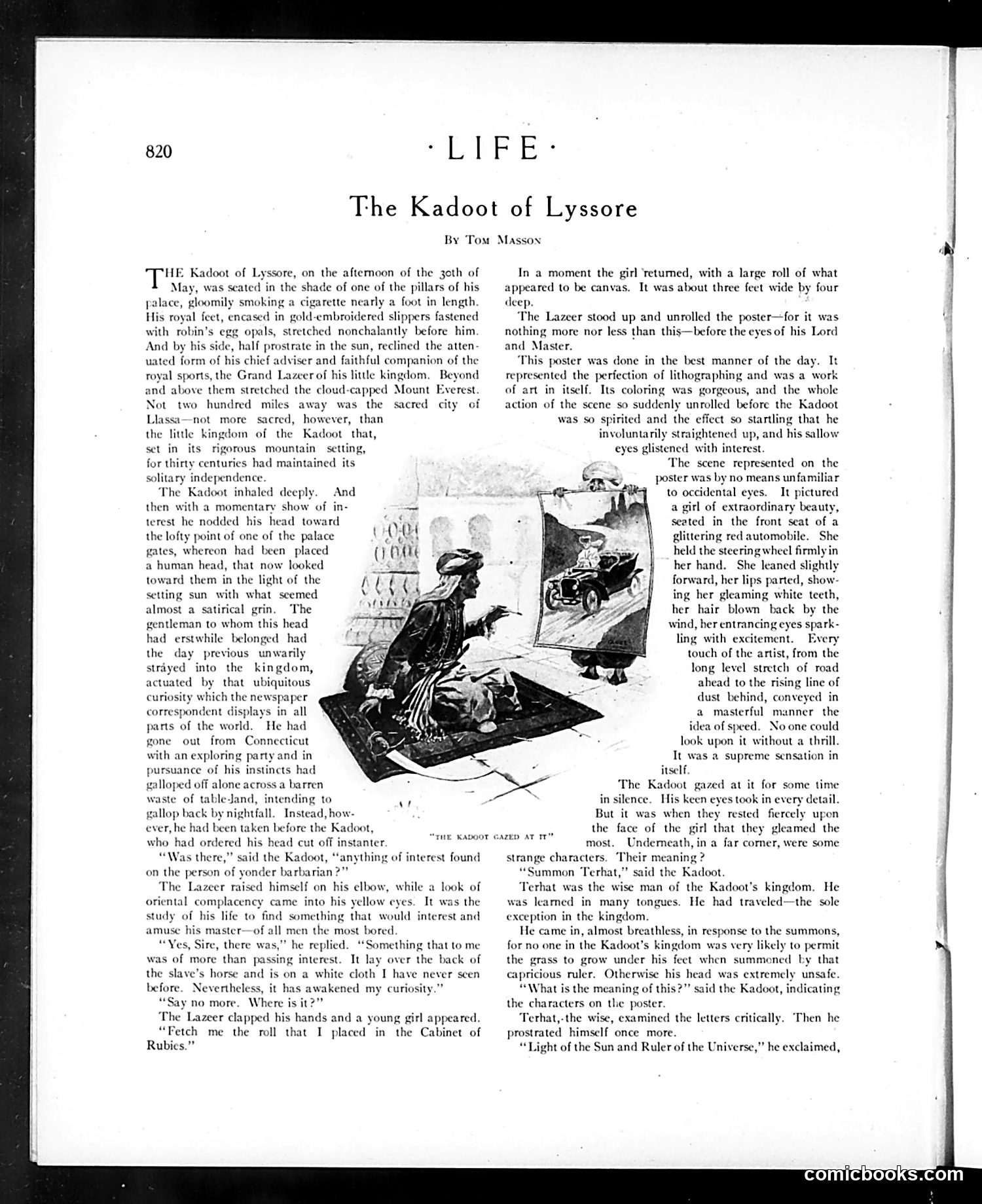
This is a satirical story (not a political cartoon) about an isolated Eastern ruler encountering Western modernity. The "Kadoot" represents a fictional Asian potentate living in rigid tradition for "thirty centuries" in a remote mountain kingdom. The satire centers on his discovery of an **automobile advertisement poster** brought by a dead American journalist. The poster depicts a woman driving a red car—embodying Western progress, speed, and female independence. The Kadoot's reaction to this image of modernity is the joke's focus. The humor targets both the isolated, bored Eastern ruler unfamiliar with Western industrial culture, and perhaps Western presumptions about introducing such "civilization" to the East. The beheaded journalist represents the fatal clash between Western curiosity and Eastern sovereignty. The story mocks orientalist stereotypes while satirizing American expansionism and cultural imperialism.
📄 Transcribed text from this page (OCR, searchable)
Machine-transcribed from the original scan — historical spelling and the odd misread are preserved.
“LIFE: The Kadoot of Lyssore By Tom Masson HE Kadoot of Lyssore, on the afternoon of the 3oth of May, was seated in the shade of one of the pillars of his palace, gloomily smoking a cigarette nearly a foot in length. His royal feet, encased in gold-embroidered slippers fastened with robin’s egg opals, stretched nonchalantly before him And by his side, half prostrate in the sun, reclined the atten uated form of his chief adviser and faithful companion of the royal sports, the Grand Lazeer of his little kingdom, Beyond nd above them stretched the cloud-capped Mount Everest. Not two hundred miles away was the sacred city of Llassa—not more sacred, however, than the lithe kingdom of the Kadoot that, set in its rigorous mountain setting, for thirty centuries had maintained its solitary independence. The Kadoot inhaled deeply. And then with a momentary show of in- terest he nodded his head toward the lofty point of one of the palace gates, whereon had been placed a human head, that now looked toward them in the light of the setting sun with what seemed almost a satirical grin, The gentleman to whom this head had erstwhile belonged had the day previous unwarily strayed into the kingdom, actuated by that ubiquitous curiosity which the newspaper correspondent displays in all parts of the world. He had gone out from Connecticut with an exploring party and in pursuance of his instincts had galloped off alone across a barren waste of tableJand, intending to rallop back by nightfall. Instead, how- ever, he had been taken before the Kadoot, who had ordered his head cut off instanter. “Was there,” said the Kadoot, “anything of interest found on the person of yonder barbarian?” The Lazeer raised himself on his elbow, while a look of oriental complacency came into his yellow eyes. It was the study of his life to find something that would interest and amuse his master—of all men the most bored. “Yes, Sire, there was,” he replied. “Something that to me was of more than passing interest. It lay over the back of the slave’s horse and is on a white cloth I have never seen before. Nevertheless, it has awakened my curiosity “Say no more. Where is it? The Lazeer clapped his hands and a young girl appeared. “Fetch me the roll that I placed in the Cabinet of Rubies.” “4ne KADOOT GAZED AT It” In a moment the girl ‘retumed, with a large roll of what appeared to be canvas. It was about three feet wide by four deep. The Lazeer stood up and unrolled the poster—for it was nothing more nor less than this—before the eyes of his Lord and Master. ‘This poster was done in the best manner of the day. It represented the perfection of lithographing and was a work of art in itself. Its coloring was gorgeous, and the whole action of the scene so suddenly unrolled before the Kadoot was so spirited and the effect so startling that he involuntarily straightened up, and his sallow eyes glistened with interest. The scene represented on the poster was by no means unfamiliar to occidental eyes. It pictured a girl of extraordinary beau seated in the front seat of a glittering red automobile. She held the steering wheel firmly in her hand. She leaned slightly forward, her lips parted, sho ing her gleaming white teeth, her hair blown back by the wind, her entrancing eyes spark- ling with excitement. Every touch of the artist, from the long level stretch of road ahead to the rising line of dust behind, conveyed in a masterful manner the idea of speed. No one could look upon it without a thrill. It was a supreme sensation in itself. The Kadoot gazed at it for some time in silence. His keen eyes took in every detail. But it was when they rested fiercely upon the face of the girl that they gleamed the most. Undemeath, in a far corner, were some strange characters. Their meaning ? “Summon Terhat,” said the Kadoot. Terhat was the wise man of the Kadoot’s kingdom. He was leamed in many tongues. He had traveled—the sole exception in the kingdom. He came in, almost breathless, in response to the summons, for no one in the Kadoot’s kingdom was very likely to permit the grass to grow under his feet when summoned by that capricious ruler. Otherwise his head was extremely unsafe. “What is the meaning of this?” said the Kadoot, indicating the characters on the poster. Terhat,-the wi mined the letters critically. Then he prostrated himself once more. “Light of the Sun and Ruler of the Universe,” he exclaimed, 3 Sad