
Life, 1906-07-05 · page 18 of 40
Life — July 5, 1906 — page 18: what you’re looking at
What you’re looking at
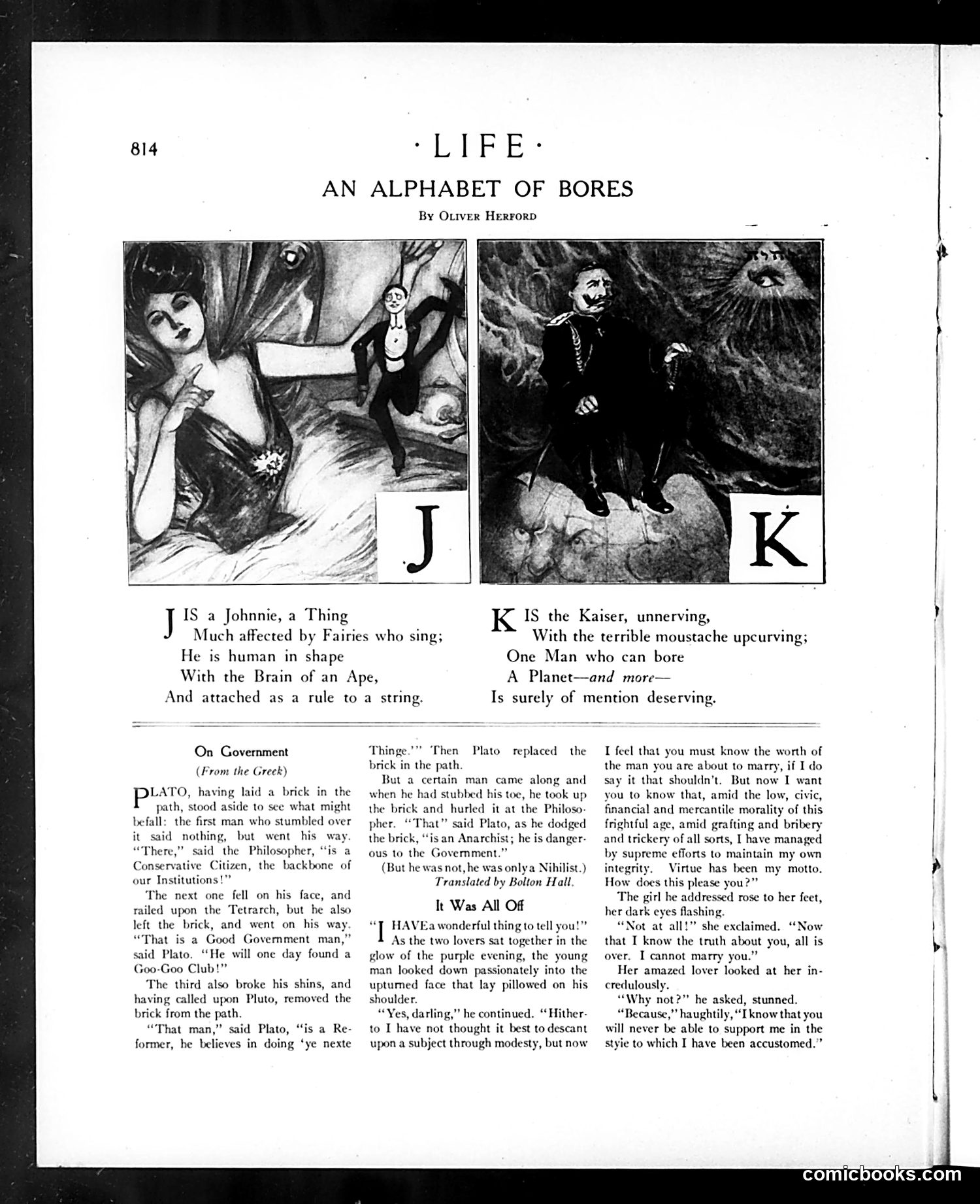
This page presents satirical character sketches. The "J" entry mocks affected aesthetes influenced by the Decadent movement—vain men obsessed with fairy tales and artistic pretension despite lacking intelligence. The "K" entry targets Kaiser Wilhelm II of Germany, caricatured with his famous upturned mustache as a tedious, dangerous bore capable of causing planetary-scale destruction. The Plato anecdote ridicules different political responses: the conservative accepts injustice passively; the reformer removes obstacles to progress; the anarchist/nihilist violently rejects the system itself. Plato's dismissal of the brick-thrower as dangerous despite being "only a Nihilist" suggests satirical confusion about revolutionary movements. The final story mocks self-righteous hypocrisy: a man boasts of maintaining integrity amid universal corruption, only to be rejected by his fiancée, who reveals her real concern—she needs his *money*, not his virtue, to sustain her lifestyle.
📄 Transcribed text from this page (OCR, searchable)
Machine-transcribed from the original scan — historical spelling and the odd misread are preserved.
© LEP E* AN ALPHABET OF BORES By Ottver HEerProrD IS a Johnnie, a Thing Much affected by Fairies who sing; He is human in shape With the Brain of an Ape, And attached as a rule to a string. On Government (From the Greek) LATO, having laid a brick in the path, stood aside to see what might befall: the first man who stumbled over it said nothing, but went his way. “There,” said the Philosopher, “is a Conse: e Citizen, the backbone of our Institutions!” The next one fell on his face, and railed upon the Tetrarch, but he also left the brick, and went on his way, “That is a Good Government man,” said Plato. “He will one day found a Goo-Goo Club!” The third also broke his shins, and having called upon Pluto, removed the brick from the path. “That man,” said Plato, “is a Re- former, he believes in doing ‘ye nexte IS the Kaiser, unnerving, With the terrible moustache upcurving; One Man who can bore Thinge.’” Then Plato replaced the brick in the path. But a certain man came along and when he had stubbed his toe, he took up. the brick and hurled it at the Philoso- pher. “That” said Plato, as he dodged the brick, “is an Anarchist; he is danger- ous to the ‘mment.”” (But he was not, he was only a Nihilist.) Translated by Bolton Hall. It Was All Of “T HAVEa wonderful thing to tell you!” As the two lovers sat together in the glow of the purple evening, the young man looked down passionately into the uptumed face that lay pillowed on his shoulder. “Yes, darling,” he continued. “Hither- to I have not thought it best to descant upon a subject through modesty, but now A Planet—and more— Is surely of mention deserving. I feel that you must know the worth of the man you are about to marry, if I do say it that shouldn’t. But now I want you to know that, amid the low, civic, financial and mercantile morality of this frightful age, amid grafting and bribery and trickery of all sorts, I have managed by supreme efforts to maintain my own integrity, Virtue has been my motto. How does this please you?” The girl he addressed rose to her feet, her dark eyes flashing. “Not at all!” she exclaimed. “Now that I know the truth about you, all is over. I cannot marry you.” Her amazed lover looked at her in- credulously. “Why not?” he asked, stunned. “Because,” haughtily, “I know that you will never be able to support me in the styie to which I have been accustomed.”