
Life, 1906-07-05 · page 10 of 40
Life — July 5, 1906 — page 10: what you’re looking at
What you’re looking at
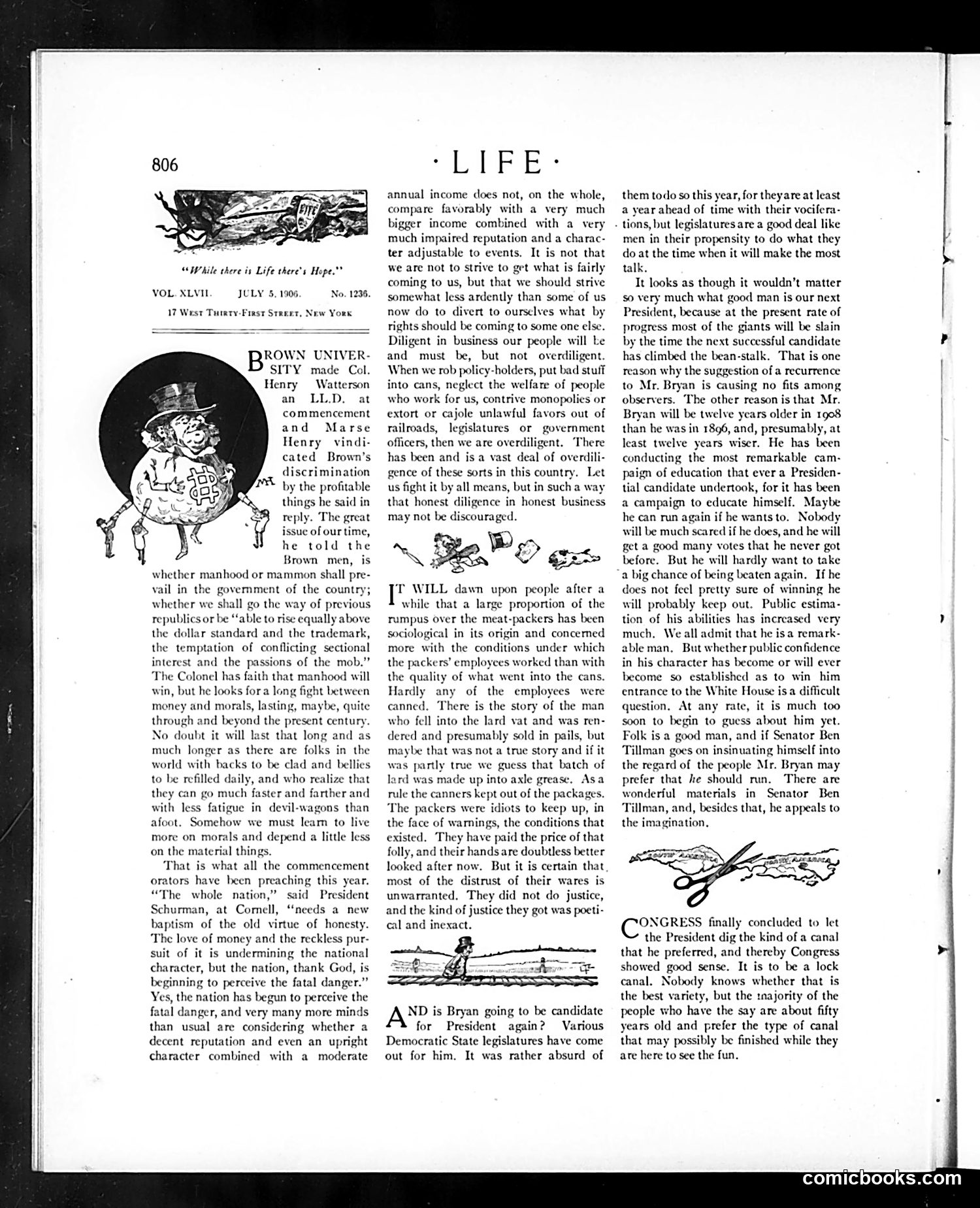
This page contains editorial commentary rather than political cartoons. The text discusses Brown University's commencement address by Col. Henry Watterson (an L.L.D. honoree), emphasizing themes of honesty, manhood, and moral character in business and government. The main illustration shows a rotund, caricatured figure (likely representing a corrupt businessman or politician) being manipulated like a puppet by unseen forces—a visual metaphor for how dishonest interests control public figures. The editorial goes on to discuss William Jennings Bryan's potential 1908 presidential candidacy, questioning whether his reputation has recovered enough to win. The overall message criticizes business monopolies, government corruption, and urges "honest diligence" in public service during the Progressive Era.
📄 Transcribed text from this page (OCR, searchable)
Machine-transcribed from the original scan — historical spelling and the odd misread are preserved.
“While there is Life there's Hope.” VOL. XLVIL JULY 5, 1906. No. 1236. 17 West Tutety-Finst Street, New Yore ROWN UNIVER- SITY made Col. Henry — Watterson an LL.D. at commencement and Marse Henry vindi- cated Brown's discrimination by the profitable things he said in reply. The great issue of our time, he told the Brown men, is whether manhood or mammon shall pre- vail in the government of the country; whether we shall go the way of previous republics or be “able to rise equally above the dollar standard and the trademark, the temptation of conflicting sectional interest and the passions of the mob.” The Colonel has faith that manhood will win, but he looks fora long fight between mon nd morals, lasting, maybe, quite through and beyond the present century. No doubt it will last that long and much longer as there are folks in the world with backs to be clad and bellies to be refilled daily, and who realize that they can go much faster and farther and with | fatigue in devil-wagons than afoot. Somehow we must leam to live more on morals and depend a little less on the material things. ‘That is what all the commencement orators have been preaching this year. “The whole nation,” said President Schurman, at Cornell, “needs a new baptism of the old virtue of honesty. ‘The love of money and the reckless pur- suit of it is undermining the national character, but the nation, thank God, beginning to perceive the fatal danger.” Yes, the nation has begun to perceive the fatal danger, and very many more minds than usual are considering whether a decent reputation and even an upright character combined with a moderate s ‘LIFE: annual income does not, on the whole, compare favorably with a very much bigger income combined with a very much impaired reputation and a charac- ter adjustable to events. It is not that we are not to strive to get what is fairly coming to us, but that we should strive somewhat less ardently than some of us now do to divert to ourselves what by rights should be coming to some one else. Diligent in business our people will be and must be, but not overdiligent. When we rob policy-holders, put bad stuff into cans, neglect the welfare of people who work for us, contrive monopolies or extort or cajole unlawful favors out of railroads, legislatures or government officers, then we are overdiligent. There has been and is a vast deal of overdili- gence of these sorts in this country, Let us fight it by all means, but in such a way that honest diligence in honest business may not be discouraged. T WILL dawn upon people after a while that a large proportion of the rumpus over the meat-packers has been sociological in its origin and concemed more with the conditions under which the packers’ employces worked than with the quality of what went into the cans. Hardly any of the employees were canned. There is the story of the man who fell into the lard vat and was ren- dered and presumably sold in pails, but maybe that was not a true story and if it was partly true we guess that batch of lard was made up into axle grease. Asa rule the canners kept out of the packag The packers were idiots to keep up, in the face of warnings, the conditions that existed. They have paid the price of that folly, and their hands are doubtless better looked after now. But it is certain that most of the distrust of their wares is unwarranted, They did not do justice, and the kind of justice they got was poeti- cal and inexact. A D is Bryan going to be candidate for President again? Various Democratic State legislatures have come out for him. It was rather absurd of them todo so this year, for theyare at least a year ahead of time with their vocifera- - tions, but legislatures are a good deal like men in their propensity to do what they do at the time when it will make the most talk. Tt looks as though it wouldn’t matter so very much what good man is our next President, because at the present rate of progress most of the giants will be slain by the time the next successful candidate has climbed the bean-stalk. That is one reason why the suggestion of a recurrence to Mr. Bryan is causing no fits among observers. The other reason is that Mr. Bryan will be twelve years older in 1908 than he was in 1896, and, presumably, at least twelve years wiser. He has been conducting the most remarkable cam- paign of education that ever a Presiden- tial candidate undertook, for it has been a campaign to educate himself. Maybe he can run again if he wants to. Nobody will be much scared if he does, and he will get a good many votes that he never got before. But he will hardly want to take a big chance of being beaten again. If he does not feel pretty sure of winning he will probably keep out. Public estima- tion of his abilities has increased very much, We admit that he is a remark- able man. But whether public confidence in his character has become or will ever become so established as to win him entrance to the White House isa difficult question, At any rate, it is much too soon to begin to guess about him yet. Folk is a good man, and if Senator Ben Tillman goes on insinuating himself into the regard of the people Mr. Bryan may prefer that hte should run. There are wonderful materials in Senator Ben Tillman, and, besides that, he appeals to the imagination, ONGRESS finally concluded to let the President dig the kind of a canal that he preferred, and thereby Congress showed good sense. It is to be a lock canal. Nobody knows whether that is the best variety, but the tnajority of the people who have the say are about fifty ars old and prefer the type of canal that may possibly be finished while they are here to see the fun. —- ~ comicbooks.com