
Life, 1906-07-05 · page 22 of 40
Life — July 5, 1906 — page 22: what you’re looking at
What you’re looking at
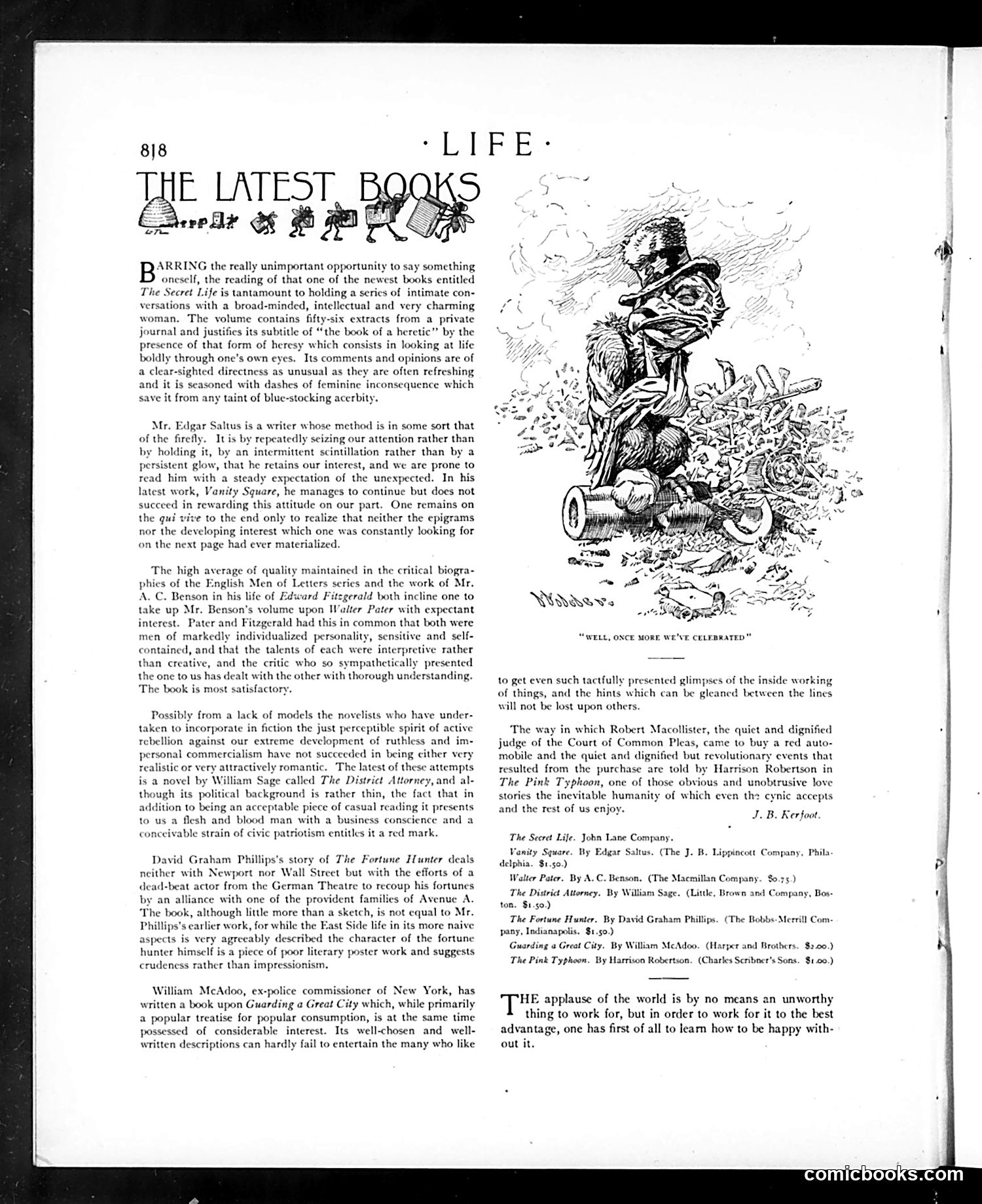
This page is primarily a **book review section**, not political satire. The single cartoon shows a figure celebrating atop what appears to be a wheeled vehicle or wagon, captioned "Well, once more we've celebrated"—likely mocking the repetitive, hollow nature of social celebrations or commemorations. The text reviews recent novels and non-fiction works, including *The Secret Life*, *Vanity Square* by Edgar Saltus, and *The Fortune Hunter* by David Graham Phillips. The reviews praise some works (like Benson's biography of Walter Pater) while critiquing others as poorly constructed or lacking substance. The cartoon's modest humor seems to satirize the cyclical, performative aspects of social ritual rather than targeting specific political figures or events. The page reflects early 20th-century literary culture and Life's role as a vehicle for both satire and cultural commentary.
📄 Transcribed text from this page (OCR, searchable)
Machine-transcribed from the original scan — historical spelling and the odd misread are preserved.
8]8 THE LATEST ARRING the really unimportant opportunity to say something oneself, the reading of that one of the newest books entitled The Secret Life is tantamount to holding a series of intimate con- versations with a broad-minded, intellectual and very charming woman. The volume contains fifty-six extracts from a private journal and justifies its subtitle of “the book of a heretic” by the presence of that form of heresy which consists in looking at boldly through one’s own eyes. Its comments and opinions are of a clear-sighted directness as unusual as they are often refreshing and it is seasoned with dashes of feminine inconsequence which save it from any taint of blue-stocking acerbity. Mr. Edgar Saltus is a writer whose method is in some sort that of the firefly. It is by repeatedly seizing our attention rather than by holding it, by an intermittent scintillation rather than by a persistent glow, that he retains our interest, and we are prone to read him with a steady expectation of the unexpected. In his latest work, Vanity Square, he manages to continue but docs not succeed in rewarding this attitude on our part. One remains on the qui vive to the end only to realize that neither the epigrams nor the developing interest which one was constantly looking for on the next page had ever materialized. The high average of quality maintained in the critical biogra~ phics of the English Men of Letters series and the work of Mr. A. C. Benson in his life of Edward Fitsgerald both incline one to take up Mr. Benson's volume upon Walter Pater with expectant interest. Pater and Fitzgerald had this in common that both were men of markedly individualized personality, sensitive and self- contained, and that the talents of each were interpretive rather than creative, and the critic who so sympathetically presented the one to us has dealt with the other with thorough understanding. ‘The book is most satisfactory. Possibly from a lack of models the novelists who have under- taken to incorporate in fiction the just perceptible spirit of active rebellion against our extreme development of ruthless and im- personal commercialism have not succeeded in being cither very alistic or very attractively romantic. ‘The latest of these attempts is a novel by William Sage called The District Attorney, and al- though its political background is rather thin, the fact that in addition to being an acceptable piece of casual reading it presents flesh and blood man with a business conscience and a ic patriotism entitles it a red mark. to us conceivable strain of ci David Graham Phillips's story of The Fortune Hunter deals neither with Newport nor Wall Street but with the efforts of a dead-beat actor from the German Theatre to recoup his fortunes by an alliance with one of the provident families of Avenue A. ‘The book, although little more than a sketch, is not equal to Mr. Phillips's earlier work, for while the East Side life in its more naive aspects is very agreeably described the character of the fortune hunter himself is a piece of poor literary poster work and suggests crudeness rather than impressionism, mn McAdoo, ex-police commissioner of New York, has written a book upon Guarding a Great City which, while primarily a popular treatise for popular consumption, is at the same time possessed of considerable interest. Its well-chosen and well written descriptions can hardly fail to entertain the many who like Marys “WELL, ONCE MORE WE'VE CELEBRATED" to get even such tactfully presented glimpses of the inside working of things, and the hints which can be gleaned between the lines will not be lost upon others. ‘The way in which Robert Macollister, the quiet and dignified judge of the Court of Common Pleas, came to buy a red auto- mobile and the quiet and dignified but revolutionary events that resulted from the purchase are told by Harrison Robertson in The Pink Typhoon, one of those obvious and unobtrusive love stories the inevitable humanity of which even thz cynic accepts and the rest of us enjoy. T-B. Kerfoot The Secret Lije. John Lane Company. Vanity Square. By Edgar Saltus. (The J. B. Lippincott Company, Phila delphia. $1.50.) Walter Pater. By A.C. Benson, (The Macmillan Company. $0.75.) The District Attorney. By William Sage. (Little, Brown and Company, Bos- ' ton. $1.50.) The Fortune Hunter. By David Graham Phillips. (The Bobbs-Me pany, Indianapolis. $1.50.) Guarding a Great City. By William McAdoo. (Harper and Brothers. $2.0.) The Pink Typhoon. By Harrison Robertson. (Charles Scribnet’s Sons. $1.00.) Com- 'HE applause of the world is by no means an unworthy thing to work for, but in order to work for it to the best advantage, one has first of all to leam how to be happy with- out it.