
A complete issue · 42 pages · 1906
Life — June 7, 1906
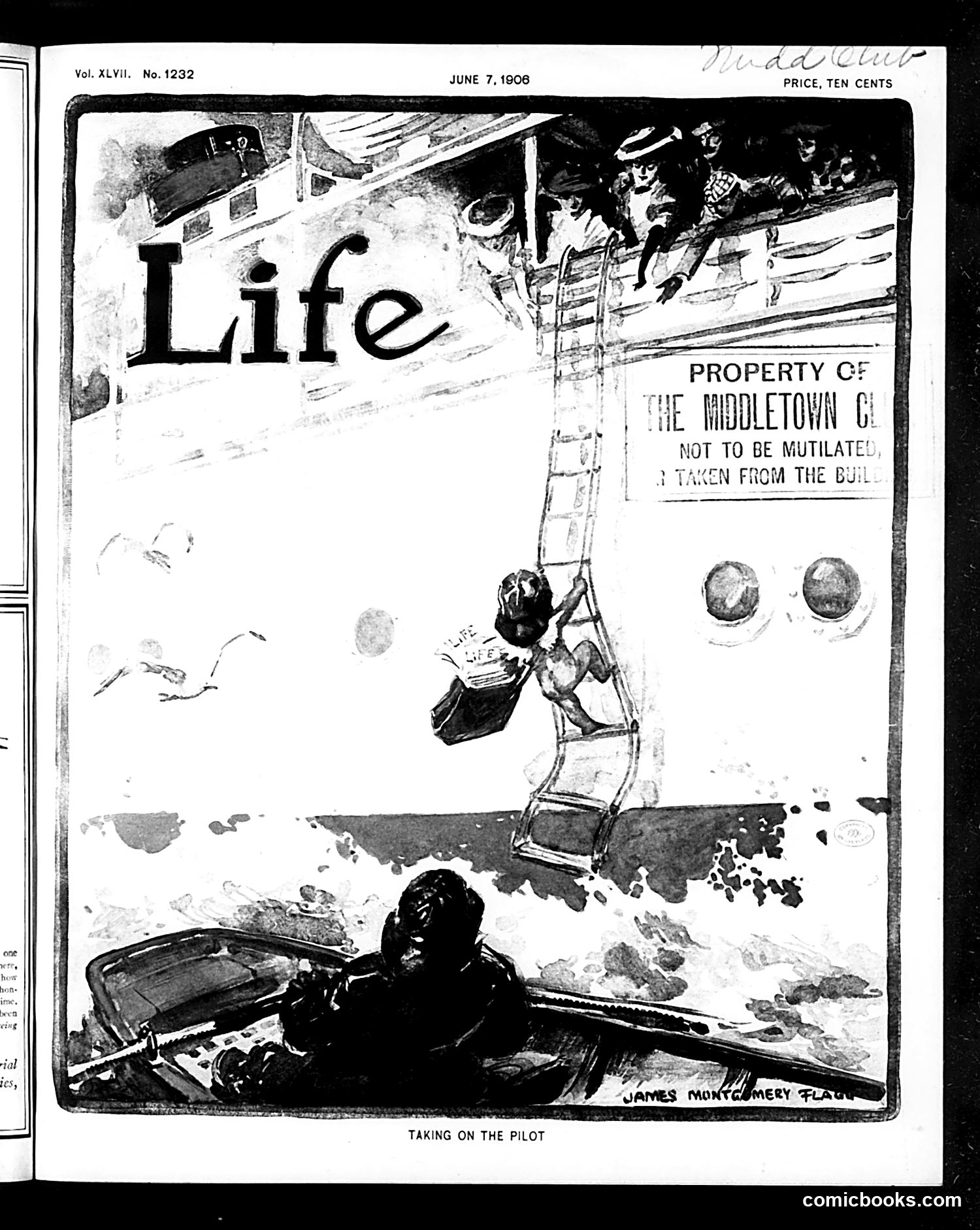
This cover illustrates "Taking on the Pilot"—a maritime scene showing someone climbing a ladder aboard a ship to take control from the current pilot. The cartoon likely functions as **political allegory**, with the ship representing the nation or government. The figure ascending the ladder presumably represents a political leader or reformer preparing to assume power or direction. The property stamp from "The Middletown G[azette]" suggests this was a library copy. James Montgomery Flagg's signature indicates his authorship of this satirical illustration. Without additional context about 1906 political events, the specific identity of the ascending figure remains unclear, though the "taking the helm" metaphor suggests commentary on political transition or leadership change.
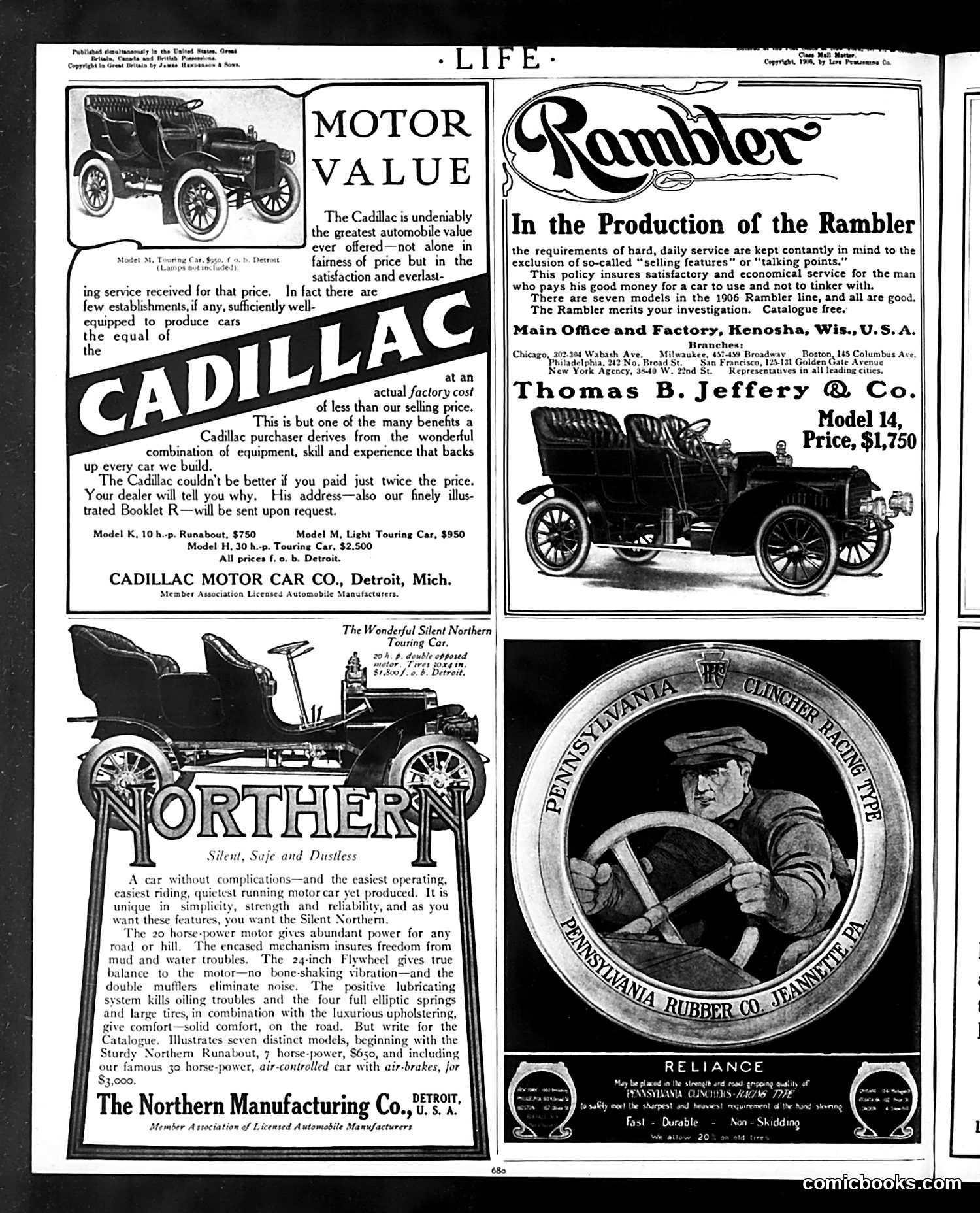
This page is **primarily automobile advertisements**, not satirical content. It contains four car ads from circa 1908-1909: 1. **Cadillac** emphasizes "Motor Value"—affordable luxury at factory cost 2. **Rambler** advertises Model 14 at $1,150, highlighting quality construction 3. **Northern** touts a "Silent, Safe and Dustless" vehicle with advanced features like air brakes 4. **Pennsylvania Clincher** tire ad features a driver portrait, emphasizing durability ("fast, durable, non-skidding") The page reflects the early automobile era's competitive market, where manufacturers stressed reliability, affordability, and technological innovation to convince skeptical consumers. There is no political satire present—this represents Life magazine's revenue model through paid advertising rather than editorial commentary.
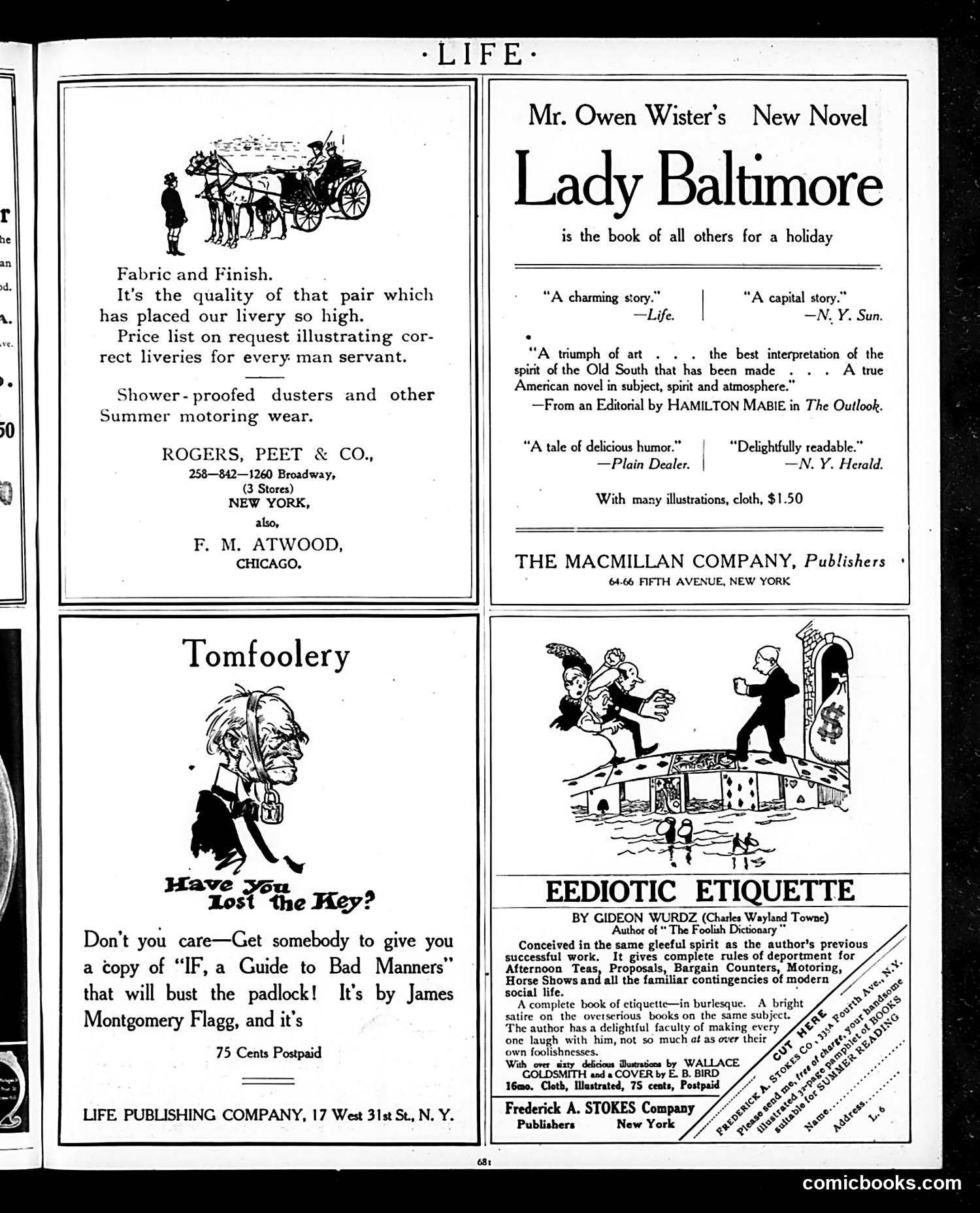
This page is primarily **advertising**, not political satire. It contains four book/product advertisements from early 20th-century publishers: 1. **Top left**: Rogers, Peet & Co. advertises livery services and summer wear 2. **Top right**: The Macmillan Company promotes Owen Wister's novel *Lady Baltimore*, calling it ideal for holidays 3. **Bottom left**: Life Publishing Company sells "If, a Guide to Bad Manners" by James Montgomery Flagg—a humorous etiquette guide featuring a caricatured face with text "Have you lost the Key?" The joke satirizes poor manners as foolishness 4. **Bottom right**: Frederick A. Stokes Company advertises *Fediotic Etiquette* by Gideon Wurdz, another satirical etiquette book The etiquette guides represent the period's popular humor mocking social pretension and bad behavior.
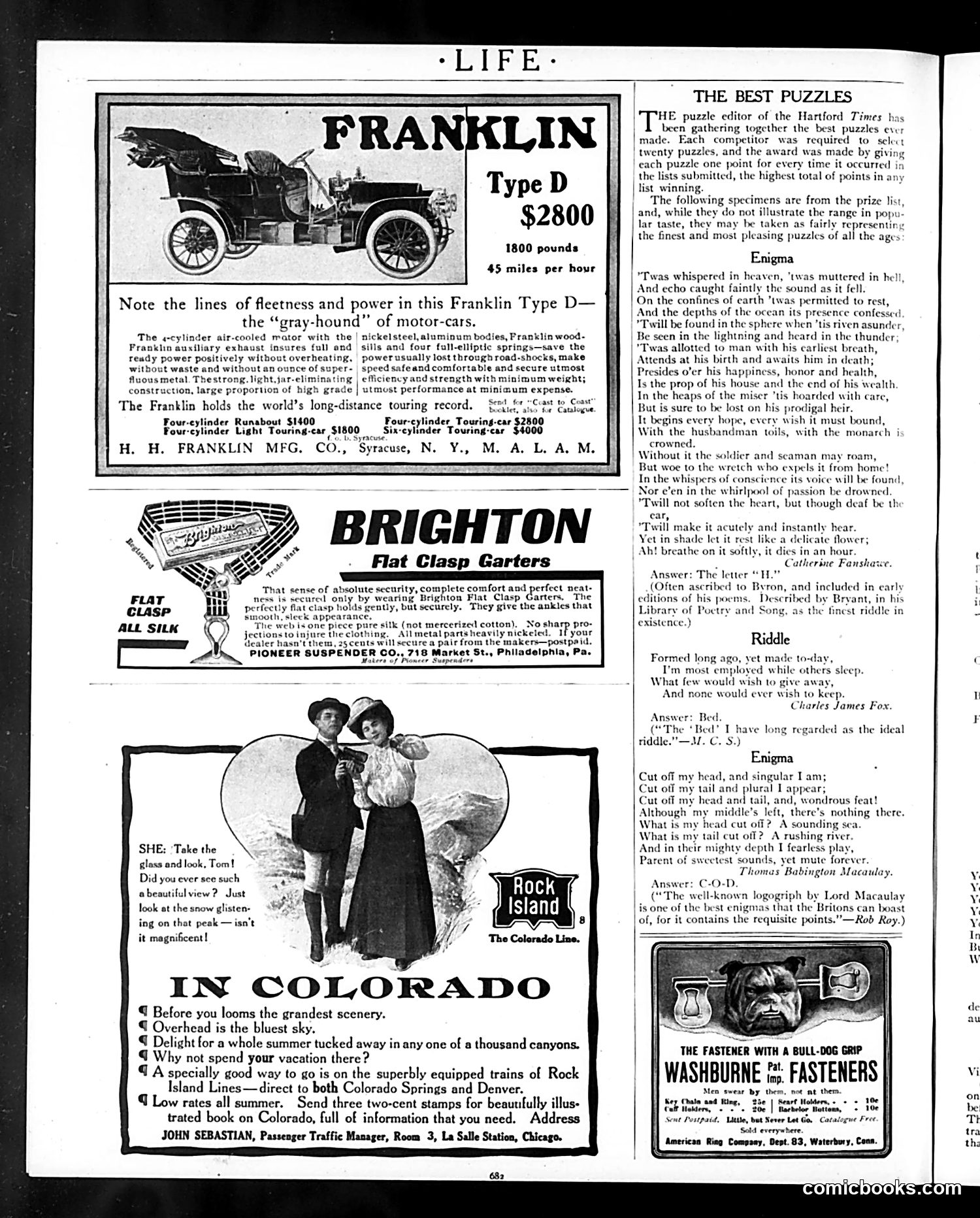
This page is primarily **advertising** rather than political cartoons. It features: 1. **Franklin automobile ad** (top) - promoting the Type D model at $2800, emphasizing its air-cooled engine and engineering superiority. 2. **Brighton Flat Clasp Garters ad** - highlighting secure, comfortable garter fasteners. 3. **Rock Island railroad ad** - promoting Colorado tourism and train travel, featuring a couple admiring scenic mountain views. 4. **Washburne Fasteners ad** (bottom right) - industrial hardware products. The page also includes "The Best Puzzles" section with riddles and enigmas—typical Life magazine features mixing word puzzles with poetry. No political satire or caricature appears here; this is a standard early-20th-century magazine page balancing editorial content with commercial advertisements.
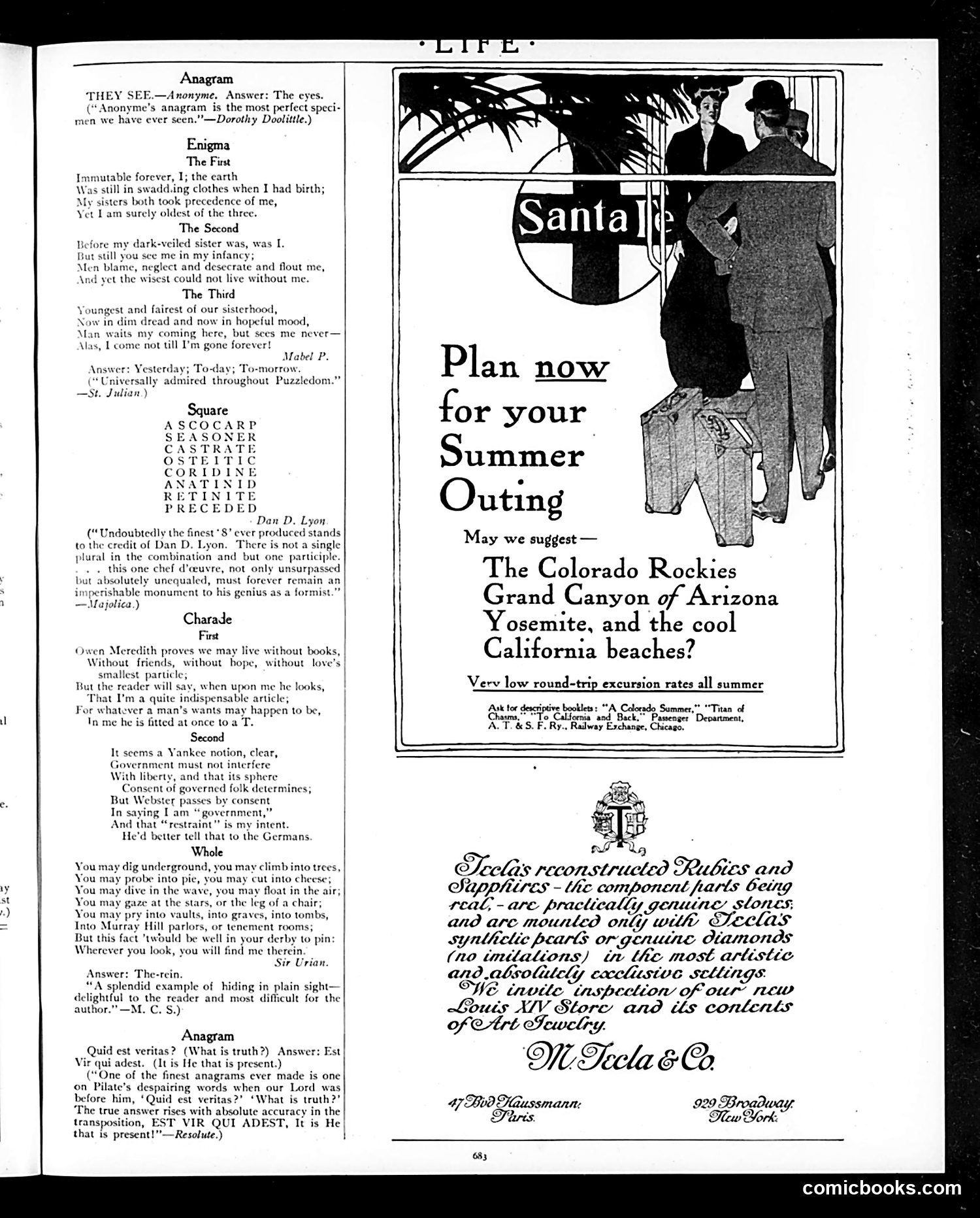
This page is **primarily advertising** with some editorial puzzles. The main visual is a Santa Claus advertisement promoting summer travel to Colorado, the Grand Canyon, Yosemite, and California beaches—a counterintuitive juxtaposition of winter's Santa with summer vacation planning. The left column contains word puzzles and riddles typical of Life's editorial content: anagrams, enigmas, charades, and a square word puzzle. These are lighthearted brain-teasers with literary or philosophical answers. At the bottom, an advertisement for M. Ticla & Co jewelry showcases "reconstructed Rubies and Sapphires," emphasizing they are "practically genuine stones" in "artistic and absolutely exclusive settings"—a sales pitch that paradoxically highlights the products' artificial nature while claiming superiority over imitations.
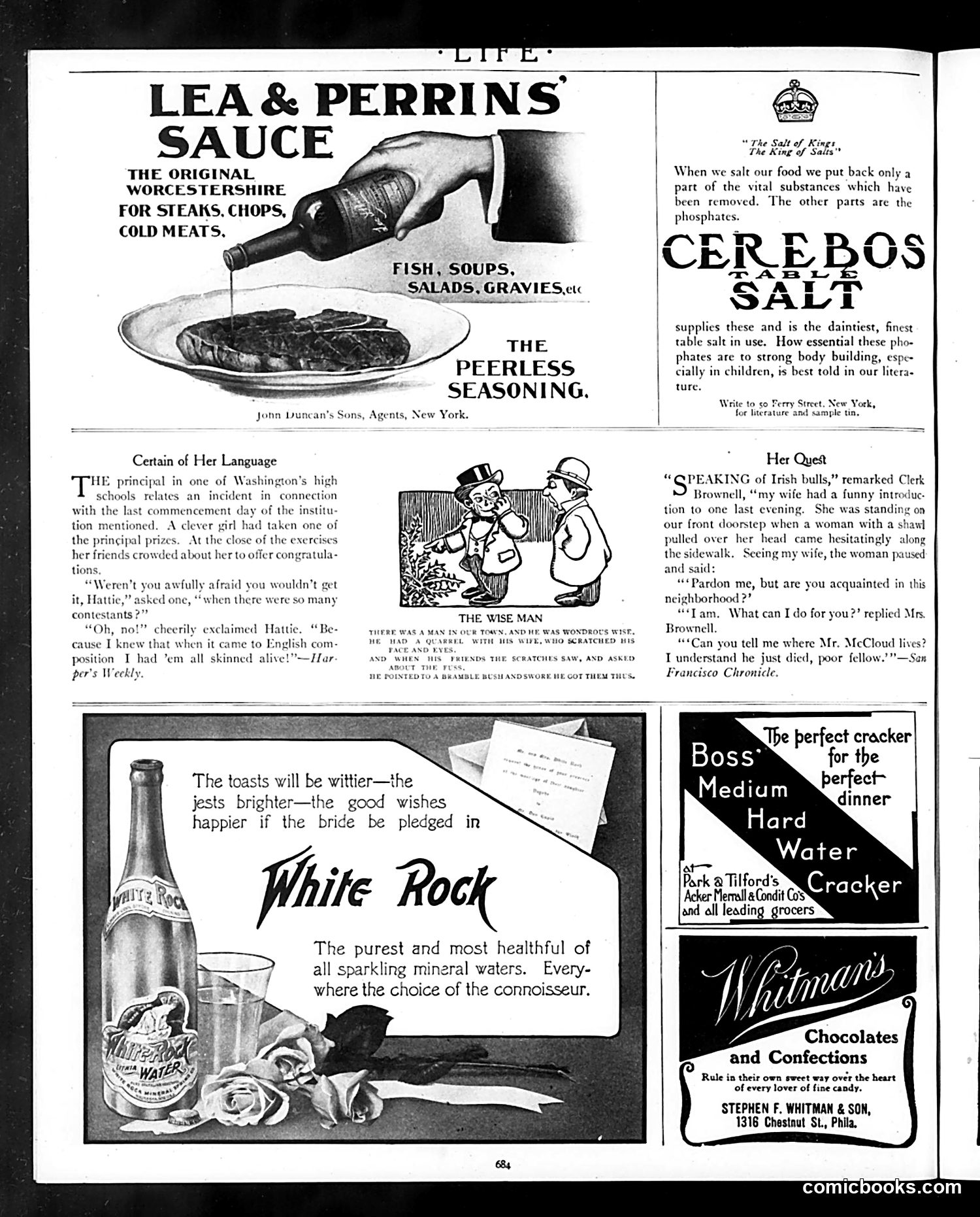
This page is primarily **advertising**, featuring four commercial products typical of early 20th-century America: Lea & Perrins Sauce, Cerebos Salt, White Rock sparkling water, Boss crackers, and Whitman's Chocolates. The only editorial content is a short humor piece titled **"Certain of Her Language,"** describing a Washington school principal who couldn't explain why she chose a student for prizes, admitting ignorance of English composition despite teaching it. The joke mocks pretentious educators unfamiliar with their own subject matter. A second brief item, **"Her Quest,"** recounts an Irish woman asking Mrs. Brownell where a neighbor lives—mild social humor about Irish stereotypes. The cartoon **"The Wise Man"** depicts two men discussing scratches and bruises from a domestic dispute with a woman.
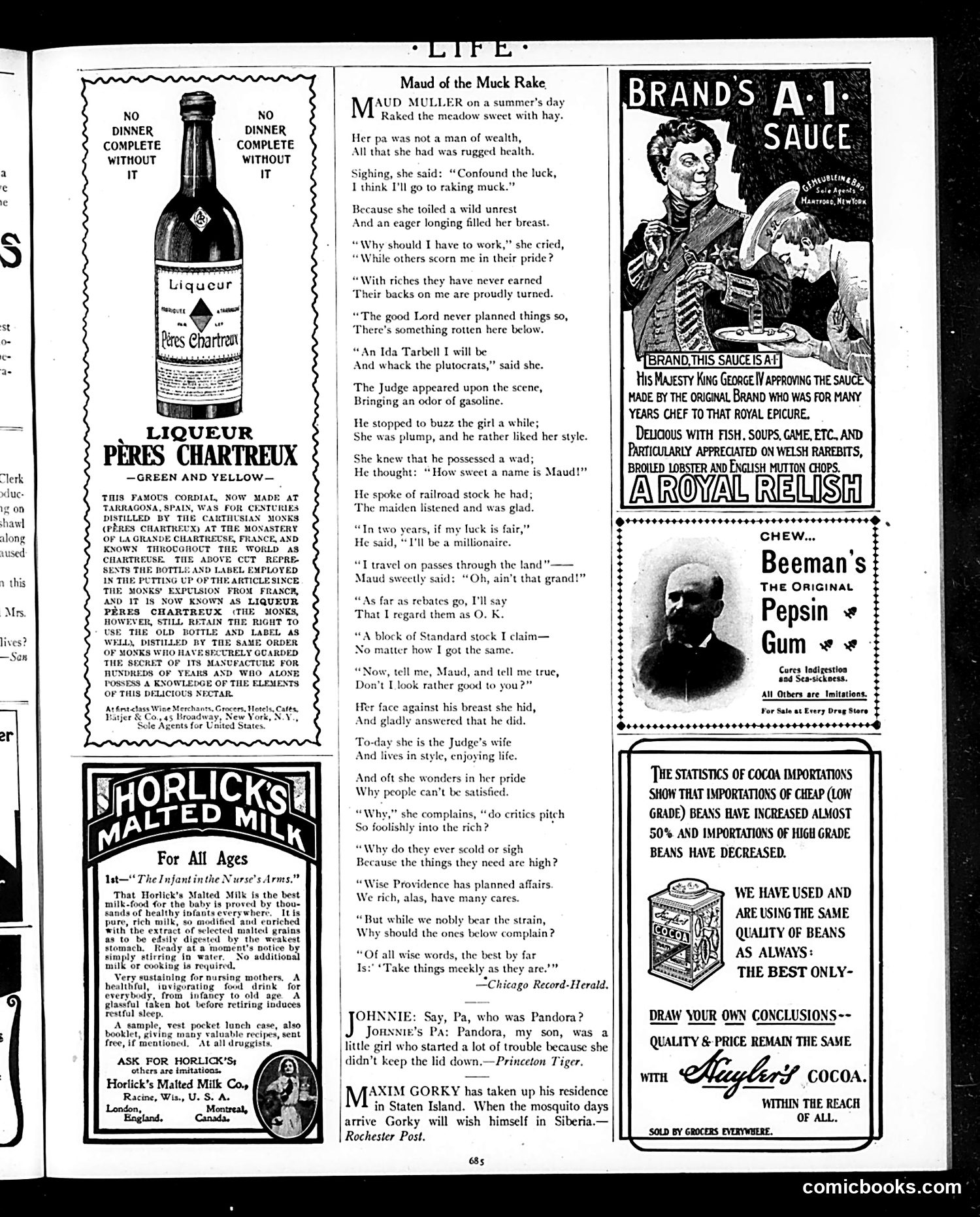
This page is primarily **advertisements and product promotions** rather than political cartoons or satirical content. The main features are: - **Pères Chartreux Liqueur** advertisement promoting a French spirit - **Horlick's Malted Milk** ad claiming nutritional benefits for infants and children - **Brand's A.1. Sauce** advertisement featuring a man approving the condiment - **Beeman's Pepsin Gum** promotional ad - **Rayner's Cocoa** advertisement discussing bean quality In the center is a poem titled "Maud of the Muck Rake" (reprinted from *Chicago Record-Herald* and *Princeton Tiger*) about a working-class woman's frustrations with class inequality and labor conditions. The page also includes brief humorous anecdotes about Pandora and Maxim Gorky. This represents typical early 20th-century magazine content: commercial advertisements interspersed with light satirical poetry and jokes.
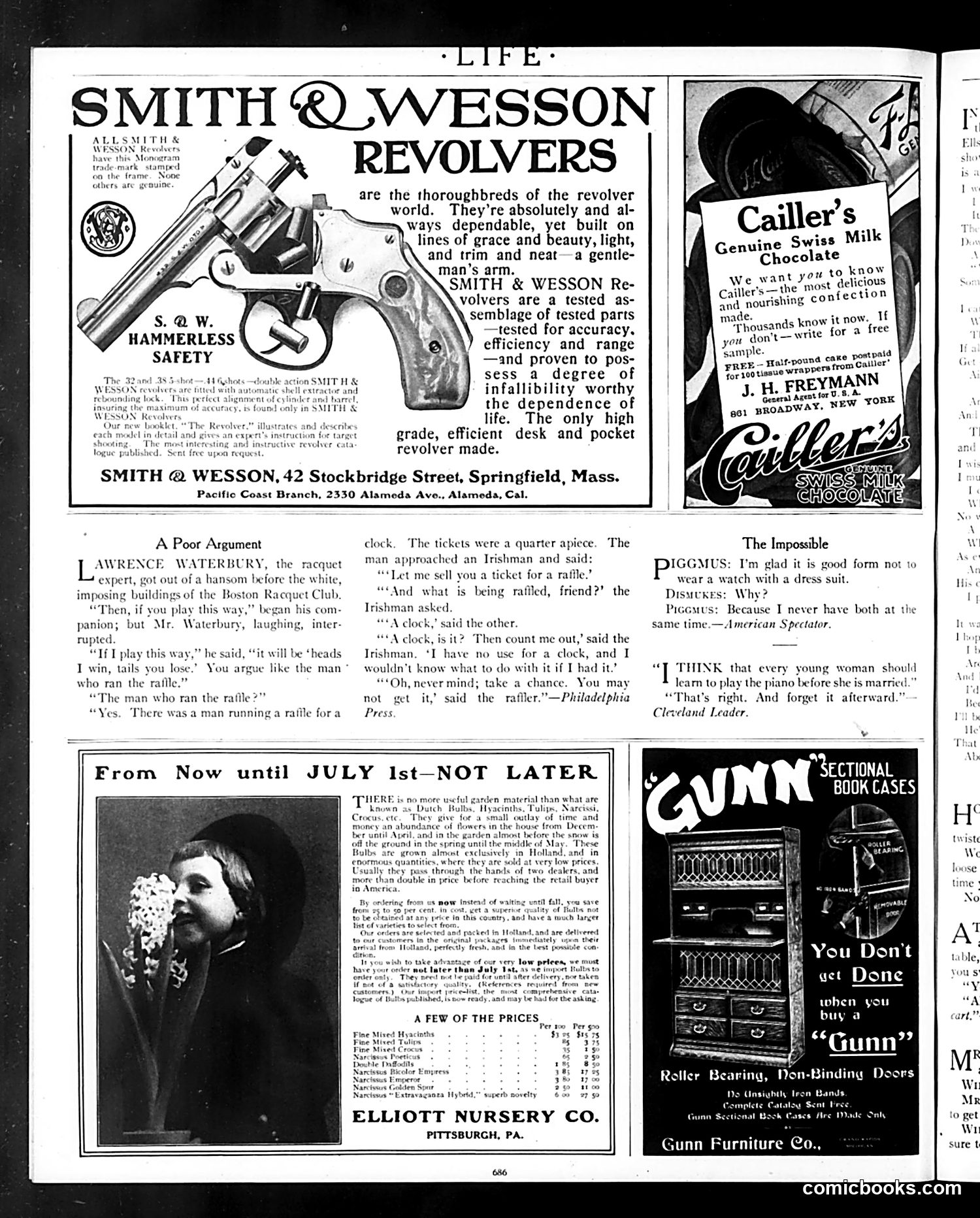
This page is primarily **advertising** rather than satire or political commentary. It contains: 1. **Smith & Wesson Revolvers** ad (top left): Markets firearms as reliable, well-crafted products for dependable self-defense—a standard early 20th-century gun advertisement. 2. **Cailler's Swiss Milk Chocolate** ad (top right): Promotes chocolate as a delicious confection. 3. **Three humor shorts** (middle): Brief joke exchanges about billiards, watches, and piano lessons—light, apolitical comic filler common to Life magazine. 4. **Elliott Nursery Co.** ad (bottom left): Advertises flower bulbs for spring planting. 5. **Gunn Sectional Book Cases** ad (bottom right): Promotes furniture with roller bearings. The page reflects typical early 1900s Life content: a mix of commerce and light entertainment with no discernible political messaging.
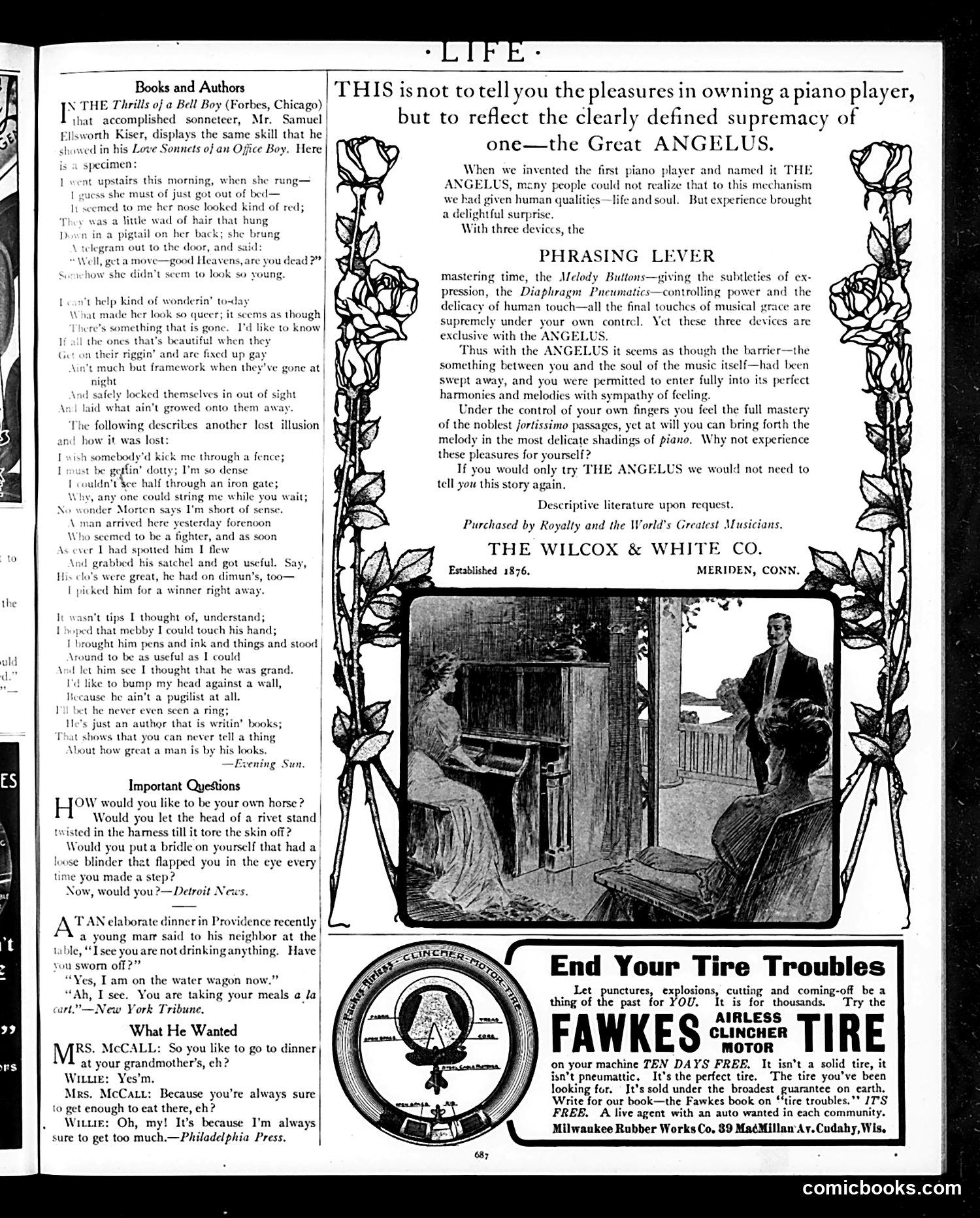
This page is primarily **advertising and poetry**, not political satire. The left column contains two literary pieces: a poem about a woman visiting a friend, and humorous "Important Questions" mocking common social situations (from *Evening Sun* and *Detroit News*). The main content is **advertisements**: 1. **The Angelus piano player** (center) — a luxury music device marketed to wealthy homes, with decorative rose illustrations framing text about its superior "phrasing lever" and musical mastery. 2. **Wilcox & White Company** (Meriden, Connecticut) — established 1876, selling the Angelus. 3. **Fawkes Airless Rubber Motor Tire** (bottom right) — promoting puncture-resistant tires for automobiles, offering a free "tire troubles" book. The page reflects early-20th-century consumer culture targeting affluent readers.
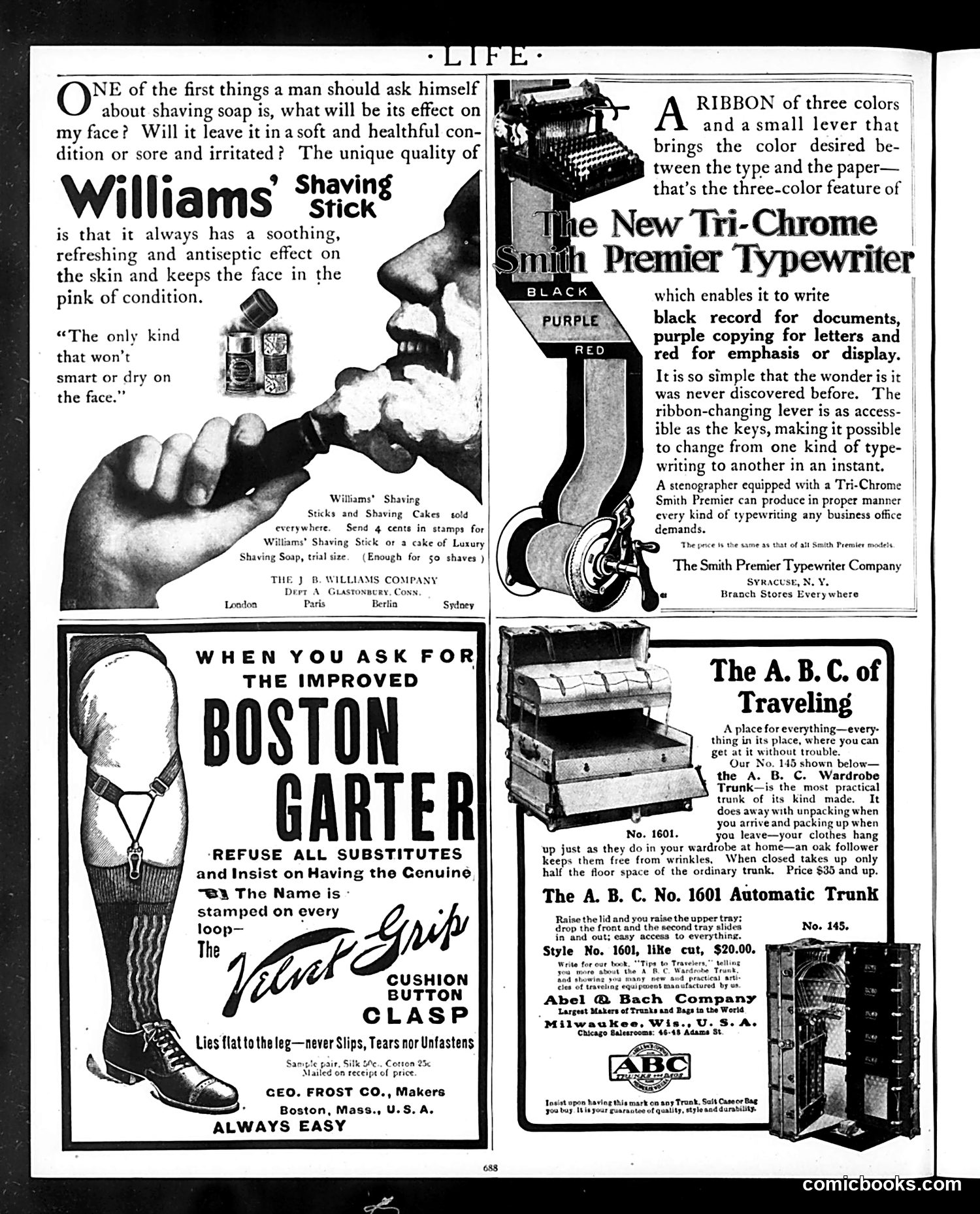
This is primarily a **commercial advertising page**, not political satire. It contains four product advertisements typical of early 20th-century American magazines: 1. **Williams' Shaving Stick** — promotes its soothing, antiseptic properties for face care 2. **Smith Premier Tri-Chrome Typewriter** — highlights its three-color ribbon capability for different document types 3. **Boston Garter** — advertises a garter clasp promising secure fit without slipping 4. **A.B.C. Traveling Trunks** — showcases practical luggage for travelers Each ad uses period-appropriate marketing language emphasizing product reliability and superiority. There is no political content, satire, or caricature with identifiable figures. The page simply demonstrates commercial advertising conventions and consumer goods available to early 20th-century audiences.
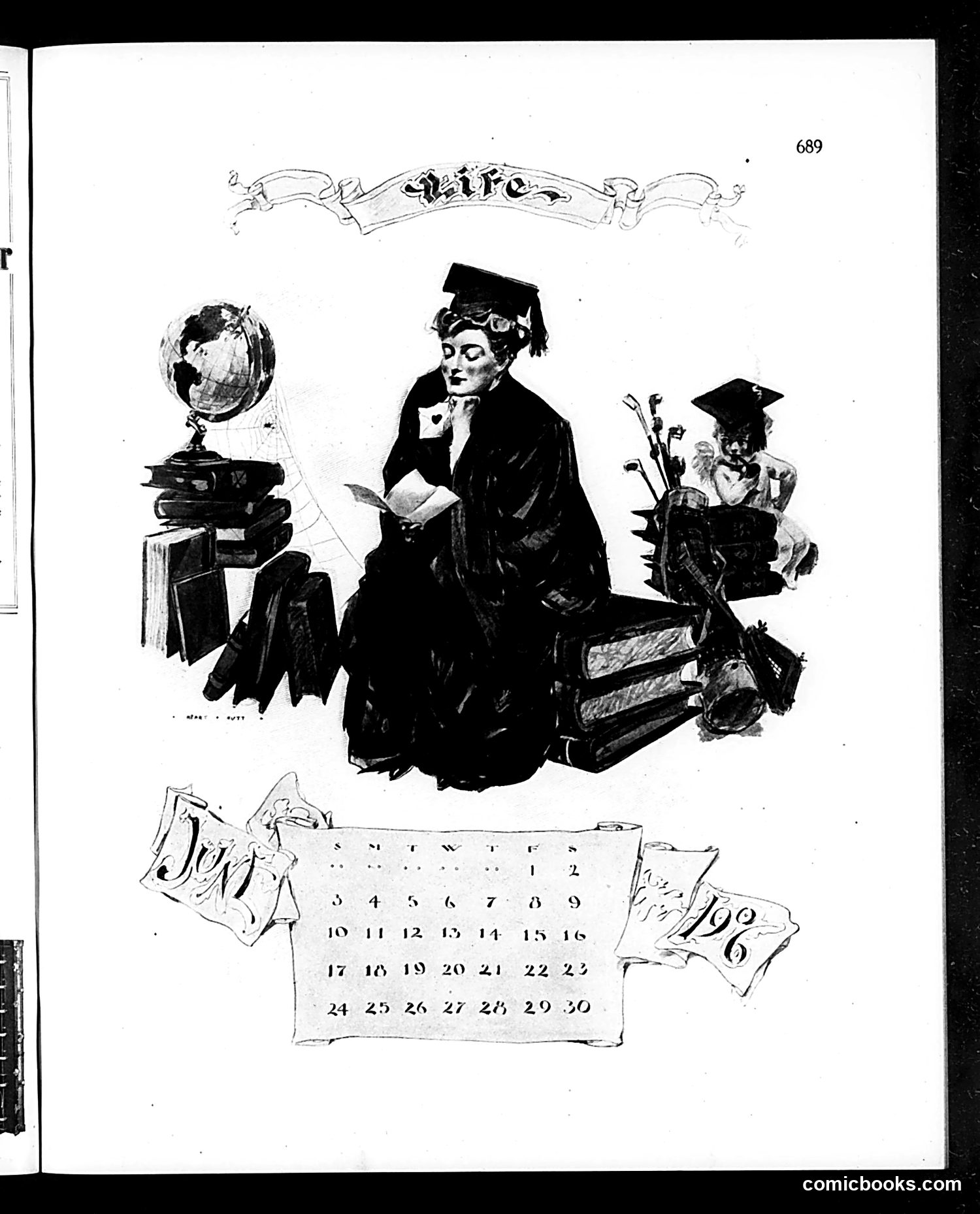
This page appears to be a calendar illustration from *Life* magazine (page 689). The central figure is a scholar or professor wearing academic robes and a mortarboard cap, surrounded by educational symbols: a globe on stacked books to the left, and flowering plants in a pot to the right. The calendar below shows a full month (appears to be June, based on "1896" visible on the right side). The satire likely comments on education or academic life during the 1890s. The juxtaposition of the learned figure amid these symbols of knowledge and nature suggests commentary on educational institutions or scholarly pursuits of the era. Without additional context text, the specific satirical target remains unclear, though it appears to celebrate or critique academic culture.
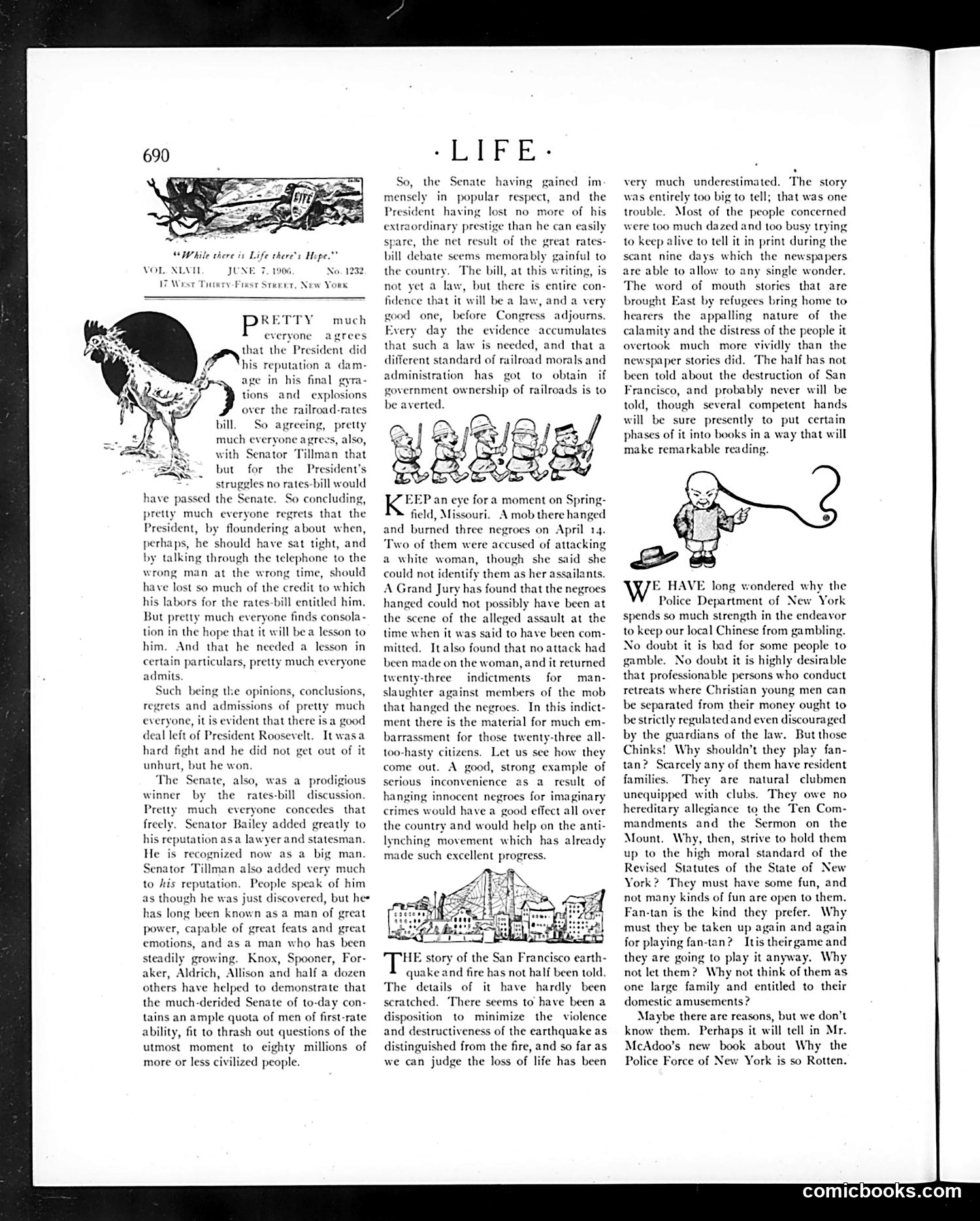
This page contains editorial commentary on President Roosevelt's handling of a railroad rates bill in Congress. The text praises Senator Tillman's support for the President while acknowledging Roosevelt "lost so much of the credit" for the bill's passage. The **rooster cartoon** (left) appears to satirize political posturing around the rates debate—a common symbol of boastful rhetoric. The page also discusses a lynching in Springfield, Missouri, where a Grand Jury found the accused Black men not guilty of assault charges, yet they were later indicted for manslaughter. The text critiques this legal inconsistency and comments on anti-lynching progress. A **cityscape illustration** (lower right) accompanies discussion of the San Francisco earthquake's destruction. The satirical tone targets legal contradictions and political ineffectiveness regarding racial violence and corporate regulation.
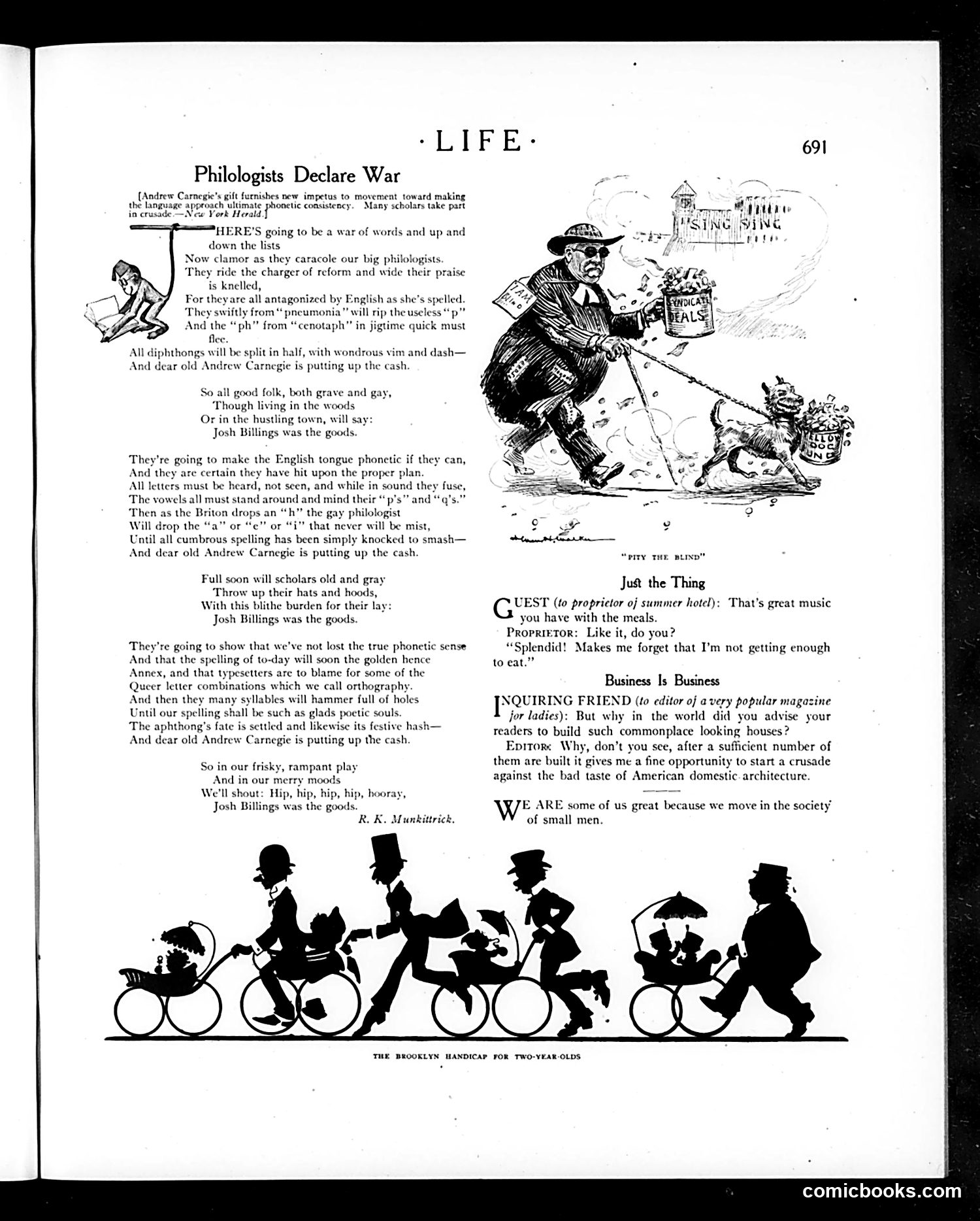
This satirical poem by R. K. Munkittrick mocks a movement to reform English spelling and pronunciation. The cartoon shows a man (likely representing reformers or Andrew Carnegie, mentioned in the text) attacking traditional spelling conventions with weapons labeled "PHONETIC SEALS." The satire targets philologists advocating phonetic spelling reform—removing silent letters from words like "pneumonia" and standardizing pronunciation. The poem humorously warns that such changes would devastate English language traditions and create chaos. The small silhouette illustration at bottom depicts a "Brooklyn Handicap for Two-Year-Olds"—an unrelated joke about wealthy people and children, typical of Life's miscellaneous humor sections. The piece reflects early 20th-century conservative resistance to linguistic modernization efforts.
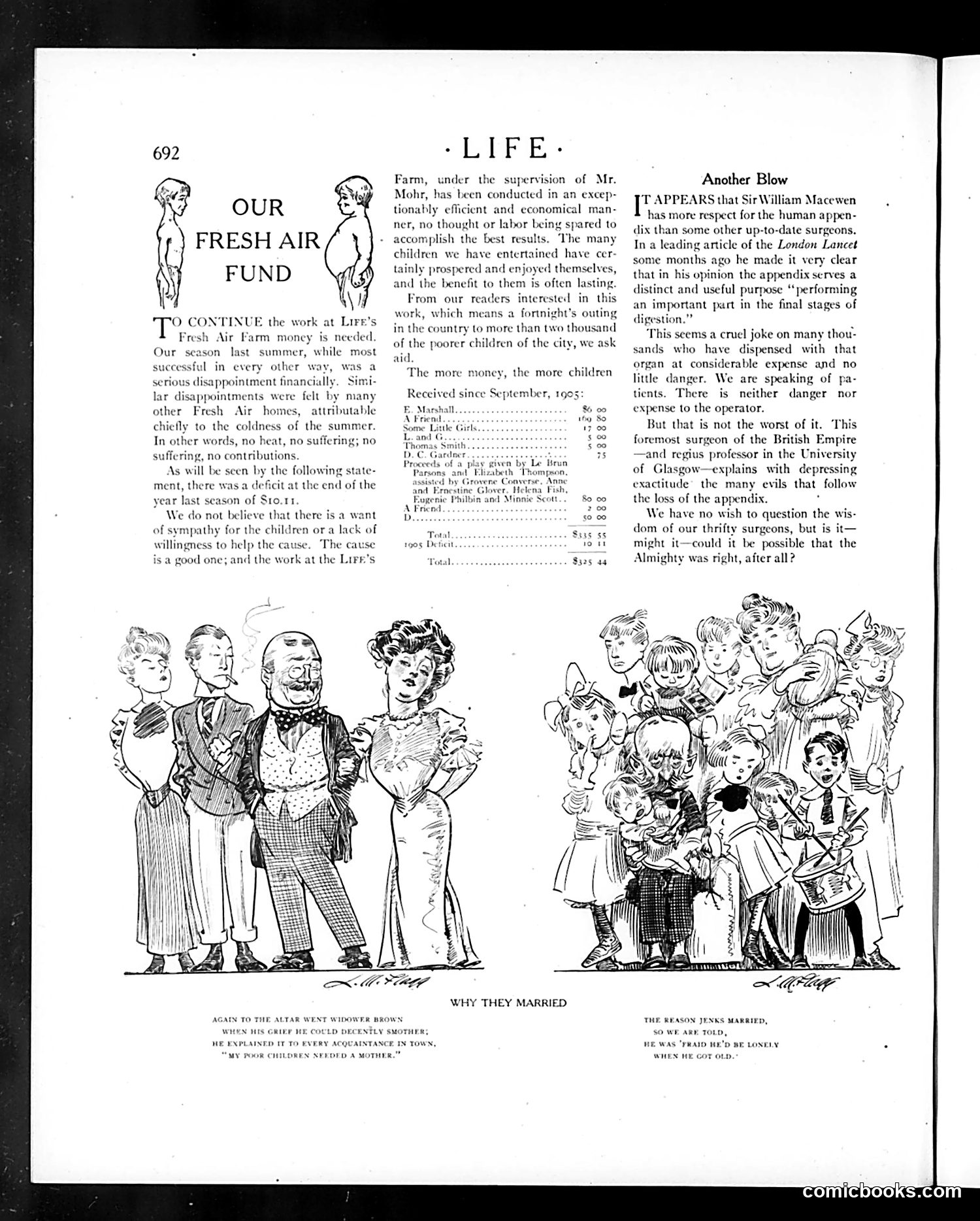
This *Life* magazine page contains three distinct items: **1. "Our Fresh Air Fund"** (left): A fundraising appeal for Life's Fresh Air Farm, which provided summer outings to poor urban children. The appeal notes a financial deficit because the previous summer was mild—fewer donations came in without visible child suffering to motivate readers' sympathy. **2. "Another Blow"** (right column): Satire attacking Sir William Macewen, a prominent British surgeon, who recently published that the appendix serves a useful digestive purpose. The article mocks surgeons who have profitably removed thousands of appendixes, suggesting they won't welcome news the organ is actually valuable. The closing rhetorical question sarcastically implies God designed it for a reason. **3. "Why They Married"** (bottom): Two captioned cartoons satirizing men's stated reasons for remarriage—both transparently self-serving (needing a mother for children; fearing loneliness in old age) rather than genuine affection.
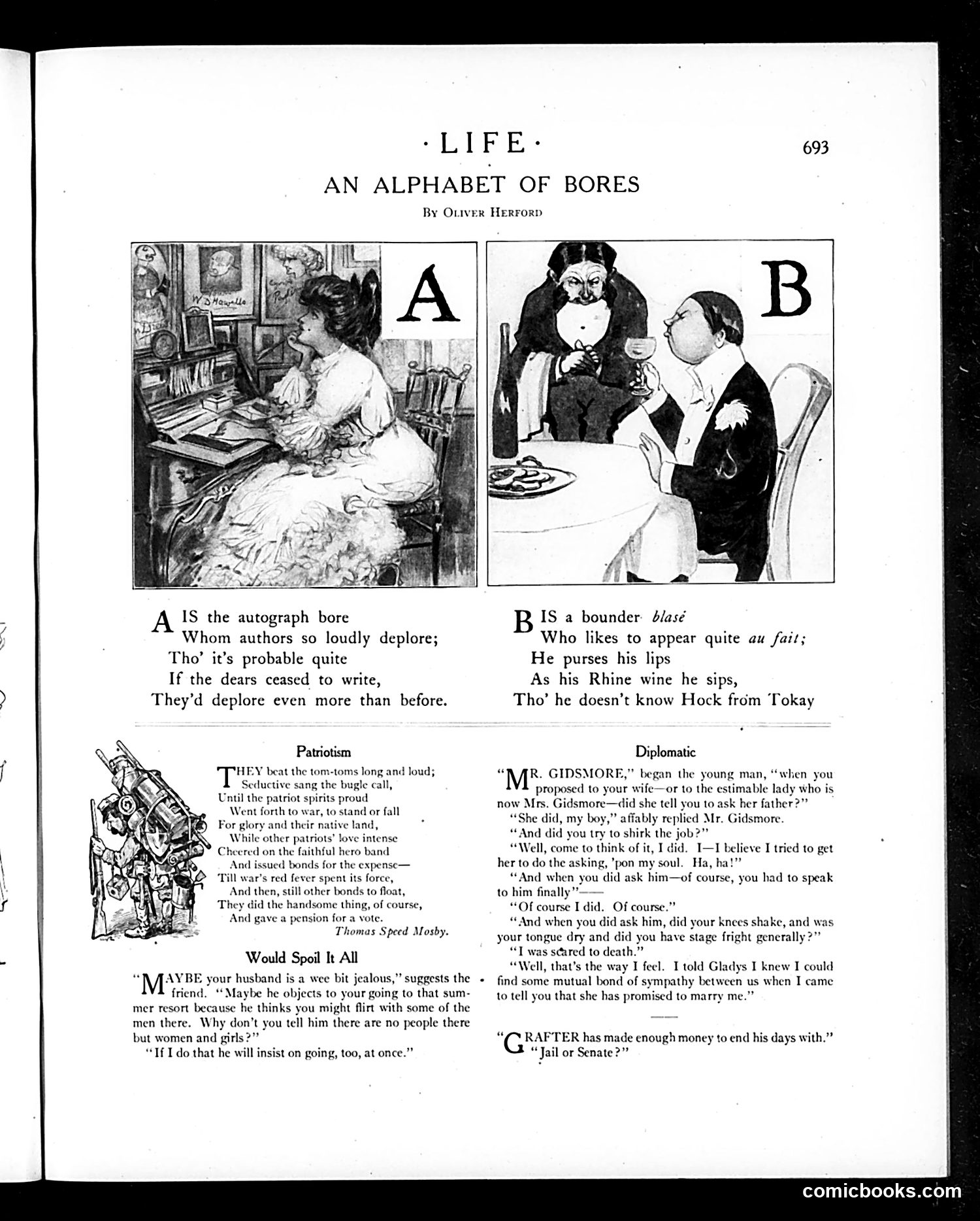
This is a satirical humor page from *Life* magazine featuring character sketches by Oliver Herford. The "Alphabet of Bores" presents social types through paired illustrations and witty verse: **A** mocks the "autograph bore"—people pestering famous authors for signatures, with the ironic twist that authors secretly need the attention. **B** caricatures the pretentious "bounder"—a social climber affecting Continental sophistication (French phrases, Rhine wine) while revealing his ignorance (confusing wine varieties). Additional sketches satirize patriotism (citizens profiting from war bonds rather than sacrifice), marital jealousy, and diplomatic awkwardness in marriage proposals. A final joke about "Grafter" suggests someone so corrupt his wealth came from either imprisonment or political office—both equally disreputable. The humor relies on gentle character mockery of recognizable social types rather than specific political figures or events.
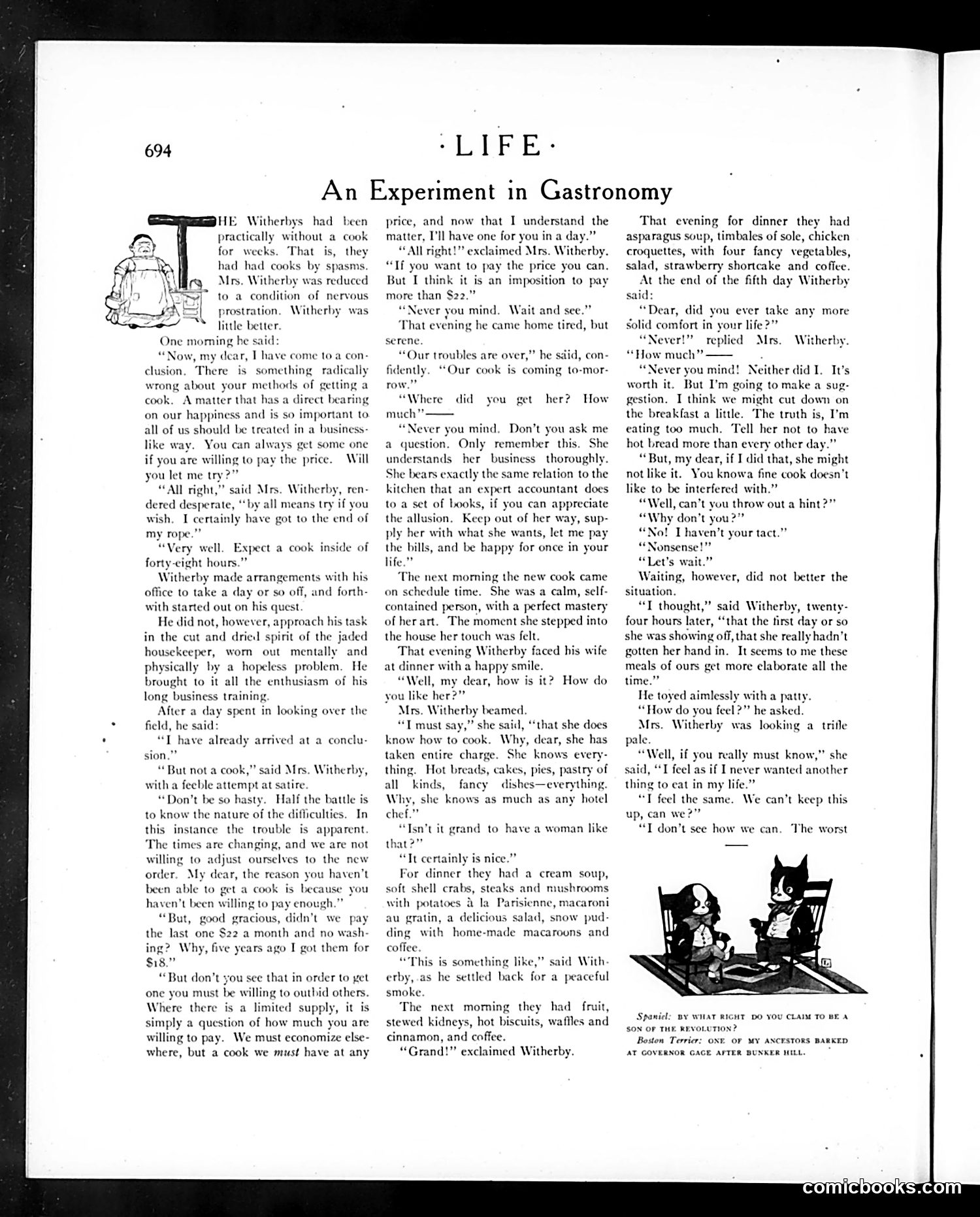
This satirical story mocks early 20th-century domestic management and class attitudes. Mr. Witherby, a businessman, applies "modern business principles" to solve his wife's chronic cook shortage—essentially arguing that the domestic labor market operates like any other: pay more, get better service. The joke targets multiple audiences: wives who struggle with household help, and husbands who arrogantly assume their business acumen solves "women's problems." Witherby's pompous language about "expert accountants" and "limited supply" reduces cooking to economics, yet he succeeds—suggesting the satirist both mocks his condescension *and* validates his market-based logic. The cartoon (showing figures on a sled, caption about ancestors and Bunker Hill) appears unrelated—likely a separate satirical item. The piece reflects genuine turn-of-century anxieties about domestic servant scarcity and changing labor conditions.
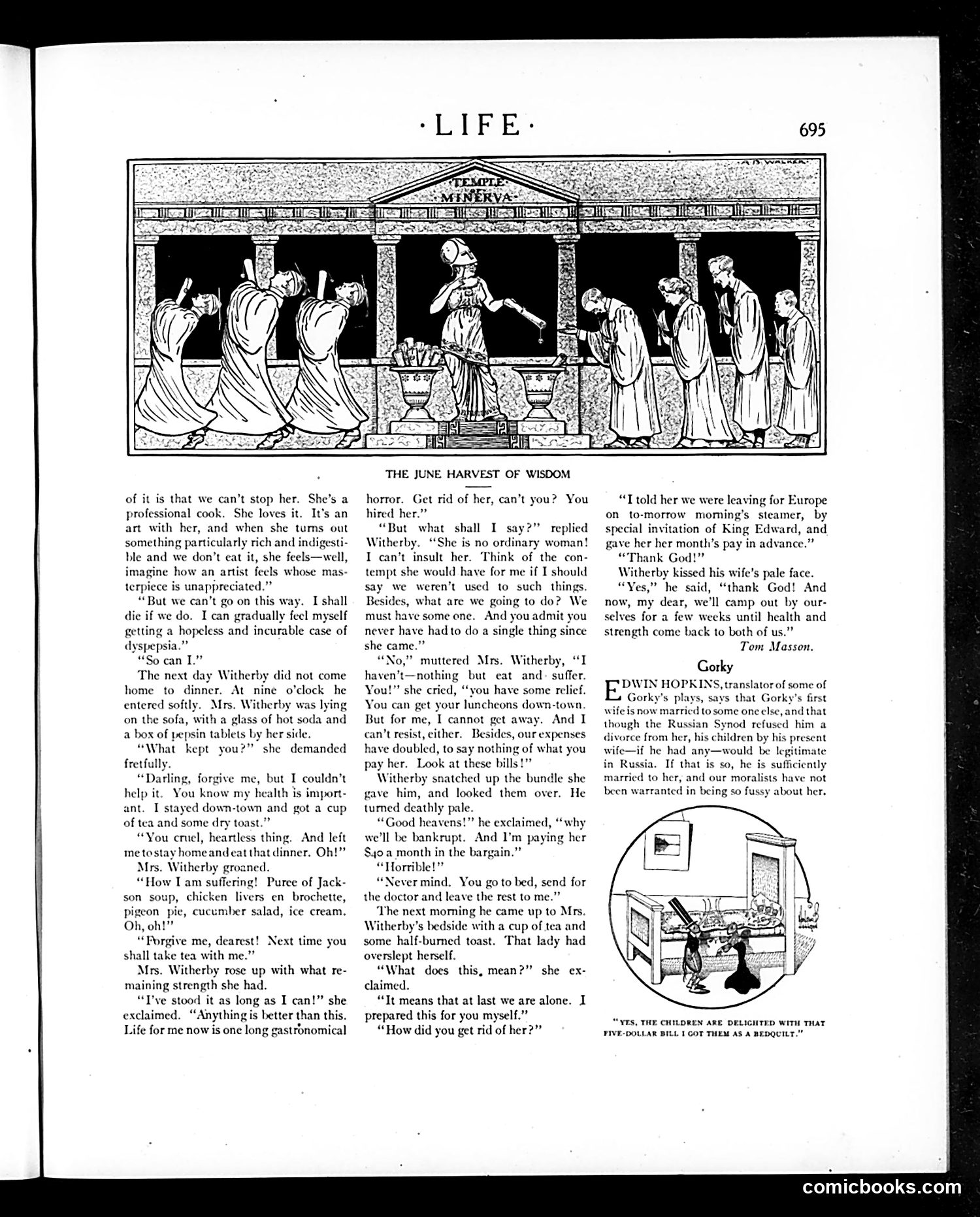
This satirical story mocks upper-middle-class domestic anxiety. A couple hires an excellent professional cook, but her rich food makes Mrs. Witherby chronically ill with indigestion. Mr. Witherby escapes to eat simple toast downtown, infuriating his wife, who feels trapped eating elaborate meals she cannot refuse without insulting the cook's artistry. The absurdist resolution: Witherby solves the problem by lying to the cook, claiming they're leaving for Europe at King Edward's invitation, paying her a month's severance to depart. The satire targets: marital dysfunction, class-conscious anxiety about servants, hypochondria, and the era's etiquette-bound inability to simply dismiss an employee honestly. The joke is that a fabricated royal connection succeeds where honesty would fail—mocking both social pretension and cowardice. The page's second item briefly notes translator Edwin Hopkins discussing Maxim Gorky's marital complications in Russia.
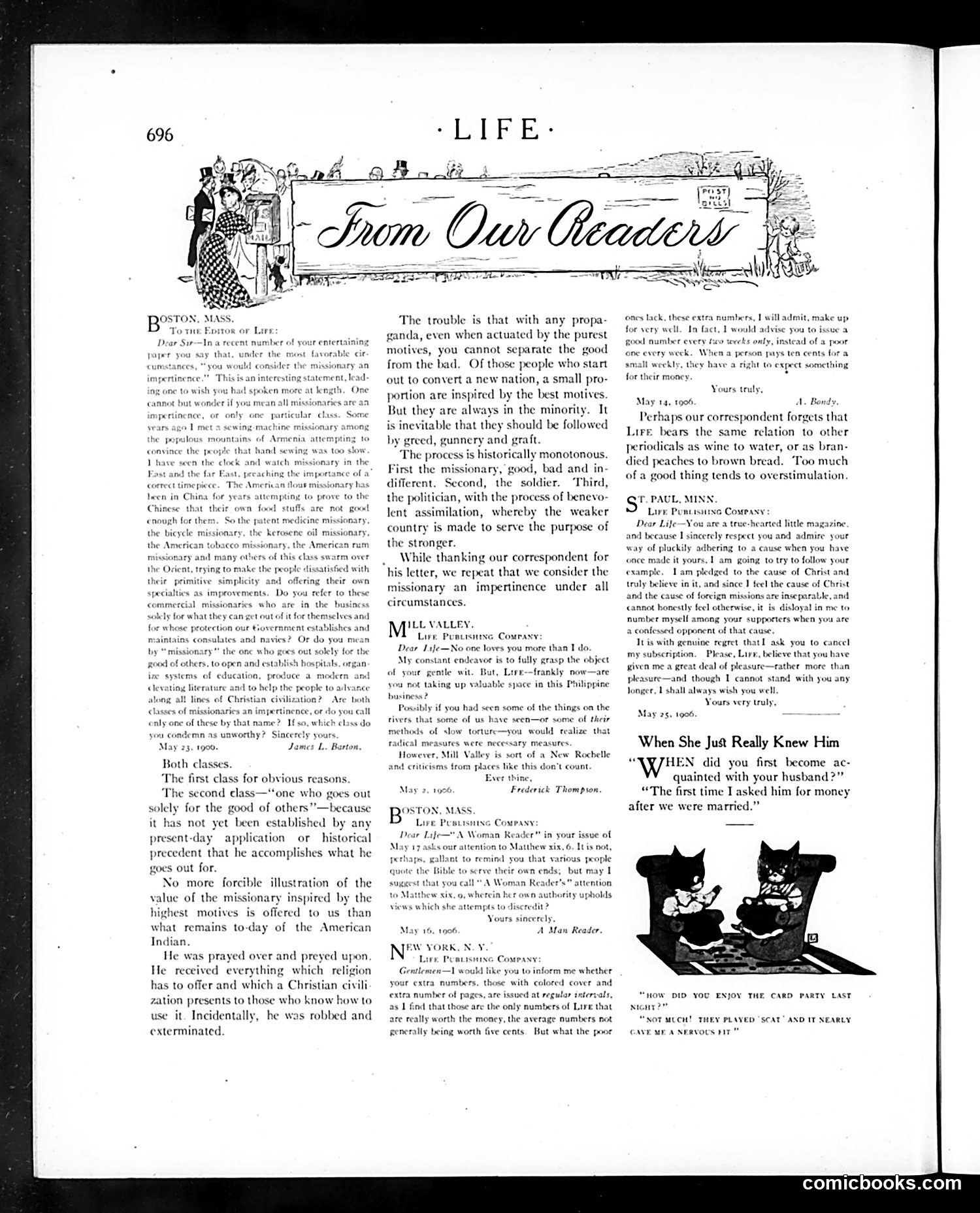
This page presents a "Letters to the Editor" section debating American missionary work and imperialism. The key exchange concerns whether missionaries are beneficial or exploitative. **The Core Debate:** A Boston reader defends missionaries, distinguishing between altruistic ones serving others and cynical ones seeking personal gain. Life's editor responds harshly: missionaries—even well-intentioned ones—are inherently "an impertinence," citing the American Indian as historical proof. The editor argues that missionary work inevitably enables exploitation: "First the missionary, good, bad and indifferent. Second, the soldier. Third, the politician." **Historical Context:** This reflects early-1900s American skepticism about U.S. imperial expansion, particularly in the Philippines (explicitly mentioned). The editor critiques the "benevolent assimilation" rhetoric masking colonial conquest, suggesting missionaries provide moral cover for economic exploitation and cultural destruction. **The Cartoon:** The bottom illustration shows two black cats with caption referencing a card party—likely satirizing social pretension, though the connection to the missionary debate above is unclear.
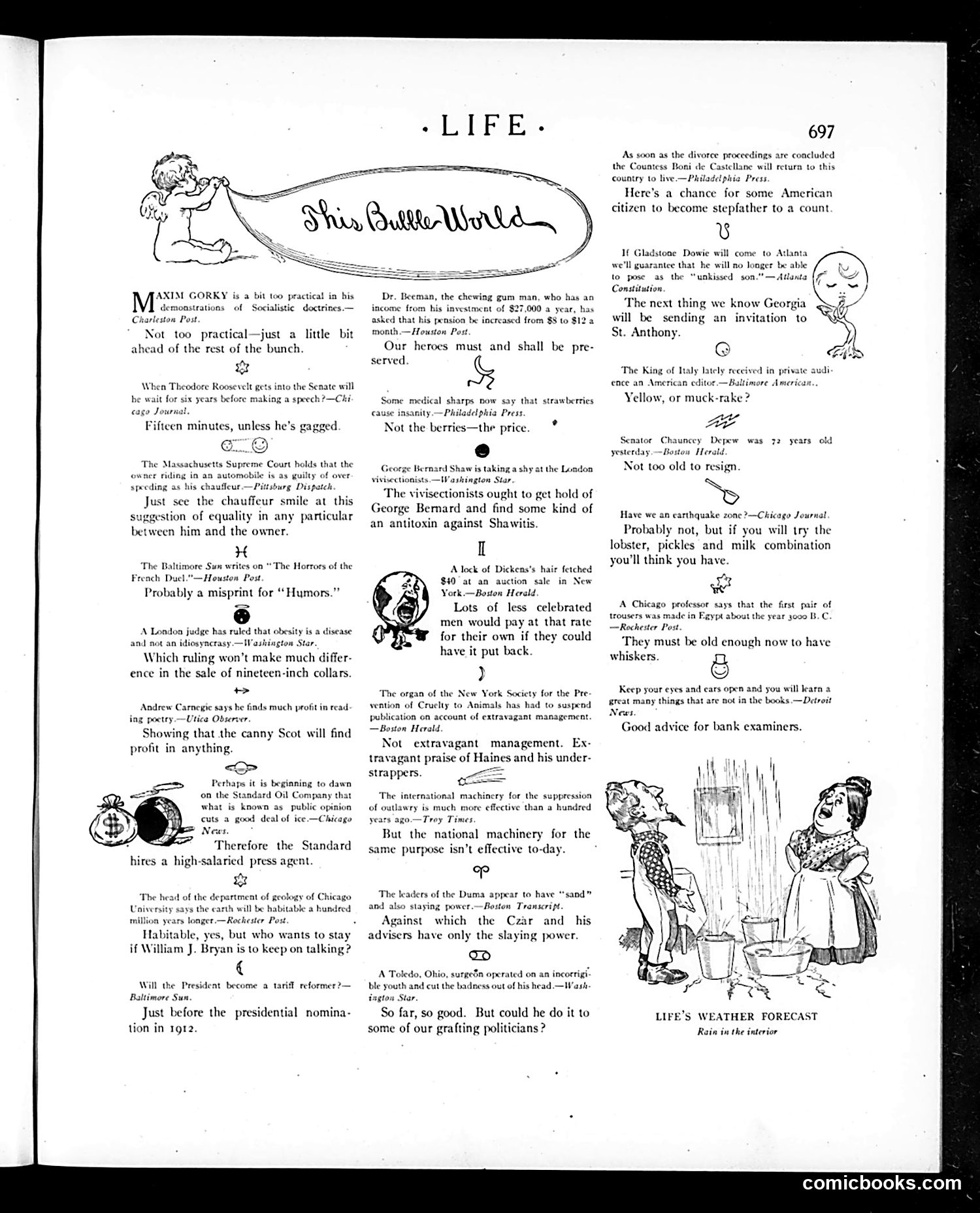
This page from Life magazine (circa 1912) consists of brief satirical quips commenting on contemporary news and public figures. The humor relies on wordplay and ironic reversals rather than elaborate cartoons. Key targets include: - **Theodore Roosevelt**: Mocked for his verbose nature, suggesting he'd need gagging if joining the Senate - **William Jennings Bryan**: Criticized for endless talking - **George Bernard Shaw**: Attacked for his criticism of vivisection (animal testing) - **Standard Oil Company**: Lampooned for hiring a press agent, implying they need public relations damage control - **Andrew Carnegie**: Teased for profiting even from reading poetry The quips satirize wealth inequality (chauffeurs held equally liable to owners), social absurdities (obesity classified as disease), and political corruption (grafting politicians). References to Dickens memorabilia, French duels, and tariff reform reflect concerns of the 1912 era. The cartoons at bottom appear unrelated vignettes. Overall, this represents Life's signature format: punchy, topical social commentary targeting the powerful and absurd.
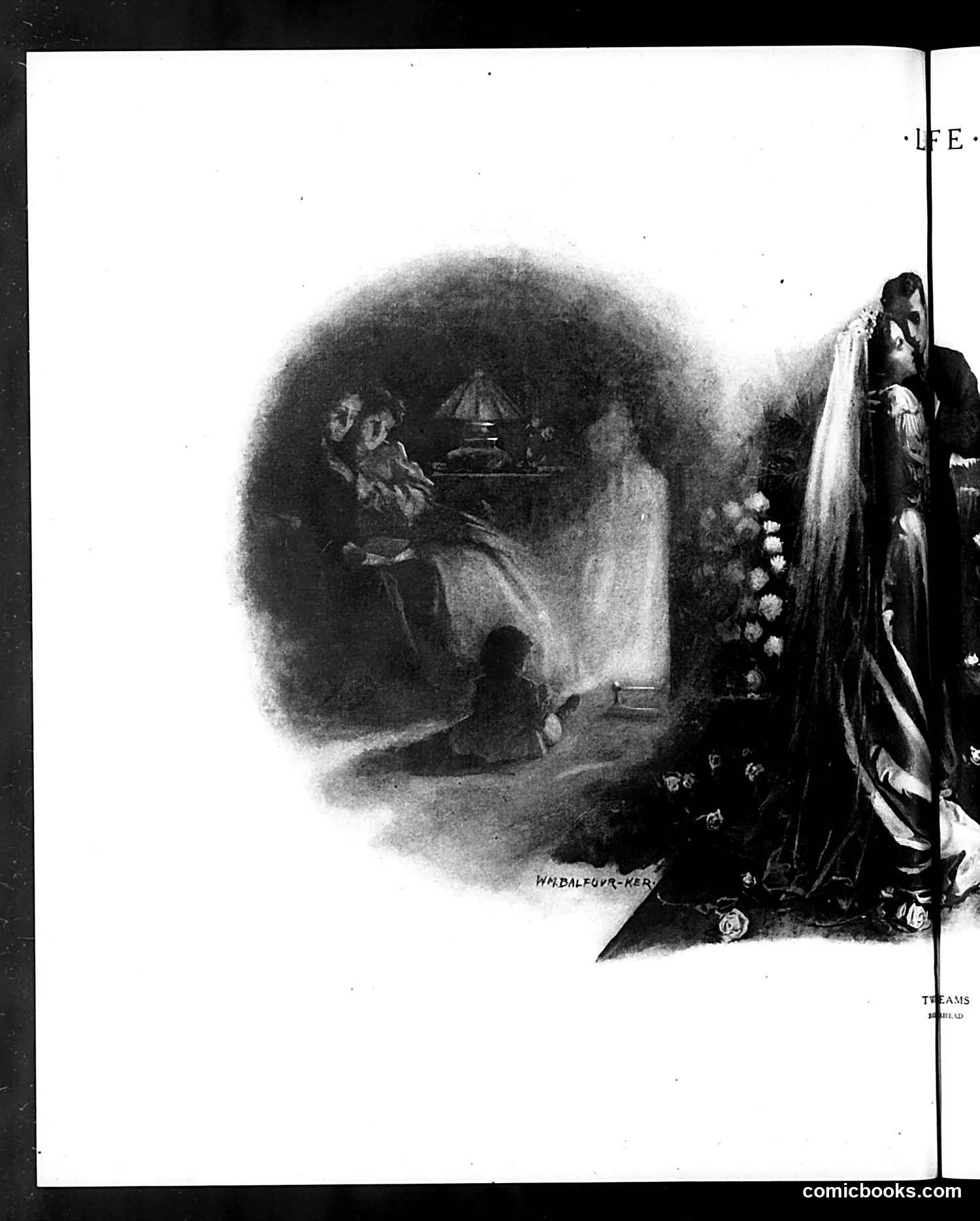
This appears to be a page from *Life* magazine featuring an illustration by W.M. Dalfour-Ker (visible signature). The image shows a theatrical or operatic scene: a figure in elaborate costume with a long cape stands on the right, while the left side depicts what appears to be a ghostly or supernatural vision within a shadowy, smoke-filled space—suggesting a dramatic supernatural encounter or haunting scene. Without more context or visible text explaining the cartoon's specific political or social commentary, I cannot definitively identify the figures or the satirical point being made. The theatrical styling suggests this may reference a popular opera, play, or cultural performance of the era, but the exact target of satire remains unclear from the image alone.
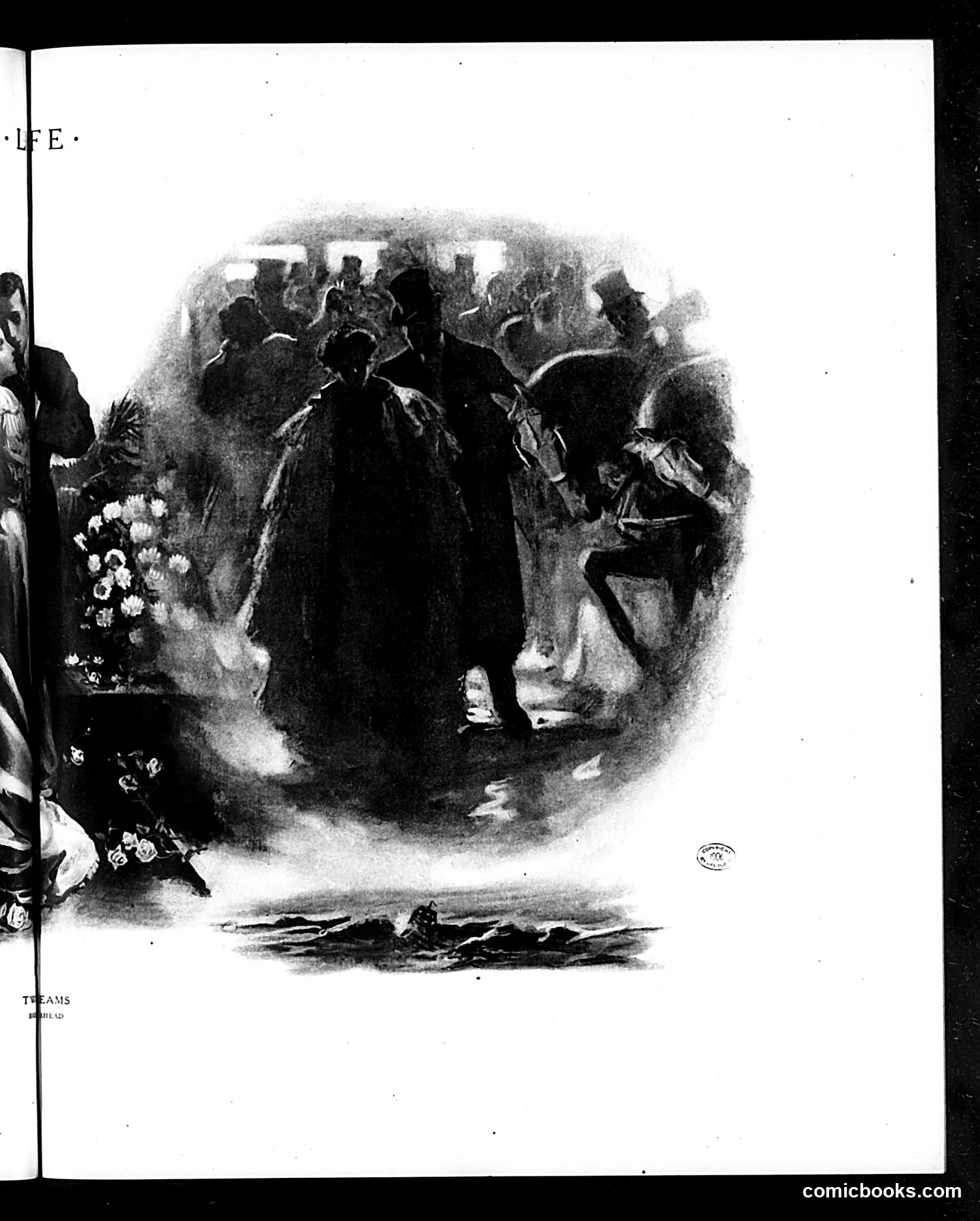
This appears to be a satirical illustration depicting a formal social gathering or reception, shown in silhouette. The central figure—a woman in an elaborate dress with a large hat—stands prominently, surrounded by formally dressed men in top hats and military or formal attire. Flowers are visible at left. The style suggests **early 20th-century social satire**, likely commenting on high society gatherings or aristocratic pretension. The dramatic silhouette technique emphasizes the formal poses and elaborate dress as objects of ridicule. Without additional caption text visible, the specific social or political target remains unclear—it could reference debates about class, gender roles in society, or fashionable excess among the wealthy. The inclusion of what appear to be military figures suggests possible commentary on militarism within elite circles.
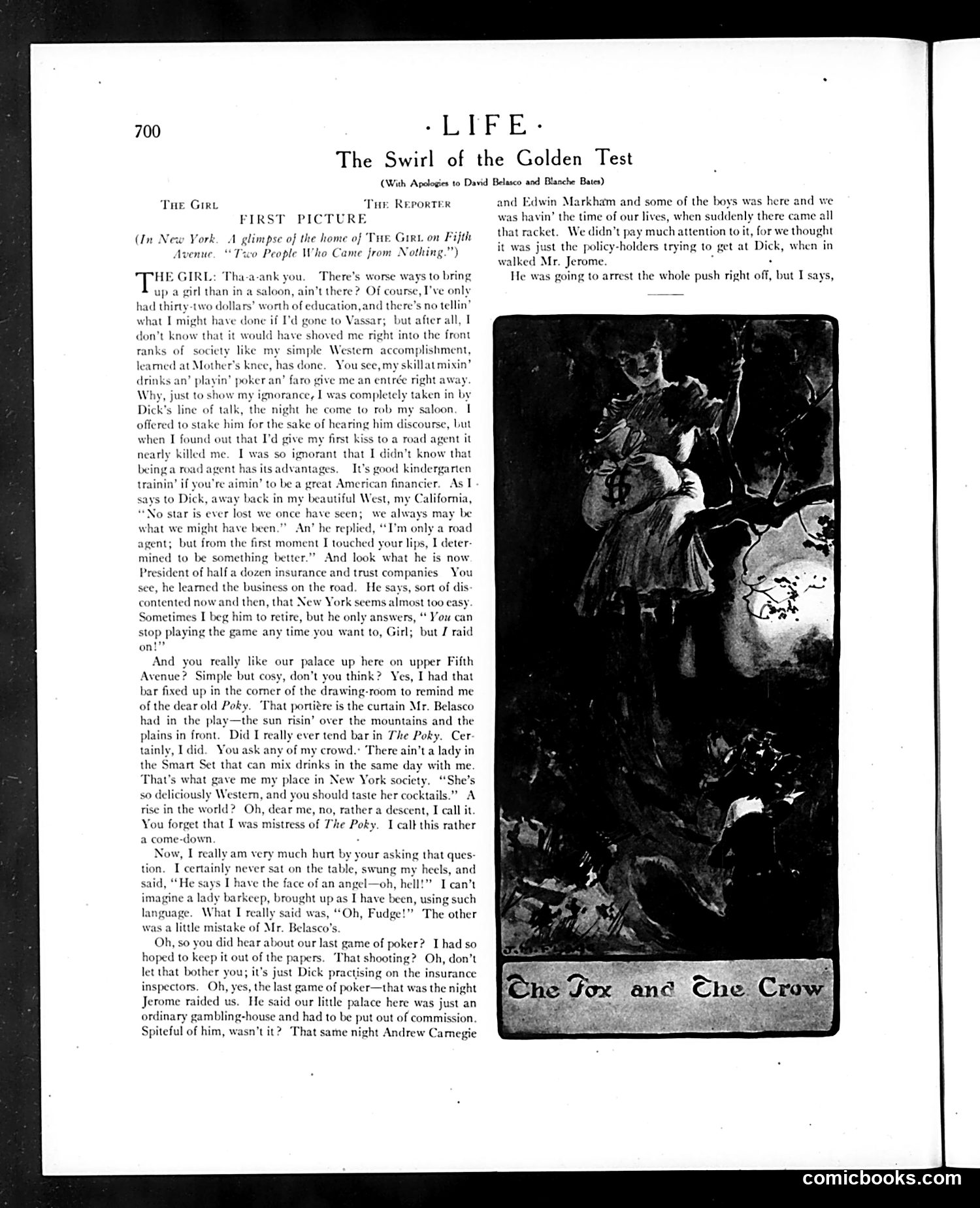
This page satirizes the theatrical melodrama *The Girl of the Golden West* (by David Belasco, starring Blanche Bates). The monologue parodies the play's romanticized narrative of a rough Western saloon girl who reforms a bandit into a respectable businessman. Life's satire targets gilded-age social climbing and corruption. The character boasts that her saloon skills—mixing drinks and playing poker—gave her entry into high society, while her lover's criminal past as a "road agent" conveniently transformed into insurance company presidency. References to District Attorney Jerome's raid and Andrew Carnegie's presence mock how wealth and connections shield the wealthy from scandal. The cartoon below (titled "The Fox and The Crow") likely comments on cunning deception—fitting the satirical theme of criminals posing as respectable society members. The joke: American "success" rewarded criminal enterprise repackaged as legitimate business.
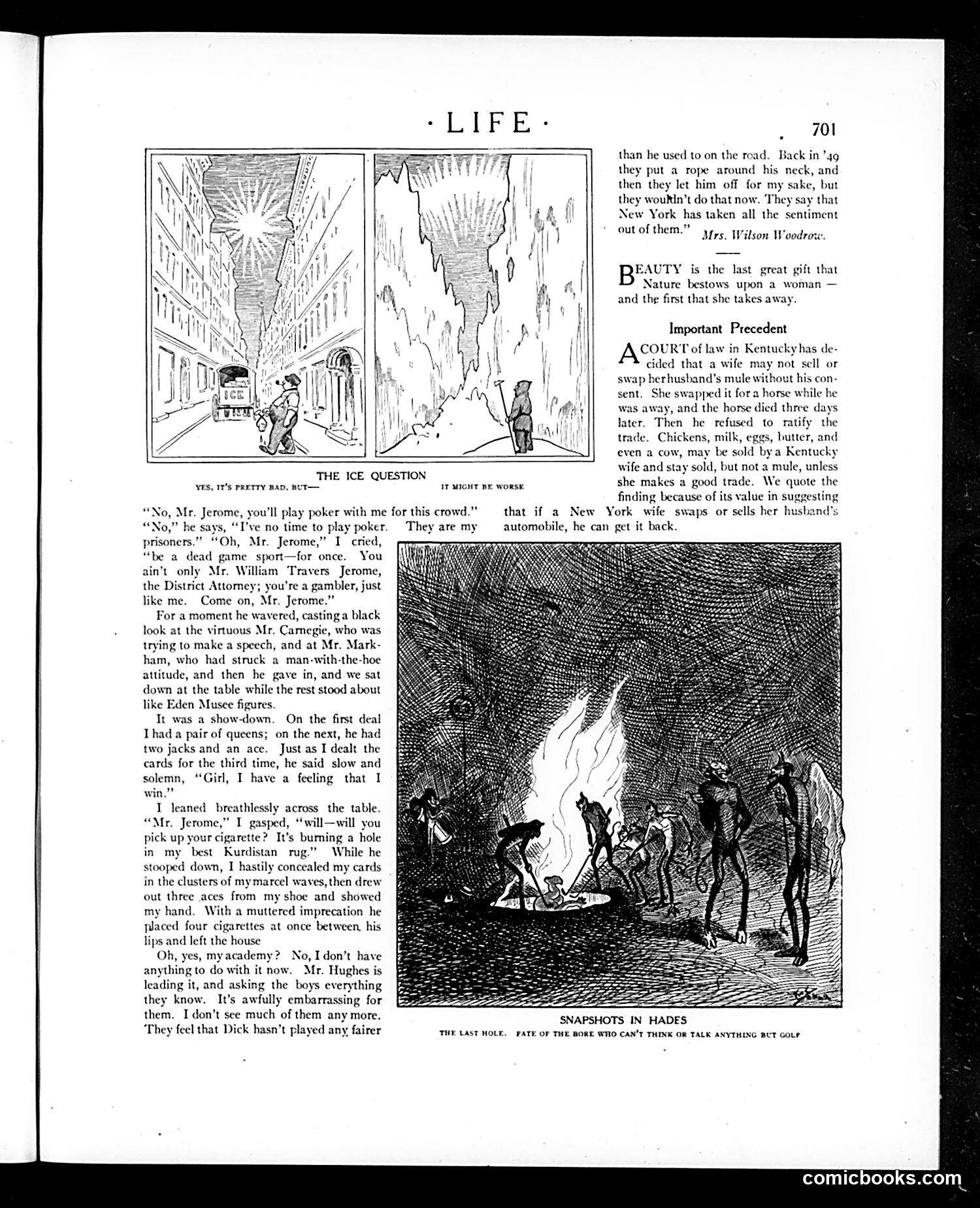
This page contains three distinct pieces of satire: **"The Ice Question"** (top comics): Two panels contrasting urban conditions—one showing a crowded New York street, another showing what appears to be rural/frontier conditions. The caption suggests commentary on changing American society and sentiment, with a quote from "Mrs. Wilson Woodrow" lamenting that New York has eliminated rural roughness. **"Important Precedent"** (middle): A humorous legal note about a Kentucky court ruling that wives cannot sell their husbands' mules without consent, though other livestock is permitted. The satire extends this to suggest a New York wife could similarly reclaim a swapped automobile from her husband—poking fun at regional legal disparities and marital property rights of the era. **"The Ice Question" (bottom text)**: A narrative anecdote about the author playing poker with William Travers Jerome, the District Attorney, who initially refuses to gamble but eventually joins. The humor lies in Jerome's apparent hypocrisy—as a law enforcer refusing to play while later relenting. **"Snapshots in Hades"** (bottom image): A cartoon depicting a bore obsessed with golf, condemned to eternal torment for his tedious conversation.
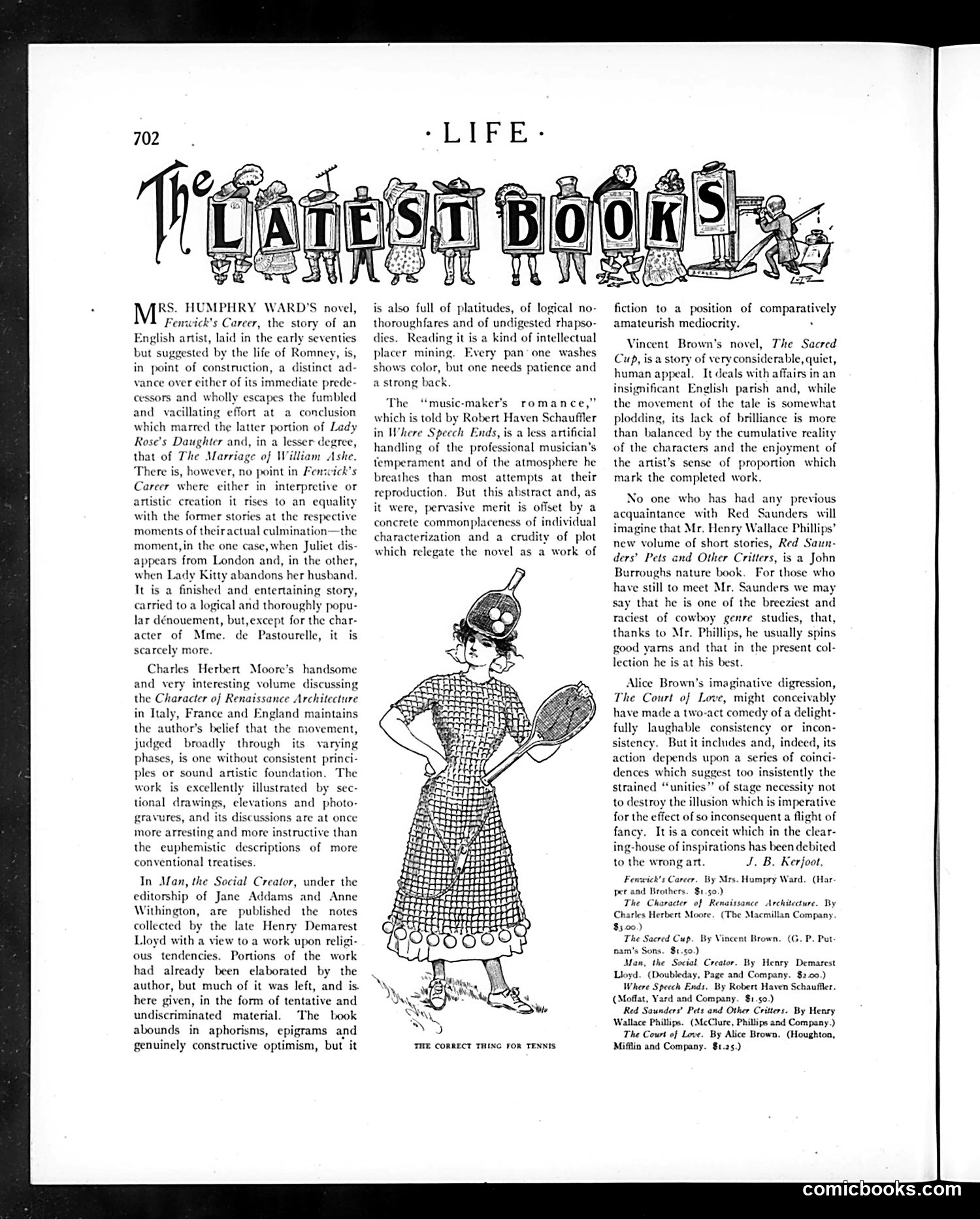
This is a book review section from Life magazine, not a political cartoon. The page critiques several contemporary novels and works of non-fiction, including Mrs. Humphry Ward's *Fenwick's Career*, Charles Herbert Moore's study of Renaissance architecture, and Henry Demarest Lloyd's collection *Man, the Social Creator*. The single illustration—labeled "The Correct Thing for Tennis"—shows a woman in early 1900s athletic wear (a fitted dress with a geometric pattern and a hat), holding a tennis racket. This is a gentle satire on women's sports fashion of the era, mocking the impractical, heavily corseted clothing women were expected to wear even while playing athletics. The reviews themselves are substantive literary criticism typical of Life's cultural coverage during this period, assessing plot construction, characterization, and artistic merit.
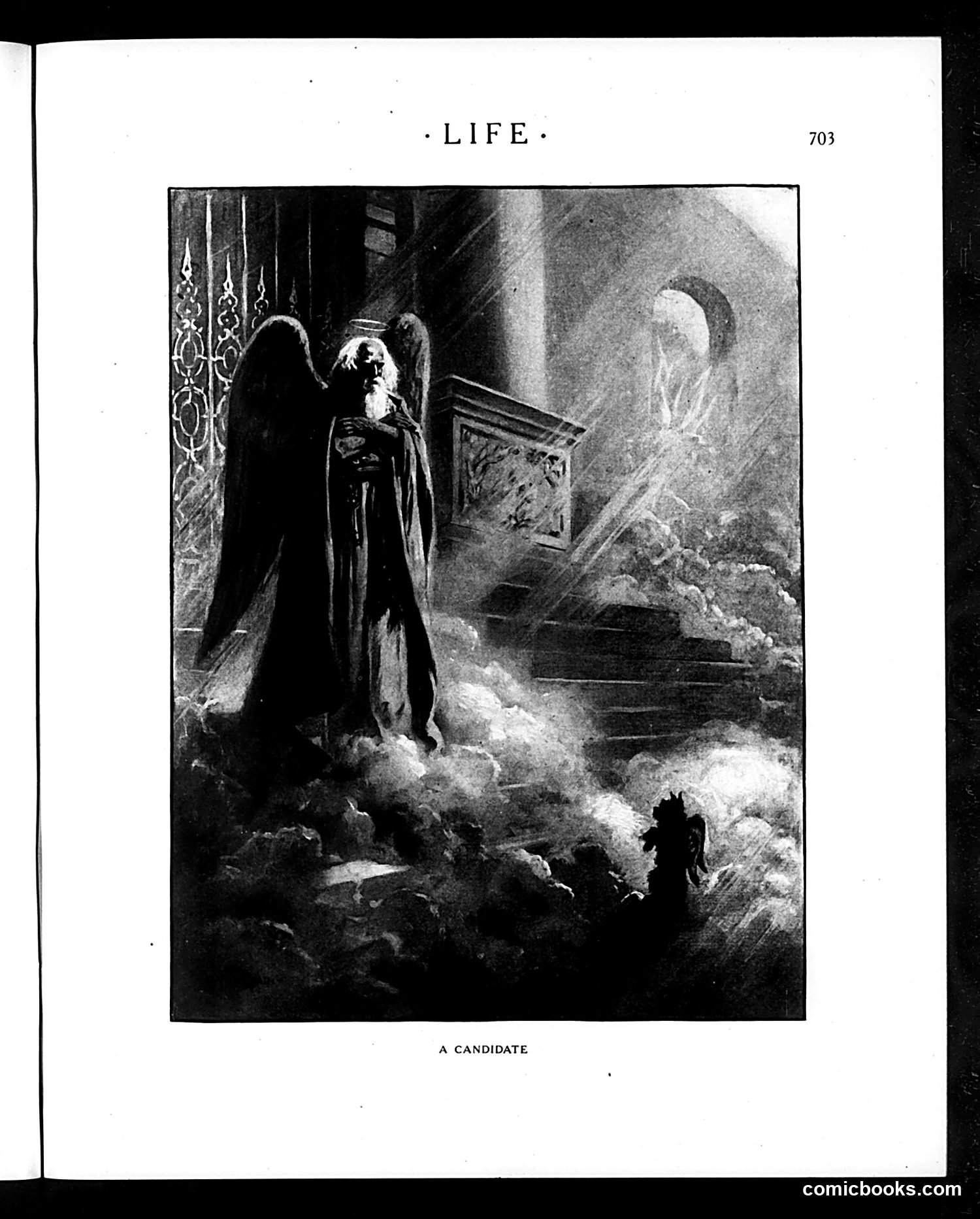
This illustration depicts a religious or supernatural scene: an angelic or divine figure with wings stands elevated, illuminated by divine light, while demonic or devilish figures crouch below in shadows and clouds. The caption "A Candidate" suggests political satire about electoral selection. The imagery appears to contrast heavenly virtue (the winged figure above) with infernal corruption (the dark figures below), likely satirizing how political candidates present themselves versus their true nature, or the gap between ideal candidates and actual contenders. Without a visible date or additional context, the specific election or candidates referenced remain unclear, but the cartoon's message critiques the hypocrisy or moral questionability of political candidates who claim virtue while harboring darker intentions or associations.
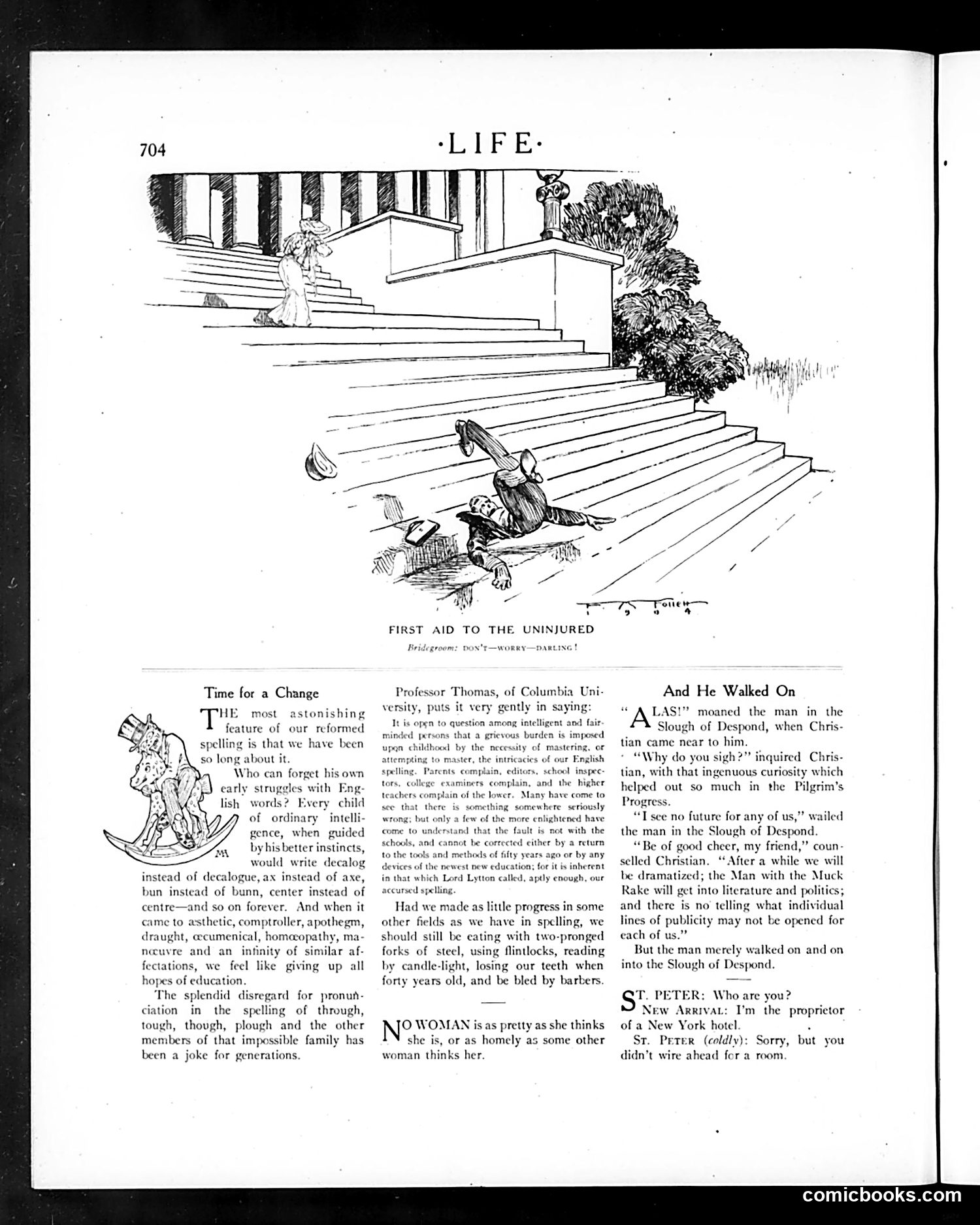
This page contains three separate satirical pieces: 1. **"Time for a Change"** (left column): Mocks reform spelling advocates. The author argues English spelling, while illogical, shouldn't be changed—citing bizarre examples (decalog, ax, center). The satire suggests that if we've survived this long with archaic spelling, abandoning it now is pointless. This reflects early 20th-century debates over simplified spelling. 2. **"First Aid to the Uninjured"** (top cartoon): Shows a couple on steps; the bridegroom warns "don't worry darling!" The caption satirizes newlyweds' anxieties about trivial matters. 3. **"And He Walked On"** (right column): Parodies *Pilgrim's Progress*, where a despairing man in the Slough of Despond dismisses Christian's optimistic suggestions about future dramatization and publicity. The joke: even promising him literary/political fame doesn't cheer him—darker than the original allegory. 4. **"St. Peter" (bottom)**: A New York hotel proprietor arrives at heaven but wasn't pre-registered, getting rejected. Light satire on American hospitality/bureaucracy.
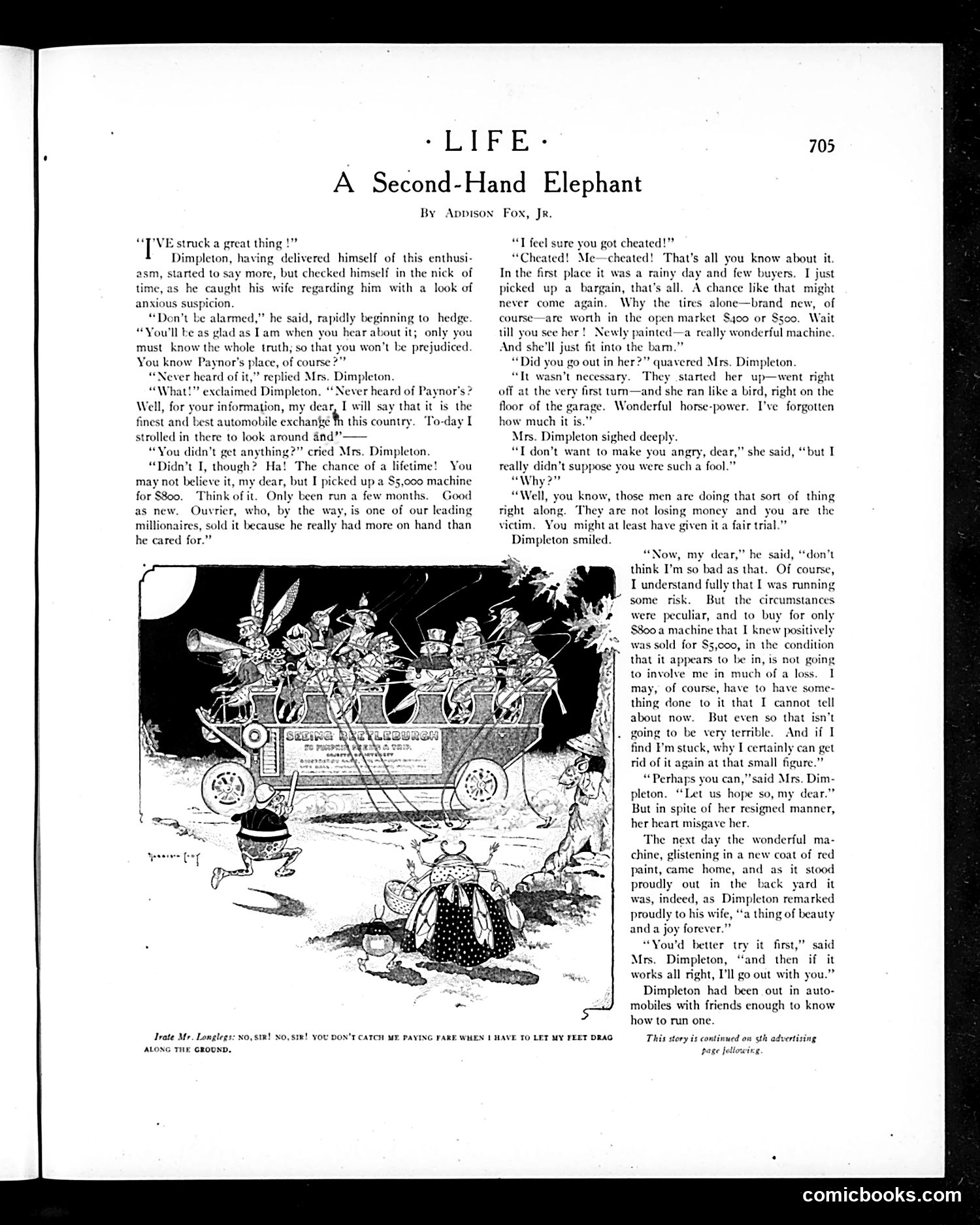
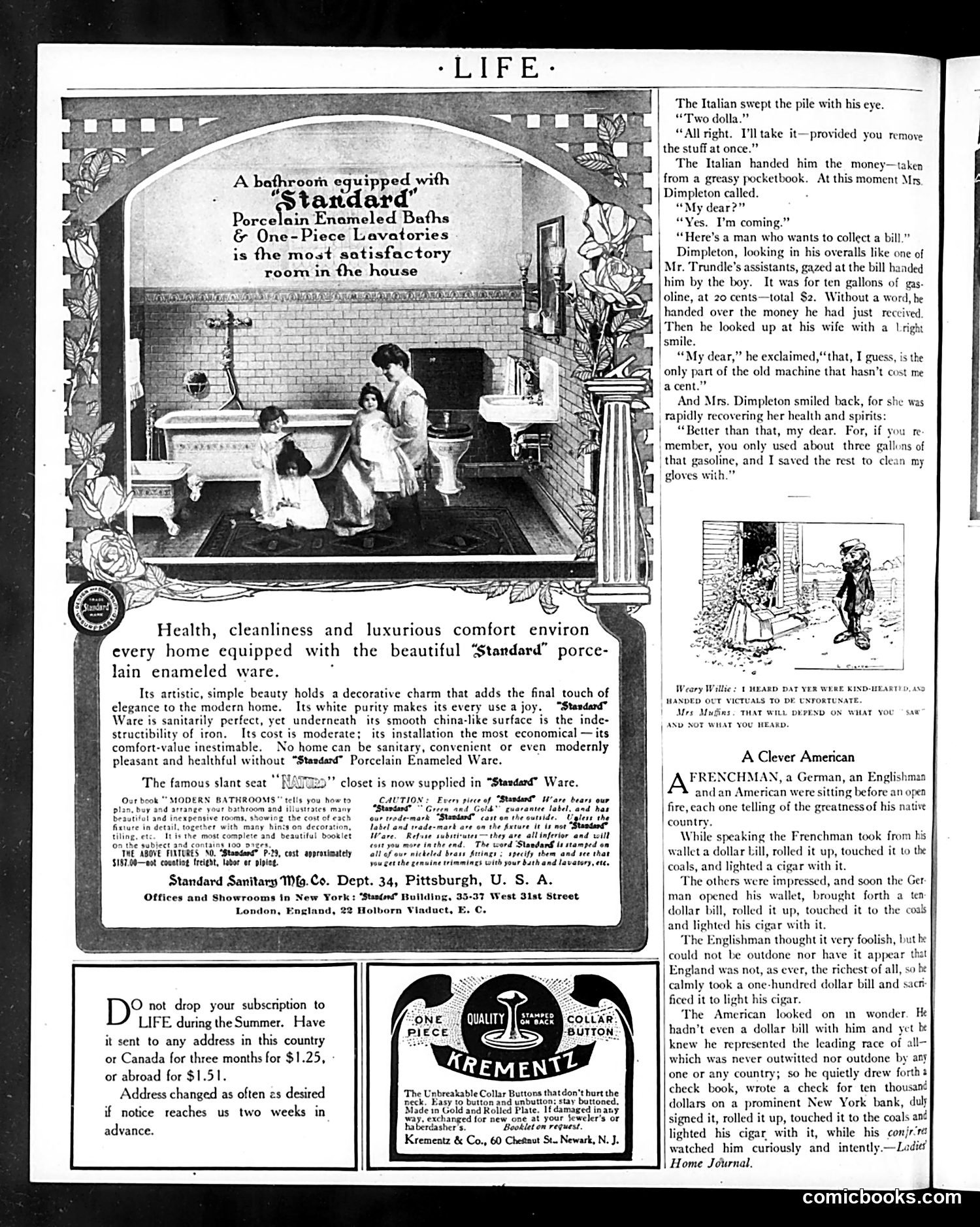
This is a humorous short story (not a political cartoon) about Mr. Dimpleton, a gullible buyer who purchases a used automobile for $800, believing it was originally worth $5,000. His skeptical wife Mrs. Dimpleton suspects he's been cheated by Paynor's automobile exchange—a used-car dealer running a classic con. The satire targets early 20th-century consumer naiveté and dishonest business practices in the emerging auto industry. The title "Second-Hand Elephant" suggests an unwieldy, problematic purchase (referencing the phrase "white elephant"—an expensive, burdensome gift). The accompanying cartoon shows an absurdly overloaded automobile, illustrating the joke: Dimpleton's "bargain" will likely prove costly and troublesome. The story continues on another page, presumably revealing whether the machine actually works or becomes the disaster his wife expects.
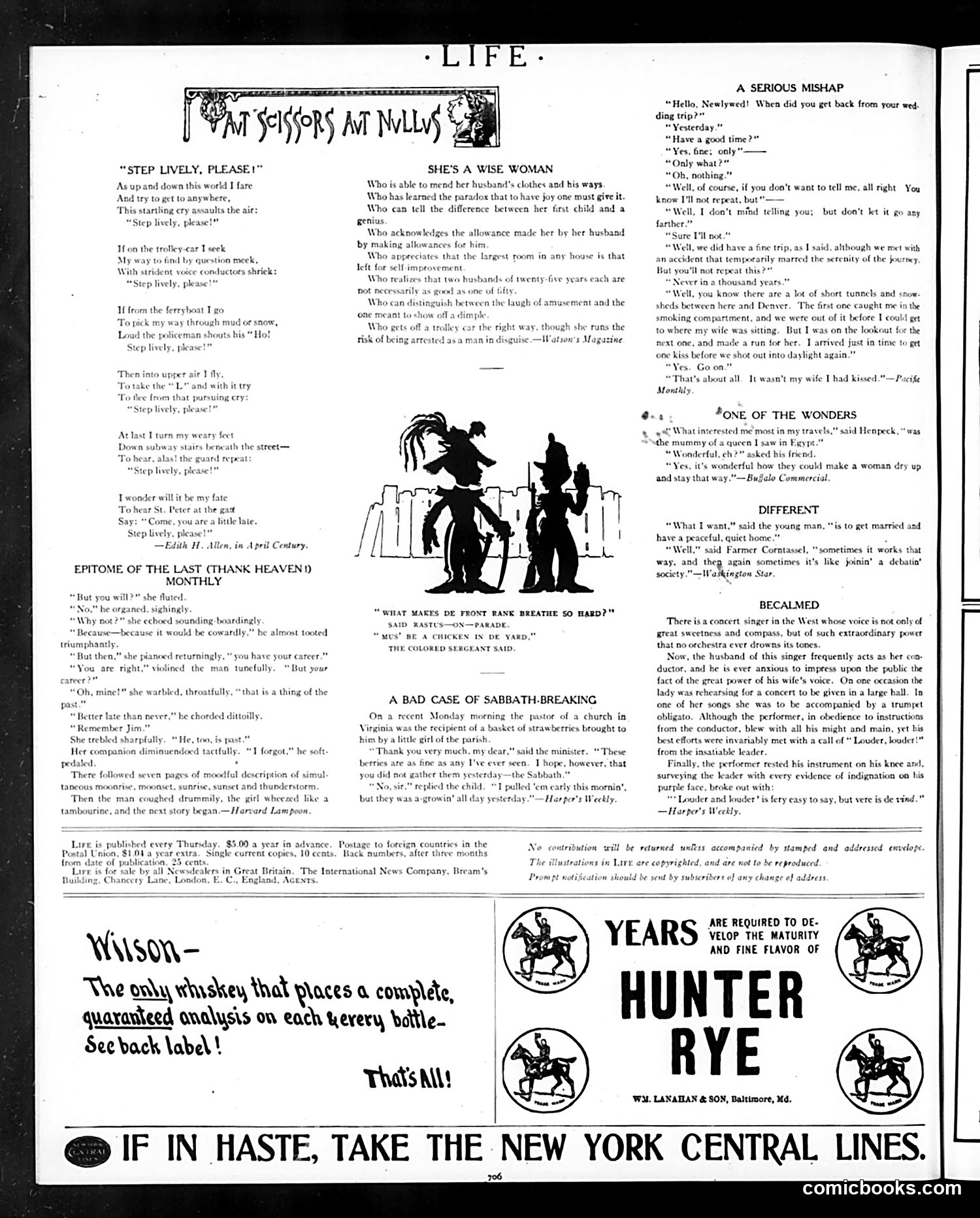
This is a humor page from *Life* magazine featuring multiple short comedic pieces and poems. The main content includes: **"Step Lively, Please!"** — A poem mocking the constant rush of urban commuting (trolleys, ferries, subways) where conductors perpetually shout orders at hurried passengers. **"A Serious Mishap"** — A newlywed couple's anecdote: the husband kisses the wrong woman in a train's smoking compartment, creating marital awkwardness. **"A Bad Case of Sabbath-Breaking"** — A minister receives fresh strawberries on Monday, then scolds the girl for picking them on Sunday (violating the Sabbath). **"One of the Wonders"** and other brief quips provide light social commentary on travel, marriage expectations, and performers. The cartoons appear to reference African American stereotypes typical of early 20th-century American humor magazines—a racial caricature appears in "What Makes de Front Rank Breathe So Hard?" The page is primarily satirical commentary on urban life, marriage, and social propriety, common *Life* magazine fare of this era.
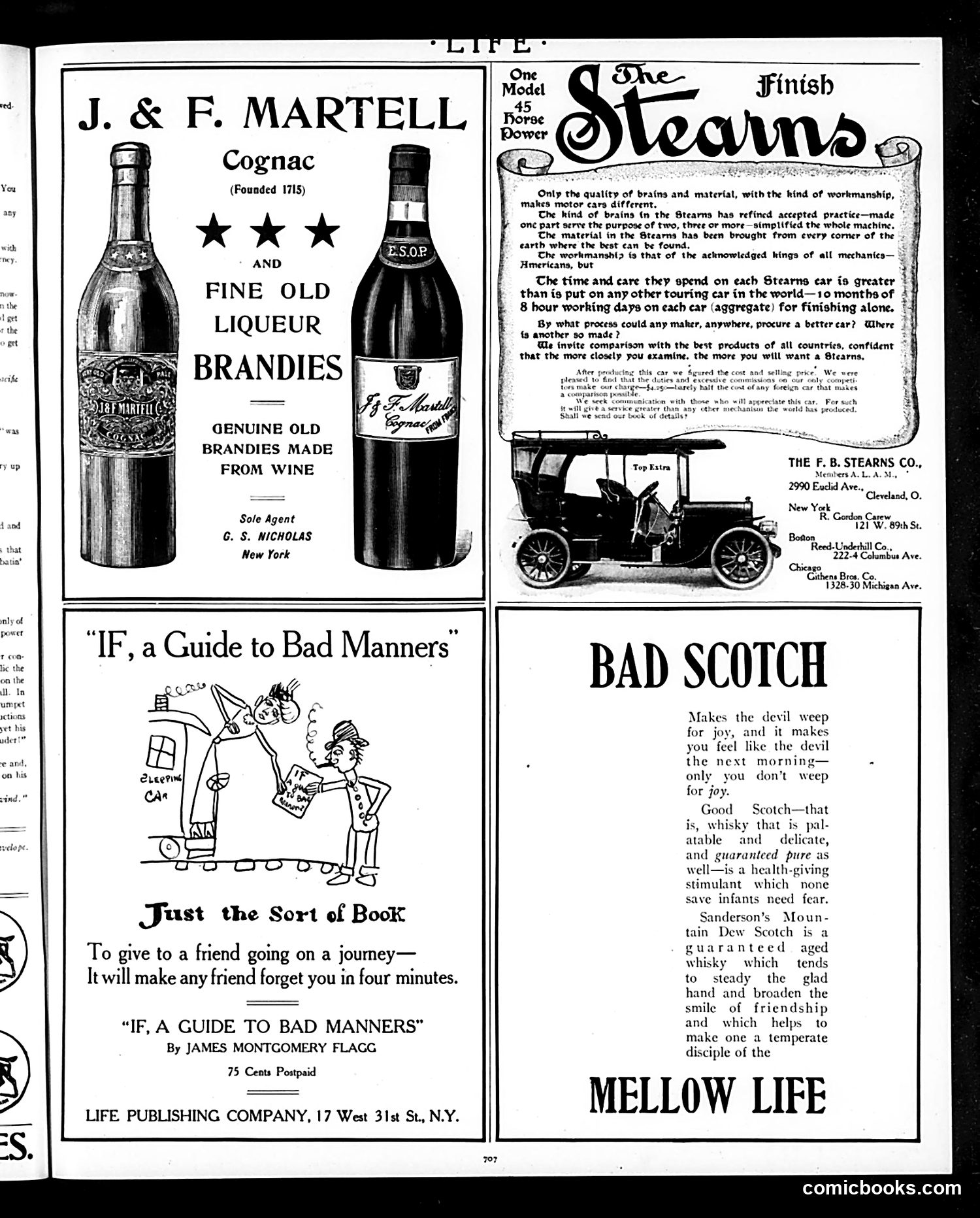
This page consists primarily of **advertisements** rather than editorial satire. The main content includes: 1. **Martell Cognac ad** (top left): A straightforward liquor advertisement featuring two brandy bottles, emphasizing the product's French founding date (1715) and quality. 2. **Stearns automobile ad** (top right): Promotes luxury cars through claims of superior engineering, materials sourcing, and American craftsmanship—typical early 20th-century automotive marketing. 3. **"If, a Guide to Bad Manners" book promotion** (bottom left): A humorous meta-advertisement by cartoonist James Montgomery Flagg offering a satirical etiquette guide as a gag gift. The cartoon shows crude behavior; the joke is that giving this book to a departing friend will make them forget you quickly. 4. **Scotch whisky ad** (bottom right): Uses contrasting humor—"bad scotch" causes hangovers while good Scotch (Sanderson's Mountain Dew) promotes friendship and temperance. The page reflects early 20th-century consumer culture and advertising strategies mixing humor with product promotion.
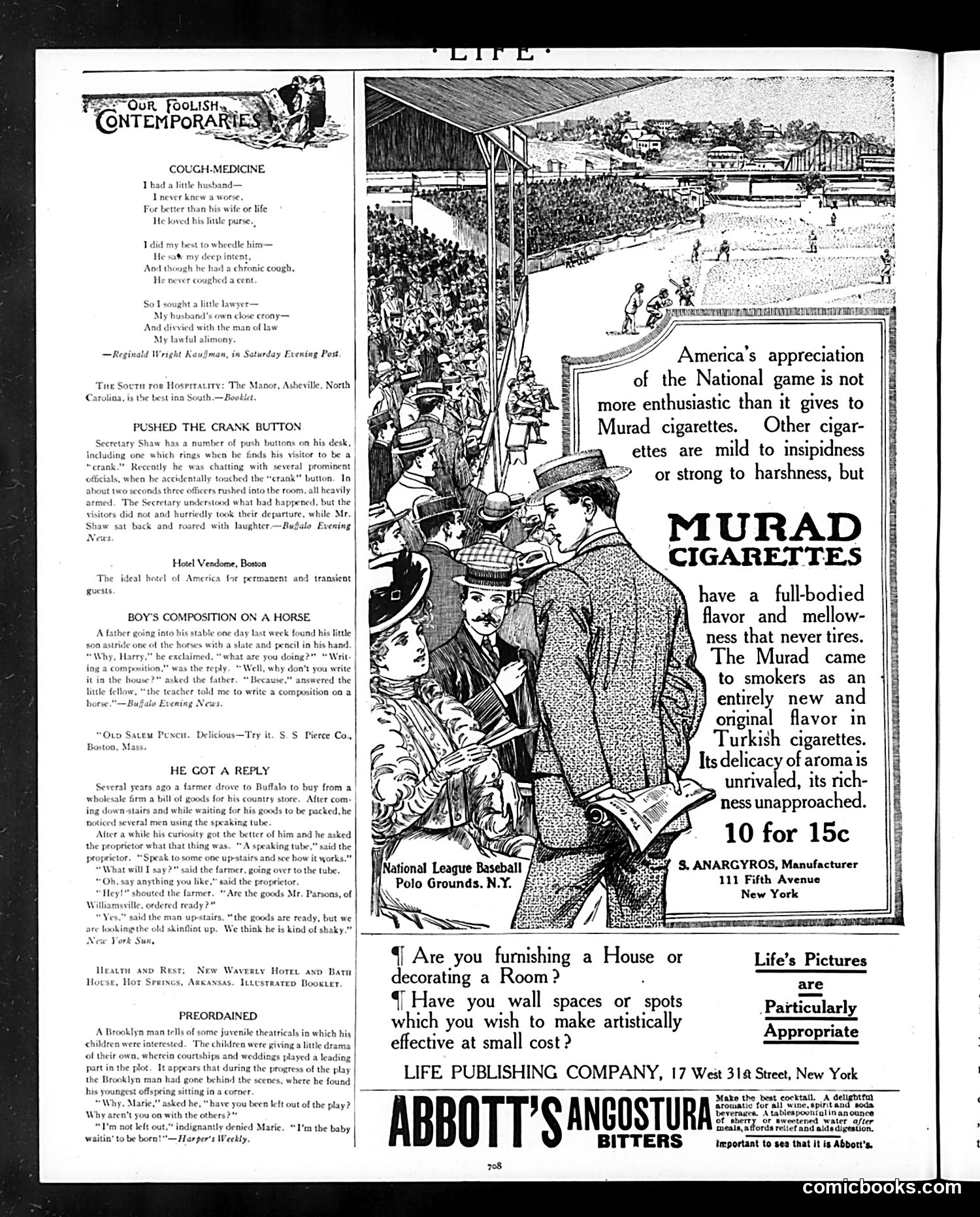
This page mixes satirical humor pieces with period advertising. The left column contains four short humorous anecdotes typical of Life's "Our Foolish Contemporaries" section—brief comedic stories poking fun at everyday people and situations. These include tales of a wife manipulating her husband through illness, a man accidentally activating an office prank button, a boy's school composition, and a farmer confused by a speaking tube—all gentle mockery of ordinary foolishness. The right side features full-page advertisements, primarily for Murad cigarettes (linking smoking to baseball appreciation) and Abbott's Angostura Bitters. The baseball stadium illustration shows the sport's mass popularity during this era. The overall tone reflects early 20th-century American humor: domestic comedy, workplace mishaps, and rural/urban culture clashes presented as entertainment for affluent magazine readers.
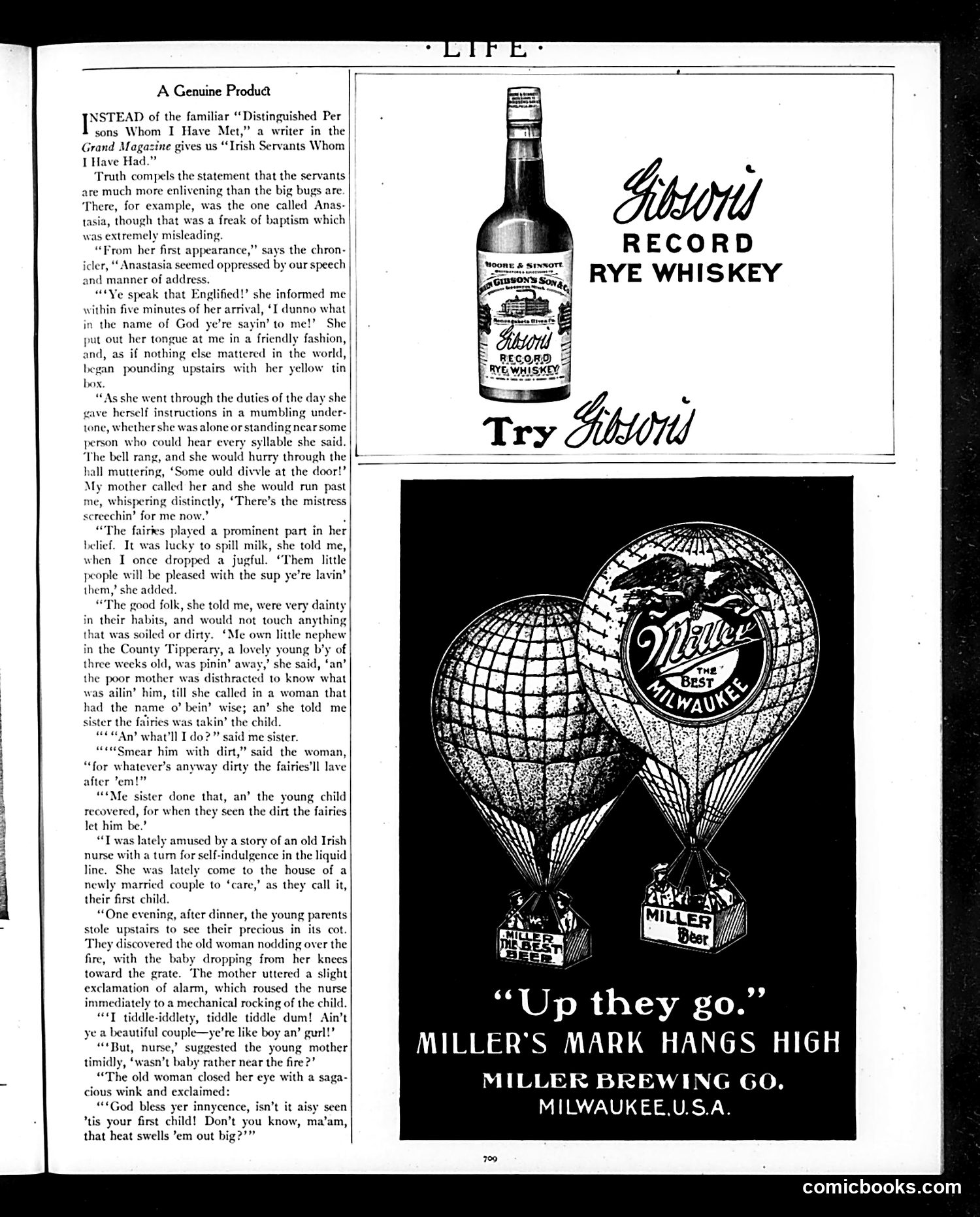
This page contains a humorous article about Irish domestic servants, paired with two liquor advertisements. **The Main Content:** The text is an excerpt from *Grand Magazine* featuring anecdotes about an Irish servant named Anastasia. The humor relies on ethnic stereotyping—portraying her as speaking in a thick Irish brogue, being superstitious about fairies, and giving bizarre (dangerous) childcare advice. A recurring joke involves her belief that heat makes babies grow larger, leading her to nearly let an infant fall toward a fire. **The Satire:** This reflects early-20th-century Anglo-Irish class attitudes, where Irish servants were portrayed in British/American publications as quaint, credulous, and comically unfit for responsibility—yet oddly endearing. The "charm" of the piece lies entirely in mocking Irish dialect and folk beliefs. **The Advertisements:** Two period liquor ads appear: Osborn's Record Rye Whiskey and Miller's Best Beer (hot-air balloon imagery). These are standard product placement typical of *Life* magazine's era. The page exemplifies how casual ethnic humor and advertising were normalized in early 20th-century American magazines.
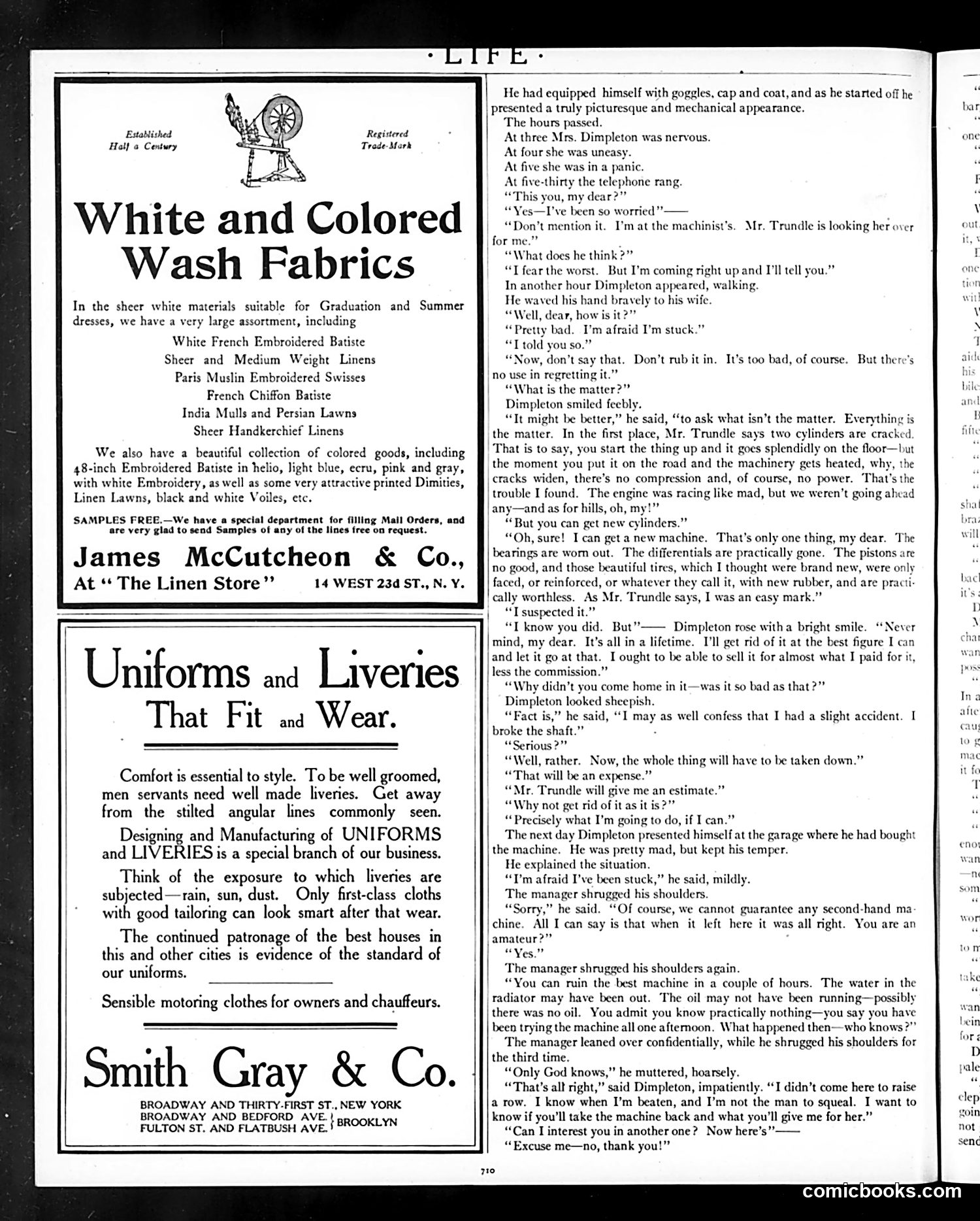
This page consists primarily of **advertisements** for fabric and clothing retailers (James McCutcheon & Co. linen store, Smith Gray & Co. uniforms), with a serialized **humorous story** occupying the right column. The story depicts a gentleman, Mr. Dimpleton, who purchases an automobile. After confidently setting out in his new vehicle equipped with "goggles, cap and coat," he returns hours later with mechanical problems: cracked cylinders, worn bearings, deteriorated tires. Throughout his recounting of the machine's failures, Dimpleton attempts to maintain good humor and optimism, despite his wife's "I told you so" attitude. The satire targets **early automobile culture**—specifically the gap between the glamorous promise of motoring and the mechanical reality of unreliable, poorly-made early cars. Dimpleton's cheerful resignation ("It's all in a lifetime") mocks both male pride in new technology and the common experience of purchasing defective automobiles marketed as reliable transportation. The joke relies on readers' familiarity with automobile disappointments.
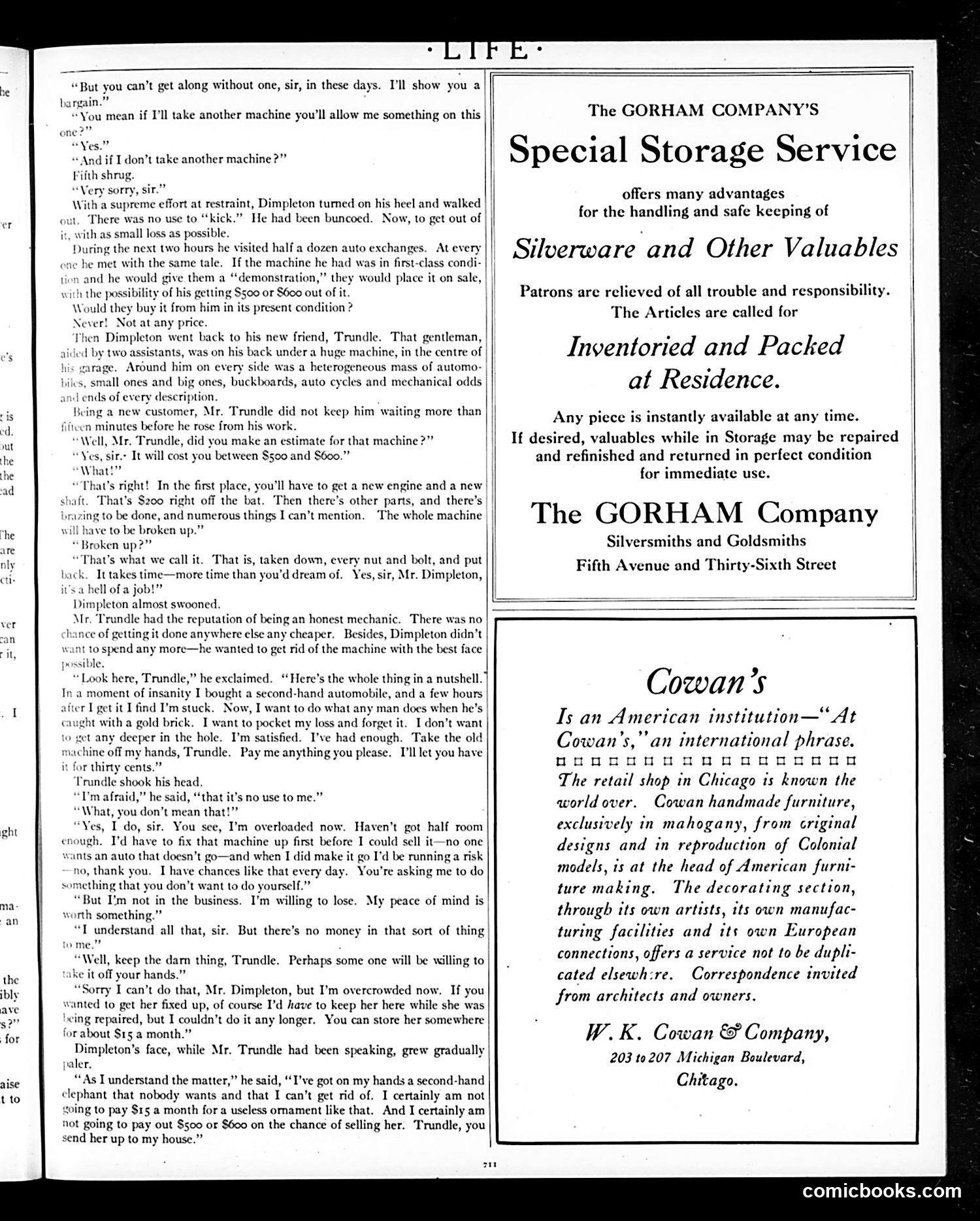
This page presents a satirical story about "Dimpleton," a man who impulsively bought a used automobile and now regrets it. The narrative mocks the emerging automobile industry's aggressive sales tactics and the subsequent buyer's remorse. **The Satire:** Dimpleton is swindled by dealers who offer trade-in allowances only if he buys *another* machine. When he seeks repairs, mechanics estimate $500-600 in work, including completely disassembling the vehicle ("breaking it up"). The honest mechanic Trundle refuses to take the car off his hands—even for free—claiming he's overcrowded, though conveniently suggesting $15/month storage fees. **Social Context:** This reflects early 1900s skepticism toward the automobile industry: high costs, unreliable machines, exploitative dealers, and mechanics' apparent collusion to profit from breakdowns. The joke targets both naive consumers and the industry's questionable practices. The right side contains period advertisements for luxury storage services and Cowan furniture, unrelated to the story.
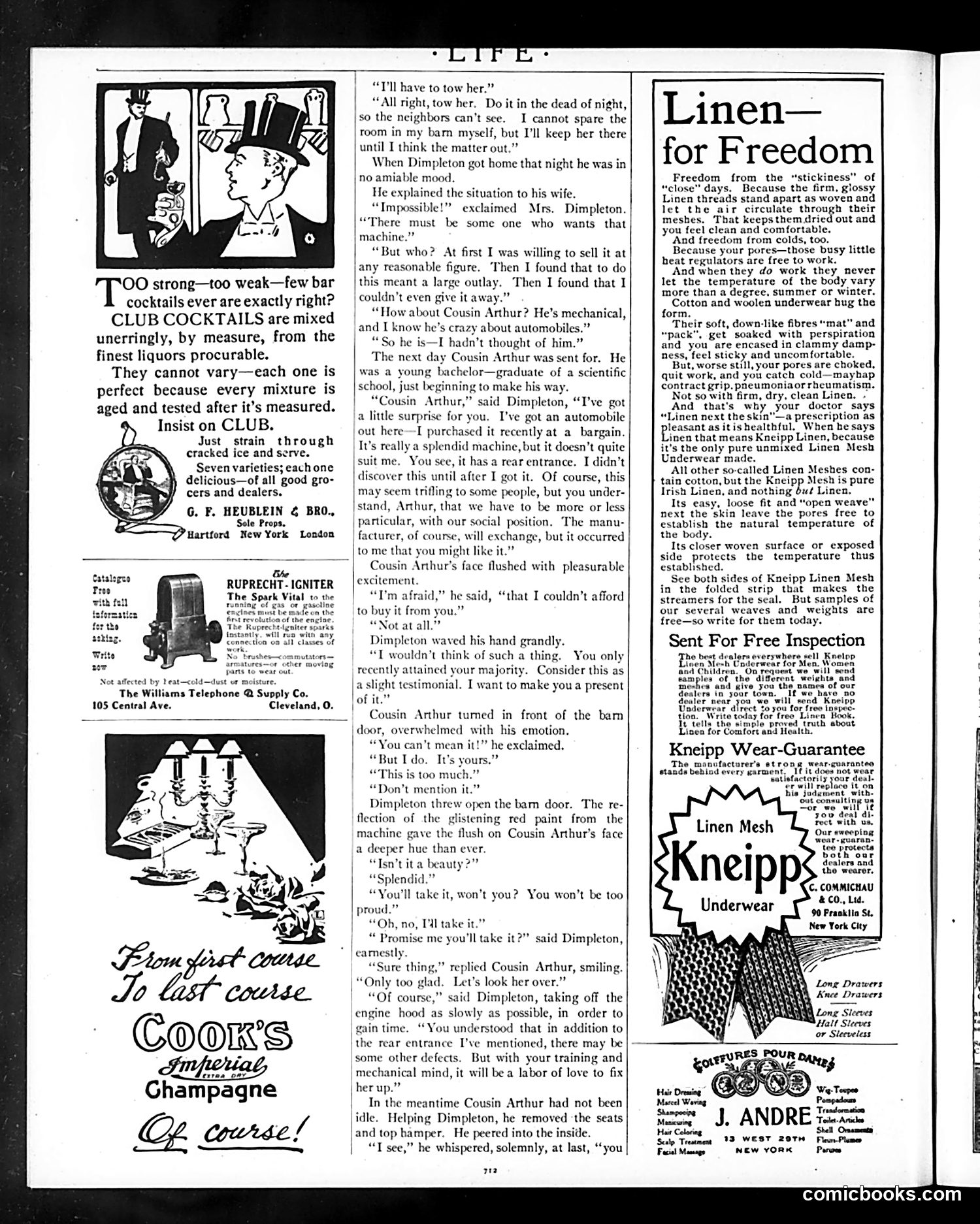
The main narrative depicts a wealthy man, Dimpleton, attempting to unload a defective automobile onto his naive young cousin Arthur by disguising it as a generous gift. The car has a "rear entrance" (likely a euphemism for structural damage), and Dimpleton repeatedly asks Arthur to "promise" he'll take it—manipulative language suggesting awareness of the deception. The satire targets the era's nouveau riche and their social pretensions. Dimpleton hides the car in a barn "so the neighbors can't see," revealing that his concern is appearances, not substance. He exploits Arthur's youth, gratitude, and mechanical skills, framing repairs as a "labor of love" while offloading his problem. The joke hinges on wealthy hypocrisy: Dimpleton wraps selfishness in generosity, using social status as cover. The final panel shows Arthur discovering the car's true condition—the reveal of the con. This reflects early 20th-century anxieties about class mobility and automobile ownership as status symbols.
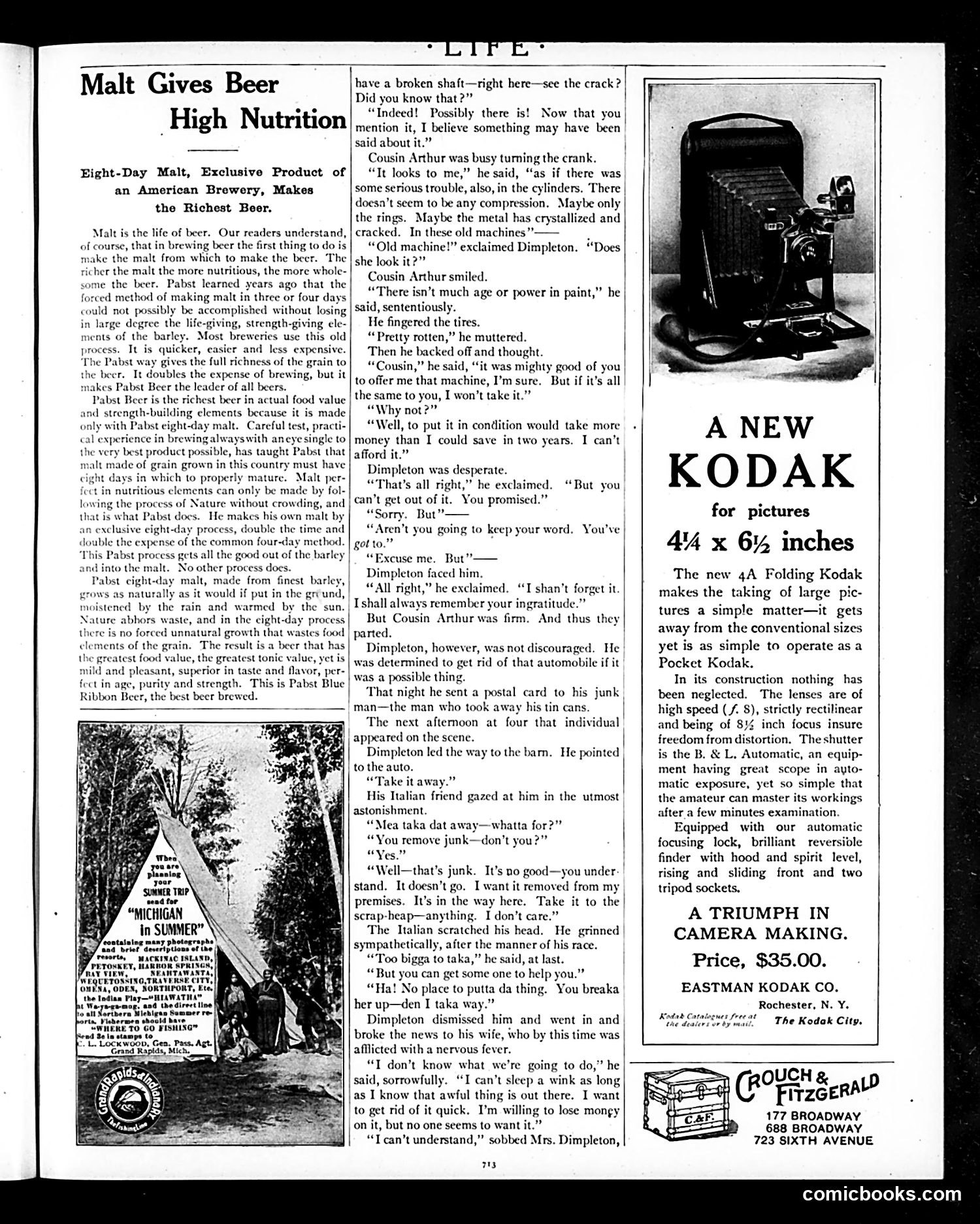
This page contains two distinct elements: **Left side:** A Pabst Beer advertisement claiming superior nutrition from an eight-day malt process. It emphasizes that Pabst's slower method preserves the barley's "life-giving" elements better than competitors' faster four-day processes. This reflects early 20th-century marketing that positioned beer as a wholesome, nutritious beverage—a common sales pitch before Prohibition (1920-1933). **Right side:** A serialized story about "Cousin Arthur" and "Dimpleton." Dimpleton offers Arthur an old, deteriorating automobile as a gift, but Arthur refuses because repair costs would exceed savings. Dimpleton becomes determined to force the gift upon him anyway. The narrative appears to be a humorous tale about stubbornness and unwanted generosity, likely continuing across multiple magazine issues. The Kodak camera advertisement below promotes a new 4½ x 6½ inch folding model, priced at $35.00—positioning photography as an accessible consumer technology for middle-class Americans.
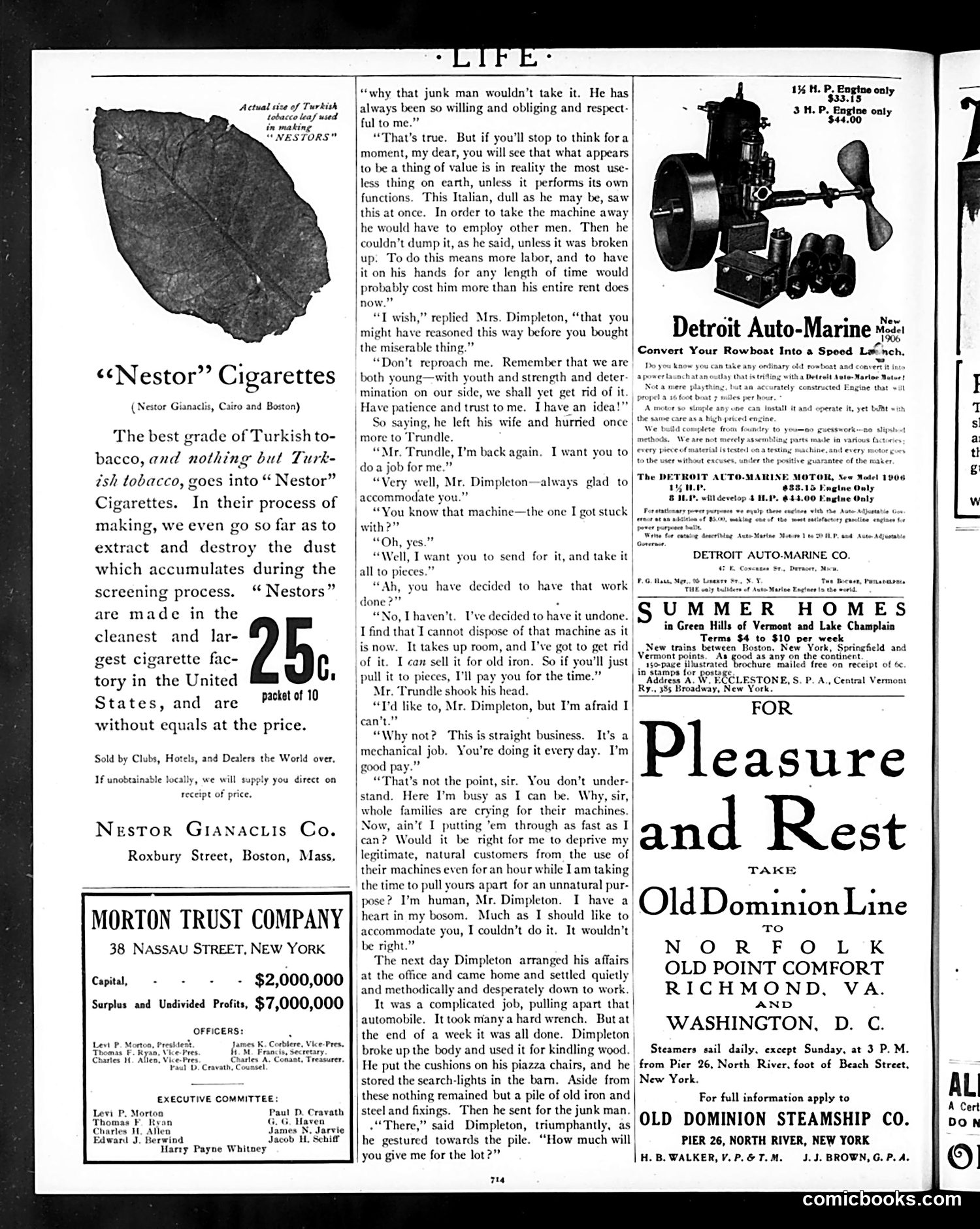
This page is primarily **advertising**, not satire or political commentary. It contains three distinct ads: 1. **"Nestor" Cigarettes**: Markets Turkish tobacco cigarettes, emphasizing purity and manufacturing quality. The large tobacco leaf image serves as visual proof of product authenticity. 2. **Morton Trust Company**: A financial institution advertisement listing officers and capital. 3. **Detroit Auto-Marine Motor** and **Old Dominion Line**: Travel/transportation advertisements. The longest text is a **serialized story** about Mr. Dimpleton trying to dispose of a broken machine. The narrative illustrates a moral lesson: a junk man refuses to disassemble it because he's too busy helping legitimate customers. This appears designed to be humorous and morally instructive rather than satirical. The page reflects early 1900s concerns about commerce, labor, and consumer goods, but contains no clear political cartoon or identifiable caricatured figures requiring historical context for a modern reader.
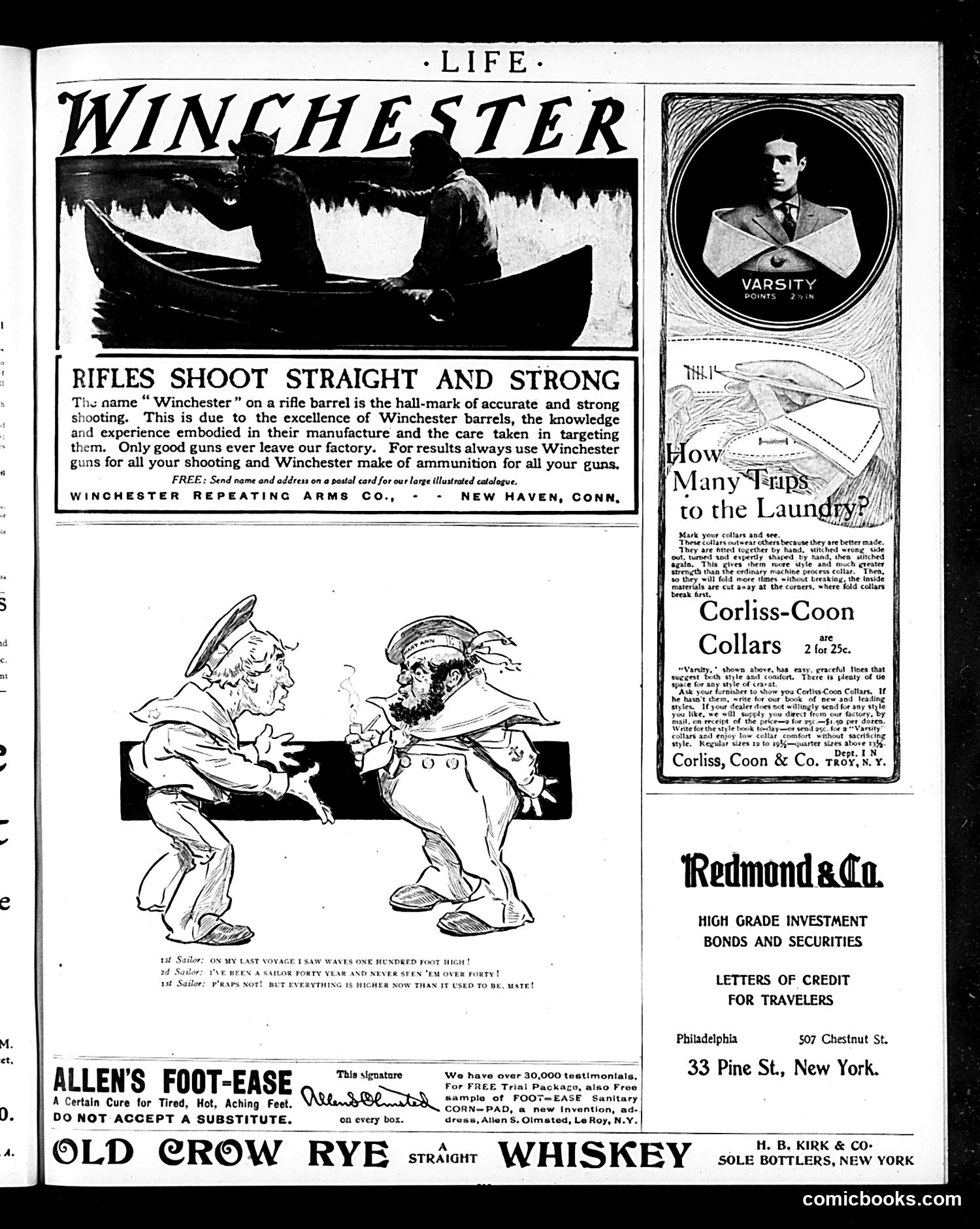
This page is primarily **advertising**, with one satirical cartoon. The cartoon depicts two sailors in conversation. The first sailor boasts he's been sailing forty years without spending more than forty dollars, while the second responds that everything costs more now than it used to. The joke plays on **post-WWI inflation**—a major economic concern of the early 1920s when prices had risen dramatically. The satire mocks the nostalgia of older generations ("in my day") while acknowledging the contemporary reality that living costs had become unaffordable. The remaining content consists of period advertisements: Winchester rifles, Corliss-Coon collars, Allen's Foot-Ease (a corn remedy), Old Crow whiskey, Redmond investment bonds, and other products typical of early 20th-century American consumer goods. The "Varsity Points" sidebar appears to be a fashion or lifestyle feature unrelated to the main cartoon.
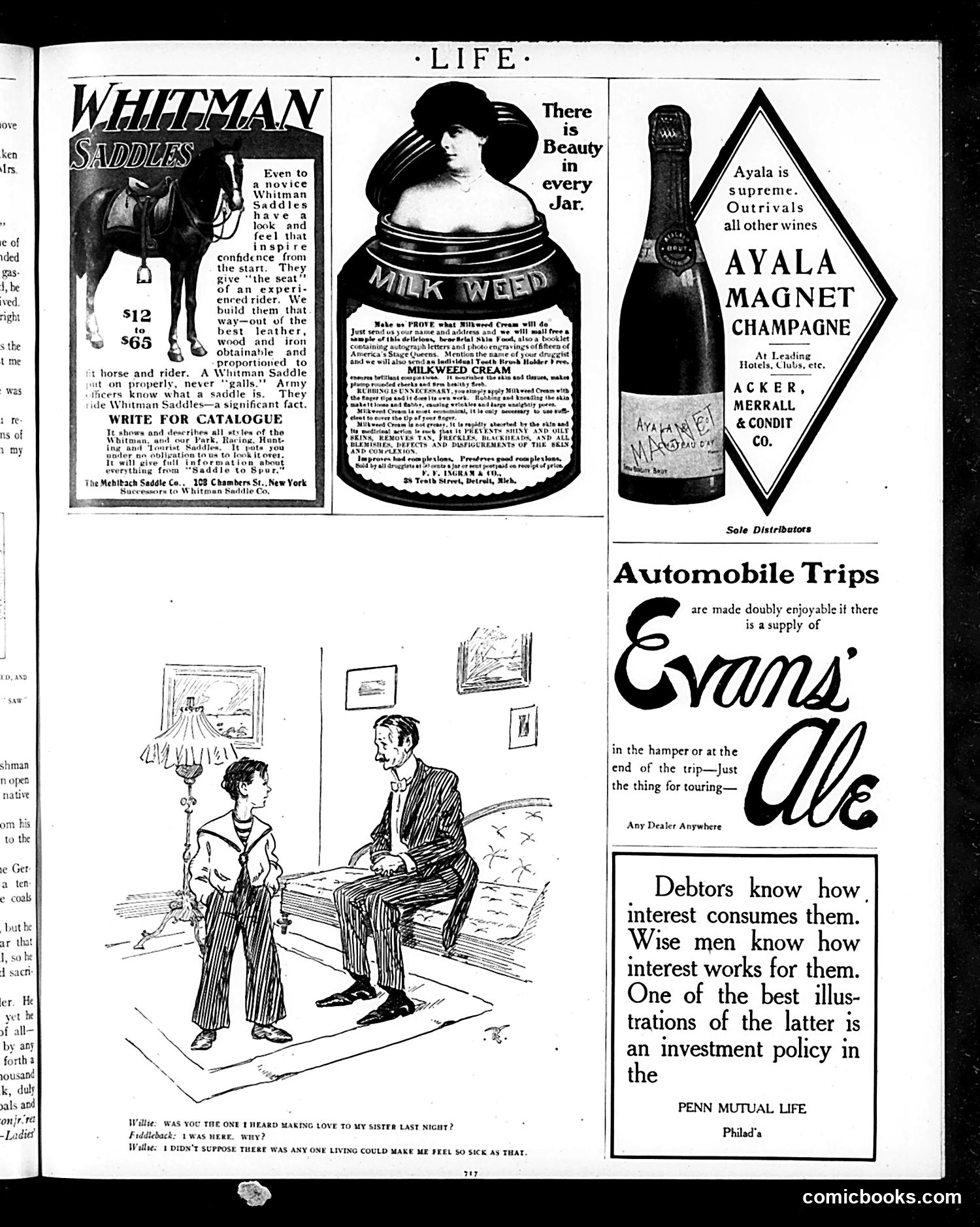
This page is primarily **advertising**, with one cartoon joke at the bottom. The main cartoon depicts two men in conversation indoors. The joke plays on a misunderstanding: Willie asks if the other man (identified as "Fiddleback") was the one making romantic advances to Willie's sister the previous night. Fiddleback confirms he was there, prompting Willie's punchline: he's so disgusted by this that he feels physically ill—implying the sister's suitor is so objectionable that the mere thought of him with his sister nauseates him. The humor is a simple insult joke relying on the setup of mistaken confirmation, common to early 20th-century magazine humor. The remainder of the page consists of period advertisements for **Whitman Saddles, Milkweed Cream, Ayala Magnet Champagne, Evans' Ale, and Penn Mutual Life Insurance**—typical products marketed in a magazine of this era targeting middle and upper-class readers.
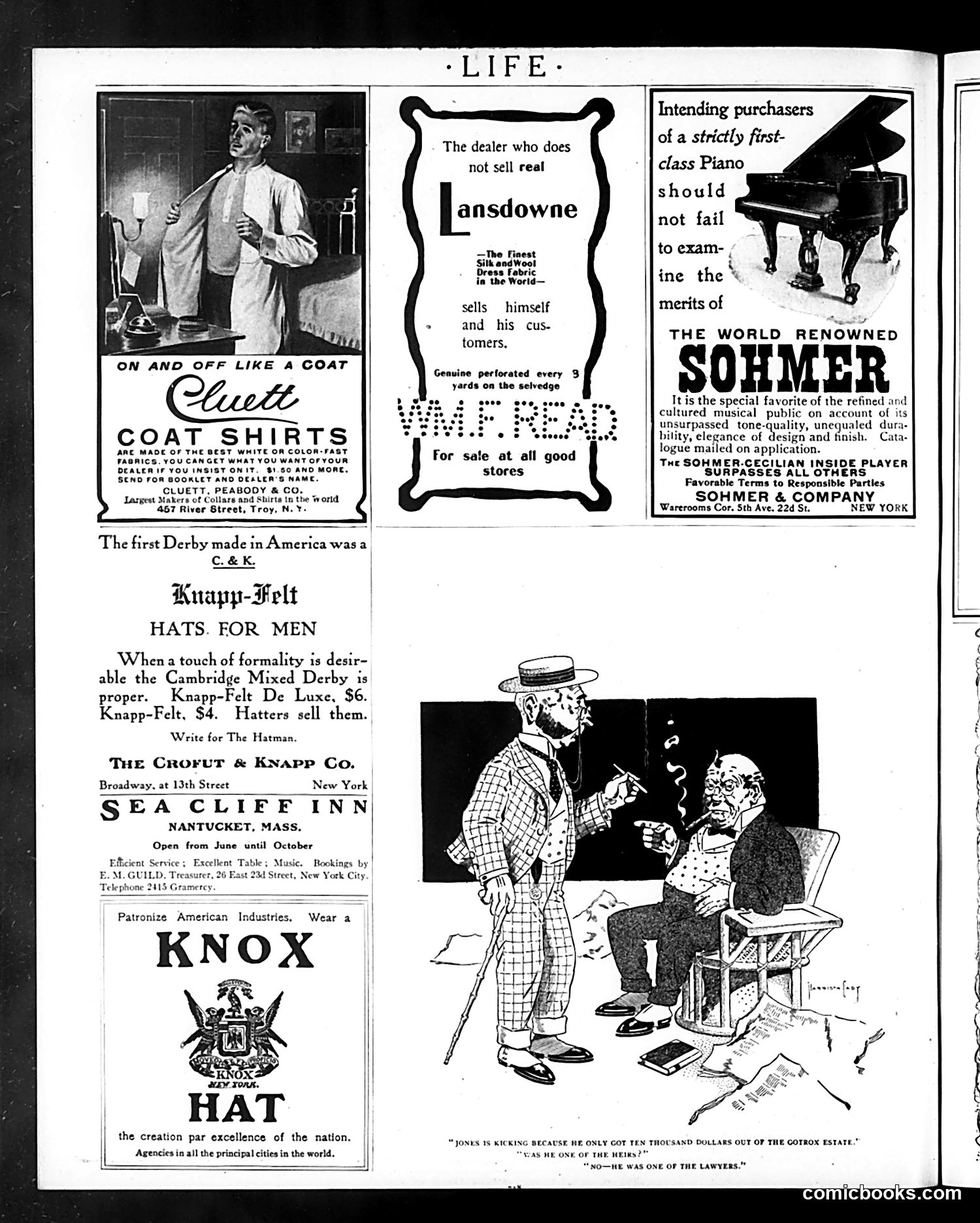
This page is primarily **advertisements** for various products (shirts, hats, pianos, fabric) interspersed with one cartoon at bottom right. The cartoon depicts a humorous scene: a well-dressed man in a checked suit and hat stands before a seated, disheveled figure, apparently discussing an estate or inheritance. The caption reads: "Jones is kicking because he only got ten thousand dollars out of the Gotrok estate." The responses are: "Was he one of the heirs?" / "No—he was one of the lawyers." **The joke:** A lawyer (Jones) expected a much larger payout from his legal work on an estate settlement than the mere $10,000 he received, suggesting lawyers' notorious reputation for inflating fees and expecting lucrative paydays from estate administration. The humor lies in the deflation of his greedy expectations—even being "one of the lawyers" didn't secure him the windfall he apparently felt entitled to. This reflects early 20th-century satirical commentary on the legal profession's perceived avarice.
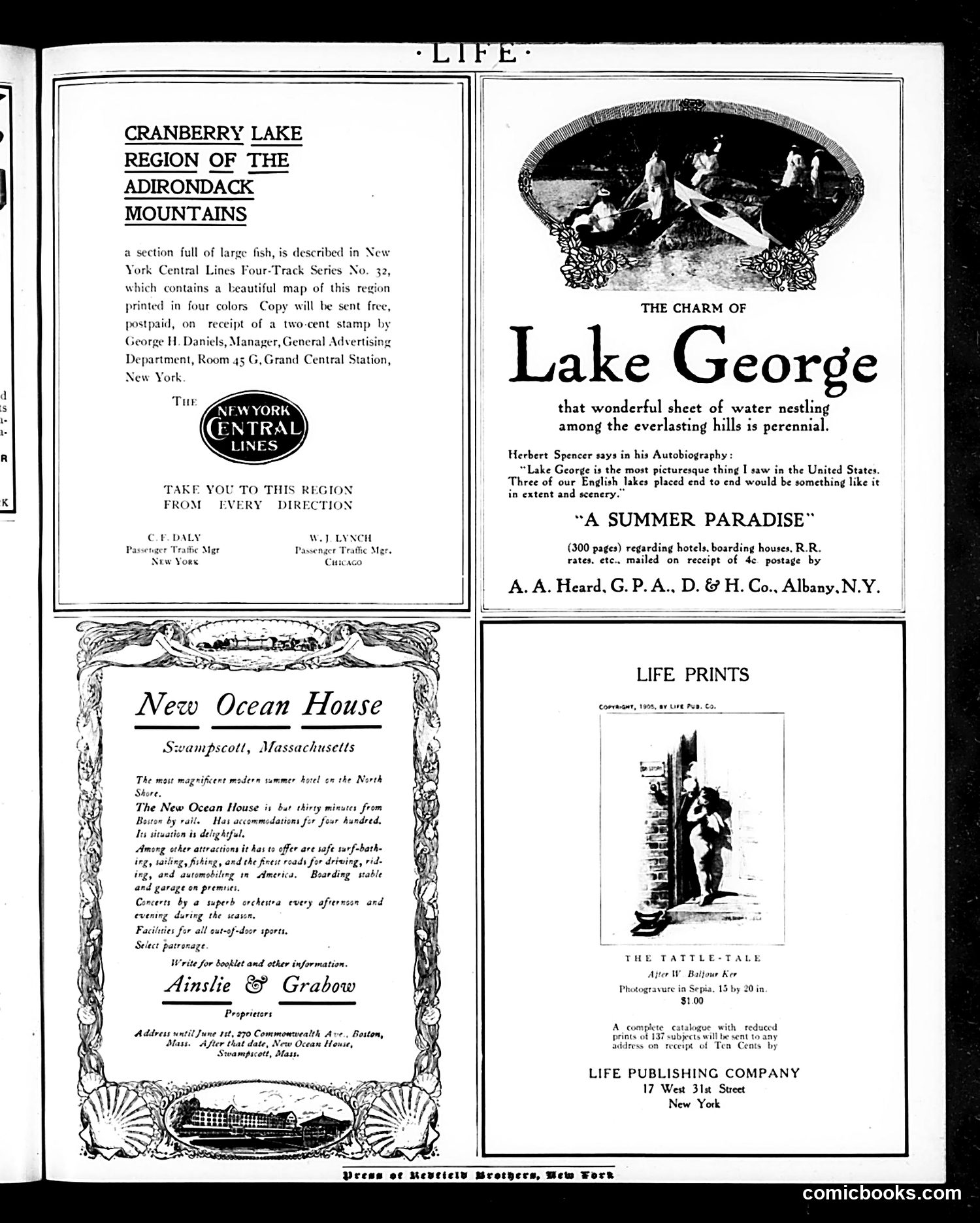
This page is primarily **advertising and promotional content**, not satirical cartoons. It consists of four distinct advertisements: 1. **New York Central Lines** promotes train travel to Cranberry Lake in the Adirondack Mountains, offering free maps to tourists. 2. **Lake George tourism ad** quotes philosopher Herbert Spencer praising the lake's picturesque beauty, positioning it as a "Summer Paradise" for wealthy vacationers. 3. **New Ocean House** advertises a luxury resort in Swampscott, Massachusetts, offering upscale amenities (safe bathing, sailing, riding, orchestral concerts) for approximately 400 guests—clearly targeting affluent leisure travelers. 4. **Life Prints** offers a photogravure titled "The Tattle-Tale" by Balfour Ker for $1.00. The page reflects the **Gilded Age travel industry**, targeting wealthy Americans seeking scenic destinations and resort experiences. There is no political satire visible—this represents Life magazine's commercial side supporting leisure and tourism businesses.
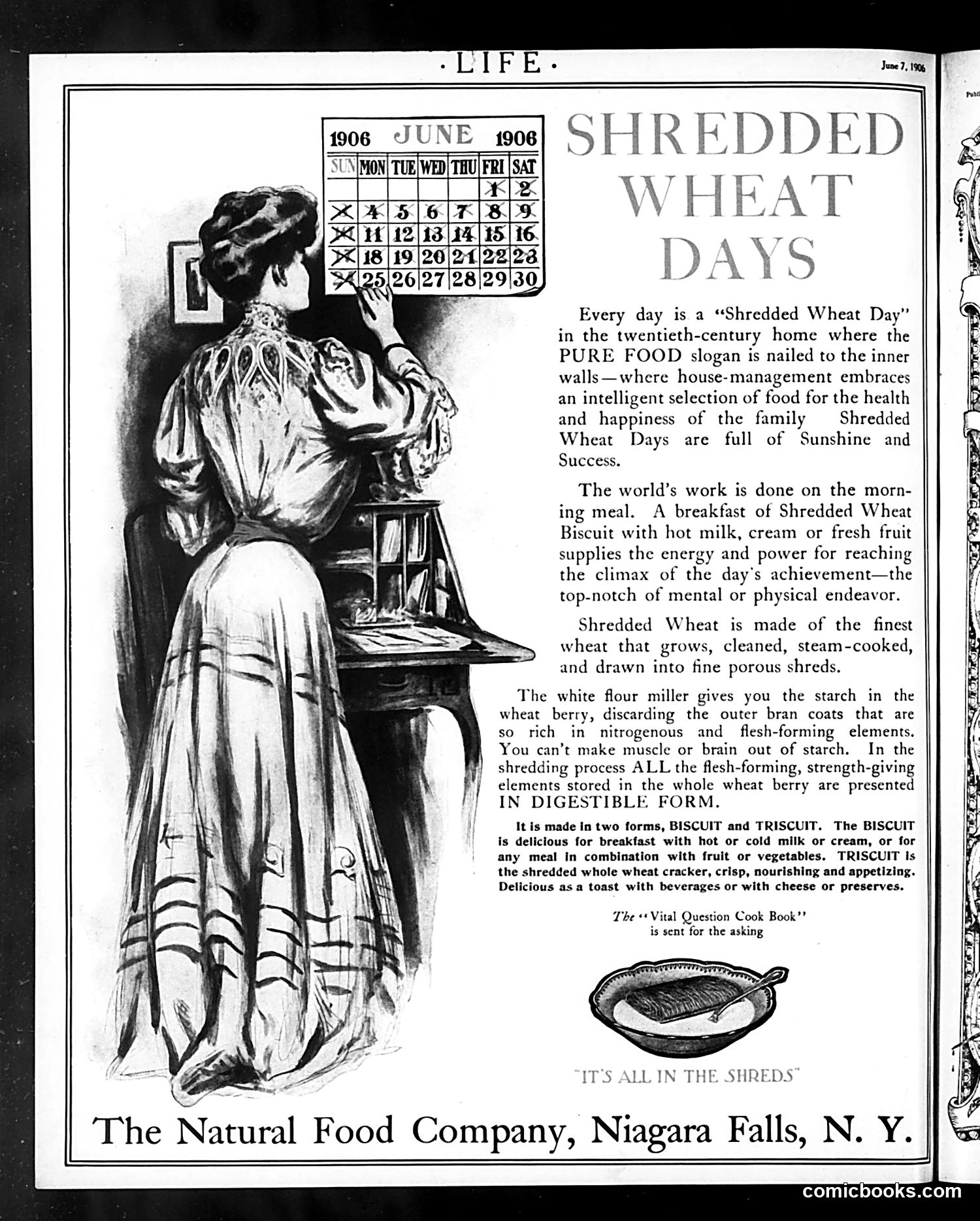
This is primarily a **full-page advertisement**, not satire. It promotes Shredded Wheat cereal to early 20th-century housewives by invoking the "Pure Food" movement—a progressive-era campaign against adulterated food. The illustration shows an elegant woman checking a June 1906 calendar, symbolizing modern household management. The ad's rhetoric emphasizes that eating Shredded Wheat aligns with scientific nutrition and proper domesticity: it provides "digestible" whole-wheat nutrition superior to refined white flour, fuels daily achievement, and reflects intelligent motherhood. The "Pure Food" reference links to contemporary food-safety reforms following *The Jungle* (1906), positioning Shredded Wheat as trustworthy, scientifically-made nutrition for health-conscious families. The tagline "It's All in the Shreds" emphasizes product integrity and wholesomeness.