
Life, 1906-06-07 · page 24 of 42
Life — June 7, 1906 — page 24: what you’re looking at
What you’re looking at
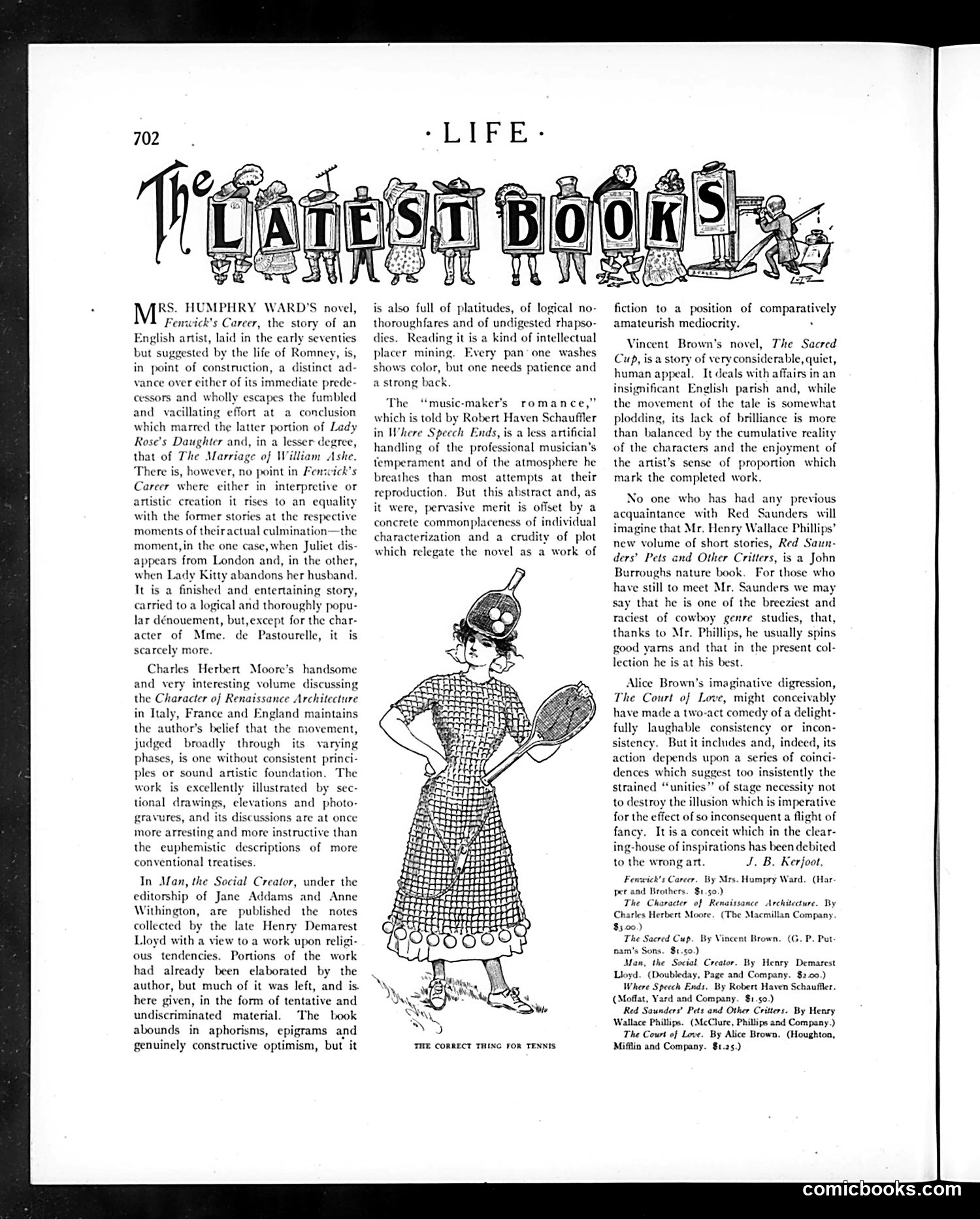
This is a book review section from Life magazine, not a political cartoon. The page critiques several contemporary novels and works of non-fiction, including Mrs. Humphry Ward's *Fenwick's Career*, Charles Herbert Moore's study of Renaissance architecture, and Henry Demarest Lloyd's collection *Man, the Social Creator*. The single illustration—labeled "The Correct Thing for Tennis"—shows a woman in early 1900s athletic wear (a fitted dress with a geometric pattern and a hat), holding a tennis racket. This is a gentle satire on women's sports fashion of the era, mocking the impractical, heavily corseted clothing women were expected to wear even while playing athletics. The reviews themselves are substantive literary criticism typical of Life's cultural coverage during this period, assessing plot construction, characterization, and artistic merit.
📄 Transcribed text from this page (OCR, searchable)
Machine-transcribed from the original scan — historical spelling and the odd misread are preserved.
RS. HUMPHRY WARD'S novel, Fenwick’s Career, the story of an English artist, laid in the early seventies but suggested by the life of Romney, i in point of construction, a distinct ad- vance over cither of its immediate prede- cessors and wholly escapes the fumbled and vacillating effort at a conclusion which marred the latter portion of Lady Rose's Daughter and, in a lesser degree, that of The Marriage of William Ashe. There is, however, no point in Fenwick’s Career where either in interpretive or artistic creation it rises to an equality with the former stories at the respective moments of theiractual culmination—the moment,in the one case, when Juliet dis- appears from London and, in the other, when Lady Kitty abandons her husband. It is a finished and entertaining story, carried to a logical and thoroughly popu- lar dénouement, but,except for the char- acter of Mme. de Pastourelle, it is scarcely more Charles Herbert Moore’s handsome and very interesting volume discussing the Character oj Renaissance Architecture in Italy, France and England maintains the author’s belief that the movement, judged broadly through its varying phases, is one without consistent princi- ples or sound artistic foundation. The work is excellently illustrated by sec- tional drawings, elevations and_ photc gravures, and its discussions are at once more arresting and more instructive than the euphemistic descriptions of more conventional treati In Man, the Social Creator, under the editorship of Jane Addams and Anne Withington, are published the notes collected by the late Henry Demarest Lloyd with a view to a work upon religi- ous tendencies. Portions of the work had already been elaborated by the author, but much of it was left, and is. here given, in the form of tentative and undiscriminated material. The book abounds in aphorisms, epigrams and genuinely constructive optimism, but it is also full of platitudes, of logical no- thoroughfares and of undigested rhapso- di Reading it is a kind of intellectual placer mining. Every pan’ one washes shows color, but one needs patience and a strong bac! The “music-maker’s romance,” which is told by Robert Haven Schauffler in Where Speech Ends, is a less artificial handling of the professional musician's temperament and of the atmosphere he breathes than most attempts at their reproduction. But this abstract and, as it were, pervasive merit is offset by a concrete commonplaceness of individual characterization and a crudity of plot which relegate the novel as a work of THE CORRECT THING TOR TENNIS fiction to a position of comparatively amateurish mediocrity Vincent Brown's novel, The Sacred Cup, isa story of very considerable, quiet, human appeal. It deals with affairs in an insignificant English parish and, while the movement of the tale is somewhat plodding, its lack of brilliance is more than balanced by the cumulative reality of the characters and the enjoyment of the artist’s sense of proportion which mark the completed work. No one who has had any previous acquaintance with Red Saunders will imagine that Mr. Henry Wallace Phillips’ new volume of short stories, Red Saun- ders’ Pets and Other Critters, is a John Burroughs nature book. For those who have still to meet Mr. Saunders we may say that he is one of the breeziest and raciest of cowboy genre studies, that, thanks to Mr. Phillips, he usually spins good yams and that in the present col- lection he is at his best. Alice Brown's imaginative digression, The Court of Love, might conceivably have made a two-act comedy of a delight- fully laughable consistency or incon- sistency. Butit includes and, indeed, its action ‘depends upon a series of coinci- dences which suggest too insistently the strained “unities” of stage necessity not to destroy the illusion which is imperative for the effect of so inconsequent a flight of fancy. It is a conceit which in the clear- ing-house of inspirations has been debited to the wrong art. J. B. Kerjoot. Fenwick’s Career. By Mrs. Humpry Ward. (Har. per and Brothers. $1.50.) The Character of Renaissance Architecture. By Charles Herbert Moore. (The Macmillan Company 83.00.) The Sacred Cup. ns. $1.50.) Man, the Social Creator, By Henry Demarest Lloyd. (Doubleday, Page and Company. $2.00.) Where Speech Ends. By Robert Haven Schauffler. (Moffat, Yard and Company. $1.50.) Red Saunders’ Pets and Other Critters. By Henry Wallace Phillips. (McClure, Phillips and Company.) The Court of Love. By Alice Brown. (Houghtoa, Miflin and Company. 81.25.) By Vincent Brown. (G. P. Put ram's comicbooks.com