
Life, 1906-06-07 · page 12 of 42
Life — June 7, 1906 — page 12: what you’re looking at
What you’re looking at
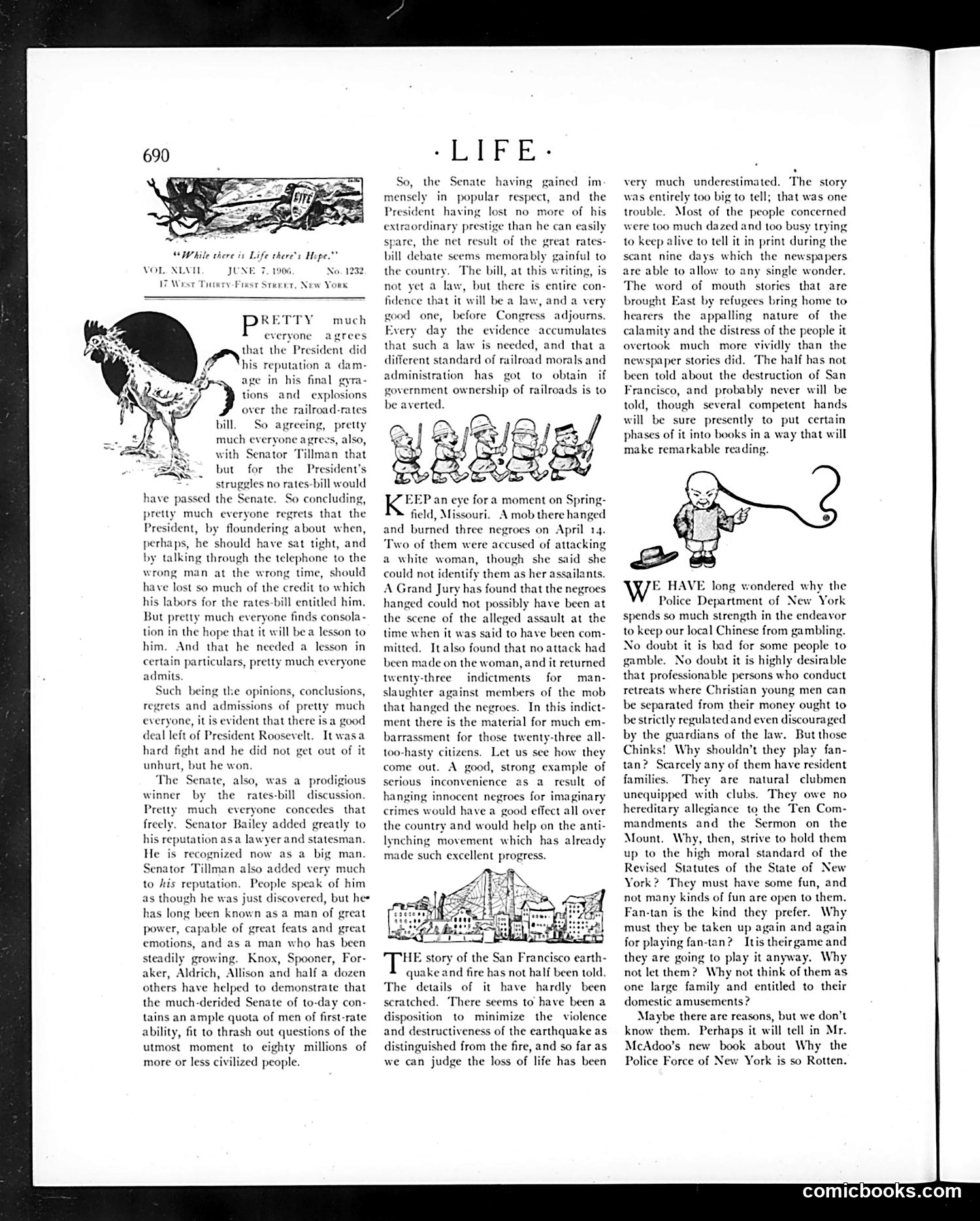
This page contains editorial commentary on President Roosevelt's handling of a railroad rates bill in Congress. The text praises Senator Tillman's support for the President while acknowledging Roosevelt "lost so much of the credit" for the bill's passage. The **rooster cartoon** (left) appears to satirize political posturing around the rates debate—a common symbol of boastful rhetoric. The page also discusses a lynching in Springfield, Missouri, where a Grand Jury found the accused Black men not guilty of assault charges, yet they were later indicted for manslaughter. The text critiques this legal inconsistency and comments on anti-lynching progress. A **cityscape illustration** (lower right) accompanies discussion of the San Francisco earthquake's destruction. The satirical tone targets legal contradictions and political ineffectiveness regarding racial violence and corporate regulation.
📄 Transcribed text from this page (OCR, searchable)
Machine-transcribed from the original scan — historical spelling and the odd misread are preserved.
“While there is Life there's Hope.” VOL XLVI JUNE 7.1906 No. 1232 17 West Titery-Frest Stener, New Yore, RETTY everyone much agrees that the President did his reputation a dam- age in his final gyre tions and_ explosions over the railroad-rates bill. So agreeing, pretty much everyone agrees, also, with Senator Tillman that but for the President's struggles no rates-bill would have passed the Senate. So concluding, pretty much everyone regrets that the President, by floundering about when, perhaps, he should have sat tight, and by talking through the telephone to the wrong man at the wrong time, should have lost so much of the credit to which his labors for the rates-bill entitled him, But pretty much everyone finds consola tion in the hope that it will bea lesson to him. And that he necded a lesson in certain particulars, pretty much everyone Amits. Such being the opinions, conclusions, Coed regrets and admissions of pretty much everyone, it is evident that there isa good deal left of President Roosevelt. Itwasa hard fight and he did not get out of it unhurt, but he won. The Senate, also, was a prodigious winner by the rates-bill discussion. Pretty much everyone concedes that freely. Senator Bailey added greatly to his reputation asa lawyer and statesman. He is recognized now as a big man. enator Tillman also added very much to his reputation. People speak of him as though he was just discovered, but hee has long been known as a man of great power, capable of great feats and great emotions, and as a man who has been steadily growing. Knox, Spooner, For- aker, Aldrich, Allison and half a dozen others have helped to demonstrate that the much-derided Senate of to-day con- tains an ample quota of men of first-rate ability, fit to thrash out questions of the utmost moment to eighty millions of more or less civilized people -LIFE.- So, the Senate having gained im mensely in popular respect, and the President having lost no more of his extraordinary prestige than he can easily spare, the net result of the great rates- bill debate seems memorably gainful to the country. The bill, at this writing, is not yet a law, but there is entire con- fidence that it will be a law, and a very good one, before Congress adjourns. Every day the evidence accumulates that such a law is needed, and that a different standard of railroad morals and administration has got to obtain if government ownership of railroads is to be averted. EEP an eye for a moment on Spring- field, Missouri. A mob there hanged and burned three negroes on April 14. ‘Two of them were accused of attacking a white woman, though she said she could not identify them as her assailants. A Grand Jury has found that the negroes hanged could not possibly have been at the scene of the alleged assault at the time when it was said to have been com- mitted. It also found that no attack had been made on the woman, and it returned twenty-three indictments for —man- slaughter against members of the mob that hanged the negroes. In this indict- ment there is the material for much em- barrassment for those twenty-three all- too-hasty citizens. Let us see how they come out. A good, strong example of serious inconvenience as a result of hanging innocent negroes for imaginary crimes would have a good effect all over the country and would help on the anti- ynching movement which has already made such excellent progress. HE story of the San Francisco earth- quake and fire bas not half been told, The details of it have hardly been scratched. There seems to have been a disposition to minimize the violence and destructiveness of the earthquake as distinguished from the fire, and so far as we can judge the loss of life has been very much underestimated. ‘The story was entirely too big to tell; that was one trouble. Most of the people concerned were too much dazed and too busy trying to keep alive to tell it in print during the scant nine days which the newspapers are able to allow to any single wonder. The word of mouth stories that are brought East by refugees bring home to hearers the appalling nature of the calamity and the distress of the people it overtook much more vividly than the newspaper stories did. The half has not been told about the destruction of San Francisco, and probably never will be told, though several competent hands will be sure presently to put certain phases of it into books in a way that will make remarkable reading. HAVE long wondered why the Police Department of New York spends so much strength in the endeavor to keep our local Chinese from gambling. No doubt it is bad for some people to gamble. No doubt it is highly desirable that professionable persons who conduct retreats where Christian young men can be separated from their money ought to be strictly regulated and even discouraged by the guardians of the law. But those Chinks! Why shouldn’t they play fan- tan? Scarcely any of them have resident families. They are natural clubmen unequipped with clubs. They owe no hereditary allegiance to the Ten Com- mandments and the Sermon on the Mount. Why, then, strive to hold them up to the high moral standard of the Revised Statutes of the State of New York? They must have some fun, and not many kinds of fun are open to them. Fan-tan is the kind they prefer. Why must they be taken up again and again for playing fan-tan? Itis theirgame and they are going to play it anyway. Why not let them? Why not think of them as one large family and entitled to their domestic amusements ? Maybe there are reasons, but we don’t know them. Perhaps it will tell in Mr. McAdoo’s new book about Why the Police Force of New York is so Rotten. comicbooks.com