
Life, 1906-06-07 · page 18 of 42
Life — June 7, 1906 — page 18: what you’re looking at
What you’re looking at
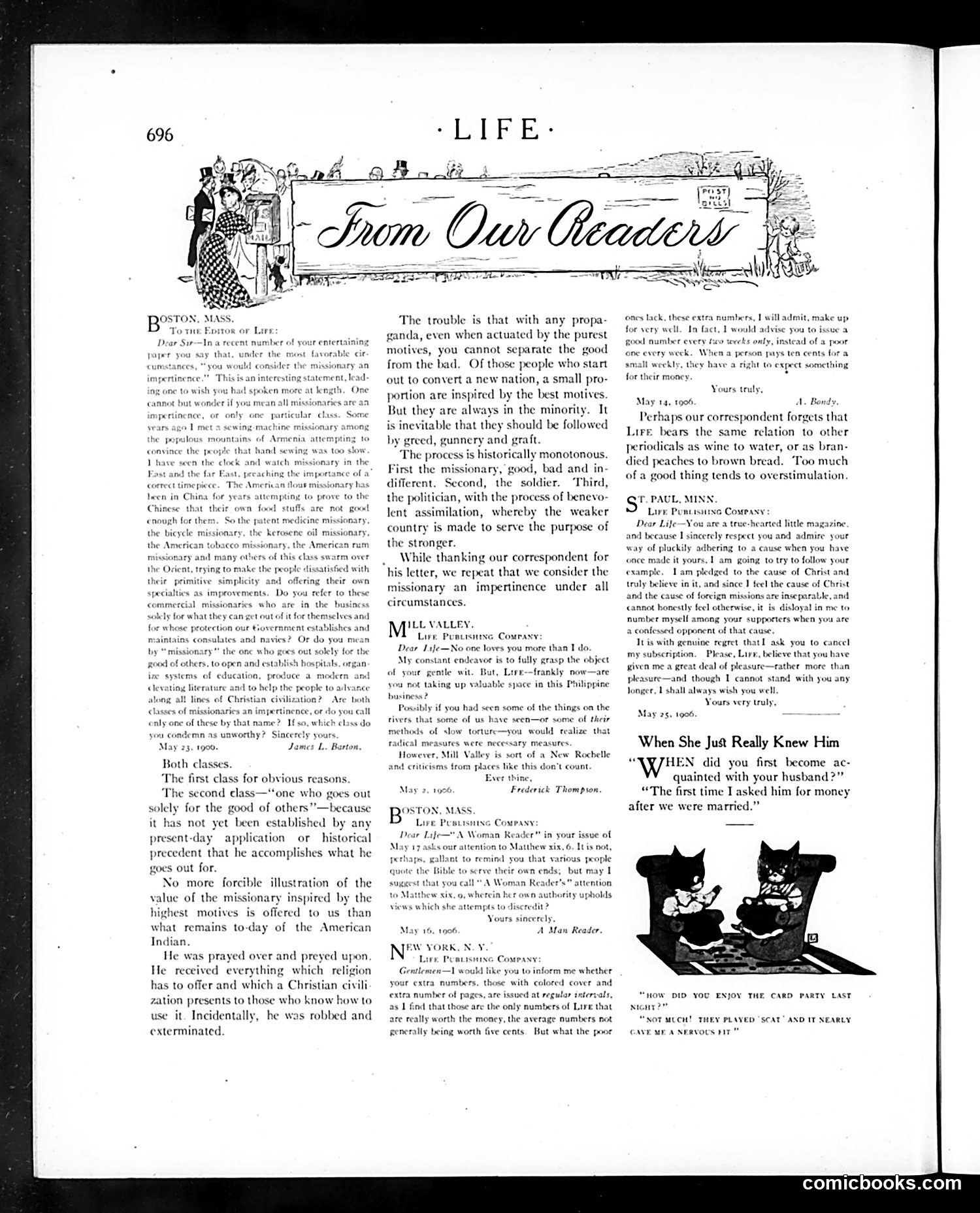
This page presents a "Letters to the Editor" section debating American missionary work and imperialism. The key exchange concerns whether missionaries are beneficial or exploitative. **The Core Debate:** A Boston reader defends missionaries, distinguishing between altruistic ones serving others and cynical ones seeking personal gain. Life's editor responds harshly: missionaries—even well-intentioned ones—are inherently "an impertinence," citing the American Indian as historical proof. The editor argues that missionary work inevitably enables exploitation: "First the missionary, good, bad and indifferent. Second, the soldier. Third, the politician." **Historical Context:** This reflects early-1900s American skepticism about U.S. imperial expansion, particularly in the Philippines (explicitly mentioned). The editor critiques the "benevolent assimilation" rhetoric masking colonial conquest, suggesting missionaries provide moral cover for economic exploitation and cultural destruction. **The Cartoon:** The bottom illustration shows two black cats with caption referencing a card party—likely satirizing social pretension, though the connection to the missionary debate above is unclear.
📄 Transcribed text from this page (OCR, searchable)
Machine-transcribed from the original scan — historical spelling and the odd misread are preserved.
OSTON, MASS. To 1x Epitor Dear Sir a recent number of your entertaining under the most favorable cir cumstances, “you would consider the missionary an imgertinence.” This is an interesting statement, lead cannot but wonder if you mean all missionaries are aa mpertinence, or only on T met s of Armen 3 to convince the poopie that hand sewing J have seen the clock and watch m Fast far F jonary in the 1. peeaching the importance of a The American flous missionary has to thi ne piece leen in China for years attempting to pros Chinese that their own food stuffs an enough for them not goo So the patent medicine missionary «ken onary the bicycle missionary ene oil missionary the Americ American rum ass swarm over ying to make the people «i many others of this tisfied with simplicity and offering their own ies as improvements. Do you refer to these 1 miss in the business 4 it for themselves and 1 Government establishes and aries who are solely for what they can get ou for whose protection 0 s consul maint sand navies? Or do you mean by “missionary” the one who gocs out solely for the od of others, to open and est ize systems of education, prc a modern and {to help the people to advance Are both levating literature s of Ct along a ian civilization? aries > you call which class do May 23. 1900. Both classe ‘The first class for obvious reasons. The second class—“one who goes out solely for the good of others”—because it has not yet been established by any present-day application or precedent that he accompl s out for. No more forcible illustration of the value of the missionary inspired by the historical hes what hi highest motives is offered to us what remains to-day of the American Indian. He was prayed over and preyed upon He received everything which religion has to offer and which a Christian civili zation presents to those who know how to use it. Incidentally, he was robbed and exterminated. The trouble is that with any propa- ganda, even when actuated by the purest motives, you cannot separate the good from the bad. Of those people who start out to convert a new nation, a small pro- portion are inspired by the best motives. But they are always in the minority. It is inevitable that they should be followed by greed, gunnery and graft. The process is historically monotonous. First the missionary, good, bad and in different. Second, the soldier. Third, the politician, with the process of benevo- lent assimilation, whereby the weaker country is made to serve the purpose of the stronger. While thanking our correspondent for s letter, we repeat that we consider the missionary an impertinence under all circumstances. ILL VALLEY Lire Pemuisnise Costrasy: Dear LiJe—No one loves you mare than I do. My constant endeavor is to fully grasp the object of y c wit. But, Lire-—frankly now—are you not taking up valuable space in this Philipp business? Possibly if you had sen some of the things on the rivers that some of us have seen—or some of their methods of slow torture—you would realize that radical measures were necessary measures However, Mill Valley is sort of a New Rochelle and criticisms from places like this don’t count Ever t May 2, 1906. Frederick Thompion. Bo" N, MASS Live Pepuisnixe Co Dear Lije—" A Woman Re May 17 asks our atte sy ler” in your issue of on to Matthew xix, 6, Itis not, lant to remind you that va serve their own ¢ call “A Woman Reader's” new xix, 0, wherein her own authority views which she attempts to discredit ? Yours sincerely, May 16, 1906. A Man Reader NEW york. 8. ¥ Li & Poatisiixe Costpaxy entlemen—1 would like you to i extra numbers, those with colored cover fat regu only numbers of Lire that the average numbers not generally being worth five cents. But what the poor umber of pages, are iss as 1 find tha Fe th v intervals, Ses ‘ones lack, these extra numbers, 1 will In fact, 1 would advise good number every fs Imit, make up for very well, a1 to issue a ks only, instead of a poor one every week. When a person pays ten cents for a small weekly, they have 1 to expect something for their money. . Yours truly, May 14, 1906. d Perhaps our correspondent forgets that Lire bears the same relation to other periodicals as wine to water, or as bran- died peaches to brown bread. ‘Too much of a good thing tends to overstimulation S T. PAUL, MINS Lire, Pontisiina Cospaxy: Dear LiJe—You are a true-hearted little m: and because I sincerely respect you and adm way of pluckily a cause when you have murs, Lam going to try to follow your 1am pledged to the cause of Christ and truly believe in it, and since J feel the cause of Christ and the cause of foreign missions are inseparable, and cannot honestly feel otherwise, it is disloyal in me to number myself among your suppor a confessed opponent of that cause, It is with genuine regret that ask you to cancel my subscription given me a gre: azine. © yout rs when you a Please, Lire, believe that you have deal of pleasure—and though I cannot stand with you any father more tha Jonger, I shall always wish you well Yours very truly, May 25, 1906. When She Just Really Knew Him “YYJHEN did you first become ac- quainted with your husband?” “The first time I asked him for money after we were married.” HOW DID YOU ENJOY THE CARD PARTY LAST nour?” NOT MUCH! THEY PLAYED “SCAT’ AND IT NEARLY GAVE MEA NERVOUS HT" comicbooks.com