
A complete issue · 28 pages · 1906
Life — May 17, 1906
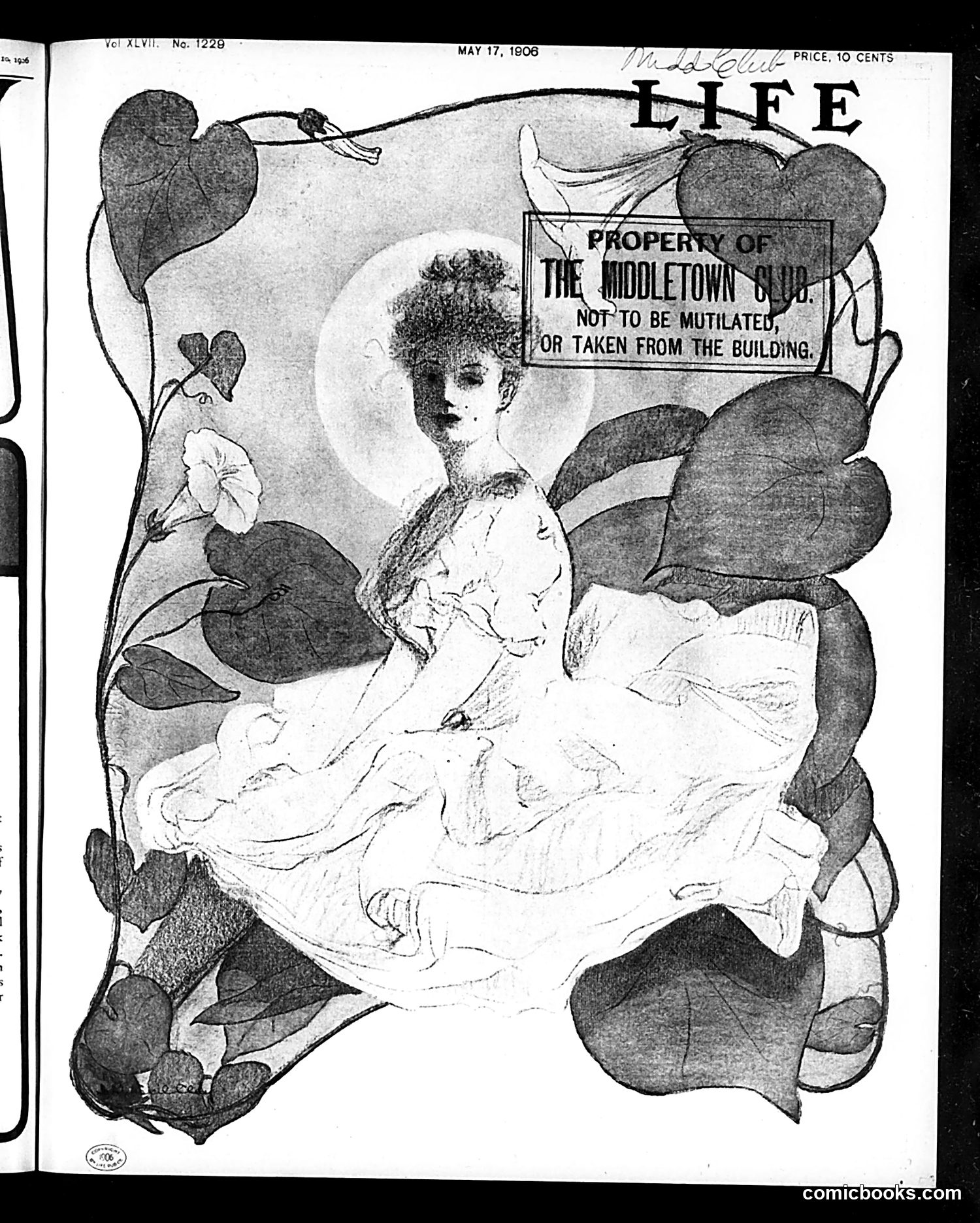
This is a cover illustration featuring an elegantly dressed woman in a white gown, surrounded by large heart-shaped leaves and flowering vines. The woman has an idealized, romanticized appearance typical of early 1900s illustration styles. The copyright notice reads "PROPERTY OF THE MIDDLETOWN CLUB. NOT TO BE MUTILATED, OR TAKEN FROM THE BUILDING," suggesting this was a library copy owned by a private club. The cover's satire appears to mock romantic or sentimental imagery popular in the era—the ornate, heavily decorated frame of hearts and flowers surrounding the idealized female figure may be satirizing the excessive sentimentality of contemporary art, literature, or advertising. The specific local reference to "Middletown Club" remains unclear without additional context.
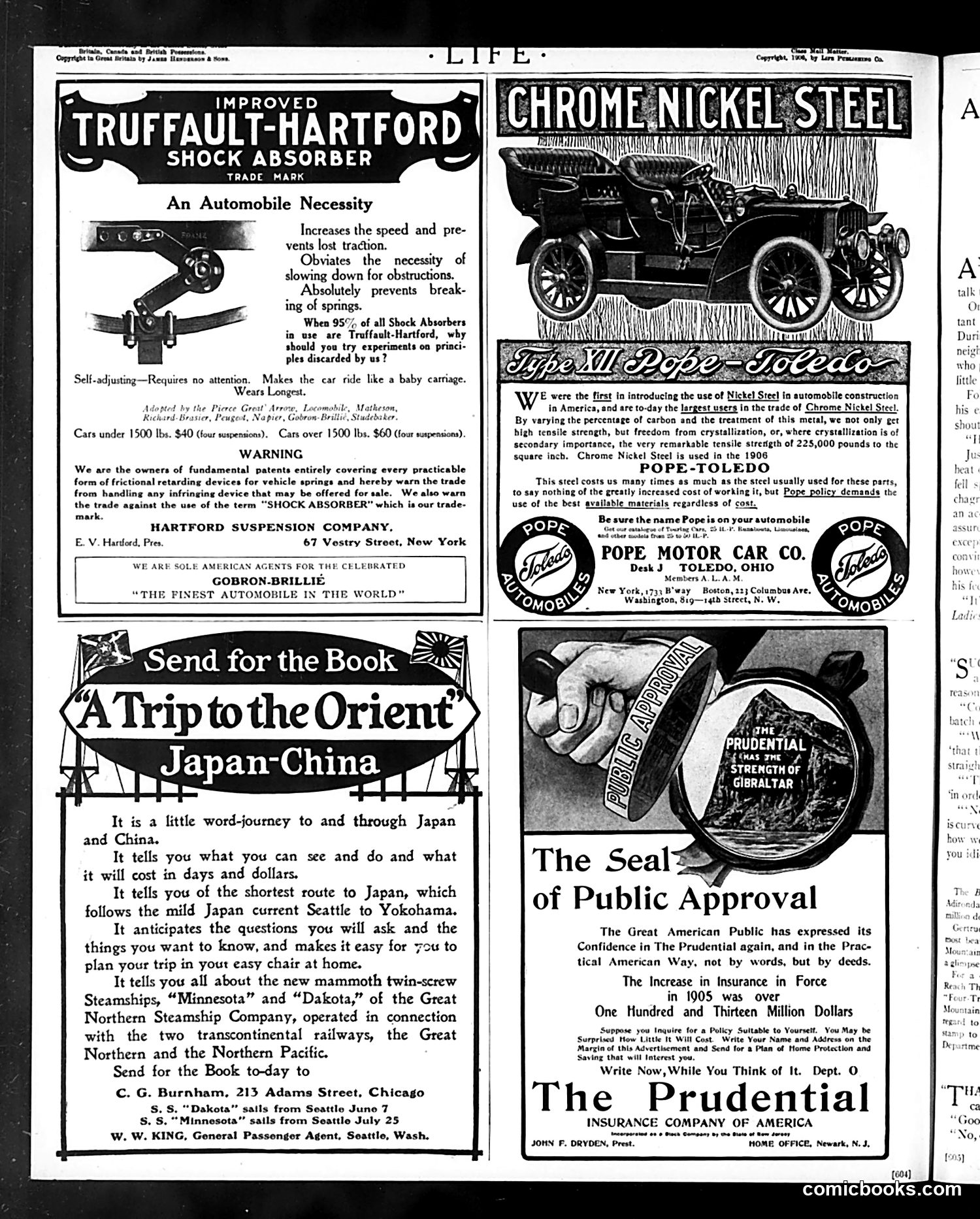
This page is **primarily advertisements** rather than satirical content. The top left advertises the **Truffeault-Hartford Shock Absorber** for automobiles, emphasizing it as "An Automobile Necessity" that improves speed and traction. The top right features the **Pope-Toledo automobile**, a Type XII model, highlighting its use of "Chrome Nickel Steel" in construction—positioning this material as a modern innovation for vehicle durability. The bottom left advertises a travel book, "A Trip to the Orient: Japan-China," promoting steamship voyages through the Great Northern Steamship Company. The bottom right promotes **The Prudential Insurance Company**, emphasizing public confidence in their policies, citing a "$113 million" increase in force during 1905. All content reflects early 1900s commercial messaging with no apparent political satire.
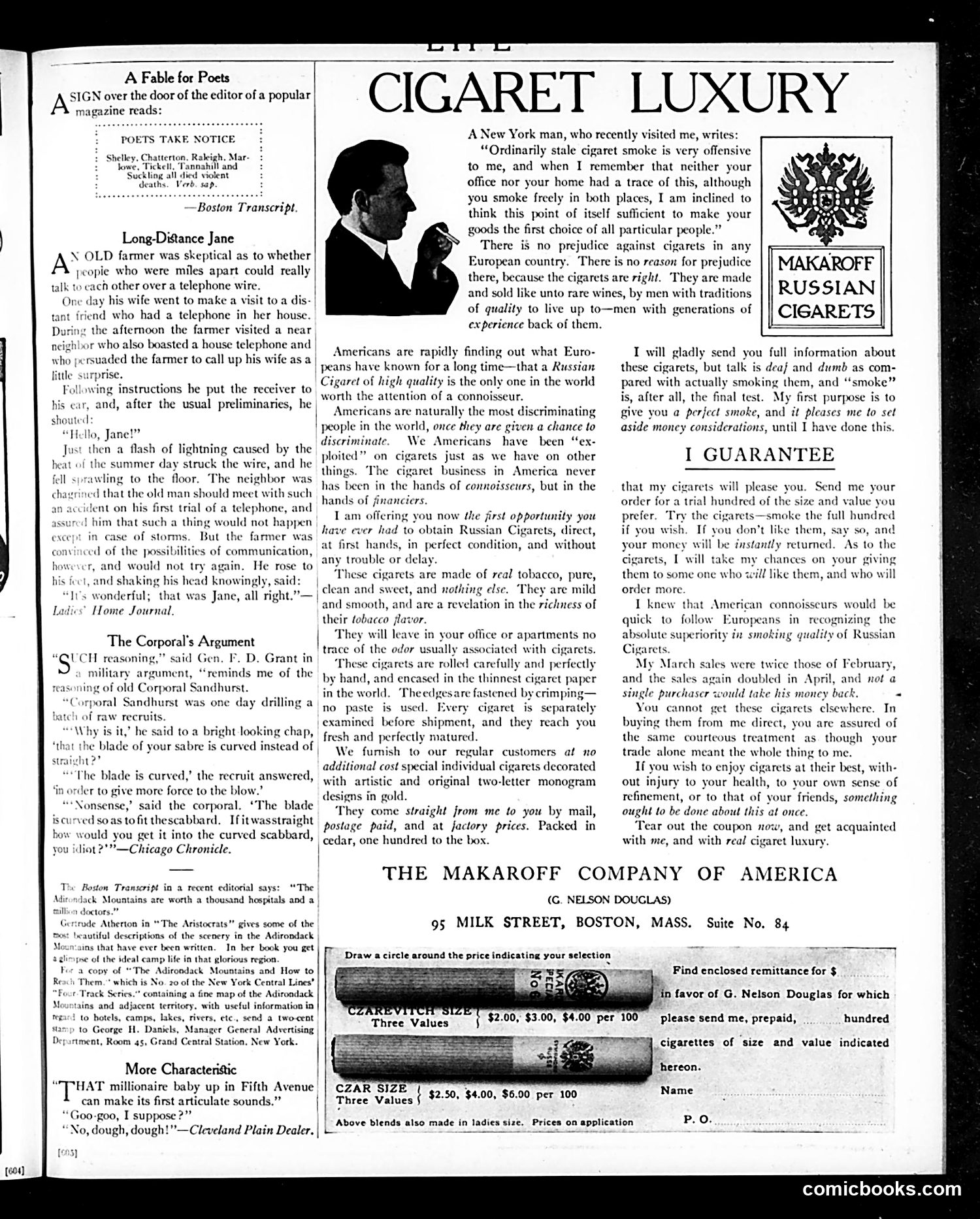
This page is primarily **advertising for Makaroff Russian Cigarettes**, not political satire. The left column contains humorous short pieces ("A Fable for Poets," "Long-Distance Jane," "The Corporal's Argument," "More Characteristic") typical of Life magazine's comedy section. The main advertisement features a man in profile smoking a cigarette, promoting Russian cigars as a luxury item. The text argues that Russians have "quality" and "experience" with tobacco, and that Americans should recognize this superiority. The ad emphasizes the cigarettes are "real," "pure," and superior to American brands. This reflects early 20th-century attitudes valuing European (particularly Russian) products as inherently more refined than American alternatives—a common advertising strategy of the era targeting affluent consumers seeking status through imported goods.
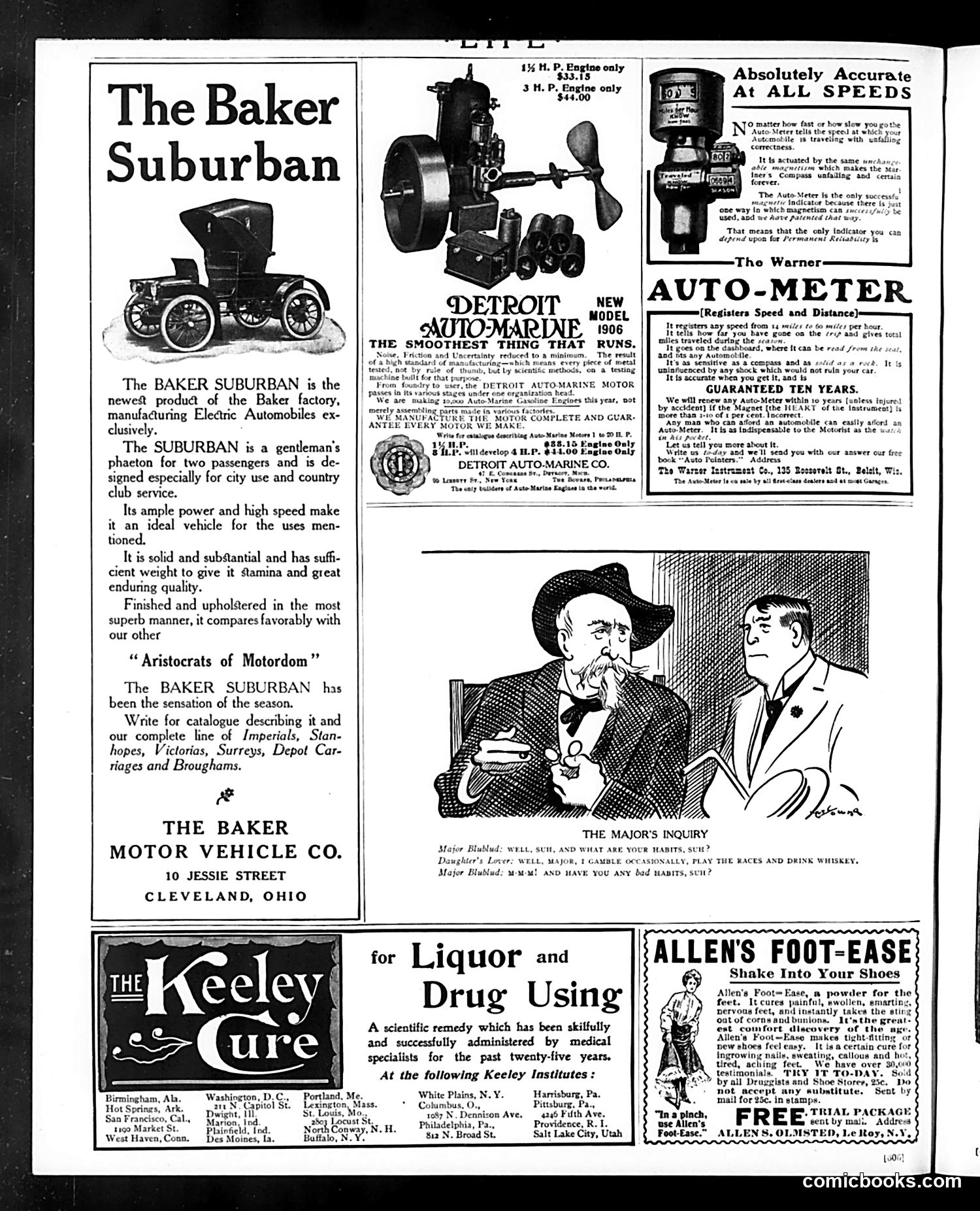
This page is primarily **advertising** for automobiles, speedometers, and patent medicines. However, the central cartoon—"The Major's Inquiry"—depicts two men in conversation. The older man (labeled "Major") wears a wide-brimmed hat and has a distinctive mustache; the younger man listens as the Major asks about his habits. The Major's questions—about whiskey, racing, and driving—suggest he's interrogating the younger man about dissolute behavior. The humor appears to rest on **generational conflict**: an older authority figure (the "Major") expressing disapproval of modern vices, particularly drinking and reckless motorcar driving. The cartoon likely satirizes anxiety about youth culture and automotive-era excess, though the specific Major figure remains **unclear**.
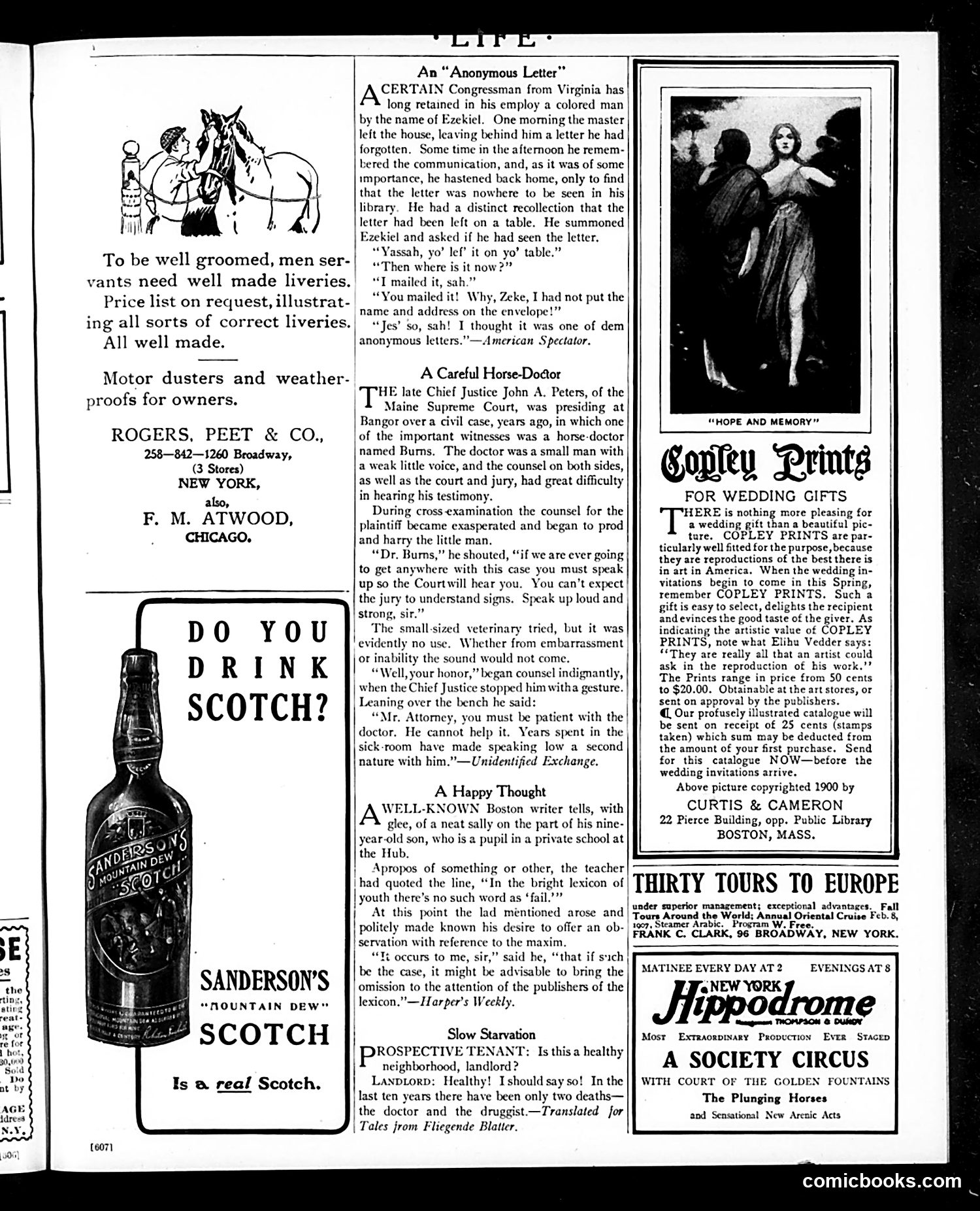
This page is primarily **advertising and anecdotal content** rather than political satire. The main elements include: **Advertisements:** - Rogers, Peet & Co. (liveries/horse equipment) - Sanderson's "Mountain Dew" Scotch whisky - Copley Prints (wedding gifts) - New York Hippodrome theater - Travel tours to Europe **Anecdotal Stories:** The text pieces are humorous short stories—an "Anonymous Letter" about a enslaved man named Ezekiel who mailed his master's forgotten letter, "A Careful Horse-Doctor" about courtroom testimony, and observations on Boston and school life. These are light social humor rather than political commentary, typical of *Life* magazine's satirical style in this era.
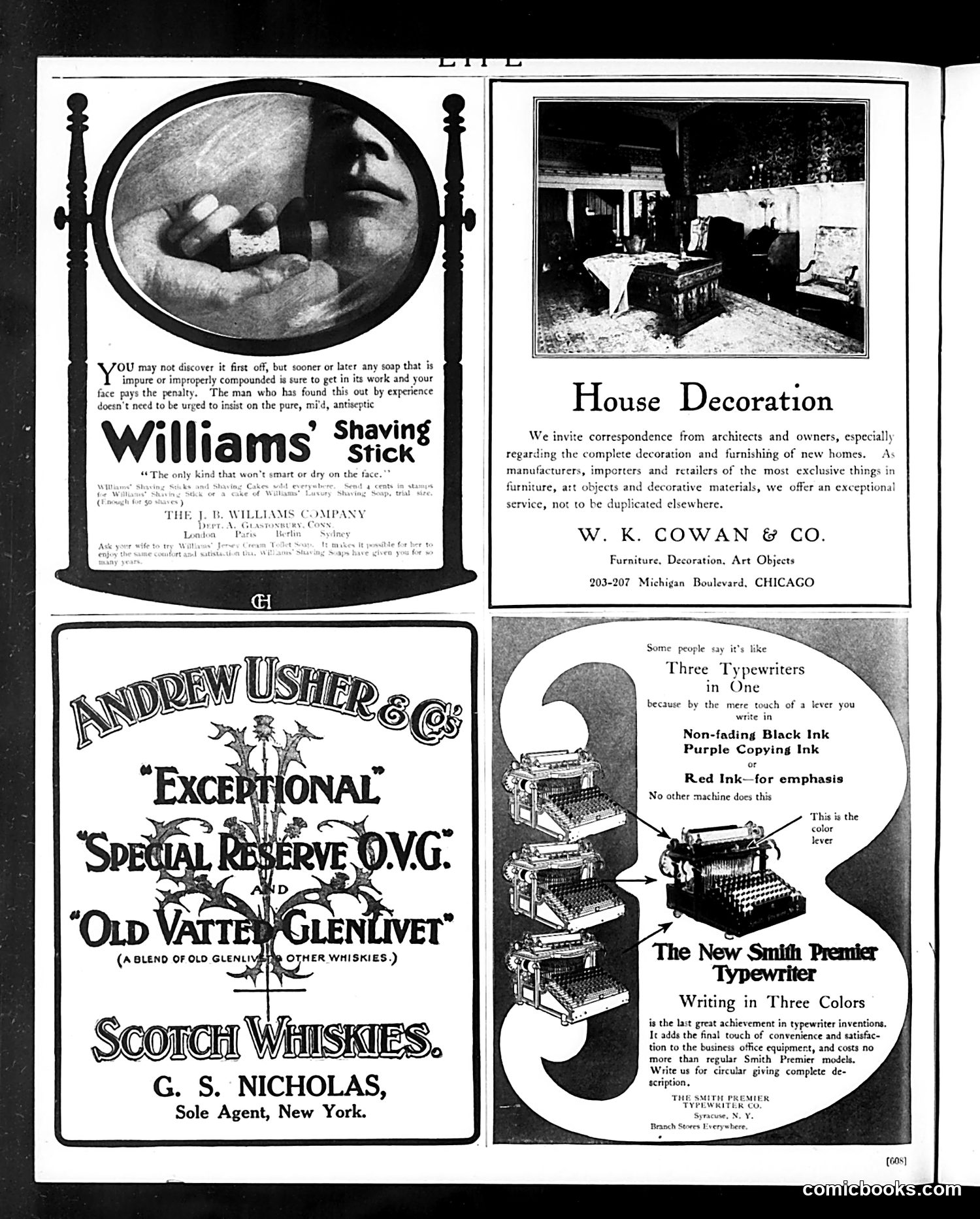
This page is primarily **advertising**, not satirical content. It contains four advertisements: 1. **Williams Shaving Stick** (top left): Shows a man's face in profile with a shaving brush, promoting a grooming product with claims about avoiding skin irritation. 2. **W. K. Cowan & Co.** (top right): Solicits architectural and home furnishing commissions for interior decoration services in Chicago. 3. **Andrew Usher & Co.** (bottom left): Advertises Scottish whiskies including "Old Vatte Glenlivet," targeting upscale consumers. 4. **Smith Premier Typewriter** (bottom right): Highlights a new model claiming to write in three ink colors (black, purple, red) simultaneously—marketed as a competitive advantage over other machines. No political satire or caricature appears on this page. It reflects early 20th-century consumer goods and services.
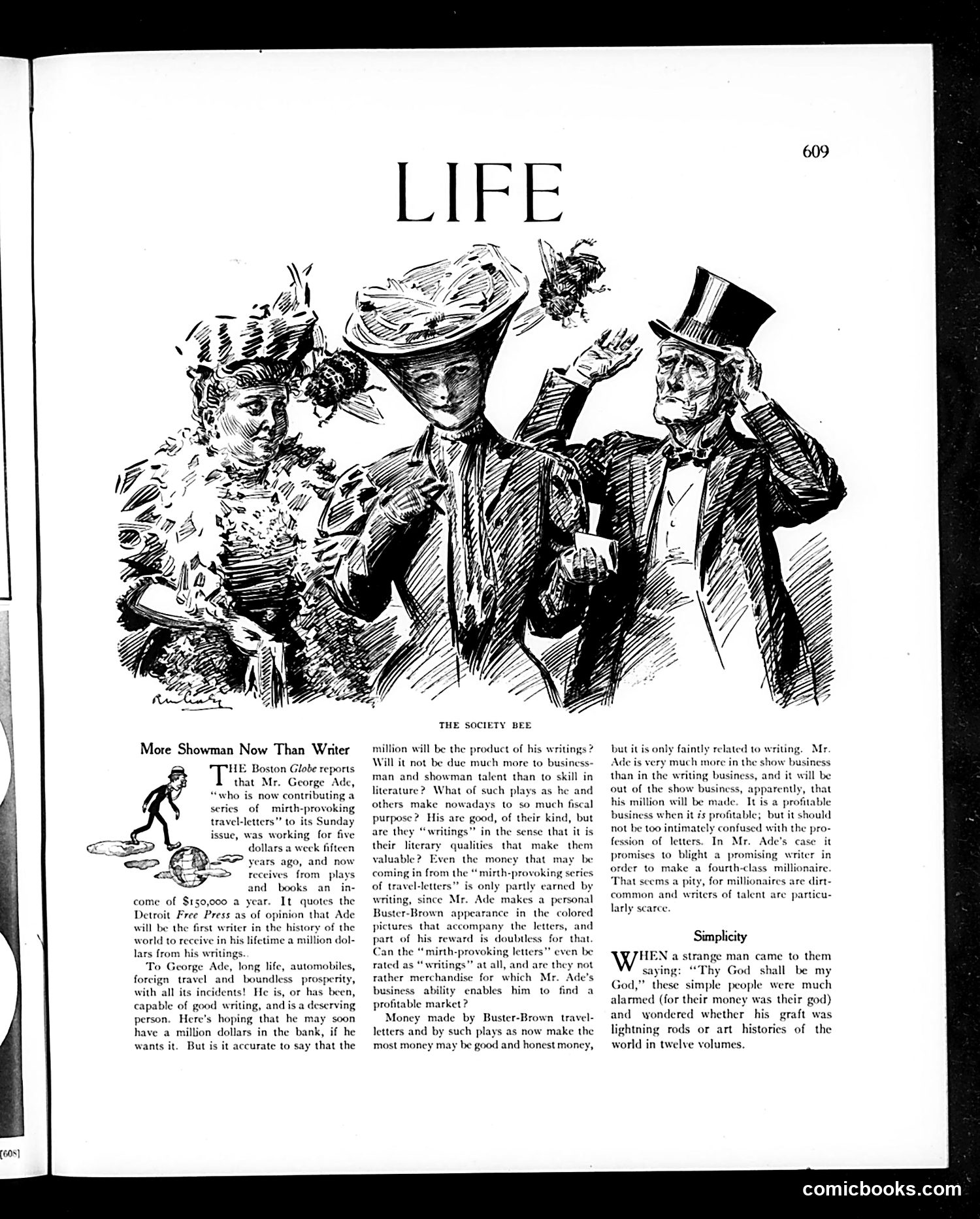
This page from *Life* magazine features two satirical pieces about writing and popular culture. **"More Showman Now Than Writer"** criticizes Charles Dana Gibson (the illustrator shown running with a globe), focusing on his transformation from serious artist to commercial entertainer. The text questions whether his travel-letters constitute genuine "writing" or mere showmanship, and notes his substantial earnings ($150,000 annually) come more from theatrical performances and illustrations than literary merit. The satire suggests he's prioritized financial success and public spectacle over artistic integrity. **"Simplicity"** is a brief anecdote (details unclear from visible text) about a stranger presenting himself as "God" to unsuspecting people, apparently satirizing credulous acceptance of grandiose claims—possibly commentary on public gullibility or fraudulent self-promotion.
This page discusses a heresy trial in the Episcopal church, centered on **Dr. Crapsey** (referenced in the text). The article debates whether the Episcopal church was right to try him for doctrinal violations, or whether he should have been left alone. The small cartoons appear to be generic satirical illustrations—showing figures in various poses—rather than specific caricatures of identifiable individuals. The core argument is about **religious freedom vs. institutional orthodoxy**: whether churches should enforce strict doctrinal compliance or allow ministers latitude in their beliefs. The author argues that heresy trials are problematic and that some theological diversity is healthy, particularly during times of intellectual change. The piece advocates for tolerance of unorthodox religious opinion within established churches.
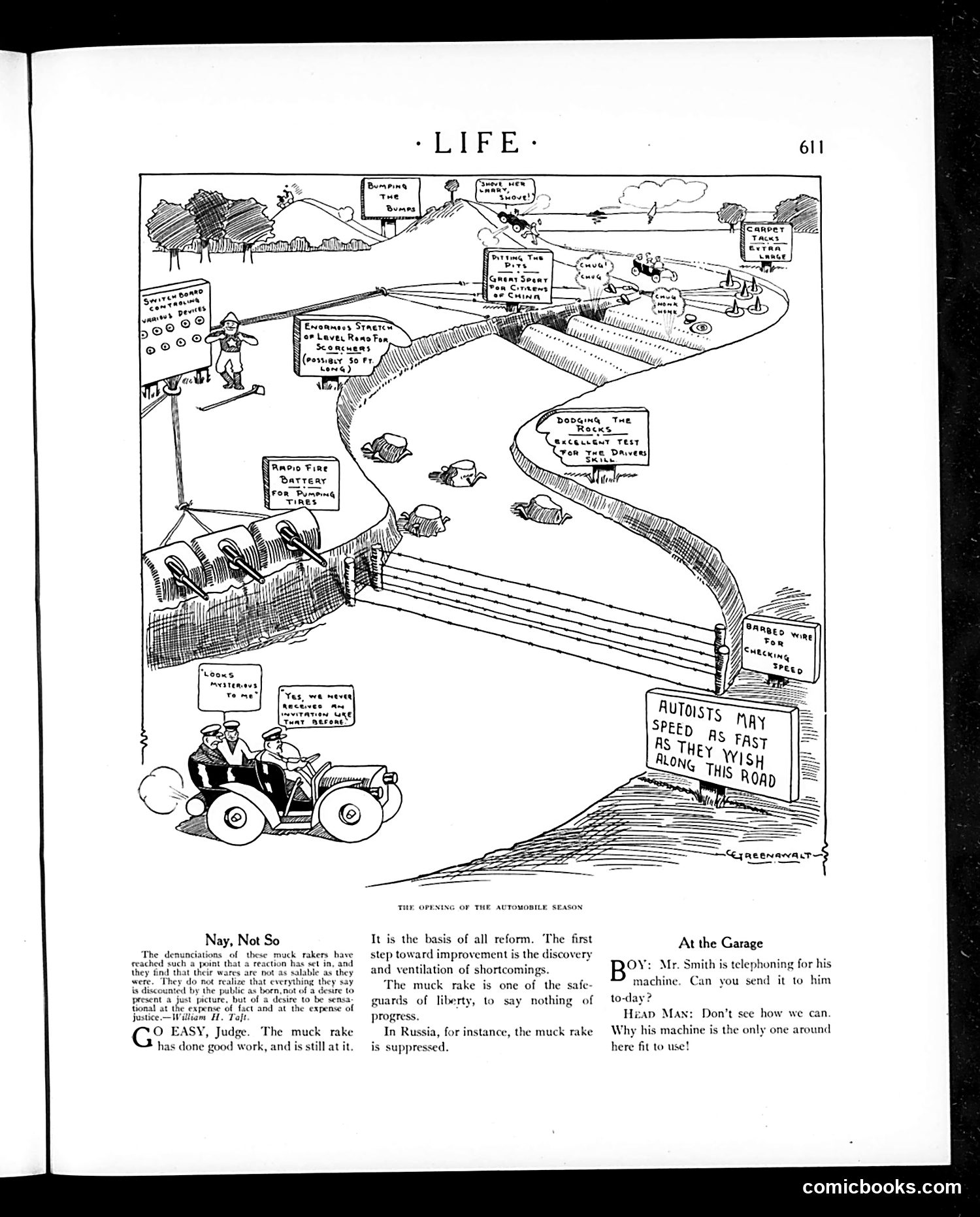
This satirical cartoon mocks the dangers and hazards of early automobile use. The illustration shows a treacherous obstacle course titled "The Opening of the Automobile Season," depicting various road hazards: rough tire batteries, rapid fires for checking tires, barbed wire, and ditches. The accompanying text criticizes "muck rakes"—reformers who expose social problems—for their denunciations of these hazards. The satire suggests that while reformers complain about automobile dangers, the vehicles themselves and poor road conditions remain the real threats. A sign declares "AUTOISITS MAY SPEED AS FAST AS THEY WISH ALONG THIS ROAD," ironically mocking inadequate safety regulations. The dialogue shows exasperation that only one automobile is available for use, highlighting the era's scarcity and high demand for these new vehicles despite their obvious dangers.
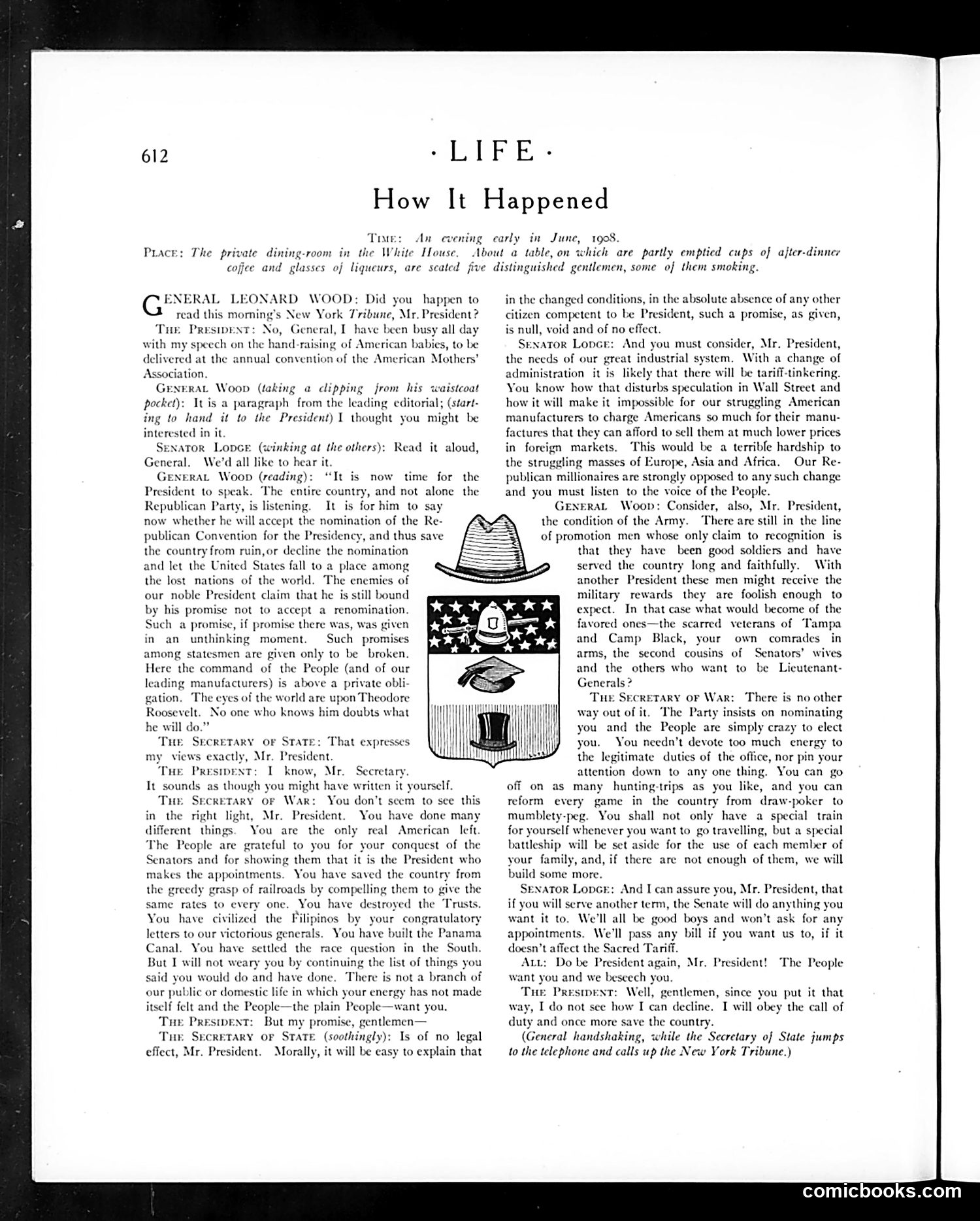
This page depicts a conversation between **General Leonard Wood** (a military figure) and **President Theodore Roosevelt** in the White House dining room. The dialogue satirizes Roosevelt's potential return to politics and promises made to supporters. The satire targets Roosevelt's contradictory positions: he promised Republican Party backing for a presidential nominee, yet senators and generals pressure him to run again himself. General Wood argues Roosevelt should accept nomination; Senator Lodge insists the Party needs Roosevelt's leadership. The central joke mocks Roosevelt's political maneuvering—his public promises versus behind-the-scenes pressure from influential figures wanting him back in power. The illustration shows military insignia, emphasizing the military-political establishment pushing for Roosevelt's return during the 1928 election cycle.
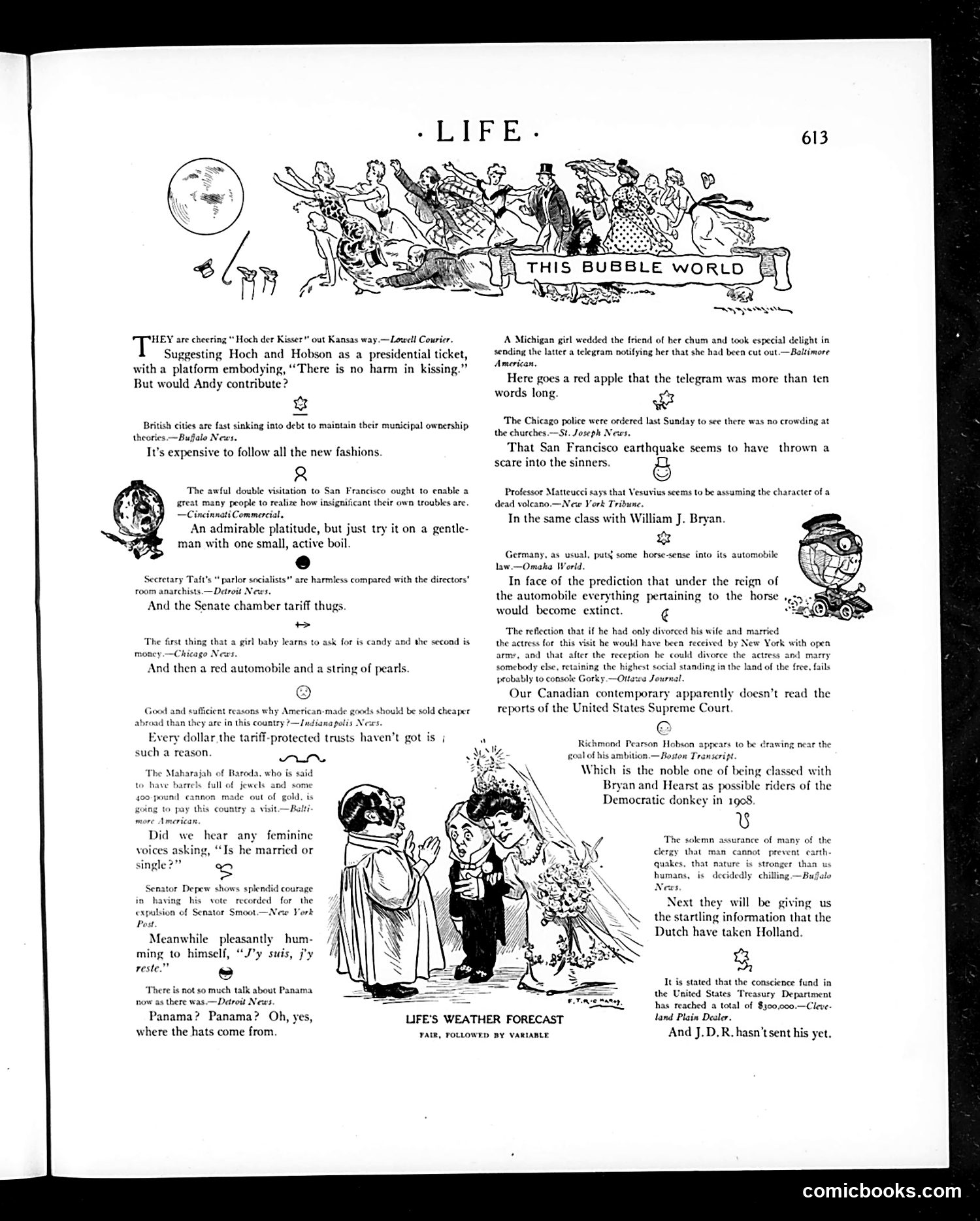
This page from *Life* magazine's "This Bubble World" section collects brief political and social satirical items. Key targets include: **William Jennings Bryan and populism**: References Bryan's 1898 presidential ambitions, mocking him alongside heartist candidates as "possible riders of the Democratic donkey." **Tariff politics**: Satirizes Senate protectionists and automobile industry monopolies, suggesting tariffs artificially inflate prices. **San Francisco earthquake aftermath**: Makes dark jokes about sinners being frightened by the disaster. **Automobiles vs. horses**: Predicts the horse will become extinct under automotive progress—a prescient observation for the era. The cartoon style with small illustrations accompanies quips on currency, Panama politics, and contemporary scandals. The tone is typical of *Life's* irreverent, quick-hit humor targeting politicians and social trends.
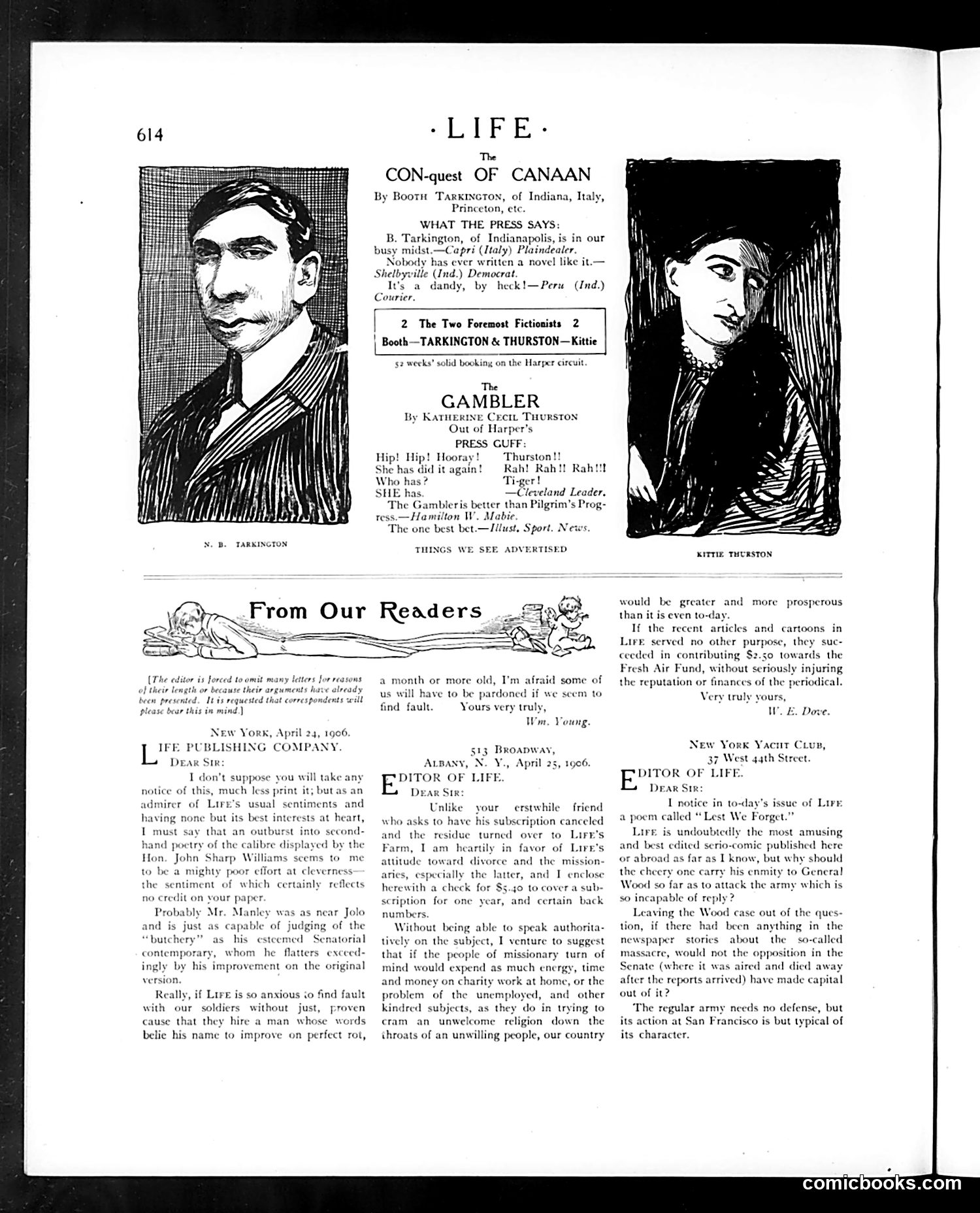
This page features **literary advertisements and reader correspondence**, not political cartoons. The top section promotes two books by Booth Tarkington and Katherine Cecil Thurston, with portrait woodcuts of the authors (labeled "S. B. Tarkington" and "Kittie Thurston"). The lower section, "From Our Readers," contains three letters to the editor. One reader praises *Life*'s editorial cartoonist John Sharp Williams; another discusses missionary work and charitable giving; a third comments on a poem titled "Lest We Forget" published in *Life*. The page demonstrates *Life*'s dual function as both satirical magazine and literary journal, featuring contemporary fiction promotion alongside reader engagement. No identifiable political satire or caricature appears on this particular page.
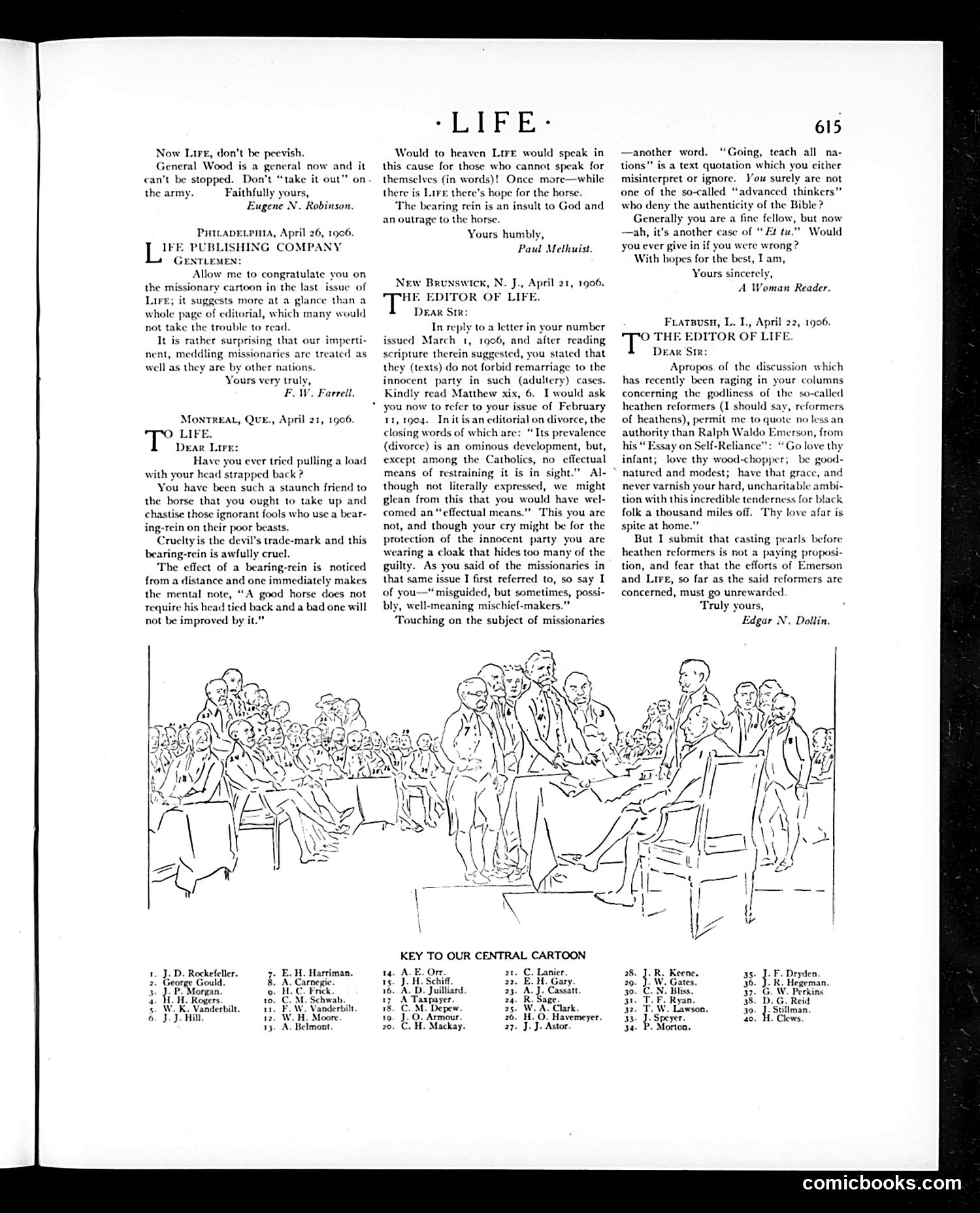
This page contains reader letters to the editor, not political cartoons. The cartoon at bottom appears to be a social gathering—likely depicting a formal meeting or society event with numerous figures seated and standing around tables. The letters discuss serious topics: one addresses missionary work and religious education; another debates divorce and remarriage in the Catholic Church; a third critiques Emerson and Thoreau's philosophy regarding heathen reform. The "Key to Our Central Cartoon" identifies 40+ individuals by number, suggesting the cartoon satirizes specific recognizable people in contemporary society—likely prominent New Yorkers or public figures. Without identifying each person, the cartoon appears to mock social pretension or institutional authority through caricature. The page primarily documents early-1900s intellectual and social debates rather than explicit political satire.
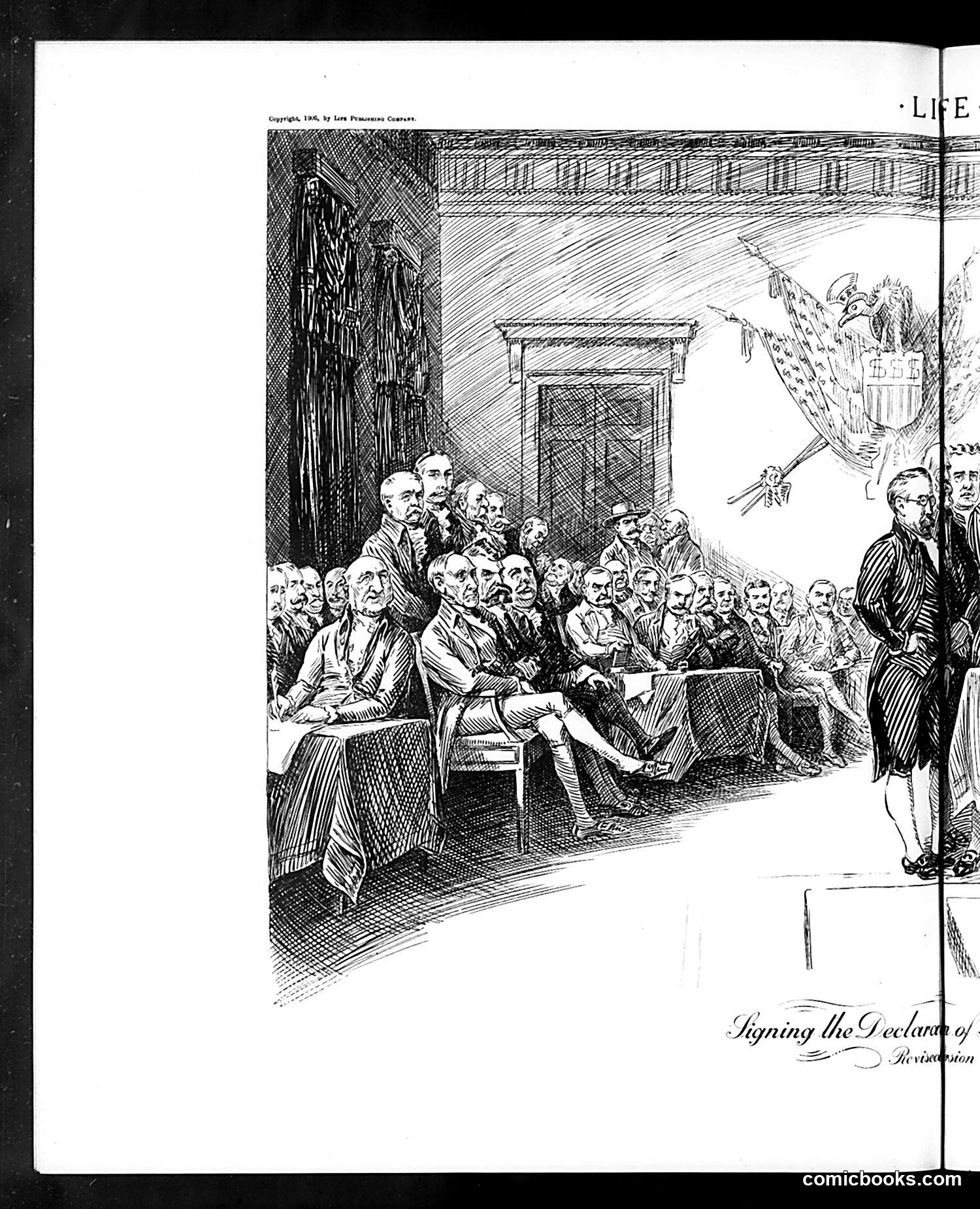
This historical satirical illustration depicts a formal signing ceremony in an interior setting. A group of men in 19th-century formal attire are gathered, with two figures prominently seated at a table signing a document, while others stand or sit observing. The title references "Signing the Declaration of Revolution." The image appears to be political commentary using the American Declaration of Independence as a historical reference point, likely satirizing a contemporary political or social movement through this historical parallel. The crowded assembly and formal atmosphere suggest the solemnity being mocked. Without additional context about the publication date or surrounding articles, the specific revolution or declaration being referenced cannot be definitively identified, though the composition mimics famous historical signing scenes.
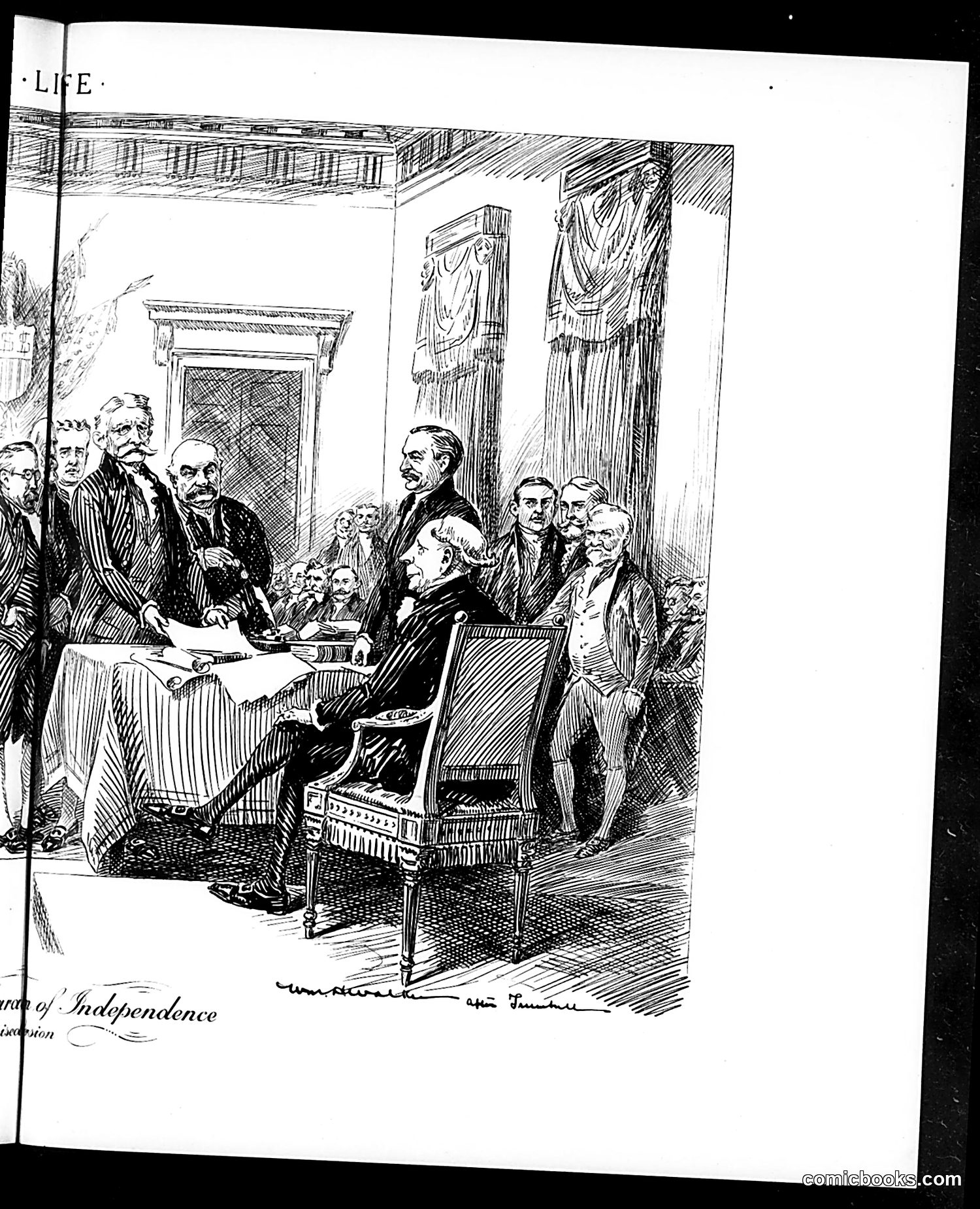
This is a political cartoon from *Life* magazine depicting a formal indoor scene with multiple men in 19th-century dress gathered around a table. A seated figure (appearing to be a person of authority) signs or reviews documents while standing officials observe. The caption references "Declaration of Independence," suggesting this depicts a historical founding moment or satirizes contemporary politics through that lens. The cartoon likely mocks a specific political event—possibly related to independence movements, colonial affairs, or treaty negotiations of its era. Without clearer text or dates visible, the exact target remains unclear, but the formal setting and historical reference suggest satire of serious political proceedings. The artist's signature appears present but is not fully legible in this image.
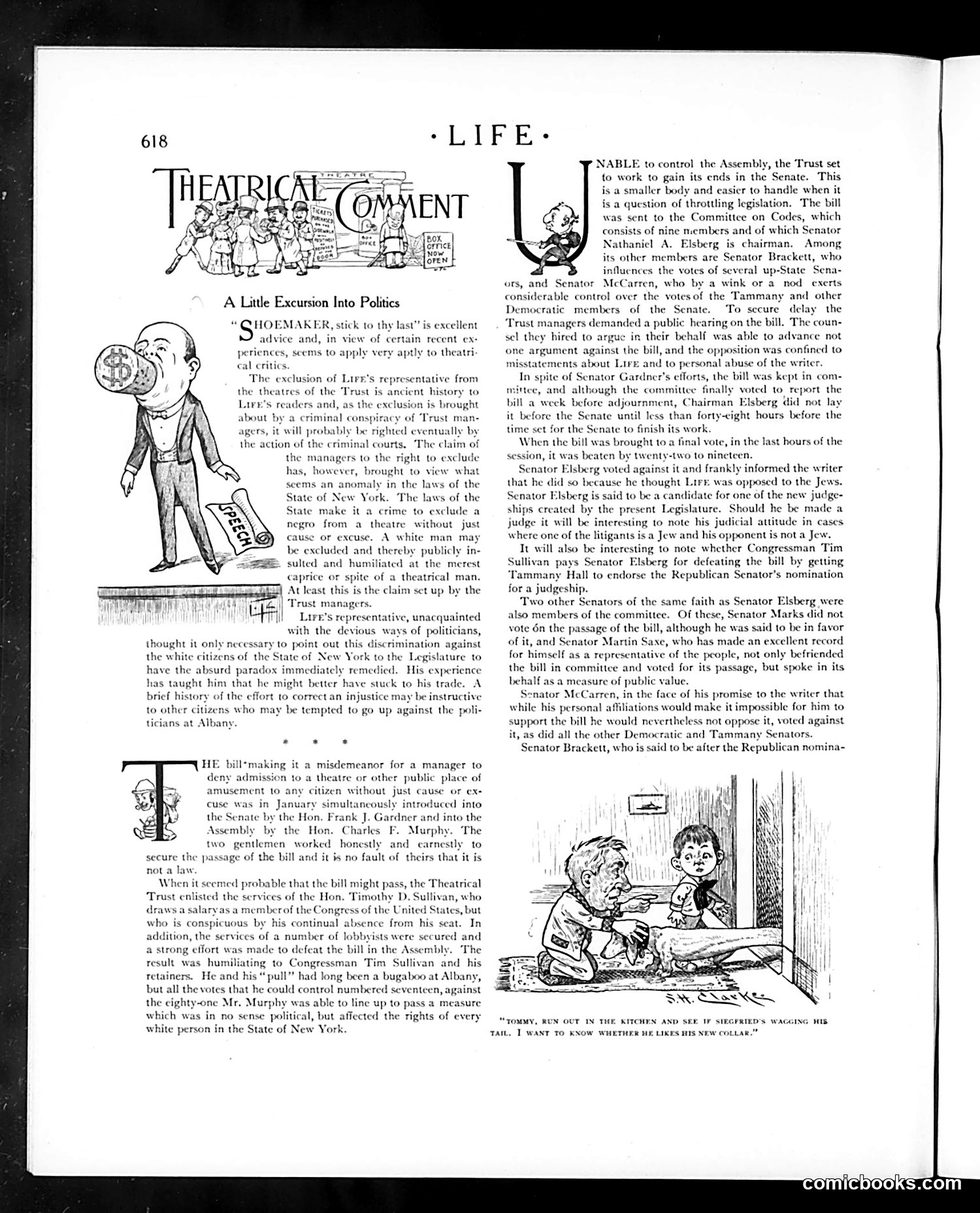
This satirical piece describes efforts to pass legislation protecting citizens (specifically white men) from arbitrary exclusion by theatre managers—a response to the Theatrical Trust's blacklisting of Life magazine's representative. The article documents how the Trust defeated the bill through political maneuvering. In the Assembly, Congressman Tim Sullivan (a Tammany Hall operative) could only control 17 votes against Charles F. Murphy's 81 supporting votes. Unable to block it there, the Trust shifted to the Senate, where fewer votes were needed. Senators Elsberg, Brackett, and McCarren—allegedly influenced by the Trust—kept the bill stalled in committee despite its passage potential. The cartoon's point: theatrical managers enjoyed arbitrary power over citizens that would be illegal if applied to Black patrons, exposing an absurd legal double standard. The satire targets both Trust corruption and Albany politicians' susceptibility to special-interest "pull."
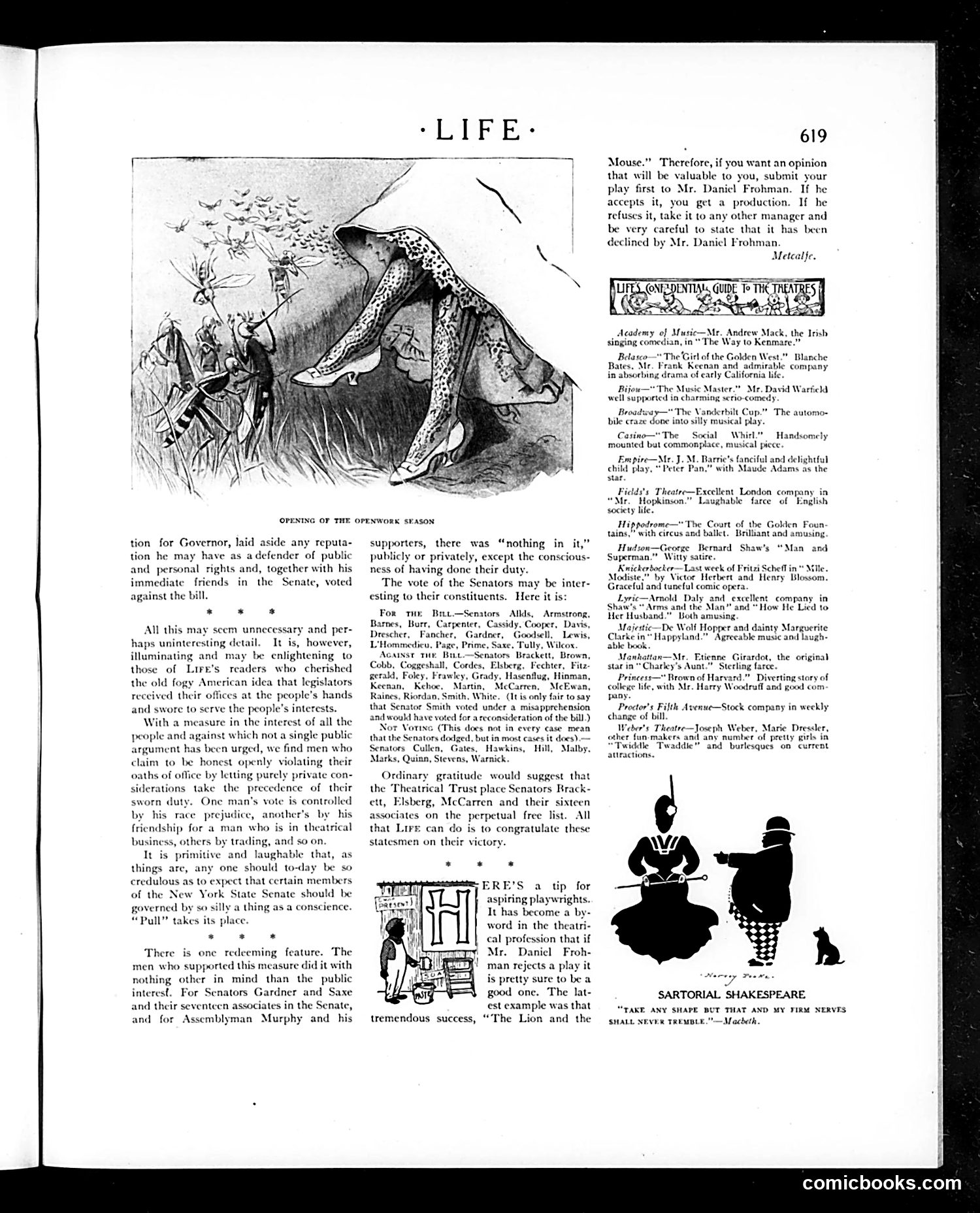
This page discusses New York State senators' votes on theater regulation. The main illustration shows a large dragon or serpent labeled "Opening of the Openwork Season," representing the **Theatrical Trust** — a monopoly controlling what plays got produced. The text criticizes senators who voted against a bill regulating this trust, despite claiming to serve the public interest. It lists which senators voted for and against the measure, arguing their votes were controlled by personal loyalty and financial interest rather than principle. The page then pivots to theater reviews, listing current Broadway productions with cast members and brief critiques — standard entertainment coverage. **The satire's point**: Legislators claimed to represent voters but secretly served the powerful Theatrical Trust's interests. The dragon imagery suggests this monopoly was a destructive force consuming theatrical freedom. For modern readers, this reflects ongoing debates about corporate influence on politics and regulation.
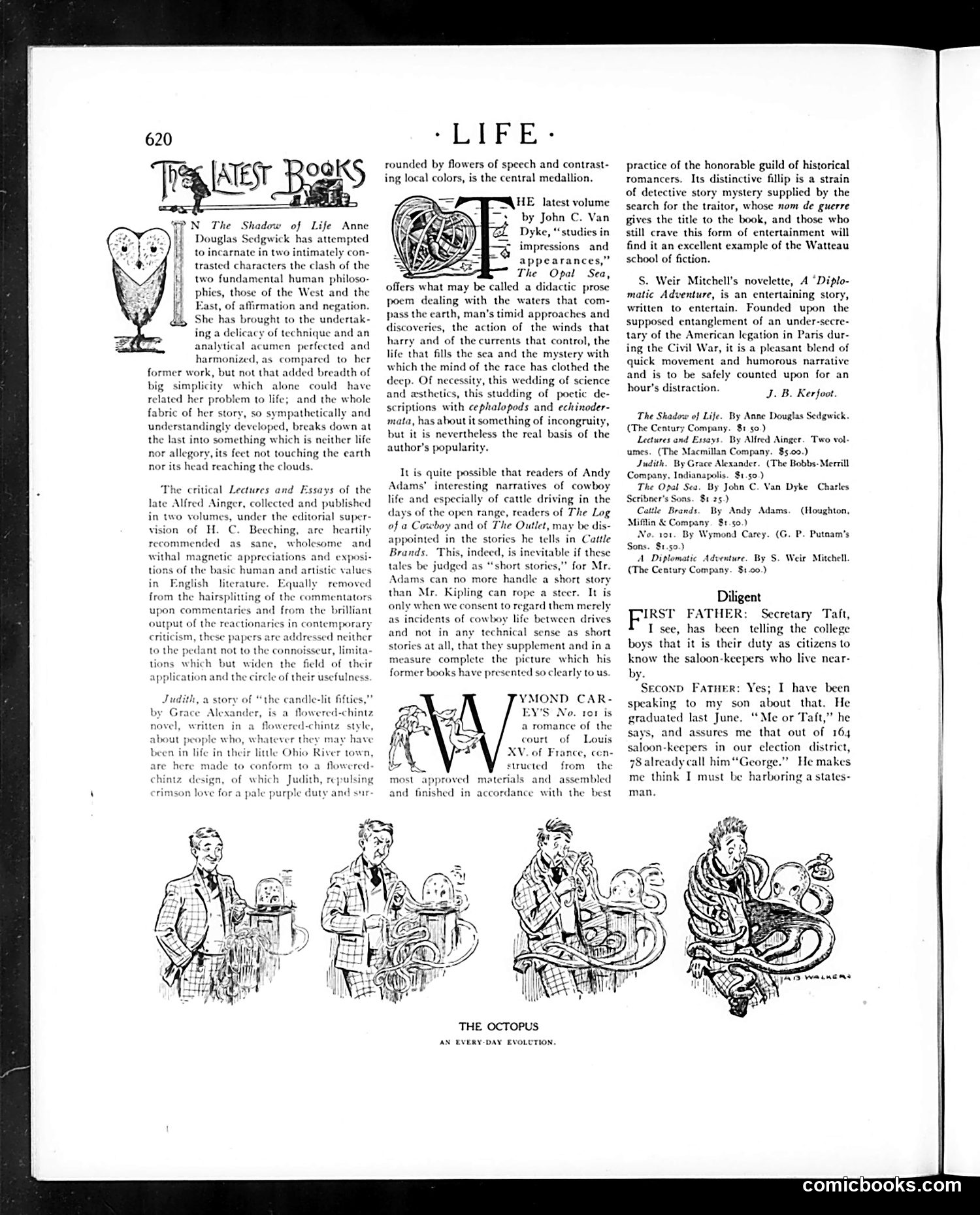
This cartoon satirizes the progressive acquisition of bureaucratic power or social obligations. Four sequential panels show a man increasingly entangled by octopus tentacles, each labeled (though the labels aren't clearly legible in this image). The progression visualizes how commitments or responsibilities gradually ensnare and constrain someone, growing inescapable over time. The title "An Every-Day Evolution" suggests this is a commentary on modern life—how ordinary people become gradually trapped by mounting duties, likely referring to government regulation, corporate control, or social expectations expanding in early 20th-century America. The visual metaphor of the octopus as a suffocating, many-armed force was common period imagery for monopolies, bureaucracy, or corruption. The cartoon critiques this "evolution" as unavoidable entanglement rather than progress.
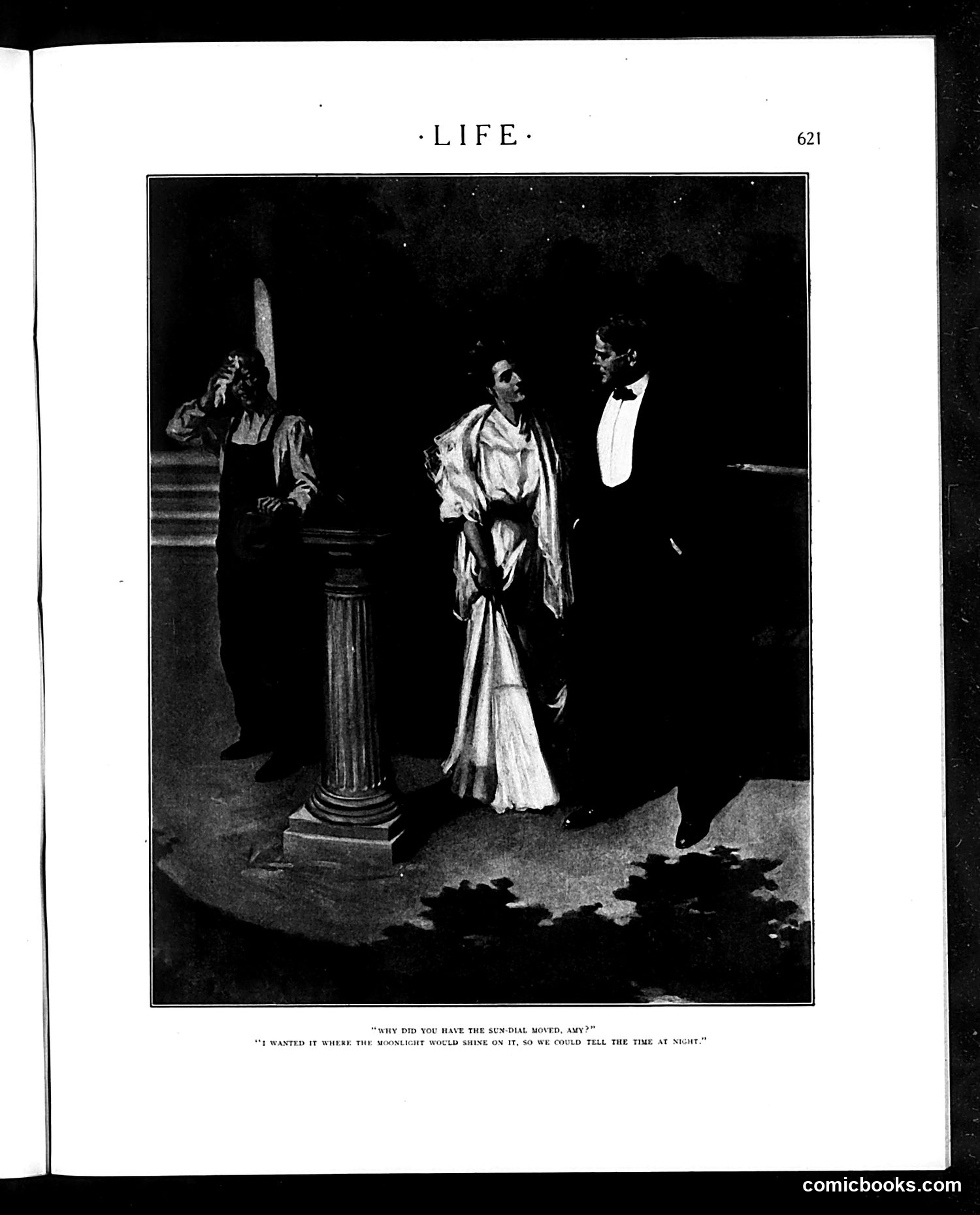
This is a satirical cartoon mocking a woman's illogical reasoning. The scene depicts what appears to be a formal evening gathering with a woman in an elegant gown and two men in formal attire discussing a relocated sundial. The joke targets female stupidity (a common stereotype in early 20th-century humor): the woman, "Amy," has moved a sundial—an instrument that tells time using sunlight—so moonlight can shine on it at night. This reveals absurd logic, since a sundial cannot function without the sun. The satire reflects period attitudes about women's intelligence and decision-making capabilities, presenting her reasoning as laughably flawed. The formal setting emphasizes the social awkwardness of her foolishness among refined company.
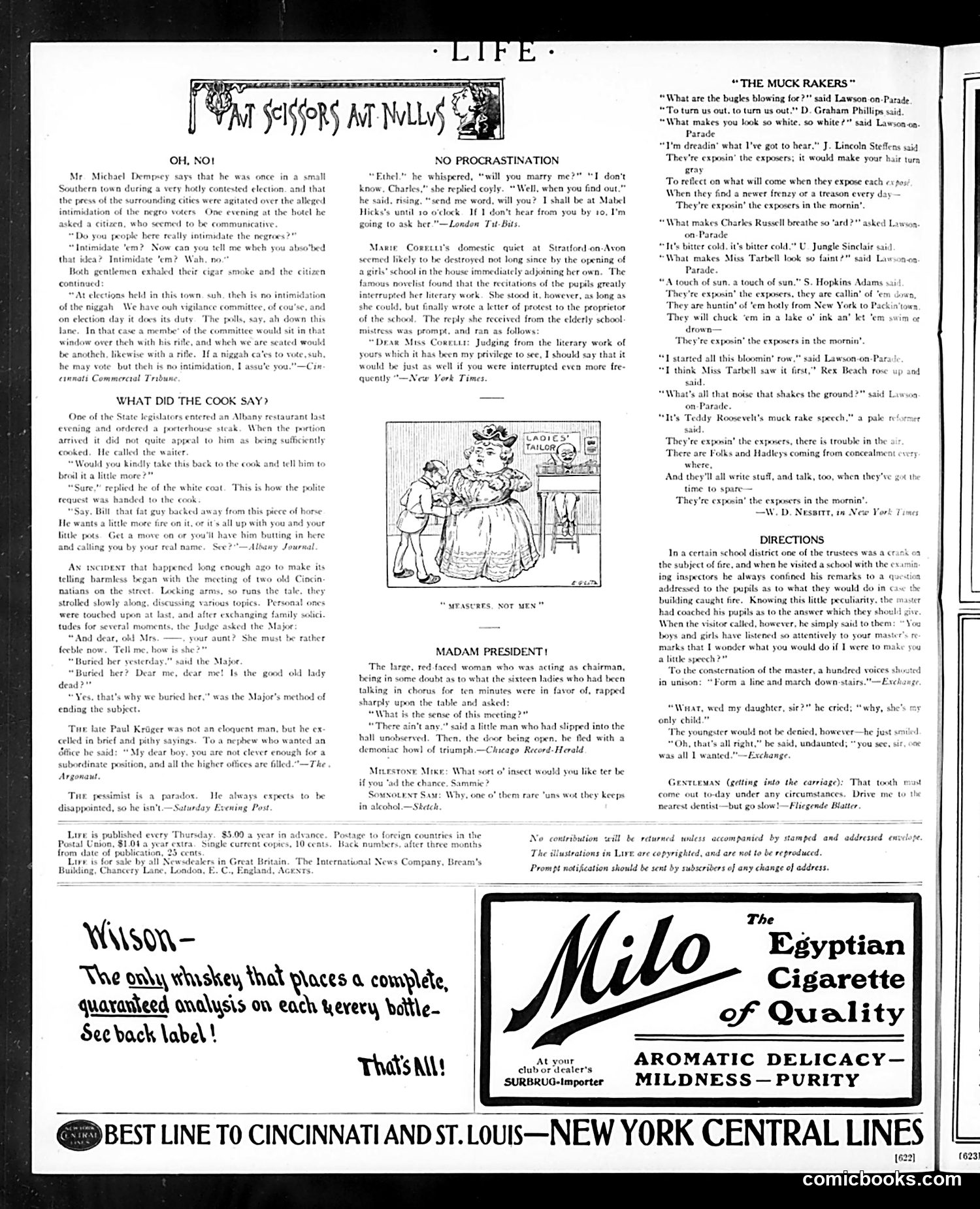
This page from the American satirical magazine *Life* contains several brief humorous pieces mocking social conventions and politics of the era. The lead story, "OH, NO!" satirizes racial intimidation during Southern elections. It presents a conversation where a Southern citizen casually describes how a "vigilance committee" ensures Black voters don't actually vote—a thinly veiled reference to voter suppression through intimidation and violence. The joke's irony lies in the citizen's oblivious candor about what was effectively disenfranchisement. Other pieces mock domestic relationships ("NO PROCRASTINATION"), workplace miscommunication ("WHAT DID THE COOK SAY?"), and female-led organizations ("MADAM PRESIDENT!"). The page reflects *Life's* satirical approach to contemporary American society—using humor to expose pretension, absurdity, and social hypocrisy. The racial commentary piece is particularly significant as social criticism, however gently presented through humor. The page also contains period advertisements for whiskey and Egyptian cigarettes.
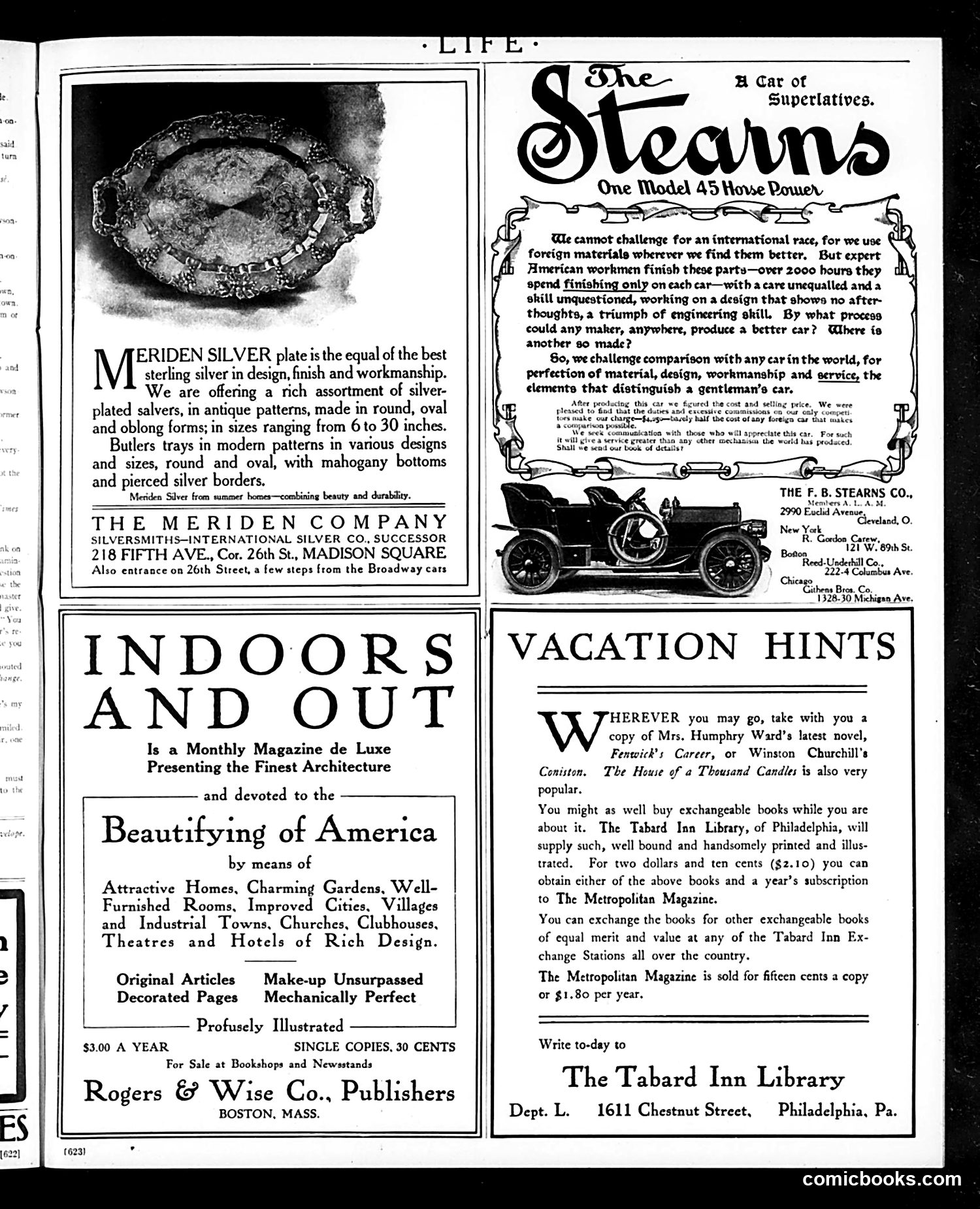
This page contains **no political cartoons or satire**—it is primarily **advertising and promotional content** from what appears to be an early 1900s issue of Life magazine. The ads promote luxury goods: Meriden silverware, a Stearns automobile ("One Model 45 Horse Power"), and "Indoors and Out," a magazine devoted to architecture and beautifying America. The Stearns car ad boasts American workmanship finishing foreign materials—appealing to patriotic consumers. The "Vacation Hints" section recommends books and The Tabard Inn Library's exchangeable book service, suggesting leisured travel among the magazine's wealthy readership. **What's notable for modern readers**: This reflects the early 1900s leisure class culture—where vacation meant traveling with novels, exchanging books at library stations, and purchasing imported luxury goods. The ads target an affluent, cultured audience concerned with refined taste and gentlemanly standards.
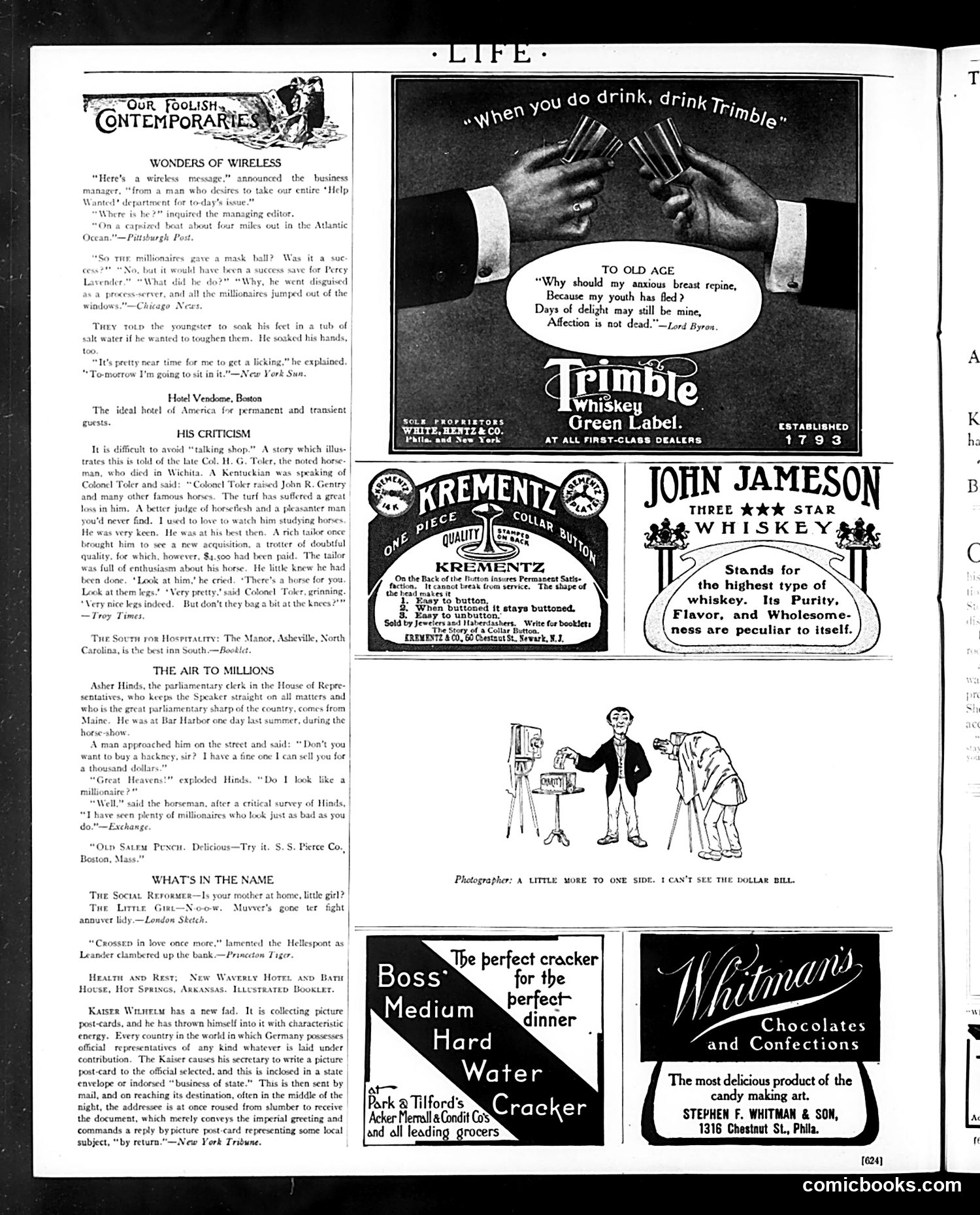
This page from *Life* magazine consists primarily of **advertisements and humorous anecdotes** rather than political cartoons. The content includes: **"Our Foolish Contemporaries"** section with short satirical stories mocking various figures—including anecdotes about a wealthy Kentuckian, parliamentary clerk Asher Hinds, and others. These are gentle social satires about pretension and foolishness among the upper classes. **One cartoon** shows a photographer telling subjects "A little more to one side. I can't see the dollar bill"—satirizing how wealth and material status dominate social interaction. The page is heavily populated with **period advertisements** for whiskey (Trimble, Krementz, John Jameson), chocolates, crackers, and hotel services—typical of *Life's* revenue model. The overall tone is **light satirical humor** about American society's quirks, class dynamics, and materialism, rather than hard political commentary. The magazine functioned as both humor publication and advertising vehicle.
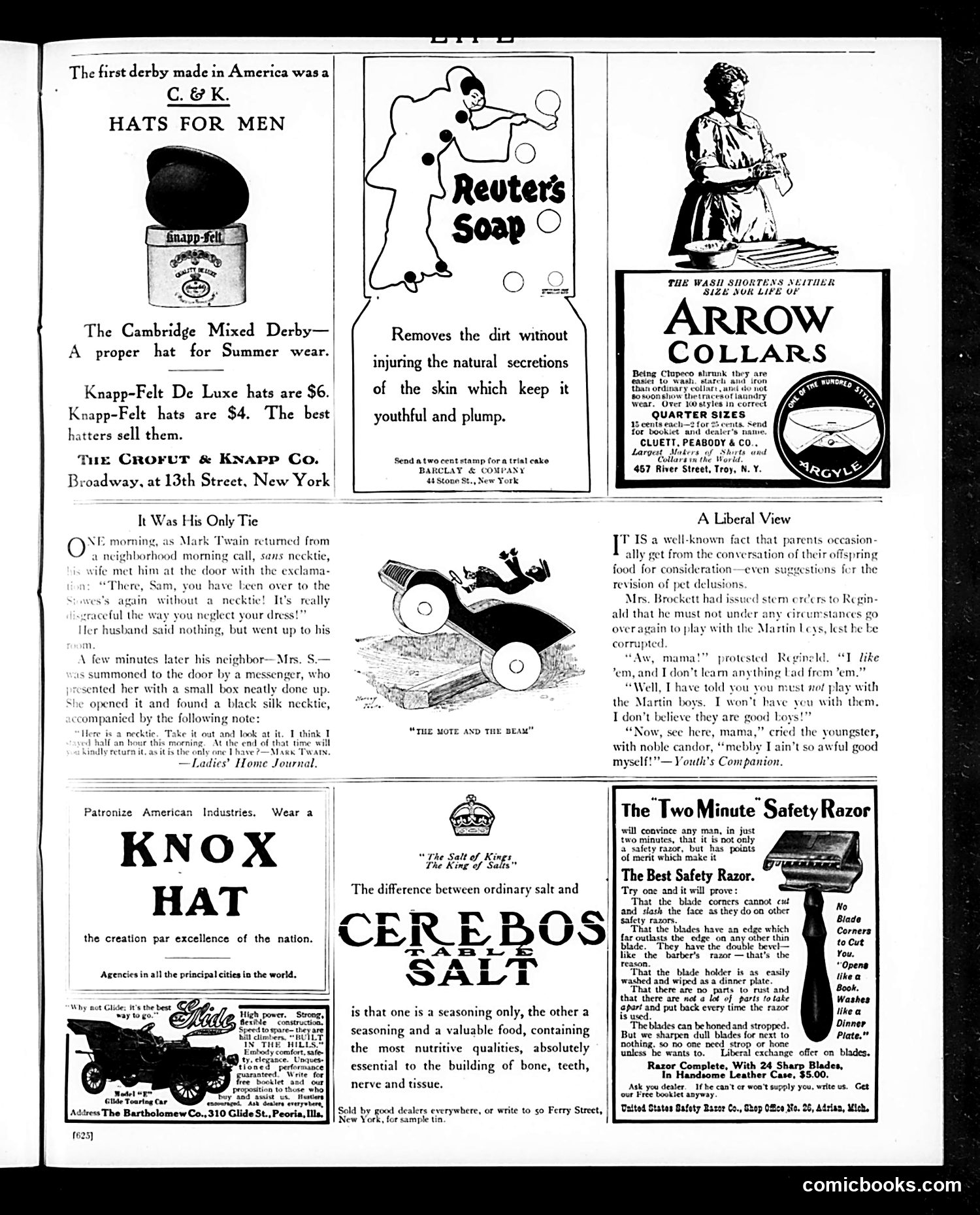
This page is primarily **advertisements and humorous anecdotes**, not political satire. The main content includes: **"It Was His Only Tie"** — A genteel anecdote about Mark Twain arriving home without a necktie. His wife scolds him for neglecting his appearance; he responds by having a messenger deliver her a single necktie with a note implying it's her only tie (a cutting remark about *her* appearance). The joke relies on Twain's reputation for wit and social commentary. **"A Liberal View"** — A domestic humor piece where a boy defends his friends (the Martin boys) against his mother's moral disapproval, turning her own logic against her—suggesting he himself isn't perfectly behaved either. The page is otherwise filled with period advertisements for hats, soap, collars, safety razors, and automobiles, reflecting early 20th-century consumer goods marketing. The ads feature product illustrations and testimonials typical of the era. No significant political commentary or caricature appears here.
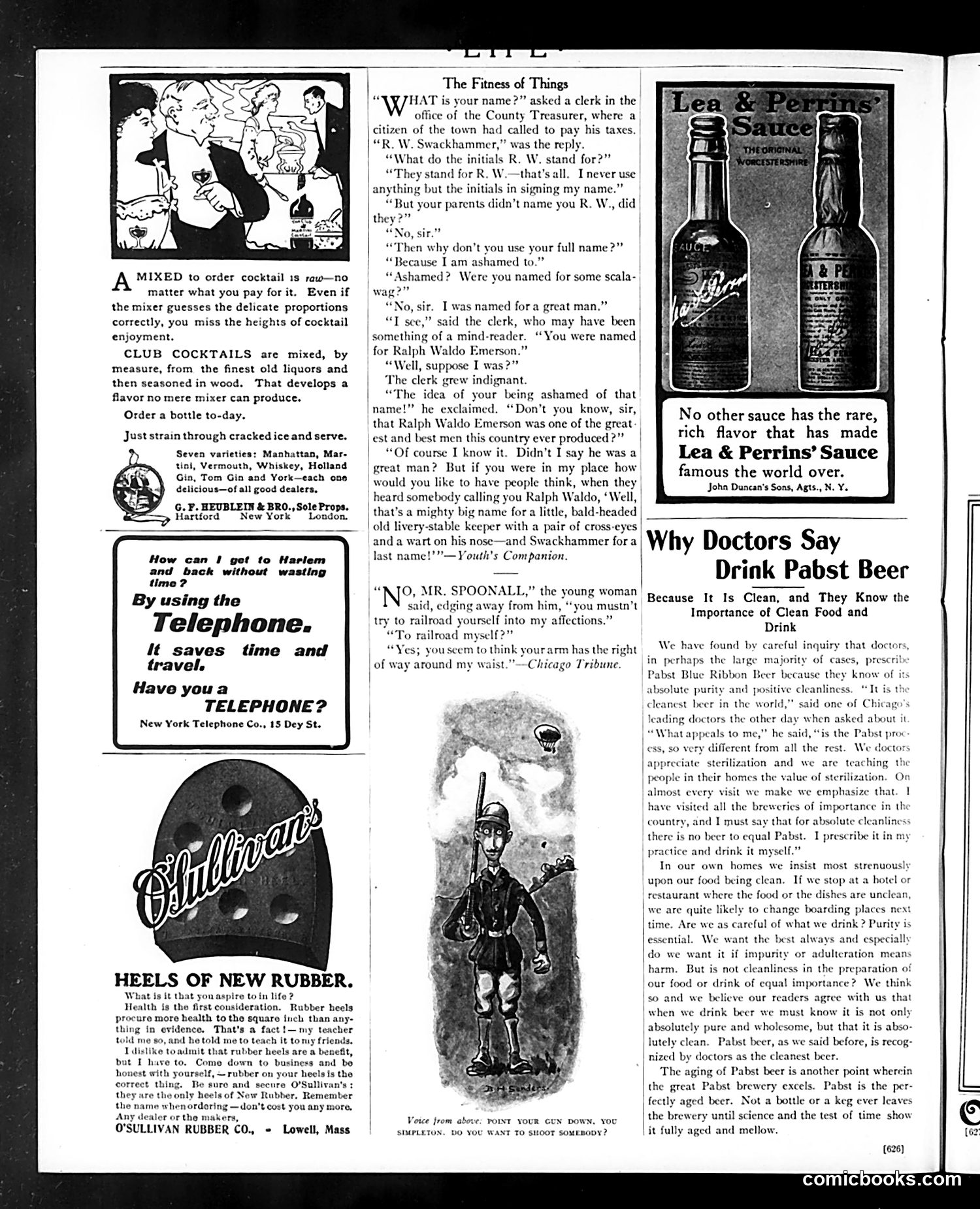
This page's main satirical cartoon (center) mocks social pretension through a humorous anecdote. A man named R.W. Swackhammer is ashamed to use his full name because he was named after Ralph Waldo Emerson, the famous American philosopher and writer. The joke: Swackhammer fears people will mock the disparity between the illustrious name of one of 19th-century America's greatest intellectuals and his own modest identity as a "bald-headed old livery-stable keeper." The clerk's indignation at his shame satirizes both small-town social attitudes and the absurdity of judging someone's worthiness by their name alone. The secondary joke below involves railroad-themed flirtation wordplay ("railroad yourself into my affections"). The page is primarily **advertisements** (Heublein cocktails, telephone service, O'Sullivan rubber heels, Lea & Perrins sauce, Pabst Beer) interspersed with this single humorous narrative from *Youth's Companion* magazine.
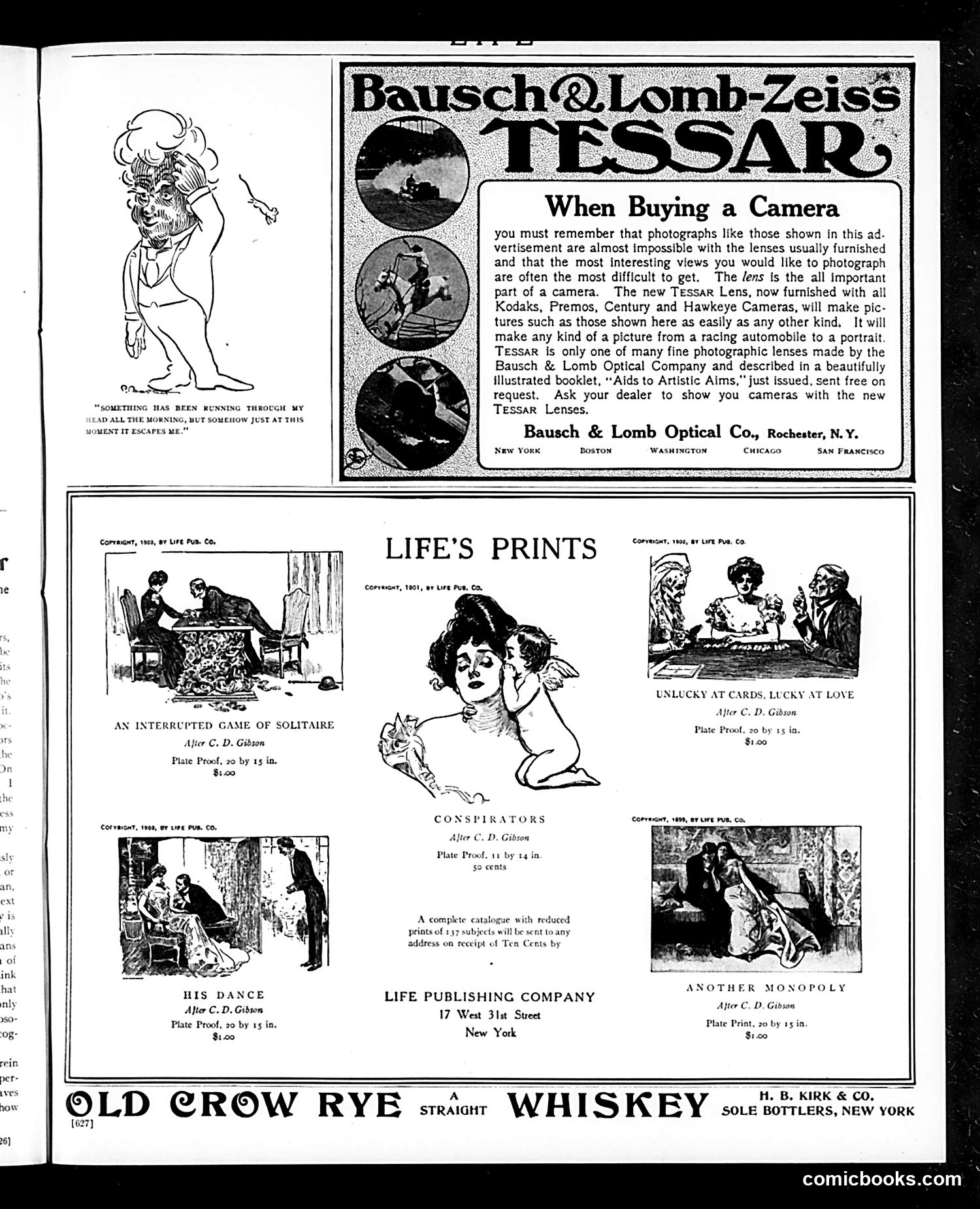
This page is primarily **advertising and promotional content** rather than political satire. The dominant feature is a Bausch & Lomb Tessar camera lens advertisement emphasizing superior optical quality for difficult photography. Below that, "Life's Prints" showcases **C.D. Gibson illustrations**—Gibson was Life's celebrated cartoonist known for the "Gibson Girl" ideal. These are advertisement samples for printable artwork available from Life Publishing Company, depicting genteel social situations: solitaire, romantic encounters, dancing, and card games. The titles ("Unlucky at Cards, Lucky at Love," "His Dance") suggest gentle domestic humor about courtship and leisure. The bottom advertisement is for **Old Crow Rye whiskey**. The small cartoon at top-left appears unrelated—a caricatured figure with the caption "Something has been running through my head all morning, but somehow just at this moment it escapes me," likely a standalone joke about forgetfulness rather than political commentary. The page reflects early 1900s Life magazine's focus on advertising, consumer goods, and sentimental social humor rather than political satire.
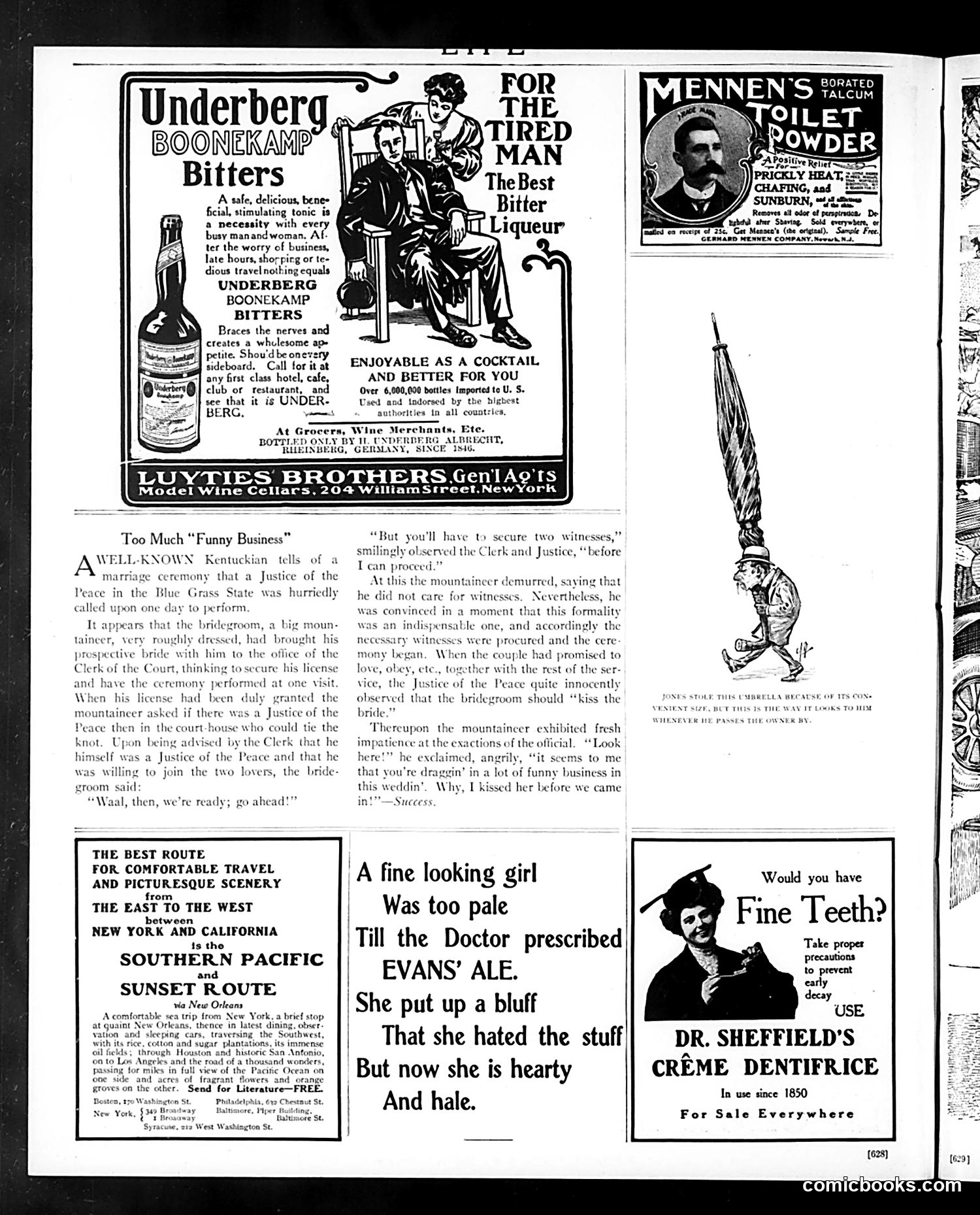
This page is primarily **advertisements** interspersed with one humorous anecdote. **The main cartoon/story** is "Too Much 'Funny Business'"—a dialect humor piece about a Kentucky mountaineer getting married. The joke plays on rural/backwoods stereotypes: the groom resists having witnesses (viewing it as unnecessary formality) and becomes indignant when the Justice of the Peace instructs him to kiss the bride after the ceremony, claiming he already kissed her before arriving. The humor relies on portraying rural Appalachians as unsophisticated and overly literal. **The advertisements** include: - German liqueur (Underberg Bitters) marketed as medicinal tonic - Evans' Ale promoting female health/complexion - Dr. Sheffield's toothpaste (in business since 1850) - Southern Pacific railroad - Mennen's talcum powder The ads reflect early-1900s patent medicine culture, where alcohol and dubious products were marketed with health claims. The overall page represents typical Life magazine content: satirical humor mocking rural Americans alongside period advertisements now considered quaint or problematic.
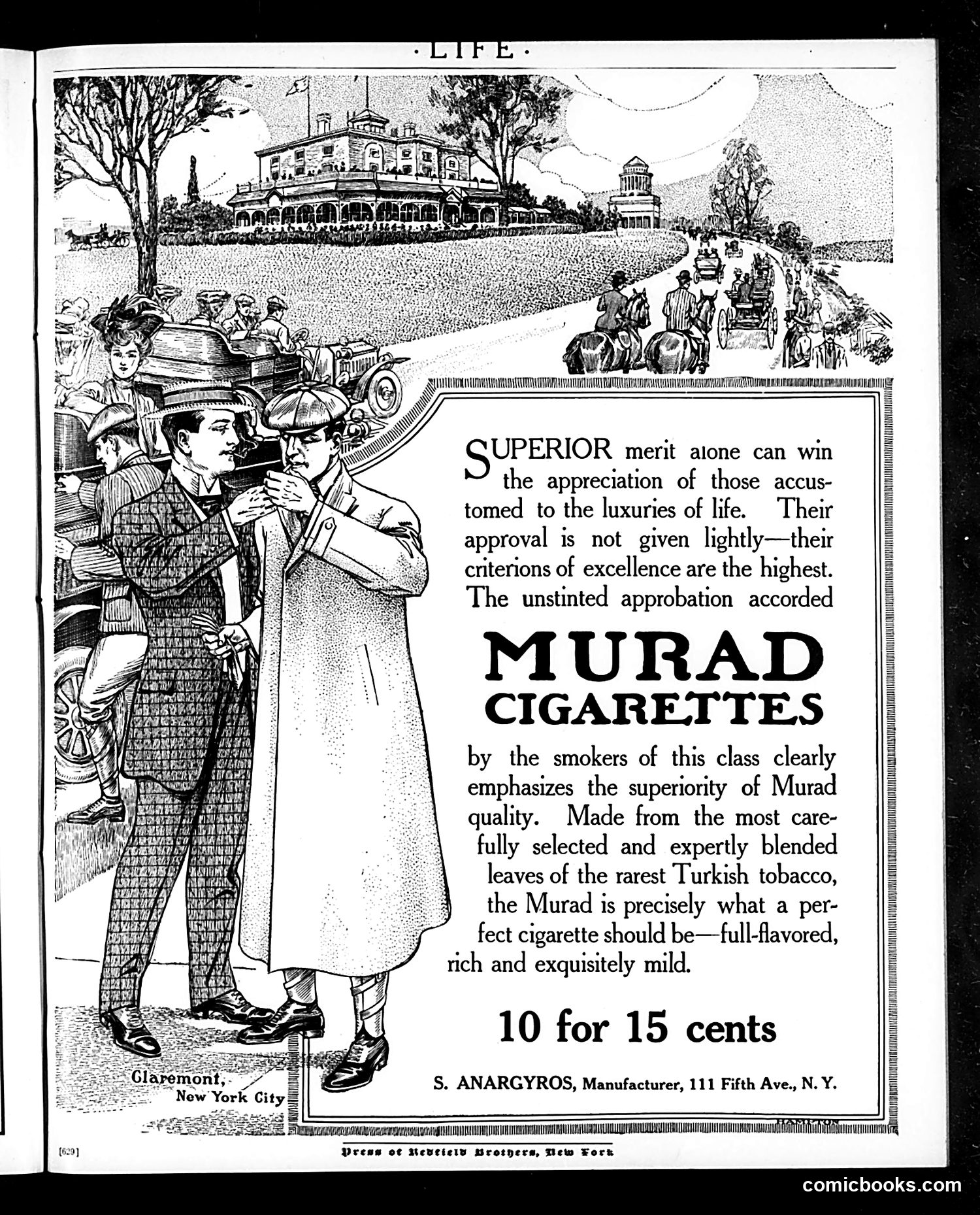
This page is primarily a **cigarette advertisement**, not political satire. It features an illustration of two well-dressed figures in an elegant setting (a grand estate visible in the background) to market Murad cigarettes to affluent consumers. The advertisement's strategy targets class aspirations: it argues that "superior merit" earns approval from those "accustomed to the luxuries of life," implying that smoking Murad cigarettes signals membership in this exclusive, refined class. The copy emphasizes Turkish tobacco quality and describes the product as "full-flavored, rich and exquisitely mild." The price—10 for 15 cents—and manufacturer address (S. Anargyros, 111 Fifth Ave., N.Y.) suggest this is early 20th-century marketing designed to appeal to wealthy, status-conscious smokers by associating the product with gentility and exclusivity.
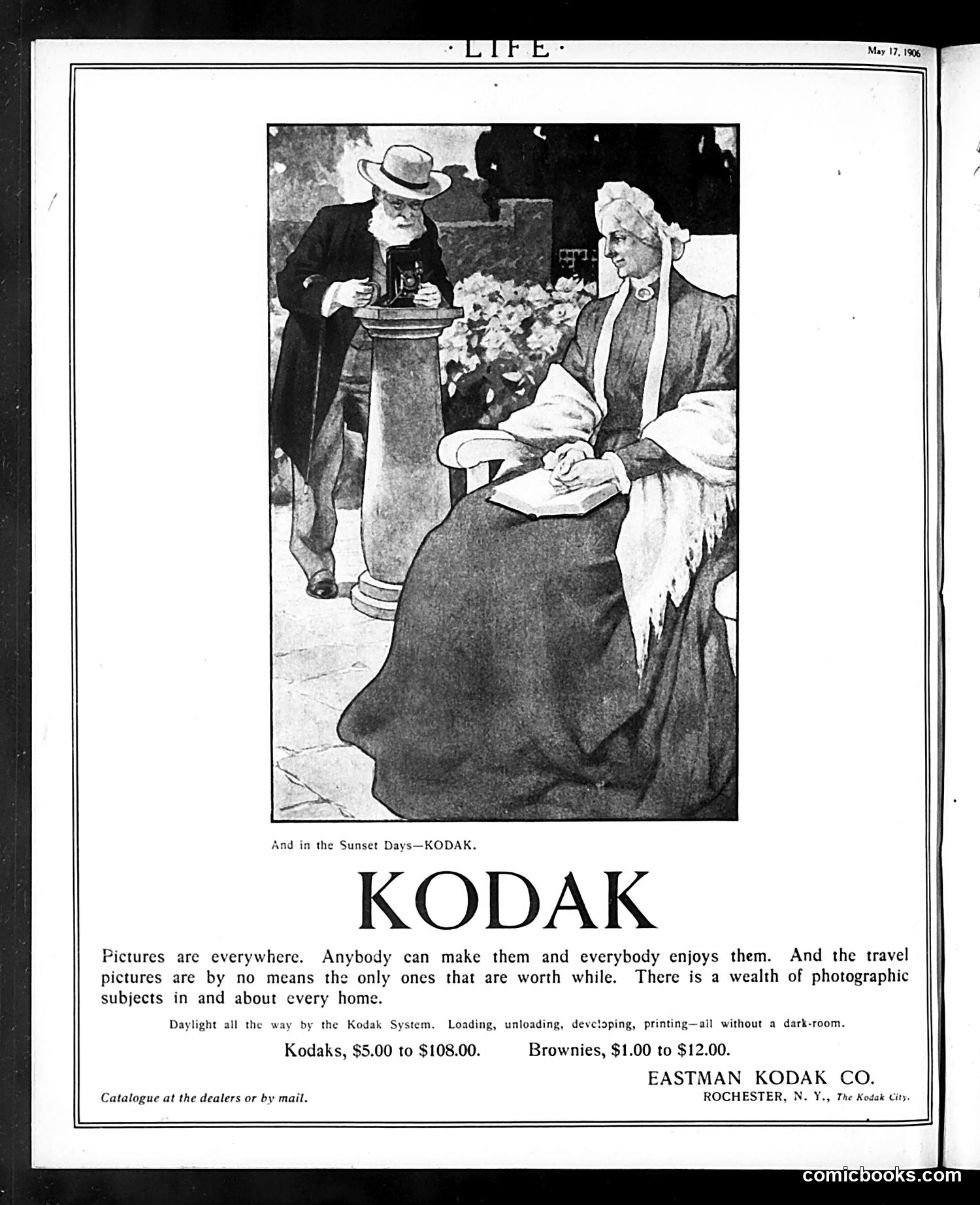
This is a **Kodak camera advertisement**, not political satire. The illustration depicts an elderly couple—the man standing with a camera, the woman seated with flowers—suggesting domestic photography for ordinary people. The ad's message targets middle-class families: photography isn't just for professionals or travelers. Kodak's "System" promises simple operation ("without a dark-room") and affordable prices ($1–$108), making picture-taking accessible to everyone. The tagline "And in the Sunset Days" romanticizes capturing life's moments in old age. The phrase "Pictures are everywhere" reflects early-20th-century enthusiasm for amateur photography as a democratizing technology. Kodak positioned itself as enabling ordinary households to document their own lives—a revolutionary marketing concept at the time.