
Life, 1906-05-17 · page 17 of 28
Life — May 17, 1906 — page 17: what you’re looking at
What you’re looking at
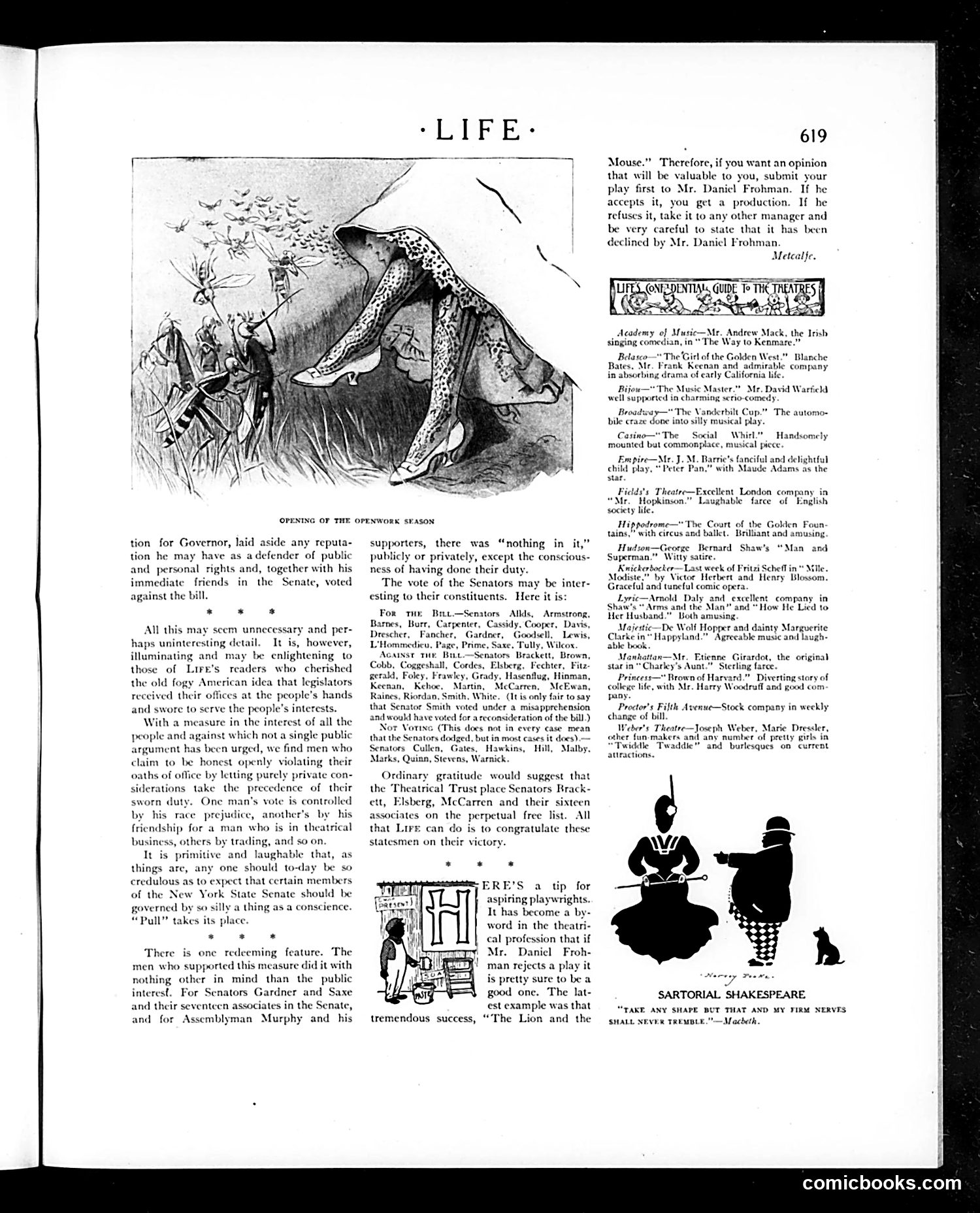
This page discusses New York State senators' votes on theater regulation. The main illustration shows a large dragon or serpent labeled "Opening of the Openwork Season," representing the **Theatrical Trust** — a monopoly controlling what plays got produced. The text criticizes senators who voted against a bill regulating this trust, despite claiming to serve the public interest. It lists which senators voted for and against the measure, arguing their votes were controlled by personal loyalty and financial interest rather than principle. The page then pivots to theater reviews, listing current Broadway productions with cast members and brief critiques — standard entertainment coverage. **The satire's point**: Legislators claimed to represent voters but secretly served the powerful Theatrical Trust's interests. The dragon imagery suggests this monopoly was a destructive force consuming theatrical freedom. For modern readers, this reflects ongoing debates about corporate influence on politics and regulation.
📄 Transcribed text from this page (OCR, searchable)
Machine-transcribed from the original scan — historical spelling and the odd misread are preserved.
619 Mouse.” Therefore, if you want an opinion that will be valuable to you, submit your play first to Mr. Daniel’ Frohman. If he accepts it, you get a production. If he refuses it, take it to any other manager and be very careful to state that it has been declined by Mr. Daniel Frohman. Metcalfe. 0 S NTIS Guipt re ey oe Academy of Musico—Mr. Andrew Mack, the Irish singing comedian, in The Way to Kenmare.” Belasco—* The Gitl of the Gokien West." Blanche Bates, Me. Frank Keenan and admirable company in absorbing drama of early California life. Bijou—* The Music Master.” Mr. David Warfickd well supported in charming serio-comedy Broadway—" The Vanderbilt Cup.” The automo- bile craze done into silly musical play. Casino—" The Social Handsomely mounted but commonplace, Empire—Mr. J. M. Barrie's fanciful and delightful child play, “Peter Pan,” with Maude Adams as the star. Fields's Theatre—Excellent London company in “Mr. Hopkinson.” Laughable farce of English society life. NG OF THE OFENWORK SEASON Hippotrome—"'The Court of the Goklen Foun: tains,” with circus and ballet. Brilliant and amusing. tion for Governor, laid aside any reputa- tion he may have as adefender of public and personal rights and, together with his immediate friends in the Senate, voted against the bill. * * supporters, there was “nothing in it, Hudion—George Bernard Shaw's “Man and publicly or privately, except the conscious- Superman.” Witty satire. ness of having done their duty. Knickerbocker—Last week of Fritzi Scheff in Nelle The vote of th stmaybedd Modiste.” by Victor Herbert The vote of the Senators may be inter- Gracefui and tuneful co esting to their constituents. Here it is: Lyric—Ammold Daly and excellent company in Shaw's" Arms and the Man and “How He Lied to * For rir Bni—Senators Allds, Armstrong, — jler Husband” Both amusing. Beat haps uninteresting detail, It is, however, — L'Hommedicu, Page, Prime, Saxe, Tully, Wilcox. able book. ° illuminating and may be enlightening to Acaixst tHe But.—Senators Brackett, Brown, Manhatlan—Mr. Etienne Girardot, the original those of Lire’s readers who cherished Cobb. Coggeshall, Cordes, Elsberg, Fechter, Fitz: starin "Charley's Aunt.” Sterling farce. Heald fogs American idea that legislators 2M: Foley, Frawley, Grady, Hasentg, Hinman, Princess —" Brown of Harvard.” Diverting story of the old fogy American idea that legislators Keenan, Kehoe, Martin, McCarren, McEwan, college life, with Mr. Harry Woodruff and good com received their offices at the people's hands Raines, Riordan, Smith, White. (Itis only fair tosay pany. and swore to serve the people's interests. that Senatoe Smith voted under a misapprehension | Proce’s Filth Avenue—Stock company in weckly y in the interest of all the 224 "ould have voted for a reconsideration of the bill.) change of bil AVith:w neasure an, the interest of all the (This does not in every case mean Webvr's Theatre—Joseph Weber, Marie Dressler, people and against which not a single public ut in most cases it does)— other fun-makers anil any number of pretty girls in argument has been urged, we find men who — Senators Cullen, Gates, Hawkins, Hill, Malby. pit Twaddie” and burlesques on current claim to be honest openly violating their Marks, Quinn, Stevens, Warnick, shieestieee oaths of office by letting purely private con- the precedence of their Barnes, Burr, ( Ordinary gratitude would suggest that siderations take the Theatrical Trust place Senators Rrack- sworn duty. One man’s vote is controlled — ett, E by his race prejudice, another's by his friendship for a man who is in theatrical business, others by trading, and so on. It is primitive and laughable that, as things are, any one should to-day be so credulous as to expect that certain members of the New York State Senate should be governed by so silly a thing as a conscience. “Pull” takes its place. * 8 * There is one redeeming feature. The men who supported this measure did it with nothing other in mind than the public interest. For Scnators Gardner and Saxe and their seventeen associates in the Senate berg, McCarren and their sixteen associates on the perpetual free list. All that Lire can do is to congratulate these statesmen on their victory. ER a tip for aspiring playwrights. It has become a by. word in the theatri- cal profession that if Mr. Daniel Froh- man rejects a play it is pretty sure to be a good one. The lat- est example was that . SARTORIAL SHAKESPEARE “TAKE ANY SHAPE BUT THAT AND MY FIRM NERVES. and for Assemblyman Murphy and his tremendous success, “The Lion and the SMALL NEVER TREMBLE." —Macheth. comicbooks.com