
Life, 1906-05-17 · page 18 of 28
Life — May 17, 1906 — page 18: what you’re looking at
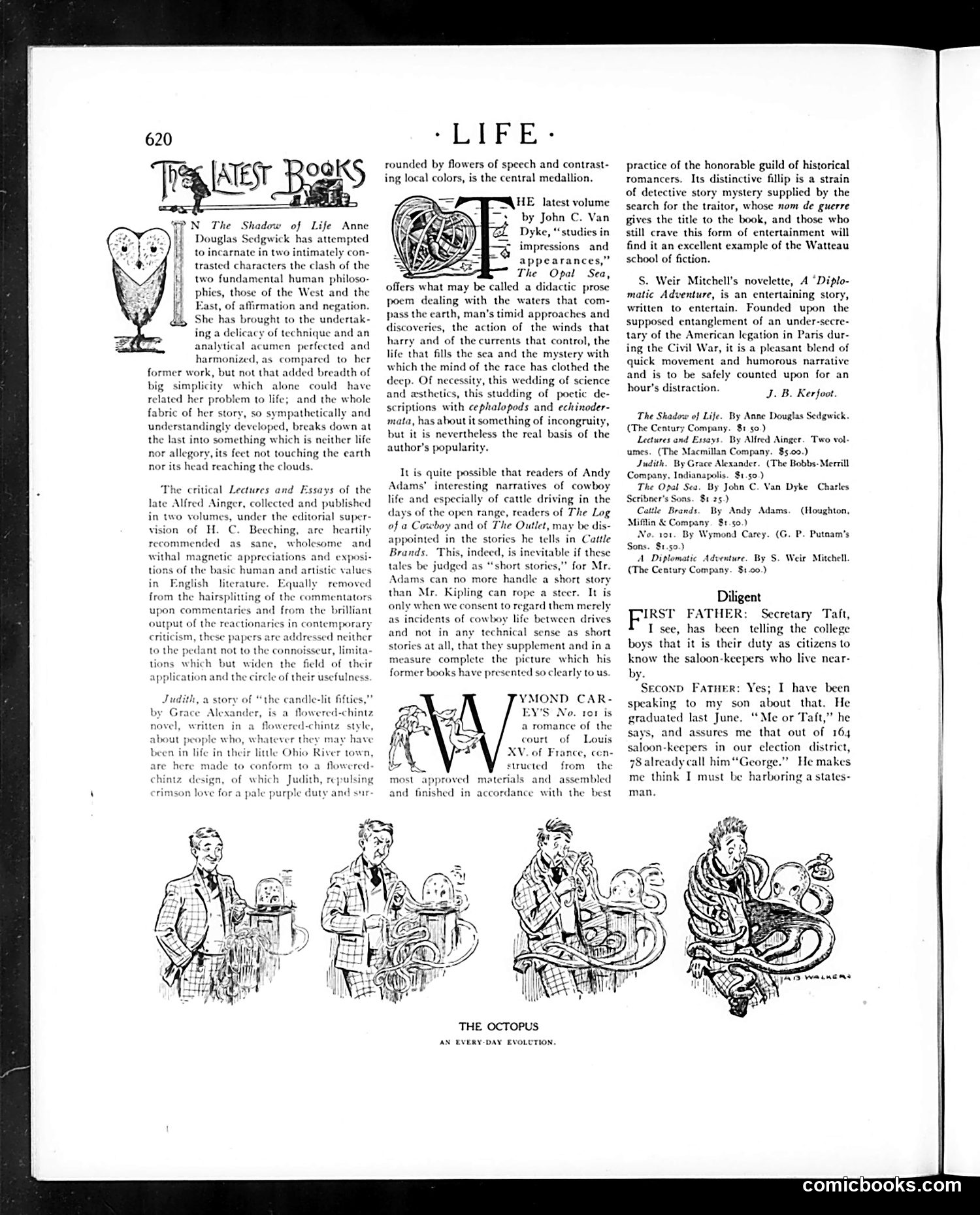
What you’re looking at
This cartoon satirizes the progressive acquisition of bureaucratic power or social obligations. Four sequential panels show a man increasingly entangled by octopus tentacles, each labeled (though the labels aren't clearly legible in this image). The progression visualizes how commitments or responsibilities gradually ensnare and constrain someone, growing inescapable over time. The title "An Every-Day Evolution" suggests this is a commentary on modern life—how ordinary people become gradually trapped by mounting duties, likely referring to government regulation, corporate control, or social expectations expanding in early 20th-century America. The visual metaphor of the octopus as a suffocating, many-armed force was common period imagery for monopolies, bureaucracy, or corruption. The cartoon critiques this "evolution" as unavoidable entanglement rather than progress.
📄 Transcribed text from this page (OCR, searchable)
Machine-transcribed from the original scan — historical spelling and the odd misread are preserved.
N The Shadow of Life Anne Douglas Sedgwick has attempted to incarnate in two intimately con- trasted characters the clash of the two fundamental human philoso- phics, those of the West and the East, of affirmation and negation. She has brought to the undertak- ing a delicacy of technique and an analytical acumen perfected and harmonized, as compared to her former work, but not that added breadth of big simplicity alone related her problem to life; and the whole fabric of her story, so sympathetically and understandingly developed, breaks down at the last into something which is neither life nor allegory, its feet not touching the earth nor its head reaching the clouds. which could have The critical Lectures and Essays of the late Alfred Ainger, collected and published in two volumes, under the editorial super- vision of H. C. Beeching, are heartily recommen ane, withal m -ciations tior in English wholesome literature. Equally removed > hairsplitting of the commentat upon commentaries and from the brillia output of the reactionaries in contemporary ism, these papers are addressed neith to the pedant not to the connoisseur, limita- which but widen the field of th ication and the circle of thei from usefulness. tory of “the candle-lit fifties,” -chintz hintz style, by Grac flowere novel, wri af about people who, whatever they may have been in life in their little Ohio River town, are here made to conform to a flowered sign, of which J love for a pale purple duty and s -LIFE- rounded by flowers of speech and contrast- ing local colors, is the central medallion. HE latest volume A by John C. Va GL Dyke, “studies in = impressions and appearances,” The Opal Sea, offers what may be called a didactic prose poem dealing with the waters that com- pass the carth, man’s timid approaches and discoveries, the action of the winds that harry and of the currents that control, the life that fills the sea and the mystery with which the mind of the race has clothed the deep. Of necessity, this wedding of science and wsthetics, this studding of poctic de- scriptions with cephalopods and echinoder- mata, has about it something of incongruity, but it is nevertheless the real basis of the author's popularity. It is quite possible that readers of Andy Adams’ interesting narratives of cowboy life and especially of cattle driving in the of The Log may be dis- stories he tells in Cattle nis, indecd, is inevitable if these for Mr. Adams can no more handle a short story than Mr. Kipling can rope a steer. It is only when we consent to regard them merely as incidents of cowboy life between drives and not in any technical sense as short stories at all, that they supplement and in a measure complete the picture which his former books have presented so clearly to us. days of the open range, reade: of a Cowboy and of The Outle appointed in the Brands. 1] tales be judged as “short storie: MOND CAR- EY’S No. ror is a romance of the court of — Louis XV. of France, cen- structed from the s and assembled and finished in accordance with the proved mate best ay THE OCTOPUS AN EVERY-DAY EVOLUTION. practice of the honorable guild of historical romancers. Its distinctive fillip is a strain of detective story mystery supplied by the search for the traitor, whose nom de guerre gives the title to the book, and those who still crave this form of entertainment will find it an excellent example of the Watteau school of fiction. S. Weir Mitchell’s novelette, A “Diplo- matic Adventure, is an entertaining story, written to entertain. Founded upon the supposed entanglement of an under-secre- tary of the American legation in Paris dur- ing the Civil War, it is a pleasant blend of quick movement and humorous narrative and is to be safely counted upon for an hour's distraction. J.B. Kerfoot. The Shadow of Life. By Anne Douglas Sedgwick. (The Century Company. $1 50.) Lectures and Essays. By Alfred Ainger. Two vol- umes. (The Macmillan Company. $5.00.) Judith. By Grace Alexander. (The Bobbs-Merrill Company, Indianapolis. $1.50) The Opat Sea. By Jobn C. Van Dyke Scribner's Sons. 81 25.) Cattle Brands. By Andy Adams Mifflin & Company. $t.s0.) No. 101. By Wymond Carey. (G. P. Putnam's Sons. $1.59.) A Diplomatic Adventure. By S. (The Century $1.00.) Charles (Houghton, Weir Mitchell. ompany Diligent IRST FATHER: Secretary Taft, I see, has been telling the college boys that it is their duty as citizens to know the saloon-keepers who live near- by. ronp Fatuer: Yes; I have been speaking to my son about that. He graduated last June. “Me or Taft,” he and assures me that out of 164 saloon-keepers in our election district, 78 already call him He makes me think I must be harboring a states- man. comicbooks.com