
Life, 1906-05-17 · page 8 of 28
Life — May 17, 1906 — page 8: what you’re looking at
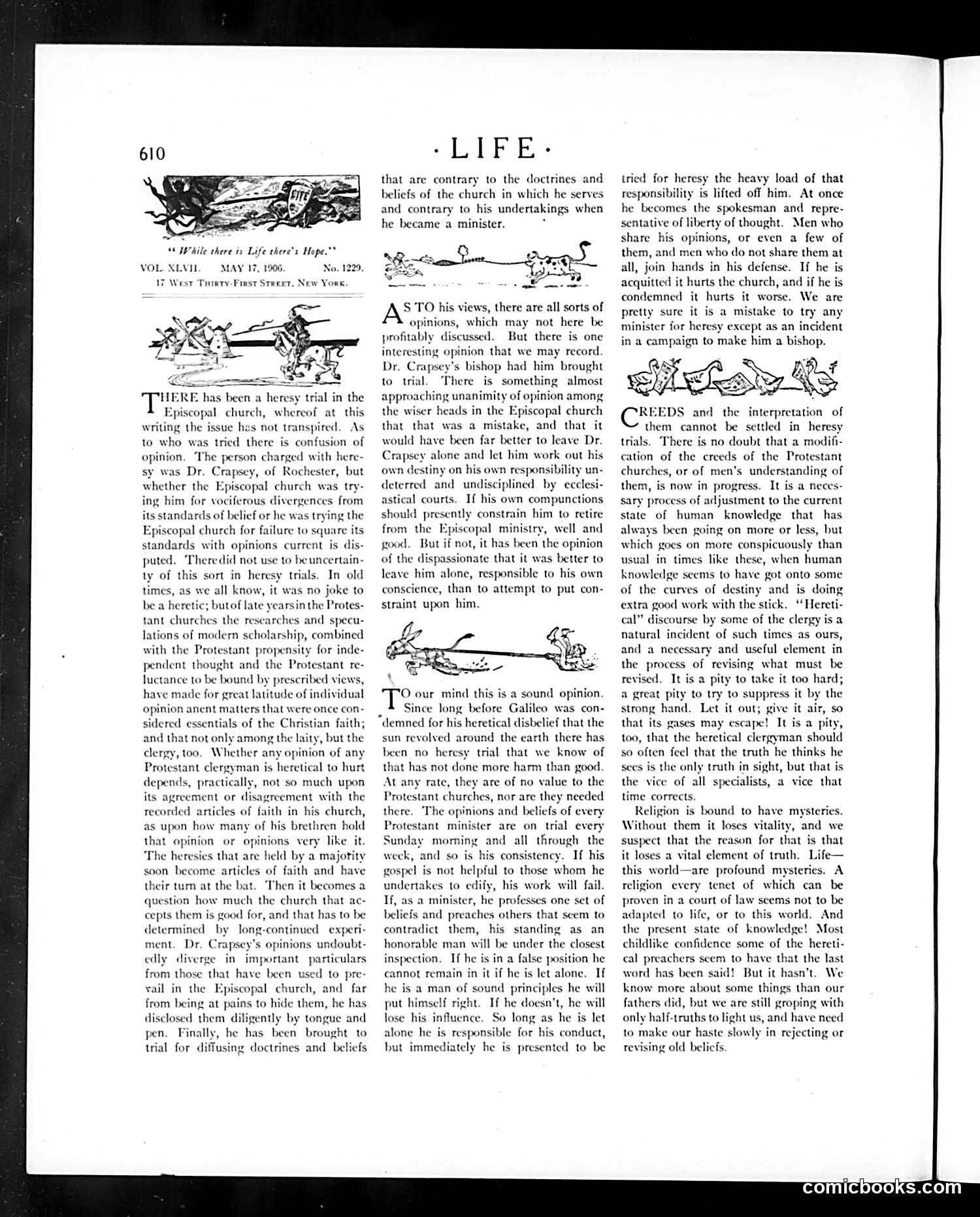
What you’re looking at
This page discusses a heresy trial in the Episcopal church, centered on **Dr. Crapsey** (referenced in the text). The article debates whether the Episcopal church was right to try him for doctrinal violations, or whether he should have been left alone. The small cartoons appear to be generic satirical illustrations—showing figures in various poses—rather than specific caricatures of identifiable individuals. The core argument is about **religious freedom vs. institutional orthodoxy**: whether churches should enforce strict doctrinal compliance or allow ministers latitude in their beliefs. The author argues that heresy trials are problematic and that some theological diversity is healthy, particularly during times of intellectual change. The piece advocates for tolerance of unorthodox religious opinion within established churches.
📄 Transcribed text from this page (OCR, searchable)
Machine-transcribed from the original scan — historical spelling and the odd misread are preserved.
“(While there is Life there's Hope.”* VOL. XLVI. MAY 17, 1906. No. 1229. 17 West Tinety-First Senet, New York. HERE ha been a heresy trial in the piscopal church, whereof at. this writing the issue has not transpired. As to who was tried there is confusion of opinion. The person charged with here- sy was Dr. Crapsey, of Rochester, but whether the Episcopal church was try- ing him for vociferous divergences from its standards of belief or he was trying the Episcopal church for failure to square its standards with opinions current is dis- puted. Theredid not use to be uncertain- ty of this sort in heresy trials. In old times, as we all know, it was no joke to be a heretic; butof late yearsin the Protes- tant churches the researches and specu- lations of modern scholarship, combined with the Protestant propensity for inde- pendent thought and the Protestant re- luctance to be bound by prescribed vie have made for great latitude of individ opinion anent matters that were once con- sidered essentials of the Christian faith; and that not only among the laity, but the clergy, too, Whether any opinion of any Protestant clergyman is heretical to hurt depends, practically, not so much upon its agreement or disagreement with the recorded articles of faith in his church, as upon how many of his brethren hold that opinion or opinions very like it. ¢ heresies that are held by a majotity soon become articles of faith and have their turn at the bat. Then it becomes a question how much the church that ac- cepts them is good for, and that has to be determined by long-continued experi- ment. Dr. Crapsey’s opinions undoubt- edly diverge in important’ particulars from those that have been used to pre- vail in the Episcopal church, and. fi from being at pains to hide them, he has disclosed them diligently by tongue and pen. Finally, he has been brought to trial for diffusing doctrines and_ beliefs -LIFE- that are contrary to the doctrines and beliefs of the church in which he serves and contrary to his undertakings when he became a minister. . S TO his views, there are all sorts of opinions, which may not here be profitably discussed. But there is one interesting opinion that we may record Dr. Crapsey’s bishop had him brought to trial. There is something almost approaching unanimity of opinion among the wiser heads in the Episcopal church that that was a mistake, and that it would have been far better to leave Dr. Crapsey alone and let him work out his own destiny on his own responsibility un- deterred and undisciplined by ecclesi- astical courts. If his own compunctions should presently constrain him to retire from the Episcopal ministry, well and good. But if not, it has been the opinion of the dispassionate that it was better to leave him alone, responsible to his own conscience, than to attempt to put con- straint upon him. is a sound opinion Since long before Galileo was con- “demned for his heretical disbelief that the sun revolved around the earth there has been no heresy trial that we know of that has not done more harm than good. At any rate, they are of no value to the Protestant churches, nor are they needed there. The opinions and beliefs of eve Protestant minister are on trial every Sunday moming and all through the week, and so is his consistency. If his gospel is not helpful to those whom he undertakes to edify, his work will fail If, as a minister, he professes one set of beliefs and preaches others that seem to contradict them, his standing as an honorable man will be under the closest inspection. If he is in a false position he cannot remain in it if he is let alone. If he is a man of sound principles he will put himself right. If he doesn’t, he will lose his influence. So long as he is let alone he is responsible for his conduct, but immediately he is presented to be tried for heresy the heavy load of that responsibility is lifted off him. At once he becomes the spokesman and repre- sentative of liberty of thought. Men who share his opinions, or even a few of them, and men who do not share them at all, join hands in his defense. If he is acquitted it hurts the church, and if he is condemned it hurts it worse. We are pretty sure it is a mistake to try any minister for heresy except as an incident in a campaign to make him a bishop. EDS and the interpretation of them cannot be settled in heresy trials. There is no doubt that a modifi- cation of the creeds of the Protestant churches, or of men’s understanding of them, is now in progress. It is a neces- sary process of adjustment to the current state of human knowledge that has always been going on more or less, but which goes on more conspicuously than usual in times like these, when human knowledge seems to have got onto some of the curves of destiny and is doing extra good work with the stick. ‘‘Hereti- al” discourse by some of the clergy is a natural incident of such times as ours, and a necessary and useful element in the process of revising what must be revised. It is a pity to take it too hard; a great pity to try to suppress it by the strong hand. Let it out; give it air, so that its gases may escape! It is a pity, too, that the heretical clergyman should so often feel that the truth he thinks he sees is the only truth in sight, but that is the vice of all specialists, a vice that time corrects. Religion is bound to have mysteries. Without them it loses vitality, and we suspect that the reason for that is that it loses a vital element of truth. Life— this world—are profound mysteries. A religion every tenet of which can be proven in a court of law scems not to be adapted to life, or to this world. And the present state of knowledge! Most childlike confidence some of the hereti- cal preachers seem to have that the last word has been said! But it hasn’t. We know more about some things than our fathers did, but we are still groping with only half-truths to light us, and have need to make our haste slowly in rejecting or revising old beliefs. comicbooks.com