
Life, 1906-05-17 · page 16 of 28
Life — May 17, 1906 — page 16: what you’re looking at
What you’re looking at
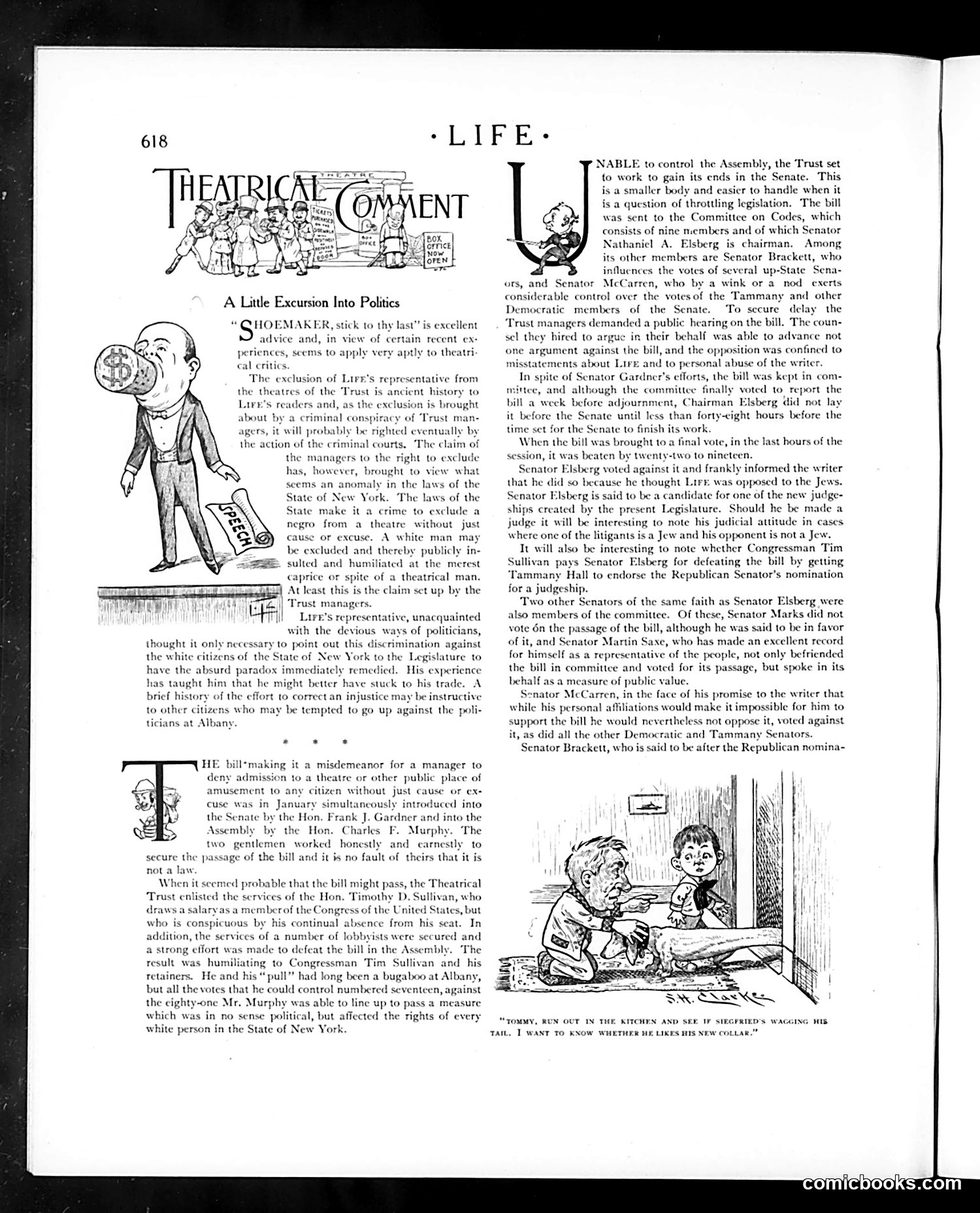
This satirical piece describes efforts to pass legislation protecting citizens (specifically white men) from arbitrary exclusion by theatre managers—a response to the Theatrical Trust's blacklisting of Life magazine's representative. The article documents how the Trust defeated the bill through political maneuvering. In the Assembly, Congressman Tim Sullivan (a Tammany Hall operative) could only control 17 votes against Charles F. Murphy's 81 supporting votes. Unable to block it there, the Trust shifted to the Senate, where fewer votes were needed. Senators Elsberg, Brackett, and McCarren—allegedly influenced by the Trust—kept the bill stalled in committee despite its passage potential. The cartoon's point: theatrical managers enjoyed arbitrary power over citizens that would be illegal if applied to Black patrons, exposing an absurd legal double standard. The satire targets both Trust corruption and Albany politicians' susceptibility to special-interest "pull."
📄 Transcribed text from this page (OCR, searchable)
Machine-transcribed from the original scan — historical spelling and the odd misread are preserved.
A Little Excursion Into Politics “ QHOEMAKER, stick to thy last’ is excellent advice and, in view of certain recent ex: periences, seems to apply very aptly to theatri cal critics The exclusion of Lirr’s representative from the the Trust is ancient history to Lirr’s readers and, as the exclusion is brought about t of Trust man- ted eventually by the action of the criminal courts. The cls the managers to the right to exclude has, however, brought to view what seems an anomaly in the laws of the State of New York. The laws of the State make it a crime to exclude a negro from a theatre without just cause or excuse. A white man may d thereby publicly in- sulted and humiliated at the merest caprice or spite of a theatrical man. 1 At Icast this is the claim set up by the Trust managers. theatres ¢ y a criminal conspirac agers, it will probably be righ of be excluded ar resentative, unacquainted with the devious ways of politicians, thought it only necessary to point out this discrimination against the white citizens of the State of New York to the Legislature to have the absurd paradox immediately remedied. His experienc has taught him that he might better have stuck to his trade. A brief history of the effort to correct an injustice may be instructive to other citizens who may be tempted to go up against the poli- ticians at Albany. HE bill*making it a misdemeanor for a manager to deny admission to a theatre or other public place of amusement to any citizen without just cause or ex cuse was in January simultancously introduced into the Senate by the Hon. Frank J. Gardner and into the Hon. Charles F. Murphy. The en worked honestly and earnestly to secure the passage of the bill and it is no fault of theirs that it is not a law When it seemed probable that the bill might pass, the Theatrical ‘Trust enlisted the services of the Hon. Timothy D. Sullivan, who draws a salary as a member of the Congress of the United States, but who is conspicuous by his continual absence from his seat. In addition, the services of a number of lobbyists were secured and a strong effort was made to defeat the bill in the Assembly. ‘The result was humiliating to Congressman Tim Sullivan and his retainers. He and his“ pull” had long been a bugaboo at Albany, but all the votes that he could control numbered seventeen, against Assembly by the two gentle the eighty-one Mr. Murphy was able to line up to pass a m which was in no sense political, but affected the rights of ¢ white person in the State of New York. sure ery NABLE to control the Assembly, the ‘Trust set to work to gain its ends in the Senate. This is a smaller body and easier to handle when it is a question of throttling legislation. The bill was sent to the Committee on Codes, which consists of nine nuembers and of which Senator Nathaniel A. Elsberg is chairman, Among its other members are Senator Brackett, who influences the votes of several up-State Sen: ors, and Senator McCarren, who by a wink or a nod exerts considerable control over the votes of the Tammany and other Democratic members of the Senate. ‘To secure delay the ‘Trust managers demanded a public hearing on the bill. The coun sel they hired to argue in their behalf was able to advance not one argument against the bill, and the opposition was confined to misstatements about Lire and to personal abuse of the writer. In spite of Senator Gardner's efforts, the bill was kept in com- mittee, and although the committee finally voted to report the bill a week before adjournment, Chairman Elsberg Wid not lay it before the Senate until Iess than forty-eight hours before the time set for the Senate to finish its work. When the bill was brought to a final vote, in the last hours of the session, it as beaten by twenty-two to nineteen. Senator Elsberg voted against it and frankly informed the writer that he did so because he thought Lire: was opposed to the Jews. Senator I ships cre sberg is said to be a candidate for one of the new judge- ted by the present Legislature. Should he be made a judge it w J attitude in cases where one of the litigants is a Jew and his opponent is not a Jew. It will also be interesting to note whether Congressman Sullivan pays Senator Elsberg for defeating the bill by getting ‘Tammany Hall to endorse the Republican Senator's nomination for a judgeship. Two other Senators of the same faith as Senator Elsberg were also members of the committee. Of these, Senator Marks did not vote én the passage of the bill, although he was said to be in favor of it, and Senator Martin Saxe, who has made an excellent record for himself as a representative of the people, not only befriended the bill in comm { as a measure of public value. nator McCarren, in the face of his promise to the writer that ile his personal affiliations would make it impossible for him to support the bill he would nevertheless not oppose it, voted dic 1 be interesting to note his judic tee and voted for its passage, but spoke in its I the other Democratic and Tammany Senators. “TOMMY, RUN OUT IN THE KITCHEN AND SEE IV SIEGHRIED'S WAGGING 118 al . 1 WANT TO KNOW WHETHER HE LIKES HIS NEW COLLAR.”