
A complete issue · 58 pages · 1906
Life — April 5, 1906
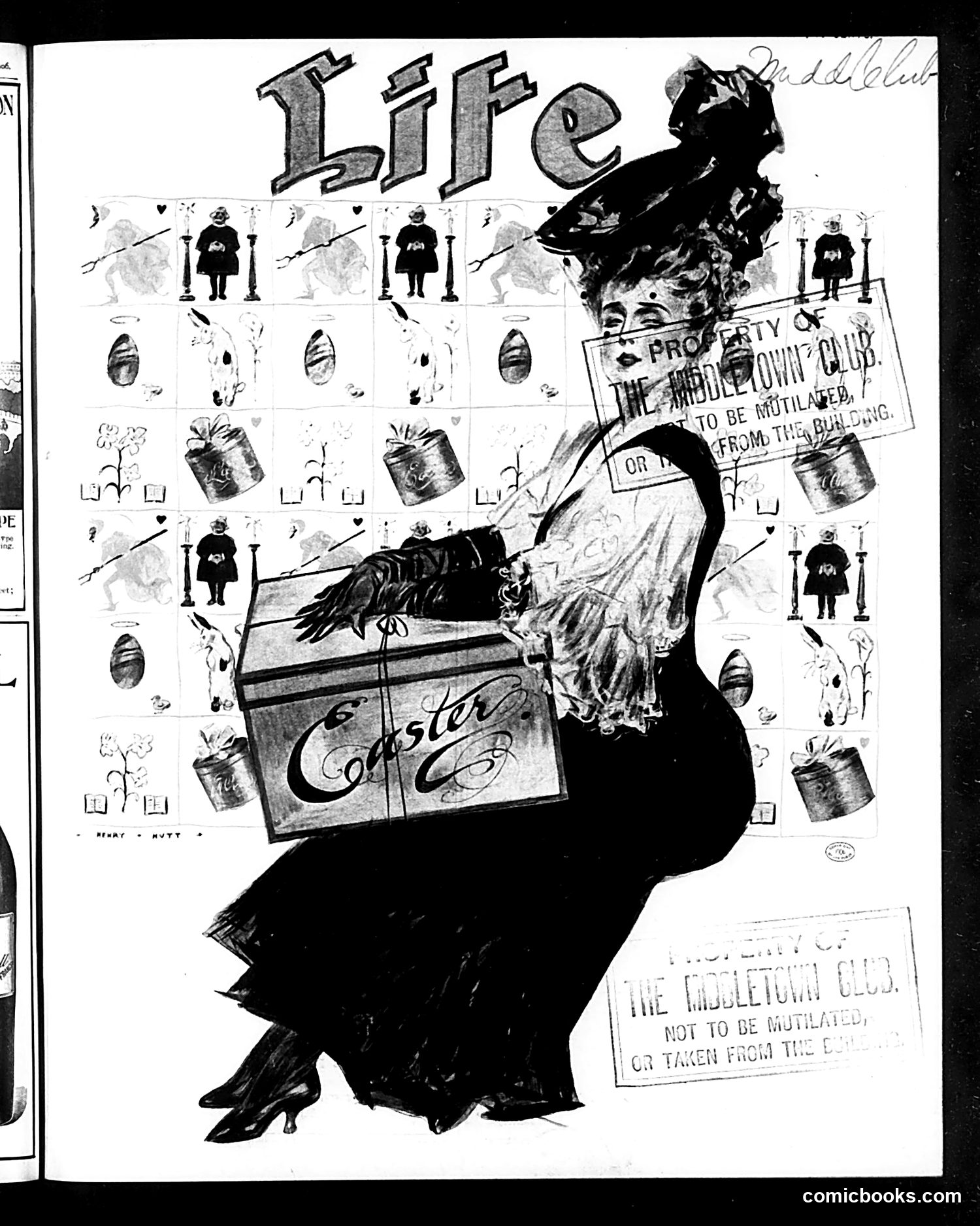
This page from *Life* magazine appears to be satirizing a scandal involving the Middletown Club. The central silhouette depicts a figure (likely a club member or prominent person) holding a "Coaster" box—possibly referencing both the object and something being "coasted" through or covered up. The repeated grid pattern in the background shows various domestic scenes (figures, household items, plants, containers), suggesting the contrast between private life and public scandal. The stamp reading "PROPERTY OF THE MIDDLETOWN CLUB / NOT TO BE MUTILATED / OR TAKEN FROM THE BUILDING" emphasizes institutional hypocrisy. The satire likely mocks how scandals were suppressed or concealed by exclusive clubs protecting their members. The cartoon critiques both the club's attempt to contain information and the complicity of prominent members.
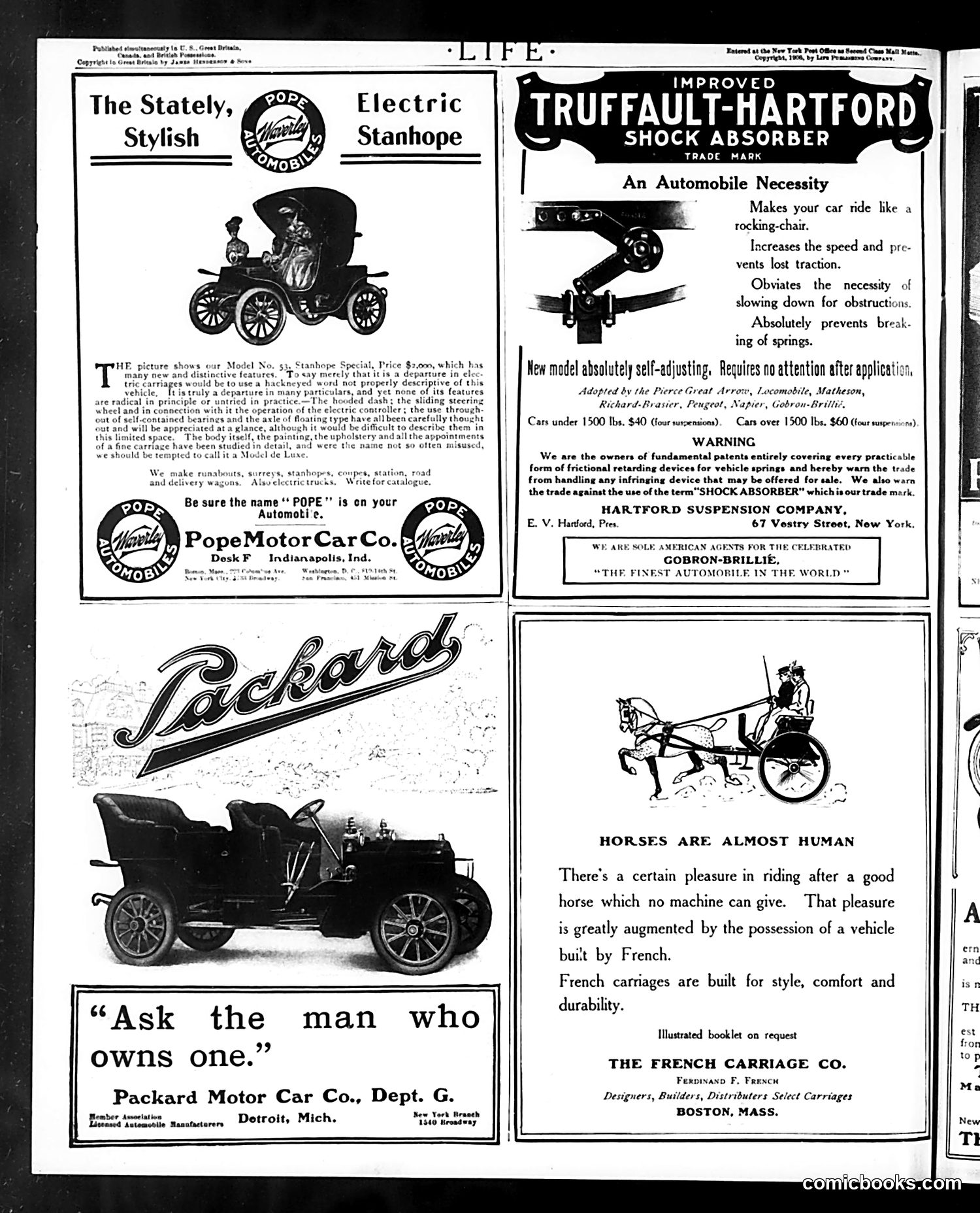
This page is primarily **advertising**, not satire or political commentary. It contains four automobile and carriage advertisements from the early 1900s: 1. **Pope Electric Stanhope** - promotes an electric car as "stately, stylish" 2. **Truffault-Hartford Shock Absorber** - technical auto accessory ad 3. **Packard Motor Car** - luxury automobile with tagline "Ask the man who owns one" 4. **French Carriage Company** - horse-drawn carriage ad emphasizing French craftsmanship The only notable aspect is the **juxtaposition**: while automobiles dominate three ads, the French Carriage ad defends horse-drawn vehicles by asserting "Horses Are Almost Human" and claiming carriages offer pleasures "no machine can give." This reflects the **transition period** when motorized vehicles were competing with traditional horse transportation—the ad's tone suggests defensive nostalgia for the older technology.
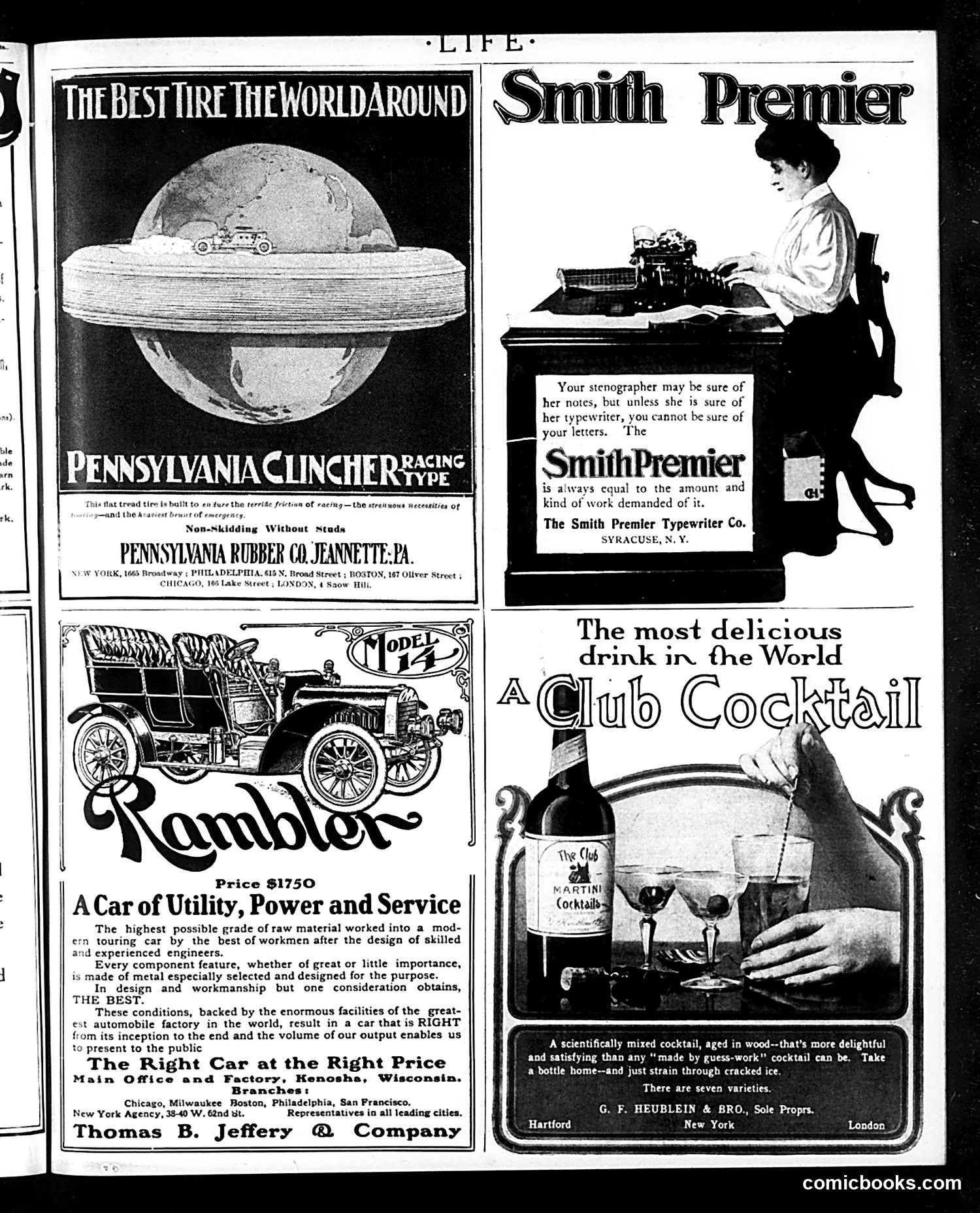
This page contains **four advertisements, not political cartoons or satire**. It appears from an early 1900s issue of *Life* magazine. The ads promote: 1. **Pennsylvania Clincher Racing Tire** – emphasizes the tire's ability to handle various road conditions 2. **Smith Premier Typewriter** – targets stenographers, claiming reliability equals the work demanded 3. **Model 44 Rambler automobile** – priced at $1,750, marketed as practical and well-engineered 4. **Club Cocktail** (Martini brand) – advertises this as "the most delicious drink in the World" These are straightforward product advertisements typical of the era, reflecting consumer goods, emerging automobile culture, office technology, and leisure products marketed to middle and upper-class readers. There is no discernible satirical content or political commentary on this particular page.
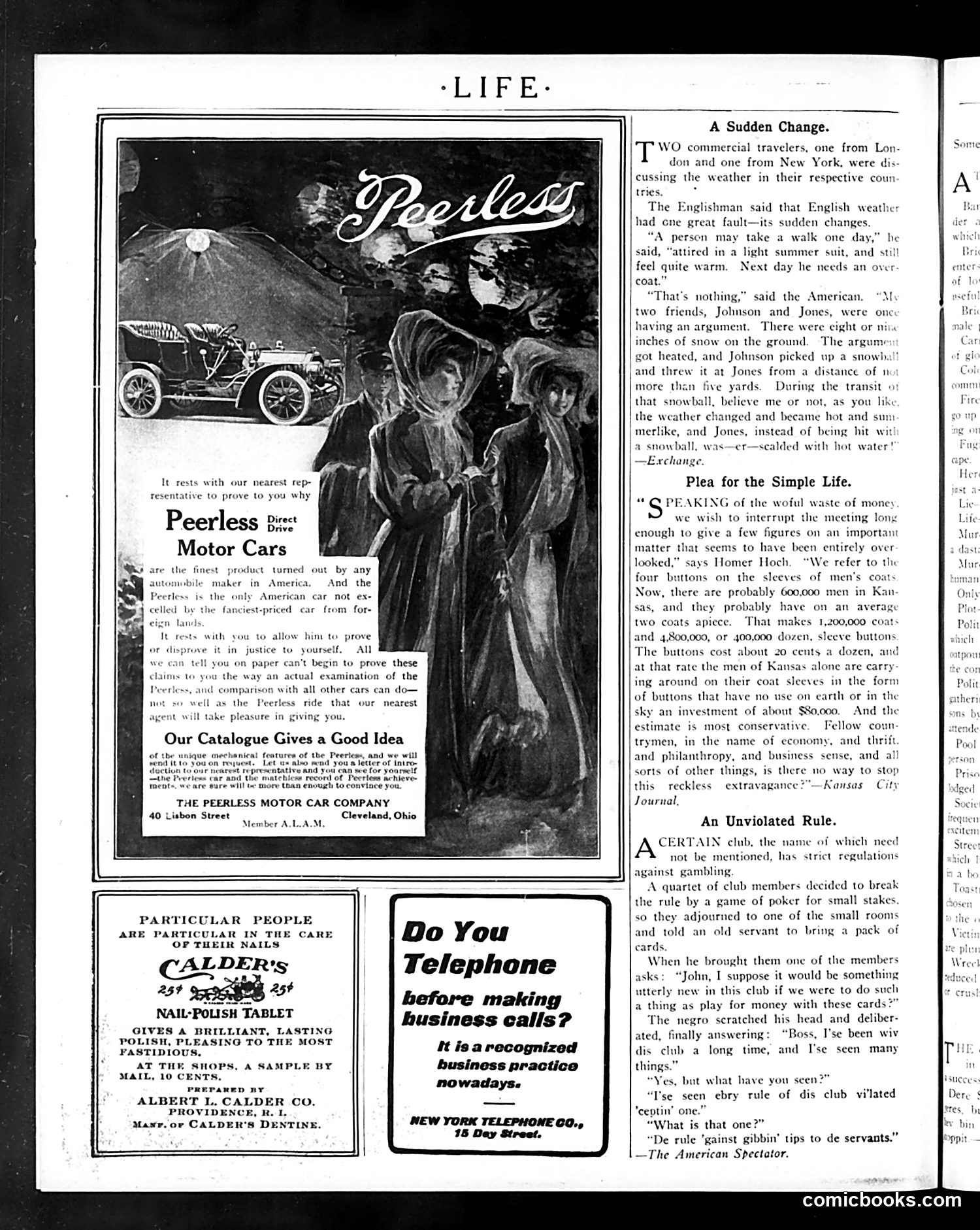
This page is primarily **advertising and humorous anecdotes** rather than political satire. The main advertisement promotes **Peerless Motor Cars**, emphasizing American manufacturing superiority over foreign brands. The accompanying illustration shows people in winter clothing, likely contrasting comfort/reliability themes. Below are three smaller ads (Calder's Nail Polish, New York Telephone Company) and three brief humorous stories: 1. **"A Sudden Change"** — British and American travelers debate weather preparedness; an American wins by throwing snowballs filled with hot water. 2. **"Plea for the Simple Life"** — Satirizes Kansas City's wasteful spending on men's coats and buttons. 3. **"An Unviolated Rule"** — A club servant cleverly evades a rule against gambling by retrieving playing cards. These are light, genteel humor pieces typical of Life magazine's era.
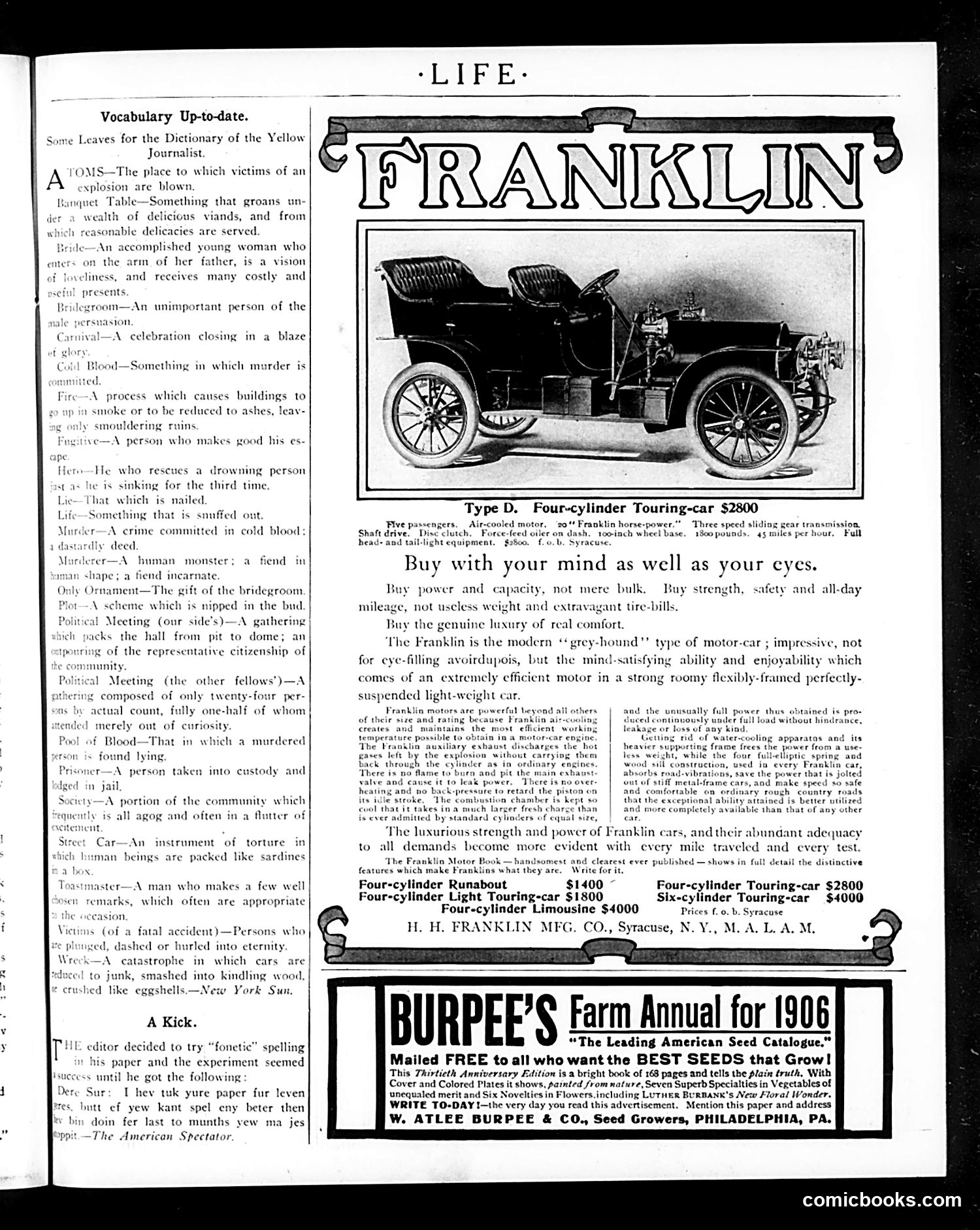
This page contains **no political cartoons or satirical commentary**. Instead, it features: 1. **Vocabulary definitions** (left column) — humorous slang terms from "The Dictionary of the Yellow Journalist," including entries like "Bride," "Bridegroom," and "Murder," presented with satirical definitions mocking journalism conventions. 2. **Franklin automobile advertisement** (center/right) — a substantial ad for the Franklin Motor Company's four-cylinder touring car ($2,800), emphasizing engineering quality and power. 3. **Burpee's Farm Annual advertisement** (bottom) — promoting their seed catalog as "The Leading American Seed Catalogue." The page is primarily **advertising-driven content** with minimal satirical elements limited to the vocabulary section's tongue-in-cheek journalistic terminology.
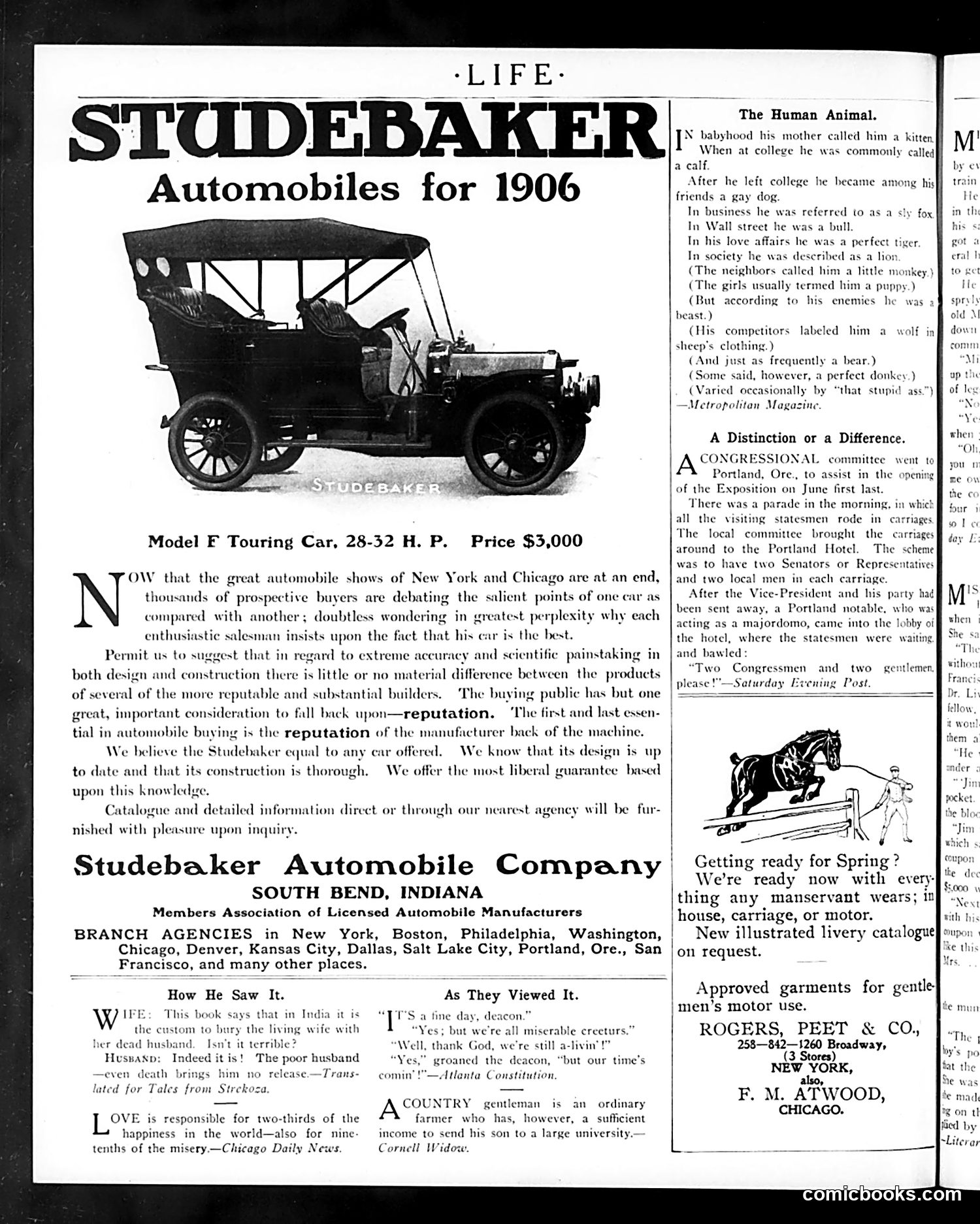
This page is primarily **advertising for Studebaker automobiles** (Model F Touring Car, $3,000), emphasizing the manufacturer's reputation and design quality as selling points to prospective buyers comparing different car brands. The right column contains **humorous social commentary** rather than political satire. "The Human Animal" mockingly catalogs how a man is labeled differently depending on his social context—a "calf" at home, "gay dog" after college, "bull" on Wall Street, "tiger" in romance, and "donkey" by competitors. This satirizes how people adopt different personas in different settings, a common Life magazine theme of social hypocrisy. The remaining items are minor filler pieces and advertisements typical of early 1900s magazines.
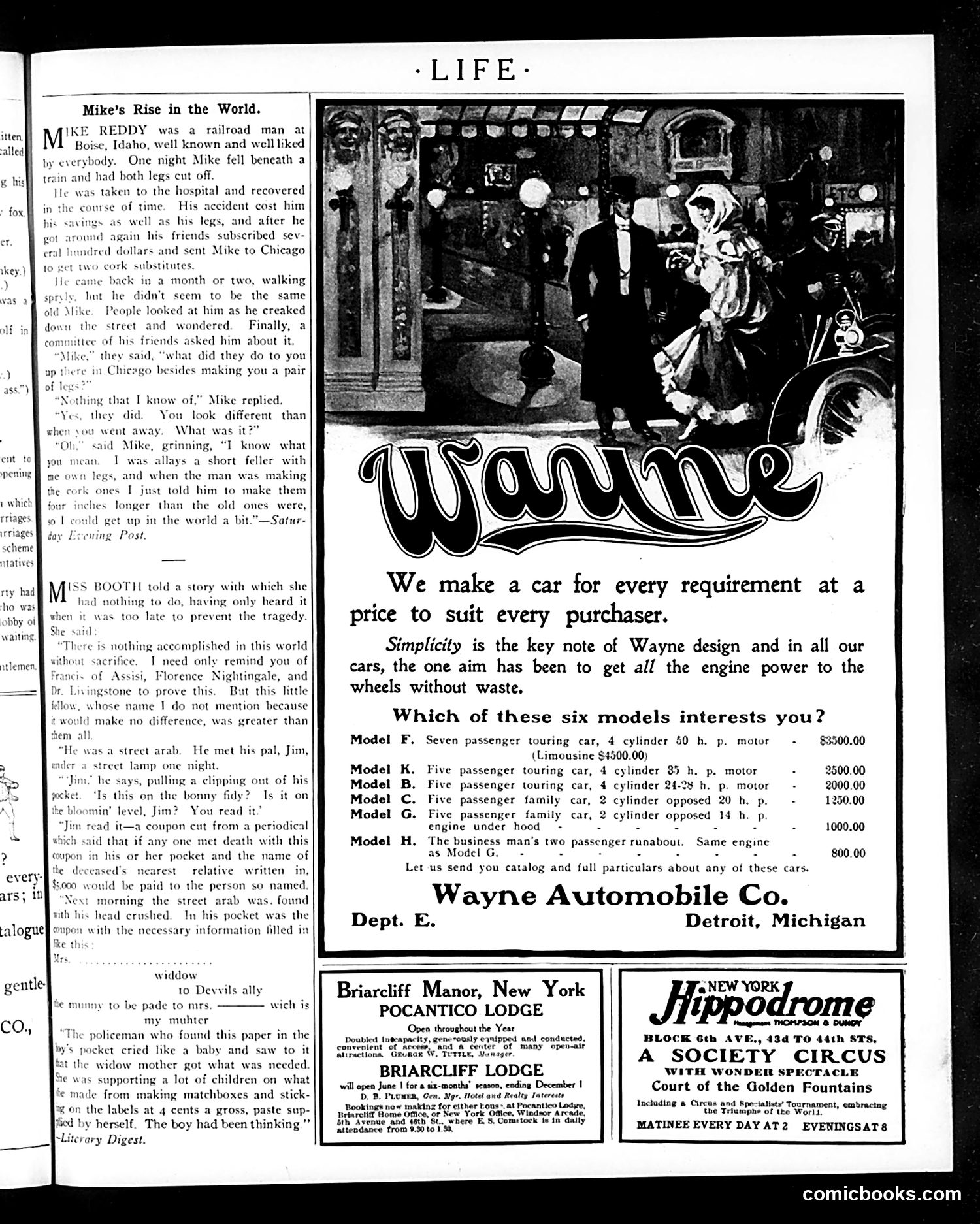
This page is primarily **advertising**, not satire or political cartoon. The dominant feature is a Wayne Automobile Company advertisement showcasing six car models (F, K, B, C, G, H) with prices ranging from $800 to $3,500. The left column contains a short story titled "Mike's Rise in the World" about a railroad worker who loses both legs in an accident but recovers and returns to his community. The story appears designed to inspire readers about perseverance and community support. The bottom section includes advertisements for Briarcliff Manor Lodge in New York and the Hippodrome theater in New York City. There is **no political cartoon or satire** on this page—it represents typical early 20th-century magazine content mixing fiction, automotive marketing, and entertainment advertising.
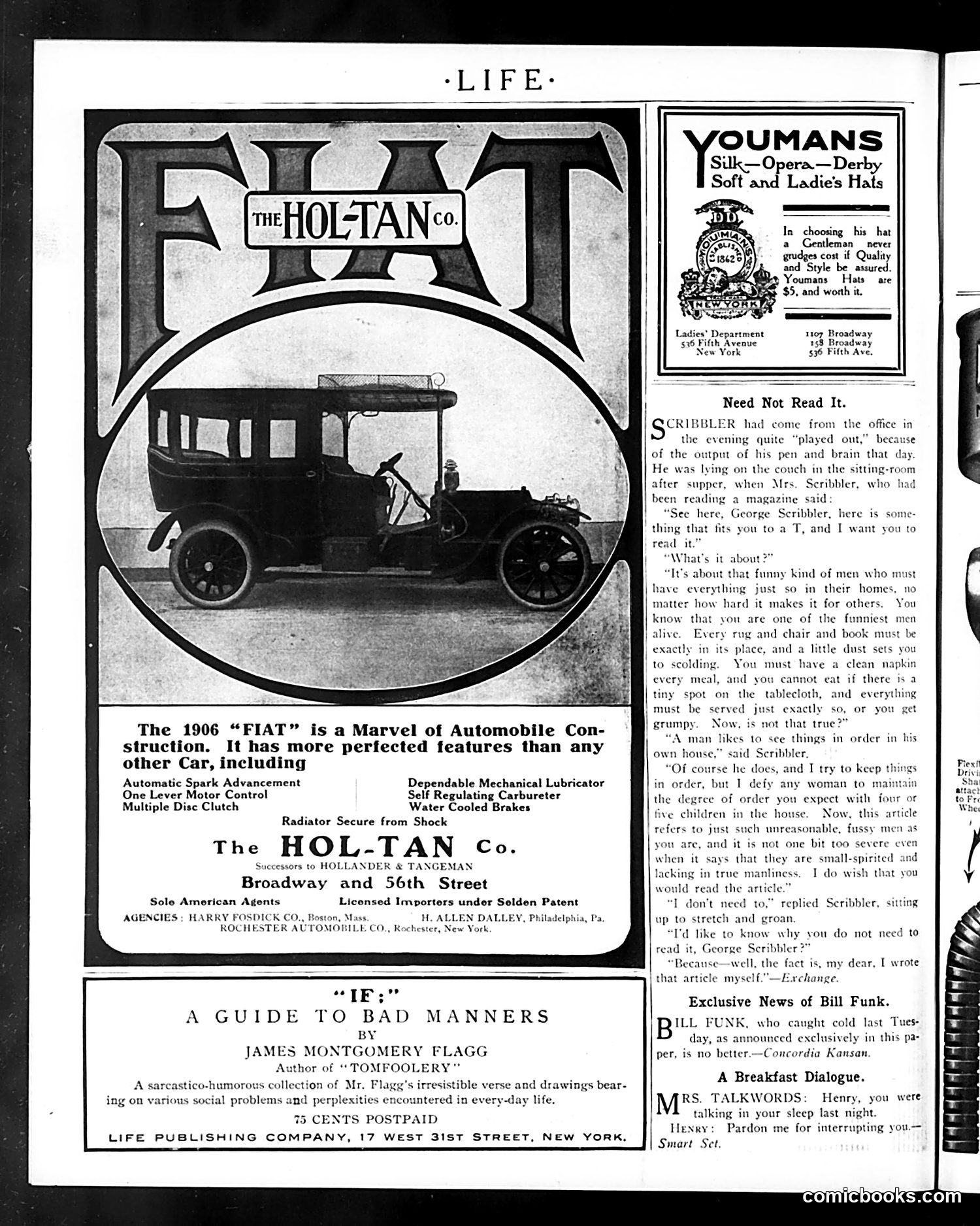
This page is primarily **advertising and literary content** rather than political satire. The dominant advertisement promotes the 1906 **FIAT automobile**, emphasizing its advanced engineering features. The car image appears to be the latest automotive technology of that era. The text section "Need Not Read It" is a humorous domestic sketch about a husband (Scribbler) whose wife insists he read an article about maintaining orderly homes. It satirizes **gender roles and household management expectations** of the early 1900s—poking fun at men who expect everything "just so" while resisting domestic responsibility. Lower sections advertise **James Montgomery Flagg's book "A Guide to Bad Manners"** (a satirical collection about social problems) and contain brief comedic dialogues. The page reflects early-20th-century attitudes toward marriage, cleanliness standards, and emerging consumer culture.
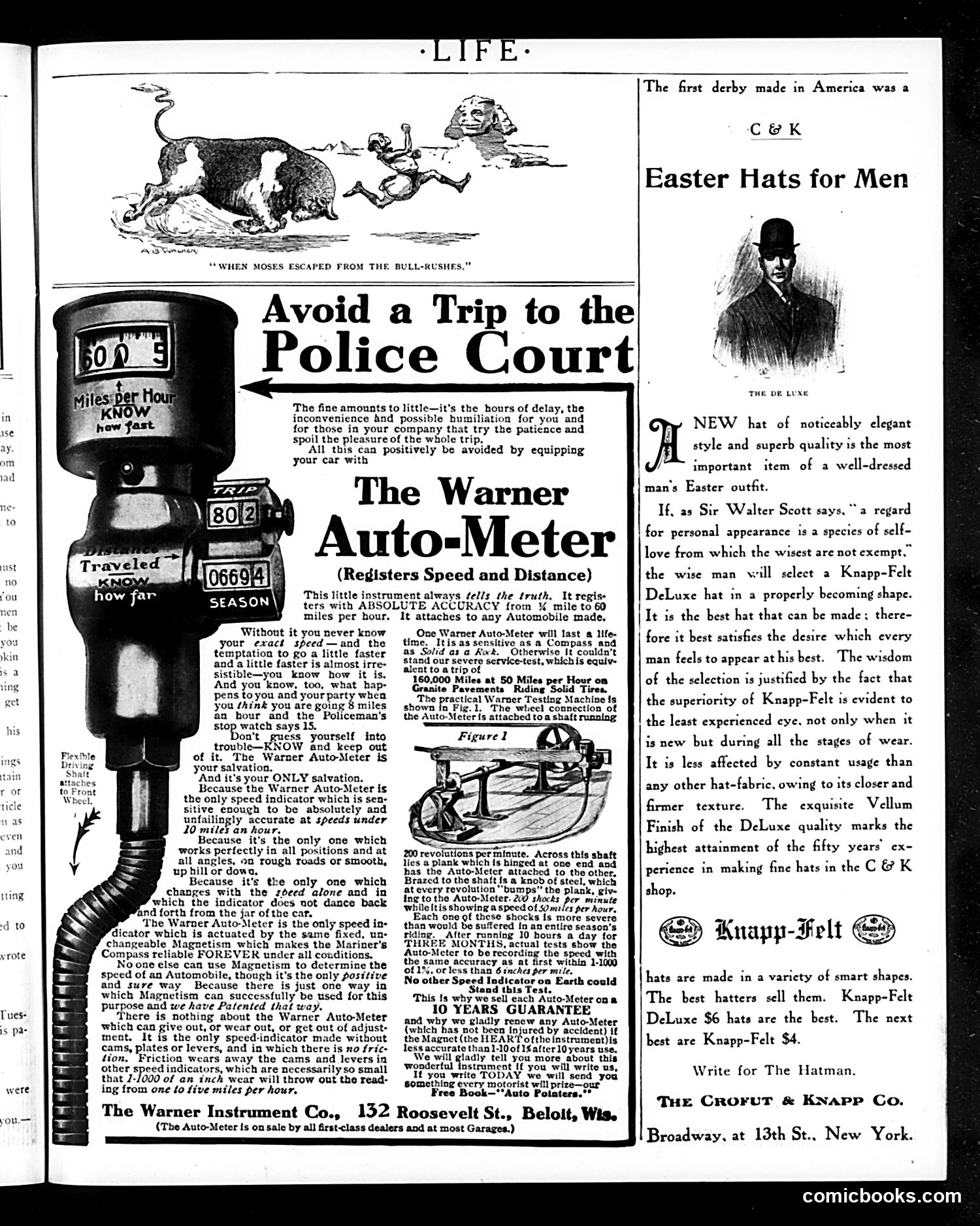
This page is primarily **advertising content** rather than political satire. The main cartoon at top left—"When Moses Escaped from the Bull-Rushes"—appears to be a humorous illustration of a man fleeing an escaped bull, likely a visual pun on the biblical reference to "bulrushes." The dominant content advertises the **Warner Auto-Meter**, a device measuring vehicle speed and distance. The lengthy ad emphasizes accuracy and claims to prevent speeding tickets and traffic violations by encouraging drivers to monitor their actual speed. The right side advertises **Knapp-Felt DeLuxe Easter hats for men**, suggesting this is a spring issue of *Life* magazine. Both ads target affluent male consumers of the era with automotive and fashion products.
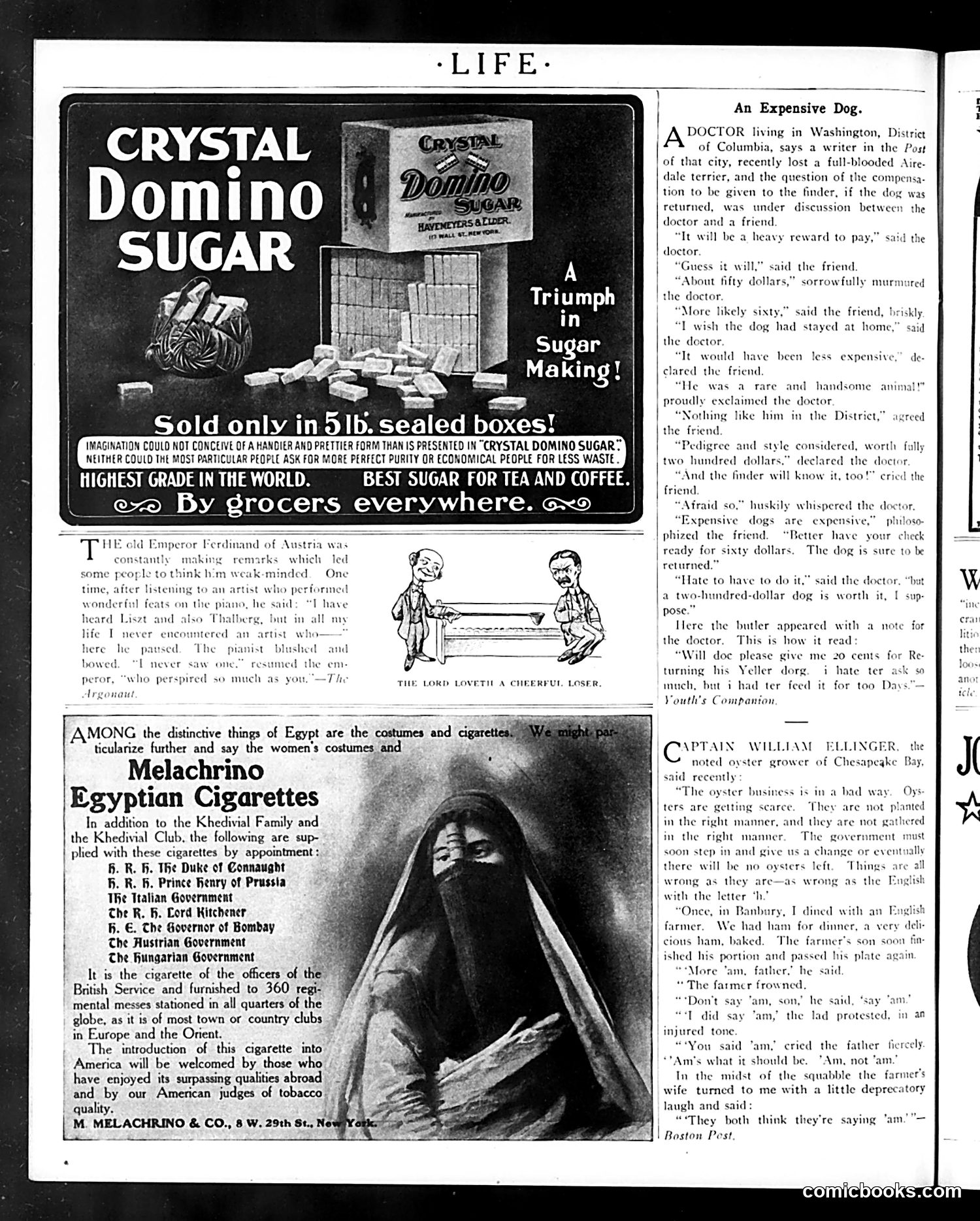
This page contains primarily **advertisements and unrelated articles** rather than political satire. The top half features a **Crystal Domino Sugar advertisement** promoting their product in 5-pound sealed boxes, claiming it's "highest grade in the world" and "best sugar for tea and coffee." Below is an anecdote about **Emperor Ferdinand of Austria** and a pianist, illustrating a humorous social interaction—not political commentary. The lower section advertises **Melachrino Egyptian Cigarettes**, listing aristocratic and governmental patrons (various European nobility and officials) to establish prestige through association. On the right are separate brief humorous articles: one about a doctor's expensive lost dog, another about oyster farming, and a dialect-humor piece about mispronouncing "am." This appears to be a typical early 20th-century *Life* magazine page mixing advertisements, light humor, and social anecdotes rather than sharp political satire.
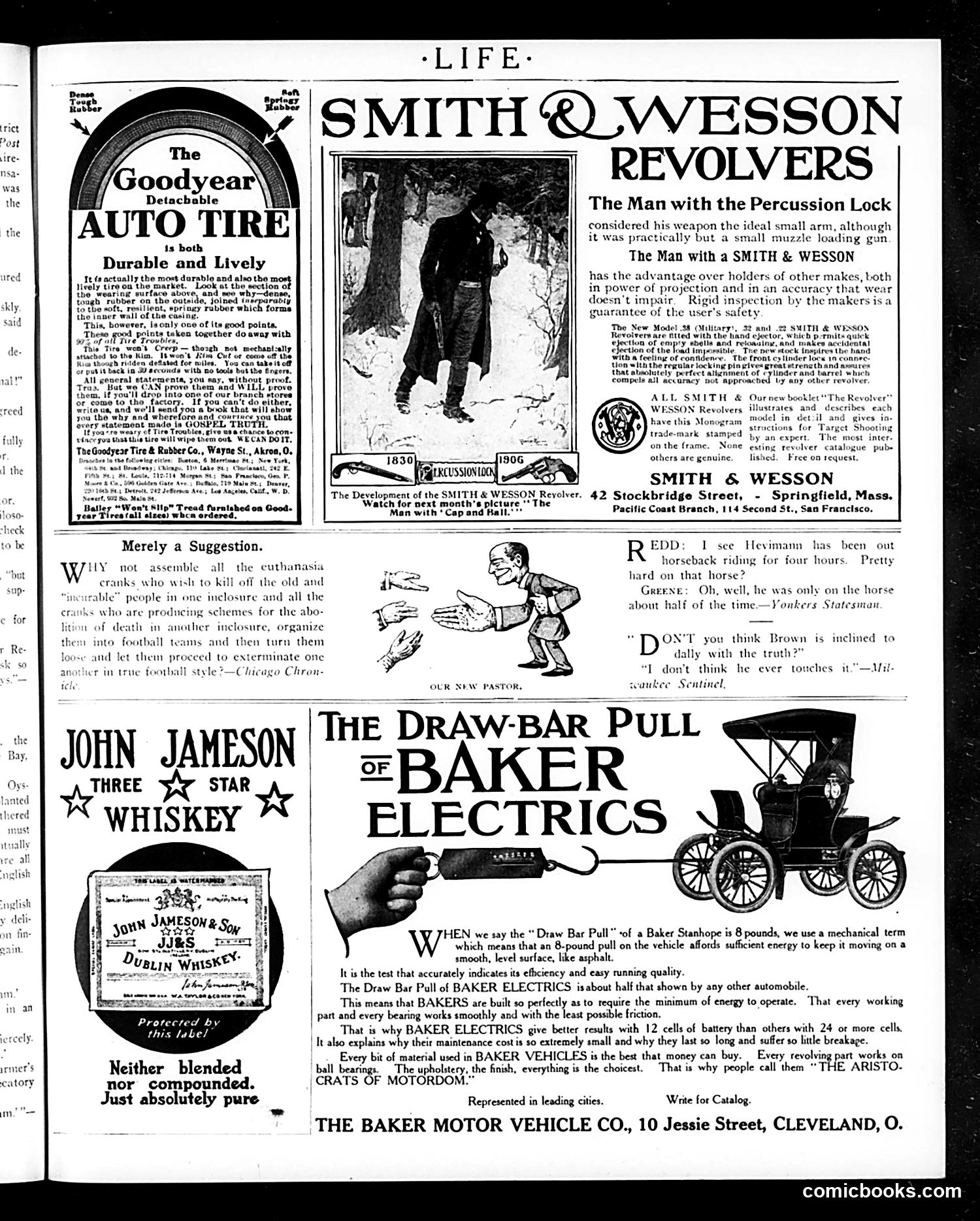
This is primarily an **advertising page** from Life magazine, featuring product promotions for Goodyear auto tires, Smith & Wesson revolvers, John Jameson whiskey, and Baker Electric automobiles. The only satirical content is a brief section titled **"Merely a Suggestion"** that mocks enthusiasts of violent spectacles. It sarcastically proposes organizing football teams composed of "cranks" obsessed with death and destruction, then having them play football "to exterminate one another in true football style"—a jab at the brutal, sometimes fatal nature of early 20th-century American football and society's appetite for dangerous entertainment. The remainder consists of commercial advertisements typical of the era, with no political figures or sustained satirical commentary.
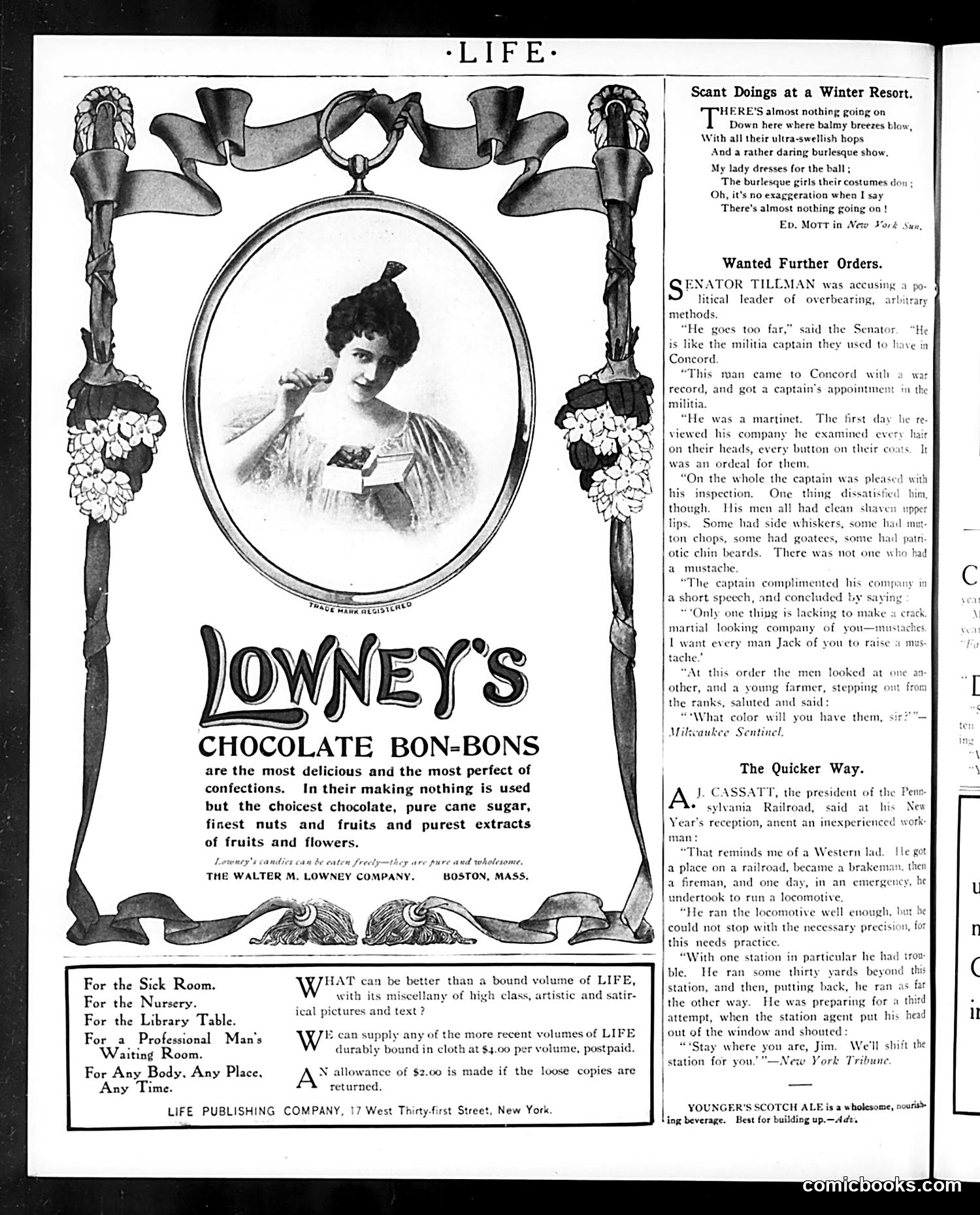
This page is primarily a **Lowney's Chocolate advertisement** featuring an elegant portrait of a woman in an ornamental frame. The ad emphasizes quality ingredients and purity—standard luxury marketing for early 20th-century confectionery. The right column contains three brief satirical pieces typical of *Life* magazine's humor section: 1. **"Scant Doings at a Winter Resort"** mocks the dullness of wealthy winter destinations, quoting a society publication lamenting lack of excitement. 2. **"Wanted Further Orders"** satirizes Senator Tillman's authoritarian leadership style through an anecdote about a militia captain demanding men grow mustaches—critiquing arbitrary abuse of power. 3. **"The Quicker Way"** is a joke about railroad advancement, where an ambitious young man climbs the corporate ladder by running a locomotive better than instructed. These reflect *Life's* characteristic social satire targeting authority figures and American pretension.
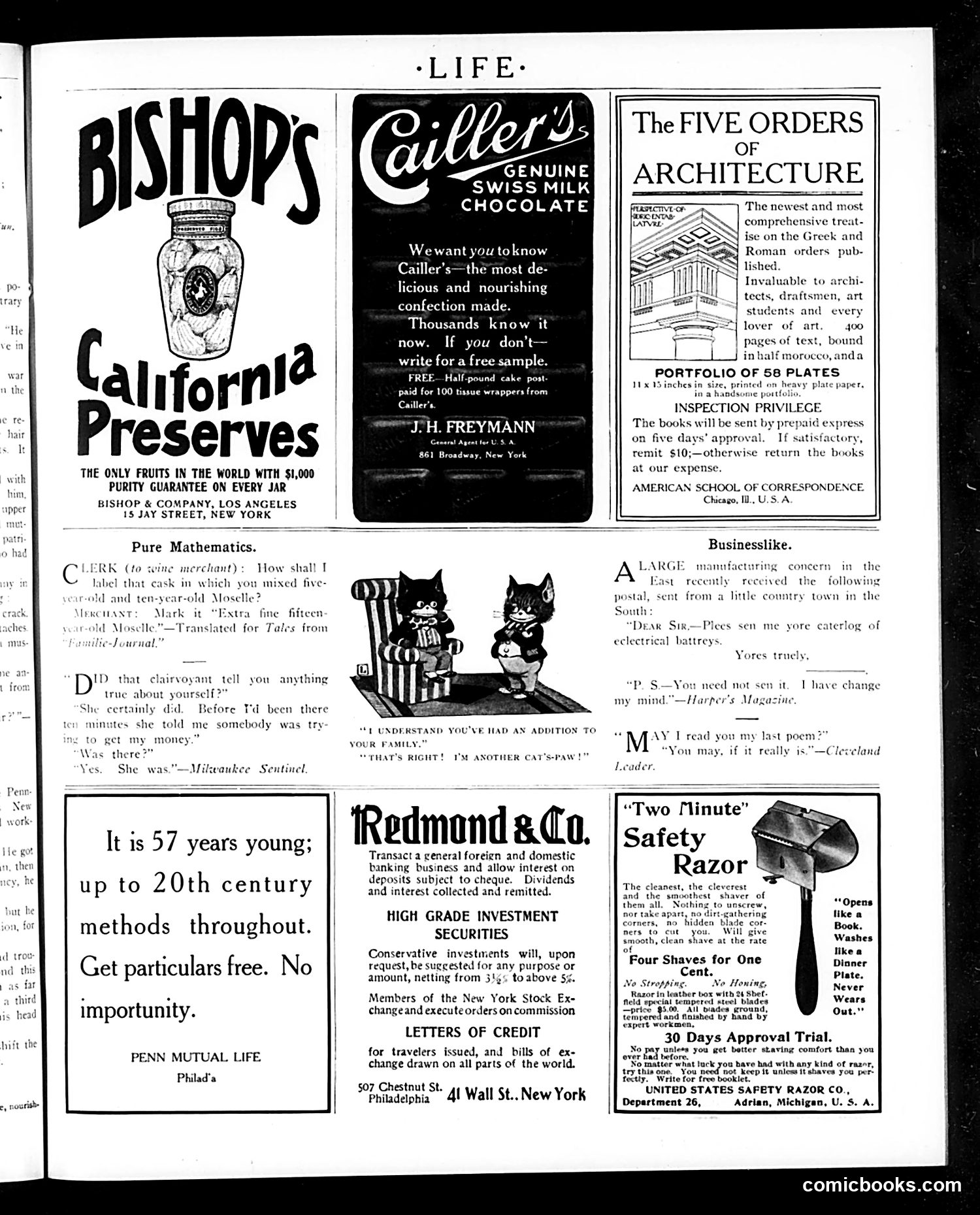
This page is primarily **advertisements and humor fillers** rather than editorial content or political satire. The main cartoon shows two anthropomorphic cats in striped chairs with the caption: "I UNDERSTAND YOU'VE HAD AN ADDITION TO YOUR FAMILY—THAT'S RIGHT! I'M ANOTHER CAT'S-PAW!" This is a **visual pun**: "cat's-paw" is an idiom meaning someone used as a tool by another, while the cartoon literally depicts cats as family members. The joke relies on wordplay rather than political reference. The page contains typical early-20th-century advertisements (Bishop's Preserves, Cailler's Chocolate, Penn Mutual Life, Redmond & Co. banking) and humor columns with jokes about clerks and business correspondence—generic period humor without specific satirical targets.
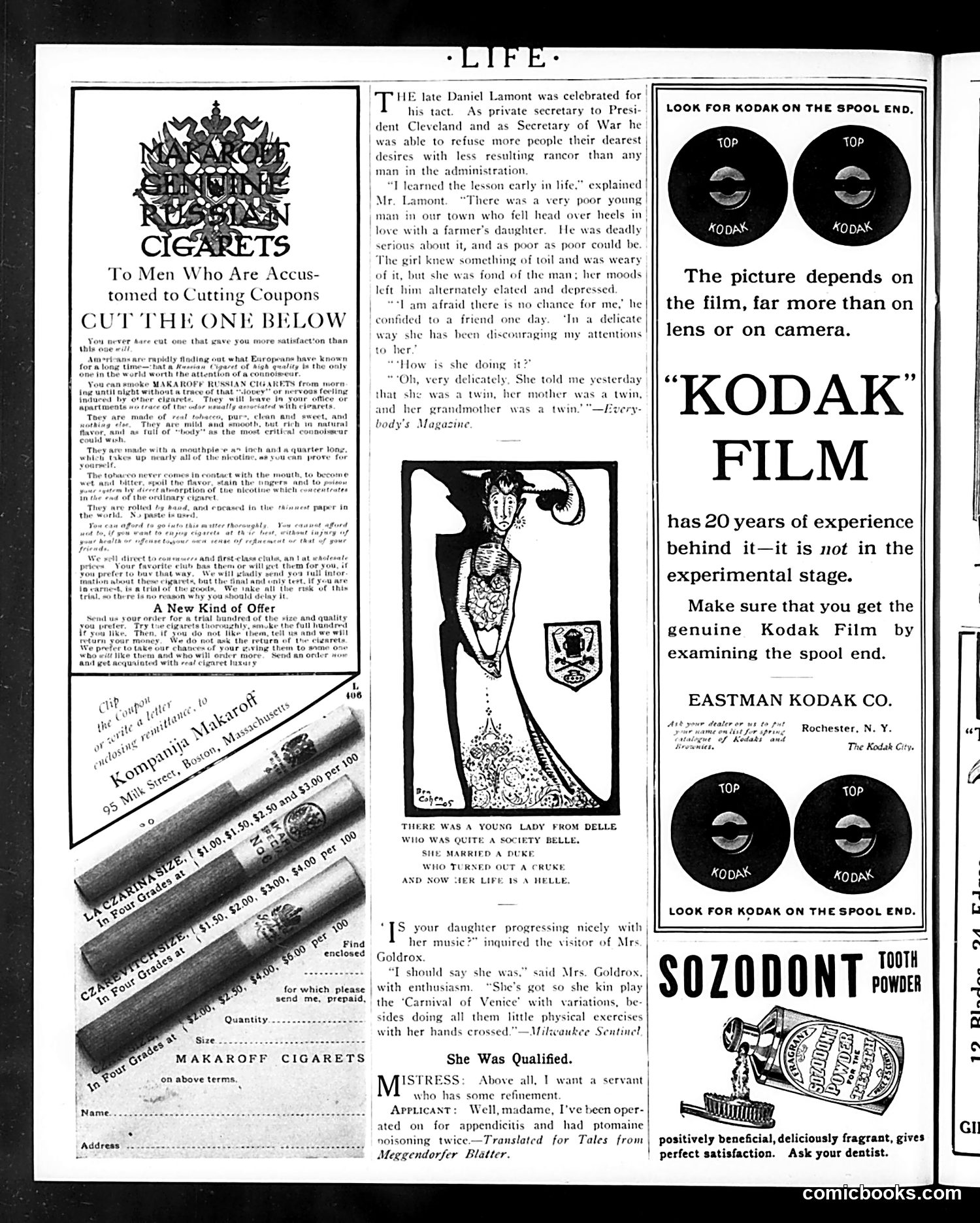
This page contains **humorous anecdotes and advertisements** rather than political cartoons. The main editorial content includes three comedic stories: 1. **Daniel Lamont anecdote**: Celebrates the late Secretary of War's tactful ability to refuse people. The example describes a poor young man rejected by a farmer's daughter who "delicately" discourages him by repeatedly mentioning her family's history of twins—implying genetic concerns about marriage. 2. **Society belle limerick**: A satirical verse about a woman marrying a "duke" who "turned out a cruke" (crook), leaving her life "helle" (hell). 3. **Daughter's musical progress** and **servant qualification** jokes: Light humor about a girl playing "Carnival of Venice" with hand exercises, and a servant applicant qualified by having survived appendicitis and food poisoning. The remaining space features **product advertisements**: Makaroff Cigarettes (offering coupon-cutting incentives), Kodak Film (emphasizing 20 years of experience), and Sozodont Tooth Powder. This is primarily an **advertising-heavy page with filler humor**—typical of early Life magazine's mixed content approach.
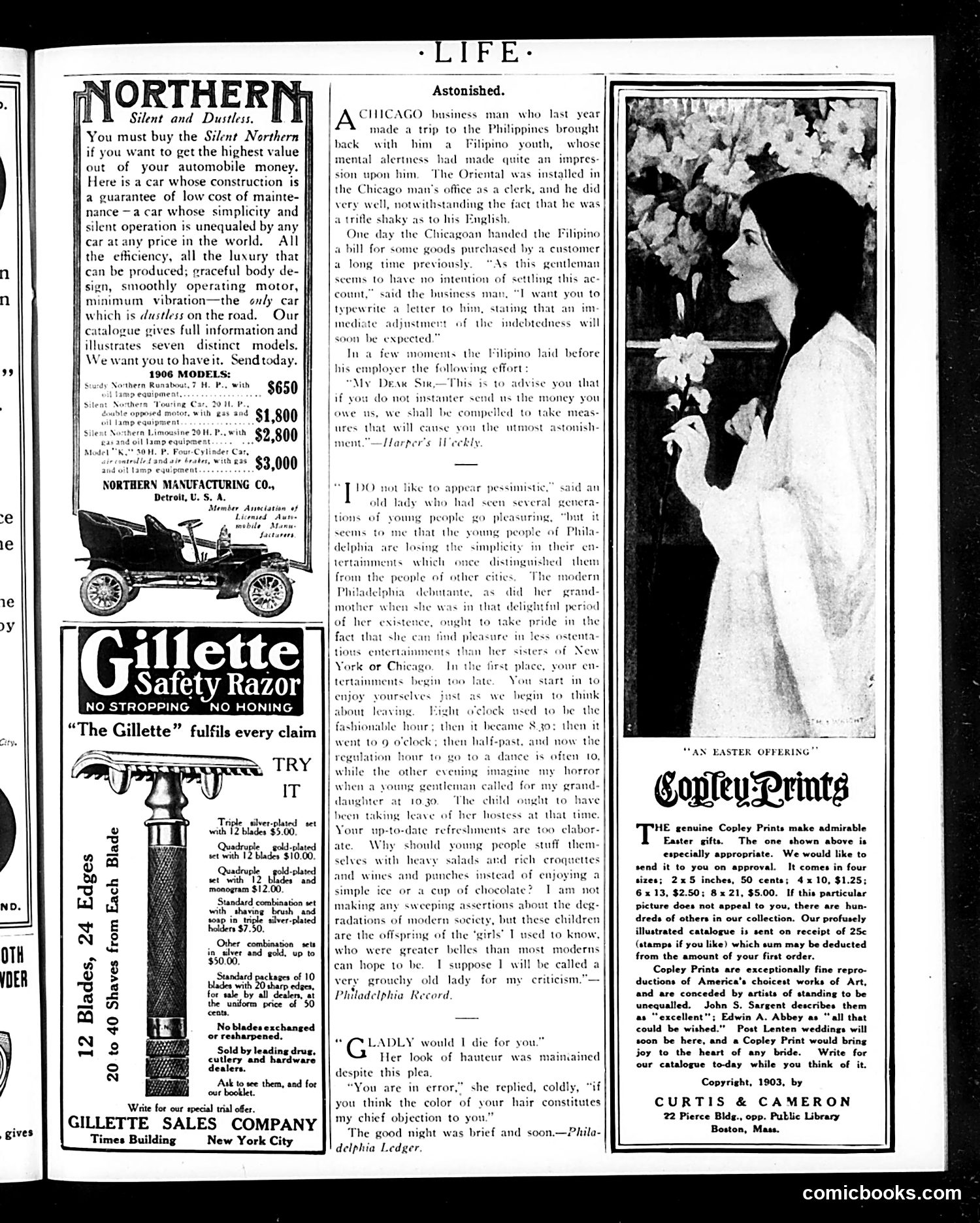
This page is primarily **advertising** rather than political satire. It contains three major advertisements: 1. **Northern Manufacturing Co.** promotes their 1906 automobile models, emphasizing low maintenance costs and silent operation—a common selling point for early automobiles. 2. **Gillette Safety Razor** advertises their "no stropping, no honing" innovation, a significant convenience over straight razors of the era. 3. **Copley Prints** offers art reproductions as Easter gifts. The editorial content includes two brief humorous anecdotes. The first describes a Chicago businessman's Filipino employee who writes an amusingly literal English letter threatening debt collection. The second features an older woman criticizing modern Philadelphia youth for late-night entertainments and heavy refreshments, nostalgically comparing them unfavorably to her generation. Both pieces reflect turn-of-the-century social attitudes: immigration humor and generational anxiety about youth behavior.
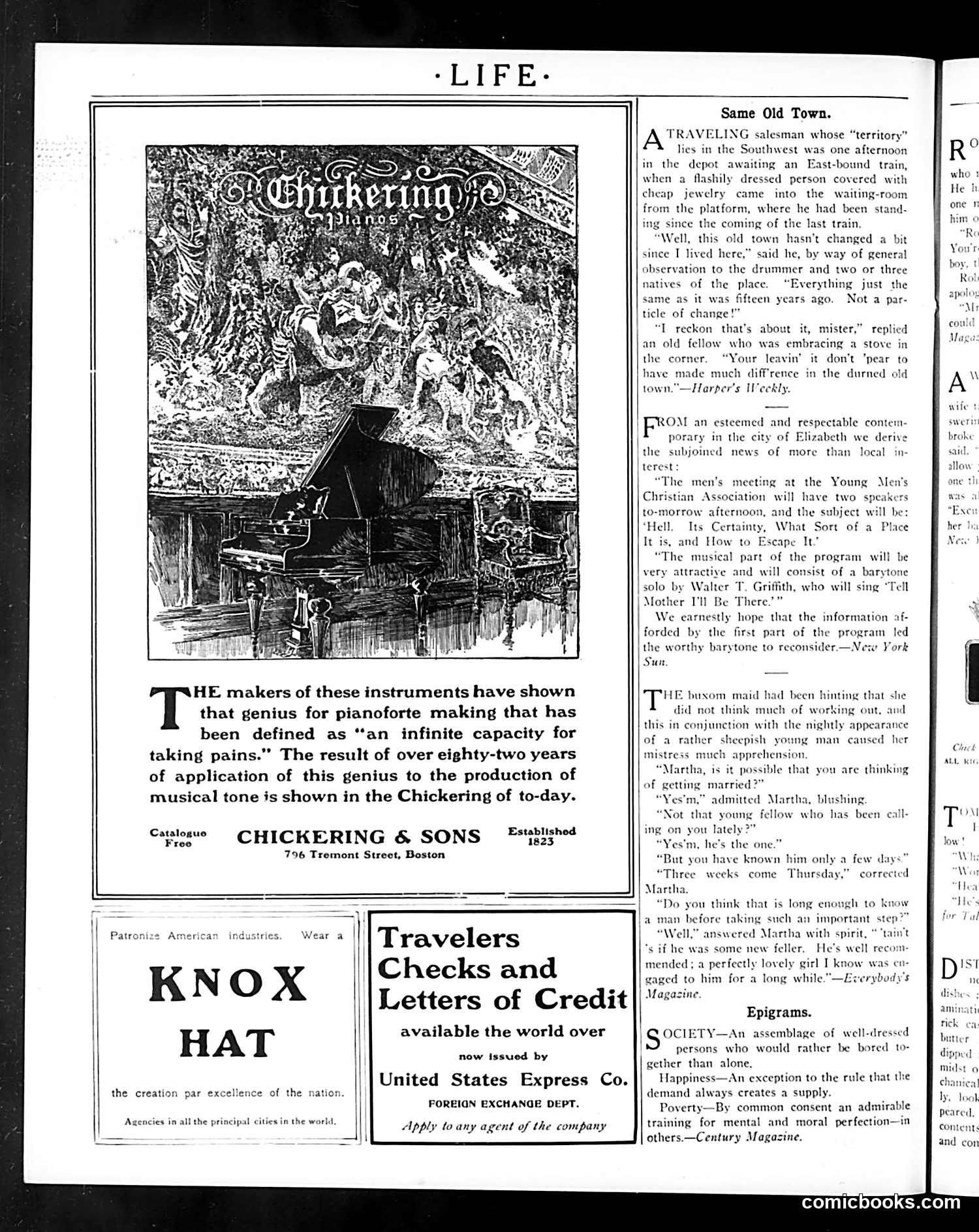
This page contains **three distinct humor pieces** typical of early 20th-century Life magazine: 1. **"Same Old Town"** (main illustrated story): A traveling salesman encounters a flashily-dressed stranger in a train depot who boasts that the town hasn't changed in fifteen years. An old local delivers the punchline: the stranger's *departure* made no difference to the town whatsoever. The satire mocks both the stranger's self-importance and the stagnation of small-town life. 2. **Elizabeth YMCA announcement satire**: Life ridicules a men's meeting advertised to discuss "Hell: Its Certainty" followed by a cheerful baritone solo ("Mother I'll Be There"). The absurdist juxtaposition—pairing damnation rhetoric with sentimental entertainment—exposes the incongruity of the program's emotional whiplash. 3. **Martha's engagement story**: A servant girl's mistress questions whether three weeks' acquaintance is adequate for marriage. Martha's defense—that her fiancé was previously engaged to a friend for "a long while"—reveals naive logic about relationship credibility. All three use working-class or provincial characters' flawed reasoning for comedic effect.
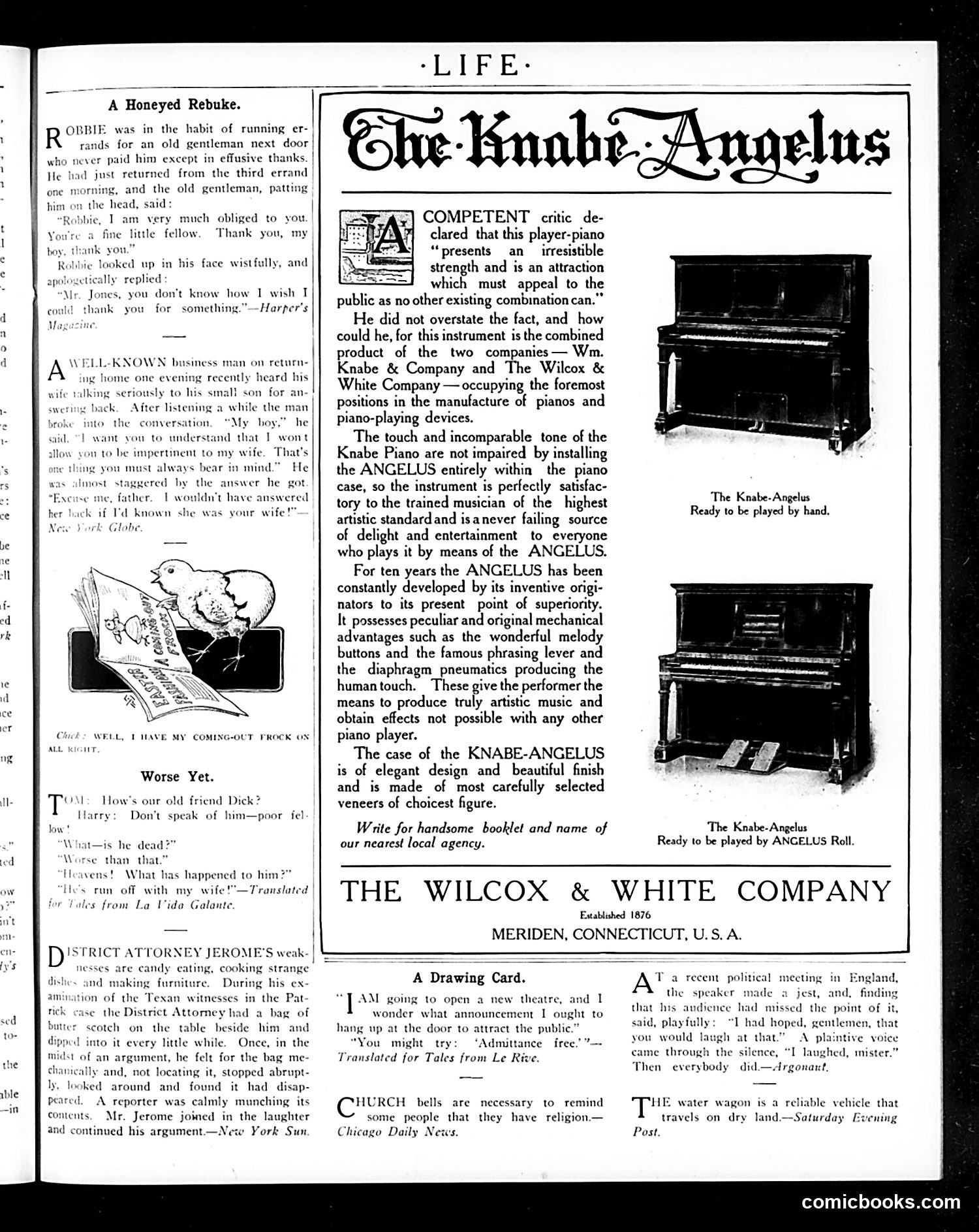
This page contains several short humorous anecdotes typical of early 20th-century American satire: **"A Honeyed Rebuke"** mocks empty gratitude—a boy repeatedly runs errands for an old gentleman who offers only effusive thanks. When finally thanked profusely, the boy wistfully replies he wishes the man would thank him *with money* instead. **"Worse Yet"** presents a domestic joke: a man warns his son never to be impertinent to his wife. When the boy later runs away with the man's own wife, the father's hypocrisy becomes the punchline. **District Attorney Jerome reference** appears to be a genuine anecdote about New York DA Jerome's quirky habit of eating candy during court proceedings—presented as charming eccentricity rather than criticism. The page is primarily **advertising** for the Knabe-Angelus player piano, emphasizing its mechanical sophistication and artistic legitimacy. Brief additional jokes mock theater admission ("charge nothing to draw crowds") and religion ("church bells remind forgetful believers").
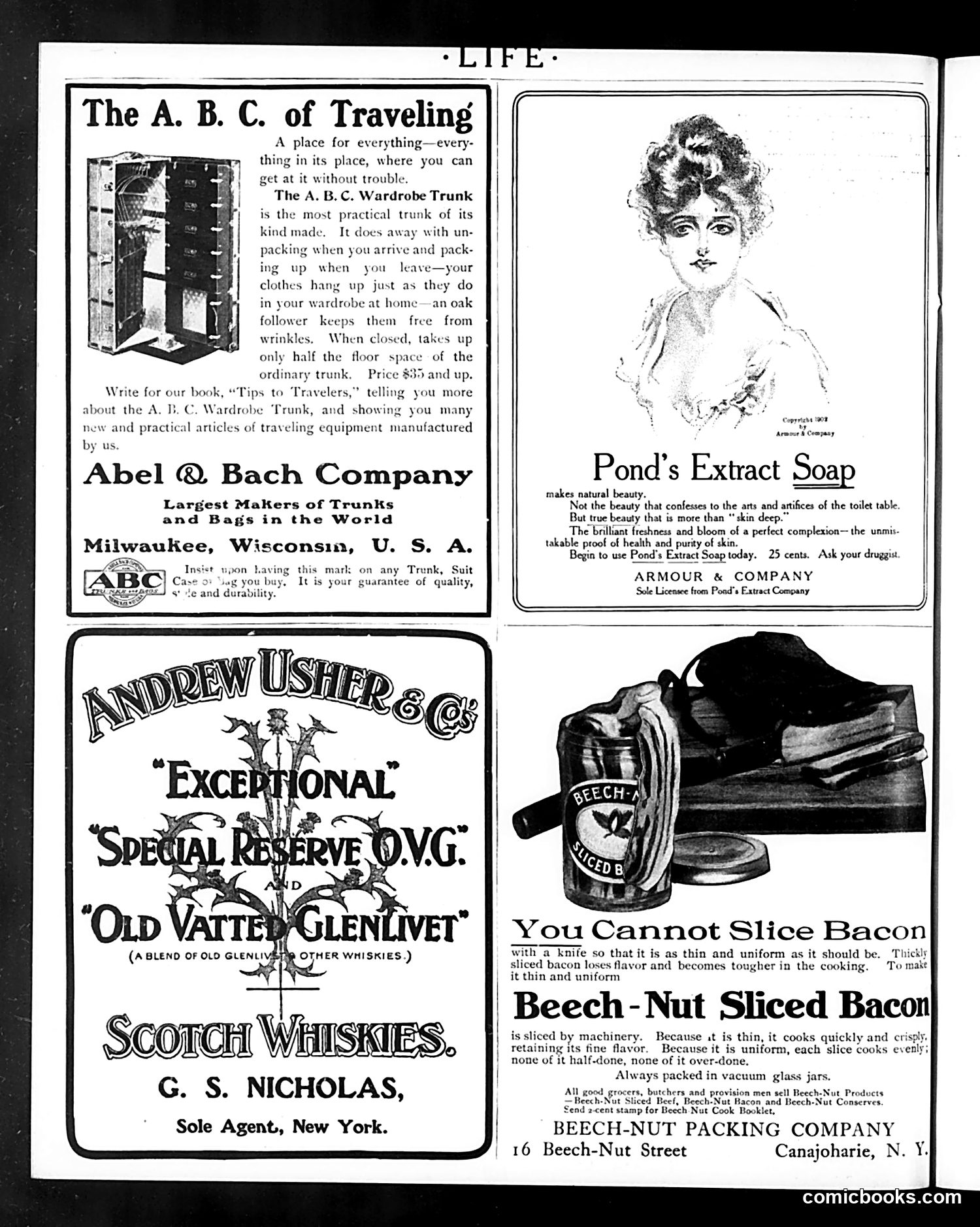
This page consists entirely of **advertisements**, not editorial content or satire. It contains four product promotions typical of early 20th-century magazines: 1. **A.B.C. Wardrobe Trunk** - A traveling trunk designed to hold clothes that hang vertically, eliminating unpacking hassles for travelers. Priced at $35+. 2. **Pond's Extract Soap** - A beauty product claiming to produce natural complexion improvements through health and purity rather than cosmetic artifice. Cost: 25 cents. 3. **Andrew Usher & Co. Scotch Whiskies** - Premium imported spirits including "Old Vatted Glenlivet." 4. **Beech-Nut Sliced Bacon** - Machine-sliced bacon marketed for uniform cooking quality, vacuum-packed in glass jars. The page reflects early 1900s consumer culture targeting middle-class travelers and home cooks. There is no political satire, no caricatures, and no jokes—merely straightforward product marketing using period typography and illustration styles.
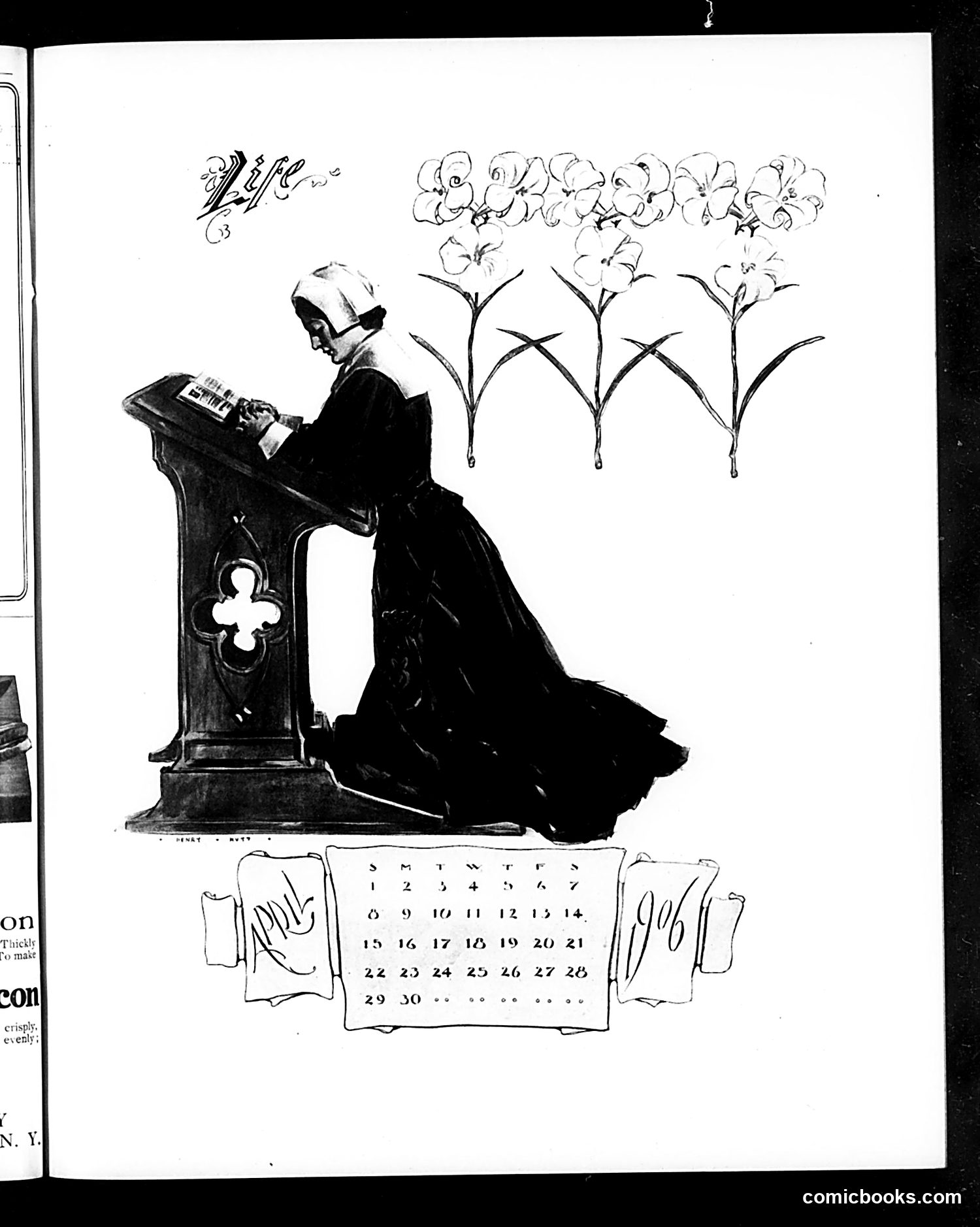
This appears to be a calendar page (likely for a specific month) from *Life* magazine. The illustration shows a figure in ornate religious or formal dress kneeling in prayer or devotion before an elaborate Gothic-style lectern or pulpit decorated with a cross. Above the calendar are decorative floral illustrations—clusters of small blossoms on stems. The satirical intent is unclear from the image alone. The religious iconography and the figure's posture suggest commentary on religious devotion, piety, or possibly the relationship between faith and contemporary society. However, without identifying the specific month/year or understanding the broader magazine context, the particular target of satire cannot be determined with certainty. The OCR text is largely illegible, preventing fuller analysis of the page's intended meaning.
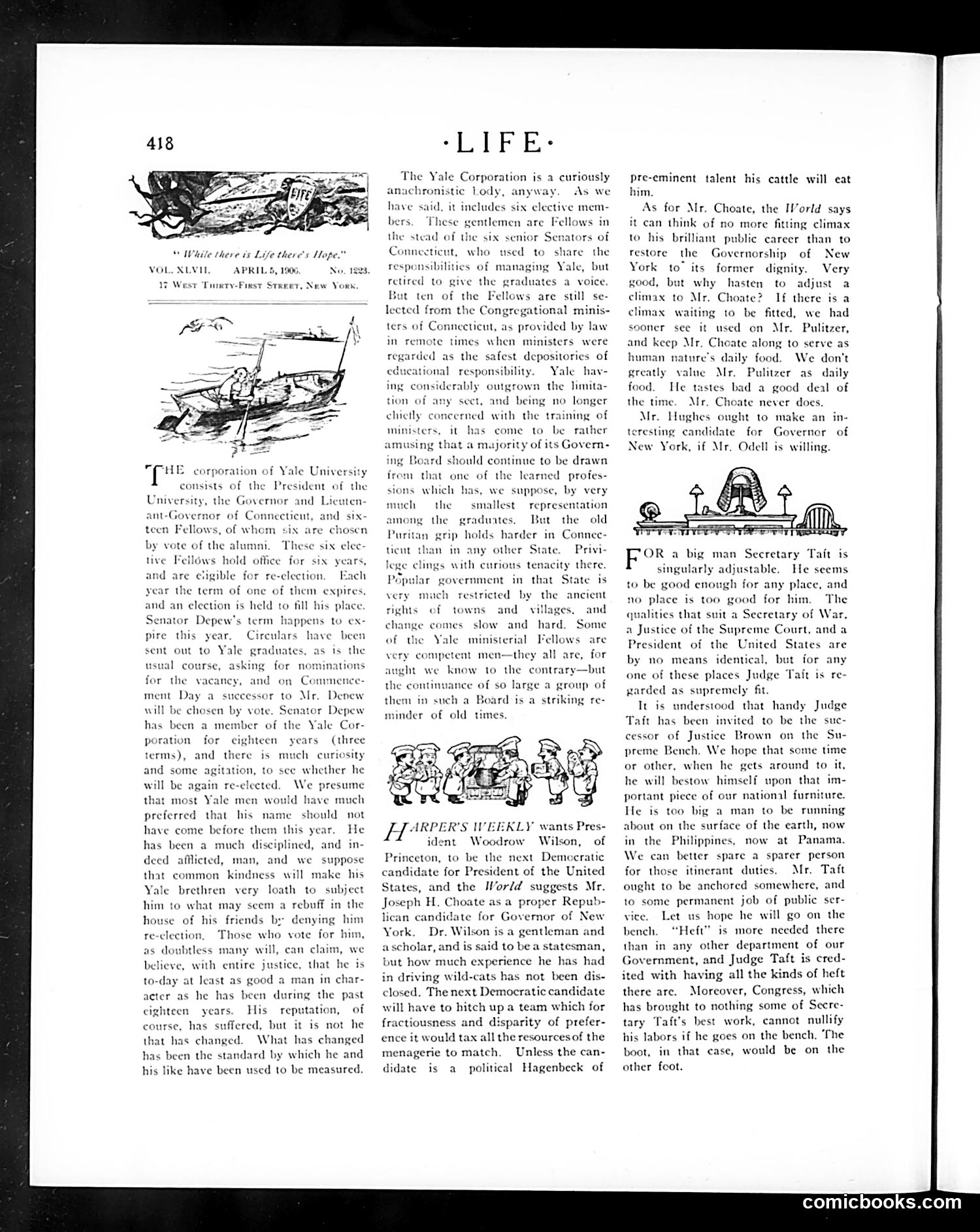
This 1906 *Life* magazine page satirizes Yale University's governance structure and discusses potential presidential candidates. **The Yale Corporation Satire:** The text criticizes Yale's "anachronistic" governing board, which still reserves seats for Congregational ministers—a practice from colonial times when clergy were considered educational trustees. *Life* finds this amusing: Yale has outgrown religious affiliation, yet ministers remain disproportionately represented. The satire targets institutional inertia and outdated privilege. **Senator Depew Issue:** The page addresses whether Senator Chauncey Depew (mentioned in the text) should be re-elected to Yale's board. The implied criticism—that his "reputation has suffered" while "the standard" by which men are judged has changed—suggests Depew faced some scandal or controversy, making his re-election awkward despite decades of service. **Presidential Politics:** The final section jokingly proposes Woodrow Wilson (Princeton president) and Joseph Choate as Democratic and Republican candidates. The "wild-cats" and "menagerie" references mock the difficulty of assembling coherent political platforms from fractious party factions.
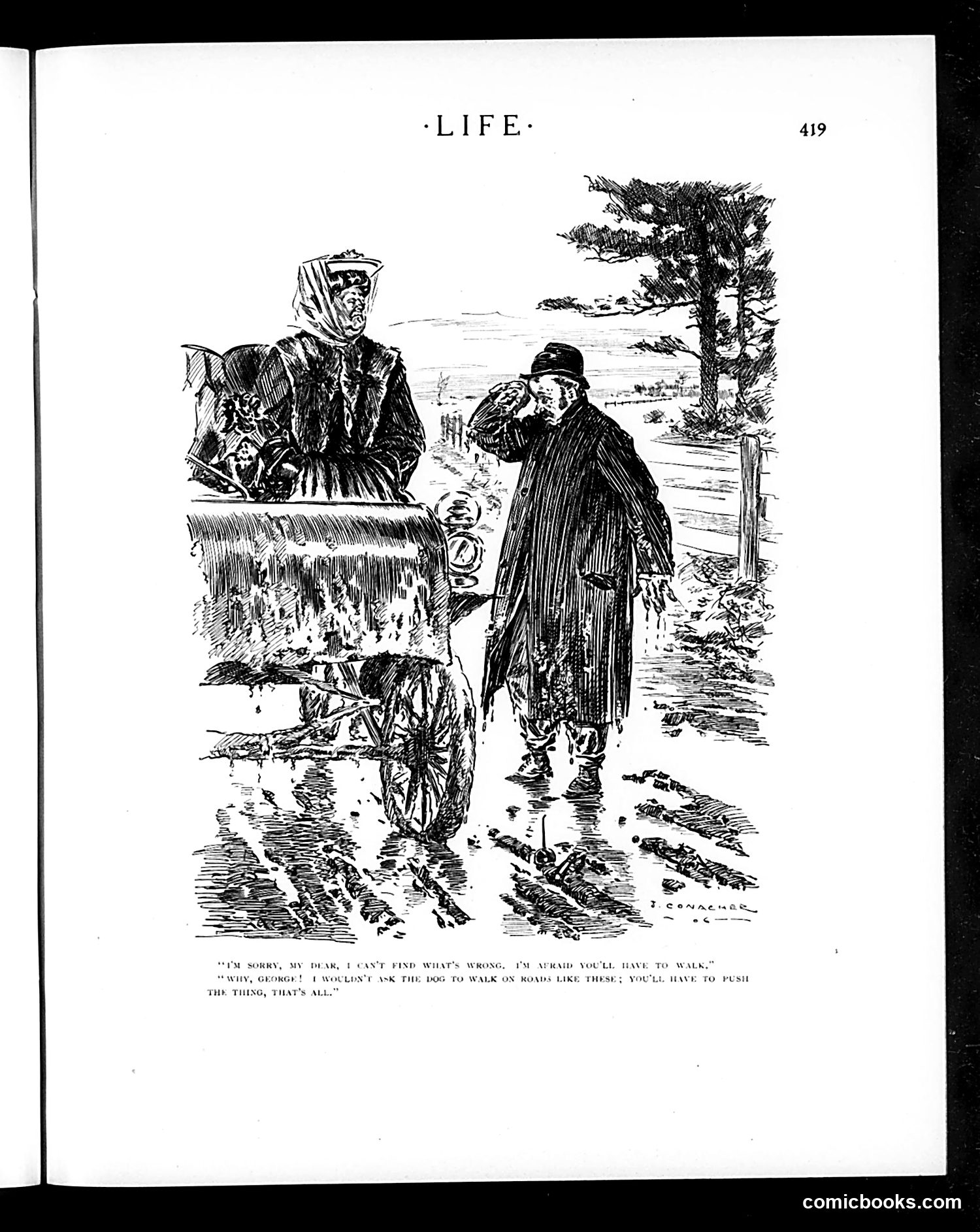
This cartoon satirizes the poor condition of American roads in the early 20th century. A man (George) tells his wife their automobile has broken down and cannot be repaired—she'll have to walk. The wife protests indignantly, pointing out the muddy, rutted road conditions are so terrible she wouldn't even make a dog walk on them. She demands he push the car instead. The satire targets both the unreliability of early automobiles and the abysmal state of American rural/suburban roads, which were largely unpaved dirt tracks prone to mud and deterioration. The joke's bite comes from the wife's logic: if roads are too bad for walking, pushing a heavy car through them is even more absurd—yet that's what he must do.
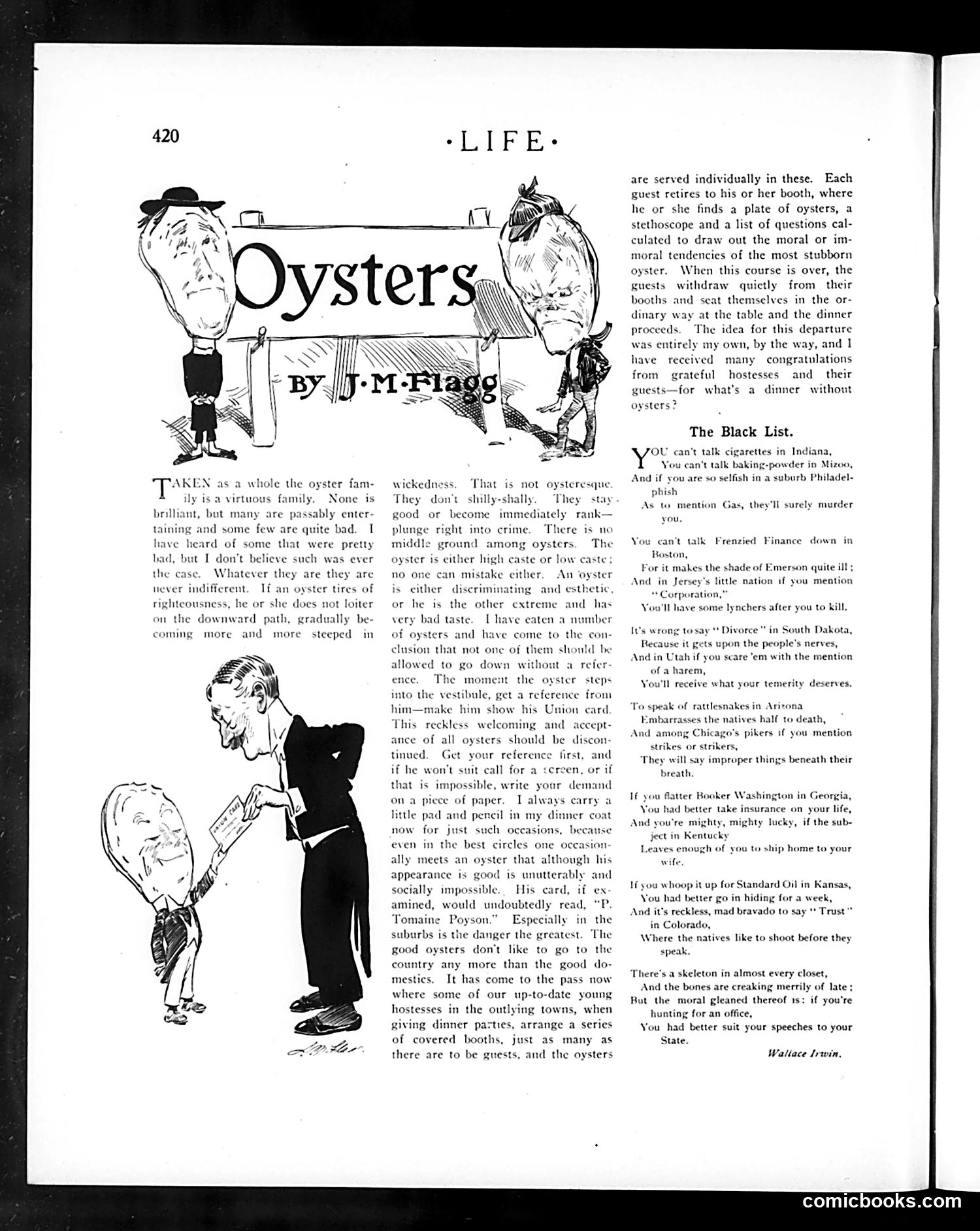
This article satirizes American social pretension and regional hypersensitivity around 1910. The main piece uses oysters as an extended metaphor for people, mocking the snobbish practice of requiring "references" before accepting dinner guests—suggesting some people are socially "criminal" or unsuitable. The absurdist humor imagines hostesses giving oysters moral examinations in private booths. "The Black List" poem that follows is the satirical payoff: it mocks how different American regions are offended by mention of different topics. Indiana won't discuss cigarettes, Boston defends Emerson from criticism, Jersey reacts violently to "corporation," Utah to polygamy, Arizona to rattlesnakes, Georgia to Booker Washington, Kansas to Standard Oil. The joke targets regional touchiness and provincial anxieties—suggesting Americans are hypersensitive about local economic, political, and social issues specific to their areas.
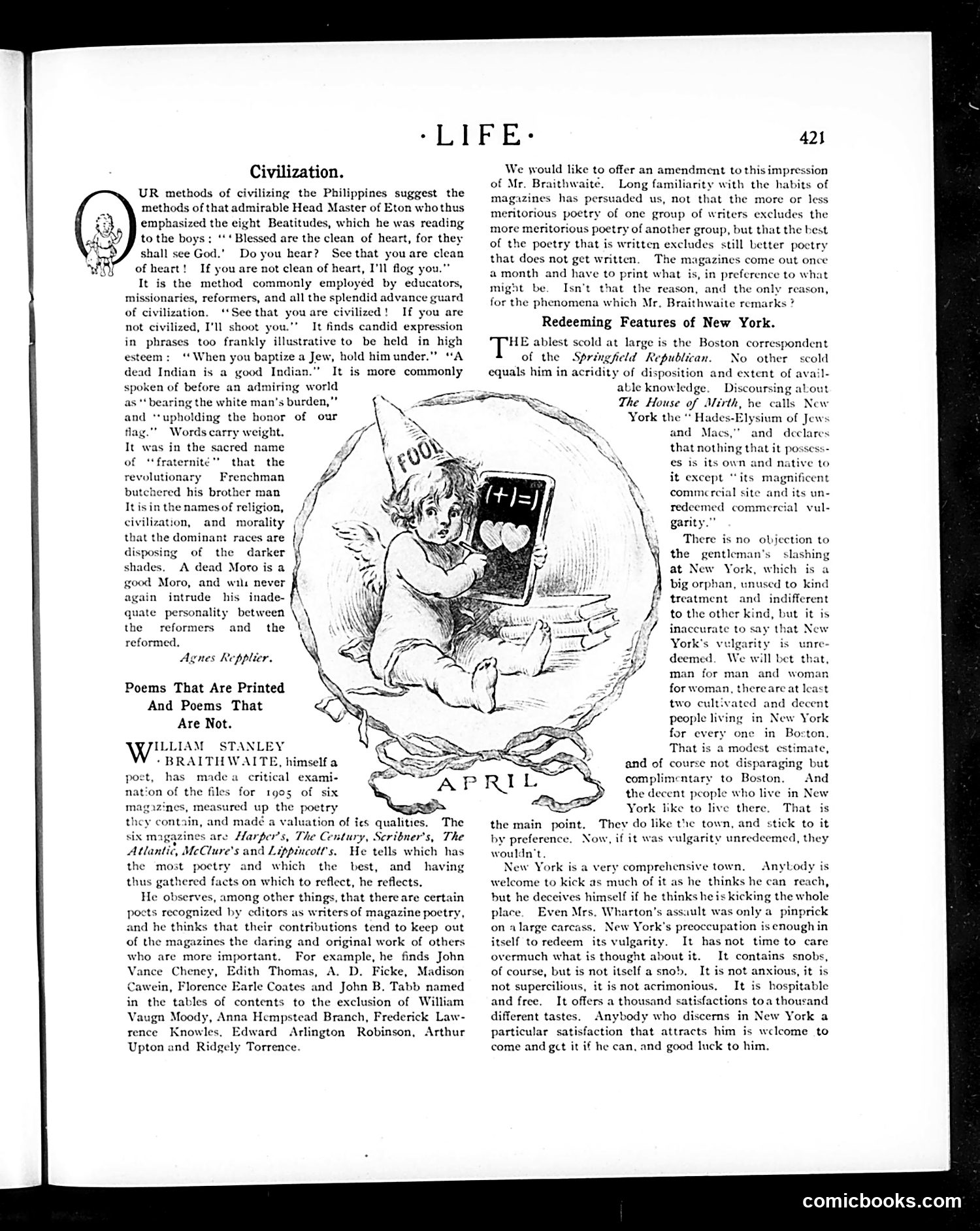
**"Civilization" Essay:** Agnes Repplier satirizes Western imperial methods, particularly America's approach to the Philippines. She mocks the hypocrisy of "civilizing" non-Christian peoples through coercion—claiming to impose Christian morality ("Blessed are the clean of heart") while employing violence ("I'll flog you"). The essay references brutal colonial attitudes ("A dead Indian is a good Indian," "When you baptize a Jew, hold him under") and critiques how euphemisms like "the white man's burden" mask violence as noble duty. **"Poems That Are Printed":** Braithwaite critiques magazine editors for repeatedly publishing established poets (Cheney, Cawein, Coates) while excluding more important, original writers (Robinson, Moody, Torrence). Life's editorial response argues the real problem isn't editorial bias but practical constraints—magazines must print what exists monthly, not ideal work that remains unwritten. **"Redeeming Features of New York":** A Boston critic dismisses New York as culturally derivative, calling it the "Hades-Elysium of Jews and Maes" with only commercial merit. Life defends New York's actual merits against this regional snobbery.
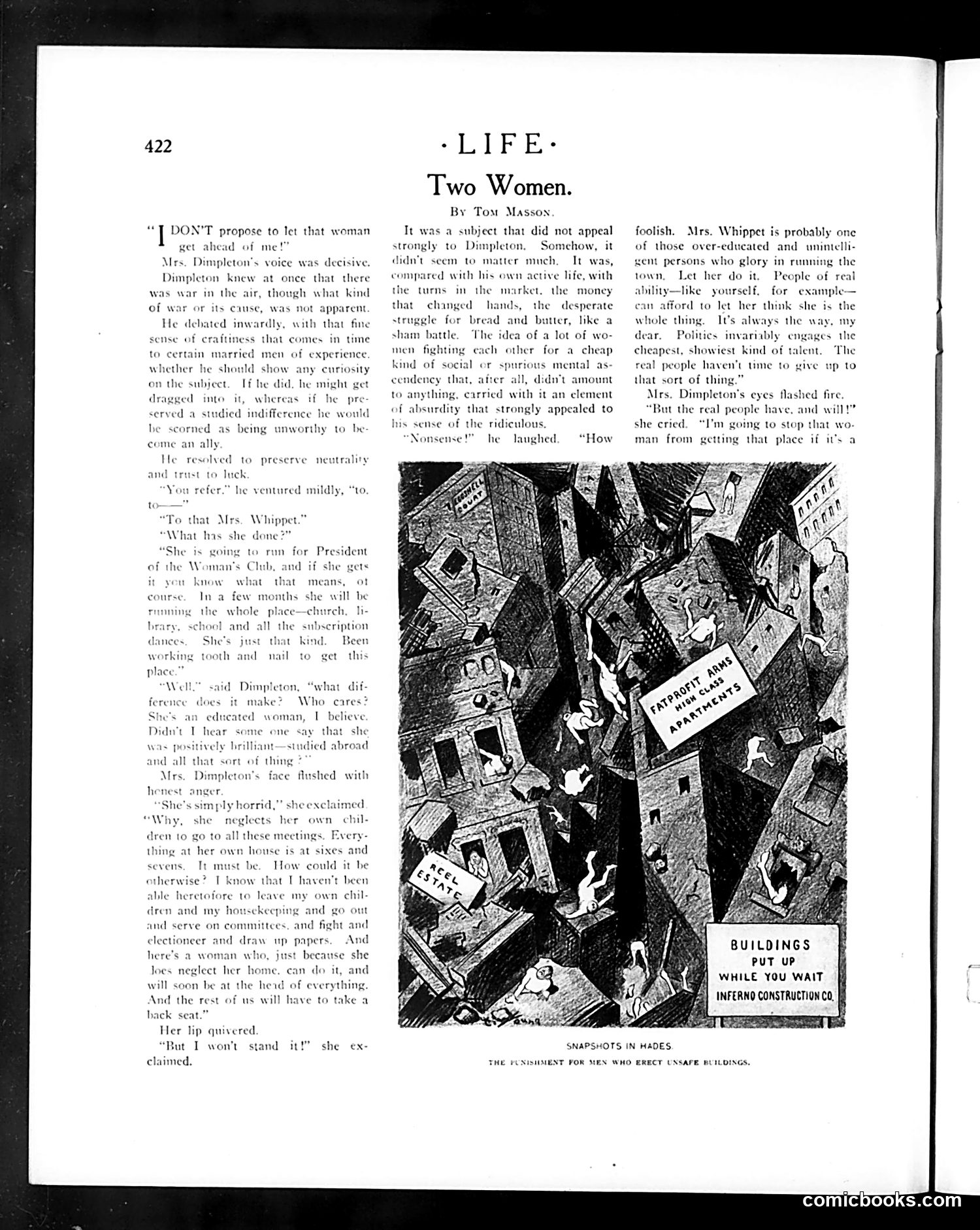
This satirical piece critiques women's emerging political activism in the early 20th century through the conflict between Mrs. Dimpleton and her rival, Mrs. Whippet. **The Setup:** Mrs. Dimpleton opposes Mrs. Whippet's candidacy for President of the Woman's Club. Whippet, an educated woman who studied abroad, neglects her household duties to pursue civic engagement—committees, campaigning, public work. **The Satire's Target:** The piece mocks *both* women. Mrs. Dimpleton resents Whippet's public ambition while admitting she herself cannot leave housekeeping to participate. Meanwhile, her husband dismisses women's political involvement as trivial vanity compared to "real" (male) business and market concerns. **The Point:** The satire exposes the contradiction: women are expected to prioritize domestic duties, yet simultaneously criticized as frivolous when they do engage politically. The husband's condescension—treating women's civic participation as harmless ego-stroking—undercuts the legitimacy of their ambitions. The accompanying illustration showing hellish urban chaos appears unrelated to the main text.
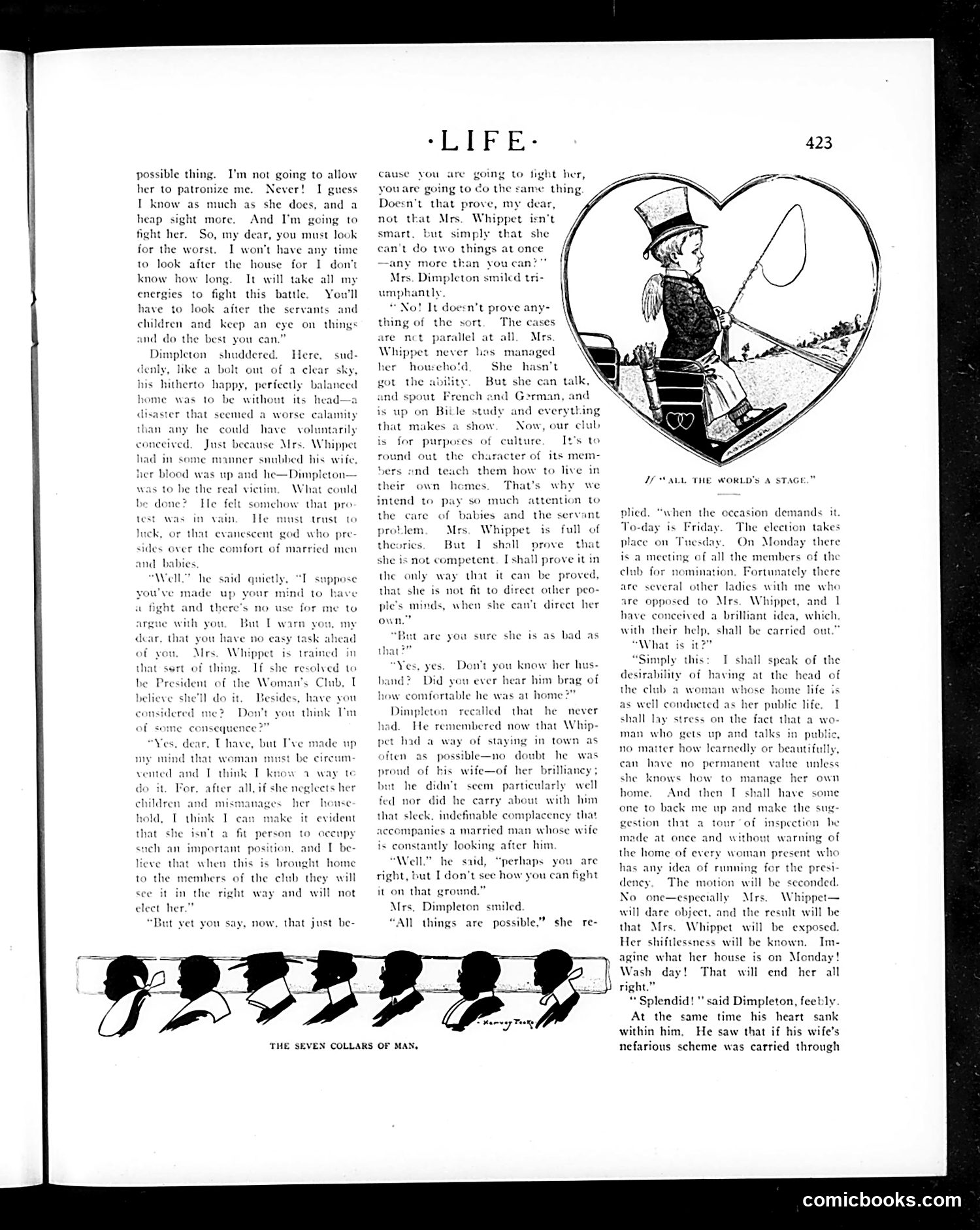
This page satirizes domestic power dynamics and women's ambition. The main narrative concerns Mr. and Mrs. Dimpleton: Mrs. Dimpleton intends to defeat Mrs. Whippet in a Women's Club election by exposing her incompetence at home management. The irony—which Mrs. Dimpleton herself articulates—is that fighting Mrs. Whippet will require her to neglect her own household duties, thereby proving the very point she wants to make: that women cannot manage multiple responsibilities simultaneously. The accompanying illustration titled "The Seven Collars of Man" (lower left) appears to show silhouettes of men's heads/collars in profile, likely satirizing male attitudes or social hierarchy, though its specific reference is unclear from this page alone. The satire critiques how women's domestic obligations constrain their public participation, while simultaneously mocking female social climbing through club politics.
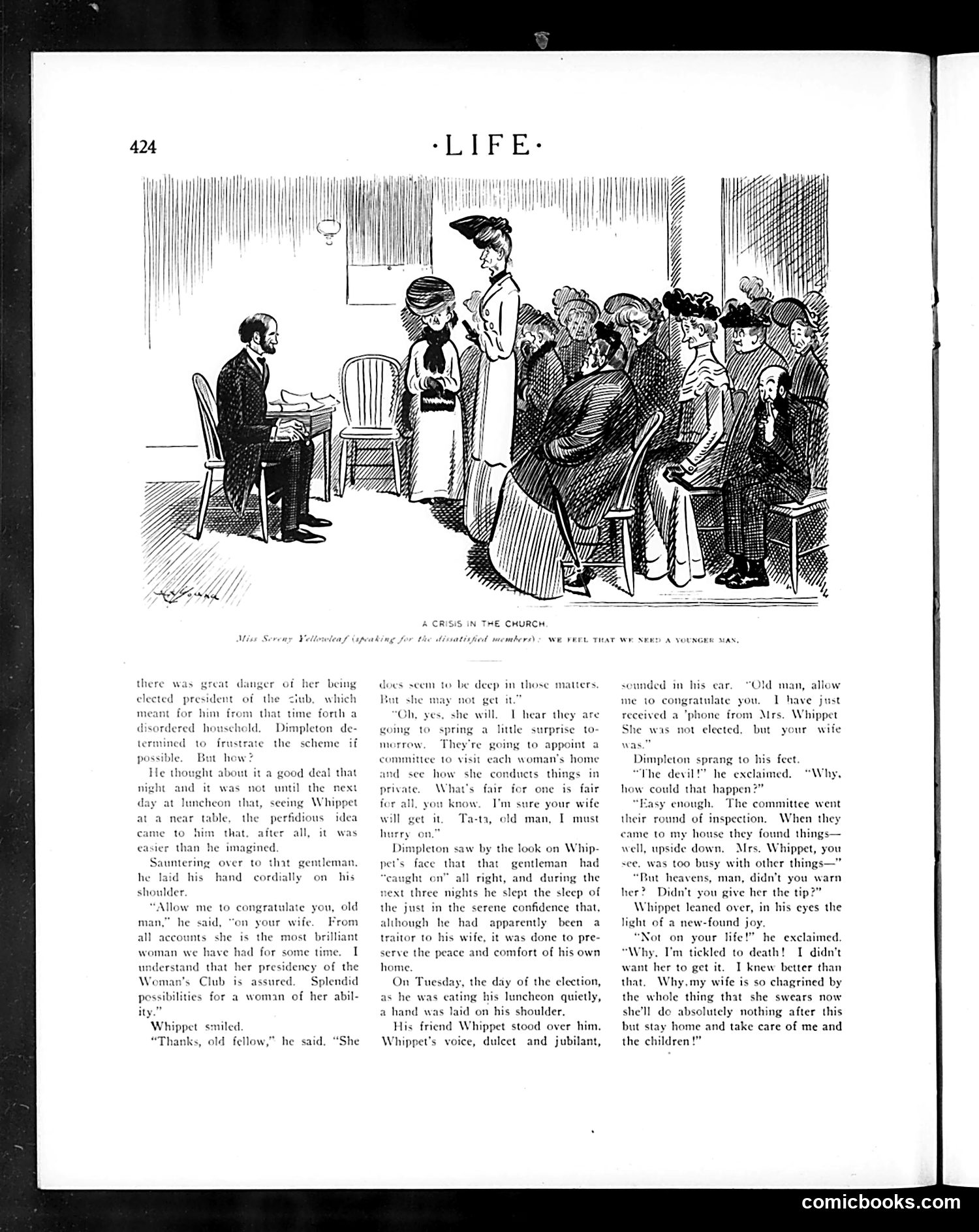
This cartoon satirizes the emerging women's suffrage/club leadership movement. The scene depicts a church women's club election where Mrs. Whippet is running for president—a position viewed as dangerously ambitious. The satire works through male sabotage and backfiring plans: Dimpleton, worried about a woman president, convinces his friend Whippet to undermine his own wife's candidacy by neglecting household duties, assuming this will disqualify her. Instead, it backfires—Whippet's deliberate domestic chaos actually *helps* Mrs. Whippet's election chances by making other candidates' homes look worse by comparison. The joke's bitter endpoint: Whippet is "tickled to death" because his wife, humiliated by losing, now swears to abandon all activities and stay home—exactly what the men wanted. The cartoon mocks both female ambition and male anxiety about women's independence, while revealing how women's public roles threaten domestic arrangements that men depend upon.
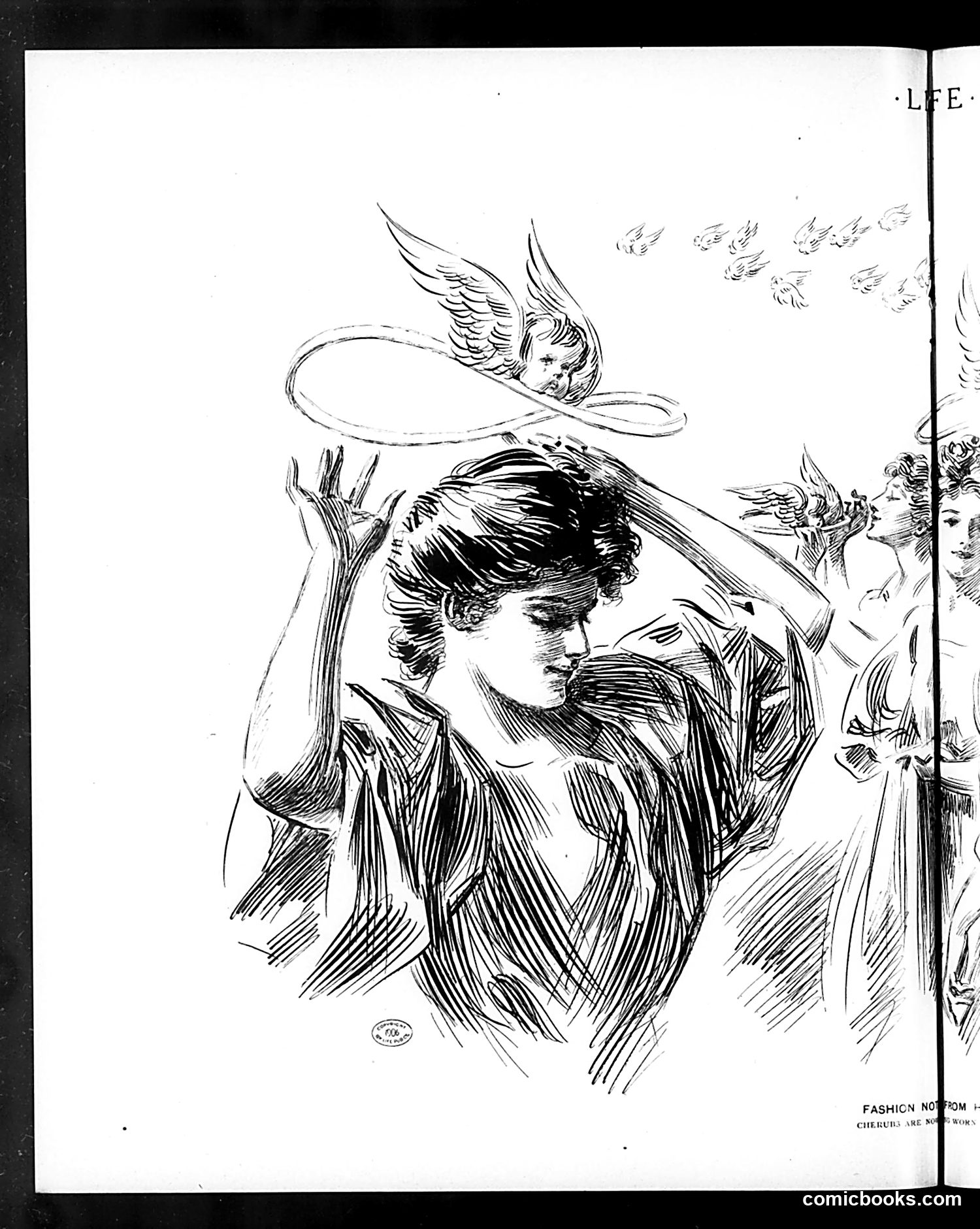
This appears to be a fashion illustration from *Life* magazine rather than a political cartoon. The image shows a elegantly dressed woman in profile, wearing what appears to be early 20th-century attire with detailed cross-hatching technique typical of period illustration. The central figure has her hair up in the fashionable style of the era, with draped fabric around her shoulders. Above her head floats a small winged cherub or cupid figure holding what resembles a halo or circular object—a classical artistic device suggesting virtue or idealization. The right side shows additional figures in lighter sketch form. The caption at bottom references "FASHION" and appears partially cut off. This is primarily a **fashion commentary illustration** rather than satirical content, likely critiquing or celebrating contemporary women's style and presentation.
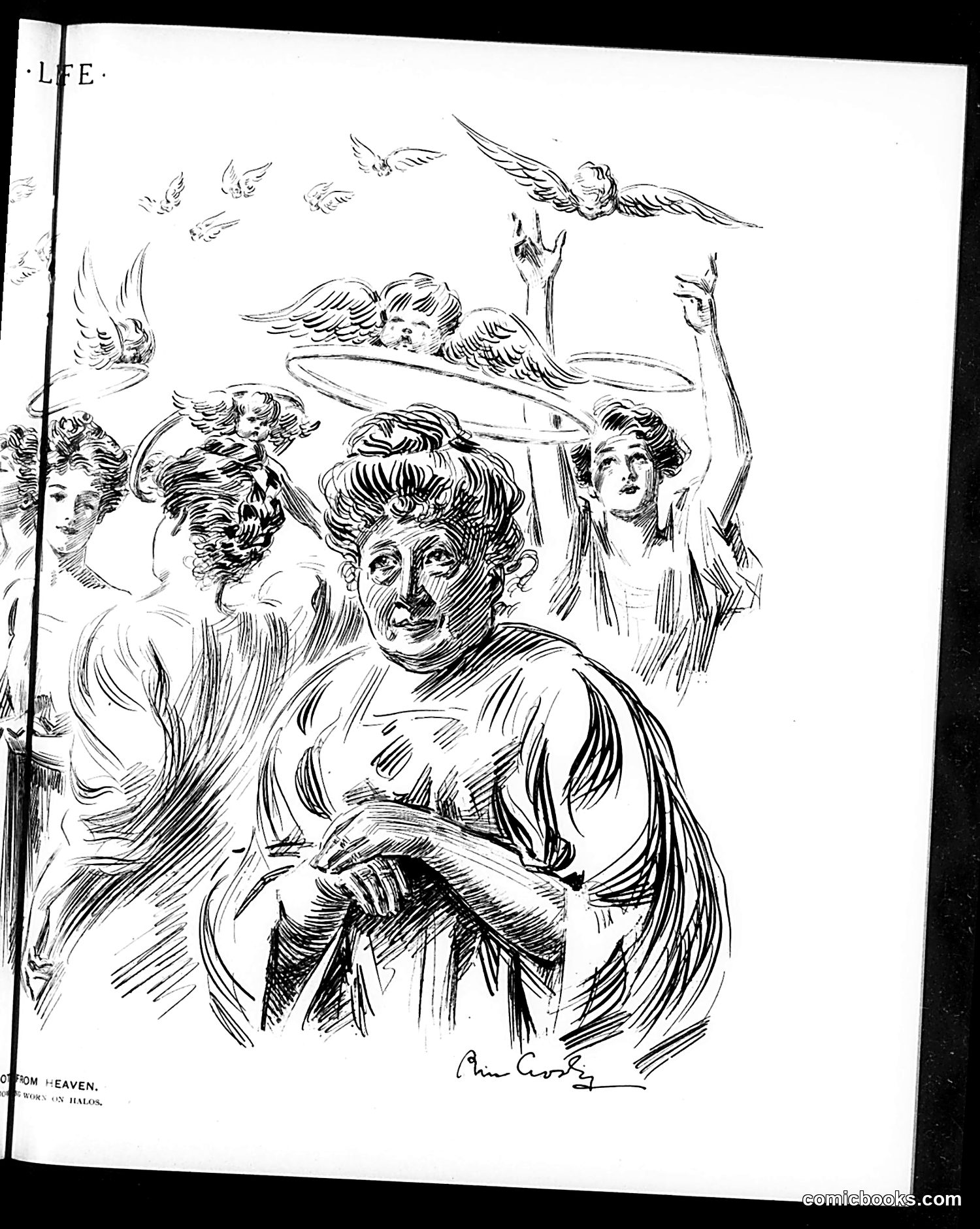
This appears to be a satirical cartoon titled "LIFE" depicting a heavenly or celestial scene. A central mature woman figure is surrounded by cherubs and angelic beings with wings floating above. The composition suggests an idealized or allegorical representation, possibly depicting "Life" as a personified feminine figure ascending or existing in an elevated, spiritual realm. The style and inscription suggest this is likely from the early 20th century. The exact satirical point is unclear from the visible text (which appears partially illegible in the OCR), but the juxtaposition of earthly feminine figures with heavenly cherubs was a common Life magazine trope for commentary on mortality, spirituality, or social ideals. Without clearer text attribution or date information, the specific political or social commentary remains uncertain.
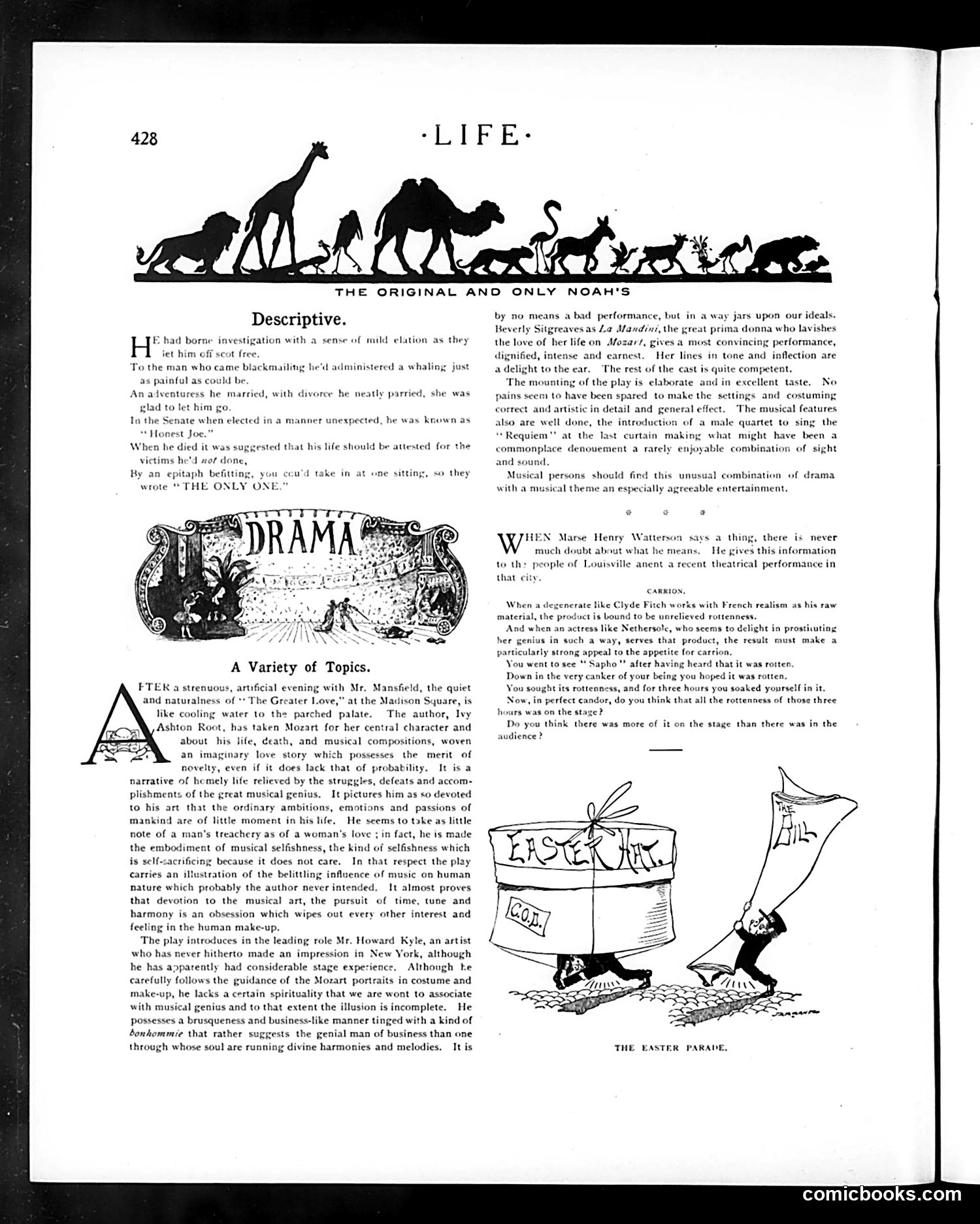
This page from *Life* magazine contains theater reviews rather than political cartoons. The main content discusses two Broadway productions: **"The Greater Love"** - A play about Mozart's life by Ivy Ashton Root, starring Howard Kyle. The reviewer criticizes Kyle's performance as lacking the spiritual depth expected of a musical genius portrayal, though he praises Beverly Sitgreaves' performance as the prima donna "La Mandini." **"Carrion"** - The review references a caustic critique by Henry Watterson (a prominent Kentucky newspaper editor) condemning playwright Clyde Fitch's work as "degenerate" for using "French realism" as source material. This reflects late 19th/early 20th-century American anxiety about European theatrical naturalism as morally corrupting. The illustration labeled "THE EASTER PARADE" appears to be unrelated satirical artwork about fashionable Easter dress. The page reflects period attitudes toward theatrical morality and artistic merit rather than political satire.
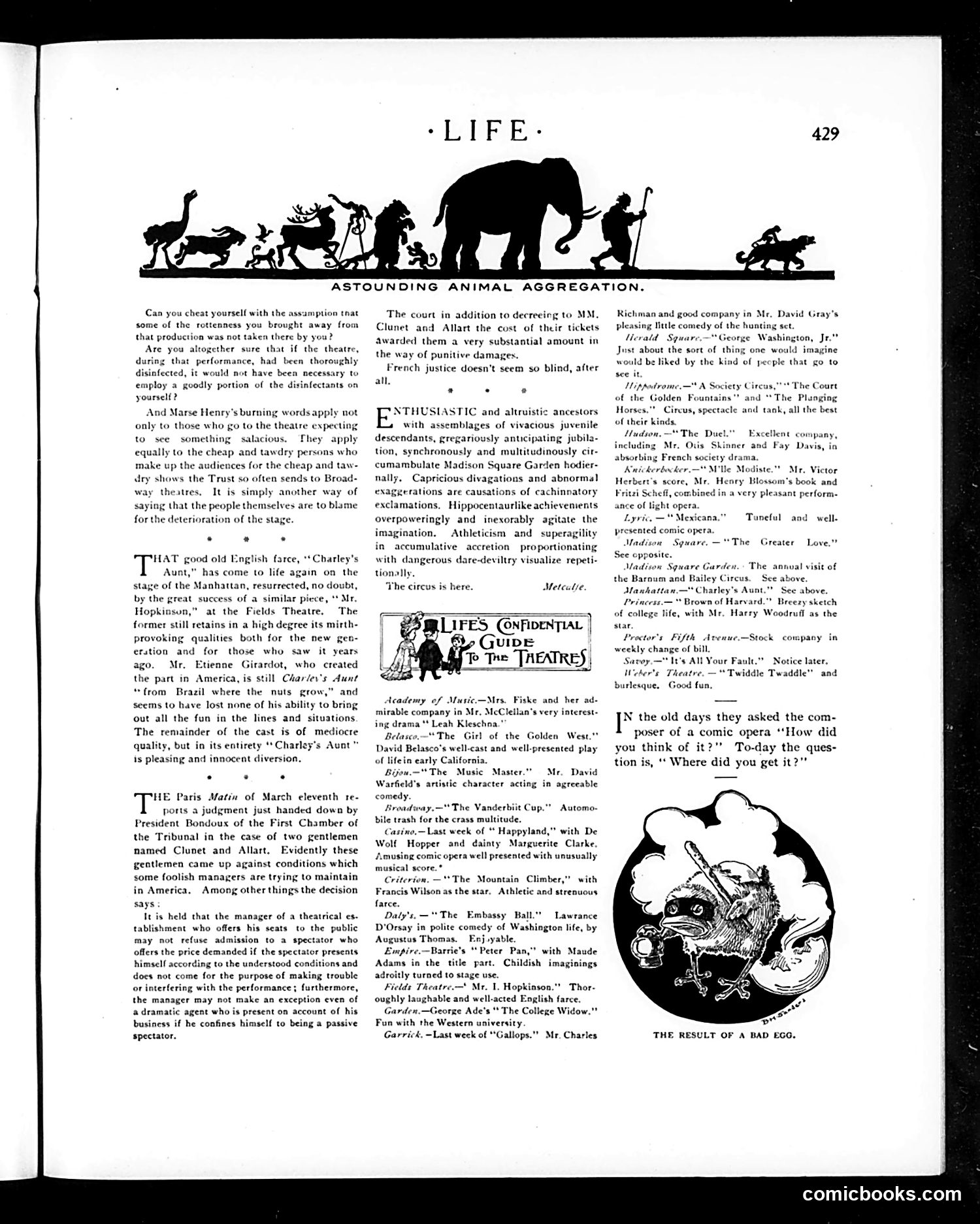
The silhouette at the page's top shows various animals (ostrich, ox, giraffe, horse, elephant, figure with staff) in a procession—a visual metaphor for the circus advertised below ("The circus is here"). The page primarily contains theater criticism. The main satire targets **theater audiences and managers**. Life argues that shabby theater productions exist because audiences *demand* them—people get what they deserve. A referenced French court decision supports this indirectly: it ruled that theater managers cannot arbitrarily deny admission to paying customers, even dramatic agents. The dense, deliberately overwrought prose paragraph about the circus ("Enthusiastic and altruistic ancestors...") appears to be satirical mockery of pretentious theatrical language—mocking how people describe simple spectacles in inflated vocabulary. The page concludes with brief theater reviews of current productions, treating both highbrow drama (Mrs. Fiske) and lowbrow entertainment ("Automobile trash for the crass multitude") with varying degrees of approval.
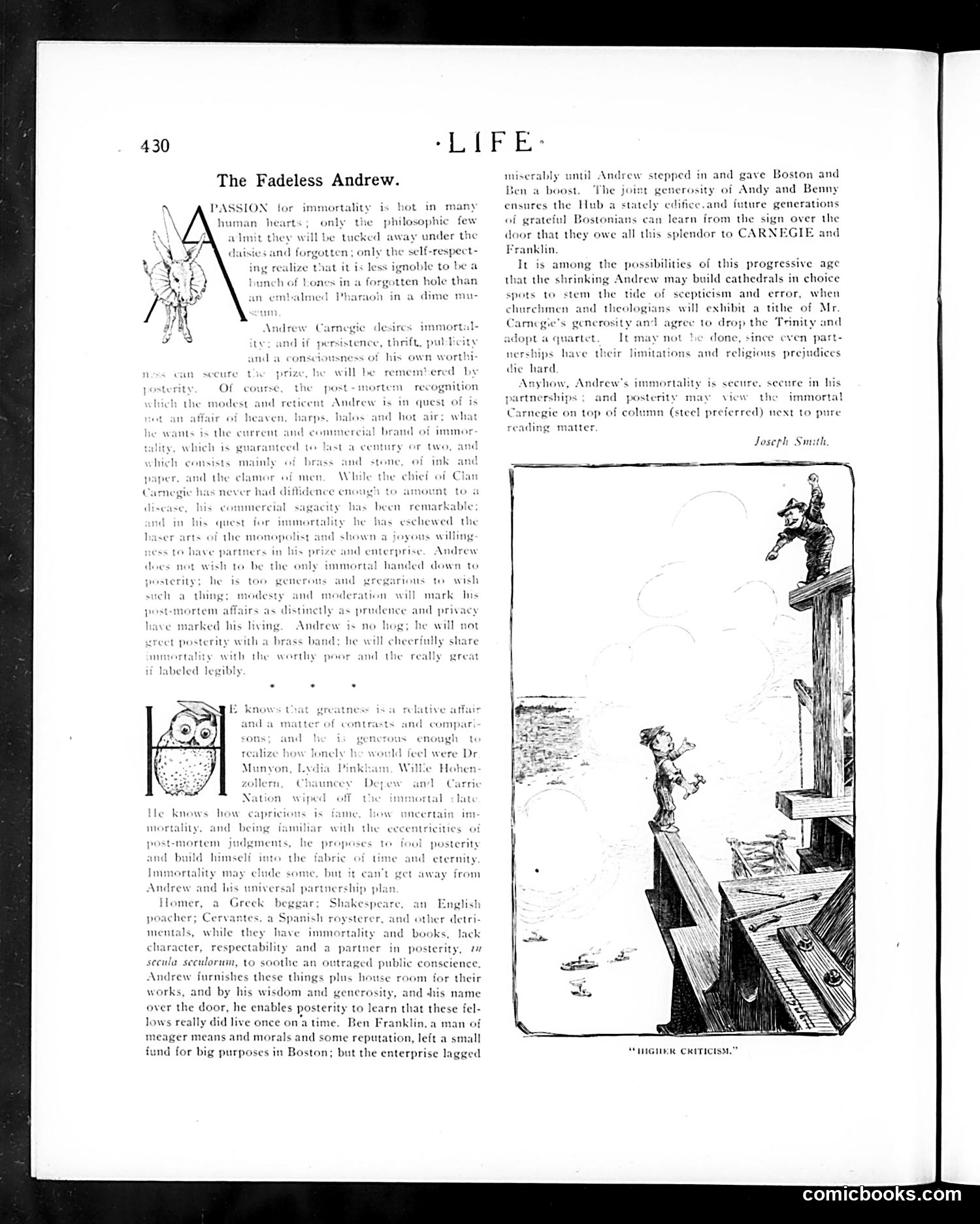
This satirical article mocks Andrew Carnegie's pursuit of immortality through philanthropy. The text criticizes Carnegie for wanting his name permanently attached to his charitable works—specifically libraries and buildings in Boston—as a guarantee of remembrance. The satire targets his vanity: Carnegie is contrasted with truly immortal figures (Homer, Shakespeare) who achieved lasting fame through merit alone, not through "brass bands" or self-promotion. The article suggests Carnegie's generosity, while real, is partly motivated by ego rather than pure altruism. The accompanying cartoon titled "Higher Criticism" (right) depicts figures climbing or perched on a tall structure—likely representing the precarious, elevated position Carnegie seeks through his monuments. The piece reflects Gilded Age anxieties about wealthy industrialists using philanthropy primarily for legacy-building and social control, rather than genuine benevolence.
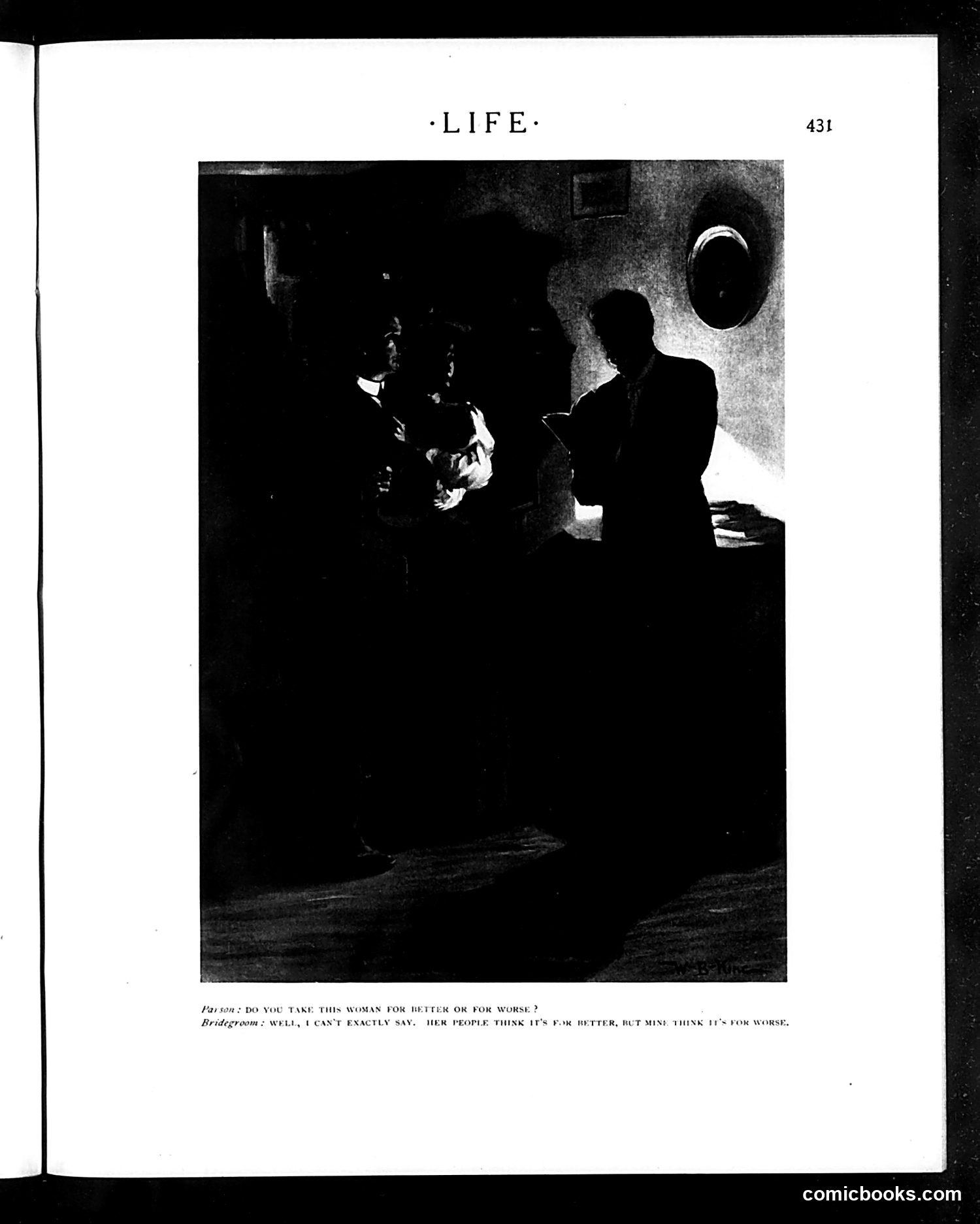
This cartoon depicts a wedding ceremony where the bridegroom's response to the traditional vow reveals class tensions. The parson asks the standard question; the groom admits he cannot decide whether marrying this woman is "for better or for worse" because **her family considers it advantageous, while his own family views it as a social step downward**. The satire targets early 20th-century anxieties about class boundaries and intermarriage. The joke hinges on the groom's honest admission that the marriage represents social mobility *for her* but social decline *for him*—a reversal of typical expectations where a groom "marries up." The cartoon mocks both the pretensions of class-conscious families and the awkwardness of such mismatched unions.
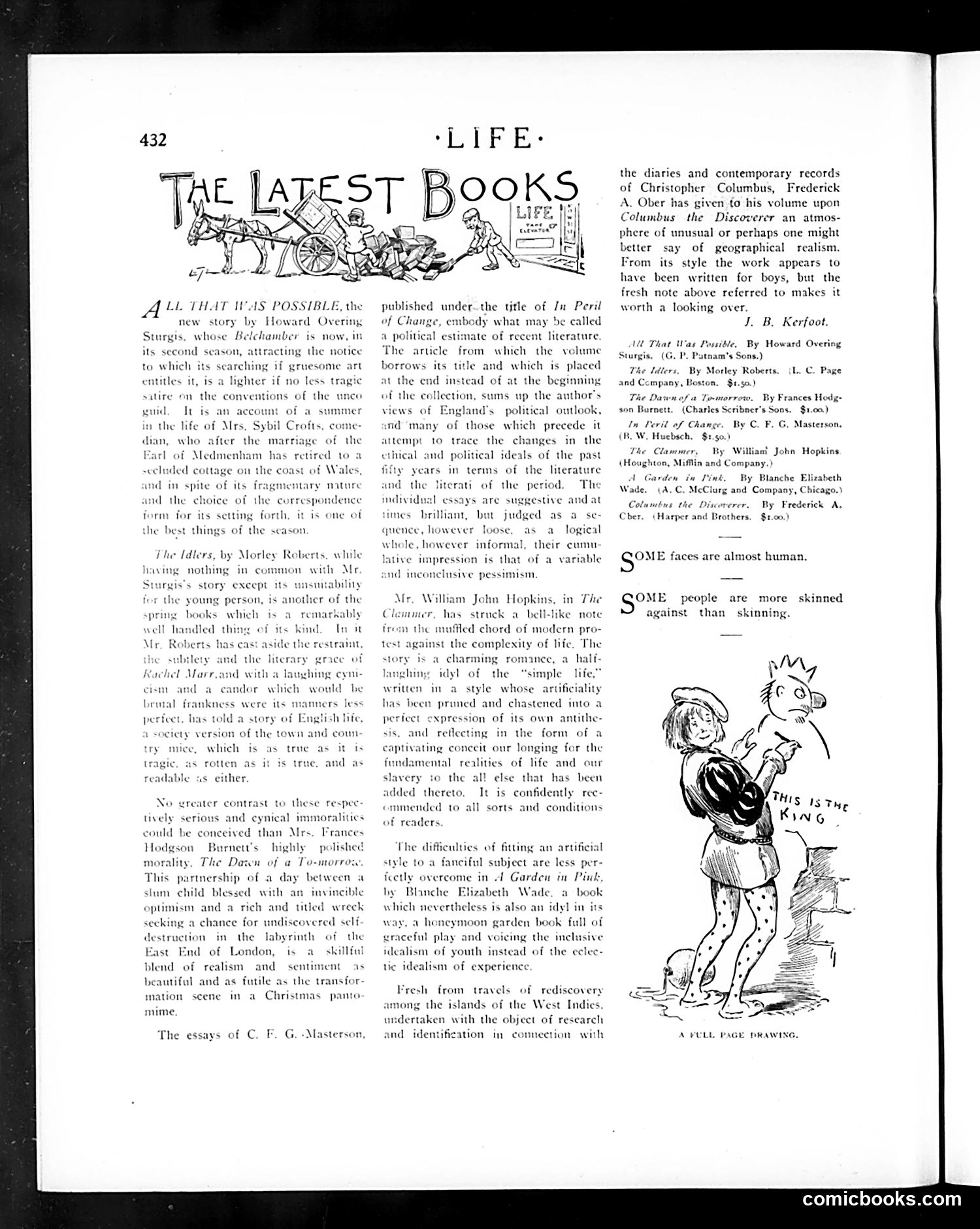
This page reviews contemporary books, with one full-page cartoon illustrating a satirical point. The cartoon depicts a character in Victorian dress addressing what appears to be a child or servant, declaring "THIS IS THE KING"—likely mocking the pretensions or absurd social hierarchies of the era. The book reviews themselves discuss literary works addressing social issues: Mrs. Hodgson Burnett's *The Dawn of To-morrow* contrasts optimistic slum reform with cynical upper-class decay; C.F.G. Masterson's essays trace political ideology through literature; and William John Hopkins's *The Clemmer* celebrates "the simple life" while critiquing modern complexity. The cartoon's point appears to be satirizing either false authority, class pretension, or the arbitrary nature of social status—suggesting someone's self-proclaimed importance is absurd or unjustified. The juxtaposition with earnest literary criticism about social reform creates ironic commentary on Victorian society's actual values.
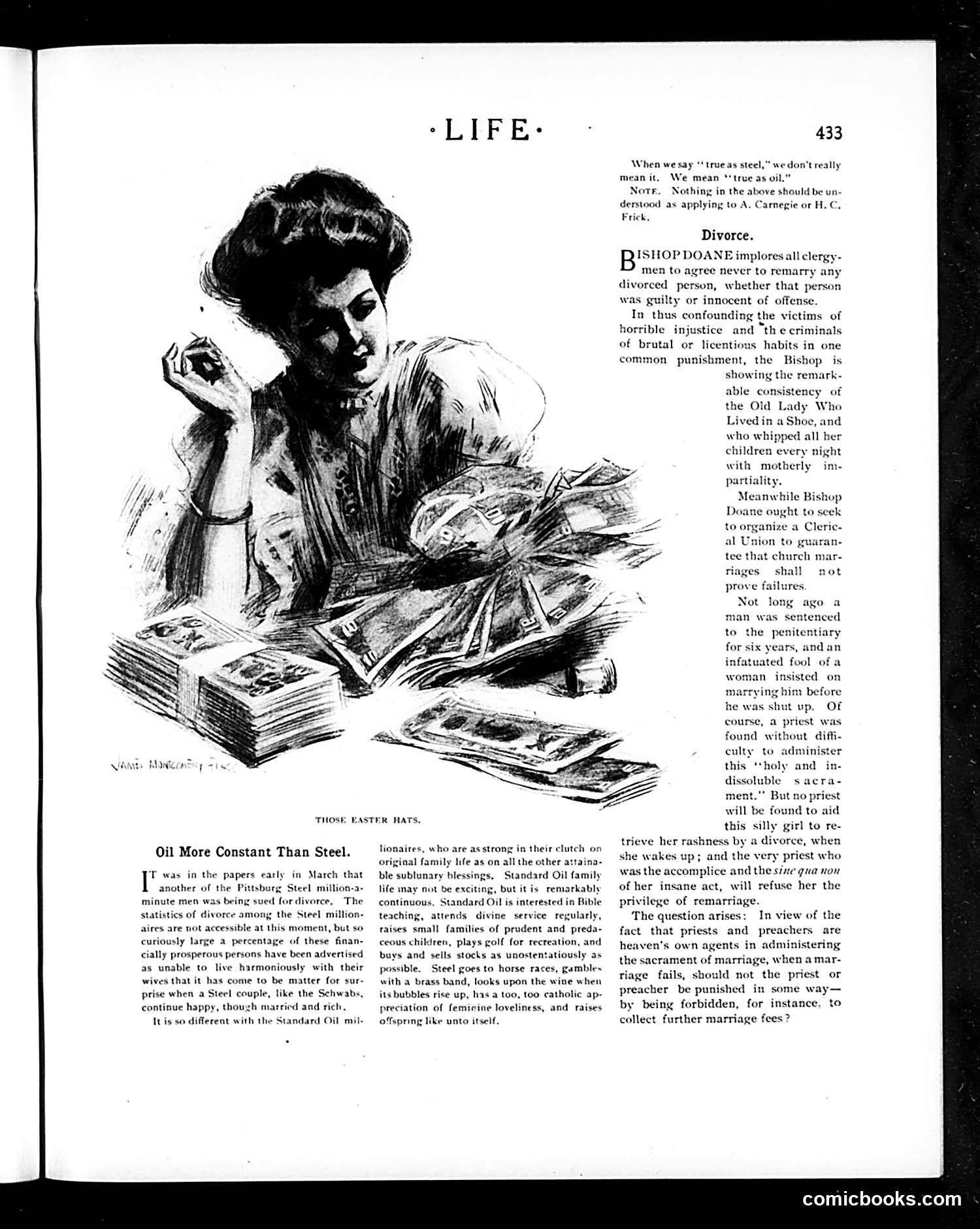
This page contains two distinct satirical pieces: **"Oil More Constant Than Steel"** compares wealthy industrialists from two industries. The text sardonically contrasts Pittsburgh Steel magnates—who frequently divorce despite their wealth—with Standard Oil millionaires, who maintain stable family lives and religious devotion. The satire suggests Steel executives are hedonistic (gambling, drinking, pursuing women) while Oil men are prudish and respectable. The punchline redefines the phrase "true as steel" to actually mean "true as oil," inverting the trusted idiom to mock Steel's reputation for infidelity. **"Divorce"** critiques Bishop Doane's call for clergy to refuse remarrying divorced persons regardless of fault. Life sarcastically compares this blanket punishment to the Old Lady Who Lived in a Shoe—suggesting absurd, indiscriminate harshness. The satire argues priests shouldn't escape accountability: if they facilitate failed marriages through administering sacraments, shouldn't they face consequences, perhaps by losing marriage fee income? Both pieces attack hypocrisy and inconsistent moral standards among the wealthy and clergy.
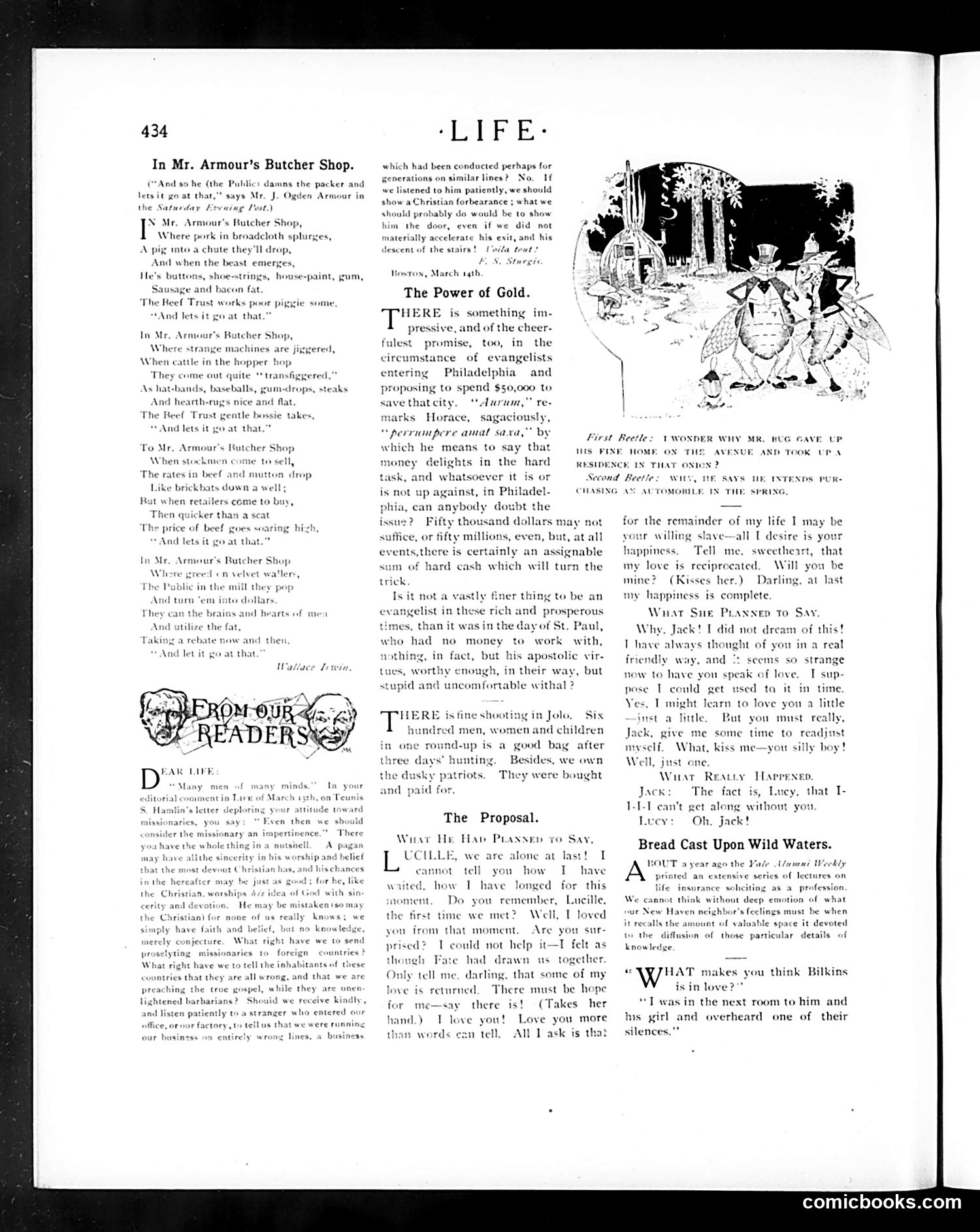
This page contains three distinct pieces of social satire typical of early 20th-century Life magazine: **"In Mr. Armour's Butcher Shop"** (verse with illustration): A satirical poem mocking J. Ogden Armour, a wealthy Chicago meatpacking magnate. It ridicules how he profits enormously ("turn 'em into dollars") from processing beef while the public suffers price increases. This reflects Progressive Era criticism of monopolistic meat-packing corporations. **"The Power of Gold"** (editorial): Critiques wealthy evangelists entering Philadelphia with $50,000 to "save the city," sarcastically contrasting modern money-driven religious work with St. Paul's apostolic virtue. The satire suggests wealth corrupts genuine spiritual mission. **"The Proposal" and "Bread Cast Upon Wild Waters"**: Sentimental romantic fiction pieces—likely humorous parodies of melodramatic love stories popular in magazines of the era. **The beetle cartoon**: Two insects discuss why "Mr. Bug" abandoned his avenue home for an onion—a absurdist joke playing on class pretension. The page satirizes wealth, corporate greed, and commercialized religion while offering lighter romantic humor.
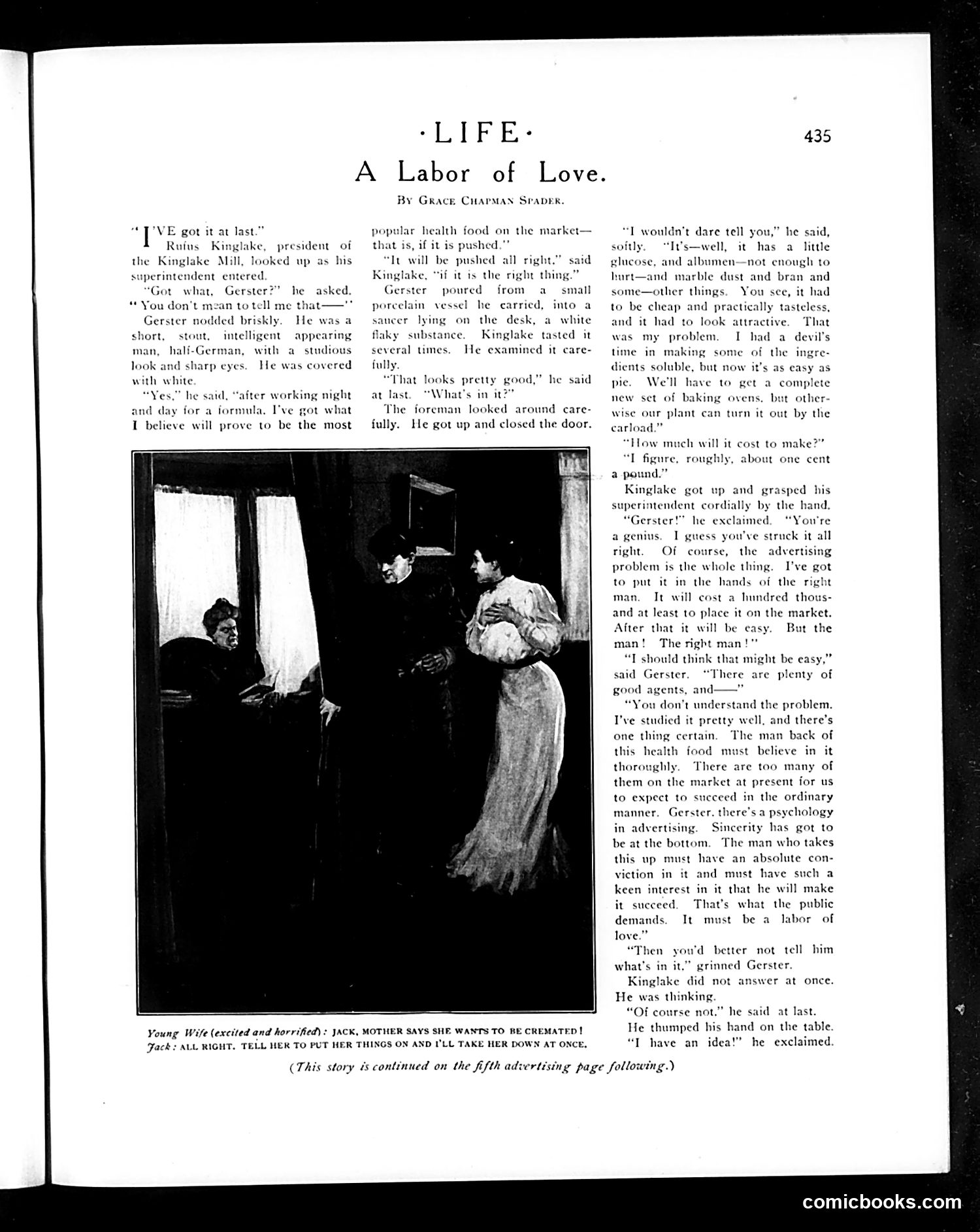
This is a satirical short story about marketing a health food product. Mill president Kinglake and superintendent Gerster develop a cheap, artificial food supplement containing glucose, albumen, marble dust, and bran—ingredients kept deliberately vague and unappealing. The satire targets **turn-of-the-century health food marketing**: Kinglake recognizes that success requires deception. He must find a salesman who genuinely *believes* in the product through ignorance of its actual ingredients. The irony is explicit: Gerster's closing quip—"Then you'd better not tell him what's in it"—exposes how consumer trust depends on withholding truth. The accompanying crude joke about cremation appears unrelated filler content. The story satirizes both **fraudulent health product industries** and the **manipulative psychology of advertising**, suggesting that sincere deception sells better than honest mediocrity.
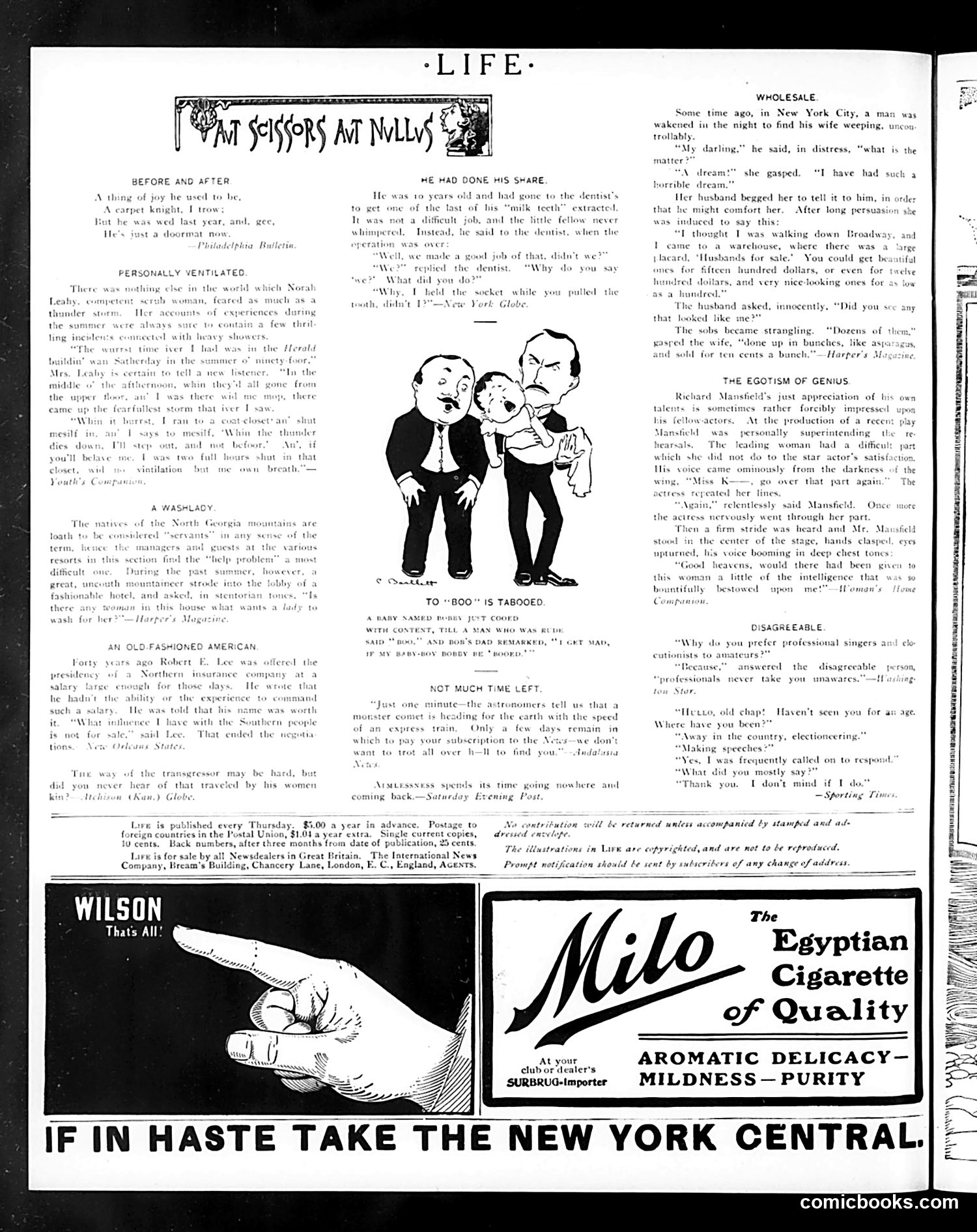
This page contains several brief satirical anecdotes typical of Life's humor section, plus period advertisements. **"Wholesale"** mocks a wife's dream where husbands are sold cheaply in bundles—satirizing marital discontent and the perceived low value placed on husbands. **"The Egotism of Genius"** targets actor Richard Mansfield (a famous stage performer of the era), ridiculing his theatrical vanity: during rehearsals, he repeatedly makes an actress redo a scene to match his own performance standards, then dismissively compliments her when she finally succeeds—implying his own ego is the real measure of talent. **"Not Much Time Left"** is a brief joke about an aging politician asked to give speeches; he claims busyness with electioneering excuses. The other titled sections are brief anecdotes on conventional topics (dentistry, mountain hospitality, an old-fashioned American businessman). The advertisements—Wilson cigarettes and Milo Egyptian cigarettes—are period commercial content typical of magazines of this era.
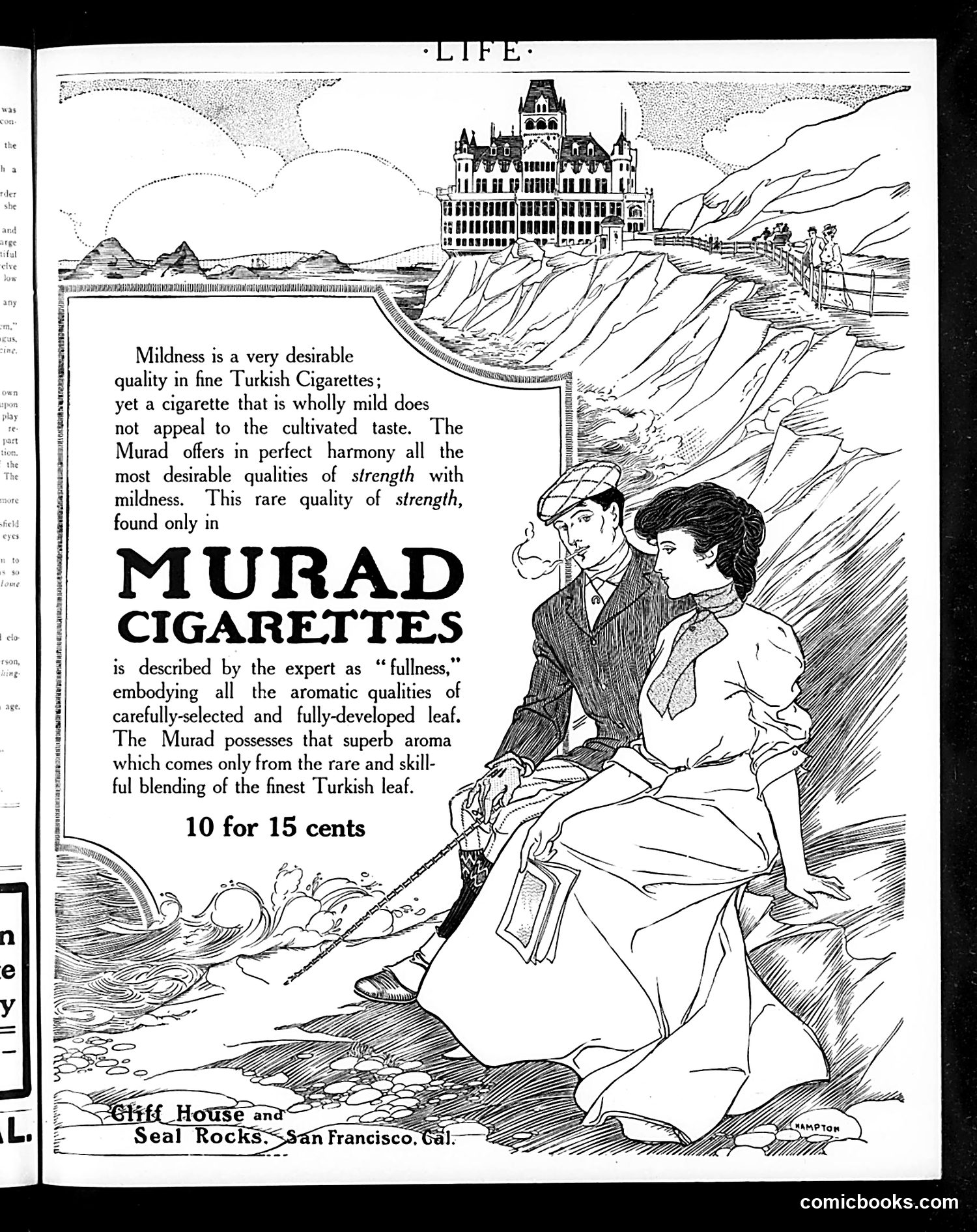
This page is primarily a **cigarette advertisement**, not political satire. It advertises Murad Cigarettes to a early 20th-century American audience. The ad features an illustration of a well-dressed couple relaxing on coastal rocks (identified as Cliff House and Seal Rocks, San Francisco). The visual presents cigarette smoking as a leisurely, sophisticated leisure activity associated with refinement and romance. The text emphasizes that Murad offers a balance of "strength with mildness"—marketing language positioning the product as suitable for the "cultivated taste" while claiming superior quality from "Turkish leaf" and expert blending. The pricing ("10 for 15 cents") indicates affordability for middle-class consumers. There is no satire or political commentary here—this is straightforward product marketing using aspirational imagery common to early 20th-century advertisements.
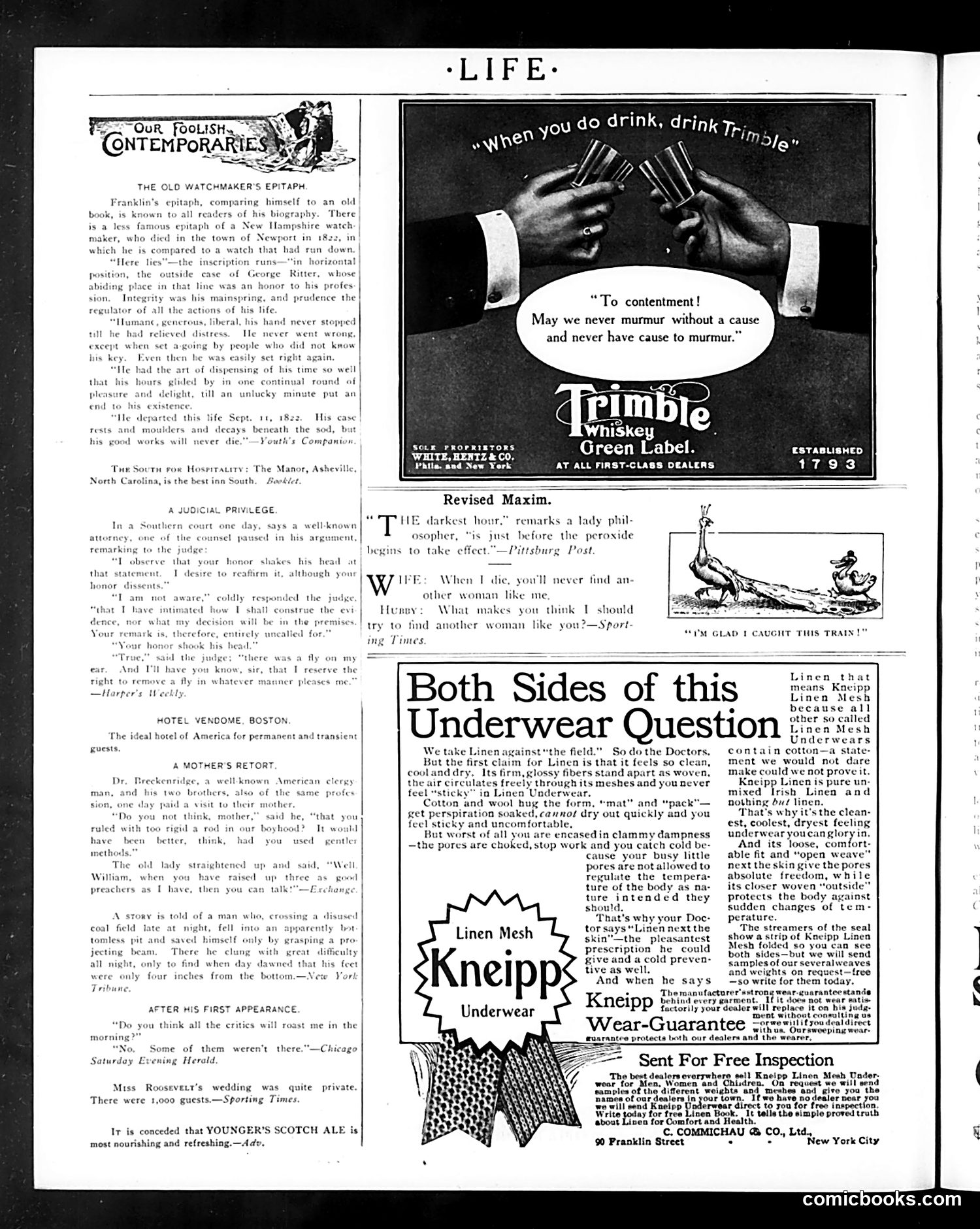
This page mixes humor pieces with advertisements, primarily for Trimble Whiskey and Kneipp Linen Mesh Underwear. **The cartoons and jokes** are brief satirical vignettes typical of Life's format: - "The Old Watchmaker's Epitaph" mocks overly sentimental epitaphs - "A Judicial Privilege" jokes about a lawyer's right to swat flies in court - "A Mother's Retort" presents a witty comeback about raising preachers - "Revised Maxim" contains a quip about a woman using peroxide (hair bleaching)—suggesting vanity **The Trimble Whiskey ad** uses a moralizing toast about contentment to sell liquor—ironic advertising strategy. **The Kneipp Underwear advertisement** is substantial, comparing linen versus cotton/wool underwear. It emphasizes linen's breathability, dryness, and cleanliness—framing the product as doctor-recommended and scientifically superior. The "Wear-Guarantee" promises quality. Overall, this is a typical early 20th-century Life page: light humor, ads, and brief anecdotes targeting middle-class readers.
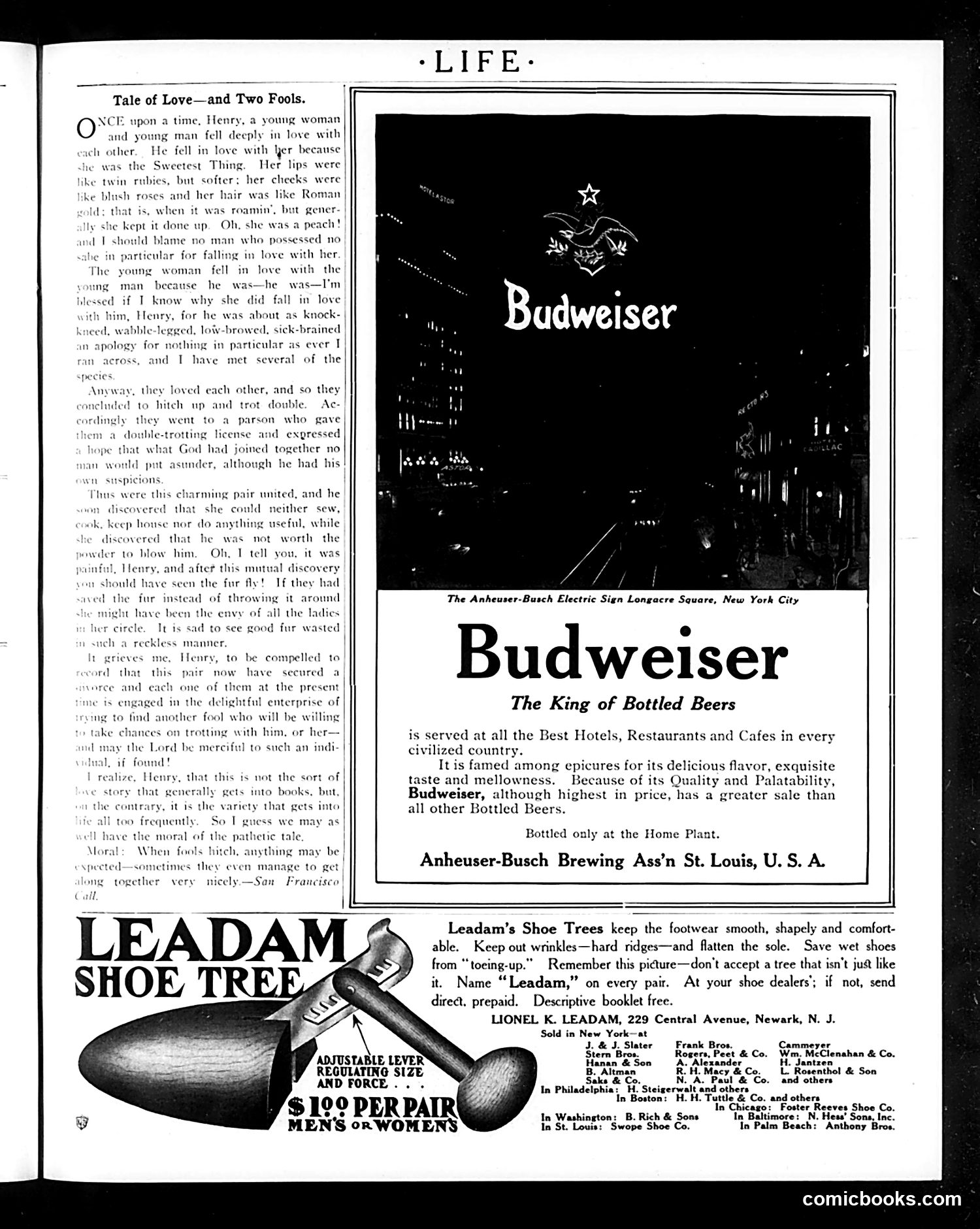
This page contains a humorous short story titled "Tale of Love—and Two Fools," which satirizes romantic marriage expectations versus reality. The narrator describes a young couple—Henry and his bride—who marry for superficial reasons (her beauty, his... unclear advantages). After marriage, they discover harsh truths: she cannot cook, sew, or manage a household; he lacks worth or capability. The story mocks both participants as fools, ending with the moral that hasty marriages often fail. The satirical point is a cynical commentary on matrimony itself—that romantic love leads people to ignore practical incompatibility, resulting in mutual disappointment. The page also features period advertisements for Budweiser beer and Leadam Shoe Trees, typical of early 20th-century Life magazine content mixing editorial humor with commercial pitches.
This page contains serialized fiction rather than political cartoons. It depicts a domestic drama involving a businessman named Kinglake, his daughter Kitty, and a young reporter named Burt Vanton. The narrative satirizes early 20th-century class anxieties: Kinglake initially opposes Vanton as a suitor because reporters earn insufficient wages to support his daughter, reflecting Victorian concerns about financial security in courtship. The story also mocks Kinglake's obsession with a new "health food" product—he tests Vanton's character by serving it to him, suggesting contemporary fads around health and nutrition were targets of ridicule. The satire lies in depicting Kinglake's materialistic calculations about romance and his eccentric belief that a young man's reaction to health food reveals his worthiness. Vanton's willingness to eat it without complaint appears designed to demonstrate his character to the watching father.
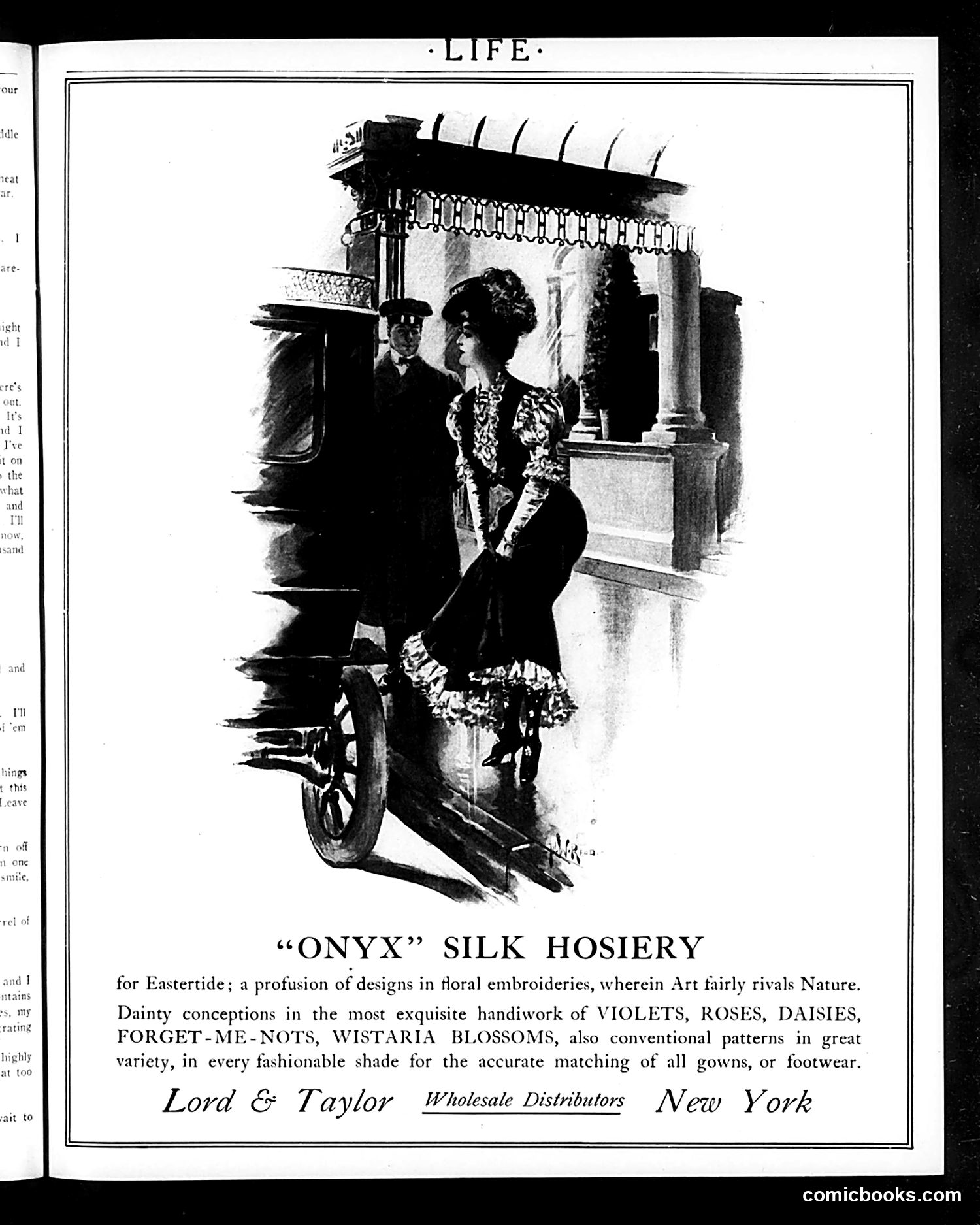
This page is primarily **advertising, not satire or political commentary**. It's a full-page advertisement for "Onyx" brand silk hosiery (stockings) distributed by Lord & Taylor, a major New York department store. The illustration shows a fashionable woman on a bicycle wearing elaborate embroidered stockings, depicted in an elegant Art Nouveau style. The ad emphasizes Easter-season hosiery featuring floral embroidery designs (violets, roses, daisies, forget-me-nots, wisteria) in various fashionable shades to coordinate with women's clothing and footwear. The bicycle and the woman's refined appearance were contemporary symbols of modern femininity and leisure for early 20th-century readers. There is no political satire present—this is straightforward luxury goods marketing.
This page combines advertisements with a serialized satirical story mocking patent medicine and get-rich-quick schemes. **The Advertisements:** - James McCutcheon & Co. promotes a bridal trousseau booklet (legitimate department store) - Hiawatha mineral water advertises health benefits (typical patent medicine claims) **The Main Story Satire:** A young man named Vanton pitches an investment scheme to manufacture "Spunk," a fake health tonic claiming to cure fatigue and weakness. The story mocks: 1. **Easy wealth delusion**: The promise of "practically unlimited capital" from a dubious product 2. **Snake oil marketing**: Using artistic campaigns and catchy slogans to sell an unproven substance 3. **Consumer gullibility**: "Nothing is too absurd to be believed in" when marketed well to the "docile" American public The narrative appears to set up comeuppance—Vanton returns home pale and feeble after the scheme apparently backfires, suggesting he consumed his own fraudulent product or suffered consequences. This satirizes the era's rampant patent medicine fraud and speculative business schemes targeting credulous consumers.
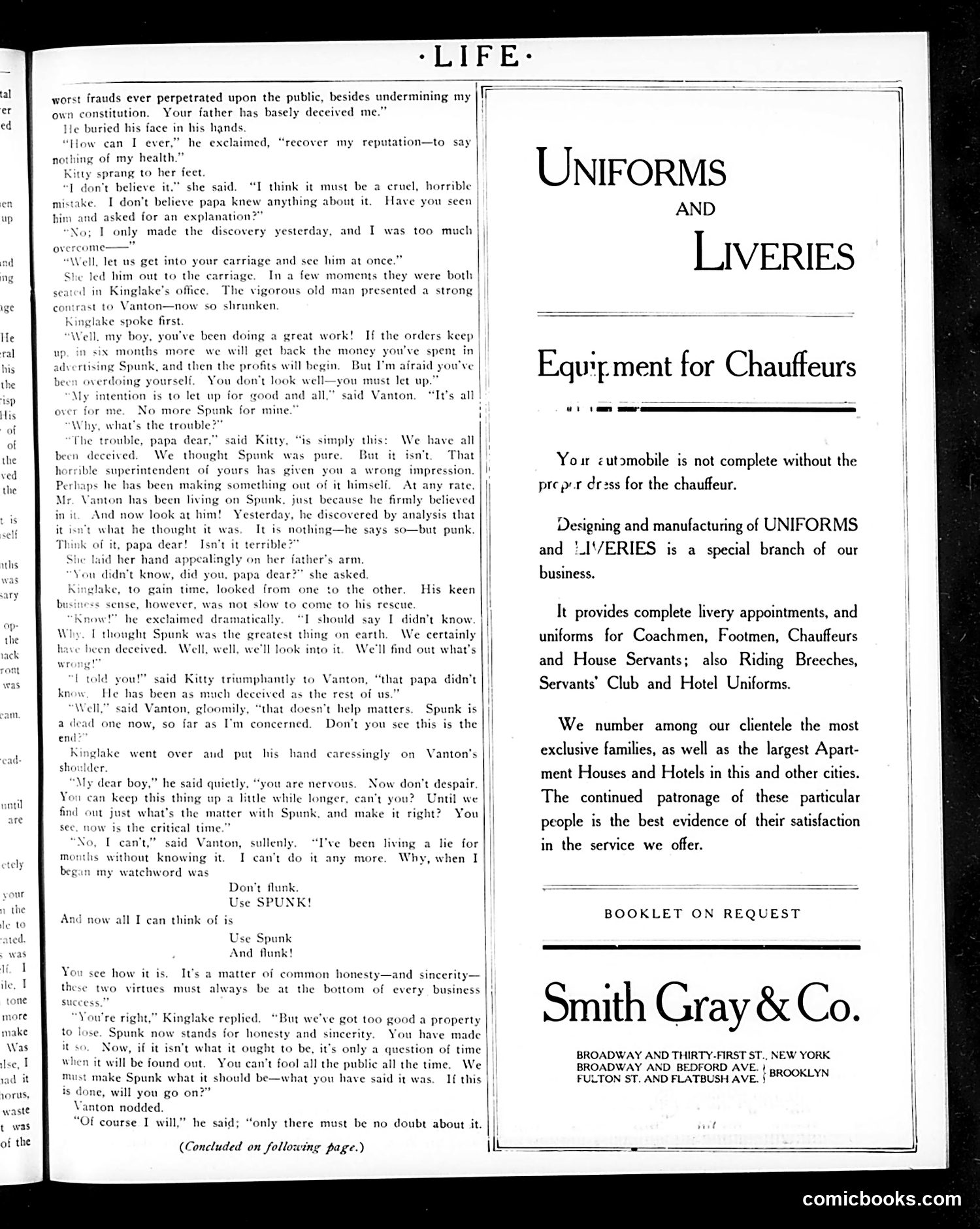
This page contains a serialized story (continued from a previous installment) about a product called "Spunk" and concludes with an advertisement for Smith Gray & Co.'s uniform business. **The Story (Left Side):** The narrative depicts a moral crisis: a young man named Vanton has been promoting "Spunk"—apparently a patent medicine or similar product—as pure and honest. His fiancée Kitty and her father Kinglake discover the product is actually adulterated or fraudulent. The story explores themes of business ethics and deception. Vanton, who has built his reputation on Spunk's supposed integrity, faces ruin. Kinglake ultimately pressures him to continue the deception, arguing the product's *reputation* for honesty matters more than its actual composition—a critique of turn-of-the-century American business practices. **The Advertisement (Right Side):** Smith Gray & Co. advertises chauffeur uniforms and liveries, targeting wealthy automobile owners. The ad emphasizes that proper dress completes the automobile experience and boasts clientele including "the most exclusive families" and "the largest Apartment Houses and Hotels." The juxtaposition is ironic: immediately after condemning business fraud, the magazine advertises luxury goods to the wealthy.
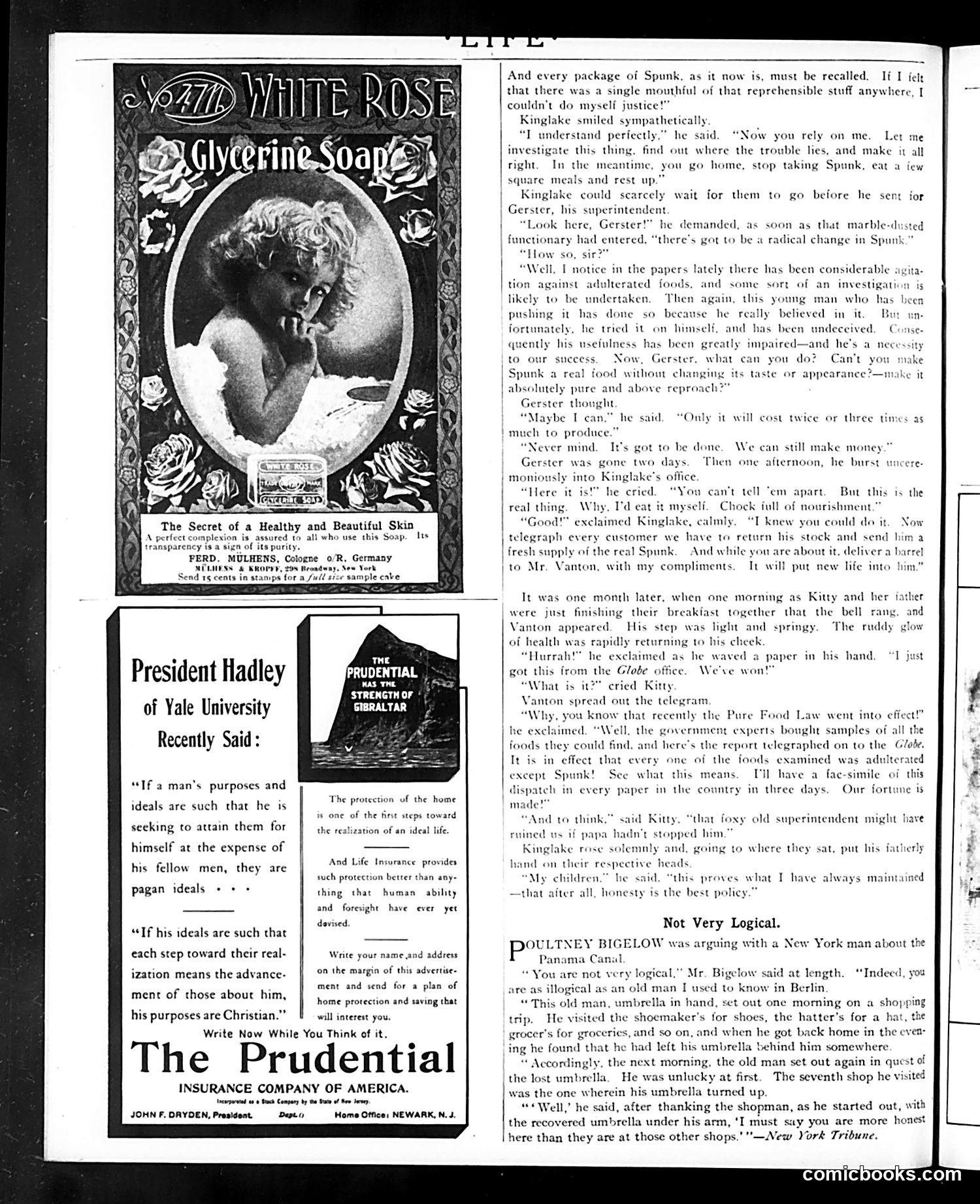
This page contains **advertisements and a serialized story** about food adulteration—a major early-20th-century scandal. The **main narrative** depicts a businessman named Kinglake who discovers his popular product "Spunk" is adulterated (contaminated/impure). A young salesman named Vanton has become ill from testing it himself. Rather than face scandal, Kinglake orders his superintendent Gerster to reformulate Spunk into genuine food while maintaining its taste, then secretly recalls the old stock and replaces customers' supplies. **The satire**: This story likely critiques corporate response to food safety scandals—companies prioritize profits and reputation over honesty. The "solution" involves deception (secret recalls, unsuspecting customers). The **advertisements** (White Rose Soap, Prudential Insurance) juxtapose with this narrative about untrustworthiness, emphasizing their own purity and protection—contrasting with Kinglake's dishonest practices. This reflects Progressive Era anxieties about food safety that led to the Pure Food and Drug Act (1906).
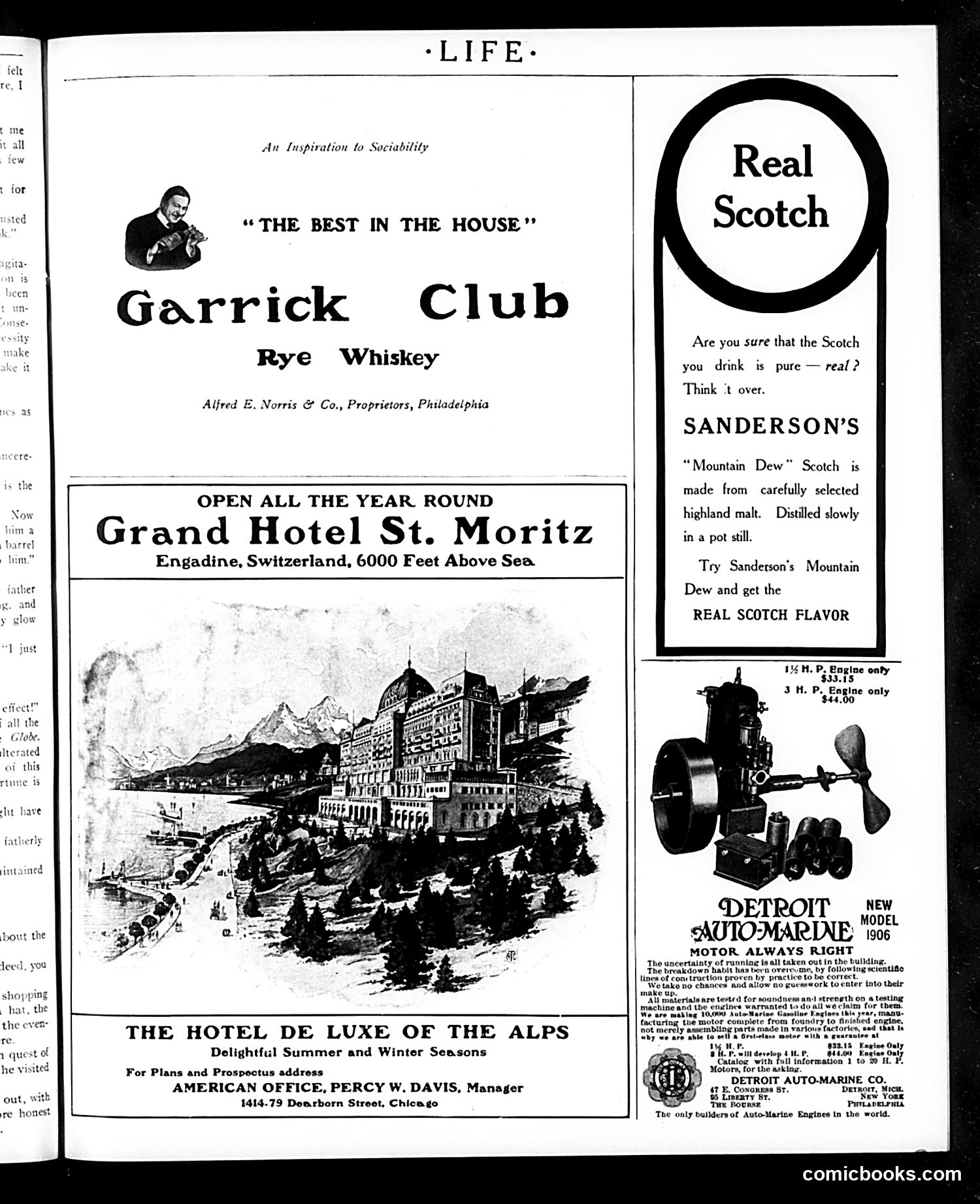
This is primarily an **advertising page**, not a satirical cartoon. It contains four distinct advertisements from circa 1906: 1. **Garrick Club Rye Whiskey** — promotes a Philadelphia-made whiskey as "the best in the house," appealing to social gatherings. 2. **Grand Hotel St. Moritz** — luxury alpine resort in Switzerland, marketed to wealthy American travelers seeking prestige destinations. 3. **Sanderson's Mountain Dew Scotch** — a competing whisky ad that challenges consumers: "Are you sure that the Scotch you drink is pure — real?" This is competitive advertising questioning product authenticity, a common sales tactic of the era. 4. **Detroit Auto-Marine Motor** — promotes a new motorboat engine model (1906), emphasizing reliability and precision manufacturing as selling points to buyers skeptical of early automotive technology. The page reflects early 1900s consumer culture: luxury goods, international travel, and emerging automotive technology marketed to affluent readers. There is no discernible political satire here.
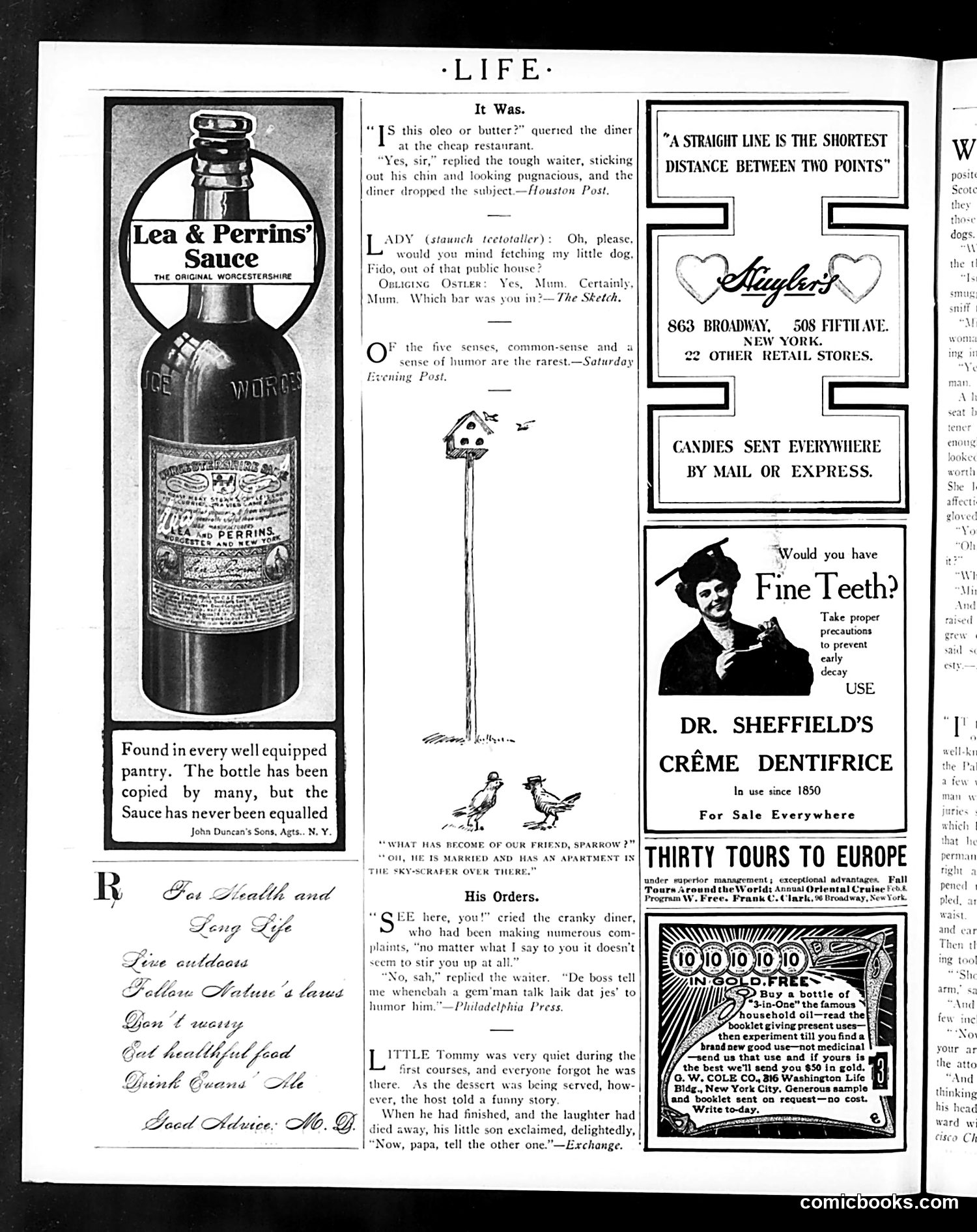
This page is primarily **advertisements and humorous anecdotes** rather than political cartoons. The **humor pieces** are short jokes about restaurant dining and social situations: - A diner questions whether he's being served oleo (margarine) or butter—reflecting early-20th-century food adulteration concerns - A lady asks a pub-keeper to fetch her dog, creating wordplay confusion - A cranky diner's complaints fall on a waiter trained by his boss to ignore complaints as humor - A child, not understanding adult dinner conversation, thinks his father is telling jokes These pieces satirize **class dynamics** (cheap restaurants, servants), **food fraud** (butter substitution), and **social pretense** (adults pretending to laugh at jokes). The advertisements include **Lea & Perrins Sauce**, **Saylor's candies**, **Dr. Sheffield's toothpaste** (in use since 1850), and **European tour packages**—typical of a wealthy magazine's target audience. The page reflects **Edwardian-era concerns**: food quality, servant behavior, and leisure travel for the affluent.
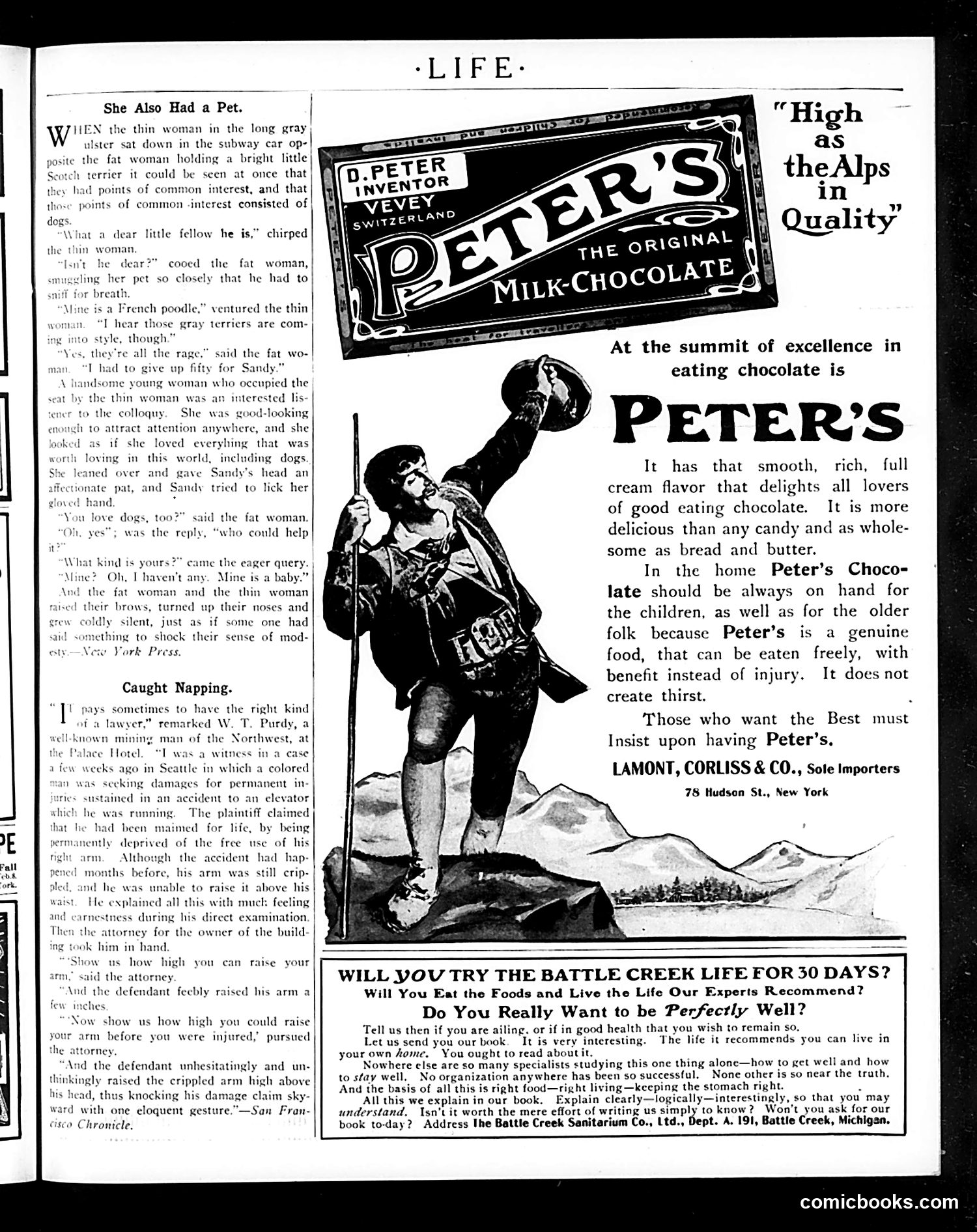
This page contains two satirical short stories and advertisements, typical of early-20th-century Life magazine's humor format. **"She Also Had a Pet"** mocks class pretension through a subway encounter. Two women bond over their dogs—one has a terrier, the other a poodle—until a third woman mentions her child. Both society women visibly recoil in disgust, literally turning away. The satire targets the shallow materialism and child-aversion of wealthy urbanites who find animals more worthy of affection than human offspring. It reflects contemporary anxieties about changing social values and gender roles. **"Caught Napping"** satirizes courtroom procedure: a plaintiff claiming permanent arm injury from an elevator accident undermines his own case when opposing counsel asks him to demonstrate his injury—he automatically raises his arm high, contradicting his damage claim. The story mocks both the plaintiff's lack of self-awareness and suggests lawyers' cleverness in cross-examination. The remainder is advertising: Peter's Chocolate and Battle Creek health products, typical period marketing emphasizing quality and wellness.
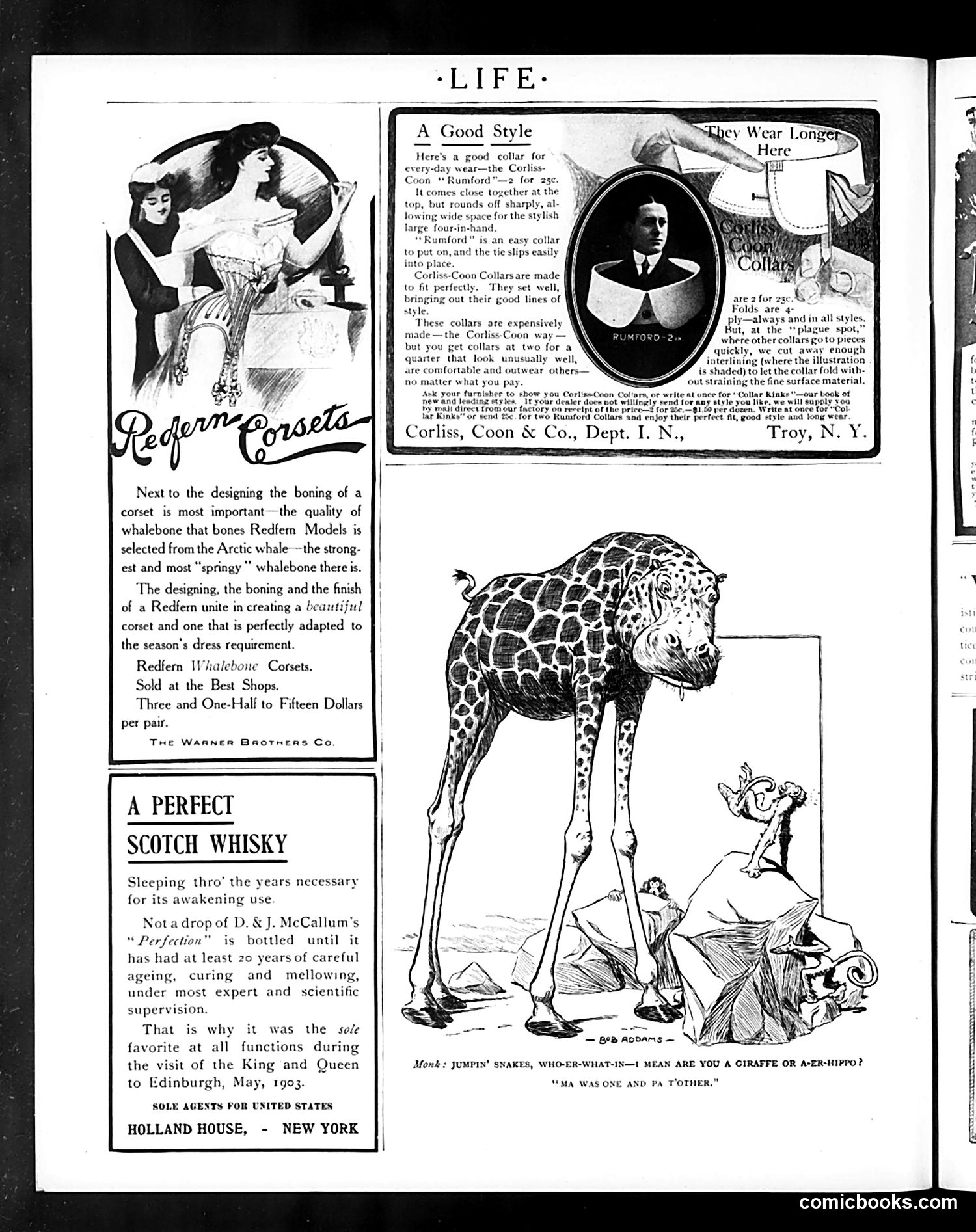
This page is primarily **advertising**, not editorial satire. The dominant content includes ads for Corliss-Coon collars, Redfern corsets, and D. & J. McCallum whisky. The only cartoon appears at bottom right: a **humorous animal illustration** showing a confused monkey or small primate encountering a tall giraffe, with dialogue about mixed parentage ("Ma was one and Pa other"). This is a simple visual joke playing on the giraffe's unusual appearance—the humor relies on the animal's bewilderment at the creature's odd proportions, a common early 20th-century approach to animal humor without deeper satirical intent. The page reflects **Edwardian-era consumer culture**: corseting technology, collar fashions, and aged whisky as luxury goods. The reference to whisky served during King Edward VII's 1903 Edinburgh visit anchors the ads to contemporary high-society events. Overall, this is a commercial page with minimal political or social satire.
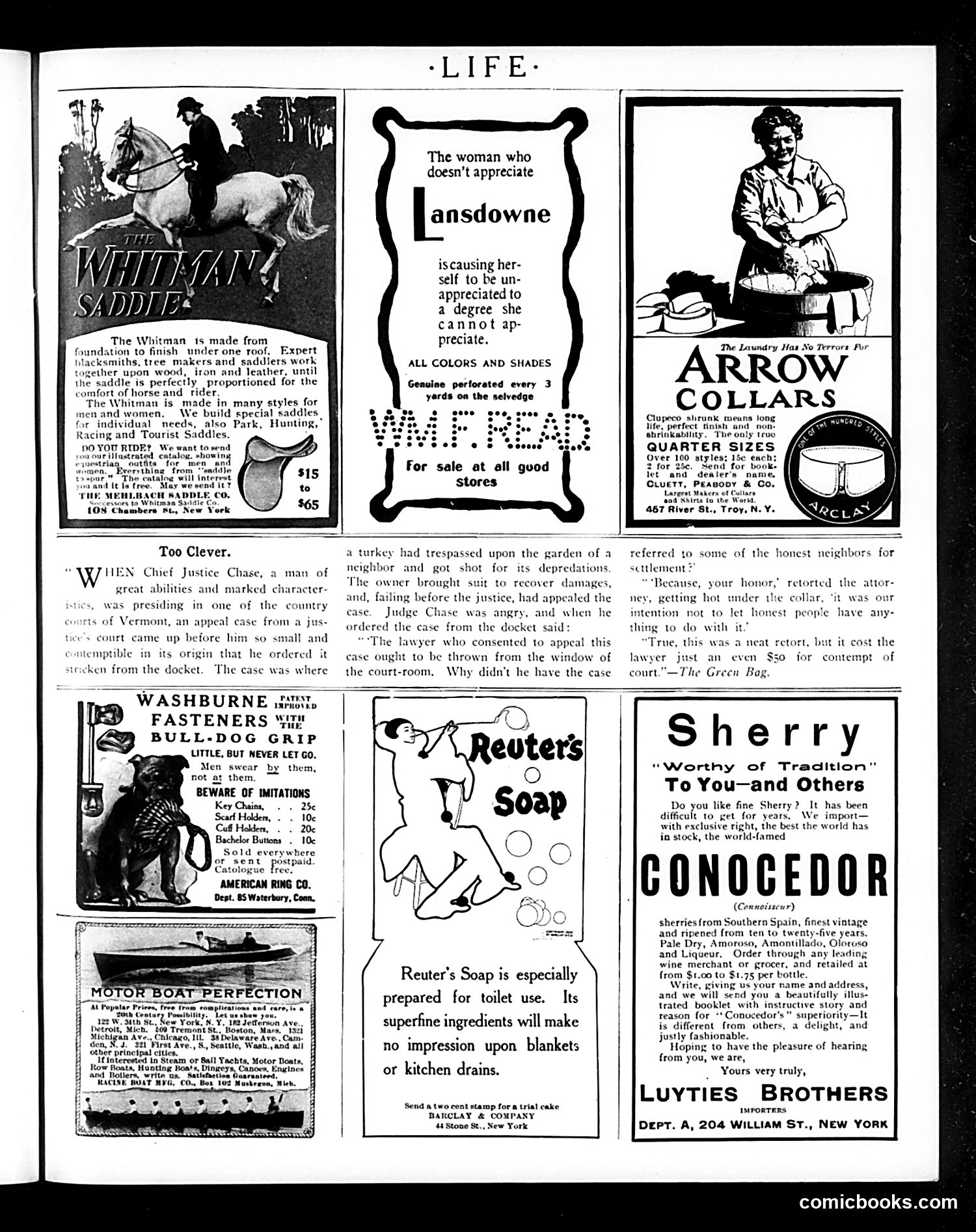
This page is primarily **advertising**, not political satire. It contains several commercial advertisements for products like saddles, collars, soap, and sherry, typical of early 20th-century magazines. The only non-advertisement content is a brief humorous anecdote titled "Too Clever," featuring **Chief Justice Chase of Vermont**. The story describes a lawsuit where a turkey trespassed on a neighbor's garden and was shot. The owner appealed the case, which Chase found absurdly trivial. When the attorney defended appealing, Chase criticized him sharply. The attorney retorted that they deliberately avoided letting "honest people" settle it—implying the legal system itself is dishonest. Chase found this a "neat retort" but the lawyer still faced contempt charges. The joke satirizes the legal profession's tendency to overcomplicate trivial matters and litigate unnecessarily, rather than seeking common-sense resolution.
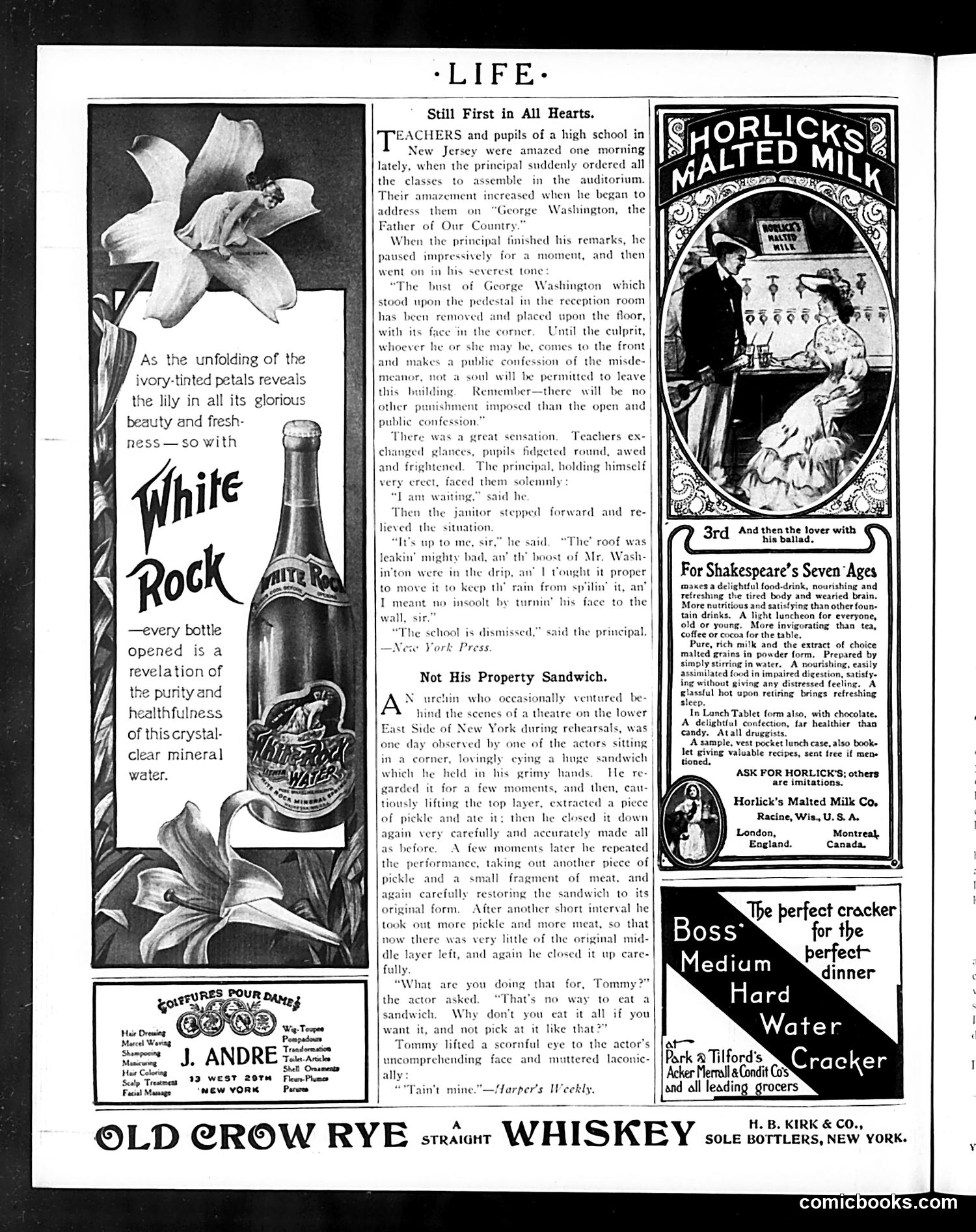
This page contains two humorous anecdotes mocking institutional hypocrisy and authority figures. The first story ridicules a high school principal who dramatically demands a public confession after a bust of George Washington is turned around. The reveal: the janitor moved it to protect it from a leaking roof—a practical, innocent act. The principal's theatrical demand for moral accountability proves absurd when the "crime" was actually considerate. The second story features a street child carefully eating a sandwich that isn't his, extracting only pickles and meat while preserving the bread's appearance to return it intact. When caught, he explains: "Tain't mine"—acknowledging he's only entitled to scraps, not the whole sandwich. Both satirize how authority invents drama around innocent actions while ignoring actual injustice. The page also contains period advertisements for mineral water, whiskey, and malted milk—typical *Life* magazine content mixing satire with commercial messaging.
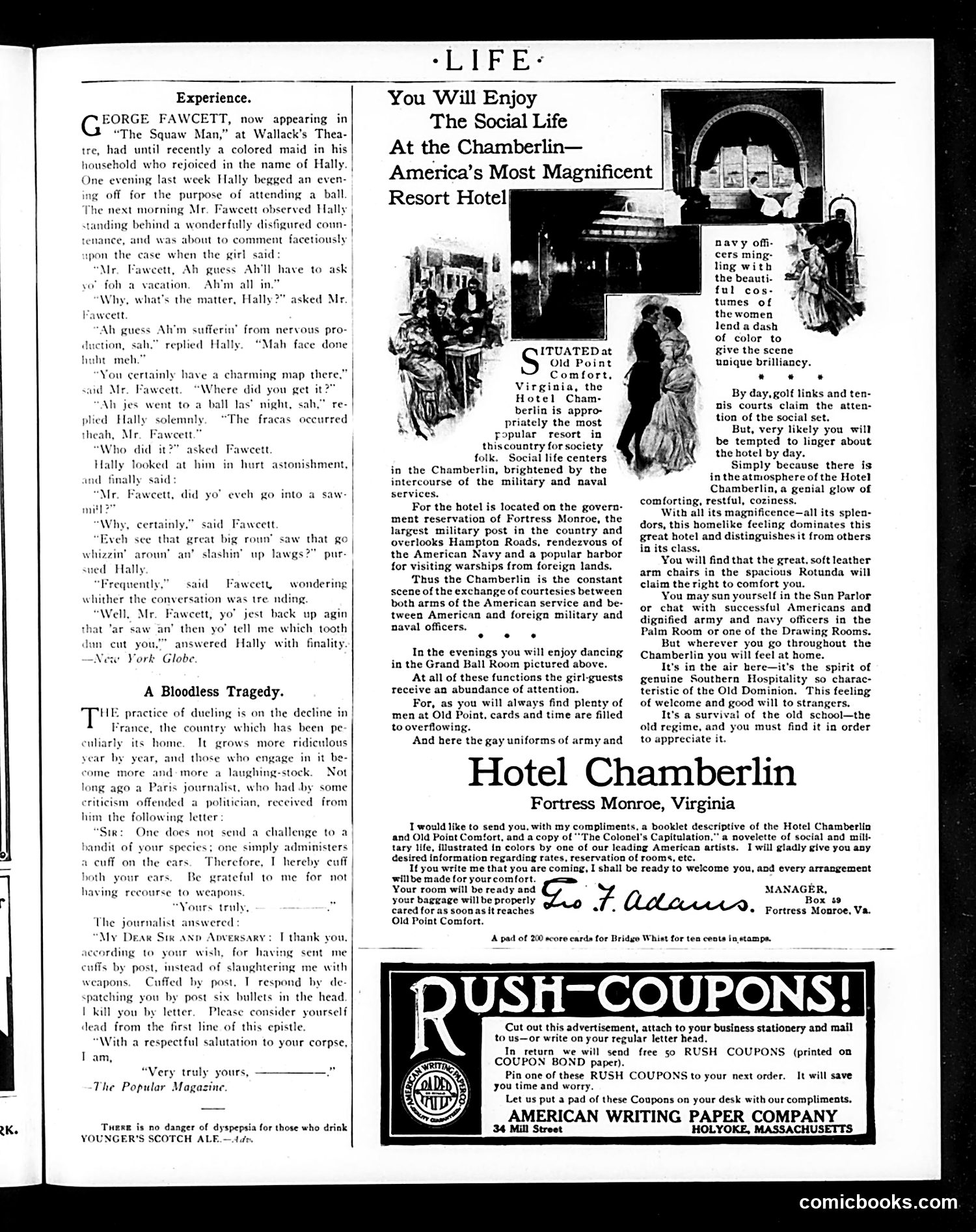
This page contains two satirical anecdotes and hotel advertising, typical of Life magazine's format. **"Experience"** mocks racial stereotypes through a dialogue between actor George Fawcett and his Black maid Hally. After attending a ball, Hally arrives bruised and requests vacation, claiming "nervous prostration." When Fawcett asks who injured her, she responds with an elaborate, indirect metaphor about a sawmill's circular blade—implying she was struck repeatedly at the ball. The "joke" relies on offensive caricature of Black dialect and comportment. **"A Bloodless Tragedy"** satirizes the decline of French dueling culture through an absurdist exchange: a politician "cuffs" a journalist by mail; the journalist "responds" by posting six bullets to the politician's head—killing him "by letter." This mocks how ridiculous formal dueling had become. The remainder advertises the Hotel Chamberlin resort in Virginia, emphasizing its appeal to upper-class socialites and military officers. The tone is aspirational rather than satirical.
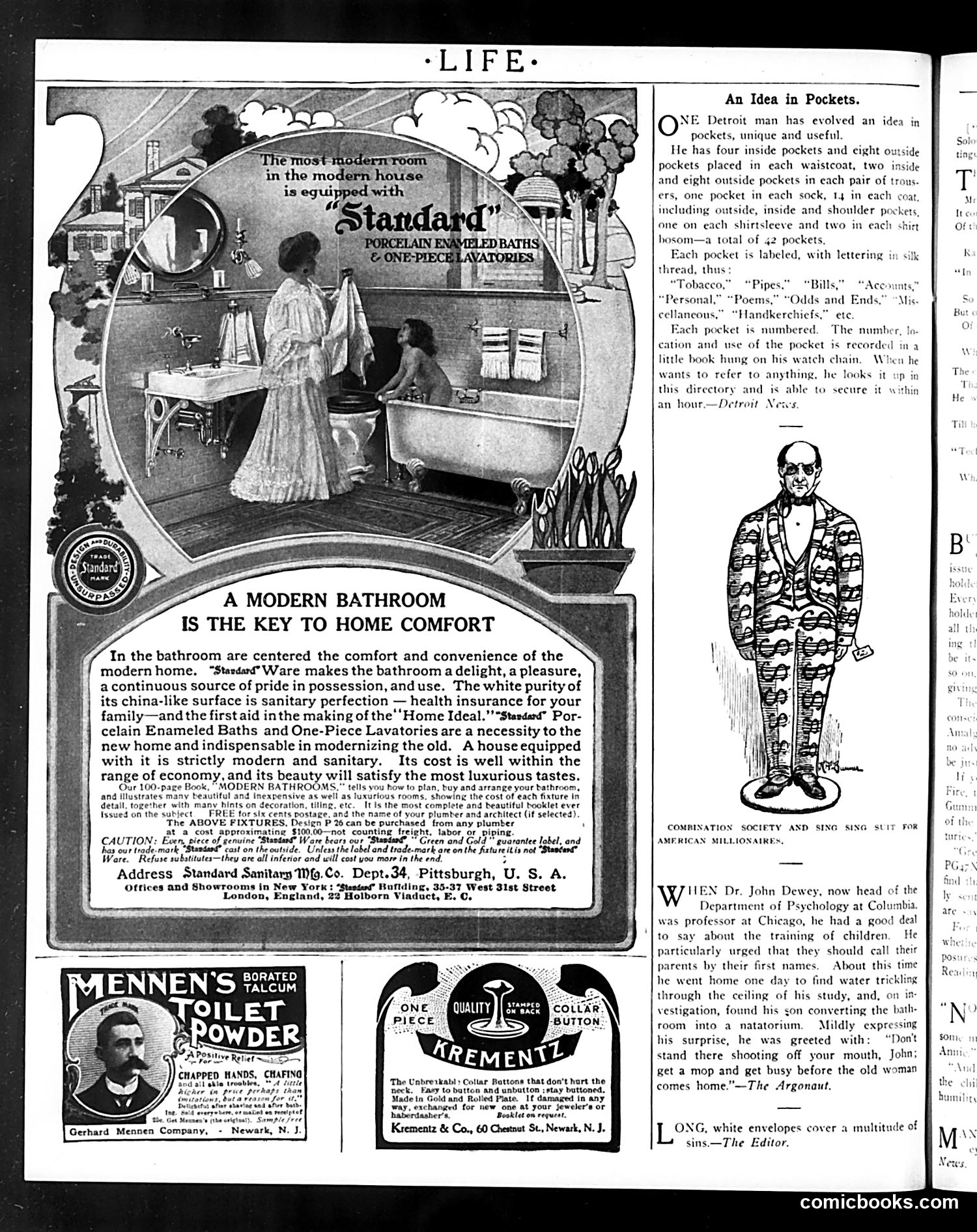
This page contains three distinct pieces: **1. "An Idea in Pockets"** (top right): A humorous anecdote about a Detroit man who organized his clothing with 42 labeled pockets—each designated for specific items like "Tobacco," "Pipes," "Bills," etc.—tracked in a reference book on his watch chain. The joke mocks obsessive organization and impracticality. **2. Standard Sanitary Manufacturing Advertisement** (center-left): A full advertisement for modern bathroom fixtures, emphasizing how "a modern bathroom is the key to home comfort" and positioning porcelain-enameled baths as markers of modernity and sanitation. **3. "Combination Society and Sing Sing Suit for American Millionaires"** (right): An anecdote about Dr. John Dewey (Columbia psychology professor) who advocated children call parents by first names. When he discovered his son flooded the bathroom converting it to a "natatorium," the boy responded disrespectfully: "Don't stand there shooting off your mouth, John." The satire mocks progressive parenting ideology and its consequences. The page mixes consumer advertising with social commentary typical of Life's satirical approach.
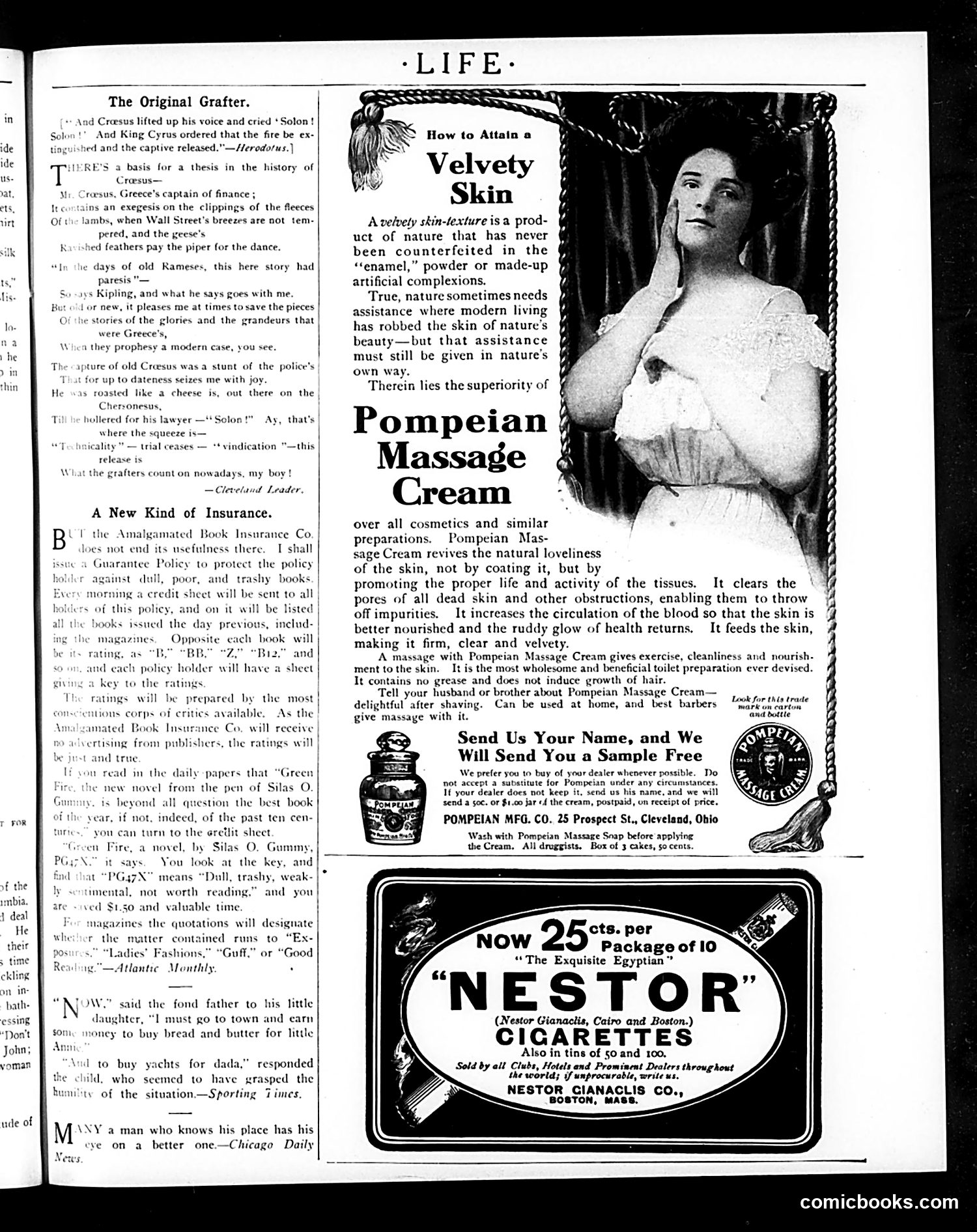
This page contains **primarily advertisements and satirical short pieces**, not a political cartoon. The main content includes: **"The Original Grafter"** — A satirical poem comparing ancient Greek king Croesus (who was captured and ransomed) to modern American grafters and corrupt businessmen. The joke: just as Croesus hired a lawyer ("Solon") to secure his release through legal means rather than punishment, modern grafters rely on lawyers and "vindication" to escape consequences. It's social satire about corruption in American business and the legal system's protection of wealthy wrongdoers. **"A New Kind of Insurance"** — Satirizes the publishing industry by proposing an absurd "Book Insurance" company that rates books daily so readers won't waste money on bad ones. The satire mocks both low-quality literature and the emerging consumer-rating culture. The page also features **period advertisements** for Pompeian Massage Cream and Nestor Cigarettes, typical of early 20th-century Life magazine. The satire targets American business corruption and consumer culture, using historical parallels and humorous hypotheticals rather than visual caricature.
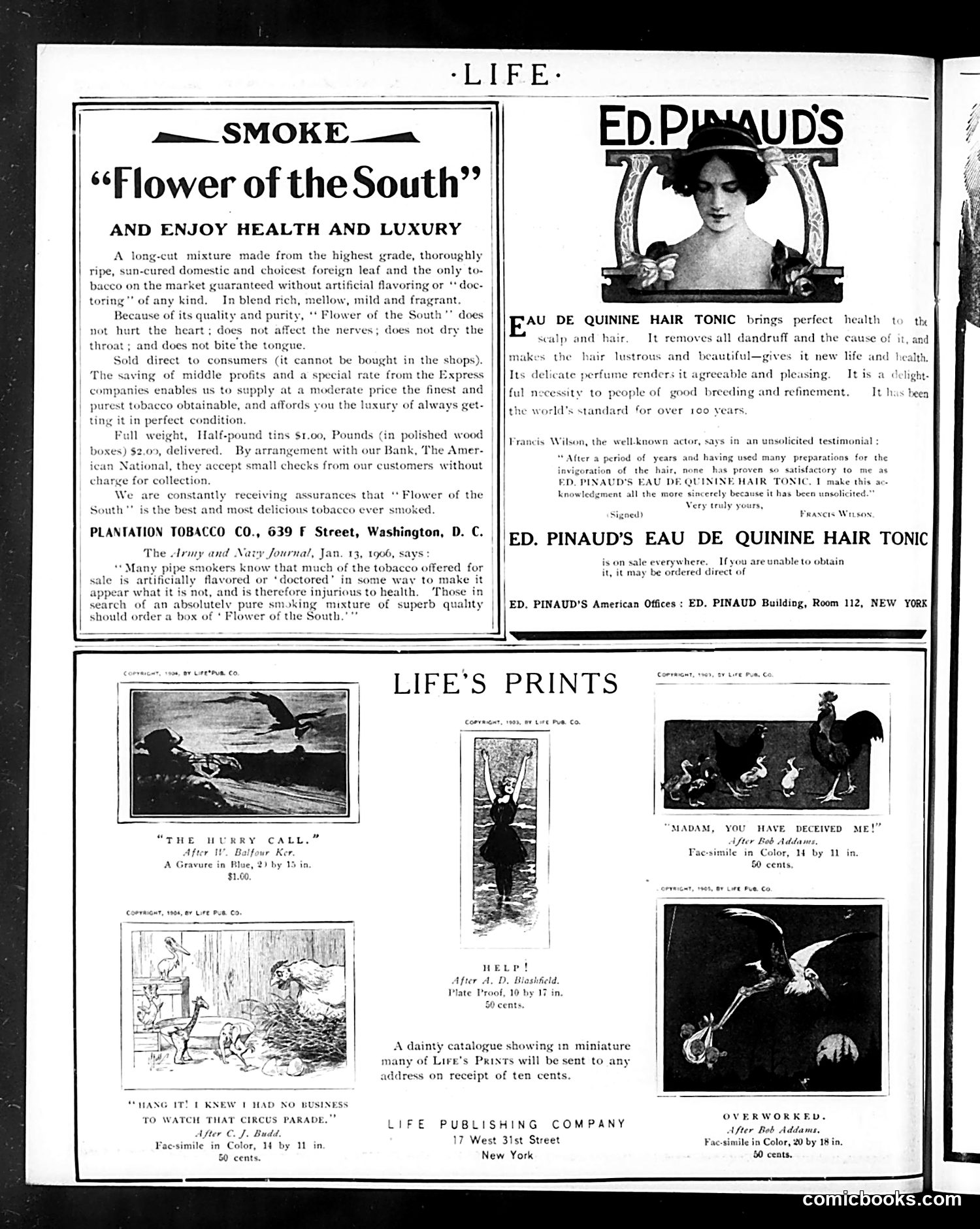
This page consists primarily of **advertisements and art prints**, not political satire. **Upper section:** Two product ads—"Flower of the South" tobacco (claiming purity and health benefits, sold direct to consumers) and Ed. Pinaud's hair tonic (endorsed by actor Francis Wilson, promising dandruff removal and lustrous hair). **Lower section:** "Life's Prints"—a catalog advertisement for reproducible artwork Life Publishing Company sold. Four prints are pictured with titles like "The Hurry Call," "Help!," "Madam, You Have Deceived Me!" and "Overworked." These appear to be humorous genre scenes (people in awkward social situations), typical of early 1900s illustration. The page reflects **commercial Life magazine practice**: mixing editorial content with advertising revenue. The prints suggest Life's sideline selling affordable reproductions of contemporary comic/sentimental art to middle-class readers.
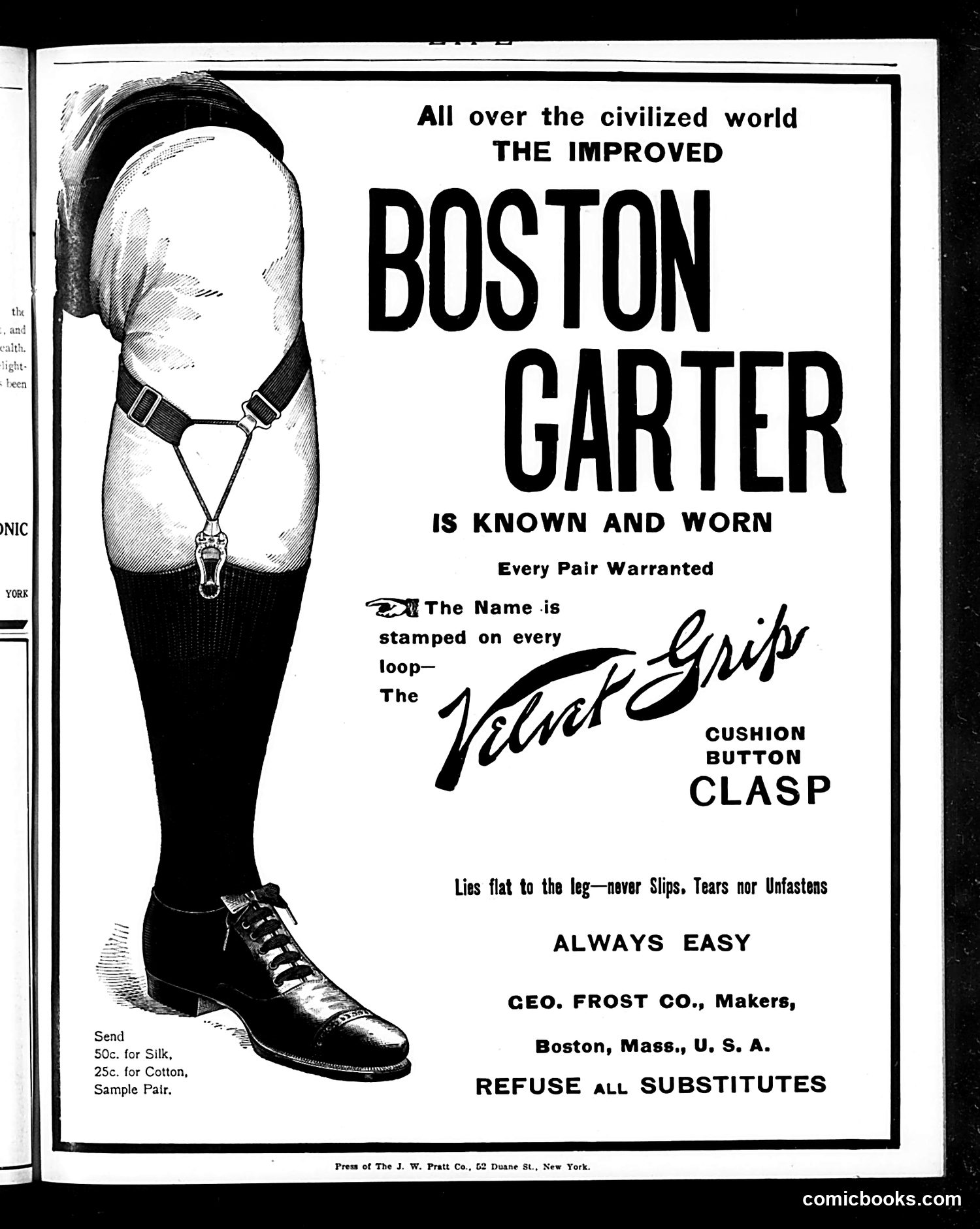
This is a straightforward product advertisement, not satire or political commentary. It promotes the "Improved Boston Garter," a garter (elastic band) worn to hold up stockings—essential hosiery hardware before modern elastic became standard. The illustration shows a woman's leg wearing the garter with its "cushion button clasp" mechanism. The ad emphasizes durability ("never Slips, Tears nor Unfastens") and availability in silk (50¢) or cotton (25¢) versions, with a sample pair available by mail. The Geo. Frost Co. of Boston positioned this as a superior product available "all over the civilized world," urging consumers to "refuse all substitutes." This reflects early 20th-century competitive marketing—establishing brand loyalty against knockoff versions. The garter remained standard women's wear until the 1960s when pantyhose became prevalent.
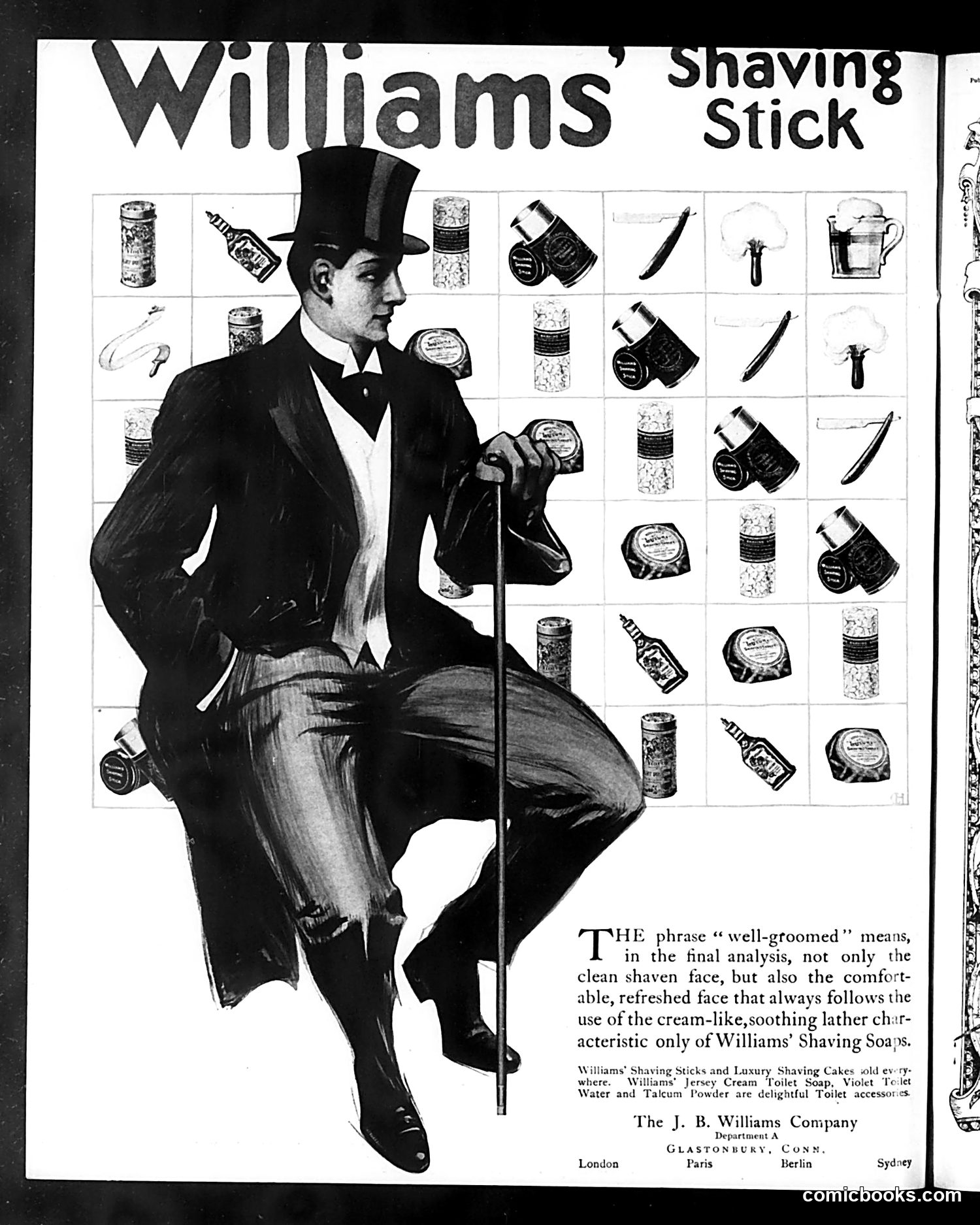
This is primarily a **product advertisement**, not political satire. It promotes Williams' Shaving Soap products through an elegantly dressed gentleman in formal attire (top hat, tuxedo, cane) striking a confident pose. The ad targets male grooming standards of the early 20th century, emphasizing that being "well-groomed" meant more than just shaving—it required the "cream-like, soothing lather" that Williams' products supposedly provided uniquely. The grid of product images (shaving sticks, soaps, jars, bottles) displays the company's full line. The J.B. Williams Company, based in Connecticut with international distribution (London, Paris, Berlin, Sydney), positioned itself as a luxury brand for refined gentlemen. This reflects the era's marketing of personal grooming as a marker of social status and masculinity.