
Life, 1906-04-05 · page 23 of 58
Life — April 5, 1906 — page 23: what you’re looking at
What you’re looking at
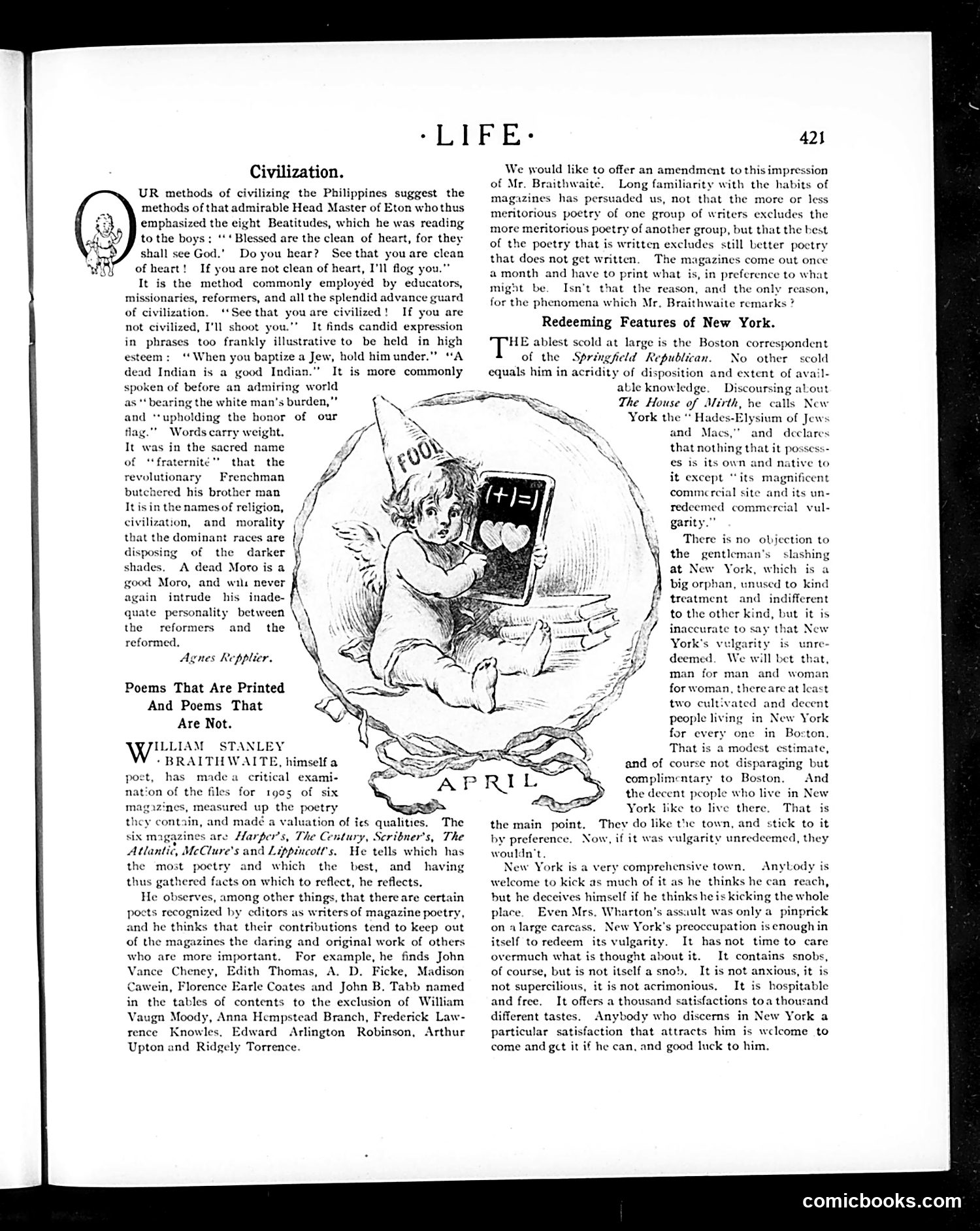
**"Civilization" Essay:** Agnes Repplier satirizes Western imperial methods, particularly America's approach to the Philippines. She mocks the hypocrisy of "civilizing" non-Christian peoples through coercion—claiming to impose Christian morality ("Blessed are the clean of heart") while employing violence ("I'll flog you"). The essay references brutal colonial attitudes ("A dead Indian is a good Indian," "When you baptize a Jew, hold him under") and critiques how euphemisms like "the white man's burden" mask violence as noble duty. **"Poems That Are Printed":** Braithwaite critiques magazine editors for repeatedly publishing established poets (Cheney, Cawein, Coates) while excluding more important, original writers (Robinson, Moody, Torrence). Life's editorial response argues the real problem isn't editorial bias but practical constraints—magazines must print what exists monthly, not ideal work that remains unwritten. **"Redeeming Features of New York":** A Boston critic dismisses New York as culturally derivative, calling it the "Hades-Elysium of Jews and Maes" with only commercial merit. Life defends New York's actual merits against this regional snobbery.
📄 Transcribed text from this page (OCR, searchable)
Machine-transcribed from the original scan — historical spelling and the odd misread are preserved.
OY a oe Civilization. UR methods of civilizing the Philippines suggest the methods of that admirable Head Master of Eton whothus emphasized the eight Beatitudes, which he was reading to the boys; ‘'‘ Blessed are the clean of heart, for they shall see God.'- Do you hear? Sce that you are clean of heart! If you are not clean of heart, I'll flog you. It is the method commonly employed by educators, missionaries, reformers, and all the splendid advance guard of civilization, ‘*See that you are civilized! If you are not civilized, I'l shoot you."’ It finds candid expression in phrases too frankly illustrative to be held in high esteem; ‘When you baptize a Jew, hold him under.” “A dead Indian is a good Indian It is more commonly spoken of before an admiring world as “ bearing the white man’s burden,”” and “upholding the honor flag.” Words carry weight. It was in the sacred name of ‘‘fraternité’’ that the revolutionary Frenchman butchered his brother man Ttis in the names of religion, civilization, and morality that the dominant races are disposing of the darker A dead Moro is a good Moro, and wii never again intrude his inade- quate personality between \ the reformers and the reformed. Agnes Repplier. shades. Poems That Are Printed And Poems That Are Not. ILLIAM STANLEY * BRAITHWAITE, himself a poet, has made a critical exami- nation of the files for 1905 of six azines, measured up the poetry they contain, and madé a valuation of ics qualities. The six magazines are Har he Century, Serit Atlantic, McClure's and Lippincott’'s, He tells which has the most poetry and which the best, and having thus gathered facts on which to reflect, he reflects, He observes, among other things, that there are certain pocts recognized by editors as writers of magazine poetry, and he thinks that their contributions tend to keep out of the magazines the daring and original work of others who are more important. For example, he finds John Vance Cheney, Edith Thomas, A. D. Ficke, Madison Cawein, Florence Earle Coates and John B, Tabb named in the tables of contents to the exclusion of William Vaugn Moody, Anna Hempstead Branch, Frederick Law- rence Knowles, Edward Arlington Robinson, Arthur Upton and Ridgely Torrence. 421 We would like to offer an amendment to this impression of Mr. Braithwaite. Long familiarity with the habits of magazines has persuaded us, not that the more or less meritorious poetry of one group of writers excludes the more meritorious poetry of another group, but that the best of the poetry that is written excludes still better poctry that does not get written. The magazines come out once a month and have to print what is, in preference to what might be. Isn't that the reason, and the only reason, for the phenomena which Mr, Braithwaite remarks ? Redeeming Features of New York. HE ablest scold at large is the Boston correspondent of the Springfield Republican. No other scold equals him in acridity of disposition and extent of avail- able knowledge. Discoursing atout The House of Mirth, he calls New York the “ Hades-Elysium of Jews and Maes," and declares that nothing that it possess- ¢s is its own and native to it except “its magnificent commercial site and its un- redeemed commerce: garity. There is no objection to the gentleman’s slashing at New York, which is a big orphan, unused to kind treatment and _ indifferent to the other kind, but it is inaccurate to say that New York's vulgarity isu deemed. We will bet that, man for man and woman for woman, thereare at t two cultivated and decent people living in New York for one in Boston, That is a modest estimate, and of course not disparaging but complimentary to Boston. And the decent people who live in New York like to live there. That is the main point. Thev do like the town, and stick to it by preference. Now, if it was vulgarity unredeemed, they wouldn't. New York is a very comprehensive town, —Anytody is welcome to kick as much of it as he thinks he can reach, but he deceives himself if he thinks heis kicking the whole Even Mrs, Wharton’s assault was only a_pinprick New York's preoccupation is enough in itself to redeem its vulgarity. It has not time to care overmuch what is thought about it. It contains snobs, of course, but is not itself a snob, It is not anxious, it is not supercilious, it isnot acrimonious. It is hospitable and free. It offers a thousand satisfactions toa thousand different tastes. Anybody who discerns in New York a particular satisfaction that attracts him is welcome to come and gct it if he can, and good luck to him. place on a large carcass comicbooks.com