
Life, 1906-04-05 · page 32 of 58
Life — April 5, 1906 — page 32: what you’re looking at
What you’re looking at
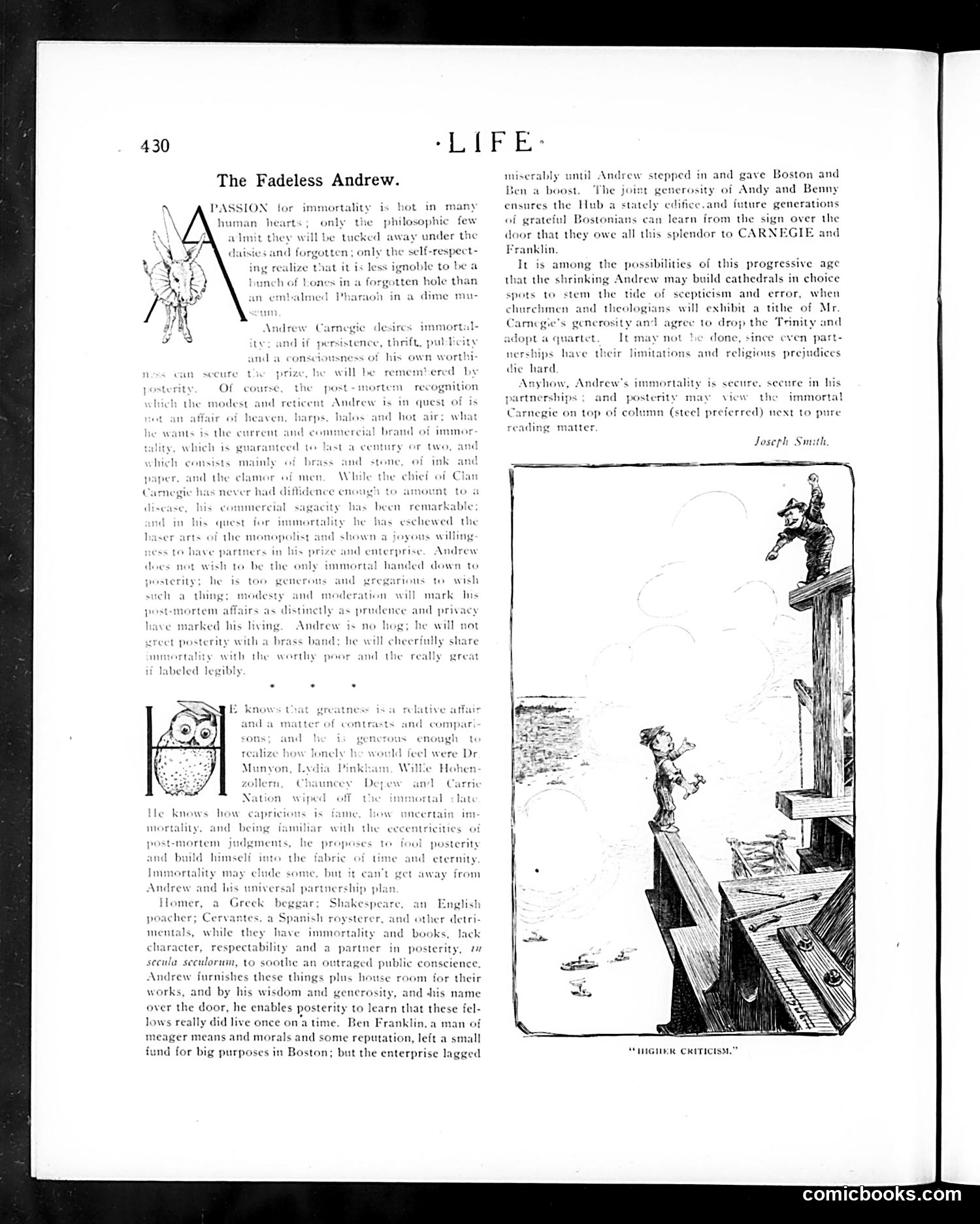
This satirical article mocks Andrew Carnegie's pursuit of immortality through philanthropy. The text criticizes Carnegie for wanting his name permanently attached to his charitable works—specifically libraries and buildings in Boston—as a guarantee of remembrance. The satire targets his vanity: Carnegie is contrasted with truly immortal figures (Homer, Shakespeare) who achieved lasting fame through merit alone, not through "brass bands" or self-promotion. The article suggests Carnegie's generosity, while real, is partly motivated by ego rather than pure altruism. The accompanying cartoon titled "Higher Criticism" (right) depicts figures climbing or perched on a tall structure—likely representing the precarious, elevated position Carnegie seeks through his monuments. The piece reflects Gilded Age anxieties about wealthy industrialists using philanthropy primarily for legacy-building and social control, rather than genuine benevolence.
📄 Transcribed text from this page (OCR, searchable)
Machine-transcribed from the original scan — historical spelling and the odd misread are preserved.
‘LIFE- The Fadeless Andrew miserably until Andrew stepped in and gave Boston and Ben a boost. ‘The joint generosity of Andy and Benny PASSION for immortality is hot in many ensures the Hub a stately edifice.and future generations hearts; only philosophic fe of grateful Bostonians can learn irom the sign over the they will be tucked away under door that they owe all this splendor to CARNEGIE and nd forgotten; only the self-respect- ‘ranklin. At it is less ignoble to be It is among the possibilities of this progressive age nex in a forgotten hole than that the shrinking Andrew may build cathedrals in choice n embalme araoh in a dime mu- s to stem the tide of scepticism and error, when churchmen and theologians will exhibit a tithe of Mr Camegie’s generosity agree to drop the Trinity and yptaquartet, It may not he done, since even part \ndrew Camegic desires immort: ty: and if persistence, thrift, public and a consciousness of his own worthi: ips have their limitations and religious prejudices 1 1 fic hard secure t priz will be remem! ered Anyhow, Andrew's immortality is secure, secure in his Of course, the post-mortem recognition and posterity may view the immortal the modest and reticent Andrew is in quest of is 1 : negie on top of column (steel preferred) next to pure wants the current a commercial brand Joseph Smith never had dif commercials t been rena quest for it he has eschewed the the mon nwn a joyous willing t wish to be the only immortal handed down to 5 too gene an arious to wish thing: modesty and ration will mark Ins nortem affairs as ¢ tly as prudence and privacy ked his living. Andrew is no 1 will not with a brass band: he will cheerfully share mmort ho the werthy poor and the really great labeled le realize | he w feel were Dr Munvon, Lydia o Vile Hoher rric how caprici ow uncerts ortem judgmer 2 prope ol posterity Immortality may ¢ nme, but it can't get away from Andrew and his universal partnersh ner, ck beggar: Shakespeare, an English poacher; ¢ . a Spanish roysterer, and other detri- mentals, while they have immortality and books, lack character, respectability and a partner in posterity, secula sceulorum, to soothe 3 aged public conscience. Andrew furnishes these things works, and by his wisdom a 1 over the door, he enables posterity to lows really did live once on’a time. Ben meager means and morals and some reputation, left a small nd for big purposes in Boston; but the enterprise r “AMGIER CRITICISM.” comicbooks.com